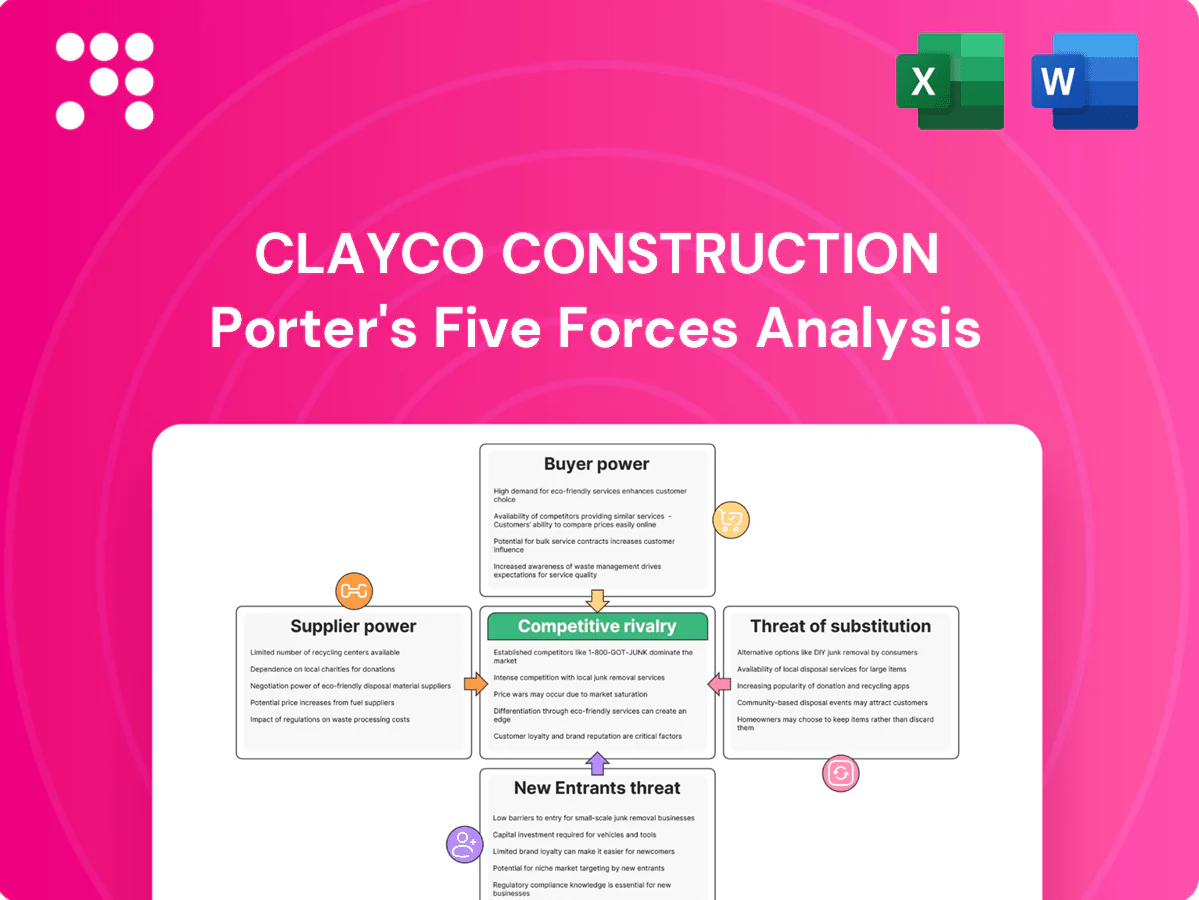
Clayco Construction Porter's Five Forces Analysis

Don't Miss the Bigger Picture
This snapshot highlights Clayco Construction’s positioning amid supplier leverage, client bargaining power, and competitive rivalry, but only scratches the surface. Unlock the full Porter's Five Forces Analysis to access force-by-force ratings, visuals, and actionable strategy implications. Get the complete report to inform investment or strategic decisions with consultant-grade insights.
Suppliers Bargaining Power

Critical materials volatility
Steel, cement and electrical-gear suppliers can wield power through sharp price swings and long lead times—US Section 232 steel tariffs of 25% and global supply shocks have amplified volatility and strained guaranteed maximum price commitments. In 2024 episodic shortages and multi-month lead times continued to pressure margins. Clayco mitigates with early procurement, hedging and alternate specs, while design-build integration and value engineering reduce material exposure and change-order risk.
Specialty subcontractor scarcity
High-demand trades like MEP, cleanroom and cold storage remain capacity constrained, with a 2024 AGC/Autodesk industry survey finding roughly 70% of firms reporting skilled-subcontractor shortages, giving subs pricing and timing leverage. Strict performance and safety qualifications shrink the eligible pool on complex projects, raising switching costs. Clayco’s preferred-partner network and repeat work help temper rates and secure reliability. Bundling multi-project pipelines further improves negotiating position.

Equipment and technology dependence
Clayco faces switching frictions as BIM/VDC platforms, drones and project-management suites (dominated by vendors like Autodesk and Trimble) lock data and workflows, enabling fee hikes or limited interoperability. Industry estimates in 2024 put BIM/digital-construction adoption above 60% among large contractors, intensifying vendor leverage. Clayco’s in-house VDC expertise and standardized tech stack raise its bargaining power, while IFC (ISO 16739) and data-ownership practices mitigate lock-in risk.

Logistics and long-lead components
Labor unions and compliance
National builder blunts supplier power via early buying, VDC & partners — 20–40 wks, 70–71%, $3.7B
Suppliers—steel, MEP trades, digital vendors—exert meaningful leverage via price volatility, long lead times (20–40 weeks), and skilled-labor scarcity; Clayco offsets with early procurement, preferred partners, VDC expertise and national scale (~3.7B rev 2023).
| Metric | 2023/24 |
|---|---|
| Clayco revenue | ~3.7B (2023) |
| Lead times | 20–40 wks (2024) |
| Craft shortages | 70–71% (2023–24) |
What is included in the product
 Detailed Word Document
Tailored to Clayco Construction, this Porter's Five Forces analysis uncovers key drivers of competition, supplier and buyer power, and market entry risks while identifying disruptive threats and substitutes that could erode market share.

 Customizable Excel Spreadsheet
A clear, one-sheet Porter’s Five Forces summary for Clayco Construction—perfect for quick risk assessment, bidder strategy and fast decision-making in complex projects.
Customers Bargaining Power

Sophisticated corporate buyers
Fortune 1000 and institutional clients (1,000 firms) use rigorous RFPs and benchmarking to extract pricing concessions in 2024, raising buyer sophistication and leverage. Owner reps and third-party consultants increase transparency and comparability across bids, compressing margin flexibility. Clayco counters with integrated design-build ROI, faster speed-to-market and single-point accountability. Lifecycle value proposals reduce emphasis on lowest initial price.
Project scale and bundling
Large multi-site programs extract volume discounts, with framework deals commonly delivering single-digit price reductions; Clayco reported roughly $1.8B revenue in 2023 and manages program scopes exceeding $500M for major clients. Framework agreements tighten KPIs and liquidated damages, shifting negotiating leverage toward clients. Clayco’s turnkey stack from site selection to FM increases share-of-wallet, while programmatic delivery and standardization justify preferred pricing tiers and repeatable margins.

Switching costs and continuity
Once design-build and preconstruction are underway switching becomes costly and risky, locking projects into Clayco’s processes and suppliers; Clayco operates across 30+ states, deepening site-specific knowledge and embedded value. Phased scopes and multi-year master service agreements (commonly 3–7 years) extend pipelines and raise exit barriers. Strong performance data and transferable warranties further reinforce client retention.

Alternative delivery options
Clients can choose CM-at-Risk, design-bid-build, or developer-led turnkey models, increasing buyer leverage in pricing and scope negotiations. Clayco positions on speed, cost certainty, and integrated financing support to capture projects that prefer consolidated risk. Early collaboration in delivery reduces change orders compared with traditional bid-build approaches.
- Delivery options: CM-at-Risk, design-bid-build, developer-led
- Buyer leverage: heightened negotiation power
- Clayco edge: speed, cost certainty, financing
- Early collaboration: fewer change orders
Schedule sensitivity
Time-to-revenue forces clients into aggressive timelines and contracts increasingly include delay penalties and bonus/malus clauses that shift cost and schedule risk onto builders. Clayco’s VDC, prefabrication, and concurrent engineering—industry studies cite schedule reductions up to 30% (2024)—allow the firm to command a premium for certainty. Transparent schedules and real-time dashboards (adoption +35% in 2024) reduce perceived risk and build client trust.
- Schedule sensitivity: drives contract leverage
- Risk shift: penalties/bonus clauses
- Clayco edge: VDC/prefab ~30% faster
- Transparency: dashboards increase trust (+35%)
Buyers extract single-digit discounts; programs exceed $1.8B, ~30% faster
Buyers (Fortune 1000, institutional programs) wield strong leverage via RFPs, frameworks and alternative delivery choices, extracting single-digit discounts; Clayco reported ~$1.8B revenue (2023) and manages programs >$500M. Switching costs and multi-year MSAs (3–7 yrs) lock clients, while VDC/prefab reduce schedules ~30% (2024), supporting price premiums.
| Metric | Value |
|---|---|
| Revenue (2023) | $1.8B |
| Program size | >$500M |
| Schedule reduction (2024) | ~30% |
| Dashboard adoption (2024) | +35% |
Preview Before You Purchase
Clayco Construction Porter's Five Forces Analysis
This preview shows the exact Clayco Construction Porter's Five Forces Analysis you'll receive—no mockups, no placeholders. The full document is fully formatted, professionally written, and ready for immediate download upon purchase. You’ll get instant access to this identical file for immediate use.

Don't Miss the Bigger Picture
This snapshot highlights Clayco Construction’s positioning amid supplier leverage, client bargaining power, and competitive rivalry, but only scratches the surface. Unlock the full Porter's Five Forces Analysis to access force-by-force ratings, visuals, and actionable strategy implications. Get the complete report to inform investment or strategic decisions with consultant-grade insights.
Suppliers Bargaining Power
Critical materials volatility
Steel, cement and electrical-gear suppliers can wield power through sharp price swings and long lead times—US Section 232 steel tariffs of 25% and global supply shocks have amplified volatility and strained guaranteed maximum price commitments. In 2024 episodic shortages and multi-month lead times continued to pressure margins. Clayco mitigates with early procurement, hedging and alternate specs, while design-build integration and value engineering reduce material exposure and change-order risk.
Specialty subcontractor scarcity
High-demand trades like MEP, cleanroom and cold storage remain capacity constrained, with a 2024 AGC/Autodesk industry survey finding roughly 70% of firms reporting skilled-subcontractor shortages, giving subs pricing and timing leverage. Strict performance and safety qualifications shrink the eligible pool on complex projects, raising switching costs. Clayco’s preferred-partner network and repeat work help temper rates and secure reliability. Bundling multi-project pipelines further improves negotiating position.
Equipment and technology dependence
Clayco faces switching frictions as BIM/VDC platforms, drones and project-management suites (dominated by vendors like Autodesk and Trimble) lock data and workflows, enabling fee hikes or limited interoperability. Industry estimates in 2024 put BIM/digital-construction adoption above 60% among large contractors, intensifying vendor leverage. Clayco’s in-house VDC expertise and standardized tech stack raise its bargaining power, while IFC (ISO 16739) and data-ownership practices mitigate lock-in risk.
Logistics and long-lead components
Labor unions and compliance
National builder blunts supplier power via early buying, VDC & partners — 20–40 wks, 70–71%, $3.7B
Suppliers—steel, MEP trades, digital vendors—exert meaningful leverage via price volatility, long lead times (20–40 weeks), and skilled-labor scarcity; Clayco offsets with early procurement, preferred partners, VDC expertise and national scale (~3.7B rev 2023).
| Metric | 2023/24 |
|---|---|
| Clayco revenue | ~3.7B (2023) |
| Lead times | 20–40 wks (2024) |
| Craft shortages | 70–71% (2023–24) |
What is included in the product
Detailed Word Document
Tailored to Clayco Construction, this Porter's Five Forces analysis uncovers key drivers of competition, supplier and buyer power, and market entry risks while identifying disruptive threats and substitutes that could erode market share.
Customizable Excel Spreadsheet
A clear, one-sheet Porter’s Five Forces summary for Clayco Construction—perfect for quick risk assessment, bidder strategy and fast decision-making in complex projects.
Customers Bargaining Power
Sophisticated corporate buyers
Fortune 1000 and institutional clients (1,000 firms) use rigorous RFPs and benchmarking to extract pricing concessions in 2024, raising buyer sophistication and leverage. Owner reps and third-party consultants increase transparency and comparability across bids, compressing margin flexibility. Clayco counters with integrated design-build ROI, faster speed-to-market and single-point accountability. Lifecycle value proposals reduce emphasis on lowest initial price.
Project scale and bundling
Large multi-site programs extract volume discounts, with framework deals commonly delivering single-digit price reductions; Clayco reported roughly $1.8B revenue in 2023 and manages program scopes exceeding $500M for major clients. Framework agreements tighten KPIs and liquidated damages, shifting negotiating leverage toward clients. Clayco’s turnkey stack from site selection to FM increases share-of-wallet, while programmatic delivery and standardization justify preferred pricing tiers and repeatable margins.
Switching costs and continuity
Once design-build and preconstruction are underway switching becomes costly and risky, locking projects into Clayco’s processes and suppliers; Clayco operates across 30+ states, deepening site-specific knowledge and embedded value. Phased scopes and multi-year master service agreements (commonly 3–7 years) extend pipelines and raise exit barriers. Strong performance data and transferable warranties further reinforce client retention.
Alternative delivery options
Clients can choose CM-at-Risk, design-bid-build, or developer-led turnkey models, increasing buyer leverage in pricing and scope negotiations. Clayco positions on speed, cost certainty, and integrated financing support to capture projects that prefer consolidated risk. Early collaboration in delivery reduces change orders compared with traditional bid-build approaches.
- Delivery options: CM-at-Risk, design-bid-build, developer-led
- Buyer leverage: heightened negotiation power
- Clayco edge: speed, cost certainty, financing
- Early collaboration: fewer change orders
Schedule sensitivity
Time-to-revenue forces clients into aggressive timelines and contracts increasingly include delay penalties and bonus/malus clauses that shift cost and schedule risk onto builders. Clayco’s VDC, prefabrication, and concurrent engineering—industry studies cite schedule reductions up to 30% (2024)—allow the firm to command a premium for certainty. Transparent schedules and real-time dashboards (adoption +35% in 2024) reduce perceived risk and build client trust.
- Schedule sensitivity: drives contract leverage
- Risk shift: penalties/bonus clauses
- Clayco edge: VDC/prefab ~30% faster
- Transparency: dashboards increase trust (+35%)
Buyers extract single-digit discounts; programs exceed $1.8B, ~30% faster
Buyers (Fortune 1000, institutional programs) wield strong leverage via RFPs, frameworks and alternative delivery choices, extracting single-digit discounts; Clayco reported ~$1.8B revenue (2023) and manages programs >$500M. Switching costs and multi-year MSAs (3–7 yrs) lock clients, while VDC/prefab reduce schedules ~30% (2024), supporting price premiums.
| Metric | Value |
|---|---|
| Revenue (2023) | $1.8B |
| Program size | >$500M |
| Schedule reduction (2024) | ~30% |
| Dashboard adoption (2024) | +35% |
Preview Before You Purchase
Clayco Construction Porter's Five Forces Analysis
This preview shows the exact Clayco Construction Porter's Five Forces Analysis you'll receive—no mockups, no placeholders. The full document is fully formatted, professionally written, and ready for immediate download upon purchase. You’ll get instant access to this identical file for immediate use.
Original: $10.00
-65%$10.00
$3.50Description
Don't Miss the Bigger Picture
This snapshot highlights Clayco Construction’s positioning amid supplier leverage, client bargaining power, and competitive rivalry, but only scratches the surface. Unlock the full Porter's Five Forces Analysis to access force-by-force ratings, visuals, and actionable strategy implications. Get the complete report to inform investment or strategic decisions with consultant-grade insights.
Suppliers Bargaining Power
Critical materials volatility
Steel, cement and electrical-gear suppliers can wield power through sharp price swings and long lead times—US Section 232 steel tariffs of 25% and global supply shocks have amplified volatility and strained guaranteed maximum price commitments. In 2024 episodic shortages and multi-month lead times continued to pressure margins. Clayco mitigates with early procurement, hedging and alternate specs, while design-build integration and value engineering reduce material exposure and change-order risk.
Specialty subcontractor scarcity
High-demand trades like MEP, cleanroom and cold storage remain capacity constrained, with a 2024 AGC/Autodesk industry survey finding roughly 70% of firms reporting skilled-subcontractor shortages, giving subs pricing and timing leverage. Strict performance and safety qualifications shrink the eligible pool on complex projects, raising switching costs. Clayco’s preferred-partner network and repeat work help temper rates and secure reliability. Bundling multi-project pipelines further improves negotiating position.
Equipment and technology dependence
Clayco faces switching frictions as BIM/VDC platforms, drones and project-management suites (dominated by vendors like Autodesk and Trimble) lock data and workflows, enabling fee hikes or limited interoperability. Industry estimates in 2024 put BIM/digital-construction adoption above 60% among large contractors, intensifying vendor leverage. Clayco’s in-house VDC expertise and standardized tech stack raise its bargaining power, while IFC (ISO 16739) and data-ownership practices mitigate lock-in risk.
Logistics and long-lead components
Labor unions and compliance
National builder blunts supplier power via early buying, VDC & partners — 20–40 wks, 70–71%, $3.7B
Suppliers—steel, MEP trades, digital vendors—exert meaningful leverage via price volatility, long lead times (20–40 weeks), and skilled-labor scarcity; Clayco offsets with early procurement, preferred partners, VDC expertise and national scale (~3.7B rev 2023).
| Metric | 2023/24 |
|---|---|
| Clayco revenue | ~3.7B (2023) |
| Lead times | 20–40 wks (2024) |
| Craft shortages | 70–71% (2023–24) |
What is included in the product
Detailed Word Document
Tailored to Clayco Construction, this Porter's Five Forces analysis uncovers key drivers of competition, supplier and buyer power, and market entry risks while identifying disruptive threats and substitutes that could erode market share.
Customizable Excel Spreadsheet
A clear, one-sheet Porter’s Five Forces summary for Clayco Construction—perfect for quick risk assessment, bidder strategy and fast decision-making in complex projects.
Customers Bargaining Power
Sophisticated corporate buyers
Fortune 1000 and institutional clients (1,000 firms) use rigorous RFPs and benchmarking to extract pricing concessions in 2024, raising buyer sophistication and leverage. Owner reps and third-party consultants increase transparency and comparability across bids, compressing margin flexibility. Clayco counters with integrated design-build ROI, faster speed-to-market and single-point accountability. Lifecycle value proposals reduce emphasis on lowest initial price.
Project scale and bundling
Large multi-site programs extract volume discounts, with framework deals commonly delivering single-digit price reductions; Clayco reported roughly $1.8B revenue in 2023 and manages program scopes exceeding $500M for major clients. Framework agreements tighten KPIs and liquidated damages, shifting negotiating leverage toward clients. Clayco’s turnkey stack from site selection to FM increases share-of-wallet, while programmatic delivery and standardization justify preferred pricing tiers and repeatable margins.
Switching costs and continuity
Once design-build and preconstruction are underway switching becomes costly and risky, locking projects into Clayco’s processes and suppliers; Clayco operates across 30+ states, deepening site-specific knowledge and embedded value. Phased scopes and multi-year master service agreements (commonly 3–7 years) extend pipelines and raise exit barriers. Strong performance data and transferable warranties further reinforce client retention.
Alternative delivery options
Clients can choose CM-at-Risk, design-bid-build, or developer-led turnkey models, increasing buyer leverage in pricing and scope negotiations. Clayco positions on speed, cost certainty, and integrated financing support to capture projects that prefer consolidated risk. Early collaboration in delivery reduces change orders compared with traditional bid-build approaches.
- Delivery options: CM-at-Risk, design-bid-build, developer-led
- Buyer leverage: heightened negotiation power
- Clayco edge: speed, cost certainty, financing
- Early collaboration: fewer change orders
Schedule sensitivity
Time-to-revenue forces clients into aggressive timelines and contracts increasingly include delay penalties and bonus/malus clauses that shift cost and schedule risk onto builders. Clayco’s VDC, prefabrication, and concurrent engineering—industry studies cite schedule reductions up to 30% (2024)—allow the firm to command a premium for certainty. Transparent schedules and real-time dashboards (adoption +35% in 2024) reduce perceived risk and build client trust.
- Schedule sensitivity: drives contract leverage
- Risk shift: penalties/bonus clauses
- Clayco edge: VDC/prefab ~30% faster
- Transparency: dashboards increase trust (+35%)
Buyers extract single-digit discounts; programs exceed $1.8B, ~30% faster
Buyers (Fortune 1000, institutional programs) wield strong leverage via RFPs, frameworks and alternative delivery choices, extracting single-digit discounts; Clayco reported ~$1.8B revenue (2023) and manages programs >$500M. Switching costs and multi-year MSAs (3–7 yrs) lock clients, while VDC/prefab reduce schedules ~30% (2024), supporting price premiums.
| Metric | Value |
|---|---|
| Revenue (2023) | $1.8B |
| Program size | >$500M |
| Schedule reduction (2024) | ~30% |
| Dashboard adoption (2024) | +35% |
Preview Before You Purchase
Clayco Construction Porter's Five Forces Analysis
This preview shows the exact Clayco Construction Porter's Five Forces Analysis you'll receive—no mockups, no placeholders. The full document is fully formatted, professionally written, and ready for immediate download upon purchase. You’ll get instant access to this identical file for immediate use.











