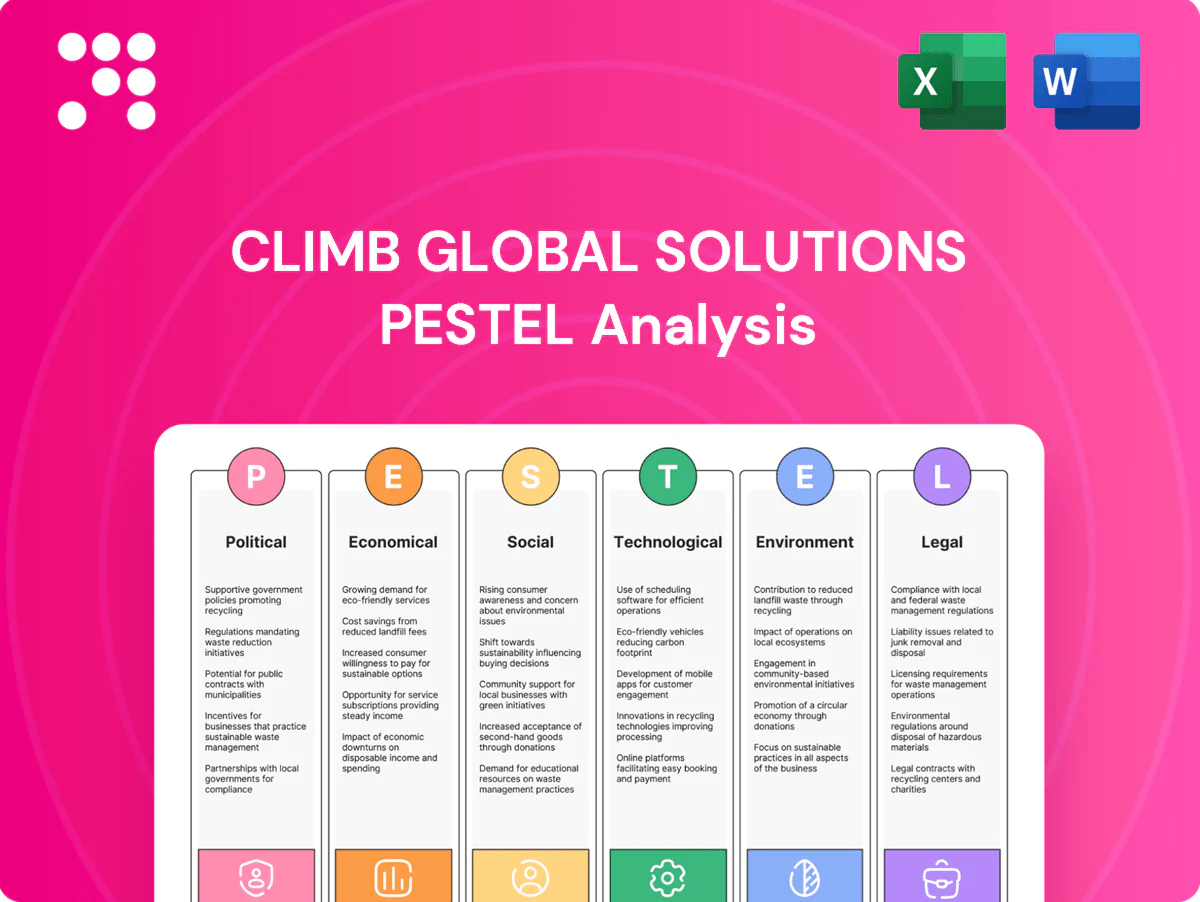
Climb Global Solutions PESTLE Analysis

Skip the Research. Get the Strategy.
Gain a competitive edge with our PESTLE Analysis of Climb Global Solutions—spot regulatory risks, economic drivers, and tech trends shaping its future. Ready-made for investors and strategists, it’s fully editable and instant-downloadable. Purchase the full report now for actionable, boardroom-ready insights.
Political factors

Trade policy and tariffs
Shifts in U.S., EU and APAC trade policy can materially change landed costs for hardware and cross-border software services, with U.S. Section 301 measures affecting roughly $360 billion of Chinese imports. Tariffs on components or finished devices, sometimes reaching up to 25%, compress distributor margins or force price pass-throughs. Proactive multi-region sourcing and alternative vendor options reduce exposure. Monitoring free-trade agreements enables optimized routing and duty planning.
Export controls and sanctions
Expanding U.S. and allied export controls on chips, AI, and cybersecurity tools in 2023–24 have narrowed eligible end-markets and increased licensing needs. Sanctions lists—OFAC's SDN list exceeded 7,000 entries by mid-2024—complicate partner vetting and deal clearance. Strengthened screening and documentation are essential to avoid penalties and shipment delays. Vendor education and automated compliance checks speed approvals.

Government IT procurement
Public-sector modernization budgets — US federal IT spending exceeded 90 billion USD in FY2024 — create sizable channel opportunities for Climb Global Solutions. Procurement rules, set-asides and certification requirements raise sales friction and extend sales cycles. Aligning with compliant resellers and securing GSA/contract vehicles accelerates access. Specialized bid support improves win rates and shortens cycle times.

Data localization policies
Data localization policies in 60+ countries as of 2024 force vendor selection and architecture changes, driving Cloud and SaaS products to satisfy residency and sovereignty criteria; noncompliance can block access to markets representing billions in ARR. Building localized line cards and alliances with in-country providers mitigates restrictions and shortens go-to-market cycles, while clear guidance helps partners position compliant solutions.
- 60+ countries with localization rules (2024)
- Global public cloud ~600B USD market (2024)
- Localized partnerships reduce entry time and legal risk
Geopolitical instability
Geopolitical conflicts and diplomatic tensions disrupt logistics, insurance and currency settlement; 2023–24 Red Sea security incidents saw war-risk premiums spike as much as 500% on affected routes and caused multi-week shipment delays. Vendors often reallocate supply away from higher-risk corridors, increasing lead times and costs. Climb maintains scenario plans, alternate distribution hubs, and transparent ETA and risk communication to preserve partner trust.
- Impact: insurance premiums up to 500%
- Supply shift: vendors reroute from risky corridors
- Mitigation: scenario planning and alternate hubs
- Trust: transparent ETA and risk updates
Trade friction and export controls raise costs, driving multi-region sourcing and localization
Trade tariffs and Section 301 actions on ~$360B of Chinese goods in 2024 raise landed costs and squeeze margins, driving multi-region sourcing.
Export controls on chips/AI and OFAC SDN >7,000 entries increase licensing and vetting burden, raising compliance costs.
Public IT spend (~$90B FY2024) and 60+ data localization regimes shape GTM; localized partnerships cut legal friction.
| Metric | 2024 Value |
|---|---|
| Section 301 exposure | $360B |
| OFAC SDN | >7,000 |
| US federal IT | $90B |
| Localization laws | 60+ |
What is included in the product
 Detailed Word Document
Examines how Political, Economic, Social, Technological, Environmental and Legal forces shape Climb Global Solutions, with data-backed trends, region- and industry-specific examples, forward-looking scenario insights and clean formatting to aid executives, investors and strategists.

 Customizable Excel Spreadsheet
Visually segmented by PESTLE categories for quick interpretation, the Climb Global Solutions PESTLE Analysis delivers a concise, editable summary that can be dropped into presentations or shared across teams to streamline external risk discussions and align strategic planning.
Economic factors

IT spending cycles
Enterprise and SMB tech budgets track GDP and rates—global IT spending hit about $4.6 trillion in 2024 while cybersecurity budgets surpassed $180 billion, driving ROI-focused buys; value-added distribution cushions downturns by prioritizing consolidation, managed services and security. In upcycles, rapid onboarding of growth vendors maximizes throughput, and cross-sector diversification smooths revenue volatility.
Currency volatility
Multi-currency receivables and payables expose Climb Global Solutions margins to FX swings; global FX markets average about 7.5 trillion USD in daily turnover (BIS 2022). FX moves force frequent channel repricing and alter rebate economics, while disciplined hedging and currency-aligned contracts reduce P&L variance, and transparent FX pass-through builds partner predictability.

Interest rates and channel financing
Higher policy rates — US federal funds around 5.25–5.50% in mid-2025 — raise working-capital costs for stocking and extend partner credit terms, squeezing margins. Offering flexible financing and extended terms can differentiate Climb Global Solutions but will pressure cash flow and borrowing needs. Implementing risk-based credit models and vendor-backed programs helps protect against defaults and scale partner purchasing power.

Vendor consolidation
Vendor consolidation driven by ongoing M&A in 2024 reshapes line cards and rebate structures, forcing re-evaluation of partner economics; integration of merged software and hardware portfolios can both simplify stacks and introduce pricing and channel conflicts. Maintaining a balanced vendor portfolio limits single-supplier dependency risk, while rapid enablement on merged offerings captures cross-sell and preserves margin.
- Risk: channel conflict from merged SKUs
- Action: diversify to limit dependency
- Opportunity: fast enablement = increased cross-sell
Inflation and cost structure
Inflation continues to push up logistics, labor and compliance expenses while higher borrowing costs (US federal funds rate around 5.25–5.50% in 2024–25) increase financing pressure; Climb Global Solutions offsets this with automation and self-service portals to protect operating leverage, periodic price adjustments and value-based bundles to preserve margins, and targeted efficiency programs to stay competitive during cost spikes.
- Automation protects operating leverage
- Price adjustments + value bundles preserve margins
- Efficiency programs sustain competitiveness
- Higher rates (Fed ~5.25–5.50%) raise financing costs
Trade friction and export controls raise costs, driving multi-region sourcing and localization
Enterprise IT spend ~$4.6T (2024) and cybersecurity >$180B drive ROI buys; FX volatility (USD daily turnover ~$7.5T) and vendor M&A reshape margins and rebates. Fed funds ~5.25–5.50% (mid-2025) raises working-capital costs; automation, hedging and vendor-backed financing protect cash flow and margins.
| Metric | Value |
|---|---|
| Global IT spend (2024) | $4.6T |
| Cybersecurity spend (2024) | $180B+ |
| FX daily turnover (BIS 2022) | $7.5T |
| Fed funds (mid-2025) | 5.25–5.50% |
Same Document Delivered
Climb Global Solutions PESTLE Analysis
The preview shown here is the exact Climb Global Solutions PESTLE Analysis you’ll receive after purchase—fully formatted, professionally structured, and ready to use. This screenshot represents the final document with complete political, economic, social, technological, legal, and environmental insights. After checkout you’ll be able to download this same file immediately, no placeholders or surprises.

Skip the Research. Get the Strategy.
Gain a competitive edge with our PESTLE Analysis of Climb Global Solutions—spot regulatory risks, economic drivers, and tech trends shaping its future. Ready-made for investors and strategists, it’s fully editable and instant-downloadable. Purchase the full report now for actionable, boardroom-ready insights.
Political factors
Trade policy and tariffs
Shifts in U.S., EU and APAC trade policy can materially change landed costs for hardware and cross-border software services, with U.S. Section 301 measures affecting roughly $360 billion of Chinese imports. Tariffs on components or finished devices, sometimes reaching up to 25%, compress distributor margins or force price pass-throughs. Proactive multi-region sourcing and alternative vendor options reduce exposure. Monitoring free-trade agreements enables optimized routing and duty planning.
Export controls and sanctions
Expanding U.S. and allied export controls on chips, AI, and cybersecurity tools in 2023–24 have narrowed eligible end-markets and increased licensing needs. Sanctions lists—OFAC's SDN list exceeded 7,000 entries by mid-2024—complicate partner vetting and deal clearance. Strengthened screening and documentation are essential to avoid penalties and shipment delays. Vendor education and automated compliance checks speed approvals.
Government IT procurement
Public-sector modernization budgets — US federal IT spending exceeded 90 billion USD in FY2024 — create sizable channel opportunities for Climb Global Solutions. Procurement rules, set-asides and certification requirements raise sales friction and extend sales cycles. Aligning with compliant resellers and securing GSA/contract vehicles accelerates access. Specialized bid support improves win rates and shortens cycle times.
Data localization policies
Data localization policies in 60+ countries as of 2024 force vendor selection and architecture changes, driving Cloud and SaaS products to satisfy residency and sovereignty criteria; noncompliance can block access to markets representing billions in ARR. Building localized line cards and alliances with in-country providers mitigates restrictions and shortens go-to-market cycles, while clear guidance helps partners position compliant solutions.
- 60+ countries with localization rules (2024)
- Global public cloud ~600B USD market (2024)
- Localized partnerships reduce entry time and legal risk
Geopolitical instability
Geopolitical conflicts and diplomatic tensions disrupt logistics, insurance and currency settlement; 2023–24 Red Sea security incidents saw war-risk premiums spike as much as 500% on affected routes and caused multi-week shipment delays. Vendors often reallocate supply away from higher-risk corridors, increasing lead times and costs. Climb maintains scenario plans, alternate distribution hubs, and transparent ETA and risk communication to preserve partner trust.
- Impact: insurance premiums up to 500%
- Supply shift: vendors reroute from risky corridors
- Mitigation: scenario planning and alternate hubs
- Trust: transparent ETA and risk updates
Trade friction and export controls raise costs, driving multi-region sourcing and localization
Trade tariffs and Section 301 actions on ~$360B of Chinese goods in 2024 raise landed costs and squeeze margins, driving multi-region sourcing.
Export controls on chips/AI and OFAC SDN >7,000 entries increase licensing and vetting burden, raising compliance costs.
Public IT spend (~$90B FY2024) and 60+ data localization regimes shape GTM; localized partnerships cut legal friction.
| Metric | 2024 Value |
|---|---|
| Section 301 exposure | $360B |
| OFAC SDN | >7,000 |
| US federal IT | $90B |
| Localization laws | 60+ |
What is included in the product
Detailed Word Document
Examines how Political, Economic, Social, Technological, Environmental and Legal forces shape Climb Global Solutions, with data-backed trends, region- and industry-specific examples, forward-looking scenario insights and clean formatting to aid executives, investors and strategists.
Customizable Excel Spreadsheet
Visually segmented by PESTLE categories for quick interpretation, the Climb Global Solutions PESTLE Analysis delivers a concise, editable summary that can be dropped into presentations or shared across teams to streamline external risk discussions and align strategic planning.
Economic factors
IT spending cycles
Enterprise and SMB tech budgets track GDP and rates—global IT spending hit about $4.6 trillion in 2024 while cybersecurity budgets surpassed $180 billion, driving ROI-focused buys; value-added distribution cushions downturns by prioritizing consolidation, managed services and security. In upcycles, rapid onboarding of growth vendors maximizes throughput, and cross-sector diversification smooths revenue volatility.
Currency volatility
Multi-currency receivables and payables expose Climb Global Solutions margins to FX swings; global FX markets average about 7.5 trillion USD in daily turnover (BIS 2022). FX moves force frequent channel repricing and alter rebate economics, while disciplined hedging and currency-aligned contracts reduce P&L variance, and transparent FX pass-through builds partner predictability.
Interest rates and channel financing
Higher policy rates — US federal funds around 5.25–5.50% in mid-2025 — raise working-capital costs for stocking and extend partner credit terms, squeezing margins. Offering flexible financing and extended terms can differentiate Climb Global Solutions but will pressure cash flow and borrowing needs. Implementing risk-based credit models and vendor-backed programs helps protect against defaults and scale partner purchasing power.
Vendor consolidation
Vendor consolidation driven by ongoing M&A in 2024 reshapes line cards and rebate structures, forcing re-evaluation of partner economics; integration of merged software and hardware portfolios can both simplify stacks and introduce pricing and channel conflicts. Maintaining a balanced vendor portfolio limits single-supplier dependency risk, while rapid enablement on merged offerings captures cross-sell and preserves margin.
- Risk: channel conflict from merged SKUs
- Action: diversify to limit dependency
- Opportunity: fast enablement = increased cross-sell
Inflation and cost structure
Inflation continues to push up logistics, labor and compliance expenses while higher borrowing costs (US federal funds rate around 5.25–5.50% in 2024–25) increase financing pressure; Climb Global Solutions offsets this with automation and self-service portals to protect operating leverage, periodic price adjustments and value-based bundles to preserve margins, and targeted efficiency programs to stay competitive during cost spikes.
- Automation protects operating leverage
- Price adjustments + value bundles preserve margins
- Efficiency programs sustain competitiveness
- Higher rates (Fed ~5.25–5.50%) raise financing costs
Trade friction and export controls raise costs, driving multi-region sourcing and localization
Enterprise IT spend ~$4.6T (2024) and cybersecurity >$180B drive ROI buys; FX volatility (USD daily turnover ~$7.5T) and vendor M&A reshape margins and rebates. Fed funds ~5.25–5.50% (mid-2025) raises working-capital costs; automation, hedging and vendor-backed financing protect cash flow and margins.
| Metric | Value |
|---|---|
| Global IT spend (2024) | $4.6T |
| Cybersecurity spend (2024) | $180B+ |
| FX daily turnover (BIS 2022) | $7.5T |
| Fed funds (mid-2025) | 5.25–5.50% |
Same Document Delivered
Climb Global Solutions PESTLE Analysis
The preview shown here is the exact Climb Global Solutions PESTLE Analysis you’ll receive after purchase—fully formatted, professionally structured, and ready to use. This screenshot represents the final document with complete political, economic, social, technological, legal, and environmental insights. After checkout you’ll be able to download this same file immediately, no placeholders or surprises.
Original: $10.00
-65%$10.00
$3.50Description
Skip the Research. Get the Strategy.
Gain a competitive edge with our PESTLE Analysis of Climb Global Solutions—spot regulatory risks, economic drivers, and tech trends shaping its future. Ready-made for investors and strategists, it’s fully editable and instant-downloadable. Purchase the full report now for actionable, boardroom-ready insights.
Political factors
Trade policy and tariffs
Shifts in U.S., EU and APAC trade policy can materially change landed costs for hardware and cross-border software services, with U.S. Section 301 measures affecting roughly $360 billion of Chinese imports. Tariffs on components or finished devices, sometimes reaching up to 25%, compress distributor margins or force price pass-throughs. Proactive multi-region sourcing and alternative vendor options reduce exposure. Monitoring free-trade agreements enables optimized routing and duty planning.
Export controls and sanctions
Expanding U.S. and allied export controls on chips, AI, and cybersecurity tools in 2023–24 have narrowed eligible end-markets and increased licensing needs. Sanctions lists—OFAC's SDN list exceeded 7,000 entries by mid-2024—complicate partner vetting and deal clearance. Strengthened screening and documentation are essential to avoid penalties and shipment delays. Vendor education and automated compliance checks speed approvals.
Government IT procurement
Public-sector modernization budgets — US federal IT spending exceeded 90 billion USD in FY2024 — create sizable channel opportunities for Climb Global Solutions. Procurement rules, set-asides and certification requirements raise sales friction and extend sales cycles. Aligning with compliant resellers and securing GSA/contract vehicles accelerates access. Specialized bid support improves win rates and shortens cycle times.
Data localization policies
Data localization policies in 60+ countries as of 2024 force vendor selection and architecture changes, driving Cloud and SaaS products to satisfy residency and sovereignty criteria; noncompliance can block access to markets representing billions in ARR. Building localized line cards and alliances with in-country providers mitigates restrictions and shortens go-to-market cycles, while clear guidance helps partners position compliant solutions.
- 60+ countries with localization rules (2024)
- Global public cloud ~600B USD market (2024)
- Localized partnerships reduce entry time and legal risk
Geopolitical instability
Geopolitical conflicts and diplomatic tensions disrupt logistics, insurance and currency settlement; 2023–24 Red Sea security incidents saw war-risk premiums spike as much as 500% on affected routes and caused multi-week shipment delays. Vendors often reallocate supply away from higher-risk corridors, increasing lead times and costs. Climb maintains scenario plans, alternate distribution hubs, and transparent ETA and risk communication to preserve partner trust.
- Impact: insurance premiums up to 500%
- Supply shift: vendors reroute from risky corridors
- Mitigation: scenario planning and alternate hubs
- Trust: transparent ETA and risk updates
Trade friction and export controls raise costs, driving multi-region sourcing and localization
Trade tariffs and Section 301 actions on ~$360B of Chinese goods in 2024 raise landed costs and squeeze margins, driving multi-region sourcing.
Export controls on chips/AI and OFAC SDN >7,000 entries increase licensing and vetting burden, raising compliance costs.
Public IT spend (~$90B FY2024) and 60+ data localization regimes shape GTM; localized partnerships cut legal friction.
| Metric | 2024 Value |
|---|---|
| Section 301 exposure | $360B |
| OFAC SDN | >7,000 |
| US federal IT | $90B |
| Localization laws | 60+ |
What is included in the product
Detailed Word Document
Examines how Political, Economic, Social, Technological, Environmental and Legal forces shape Climb Global Solutions, with data-backed trends, region- and industry-specific examples, forward-looking scenario insights and clean formatting to aid executives, investors and strategists.
Customizable Excel Spreadsheet
Visually segmented by PESTLE categories for quick interpretation, the Climb Global Solutions PESTLE Analysis delivers a concise, editable summary that can be dropped into presentations or shared across teams to streamline external risk discussions and align strategic planning.
Economic factors
IT spending cycles
Enterprise and SMB tech budgets track GDP and rates—global IT spending hit about $4.6 trillion in 2024 while cybersecurity budgets surpassed $180 billion, driving ROI-focused buys; value-added distribution cushions downturns by prioritizing consolidation, managed services and security. In upcycles, rapid onboarding of growth vendors maximizes throughput, and cross-sector diversification smooths revenue volatility.
Currency volatility
Multi-currency receivables and payables expose Climb Global Solutions margins to FX swings; global FX markets average about 7.5 trillion USD in daily turnover (BIS 2022). FX moves force frequent channel repricing and alter rebate economics, while disciplined hedging and currency-aligned contracts reduce P&L variance, and transparent FX pass-through builds partner predictability.
Interest rates and channel financing
Higher policy rates — US federal funds around 5.25–5.50% in mid-2025 — raise working-capital costs for stocking and extend partner credit terms, squeezing margins. Offering flexible financing and extended terms can differentiate Climb Global Solutions but will pressure cash flow and borrowing needs. Implementing risk-based credit models and vendor-backed programs helps protect against defaults and scale partner purchasing power.
Vendor consolidation
Vendor consolidation driven by ongoing M&A in 2024 reshapes line cards and rebate structures, forcing re-evaluation of partner economics; integration of merged software and hardware portfolios can both simplify stacks and introduce pricing and channel conflicts. Maintaining a balanced vendor portfolio limits single-supplier dependency risk, while rapid enablement on merged offerings captures cross-sell and preserves margin.
- Risk: channel conflict from merged SKUs
- Action: diversify to limit dependency
- Opportunity: fast enablement = increased cross-sell
Inflation and cost structure
Inflation continues to push up logistics, labor and compliance expenses while higher borrowing costs (US federal funds rate around 5.25–5.50% in 2024–25) increase financing pressure; Climb Global Solutions offsets this with automation and self-service portals to protect operating leverage, periodic price adjustments and value-based bundles to preserve margins, and targeted efficiency programs to stay competitive during cost spikes.
- Automation protects operating leverage
- Price adjustments + value bundles preserve margins
- Efficiency programs sustain competitiveness
- Higher rates (Fed ~5.25–5.50%) raise financing costs
Trade friction and export controls raise costs, driving multi-region sourcing and localization
Enterprise IT spend ~$4.6T (2024) and cybersecurity >$180B drive ROI buys; FX volatility (USD daily turnover ~$7.5T) and vendor M&A reshape margins and rebates. Fed funds ~5.25–5.50% (mid-2025) raises working-capital costs; automation, hedging and vendor-backed financing protect cash flow and margins.
| Metric | Value |
|---|---|
| Global IT spend (2024) | $4.6T |
| Cybersecurity spend (2024) | $180B+ |
| FX daily turnover (BIS 2022) | $7.5T |
| Fed funds (mid-2025) | 5.25–5.50% |
Same Document Delivered
Climb Global Solutions PESTLE Analysis
The preview shown here is the exact Climb Global Solutions PESTLE Analysis you’ll receive after purchase—fully formatted, professionally structured, and ready to use. This screenshot represents the final document with complete political, economic, social, technological, legal, and environmental insights. After checkout you’ll be able to download this same file immediately, no placeholders or surprises.











