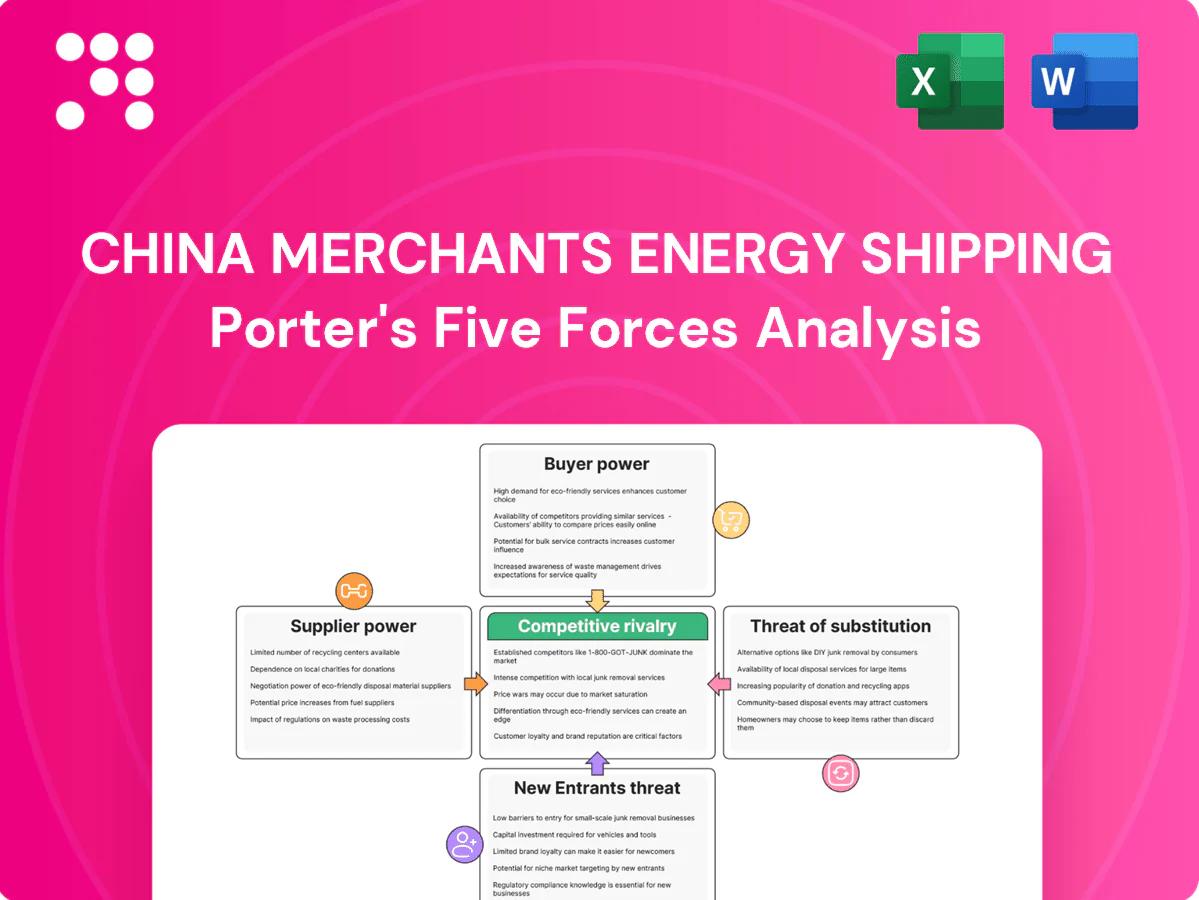
China Merchants Energy Shipping Porter's Five Forces Analysis

Elevate Your Analysis with the Complete Porter's Five Forces Analysis
China Merchants Energy Shipping faces intense competitive rivalry, moderate supplier power, strong buyer bargaining in bulk charter markets, limited substitutes but rising fuel/tech threats, and high entry barriers from capital intensity—this snapshot highlights key tensions and strategic levers. Unlock the full Porter’s Five Forces Analysis for force-by-force ratings, visuals, and actionable recommendations to guide investment or strategy.
Suppliers Bargaining Power

Concentrated shipyards and long lead-times
Deep‑sea tankers, bulkers and LNG carriers are built by a handful of Tier‑1 Asian yards with multi‑year orderbooks and typical lead‑times of 24–48 months, creating limited slot availability and high switching costs due to specialized LNG containment systems and certification requirements. Concentration allows yards to push pricing and stricter payment terms in upcycles, while CMES uses scale ordering and supplier relationships to mitigate but remains exposed to delivery risk and cost pass‑through.
Volatile bunker fuel and alternative fuels
Marine fuel suppliers remain fragmented, but 2024 price volatility in oil, VLSFO and emerging LNG bunkering amplifies their indirect leverage over CMES by driving voyage costs and margins. Transition fuels (LNG, methanol, ammonia) are nascent with limited suppliers and port availability, concentrating supply and permitting route lock‑ins and premiums. Few alternative bunkering hubs raise switching costs; CMES mitigates exposure through hedging programs and fuel‑efficiency tech investments.

Critical marine equipment OEMs
Critical marine OEMs are highly concentrated, with major players such as Wärtsilä, MAN Energy Solutions and Caterpillar dominating engine supply while specialists supply LNG containment, scrubbers/shaft generators and digital systems. Certification and warranty ties to yards and class societies raise lifecycle costs and lock-in. Long parts lead-times can create off‑hire risk that strengthens OEM leverage over pricing and SLA terms, and CMES diversifies specs but class rules limit standardization.

Port services and terminals
Pilots, towage and terminal slots at major Chinese energy ports are frequently capacity‑constrained, with berth utilization at peak times often exceeding 90% in 2024, giving local providers leverage to impose congestion and priority berthing fees that raise costs for CMES. Limited LNG‑jetty compatibility further narrows alternative terminal choices, and despite CMES’s sizable scale and cargo volume negotiating better windows, entrenched local monopolies maintain pricing power.
- Peak berth utilization: >90% (2024)
- Congestion fees raise operating costs
- LNG jetty compatibility limits alternatives
- CMES scale improves negotiating leverage but local monopolies persist
Crew supply and regulation
Crew supply is tight for qualified seafarers—LNG officers especially scarce—driving wage cycles and higher compliance costs; BIMCO/ICS warned of substantial officer shortages into 2025. Training, retention and union frameworks lift crewing expenses, and safety/regulatory requirements limit rapid substitution. CMES’s in‑house ship management reduces operational risk but not market scarcity.
- BIMCO/ICS: officer shortfalls projected into 2025
- Training/retention & unions push crewing costs higher
- In‑house management mitigates risk, not supply constraint
Shipyard lead times 24–48m, Brent USD 85/bbl, berths > 90%
Supplier power is elevated: Tier‑1 shipyards have 24–48 month lead times and limited slots, pressuring pricing and delivery for CMES in 2024. Fuel price volatility (2024 Brent avg ~USD 85/bbl) and limited LNG bunkering hubs raise voyage cost exposure. Concentrated OEMs and tight qualified crew markets (BIMCO/ICS officer shortfalls into 2025) sustain supplier leverage despite CMES scale.
| Metric | 2024 value |
|---|---|
| Shipyard lead‑time | 24–48 months |
| Brent avg | ~USD 85/bbl |
| Peak berth util | >90% |
| Officer shortage | Projected into 2025 |
What is included in the product
 Detailed Word Document
Tailored exclusively for China Merchants Energy Shipping, this analysis uncovers key drivers of competition, evaluates supplier and buyer power, identifies entry barriers and substitutes, and highlights disruptive threats shaping its pricing and profitability.

 Customizable Excel Spreadsheet
One-sheet Porter’s Five Forces for China Merchants Energy Shipping—clear, customizable pressure levels and instant spider chart visualization to simplify competitive assessment, ready to copy into decks or plug into Excel dashboards for rapid strategic decisions.
Customers Bargaining Power

Concentrated oil majors and traders
Large charterers—oil majors, NOCs and traders—dominate seaborne oil demand (seaborne crude ~50 million b/d in 2024) and set stringent tender terms that drive rate competition and operational KPIs.
Structured tendering and vetting regimes (OCIMF/SIRE) act as hard gates; reputation and inspection scores determine contract eligibility and commercial leverage.
CMES’s fleet scale and multi-year track record improve access to major tenders but do not eliminate the bargaining asymmetry when a handful of charterers control volumes and contract terms.
LNG offtakers prefer long-term charters
LNG offtakers prioritize reliability and commonly insist on multi‑year time charters with strict performance clauses; spot share rose to roughly 45% in 2024 but long‑term TCs still dominate operational planning. Few large buyers (concentrated demand) can negotiate lower dayrates and optionality, increasing their leverage. Technical needs like boil‑off management and reliquefaction raise switching costs yet focus bargaining power on anchor clients. CMES gains revenue cover from TCs but pricing power remains skewed toward those major offtakers.

Dry bulk shippers mix spot and COAs
Steel mills, power utilities and miners split cargoes across spot, COAs and index‑linked deals, with China crude steel output ~1.02bn t in 2024 underpinning steady bulk demand; in weak markets buyers pushed index discounts and greater laycan flexibility, while cargo optionality and triangulation compressed earnings. CMES’s diversified fleet (~200+ vessels) cushions exposure, but spot-driven margins remain cyclical.

High transparency of freight rates
Public indices like Baltic Dry Index (BDI averaged ~1,200 in 2024) and Worldscale make freight pricing visible, limiting carriers from setting rates above market benchmarks; buyers time fixtures and use FFA hedges (open interest rose ~20% in 2024) to strengthen negotiation and amplify price sensitivity. CMES defends premiums through lower unit cost, schedule reliability and investments in eco‑efficient tonnage.
- BDI avg 2024 ~1,200
- FFA open interest +~20% in 2024
- CMES focuses on cost, reliability, eco‑efficiency
Quality, ESG, and vetting leverage
Buyers impose strict safety, emissions and vetting thresholds that can exclude older ships or force discounts; IMO EEXI and CII (ratings A–E) implemented since 2023 raise charterer preference for low‑intensity tonnage. Compliance costs land on owners, boosting buyer leverage in negotiations. CMES’s relatively modern fleet supports customer preferencing but requires ongoing retrofits and capex to maintain ratings.
Buyers controlling ~50m b/d gain charter leverage; BDI ~1,200, FFA +20%
Concentrated buyers (majors, NOCs, traders) controlling ~50m b/d seaborne crude in 2024 exert strong rate and contract leverage. Structured vetting (OCIMF/SIRE), IMO EEXI/CII and buyer demand for low‑intensity tonnage raise switching costs but increase charterer bargaining power. Visible benchmarks (BDI avg ~1,200 in 2024; FFA open interest +20% in 2024) and LNG spot ~45% in 2024 compress pricing; CMES fleet ~200+ limits but does not remove asymmetry.
| Metric | 2024 |
|---|---|
| Seaborne crude | ~50m b/d |
| BDI avg | ~1,200 |
| FFA open interest | +20% |
| LNG spot share | ~45% |
| CMES fleet | ~200+ vessels |
Full Version Awaits
China Merchants Energy Shipping Porter's Five Forces Analysis
This preview shows the exact Porter’s Five Forces analysis of China Merchants Energy Shipping you'll receive immediately after purchase—no surprises, no placeholders. The report covers competitive rivalry, supplier and buyer power, and threats of new entrants and substitutes with actionable insights and data. It's fully formatted and ready for download the moment you buy. What you see here is the deliverable.

Elevate Your Analysis with the Complete Porter's Five Forces Analysis
China Merchants Energy Shipping faces intense competitive rivalry, moderate supplier power, strong buyer bargaining in bulk charter markets, limited substitutes but rising fuel/tech threats, and high entry barriers from capital intensity—this snapshot highlights key tensions and strategic levers. Unlock the full Porter’s Five Forces Analysis for force-by-force ratings, visuals, and actionable recommendations to guide investment or strategy.
Suppliers Bargaining Power
Concentrated shipyards and long lead-times
Deep‑sea tankers, bulkers and LNG carriers are built by a handful of Tier‑1 Asian yards with multi‑year orderbooks and typical lead‑times of 24–48 months, creating limited slot availability and high switching costs due to specialized LNG containment systems and certification requirements. Concentration allows yards to push pricing and stricter payment terms in upcycles, while CMES uses scale ordering and supplier relationships to mitigate but remains exposed to delivery risk and cost pass‑through.
Volatile bunker fuel and alternative fuels
Marine fuel suppliers remain fragmented, but 2024 price volatility in oil, VLSFO and emerging LNG bunkering amplifies their indirect leverage over CMES by driving voyage costs and margins. Transition fuels (LNG, methanol, ammonia) are nascent with limited suppliers and port availability, concentrating supply and permitting route lock‑ins and premiums. Few alternative bunkering hubs raise switching costs; CMES mitigates exposure through hedging programs and fuel‑efficiency tech investments.
Critical marine equipment OEMs
Critical marine OEMs are highly concentrated, with major players such as Wärtsilä, MAN Energy Solutions and Caterpillar dominating engine supply while specialists supply LNG containment, scrubbers/shaft generators and digital systems. Certification and warranty ties to yards and class societies raise lifecycle costs and lock-in. Long parts lead-times can create off‑hire risk that strengthens OEM leverage over pricing and SLA terms, and CMES diversifies specs but class rules limit standardization.
Port services and terminals
Pilots, towage and terminal slots at major Chinese energy ports are frequently capacity‑constrained, with berth utilization at peak times often exceeding 90% in 2024, giving local providers leverage to impose congestion and priority berthing fees that raise costs for CMES. Limited LNG‑jetty compatibility further narrows alternative terminal choices, and despite CMES’s sizable scale and cargo volume negotiating better windows, entrenched local monopolies maintain pricing power.
- Peak berth utilization: >90% (2024)
- Congestion fees raise operating costs
- LNG jetty compatibility limits alternatives
- CMES scale improves negotiating leverage but local monopolies persist
Crew supply and regulation
Crew supply is tight for qualified seafarers—LNG officers especially scarce—driving wage cycles and higher compliance costs; BIMCO/ICS warned of substantial officer shortages into 2025. Training, retention and union frameworks lift crewing expenses, and safety/regulatory requirements limit rapid substitution. CMES’s in‑house ship management reduces operational risk but not market scarcity.
- BIMCO/ICS: officer shortfalls projected into 2025
- Training/retention & unions push crewing costs higher
- In‑house management mitigates risk, not supply constraint
Shipyard lead times 24–48m, Brent USD 85/bbl, berths > 90%
Supplier power is elevated: Tier‑1 shipyards have 24–48 month lead times and limited slots, pressuring pricing and delivery for CMES in 2024. Fuel price volatility (2024 Brent avg ~USD 85/bbl) and limited LNG bunkering hubs raise voyage cost exposure. Concentrated OEMs and tight qualified crew markets (BIMCO/ICS officer shortfalls into 2025) sustain supplier leverage despite CMES scale.
| Metric | 2024 value |
|---|---|
| Shipyard lead‑time | 24–48 months |
| Brent avg | ~USD 85/bbl |
| Peak berth util | >90% |
| Officer shortage | Projected into 2025 |
What is included in the product
Detailed Word Document
Tailored exclusively for China Merchants Energy Shipping, this analysis uncovers key drivers of competition, evaluates supplier and buyer power, identifies entry barriers and substitutes, and highlights disruptive threats shaping its pricing and profitability.
Customizable Excel Spreadsheet
One-sheet Porter’s Five Forces for China Merchants Energy Shipping—clear, customizable pressure levels and instant spider chart visualization to simplify competitive assessment, ready to copy into decks or plug into Excel dashboards for rapid strategic decisions.
Customers Bargaining Power
Concentrated oil majors and traders
Large charterers—oil majors, NOCs and traders—dominate seaborne oil demand (seaborne crude ~50 million b/d in 2024) and set stringent tender terms that drive rate competition and operational KPIs.
Structured tendering and vetting regimes (OCIMF/SIRE) act as hard gates; reputation and inspection scores determine contract eligibility and commercial leverage.
CMES’s fleet scale and multi-year track record improve access to major tenders but do not eliminate the bargaining asymmetry when a handful of charterers control volumes and contract terms.
LNG offtakers prefer long-term charters
LNG offtakers prioritize reliability and commonly insist on multi‑year time charters with strict performance clauses; spot share rose to roughly 45% in 2024 but long‑term TCs still dominate operational planning. Few large buyers (concentrated demand) can negotiate lower dayrates and optionality, increasing their leverage. Technical needs like boil‑off management and reliquefaction raise switching costs yet focus bargaining power on anchor clients. CMES gains revenue cover from TCs but pricing power remains skewed toward those major offtakers.
Dry bulk shippers mix spot and COAs
Steel mills, power utilities and miners split cargoes across spot, COAs and index‑linked deals, with China crude steel output ~1.02bn t in 2024 underpinning steady bulk demand; in weak markets buyers pushed index discounts and greater laycan flexibility, while cargo optionality and triangulation compressed earnings. CMES’s diversified fleet (~200+ vessels) cushions exposure, but spot-driven margins remain cyclical.
High transparency of freight rates
Public indices like Baltic Dry Index (BDI averaged ~1,200 in 2024) and Worldscale make freight pricing visible, limiting carriers from setting rates above market benchmarks; buyers time fixtures and use FFA hedges (open interest rose ~20% in 2024) to strengthen negotiation and amplify price sensitivity. CMES defends premiums through lower unit cost, schedule reliability and investments in eco‑efficient tonnage.
- BDI avg 2024 ~1,200
- FFA open interest +~20% in 2024
- CMES focuses on cost, reliability, eco‑efficiency
Quality, ESG, and vetting leverage
Buyers impose strict safety, emissions and vetting thresholds that can exclude older ships or force discounts; IMO EEXI and CII (ratings A–E) implemented since 2023 raise charterer preference for low‑intensity tonnage. Compliance costs land on owners, boosting buyer leverage in negotiations. CMES’s relatively modern fleet supports customer preferencing but requires ongoing retrofits and capex to maintain ratings.
Buyers controlling ~50m b/d gain charter leverage; BDI ~1,200, FFA +20%
Concentrated buyers (majors, NOCs, traders) controlling ~50m b/d seaborne crude in 2024 exert strong rate and contract leverage. Structured vetting (OCIMF/SIRE), IMO EEXI/CII and buyer demand for low‑intensity tonnage raise switching costs but increase charterer bargaining power. Visible benchmarks (BDI avg ~1,200 in 2024; FFA open interest +20% in 2024) and LNG spot ~45% in 2024 compress pricing; CMES fleet ~200+ limits but does not remove asymmetry.
| Metric | 2024 |
|---|---|
| Seaborne crude | ~50m b/d |
| BDI avg | ~1,200 |
| FFA open interest | +20% |
| LNG spot share | ~45% |
| CMES fleet | ~200+ vessels |
Full Version Awaits
China Merchants Energy Shipping Porter's Five Forces Analysis
This preview shows the exact Porter’s Five Forces analysis of China Merchants Energy Shipping you'll receive immediately after purchase—no surprises, no placeholders. The report covers competitive rivalry, supplier and buyer power, and threats of new entrants and substitutes with actionable insights and data. It's fully formatted and ready for download the moment you buy. What you see here is the deliverable.
Description
Elevate Your Analysis with the Complete Porter's Five Forces Analysis
China Merchants Energy Shipping faces intense competitive rivalry, moderate supplier power, strong buyer bargaining in bulk charter markets, limited substitutes but rising fuel/tech threats, and high entry barriers from capital intensity—this snapshot highlights key tensions and strategic levers. Unlock the full Porter’s Five Forces Analysis for force-by-force ratings, visuals, and actionable recommendations to guide investment or strategy.
Suppliers Bargaining Power
Concentrated shipyards and long lead-times
Deep‑sea tankers, bulkers and LNG carriers are built by a handful of Tier‑1 Asian yards with multi‑year orderbooks and typical lead‑times of 24–48 months, creating limited slot availability and high switching costs due to specialized LNG containment systems and certification requirements. Concentration allows yards to push pricing and stricter payment terms in upcycles, while CMES uses scale ordering and supplier relationships to mitigate but remains exposed to delivery risk and cost pass‑through.
Volatile bunker fuel and alternative fuels
Marine fuel suppliers remain fragmented, but 2024 price volatility in oil, VLSFO and emerging LNG bunkering amplifies their indirect leverage over CMES by driving voyage costs and margins. Transition fuels (LNG, methanol, ammonia) are nascent with limited suppliers and port availability, concentrating supply and permitting route lock‑ins and premiums. Few alternative bunkering hubs raise switching costs; CMES mitigates exposure through hedging programs and fuel‑efficiency tech investments.
Critical marine equipment OEMs
Critical marine OEMs are highly concentrated, with major players such as Wärtsilä, MAN Energy Solutions and Caterpillar dominating engine supply while specialists supply LNG containment, scrubbers/shaft generators and digital systems. Certification and warranty ties to yards and class societies raise lifecycle costs and lock-in. Long parts lead-times can create off‑hire risk that strengthens OEM leverage over pricing and SLA terms, and CMES diversifies specs but class rules limit standardization.
Port services and terminals
Pilots, towage and terminal slots at major Chinese energy ports are frequently capacity‑constrained, with berth utilization at peak times often exceeding 90% in 2024, giving local providers leverage to impose congestion and priority berthing fees that raise costs for CMES. Limited LNG‑jetty compatibility further narrows alternative terminal choices, and despite CMES’s sizable scale and cargo volume negotiating better windows, entrenched local monopolies maintain pricing power.
- Peak berth utilization: >90% (2024)
- Congestion fees raise operating costs
- LNG jetty compatibility limits alternatives
- CMES scale improves negotiating leverage but local monopolies persist
Crew supply and regulation
Crew supply is tight for qualified seafarers—LNG officers especially scarce—driving wage cycles and higher compliance costs; BIMCO/ICS warned of substantial officer shortages into 2025. Training, retention and union frameworks lift crewing expenses, and safety/regulatory requirements limit rapid substitution. CMES’s in‑house ship management reduces operational risk but not market scarcity.
- BIMCO/ICS: officer shortfalls projected into 2025
- Training/retention & unions push crewing costs higher
- In‑house management mitigates risk, not supply constraint
Shipyard lead times 24–48m, Brent USD 85/bbl, berths > 90%
Supplier power is elevated: Tier‑1 shipyards have 24–48 month lead times and limited slots, pressuring pricing and delivery for CMES in 2024. Fuel price volatility (2024 Brent avg ~USD 85/bbl) and limited LNG bunkering hubs raise voyage cost exposure. Concentrated OEMs and tight qualified crew markets (BIMCO/ICS officer shortfalls into 2025) sustain supplier leverage despite CMES scale.
| Metric | 2024 value |
|---|---|
| Shipyard lead‑time | 24–48 months |
| Brent avg | ~USD 85/bbl |
| Peak berth util | >90% |
| Officer shortage | Projected into 2025 |
What is included in the product
Detailed Word Document
Tailored exclusively for China Merchants Energy Shipping, this analysis uncovers key drivers of competition, evaluates supplier and buyer power, identifies entry barriers and substitutes, and highlights disruptive threats shaping its pricing and profitability.
Customizable Excel Spreadsheet
One-sheet Porter’s Five Forces for China Merchants Energy Shipping—clear, customizable pressure levels and instant spider chart visualization to simplify competitive assessment, ready to copy into decks or plug into Excel dashboards for rapid strategic decisions.
Customers Bargaining Power
Concentrated oil majors and traders
Large charterers—oil majors, NOCs and traders—dominate seaborne oil demand (seaborne crude ~50 million b/d in 2024) and set stringent tender terms that drive rate competition and operational KPIs.
Structured tendering and vetting regimes (OCIMF/SIRE) act as hard gates; reputation and inspection scores determine contract eligibility and commercial leverage.
CMES’s fleet scale and multi-year track record improve access to major tenders but do not eliminate the bargaining asymmetry when a handful of charterers control volumes and contract terms.
LNG offtakers prefer long-term charters
LNG offtakers prioritize reliability and commonly insist on multi‑year time charters with strict performance clauses; spot share rose to roughly 45% in 2024 but long‑term TCs still dominate operational planning. Few large buyers (concentrated demand) can negotiate lower dayrates and optionality, increasing their leverage. Technical needs like boil‑off management and reliquefaction raise switching costs yet focus bargaining power on anchor clients. CMES gains revenue cover from TCs but pricing power remains skewed toward those major offtakers.
Dry bulk shippers mix spot and COAs
Steel mills, power utilities and miners split cargoes across spot, COAs and index‑linked deals, with China crude steel output ~1.02bn t in 2024 underpinning steady bulk demand; in weak markets buyers pushed index discounts and greater laycan flexibility, while cargo optionality and triangulation compressed earnings. CMES’s diversified fleet (~200+ vessels) cushions exposure, but spot-driven margins remain cyclical.
High transparency of freight rates
Public indices like Baltic Dry Index (BDI averaged ~1,200 in 2024) and Worldscale make freight pricing visible, limiting carriers from setting rates above market benchmarks; buyers time fixtures and use FFA hedges (open interest rose ~20% in 2024) to strengthen negotiation and amplify price sensitivity. CMES defends premiums through lower unit cost, schedule reliability and investments in eco‑efficient tonnage.
- BDI avg 2024 ~1,200
- FFA open interest +~20% in 2024
- CMES focuses on cost, reliability, eco‑efficiency
Quality, ESG, and vetting leverage
Buyers impose strict safety, emissions and vetting thresholds that can exclude older ships or force discounts; IMO EEXI and CII (ratings A–E) implemented since 2023 raise charterer preference for low‑intensity tonnage. Compliance costs land on owners, boosting buyer leverage in negotiations. CMES’s relatively modern fleet supports customer preferencing but requires ongoing retrofits and capex to maintain ratings.
Buyers controlling ~50m b/d gain charter leverage; BDI ~1,200, FFA +20%
Concentrated buyers (majors, NOCs, traders) controlling ~50m b/d seaborne crude in 2024 exert strong rate and contract leverage. Structured vetting (OCIMF/SIRE), IMO EEXI/CII and buyer demand for low‑intensity tonnage raise switching costs but increase charterer bargaining power. Visible benchmarks (BDI avg ~1,200 in 2024; FFA open interest +20% in 2024) and LNG spot ~45% in 2024 compress pricing; CMES fleet ~200+ limits but does not remove asymmetry.
| Metric | 2024 |
|---|---|
| Seaborne crude | ~50m b/d |
| BDI avg | ~1,200 |
| FFA open interest | +20% |
| LNG spot share | ~45% |
| CMES fleet | ~200+ vessels |
Full Version Awaits
China Merchants Energy Shipping Porter's Five Forces Analysis
This preview shows the exact Porter’s Five Forces analysis of China Merchants Energy Shipping you'll receive immediately after purchase—no surprises, no placeholders. The report covers competitive rivalry, supplier and buyer power, and threats of new entrants and substitutes with actionable insights and data. It's fully formatted and ready for download the moment you buy. What you see here is the deliverable.











