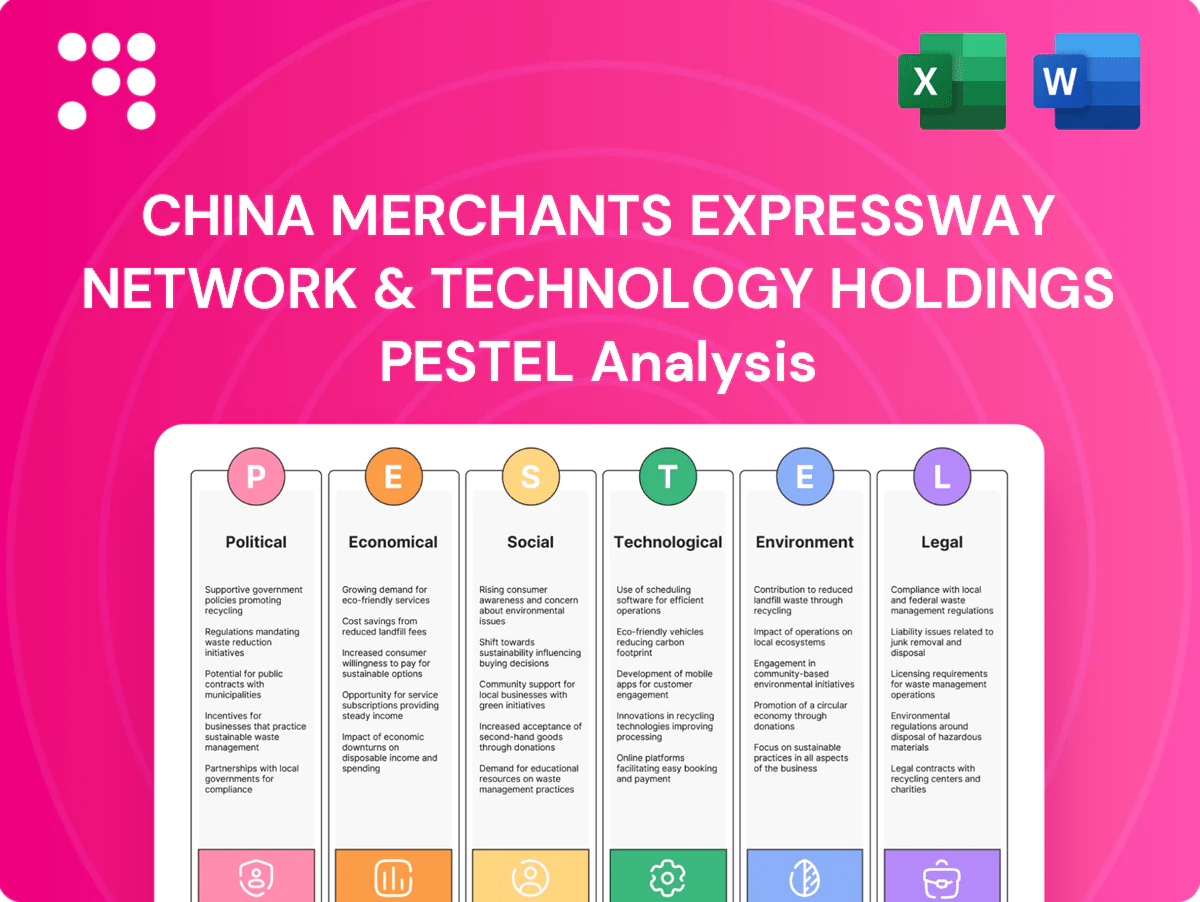
China Merchants Expressway Network & Technology Holdings PESTLE Analysis

Your Competitive Advantage Starts with This Report
Our PESTLE Analysis for China Merchants Expressway Network & Technology Holdings reveals how political oversight, macroeconomic cycles, regulatory shifts, technological innovation and environmental mandates converge to shape growth and risk exposure. Actionable insights identify strategic opportunities and vulnerabilities. Purchase the full report to access the complete, editable analysis and data-driven recommendations.
Political factors

Central transport policy and five-year plans
Central transport policy under the 14th Five-Year Plan (2021–25) prioritizes expressway maintenance, smart transport upgrades and integrated logistics while China’s expressway network stood at about 161,000 km at end-2022, guiding China Merchants Expressway’s project pipeline and capex. Policy alignment eases approvals and access to central-local funding channels and PPP models. A shift under the 15th FYP toward rail/public transit could reallocate funding away from toll roads, so continuous policy monitoring is essential for proactive capex planning.
Toll reform and concession governance
Ongoing toll reforms in China standardize toll collection, with national ETC penetration surpassing 90% by end-2023 per Ministry of Transport, and tighter concession renewal rules evolving since 2021. Changes in toll rate-setting and contract terms directly affect revenue visibility for China Merchants Expressway Network & Technology Holdings, as clearer frameworks lower renegotiation risk but may cap pricing flexibility; robust stakeholder engagement can secure favorable extensions.

SOE ecosystem and state capital oversight
As an SOE-affiliated operator, China Merchants Expressway must align with SASAC guidance—SASAC directly supervises 97 central enterprises—so state-capital efficiency goals can ease access to strategic assets while raising performance scrutiny. Policy-driven M&A and asset swaps have accelerated portfolio reshaping across SOEs, increasing the need for clear governance discipline. Strong board controls are critical to retain policy support and capital flows.

Regional coordination and local government finance
Provincial priorities and fiscal health — with China issuing about RMB 3.9 trillion in local government special bonds in 2023 and a comparable quota in 2024 — shape expressway project pipelines and payment timeliness; fiscally strained provinces postpone payments. Local debt reforms and deleveraging are altering PPP structures and slowing new concessions. Coordinated cross‑province planning boosts network connectivity and active government relations mitigate approval bottlenecks.
- Provincial fiscal pressure: affects payment cadence
- RMB 3.9 trillion: 2023 special bonds
- Debt reform: alters PPP timelines
- Coordinated planning: optimizes links
- Govt relations: speeds approvals
Geopolitics and Belt & Road exposure
Overseas expansion via Belt and Road (BRI), which covers about 149 countries and involves cumulative Chinese investment near USD 1 trillion, can diversify China Merchants Expressway Network & Technology Holdings revenue but raises political risk; sanctions and export controls (notably 2022–24 tech restrictions) can disrupt financing and supply chains, so rigorous country-risk due diligence is essential and co-financing with multilateral partners lowers sovereign risk.
- BRI footprint: ~149 countries
- Cumulative investment: ≈ USD 1 trillion
- Risk: 2022–24 tech export controls impact supply chains
- Mitigation: multilateral partners (AIIB/World Bank) reduce sovereign risk
14th FYP steers expressway upkeep, >90% ETC penetration and RMB 3.9tn local bonds
Central transport policy under the 14th FYP (2021–25) prioritizes expressway upkeep and smart upgrades, guiding CME’s capex amid a 161,000 km national network (end‑2022). ETC penetration exceeded 90% by end‑2023, affecting revenue flows. SASAC supervision of 97 central SOEs raises performance scrutiny; RMB 3.9tn local special bonds (2023) shape provincial project funding and PPP timelines.
| Metric | Value |
|---|---|
| National expressway | ≈161,000 km (2022) |
| ETC penetration | >90% (end‑2023) |
| Local special bonds | RMB 3.9tn (2023) |
| SASAC scope | 97 central SOEs |
What is included in the product
 Detailed Word Document
Explores how external macro-environmental factors uniquely affect China Merchants Expressway Network & Technology Holdings across Political, Economic, Social, Technological, Environmental and Legal dimensions, with data-driven subpoints and forward-looking insights.
Designed for executives, investors and strategists to identify risks, opportunities and actionable scenarios for planning, financing and operational resilience.

 Customizable Excel Spreadsheet
A concise, visually segmented PESTLE summary of China Merchants Expressway Network & Technology Holdings that clarifies regulatory, economic, social, technological, environmental and legal risks to support external-risk and market-positioning discussions during planning sessions; easily dropped into presentations or shared across teams for quick alignment.
Economic factors

GDP growth and traffic elasticity
Expressway volumes closely track industrial output and household consumption; China GDP grew 5.2% in 2024 (NBS), underpinning higher traffic and toll take. Freight rebounds have historically amplified toll revenues while manufacturing slowdowns compress demand; elasticity differs by corridor and competing rail/sea modes. Scenario planning using IMF 2025 GDP guidance of 4.6% helps calibrate revenue forecasts and stress tests.
Interest rates and capital structure
Debt-heavy infrastructure models at China Merchants Expressway are highly sensitive to China's benchmark LPR (1-year 3.45%, 5-year 3.65% as of 2024/2025) and widening credit spreads, which raise refinancing costs and compress project IRRs. Rate cycles have pushed average refinancing yields for Chinese infrastructure firms up by ~50–150bps in tightening phases, lowering IRRs on long-term toll and PPP assets. Proactive liability management — swapping floating for fixed coupons or extending maturities — can lock in lower funding costs, while issuing green and project bonds taps ESG investors and broadens demand.

Inflation and input costs
Material and labor inflation raised maintenance and expansion capex for China Merchants Expressway Network, with steel and asphalt input costs up about 6–9% in 2024 while average labor costs rose ~5% year-on-year; indexation clauses in ~60% of long-term construction and O&M contracts partially offset cost pressure. Persistent inflation risks compressing margins where provincial toll caps limit tariff adjustments. Efficiency programs and bulk procurement reduced unit costs by an estimated 3–4% in 2024.

Logistics cycles and e-commerce
E-commerce and manufacturing shifts drive heavy‑vehicle traffic patterns, with parcel volumes exceeding 100 billion annually (2023–24) pushing HGV peak flows on key corridors. Supply‑chain relocations to Southeast Asia and inland hubs are rerouting flows across regional expressways, increasing variability. Peak‑period congestion often rises 20–30% versus off‑peak, prompting dynamic pricing or targeted capacity expansions; aligning terminals with major logistics hubs can boost corridor throughput materially.
- e‑commerce scale: over 100 billion parcels (2023–24)
- peak HGV surge: +20–30%
- supply‑chain rerouting: ASEAN/inland hub shifts
- mitigation: dynamic pricing, corridor expansions, hub alignment
FX and overseas earnings
FX and overseas earnings expose China Merchants Expressway Network & Technology to translation and transaction risks; dividend repatriation and USD- or EUR-denominated debt servicing can be squeezed by currency moves. Natural hedges from offsetting cash flows and formal hedging programs have historically limited P&L swings, while project-level ring-fencing confines FX losses to individual SPVs, protecting the core portfolio. China’s FX reserves were about $3.1 trillion at end-2024, supporting macro liquidity.
- Translation vs transaction risk
- Dividend repatriation and debt service pressure
- Natural hedges + hedging programs reduce volatility
- Project ring-fencing limits contagion
14th FYP steers expressway upkeep, >90% ETC penetration and RMB 3.9tn local bonds
Expressway volumes track China GDP (5.2% in 2024); use IMF 2025 GDP 4.6% for revenue scenarios. Debt sensitivity is high: 1yr LPR 3.45%, 5yr LPR 3.65%; refinancing spreads can add ~50–150bps. Input inflation raised costs in 2024 (steel/asphalt +6–9%, labor +5%); ~60% of contracts have indexation.
| Metric | Value |
|---|---|
| GDP 2024 | 5.2% |
| IMF 2025 | 4.6% |
| LPR (1/5yr) | 3.45% / 3.65% |
| FX reserves | $3.1tn |
Preview the Actual Deliverable
China Merchants Expressway Network & Technology Holdings PESTLE Analysis
The preview shown here is the exact China Merchants Expressway Network & Technology Holdings PESTLE Analysis you’ll receive after purchase—fully formatted and ready to use. This is the real, final file with no placeholders or teasers and the content and structure match what’s downloadable after payment. We’re showing the actual product; you’ll get this identical document instantly upon checkout.

Your Competitive Advantage Starts with This Report
Our PESTLE Analysis for China Merchants Expressway Network & Technology Holdings reveals how political oversight, macroeconomic cycles, regulatory shifts, technological innovation and environmental mandates converge to shape growth and risk exposure. Actionable insights identify strategic opportunities and vulnerabilities. Purchase the full report to access the complete, editable analysis and data-driven recommendations.
Political factors
Central transport policy and five-year plans
Central transport policy under the 14th Five-Year Plan (2021–25) prioritizes expressway maintenance, smart transport upgrades and integrated logistics while China’s expressway network stood at about 161,000 km at end-2022, guiding China Merchants Expressway’s project pipeline and capex. Policy alignment eases approvals and access to central-local funding channels and PPP models. A shift under the 15th FYP toward rail/public transit could reallocate funding away from toll roads, so continuous policy monitoring is essential for proactive capex planning.
Toll reform and concession governance
Ongoing toll reforms in China standardize toll collection, with national ETC penetration surpassing 90% by end-2023 per Ministry of Transport, and tighter concession renewal rules evolving since 2021. Changes in toll rate-setting and contract terms directly affect revenue visibility for China Merchants Expressway Network & Technology Holdings, as clearer frameworks lower renegotiation risk but may cap pricing flexibility; robust stakeholder engagement can secure favorable extensions.
SOE ecosystem and state capital oversight
As an SOE-affiliated operator, China Merchants Expressway must align with SASAC guidance—SASAC directly supervises 97 central enterprises—so state-capital efficiency goals can ease access to strategic assets while raising performance scrutiny. Policy-driven M&A and asset swaps have accelerated portfolio reshaping across SOEs, increasing the need for clear governance discipline. Strong board controls are critical to retain policy support and capital flows.
Regional coordination and local government finance
Provincial priorities and fiscal health — with China issuing about RMB 3.9 trillion in local government special bonds in 2023 and a comparable quota in 2024 — shape expressway project pipelines and payment timeliness; fiscally strained provinces postpone payments. Local debt reforms and deleveraging are altering PPP structures and slowing new concessions. Coordinated cross‑province planning boosts network connectivity and active government relations mitigate approval bottlenecks.
- Provincial fiscal pressure: affects payment cadence
- RMB 3.9 trillion: 2023 special bonds
- Debt reform: alters PPP timelines
- Coordinated planning: optimizes links
- Govt relations: speeds approvals
Geopolitics and Belt & Road exposure
Overseas expansion via Belt and Road (BRI), which covers about 149 countries and involves cumulative Chinese investment near USD 1 trillion, can diversify China Merchants Expressway Network & Technology Holdings revenue but raises political risk; sanctions and export controls (notably 2022–24 tech restrictions) can disrupt financing and supply chains, so rigorous country-risk due diligence is essential and co-financing with multilateral partners lowers sovereign risk.
- BRI footprint: ~149 countries
- Cumulative investment: ≈ USD 1 trillion
- Risk: 2022–24 tech export controls impact supply chains
- Mitigation: multilateral partners (AIIB/World Bank) reduce sovereign risk
14th FYP steers expressway upkeep, >90% ETC penetration and RMB 3.9tn local bonds
Central transport policy under the 14th FYP (2021–25) prioritizes expressway upkeep and smart upgrades, guiding CME’s capex amid a 161,000 km national network (end‑2022). ETC penetration exceeded 90% by end‑2023, affecting revenue flows. SASAC supervision of 97 central SOEs raises performance scrutiny; RMB 3.9tn local special bonds (2023) shape provincial project funding and PPP timelines.
| Metric | Value |
|---|---|
| National expressway | ≈161,000 km (2022) |
| ETC penetration | >90% (end‑2023) |
| Local special bonds | RMB 3.9tn (2023) |
| SASAC scope | 97 central SOEs |
What is included in the product
Detailed Word Document
Explores how external macro-environmental factors uniquely affect China Merchants Expressway Network & Technology Holdings across Political, Economic, Social, Technological, Environmental and Legal dimensions, with data-driven subpoints and forward-looking insights.
Designed for executives, investors and strategists to identify risks, opportunities and actionable scenarios for planning, financing and operational resilience.
Customizable Excel Spreadsheet
A concise, visually segmented PESTLE summary of China Merchants Expressway Network & Technology Holdings that clarifies regulatory, economic, social, technological, environmental and legal risks to support external-risk and market-positioning discussions during planning sessions; easily dropped into presentations or shared across teams for quick alignment.
Economic factors
GDP growth and traffic elasticity
Expressway volumes closely track industrial output and household consumption; China GDP grew 5.2% in 2024 (NBS), underpinning higher traffic and toll take. Freight rebounds have historically amplified toll revenues while manufacturing slowdowns compress demand; elasticity differs by corridor and competing rail/sea modes. Scenario planning using IMF 2025 GDP guidance of 4.6% helps calibrate revenue forecasts and stress tests.
Interest rates and capital structure
Debt-heavy infrastructure models at China Merchants Expressway are highly sensitive to China's benchmark LPR (1-year 3.45%, 5-year 3.65% as of 2024/2025) and widening credit spreads, which raise refinancing costs and compress project IRRs. Rate cycles have pushed average refinancing yields for Chinese infrastructure firms up by ~50–150bps in tightening phases, lowering IRRs on long-term toll and PPP assets. Proactive liability management — swapping floating for fixed coupons or extending maturities — can lock in lower funding costs, while issuing green and project bonds taps ESG investors and broadens demand.
Inflation and input costs
Material and labor inflation raised maintenance and expansion capex for China Merchants Expressway Network, with steel and asphalt input costs up about 6–9% in 2024 while average labor costs rose ~5% year-on-year; indexation clauses in ~60% of long-term construction and O&M contracts partially offset cost pressure. Persistent inflation risks compressing margins where provincial toll caps limit tariff adjustments. Efficiency programs and bulk procurement reduced unit costs by an estimated 3–4% in 2024.
Logistics cycles and e-commerce
E-commerce and manufacturing shifts drive heavy‑vehicle traffic patterns, with parcel volumes exceeding 100 billion annually (2023–24) pushing HGV peak flows on key corridors. Supply‑chain relocations to Southeast Asia and inland hubs are rerouting flows across regional expressways, increasing variability. Peak‑period congestion often rises 20–30% versus off‑peak, prompting dynamic pricing or targeted capacity expansions; aligning terminals with major logistics hubs can boost corridor throughput materially.
- e‑commerce scale: over 100 billion parcels (2023–24)
- peak HGV surge: +20–30%
- supply‑chain rerouting: ASEAN/inland hub shifts
- mitigation: dynamic pricing, corridor expansions, hub alignment
FX and overseas earnings
FX and overseas earnings expose China Merchants Expressway Network & Technology to translation and transaction risks; dividend repatriation and USD- or EUR-denominated debt servicing can be squeezed by currency moves. Natural hedges from offsetting cash flows and formal hedging programs have historically limited P&L swings, while project-level ring-fencing confines FX losses to individual SPVs, protecting the core portfolio. China’s FX reserves were about $3.1 trillion at end-2024, supporting macro liquidity.
- Translation vs transaction risk
- Dividend repatriation and debt service pressure
- Natural hedges + hedging programs reduce volatility
- Project ring-fencing limits contagion
14th FYP steers expressway upkeep, >90% ETC penetration and RMB 3.9tn local bonds
Expressway volumes track China GDP (5.2% in 2024); use IMF 2025 GDP 4.6% for revenue scenarios. Debt sensitivity is high: 1yr LPR 3.45%, 5yr LPR 3.65%; refinancing spreads can add ~50–150bps. Input inflation raised costs in 2024 (steel/asphalt +6–9%, labor +5%); ~60% of contracts have indexation.
| Metric | Value |
|---|---|
| GDP 2024 | 5.2% |
| IMF 2025 | 4.6% |
| LPR (1/5yr) | 3.45% / 3.65% |
| FX reserves | $3.1tn |
Preview the Actual Deliverable
China Merchants Expressway Network & Technology Holdings PESTLE Analysis
The preview shown here is the exact China Merchants Expressway Network & Technology Holdings PESTLE Analysis you’ll receive after purchase—fully formatted and ready to use. This is the real, final file with no placeholders or teasers and the content and structure match what’s downloadable after payment. We’re showing the actual product; you’ll get this identical document instantly upon checkout.
Original: $10.00
-65%$10.00
$3.50Description
Your Competitive Advantage Starts with This Report
Our PESTLE Analysis for China Merchants Expressway Network & Technology Holdings reveals how political oversight, macroeconomic cycles, regulatory shifts, technological innovation and environmental mandates converge to shape growth and risk exposure. Actionable insights identify strategic opportunities and vulnerabilities. Purchase the full report to access the complete, editable analysis and data-driven recommendations.
Political factors
Central transport policy and five-year plans
Central transport policy under the 14th Five-Year Plan (2021–25) prioritizes expressway maintenance, smart transport upgrades and integrated logistics while China’s expressway network stood at about 161,000 km at end-2022, guiding China Merchants Expressway’s project pipeline and capex. Policy alignment eases approvals and access to central-local funding channels and PPP models. A shift under the 15th FYP toward rail/public transit could reallocate funding away from toll roads, so continuous policy monitoring is essential for proactive capex planning.
Toll reform and concession governance
Ongoing toll reforms in China standardize toll collection, with national ETC penetration surpassing 90% by end-2023 per Ministry of Transport, and tighter concession renewal rules evolving since 2021. Changes in toll rate-setting and contract terms directly affect revenue visibility for China Merchants Expressway Network & Technology Holdings, as clearer frameworks lower renegotiation risk but may cap pricing flexibility; robust stakeholder engagement can secure favorable extensions.
SOE ecosystem and state capital oversight
As an SOE-affiliated operator, China Merchants Expressway must align with SASAC guidance—SASAC directly supervises 97 central enterprises—so state-capital efficiency goals can ease access to strategic assets while raising performance scrutiny. Policy-driven M&A and asset swaps have accelerated portfolio reshaping across SOEs, increasing the need for clear governance discipline. Strong board controls are critical to retain policy support and capital flows.
Regional coordination and local government finance
Provincial priorities and fiscal health — with China issuing about RMB 3.9 trillion in local government special bonds in 2023 and a comparable quota in 2024 — shape expressway project pipelines and payment timeliness; fiscally strained provinces postpone payments. Local debt reforms and deleveraging are altering PPP structures and slowing new concessions. Coordinated cross‑province planning boosts network connectivity and active government relations mitigate approval bottlenecks.
- Provincial fiscal pressure: affects payment cadence
- RMB 3.9 trillion: 2023 special bonds
- Debt reform: alters PPP timelines
- Coordinated planning: optimizes links
- Govt relations: speeds approvals
Geopolitics and Belt & Road exposure
Overseas expansion via Belt and Road (BRI), which covers about 149 countries and involves cumulative Chinese investment near USD 1 trillion, can diversify China Merchants Expressway Network & Technology Holdings revenue but raises political risk; sanctions and export controls (notably 2022–24 tech restrictions) can disrupt financing and supply chains, so rigorous country-risk due diligence is essential and co-financing with multilateral partners lowers sovereign risk.
- BRI footprint: ~149 countries
- Cumulative investment: ≈ USD 1 trillion
- Risk: 2022–24 tech export controls impact supply chains
- Mitigation: multilateral partners (AIIB/World Bank) reduce sovereign risk
14th FYP steers expressway upkeep, >90% ETC penetration and RMB 3.9tn local bonds
Central transport policy under the 14th FYP (2021–25) prioritizes expressway upkeep and smart upgrades, guiding CME’s capex amid a 161,000 km national network (end‑2022). ETC penetration exceeded 90% by end‑2023, affecting revenue flows. SASAC supervision of 97 central SOEs raises performance scrutiny; RMB 3.9tn local special bonds (2023) shape provincial project funding and PPP timelines.
| Metric | Value |
|---|---|
| National expressway | ≈161,000 km (2022) |
| ETC penetration | >90% (end‑2023) |
| Local special bonds | RMB 3.9tn (2023) |
| SASAC scope | 97 central SOEs |
What is included in the product
Detailed Word Document
Explores how external macro-environmental factors uniquely affect China Merchants Expressway Network & Technology Holdings across Political, Economic, Social, Technological, Environmental and Legal dimensions, with data-driven subpoints and forward-looking insights.
Designed for executives, investors and strategists to identify risks, opportunities and actionable scenarios for planning, financing and operational resilience.
Customizable Excel Spreadsheet
A concise, visually segmented PESTLE summary of China Merchants Expressway Network & Technology Holdings that clarifies regulatory, economic, social, technological, environmental and legal risks to support external-risk and market-positioning discussions during planning sessions; easily dropped into presentations or shared across teams for quick alignment.
Economic factors
GDP growth and traffic elasticity
Expressway volumes closely track industrial output and household consumption; China GDP grew 5.2% in 2024 (NBS), underpinning higher traffic and toll take. Freight rebounds have historically amplified toll revenues while manufacturing slowdowns compress demand; elasticity differs by corridor and competing rail/sea modes. Scenario planning using IMF 2025 GDP guidance of 4.6% helps calibrate revenue forecasts and stress tests.
Interest rates and capital structure
Debt-heavy infrastructure models at China Merchants Expressway are highly sensitive to China's benchmark LPR (1-year 3.45%, 5-year 3.65% as of 2024/2025) and widening credit spreads, which raise refinancing costs and compress project IRRs. Rate cycles have pushed average refinancing yields for Chinese infrastructure firms up by ~50–150bps in tightening phases, lowering IRRs on long-term toll and PPP assets. Proactive liability management — swapping floating for fixed coupons or extending maturities — can lock in lower funding costs, while issuing green and project bonds taps ESG investors and broadens demand.
Inflation and input costs
Material and labor inflation raised maintenance and expansion capex for China Merchants Expressway Network, with steel and asphalt input costs up about 6–9% in 2024 while average labor costs rose ~5% year-on-year; indexation clauses in ~60% of long-term construction and O&M contracts partially offset cost pressure. Persistent inflation risks compressing margins where provincial toll caps limit tariff adjustments. Efficiency programs and bulk procurement reduced unit costs by an estimated 3–4% in 2024.
Logistics cycles and e-commerce
E-commerce and manufacturing shifts drive heavy‑vehicle traffic patterns, with parcel volumes exceeding 100 billion annually (2023–24) pushing HGV peak flows on key corridors. Supply‑chain relocations to Southeast Asia and inland hubs are rerouting flows across regional expressways, increasing variability. Peak‑period congestion often rises 20–30% versus off‑peak, prompting dynamic pricing or targeted capacity expansions; aligning terminals with major logistics hubs can boost corridor throughput materially.
- e‑commerce scale: over 100 billion parcels (2023–24)
- peak HGV surge: +20–30%
- supply‑chain rerouting: ASEAN/inland hub shifts
- mitigation: dynamic pricing, corridor expansions, hub alignment
FX and overseas earnings
FX and overseas earnings expose China Merchants Expressway Network & Technology to translation and transaction risks; dividend repatriation and USD- or EUR-denominated debt servicing can be squeezed by currency moves. Natural hedges from offsetting cash flows and formal hedging programs have historically limited P&L swings, while project-level ring-fencing confines FX losses to individual SPVs, protecting the core portfolio. China’s FX reserves were about $3.1 trillion at end-2024, supporting macro liquidity.
- Translation vs transaction risk
- Dividend repatriation and debt service pressure
- Natural hedges + hedging programs reduce volatility
- Project ring-fencing limits contagion
14th FYP steers expressway upkeep, >90% ETC penetration and RMB 3.9tn local bonds
Expressway volumes track China GDP (5.2% in 2024); use IMF 2025 GDP 4.6% for revenue scenarios. Debt sensitivity is high: 1yr LPR 3.45%, 5yr LPR 3.65%; refinancing spreads can add ~50–150bps. Input inflation raised costs in 2024 (steel/asphalt +6–9%, labor +5%); ~60% of contracts have indexation.
| Metric | Value |
|---|---|
| GDP 2024 | 5.2% |
| IMF 2025 | 4.6% |
| LPR (1/5yr) | 3.45% / 3.65% |
| FX reserves | $3.1tn |
Preview the Actual Deliverable
China Merchants Expressway Network & Technology Holdings PESTLE Analysis
The preview shown here is the exact China Merchants Expressway Network & Technology Holdings PESTLE Analysis you’ll receive after purchase—fully formatted and ready to use. This is the real, final file with no placeholders or teasers and the content and structure match what’s downloadable after payment. We’re showing the actual product; you’ll get this identical document instantly upon checkout.











