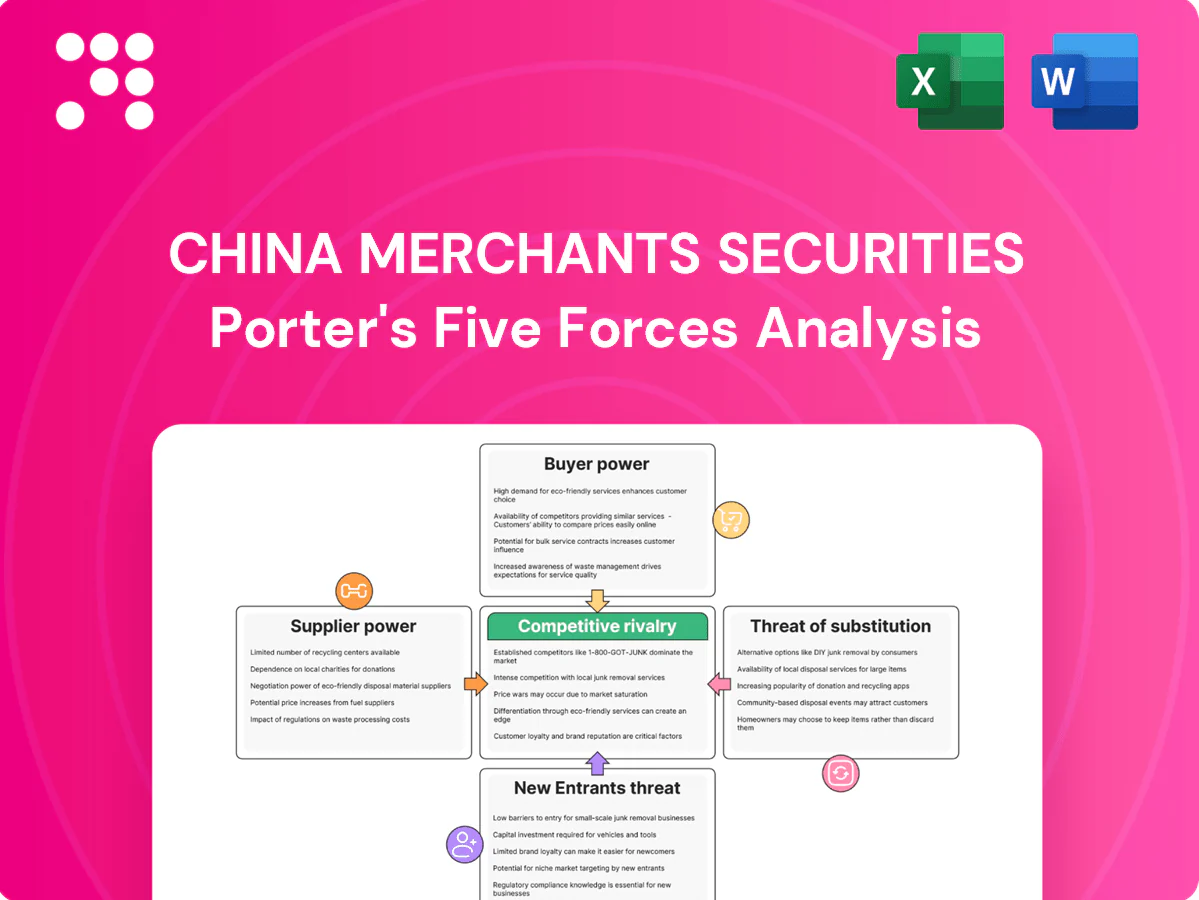
China Merchants Securities Porter's Five Forces Analysis

Elevate Your Analysis with the Complete Porter's Five Forces Analysis
China Merchants Securities faces moderate rivalry, strong regulatory pressure, and rising digital disruption that reshape client relationships and margin structures; supplier and buyer power vary across brokerage, asset management, and investment banking lines. This brief snapshot only scratches the surface—unlock the full Porter's Five Forces Analysis to explore force-by-force ratings, strategic implications, and actionable insights for investment or strategy.
Suppliers Bargaining Power

Exchange and clearing dependence
China Merchants Securities depends on state-run exchanges—Shanghai, Shenzhen and Hong Kong—and on central clearing via China Securities Depository and Clearing Corporation for onshore trades, concentrating market access and post-trade services. Fee schedules and operational standards are standardized by regulators, limiting CMS’s leverage. Any change to trading rules or fee rates by these bodies can compress margins immediately. Concentration of these infrastructures keeps supplier power moderate to high.
Licensed talent scarcity
Experienced investment bankers, research analysts and quant engineers are scarce and highly mobile, allowing top talent to extract premium compensation and better front-end splits. Compensation cycles spike with deal flow and market booms, pushing input costs for China Merchants Securities higher. Star teams negotiate larger upfront budgets, elevating supplier power in high-skill segments.

Market data and tech vendors
Proprietary trading systems at China Merchants Securities still depend on market data, connectivity and external risk engines from dominant providers like Bloomberg and Refinitiv, giving vendors take‑it‑or‑leave‑it pricing and bundled contracts. Switching costs—latency differences in microseconds, systems integration and months of compliance testing—raise barriers. High vendor concentration therefore amplifies pricing power versus CMS.

Funding and liquidity sources
Repo markets, prime brokerage lines and interbank funding determine China Merchants Securities’ cost of capital for margin lending and market making; tightening cycles lift funding spreads and compress NIMs, with the 1‑year LPR at 3.55% in 2024 reflecting persistently low policy rates that still leave short‑term liquidity swings impactful. Collateral haircuts and eligibility rules are supplier‑set and spike in stress, raising effective funding costs and supplier power.
- Repo sensitivity: higher spreads in tight cycles
- Prime lines: counterparty terms shift funding cost
- Haircuts: supplier‑driven, rise in stress
Upstream product pipelines
Access to quality IPOs, bond issuances and structured products depends heavily on issuers and SOE/local‑government platforms; competitive mandates in 2024 forced brokers to concede on fees and allocations, increasing supplier leverage. Strong issuer relationships mitigate but do not eliminate this power, which spikes in hot‑deal periods when high‑quality assets are scarce.
- 2024: issuer control central to deal flow
- Competitive mandates → fee and allocation concessions
- Hot markets amplify supplier bargaining power
Supplier power tight: 3 exchanges + CSDC, dominant vendors and LPR 1yr 3.55% squeeze margins
Supplier power is moderate‑to‑high: market access/clearing concentrated in 3 state exchanges and CSDC, limiting negotiation. Talent scarcity and vendor concentration (Bloomberg/Refinitiv dependence) push costs up. Funding sensitivity is material with 1‑yr LPR at 3.55% in 2024. Issuer control in hot‑deal periods forces fee concessions, raising supplier leverage.
| Factor | 2024 metric | Impact |
|---|---|---|
| Exchanges/Clearing | 3 exchanges + CSDC | High |
| Funding rate | LPR 1yr 3.55% | Material |
| Market data vendors | Dominant providers | Elevated |
What is included in the product
 Detailed Word Document
Uncovers key drivers of competition, customer influence, and market entry risks tailored to China Merchants Securities; evaluates bargaining power of suppliers and buyers, threat of substitutes, competitive rivalry, and barriers protecting incumbents while highlighting disruptive trends and strategic vulnerabilities for investors and management.

 Customizable Excel Spreadsheet
Tailored Porter's Five Forces analysis for China Merchants Securities that distills competitive pressures into a one-sheet snapshot, clarifying threats and opportunities for fast decisions. Easy to customize, copy into decks or integrate with dashboards to remove ambiguity and speed strategic action.
Customers Bargaining Power

Retail fee sensitivity
Online trading has commoditized brokerage commissions: with over 200 million retail securities accounts in China by 2023, price transparency and zero‑minimum apps have pushed execution fees toward floors. Retail clients multihome easily across platforms, raising their bargaining power in brokerage services, though their influence remains lower in fee‑protective advisory mandates.
Institutional mandate leverage
Mutual funds, insurers and QFIs exert strong institutional mandate leverage at China Merchants Securities, negotiating block rates and prioritized research access; top institutional clients represent the bulk of flow and can reallocate rapidly based on execution quality and financing terms. Commission sharing arrangements and algo execution performance face intense scrutiny, with institutions demanding tight slippage and transparent fees. Institutional buyer power is concentrated, disciplined and decisive in routing flow.

Corporate issuer optionality
Corporate clients shop IPO, bond and M&A mandates aggressively, with onshore bond issuance surpassing RMB 10 trillion in 2024, fueling competition among brokers and global banks. League-table pressure compressed underwriting spreads below historical averages and increased demands for balance-sheet support. Repeat issuers—especially top SOEs—extract better fees and faster execution. Bargaining power rises sharply with issuer credit quality and scarcity of headline deals.

Wealth clients demand breadth
Wealth clients demand multi-asset products, private placements and offshore channels, bargaining for lower advisory fees in return for AUM concentration; Hurun 2024 reports roughly 2.1 million Chinese HNW households, intensifying competition for their flows. Performance transparency and digital reporting accelerate reallocation, so buyer power is moderate-to-high and tightly linked to product shelf depth at brokers like China Merchants Securities.
- Product breadth: multi-asset/private/offshore
- Fee leverage: lower fees for concentrated AUM
- Mobility: rapid reallocation via transparency
- Bargaining power: moderate–high, tied to shelf depth
Low switching costs digitally
Streamlined digital account opening and e-KYC cut onboarding friction for China Merchants Securities, enabling sub-10-minute openings and lifting retention pressure; in 2024 China had about 1.07 billion mobile internet users, increasing mobile-first switching. Aggressive incentives and rate promotions across brokers drive churn, while data portability and app UX determine retention, amplifying buyer power among retail and SME clients.
- e-KYC speed: sub-10-minute onboarding
- Market context: 1.07 billion mobile users (2024)
- Key risks: promotions-driven churn; UX and data portability decisive
Moderate-high customer leverage: 200m retail, 1.07bn mobile, RMB10tn bonds
Customer bargaining power at China Merchants Securities is moderate–high: over 200m retail accounts (2023) and 1.07bn mobile users (2024) drive fee compression and churn. Institutional clients control bulk flow and demand tight slippage; onshore bond issuance >RMB10tn (2024) intensifies underwriting competition. 2.1m HNW households (Hurun 2024) raise product negotiation for concentrated AUM.
| Metric | Figure | Implication |
|---|---|---|
| Retail accounts | 200m (2023) | Price sensitive |
| Mobile users | 1.07bn (2024) | High churn |
| Onshore bonds | RMB10tn+ (2024) | Underwriting pressure |
| HNW households | 2.1m (2024) | Fee leverage |
What You See Is What You Get
China Merchants Securities Porter's Five Forces Analysis
This preview displays the exact China Merchants Securities Porter's Five Forces analysis you'll receive—comprehensive, fully formatted, and ready for immediate use. It includes industry rivalry, supplier and buyer power, threats of entry and substitution, and strategic implications. No placeholders, no mockups—what you see is the final deliverable.

Elevate Your Analysis with the Complete Porter's Five Forces Analysis
China Merchants Securities faces moderate rivalry, strong regulatory pressure, and rising digital disruption that reshape client relationships and margin structures; supplier and buyer power vary across brokerage, asset management, and investment banking lines. This brief snapshot only scratches the surface—unlock the full Porter's Five Forces Analysis to explore force-by-force ratings, strategic implications, and actionable insights for investment or strategy.
Suppliers Bargaining Power
Exchange and clearing dependence
China Merchants Securities depends on state-run exchanges—Shanghai, Shenzhen and Hong Kong—and on central clearing via China Securities Depository and Clearing Corporation for onshore trades, concentrating market access and post-trade services. Fee schedules and operational standards are standardized by regulators, limiting CMS’s leverage. Any change to trading rules or fee rates by these bodies can compress margins immediately. Concentration of these infrastructures keeps supplier power moderate to high.
Licensed talent scarcity
Experienced investment bankers, research analysts and quant engineers are scarce and highly mobile, allowing top talent to extract premium compensation and better front-end splits. Compensation cycles spike with deal flow and market booms, pushing input costs for China Merchants Securities higher. Star teams negotiate larger upfront budgets, elevating supplier power in high-skill segments.
Market data and tech vendors
Proprietary trading systems at China Merchants Securities still depend on market data, connectivity and external risk engines from dominant providers like Bloomberg and Refinitiv, giving vendors take‑it‑or‑leave‑it pricing and bundled contracts. Switching costs—latency differences in microseconds, systems integration and months of compliance testing—raise barriers. High vendor concentration therefore amplifies pricing power versus CMS.
Funding and liquidity sources
Repo markets, prime brokerage lines and interbank funding determine China Merchants Securities’ cost of capital for margin lending and market making; tightening cycles lift funding spreads and compress NIMs, with the 1‑year LPR at 3.55% in 2024 reflecting persistently low policy rates that still leave short‑term liquidity swings impactful. Collateral haircuts and eligibility rules are supplier‑set and spike in stress, raising effective funding costs and supplier power.
- Repo sensitivity: higher spreads in tight cycles
- Prime lines: counterparty terms shift funding cost
- Haircuts: supplier‑driven, rise in stress
Upstream product pipelines
Access to quality IPOs, bond issuances and structured products depends heavily on issuers and SOE/local‑government platforms; competitive mandates in 2024 forced brokers to concede on fees and allocations, increasing supplier leverage. Strong issuer relationships mitigate but do not eliminate this power, which spikes in hot‑deal periods when high‑quality assets are scarce.
- 2024: issuer control central to deal flow
- Competitive mandates → fee and allocation concessions
- Hot markets amplify supplier bargaining power
Supplier power tight: 3 exchanges + CSDC, dominant vendors and LPR 1yr 3.55% squeeze margins
Supplier power is moderate‑to‑high: market access/clearing concentrated in 3 state exchanges and CSDC, limiting negotiation. Talent scarcity and vendor concentration (Bloomberg/Refinitiv dependence) push costs up. Funding sensitivity is material with 1‑yr LPR at 3.55% in 2024. Issuer control in hot‑deal periods forces fee concessions, raising supplier leverage.
| Factor | 2024 metric | Impact |
|---|---|---|
| Exchanges/Clearing | 3 exchanges + CSDC | High |
| Funding rate | LPR 1yr 3.55% | Material |
| Market data vendors | Dominant providers | Elevated |
What is included in the product
Detailed Word Document
Uncovers key drivers of competition, customer influence, and market entry risks tailored to China Merchants Securities; evaluates bargaining power of suppliers and buyers, threat of substitutes, competitive rivalry, and barriers protecting incumbents while highlighting disruptive trends and strategic vulnerabilities for investors and management.
Customizable Excel Spreadsheet
Tailored Porter's Five Forces analysis for China Merchants Securities that distills competitive pressures into a one-sheet snapshot, clarifying threats and opportunities for fast decisions. Easy to customize, copy into decks or integrate with dashboards to remove ambiguity and speed strategic action.
Customers Bargaining Power
Retail fee sensitivity
Online trading has commoditized brokerage commissions: with over 200 million retail securities accounts in China by 2023, price transparency and zero‑minimum apps have pushed execution fees toward floors. Retail clients multihome easily across platforms, raising their bargaining power in brokerage services, though their influence remains lower in fee‑protective advisory mandates.
Institutional mandate leverage
Mutual funds, insurers and QFIs exert strong institutional mandate leverage at China Merchants Securities, negotiating block rates and prioritized research access; top institutional clients represent the bulk of flow and can reallocate rapidly based on execution quality and financing terms. Commission sharing arrangements and algo execution performance face intense scrutiny, with institutions demanding tight slippage and transparent fees. Institutional buyer power is concentrated, disciplined and decisive in routing flow.
Corporate issuer optionality
Corporate clients shop IPO, bond and M&A mandates aggressively, with onshore bond issuance surpassing RMB 10 trillion in 2024, fueling competition among brokers and global banks. League-table pressure compressed underwriting spreads below historical averages and increased demands for balance-sheet support. Repeat issuers—especially top SOEs—extract better fees and faster execution. Bargaining power rises sharply with issuer credit quality and scarcity of headline deals.
Wealth clients demand breadth
Wealth clients demand multi-asset products, private placements and offshore channels, bargaining for lower advisory fees in return for AUM concentration; Hurun 2024 reports roughly 2.1 million Chinese HNW households, intensifying competition for their flows. Performance transparency and digital reporting accelerate reallocation, so buyer power is moderate-to-high and tightly linked to product shelf depth at brokers like China Merchants Securities.
- Product breadth: multi-asset/private/offshore
- Fee leverage: lower fees for concentrated AUM
- Mobility: rapid reallocation via transparency
- Bargaining power: moderate–high, tied to shelf depth
Low switching costs digitally
Streamlined digital account opening and e-KYC cut onboarding friction for China Merchants Securities, enabling sub-10-minute openings and lifting retention pressure; in 2024 China had about 1.07 billion mobile internet users, increasing mobile-first switching. Aggressive incentives and rate promotions across brokers drive churn, while data portability and app UX determine retention, amplifying buyer power among retail and SME clients.
- e-KYC speed: sub-10-minute onboarding
- Market context: 1.07 billion mobile users (2024)
- Key risks: promotions-driven churn; UX and data portability decisive
Moderate-high customer leverage: 200m retail, 1.07bn mobile, RMB10tn bonds
Customer bargaining power at China Merchants Securities is moderate–high: over 200m retail accounts (2023) and 1.07bn mobile users (2024) drive fee compression and churn. Institutional clients control bulk flow and demand tight slippage; onshore bond issuance >RMB10tn (2024) intensifies underwriting competition. 2.1m HNW households (Hurun 2024) raise product negotiation for concentrated AUM.
| Metric | Figure | Implication |
|---|---|---|
| Retail accounts | 200m (2023) | Price sensitive |
| Mobile users | 1.07bn (2024) | High churn |
| Onshore bonds | RMB10tn+ (2024) | Underwriting pressure |
| HNW households | 2.1m (2024) | Fee leverage |
What You See Is What You Get
China Merchants Securities Porter's Five Forces Analysis
This preview displays the exact China Merchants Securities Porter's Five Forces analysis you'll receive—comprehensive, fully formatted, and ready for immediate use. It includes industry rivalry, supplier and buyer power, threats of entry and substitution, and strategic implications. No placeholders, no mockups—what you see is the final deliverable.
Description
Elevate Your Analysis with the Complete Porter's Five Forces Analysis
China Merchants Securities faces moderate rivalry, strong regulatory pressure, and rising digital disruption that reshape client relationships and margin structures; supplier and buyer power vary across brokerage, asset management, and investment banking lines. This brief snapshot only scratches the surface—unlock the full Porter's Five Forces Analysis to explore force-by-force ratings, strategic implications, and actionable insights for investment or strategy.
Suppliers Bargaining Power
Exchange and clearing dependence
China Merchants Securities depends on state-run exchanges—Shanghai, Shenzhen and Hong Kong—and on central clearing via China Securities Depository and Clearing Corporation for onshore trades, concentrating market access and post-trade services. Fee schedules and operational standards are standardized by regulators, limiting CMS’s leverage. Any change to trading rules or fee rates by these bodies can compress margins immediately. Concentration of these infrastructures keeps supplier power moderate to high.
Licensed talent scarcity
Experienced investment bankers, research analysts and quant engineers are scarce and highly mobile, allowing top talent to extract premium compensation and better front-end splits. Compensation cycles spike with deal flow and market booms, pushing input costs for China Merchants Securities higher. Star teams negotiate larger upfront budgets, elevating supplier power in high-skill segments.
Market data and tech vendors
Proprietary trading systems at China Merchants Securities still depend on market data, connectivity and external risk engines from dominant providers like Bloomberg and Refinitiv, giving vendors take‑it‑or‑leave‑it pricing and bundled contracts. Switching costs—latency differences in microseconds, systems integration and months of compliance testing—raise barriers. High vendor concentration therefore amplifies pricing power versus CMS.
Funding and liquidity sources
Repo markets, prime brokerage lines and interbank funding determine China Merchants Securities’ cost of capital for margin lending and market making; tightening cycles lift funding spreads and compress NIMs, with the 1‑year LPR at 3.55% in 2024 reflecting persistently low policy rates that still leave short‑term liquidity swings impactful. Collateral haircuts and eligibility rules are supplier‑set and spike in stress, raising effective funding costs and supplier power.
- Repo sensitivity: higher spreads in tight cycles
- Prime lines: counterparty terms shift funding cost
- Haircuts: supplier‑driven, rise in stress
Upstream product pipelines
Access to quality IPOs, bond issuances and structured products depends heavily on issuers and SOE/local‑government platforms; competitive mandates in 2024 forced brokers to concede on fees and allocations, increasing supplier leverage. Strong issuer relationships mitigate but do not eliminate this power, which spikes in hot‑deal periods when high‑quality assets are scarce.
- 2024: issuer control central to deal flow
- Competitive mandates → fee and allocation concessions
- Hot markets amplify supplier bargaining power
Supplier power tight: 3 exchanges + CSDC, dominant vendors and LPR 1yr 3.55% squeeze margins
Supplier power is moderate‑to‑high: market access/clearing concentrated in 3 state exchanges and CSDC, limiting negotiation. Talent scarcity and vendor concentration (Bloomberg/Refinitiv dependence) push costs up. Funding sensitivity is material with 1‑yr LPR at 3.55% in 2024. Issuer control in hot‑deal periods forces fee concessions, raising supplier leverage.
| Factor | 2024 metric | Impact |
|---|---|---|
| Exchanges/Clearing | 3 exchanges + CSDC | High |
| Funding rate | LPR 1yr 3.55% | Material |
| Market data vendors | Dominant providers | Elevated |
What is included in the product
Detailed Word Document
Uncovers key drivers of competition, customer influence, and market entry risks tailored to China Merchants Securities; evaluates bargaining power of suppliers and buyers, threat of substitutes, competitive rivalry, and barriers protecting incumbents while highlighting disruptive trends and strategic vulnerabilities for investors and management.
Customizable Excel Spreadsheet
Tailored Porter's Five Forces analysis for China Merchants Securities that distills competitive pressures into a one-sheet snapshot, clarifying threats and opportunities for fast decisions. Easy to customize, copy into decks or integrate with dashboards to remove ambiguity and speed strategic action.
Customers Bargaining Power
Retail fee sensitivity
Online trading has commoditized brokerage commissions: with over 200 million retail securities accounts in China by 2023, price transparency and zero‑minimum apps have pushed execution fees toward floors. Retail clients multihome easily across platforms, raising their bargaining power in brokerage services, though their influence remains lower in fee‑protective advisory mandates.
Institutional mandate leverage
Mutual funds, insurers and QFIs exert strong institutional mandate leverage at China Merchants Securities, negotiating block rates and prioritized research access; top institutional clients represent the bulk of flow and can reallocate rapidly based on execution quality and financing terms. Commission sharing arrangements and algo execution performance face intense scrutiny, with institutions demanding tight slippage and transparent fees. Institutional buyer power is concentrated, disciplined and decisive in routing flow.
Corporate issuer optionality
Corporate clients shop IPO, bond and M&A mandates aggressively, with onshore bond issuance surpassing RMB 10 trillion in 2024, fueling competition among brokers and global banks. League-table pressure compressed underwriting spreads below historical averages and increased demands for balance-sheet support. Repeat issuers—especially top SOEs—extract better fees and faster execution. Bargaining power rises sharply with issuer credit quality and scarcity of headline deals.
Wealth clients demand breadth
Wealth clients demand multi-asset products, private placements and offshore channels, bargaining for lower advisory fees in return for AUM concentration; Hurun 2024 reports roughly 2.1 million Chinese HNW households, intensifying competition for their flows. Performance transparency and digital reporting accelerate reallocation, so buyer power is moderate-to-high and tightly linked to product shelf depth at brokers like China Merchants Securities.
- Product breadth: multi-asset/private/offshore
- Fee leverage: lower fees for concentrated AUM
- Mobility: rapid reallocation via transparency
- Bargaining power: moderate–high, tied to shelf depth
Low switching costs digitally
Streamlined digital account opening and e-KYC cut onboarding friction for China Merchants Securities, enabling sub-10-minute openings and lifting retention pressure; in 2024 China had about 1.07 billion mobile internet users, increasing mobile-first switching. Aggressive incentives and rate promotions across brokers drive churn, while data portability and app UX determine retention, amplifying buyer power among retail and SME clients.
- e-KYC speed: sub-10-minute onboarding
- Market context: 1.07 billion mobile users (2024)
- Key risks: promotions-driven churn; UX and data portability decisive
Moderate-high customer leverage: 200m retail, 1.07bn mobile, RMB10tn bonds
Customer bargaining power at China Merchants Securities is moderate–high: over 200m retail accounts (2023) and 1.07bn mobile users (2024) drive fee compression and churn. Institutional clients control bulk flow and demand tight slippage; onshore bond issuance >RMB10tn (2024) intensifies underwriting competition. 2.1m HNW households (Hurun 2024) raise product negotiation for concentrated AUM.
| Metric | Figure | Implication |
|---|---|---|
| Retail accounts | 200m (2023) | Price sensitive |
| Mobile users | 1.07bn (2024) | High churn |
| Onshore bonds | RMB10tn+ (2024) | Underwriting pressure |
| HNW households | 2.1m (2024) | Fee leverage |
What You See Is What You Get
China Merchants Securities Porter's Five Forces Analysis
This preview displays the exact China Merchants Securities Porter's Five Forces analysis you'll receive—comprehensive, fully formatted, and ready for immediate use. It includes industry rivalry, supplier and buyer power, threats of entry and substitution, and strategic implications. No placeholders, no mockups—what you see is the final deliverable.











