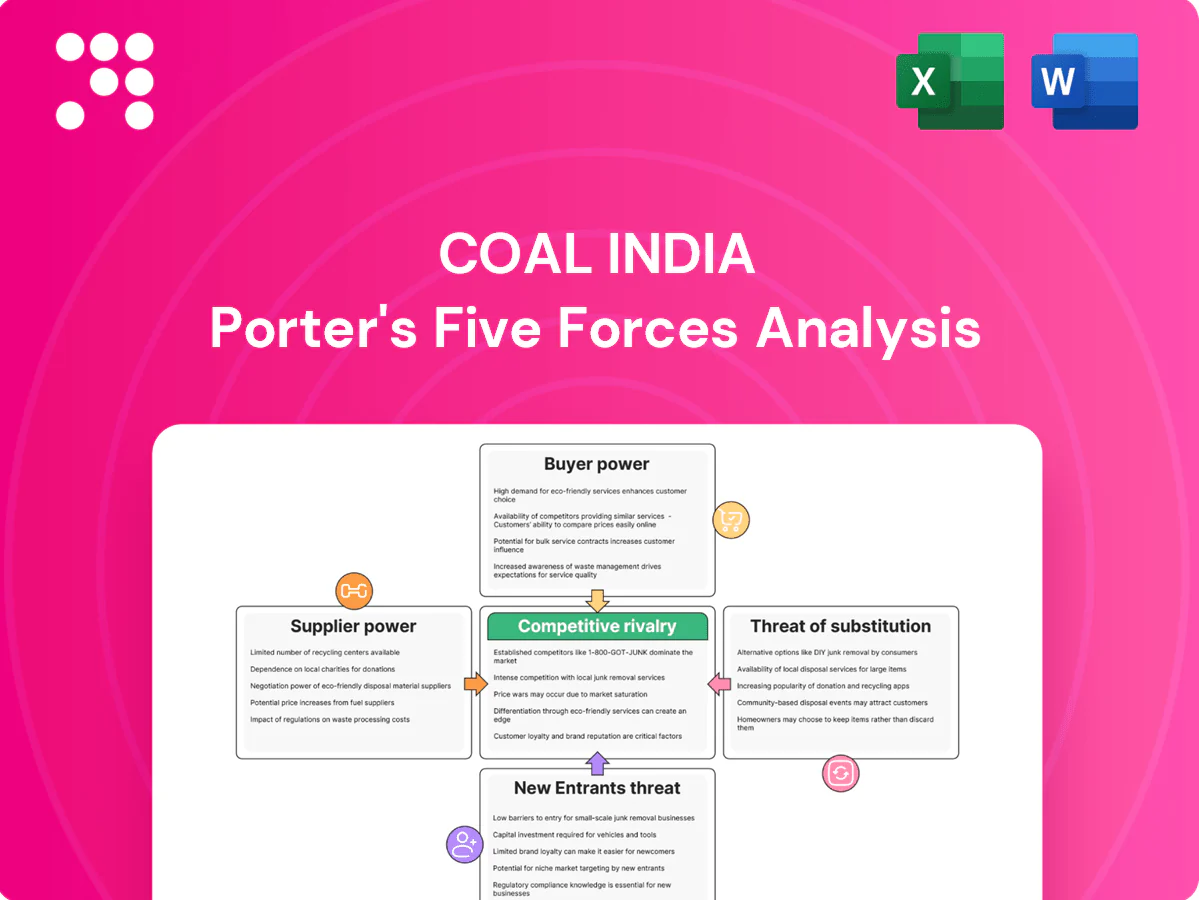
Coal India Porter's Five Forces Analysis

Don't Miss the Bigger Picture
Coal India faces moderated buyer power, high supplier/regulatory constraints, low threat of substitutes but significant operational and new-entrant barriers; rivalry is intense among state-linked miners. This snapshot highlights key pressures and strategic levers for management and investors. The full Porter's Five Forces Analysis reveals force-by-force ratings, visuals, and actionable recommendations. Unlock the detailed report to inform investment or strategic decisions.
Suppliers Bargaining Power

Scale lets CIL dictate terms
As the world’s largest coal producer with over 600 million tonnes of annual output, Coal India’s volume purchases give it leverage over equipment, explosives and service vendors. Bulk procurement and standardized specifications reduce unit costs and switching frictions, enabling lower per-unit pricing. Suppliers routinely accept Coal India’s payment and contract terms to access predictable, high-volume demand, which dampens individual supplier bargaining power.
Rail evacuation is a bottleneck
Indian Railways handles roughly 70% of India's coal movement as of 2024, concentrating evacuation power and making rail the de facto logistics gatekeeper for Coal India. Limited rakes and corridor capacity frequently constrain offtake, elevating detention, transshipment and stock-holding costs. Reliance on a single network increases exposure to changes in freight tariffs and prioritisation, giving logistics suppliers situational leverage despite CIL’s scale.

Regulated inputs and permits
Explosives licensing, land acquisition and environmental clearances function as quasi-suppliers for Coal India, with regulatory bottlenecks capable of slowing production and raising costs; Coal India supplies roughly 80 percent of India’s domestic coal. Administrative gatekeepers hold high bargaining power, and compliance calendars directly shape mine sequencing and operational flexibility, squeezing margins when approvals lag.

Fuel and energy cost exposure
Diesel, power and steel inputs are highly price-volatile and tied to global commodity markets, and sudden spikes directly raise stripping and hauling costs in opencast operations; CIL can use forward contracts and long-term procurement but cannot fully neutralize commodity swings.
Input volatility intermittently increases supplier bargaining power by compressing margins and forcing short-term cost pass-through or production adjustments.
- Diesel, power, steel: externally driven volatility raises input costs
- Opencast mines: stripping and hauling costs sensitive to fuel spikes
- Hedging reduces but does not eliminate exposure
- Volatility periodically strengthens supplier leverage
Service contractors’ localized clout
Service contractors handling overburden removal, MDOs and specialized maintenance firms gain localized clout in Coal India pits where site geology and equipment compatibility limit quick substitution; with coal still supplying about 70% of India’s power in 2023–24, regional labor availability and industrial-relations constraints further tighten switching options, creating pocketed supplier bargaining power.
- Overburden & MDO dependence
- Geology-driven switching costs
- Labor & IR constraints
- Localized high bargaining power
Scale lowers unit costs; rail moves 70% of coal, raising supplier leverage
As the world’s largest coal producer (≈600 MTpa), Coal India’s scale forces favorable terms with equipment and service vendors, lowering unit costs. However Indian Railways moves ≈70% of coal, giving logistics suppliers situational leverage. Regulatory approvals and volatile inputs (diesel, steel) intermittently raise supplier bargaining power.
| Supplier | Metric | Net impact |
|---|---|---|
| Equipment & services | Volume: ≈600 MTpa | Low |
| Rail logistics | Evacuation: ≈70% | High |
| Regulatory/inputs | CIL ≈80% domestic supply; diesel/steel volatile | Medium–High |
What is included in the product
 Detailed Word Document
Provides a Coal India–specific Porter’s Five Forces assessment identifying competitive intensity, supplier and buyer power, threat of substitutes and new entrants, and strategic levers to protect market share and pricing.

 Customizable Excel Spreadsheet
A concise one-sheet Porter's Five Forces for Coal India that visualizes competitive pressure with a radar chart and customizable scores—ideal for quick board decisions. No complex setup; swap in market data or scenario tabs to relieve analysis bottlenecks and drop directly into decks.
Customers Bargaining Power

Few large utility buyers
NTPC, state gencos and major utilities form a concentrated demand base for Coal India, with the power sector taking about 80% of CIL offtake in 2023–24 and NTPC the single largest buyer. Their scale lets buyers negotiate grades, delivery schedules and penalties. Long-term FSAs reduce price volatility but impose strict service obligations. This concentration increases buyer leverage on service and quality terms.
Regulatory pass-through cushions
Tariff structures with fuel-cost pass-through (used in many 2024 PPA and regulatory orders) mean utilities can recover coal price swings, reducing buyers’ urgency to push for steep discounts during tight markets. With coal supplying around 70% of India’s electricity, pass-through moderates buyer pressure but regulators closely scrutinize quality, linkage efficiency and FCA computations. Pass-through softens but does not erase customer bargaining power.

E-auctions and imports as options
E-auctions give buyers short-term flexibility while imported coal and the Newcastle price act as a clear price and calorific-value benchmark; with Coal India supplying roughly 80% of domestic output, buyers can shift marginal volumes to imports in tight supply, raising bargaining leverage, but port congestion, freight and forex volatility limit full substitution, so options mainly boost buyer power at the margin.

Quality and grade sensitivity
Consistency in GCV, ash and sizing directly affects plant efficiency; buyers—mainly power utilities that take about 70% of domestic coal—push for tighter specs and financial compensation for slippages, while sampling disputes and limited washery capacity recur as friction points, reinforcing buyers’ leverage on contract enforcement.
- GCV/ash/sizing affect boiler heat rate
- Buyers demand penalties for slippages
- Sampling disputes frequent
- Washery scarcity limits corrective supply
Decarbonization pressure on demand
Utilities face rising renewable obligations and emissions scrutiny that, against India’s net-zero by 2070 pledge, erode coal’s demand-growth narrative and force tougher contract terms; yet near-term baseload requirements keep buyers tethered to Coal India. Transition dynamics and policy-driven procurement give buyers growing strategic leverage over price, tenure and quality clauses.
- Coal India supplies about 80% of India’s domestic coal
- India net-zero target: 2070
- Near-term baseload demand sustains buyer engagement
Power buyers hold ~80% of domestic coal offtake; imports set marginal price
Power utilities bought ~80% of Coal India offtake in 2023–24, with NTPC the single largest buyer, giving large buyers leverage on grades, delivery and penalties. Widespread 2024 PPA fuel-cost pass-through reduces urgency for steep discounts but keeps pressure on quality and FCA calculations. Imports/Newcastle set marginal price benchmarks, so buyers can shift limited volumes, increasing bargaining power at the margin.
| Metric | Value | Note |
|---|---|---|
| Power sector share | ~80% | 2023–24 offtake |
| Coal India domestic share | ~80% | Domestic output |
| PPAs | Fuel-cost pass-through | Common in 2024 |
Same Document Delivered
Coal India Porter's Five Forces Analysis
This preview shows the Coal India Porter’s Five Forces Analysis and is the exact document you'll receive after purchase. It contains a full assessment of competitive rivalry, supplier and buyer power, threat of substitutes and barriers to entry with clear strategic implications. No placeholders or samples—fully formatted and ready for immediate download and use.

Don't Miss the Bigger Picture
Coal India faces moderated buyer power, high supplier/regulatory constraints, low threat of substitutes but significant operational and new-entrant barriers; rivalry is intense among state-linked miners. This snapshot highlights key pressures and strategic levers for management and investors. The full Porter's Five Forces Analysis reveals force-by-force ratings, visuals, and actionable recommendations. Unlock the detailed report to inform investment or strategic decisions.
Suppliers Bargaining Power
Scale lets CIL dictate terms
As the world’s largest coal producer with over 600 million tonnes of annual output, Coal India’s volume purchases give it leverage over equipment, explosives and service vendors. Bulk procurement and standardized specifications reduce unit costs and switching frictions, enabling lower per-unit pricing. Suppliers routinely accept Coal India’s payment and contract terms to access predictable, high-volume demand, which dampens individual supplier bargaining power.
Rail evacuation is a bottleneck
Indian Railways handles roughly 70% of India's coal movement as of 2024, concentrating evacuation power and making rail the de facto logistics gatekeeper for Coal India. Limited rakes and corridor capacity frequently constrain offtake, elevating detention, transshipment and stock-holding costs. Reliance on a single network increases exposure to changes in freight tariffs and prioritisation, giving logistics suppliers situational leverage despite CIL’s scale.
Regulated inputs and permits
Explosives licensing, land acquisition and environmental clearances function as quasi-suppliers for Coal India, with regulatory bottlenecks capable of slowing production and raising costs; Coal India supplies roughly 80 percent of India’s domestic coal. Administrative gatekeepers hold high bargaining power, and compliance calendars directly shape mine sequencing and operational flexibility, squeezing margins when approvals lag.
Fuel and energy cost exposure
Diesel, power and steel inputs are highly price-volatile and tied to global commodity markets, and sudden spikes directly raise stripping and hauling costs in opencast operations; CIL can use forward contracts and long-term procurement but cannot fully neutralize commodity swings.
Input volatility intermittently increases supplier bargaining power by compressing margins and forcing short-term cost pass-through or production adjustments.
- Diesel, power, steel: externally driven volatility raises input costs
- Opencast mines: stripping and hauling costs sensitive to fuel spikes
- Hedging reduces but does not eliminate exposure
- Volatility periodically strengthens supplier leverage
Service contractors’ localized clout
Service contractors handling overburden removal, MDOs and specialized maintenance firms gain localized clout in Coal India pits where site geology and equipment compatibility limit quick substitution; with coal still supplying about 70% of India’s power in 2023–24, regional labor availability and industrial-relations constraints further tighten switching options, creating pocketed supplier bargaining power.
- Overburden & MDO dependence
- Geology-driven switching costs
- Labor & IR constraints
- Localized high bargaining power
Scale lowers unit costs; rail moves 70% of coal, raising supplier leverage
As the world’s largest coal producer (≈600 MTpa), Coal India’s scale forces favorable terms with equipment and service vendors, lowering unit costs. However Indian Railways moves ≈70% of coal, giving logistics suppliers situational leverage. Regulatory approvals and volatile inputs (diesel, steel) intermittently raise supplier bargaining power.
| Supplier | Metric | Net impact |
|---|---|---|
| Equipment & services | Volume: ≈600 MTpa | Low |
| Rail logistics | Evacuation: ≈70% | High |
| Regulatory/inputs | CIL ≈80% domestic supply; diesel/steel volatile | Medium–High |
What is included in the product
Detailed Word Document
Provides a Coal India–specific Porter’s Five Forces assessment identifying competitive intensity, supplier and buyer power, threat of substitutes and new entrants, and strategic levers to protect market share and pricing.
Customizable Excel Spreadsheet
A concise one-sheet Porter's Five Forces for Coal India that visualizes competitive pressure with a radar chart and customizable scores—ideal for quick board decisions. No complex setup; swap in market data or scenario tabs to relieve analysis bottlenecks and drop directly into decks.
Customers Bargaining Power
Few large utility buyers
NTPC, state gencos and major utilities form a concentrated demand base for Coal India, with the power sector taking about 80% of CIL offtake in 2023–24 and NTPC the single largest buyer. Their scale lets buyers negotiate grades, delivery schedules and penalties. Long-term FSAs reduce price volatility but impose strict service obligations. This concentration increases buyer leverage on service and quality terms.
Regulatory pass-through cushions
Tariff structures with fuel-cost pass-through (used in many 2024 PPA and regulatory orders) mean utilities can recover coal price swings, reducing buyers’ urgency to push for steep discounts during tight markets. With coal supplying around 70% of India’s electricity, pass-through moderates buyer pressure but regulators closely scrutinize quality, linkage efficiency and FCA computations. Pass-through softens but does not erase customer bargaining power.
E-auctions and imports as options
E-auctions give buyers short-term flexibility while imported coal and the Newcastle price act as a clear price and calorific-value benchmark; with Coal India supplying roughly 80% of domestic output, buyers can shift marginal volumes to imports in tight supply, raising bargaining leverage, but port congestion, freight and forex volatility limit full substitution, so options mainly boost buyer power at the margin.
Quality and grade sensitivity
Consistency in GCV, ash and sizing directly affects plant efficiency; buyers—mainly power utilities that take about 70% of domestic coal—push for tighter specs and financial compensation for slippages, while sampling disputes and limited washery capacity recur as friction points, reinforcing buyers’ leverage on contract enforcement.
- GCV/ash/sizing affect boiler heat rate
- Buyers demand penalties for slippages
- Sampling disputes frequent
- Washery scarcity limits corrective supply
Decarbonization pressure on demand
Utilities face rising renewable obligations and emissions scrutiny that, against India’s net-zero by 2070 pledge, erode coal’s demand-growth narrative and force tougher contract terms; yet near-term baseload requirements keep buyers tethered to Coal India. Transition dynamics and policy-driven procurement give buyers growing strategic leverage over price, tenure and quality clauses.
- Coal India supplies about 80% of India’s domestic coal
- India net-zero target: 2070
- Near-term baseload demand sustains buyer engagement
Power buyers hold ~80% of domestic coal offtake; imports set marginal price
Power utilities bought ~80% of Coal India offtake in 2023–24, with NTPC the single largest buyer, giving large buyers leverage on grades, delivery and penalties. Widespread 2024 PPA fuel-cost pass-through reduces urgency for steep discounts but keeps pressure on quality and FCA calculations. Imports/Newcastle set marginal price benchmarks, so buyers can shift limited volumes, increasing bargaining power at the margin.
| Metric | Value | Note |
|---|---|---|
| Power sector share | ~80% | 2023–24 offtake |
| Coal India domestic share | ~80% | Domestic output |
| PPAs | Fuel-cost pass-through | Common in 2024 |
Same Document Delivered
Coal India Porter's Five Forces Analysis
This preview shows the Coal India Porter’s Five Forces Analysis and is the exact document you'll receive after purchase. It contains a full assessment of competitive rivalry, supplier and buyer power, threat of substitutes and barriers to entry with clear strategic implications. No placeholders or samples—fully formatted and ready for immediate download and use.
Description
Don't Miss the Bigger Picture
Coal India faces moderated buyer power, high supplier/regulatory constraints, low threat of substitutes but significant operational and new-entrant barriers; rivalry is intense among state-linked miners. This snapshot highlights key pressures and strategic levers for management and investors. The full Porter's Five Forces Analysis reveals force-by-force ratings, visuals, and actionable recommendations. Unlock the detailed report to inform investment or strategic decisions.
Suppliers Bargaining Power
Scale lets CIL dictate terms
As the world’s largest coal producer with over 600 million tonnes of annual output, Coal India’s volume purchases give it leverage over equipment, explosives and service vendors. Bulk procurement and standardized specifications reduce unit costs and switching frictions, enabling lower per-unit pricing. Suppliers routinely accept Coal India’s payment and contract terms to access predictable, high-volume demand, which dampens individual supplier bargaining power.
Rail evacuation is a bottleneck
Indian Railways handles roughly 70% of India's coal movement as of 2024, concentrating evacuation power and making rail the de facto logistics gatekeeper for Coal India. Limited rakes and corridor capacity frequently constrain offtake, elevating detention, transshipment and stock-holding costs. Reliance on a single network increases exposure to changes in freight tariffs and prioritisation, giving logistics suppliers situational leverage despite CIL’s scale.
Regulated inputs and permits
Explosives licensing, land acquisition and environmental clearances function as quasi-suppliers for Coal India, with regulatory bottlenecks capable of slowing production and raising costs; Coal India supplies roughly 80 percent of India’s domestic coal. Administrative gatekeepers hold high bargaining power, and compliance calendars directly shape mine sequencing and operational flexibility, squeezing margins when approvals lag.
Fuel and energy cost exposure
Diesel, power and steel inputs are highly price-volatile and tied to global commodity markets, and sudden spikes directly raise stripping and hauling costs in opencast operations; CIL can use forward contracts and long-term procurement but cannot fully neutralize commodity swings.
Input volatility intermittently increases supplier bargaining power by compressing margins and forcing short-term cost pass-through or production adjustments.
- Diesel, power, steel: externally driven volatility raises input costs
- Opencast mines: stripping and hauling costs sensitive to fuel spikes
- Hedging reduces but does not eliminate exposure
- Volatility periodically strengthens supplier leverage
Service contractors’ localized clout
Service contractors handling overburden removal, MDOs and specialized maintenance firms gain localized clout in Coal India pits where site geology and equipment compatibility limit quick substitution; with coal still supplying about 70% of India’s power in 2023–24, regional labor availability and industrial-relations constraints further tighten switching options, creating pocketed supplier bargaining power.
- Overburden & MDO dependence
- Geology-driven switching costs
- Labor & IR constraints
- Localized high bargaining power
Scale lowers unit costs; rail moves 70% of coal, raising supplier leverage
As the world’s largest coal producer (≈600 MTpa), Coal India’s scale forces favorable terms with equipment and service vendors, lowering unit costs. However Indian Railways moves ≈70% of coal, giving logistics suppliers situational leverage. Regulatory approvals and volatile inputs (diesel, steel) intermittently raise supplier bargaining power.
| Supplier | Metric | Net impact |
|---|---|---|
| Equipment & services | Volume: ≈600 MTpa | Low |
| Rail logistics | Evacuation: ≈70% | High |
| Regulatory/inputs | CIL ≈80% domestic supply; diesel/steel volatile | Medium–High |
What is included in the product
Detailed Word Document
Provides a Coal India–specific Porter’s Five Forces assessment identifying competitive intensity, supplier and buyer power, threat of substitutes and new entrants, and strategic levers to protect market share and pricing.
Customizable Excel Spreadsheet
A concise one-sheet Porter's Five Forces for Coal India that visualizes competitive pressure with a radar chart and customizable scores—ideal for quick board decisions. No complex setup; swap in market data or scenario tabs to relieve analysis bottlenecks and drop directly into decks.
Customers Bargaining Power
Few large utility buyers
NTPC, state gencos and major utilities form a concentrated demand base for Coal India, with the power sector taking about 80% of CIL offtake in 2023–24 and NTPC the single largest buyer. Their scale lets buyers negotiate grades, delivery schedules and penalties. Long-term FSAs reduce price volatility but impose strict service obligations. This concentration increases buyer leverage on service and quality terms.
Regulatory pass-through cushions
Tariff structures with fuel-cost pass-through (used in many 2024 PPA and regulatory orders) mean utilities can recover coal price swings, reducing buyers’ urgency to push for steep discounts during tight markets. With coal supplying around 70% of India’s electricity, pass-through moderates buyer pressure but regulators closely scrutinize quality, linkage efficiency and FCA computations. Pass-through softens but does not erase customer bargaining power.
E-auctions and imports as options
E-auctions give buyers short-term flexibility while imported coal and the Newcastle price act as a clear price and calorific-value benchmark; with Coal India supplying roughly 80% of domestic output, buyers can shift marginal volumes to imports in tight supply, raising bargaining leverage, but port congestion, freight and forex volatility limit full substitution, so options mainly boost buyer power at the margin.
Quality and grade sensitivity
Consistency in GCV, ash and sizing directly affects plant efficiency; buyers—mainly power utilities that take about 70% of domestic coal—push for tighter specs and financial compensation for slippages, while sampling disputes and limited washery capacity recur as friction points, reinforcing buyers’ leverage on contract enforcement.
- GCV/ash/sizing affect boiler heat rate
- Buyers demand penalties for slippages
- Sampling disputes frequent
- Washery scarcity limits corrective supply
Decarbonization pressure on demand
Utilities face rising renewable obligations and emissions scrutiny that, against India’s net-zero by 2070 pledge, erode coal’s demand-growth narrative and force tougher contract terms; yet near-term baseload requirements keep buyers tethered to Coal India. Transition dynamics and policy-driven procurement give buyers growing strategic leverage over price, tenure and quality clauses.
- Coal India supplies about 80% of India’s domestic coal
- India net-zero target: 2070
- Near-term baseload demand sustains buyer engagement
Power buyers hold ~80% of domestic coal offtake; imports set marginal price
Power utilities bought ~80% of Coal India offtake in 2023–24, with NTPC the single largest buyer, giving large buyers leverage on grades, delivery and penalties. Widespread 2024 PPA fuel-cost pass-through reduces urgency for steep discounts but keeps pressure on quality and FCA calculations. Imports/Newcastle set marginal price benchmarks, so buyers can shift limited volumes, increasing bargaining power at the margin.
| Metric | Value | Note |
|---|---|---|
| Power sector share | ~80% | 2023–24 offtake |
| Coal India domestic share | ~80% | Domestic output |
| PPAs | Fuel-cost pass-through | Common in 2024 |
Same Document Delivered
Coal India Porter's Five Forces Analysis
This preview shows the Coal India Porter’s Five Forces Analysis and is the exact document you'll receive after purchase. It contains a full assessment of competitive rivalry, supplier and buyer power, threat of substitutes and barriers to entry with clear strategic implications. No placeholders or samples—fully formatted and ready for immediate download and use.











