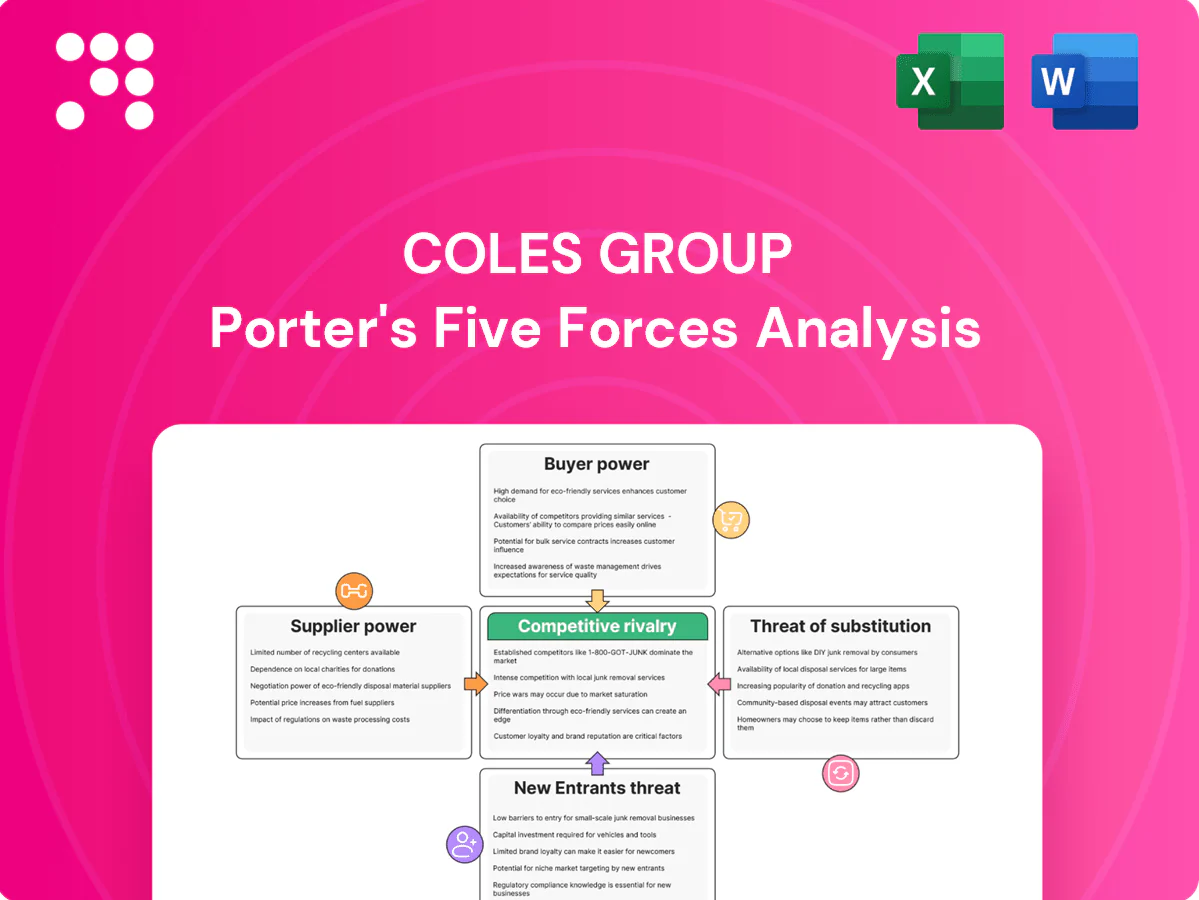
Coles Group Porter's Five Forces Analysis

Go Beyond the Preview—Access the Full Strategic Report
Coles Group operates in a highly competitive Australian grocery market where buyer price sensitivity, strong rivals, and supplier negotiations shape margins; digital retailing and private labels add substitution and threat dynamics. This snapshot highlights key pressures—unlock the full Porter's Five Forces Analysis for force-by-force ratings, visuals, and strategic recommendations to inform investment or strategy decisions.
Suppliers Bargaining Power

Concentrated retail vs fragmented growers
Coles commands roughly 28% of the Australian supermarket market in 2024, giving it strong leverage over thousands of small and mid-sized growers. Fragmented fruit, vegetable and meat producers depend on Coles’ volumes but face high switching costs and uneven seasonal supply. Seasonal variability and biosecurity incidents periodically tighten availability, and in those tight markets supplier power rises via scarcity pricing and allocation.
Powerful branded manufacturers
Global FMCG and liquor brands retain consumer pull and bargaining leverage with Coles, and in 2024 Coles held about 27% of the Australian grocery market; delisting threats are credible but risky when brands are must-stock. Negotiations focus on trade spend, promotional funding and shelf visibility, driving concentrated supplier power in categories like beverages and spirits. These dynamics create pockets of high supplier leverage despite Coles’ scale.

Private label counterweight
Coles’ growing private-label range reduces reliance on national brands and supports higher gross margins by capturing retailer margin. Multi-sourcing and expanded direct-sourcing programs in 2024 weakened single-supplier leverage for many categories. However, specialized SKUs and certain inputs still have limited substitutes, preserving supplier power in those niches. Stricter quality and ESG specs in 2024 narrowed eligible suppliers, enhancing negotiating strength for compliant partners.

Logistics, packaging, and FX exposure
Input costs tied to fuel, freight, packaging and imported commodities increased through 2024, strengthening supplier bargaining as they sought cost pass-throughs; Coles can stagger price rises but cannot avoid structural shifts in margins. Long-term contracts and FX hedging reduced volatility but did not eliminate supplier power.
- Fuel & freight inflation 2024: higher pass-through pressure
- Packaging costs: supplier leverage
- FX moves: imported inputs exposed
Regulatory and code-of-conduct dynamics
Regulatory oversight and Coles Group’s supplier code in 2024 limit hardball tactics, with ACCC scrutiny keeping major grocery players’ conduct in check; Coles held roughly 28% market share in 2024, giving suppliers leverage in niche categories. Formal dispute-resolution pathways and mediation increasingly strengthen smaller suppliers’ bargaining positions, while complex liquor licensing creates compliance advantages for specialised suppliers, modestly elevating supplier power in those segments.
Supermarket with ~28% share gains scale; branded FMCG, liquor retain supplier power
Coles’ ~28% Australian supermarket share in 2024 gives buyer scale but concentrated supplier power persists in branded FMCG, liquor and specialised SKUs where delisting is costly. Seasonal supply, biosecurity and 2024 fuel/packaging inflation tightened availability and raised scarcity pricing. Expanded private label and direct sourcing reduced supplier leverage broadly, while ACCC oversight and supplier codes limit hardball tactics.
| Metric | 2024 |
|---|---|
| Coles market share | ~28% |
| Key pressures | Fuel/packaging inflation, biosecurity |
| Supplier power pockets | Branded FMCG, liquor, specialised SKUs |
What is included in the product
 Detailed Word Document
Tailored Porter's Five Forces analysis for Coles Group, assessing competitive rivalry, buyer and supplier power, threats from new entrants and substitutes, and regulatory/disruptive pressures on margins and market share.

 Customizable Excel Spreadsheet
A one-sheet Coles Group Porter's Five Forces summary that instantly visualizes competitive pressure with a spider chart, is easy to edit (no macros), and slots straight into pitch decks or Excel dashboards—customize force levels and notes to reflect new data or regulatory shifts for rapid, board-ready decision-making.
Customers Bargaining Power

Low switching costs
Low switching costs let customers move easily to Woolworths (≈33% share), Coles (≈27%), ALDI (≈11%), Costco or IGAs; specialist stores also siphon niche spend. Online channels (online grocery ≈6% penetration in 2024) and price-comparison apps lower friction, increasing promotion hunting and price sensitivity. Coles must defend share through continual value, loyalty offers and convenience investments.
Price transparency and promos
Weekly discounts, app offers and catalogues have normalized deal-seeking among Coles shoppers, reinforcing buyer leverage; Coles held about 27% of the Australian grocery market in 2024. High price elasticity in staples amplifies this power, so Coles blends EDLP cues with tactical promotions to protect traffic. Over-promotion risks margin erosion unless compensated by favourable category mix and supplier funding.

Loyalty and data effects
Flybuys, with about 8.9 million members in 2024, personalises offers and raises stickiness, muting buyer power at the margin. Rewards remain easily replicable by Woolworths and discounters, limiting long-term defensibility. Coles uses data-driven pricing and targeted promotions to precisely capture value seekers. Net effect: customer leverage is moderated but persistent.

Omnichannel expectations
- Omni-channel parity required
- High churn from service failures
- Speed windows & substitution accuracy = table stakes
- Service intensity raises buyer negotiating power
Category optionality
Category optionality is high: liquor and financial services allow instant, broad comparison and shoppers can easily switch to independents, specialty bottle shops or fintech/bank alternatives, compressing margins in contested segments; Coles reported group revenue of AUD 39.4bn in FY24 and must bundle price, convenience and loyalty to retain buyers.
- Cross-shopping pressure: margin compression in liquor/financials
- Competitive set: independents, specialty retailers, fintechs
- FY24: Coles group revenue AUD 39.4bn
- Response: bundle value via price, convenience, Qantas/Flybuys tie-ins
Supermarket sector: price-sensitive shoppers, 6% online, 27% market share
Customers have strong bargaining power: low switching costs (Woolworths ≈33%, Coles ≈27%, ALDI ≈11%), price sensitivity driven by 6% online grocery penetration (2024) and deal-seeking behaviour; loyalty (Flybuys 8.9m) softens churn but is replicable. Omni-channel service (8m weekly customers, ~2,500 stores) and category optionality compress margins; Coles revenue AUD 39.4bn (FY24).
| Metric | 2024 |
|---|---|
| Market share | Coles 27% |
| Online penetration | 6% |
| Flybuys | 8.9m |
| Weekly customers/stores | 8m / ~2,500 |
| Revenue | AUD 39.4bn |
Full Version Awaits
Coles Group Porter's Five Forces Analysis
This preview shows the exact Coles Group Porter's Five Forces Analysis you'll receive immediately after purchase—no surprises, no placeholders. The file is fully formatted and ready for download and use the moment you buy. You're viewing the complete deliverable.

Go Beyond the Preview—Access the Full Strategic Report
Coles Group operates in a highly competitive Australian grocery market where buyer price sensitivity, strong rivals, and supplier negotiations shape margins; digital retailing and private labels add substitution and threat dynamics. This snapshot highlights key pressures—unlock the full Porter's Five Forces Analysis for force-by-force ratings, visuals, and strategic recommendations to inform investment or strategy decisions.
Suppliers Bargaining Power
Concentrated retail vs fragmented growers
Coles commands roughly 28% of the Australian supermarket market in 2024, giving it strong leverage over thousands of small and mid-sized growers. Fragmented fruit, vegetable and meat producers depend on Coles’ volumes but face high switching costs and uneven seasonal supply. Seasonal variability and biosecurity incidents periodically tighten availability, and in those tight markets supplier power rises via scarcity pricing and allocation.
Powerful branded manufacturers
Global FMCG and liquor brands retain consumer pull and bargaining leverage with Coles, and in 2024 Coles held about 27% of the Australian grocery market; delisting threats are credible but risky when brands are must-stock. Negotiations focus on trade spend, promotional funding and shelf visibility, driving concentrated supplier power in categories like beverages and spirits. These dynamics create pockets of high supplier leverage despite Coles’ scale.
Private label counterweight
Coles’ growing private-label range reduces reliance on national brands and supports higher gross margins by capturing retailer margin. Multi-sourcing and expanded direct-sourcing programs in 2024 weakened single-supplier leverage for many categories. However, specialized SKUs and certain inputs still have limited substitutes, preserving supplier power in those niches. Stricter quality and ESG specs in 2024 narrowed eligible suppliers, enhancing negotiating strength for compliant partners.
Logistics, packaging, and FX exposure
Input costs tied to fuel, freight, packaging and imported commodities increased through 2024, strengthening supplier bargaining as they sought cost pass-throughs; Coles can stagger price rises but cannot avoid structural shifts in margins. Long-term contracts and FX hedging reduced volatility but did not eliminate supplier power.
- Fuel & freight inflation 2024: higher pass-through pressure
- Packaging costs: supplier leverage
- FX moves: imported inputs exposed
Regulatory and code-of-conduct dynamics
Regulatory oversight and Coles Group’s supplier code in 2024 limit hardball tactics, with ACCC scrutiny keeping major grocery players’ conduct in check; Coles held roughly 28% market share in 2024, giving suppliers leverage in niche categories. Formal dispute-resolution pathways and mediation increasingly strengthen smaller suppliers’ bargaining positions, while complex liquor licensing creates compliance advantages for specialised suppliers, modestly elevating supplier power in those segments.
Supermarket with ~28% share gains scale; branded FMCG, liquor retain supplier power
Coles’ ~28% Australian supermarket share in 2024 gives buyer scale but concentrated supplier power persists in branded FMCG, liquor and specialised SKUs where delisting is costly. Seasonal supply, biosecurity and 2024 fuel/packaging inflation tightened availability and raised scarcity pricing. Expanded private label and direct sourcing reduced supplier leverage broadly, while ACCC oversight and supplier codes limit hardball tactics.
| Metric | 2024 |
|---|---|
| Coles market share | ~28% |
| Key pressures | Fuel/packaging inflation, biosecurity |
| Supplier power pockets | Branded FMCG, liquor, specialised SKUs |
What is included in the product
Detailed Word Document
Tailored Porter's Five Forces analysis for Coles Group, assessing competitive rivalry, buyer and supplier power, threats from new entrants and substitutes, and regulatory/disruptive pressures on margins and market share.
Customizable Excel Spreadsheet
A one-sheet Coles Group Porter's Five Forces summary that instantly visualizes competitive pressure with a spider chart, is easy to edit (no macros), and slots straight into pitch decks or Excel dashboards—customize force levels and notes to reflect new data or regulatory shifts for rapid, board-ready decision-making.
Customers Bargaining Power
Low switching costs
Low switching costs let customers move easily to Woolworths (≈33% share), Coles (≈27%), ALDI (≈11%), Costco or IGAs; specialist stores also siphon niche spend. Online channels (online grocery ≈6% penetration in 2024) and price-comparison apps lower friction, increasing promotion hunting and price sensitivity. Coles must defend share through continual value, loyalty offers and convenience investments.
Price transparency and promos
Weekly discounts, app offers and catalogues have normalized deal-seeking among Coles shoppers, reinforcing buyer leverage; Coles held about 27% of the Australian grocery market in 2024. High price elasticity in staples amplifies this power, so Coles blends EDLP cues with tactical promotions to protect traffic. Over-promotion risks margin erosion unless compensated by favourable category mix and supplier funding.
Loyalty and data effects
Flybuys, with about 8.9 million members in 2024, personalises offers and raises stickiness, muting buyer power at the margin. Rewards remain easily replicable by Woolworths and discounters, limiting long-term defensibility. Coles uses data-driven pricing and targeted promotions to precisely capture value seekers. Net effect: customer leverage is moderated but persistent.
Omnichannel expectations
- Omni-channel parity required
- High churn from service failures
- Speed windows & substitution accuracy = table stakes
- Service intensity raises buyer negotiating power
Category optionality
Category optionality is high: liquor and financial services allow instant, broad comparison and shoppers can easily switch to independents, specialty bottle shops or fintech/bank alternatives, compressing margins in contested segments; Coles reported group revenue of AUD 39.4bn in FY24 and must bundle price, convenience and loyalty to retain buyers.
- Cross-shopping pressure: margin compression in liquor/financials
- Competitive set: independents, specialty retailers, fintechs
- FY24: Coles group revenue AUD 39.4bn
- Response: bundle value via price, convenience, Qantas/Flybuys tie-ins
Supermarket sector: price-sensitive shoppers, 6% online, 27% market share
Customers have strong bargaining power: low switching costs (Woolworths ≈33%, Coles ≈27%, ALDI ≈11%), price sensitivity driven by 6% online grocery penetration (2024) and deal-seeking behaviour; loyalty (Flybuys 8.9m) softens churn but is replicable. Omni-channel service (8m weekly customers, ~2,500 stores) and category optionality compress margins; Coles revenue AUD 39.4bn (FY24).
| Metric | 2024 |
|---|---|
| Market share | Coles 27% |
| Online penetration | 6% |
| Flybuys | 8.9m |
| Weekly customers/stores | 8m / ~2,500 |
| Revenue | AUD 39.4bn |
Full Version Awaits
Coles Group Porter's Five Forces Analysis
This preview shows the exact Coles Group Porter's Five Forces Analysis you'll receive immediately after purchase—no surprises, no placeholders. The file is fully formatted and ready for download and use the moment you buy. You're viewing the complete deliverable.
Original: $10.00
-65%$10.00
$3.50Description
Go Beyond the Preview—Access the Full Strategic Report
Coles Group operates in a highly competitive Australian grocery market where buyer price sensitivity, strong rivals, and supplier negotiations shape margins; digital retailing and private labels add substitution and threat dynamics. This snapshot highlights key pressures—unlock the full Porter's Five Forces Analysis for force-by-force ratings, visuals, and strategic recommendations to inform investment or strategy decisions.
Suppliers Bargaining Power
Concentrated retail vs fragmented growers
Coles commands roughly 28% of the Australian supermarket market in 2024, giving it strong leverage over thousands of small and mid-sized growers. Fragmented fruit, vegetable and meat producers depend on Coles’ volumes but face high switching costs and uneven seasonal supply. Seasonal variability and biosecurity incidents periodically tighten availability, and in those tight markets supplier power rises via scarcity pricing and allocation.
Powerful branded manufacturers
Global FMCG and liquor brands retain consumer pull and bargaining leverage with Coles, and in 2024 Coles held about 27% of the Australian grocery market; delisting threats are credible but risky when brands are must-stock. Negotiations focus on trade spend, promotional funding and shelf visibility, driving concentrated supplier power in categories like beverages and spirits. These dynamics create pockets of high supplier leverage despite Coles’ scale.
Private label counterweight
Coles’ growing private-label range reduces reliance on national brands and supports higher gross margins by capturing retailer margin. Multi-sourcing and expanded direct-sourcing programs in 2024 weakened single-supplier leverage for many categories. However, specialized SKUs and certain inputs still have limited substitutes, preserving supplier power in those niches. Stricter quality and ESG specs in 2024 narrowed eligible suppliers, enhancing negotiating strength for compliant partners.
Logistics, packaging, and FX exposure
Input costs tied to fuel, freight, packaging and imported commodities increased through 2024, strengthening supplier bargaining as they sought cost pass-throughs; Coles can stagger price rises but cannot avoid structural shifts in margins. Long-term contracts and FX hedging reduced volatility but did not eliminate supplier power.
- Fuel & freight inflation 2024: higher pass-through pressure
- Packaging costs: supplier leverage
- FX moves: imported inputs exposed
Regulatory and code-of-conduct dynamics
Regulatory oversight and Coles Group’s supplier code in 2024 limit hardball tactics, with ACCC scrutiny keeping major grocery players’ conduct in check; Coles held roughly 28% market share in 2024, giving suppliers leverage in niche categories. Formal dispute-resolution pathways and mediation increasingly strengthen smaller suppliers’ bargaining positions, while complex liquor licensing creates compliance advantages for specialised suppliers, modestly elevating supplier power in those segments.
Supermarket with ~28% share gains scale; branded FMCG, liquor retain supplier power
Coles’ ~28% Australian supermarket share in 2024 gives buyer scale but concentrated supplier power persists in branded FMCG, liquor and specialised SKUs where delisting is costly. Seasonal supply, biosecurity and 2024 fuel/packaging inflation tightened availability and raised scarcity pricing. Expanded private label and direct sourcing reduced supplier leverage broadly, while ACCC oversight and supplier codes limit hardball tactics.
| Metric | 2024 |
|---|---|
| Coles market share | ~28% |
| Key pressures | Fuel/packaging inflation, biosecurity |
| Supplier power pockets | Branded FMCG, liquor, specialised SKUs |
What is included in the product
Detailed Word Document
Tailored Porter's Five Forces analysis for Coles Group, assessing competitive rivalry, buyer and supplier power, threats from new entrants and substitutes, and regulatory/disruptive pressures on margins and market share.
Customizable Excel Spreadsheet
A one-sheet Coles Group Porter's Five Forces summary that instantly visualizes competitive pressure with a spider chart, is easy to edit (no macros), and slots straight into pitch decks or Excel dashboards—customize force levels and notes to reflect new data or regulatory shifts for rapid, board-ready decision-making.
Customers Bargaining Power
Low switching costs
Low switching costs let customers move easily to Woolworths (≈33% share), Coles (≈27%), ALDI (≈11%), Costco or IGAs; specialist stores also siphon niche spend. Online channels (online grocery ≈6% penetration in 2024) and price-comparison apps lower friction, increasing promotion hunting and price sensitivity. Coles must defend share through continual value, loyalty offers and convenience investments.
Price transparency and promos
Weekly discounts, app offers and catalogues have normalized deal-seeking among Coles shoppers, reinforcing buyer leverage; Coles held about 27% of the Australian grocery market in 2024. High price elasticity in staples amplifies this power, so Coles blends EDLP cues with tactical promotions to protect traffic. Over-promotion risks margin erosion unless compensated by favourable category mix and supplier funding.
Loyalty and data effects
Flybuys, with about 8.9 million members in 2024, personalises offers and raises stickiness, muting buyer power at the margin. Rewards remain easily replicable by Woolworths and discounters, limiting long-term defensibility. Coles uses data-driven pricing and targeted promotions to precisely capture value seekers. Net effect: customer leverage is moderated but persistent.
Omnichannel expectations
- Omni-channel parity required
- High churn from service failures
- Speed windows & substitution accuracy = table stakes
- Service intensity raises buyer negotiating power
Category optionality
Category optionality is high: liquor and financial services allow instant, broad comparison and shoppers can easily switch to independents, specialty bottle shops or fintech/bank alternatives, compressing margins in contested segments; Coles reported group revenue of AUD 39.4bn in FY24 and must bundle price, convenience and loyalty to retain buyers.
- Cross-shopping pressure: margin compression in liquor/financials
- Competitive set: independents, specialty retailers, fintechs
- FY24: Coles group revenue AUD 39.4bn
- Response: bundle value via price, convenience, Qantas/Flybuys tie-ins
Supermarket sector: price-sensitive shoppers, 6% online, 27% market share
Customers have strong bargaining power: low switching costs (Woolworths ≈33%, Coles ≈27%, ALDI ≈11%), price sensitivity driven by 6% online grocery penetration (2024) and deal-seeking behaviour; loyalty (Flybuys 8.9m) softens churn but is replicable. Omni-channel service (8m weekly customers, ~2,500 stores) and category optionality compress margins; Coles revenue AUD 39.4bn (FY24).
| Metric | 2024 |
|---|---|
| Market share | Coles 27% |
| Online penetration | 6% |
| Flybuys | 8.9m |
| Weekly customers/stores | 8m / ~2,500 |
| Revenue | AUD 39.4bn |
Full Version Awaits
Coles Group Porter's Five Forces Analysis
This preview shows the exact Coles Group Porter's Five Forces Analysis you'll receive immediately after purchase—no surprises, no placeholders. The file is fully formatted and ready for download and use the moment you buy. You're viewing the complete deliverable.











