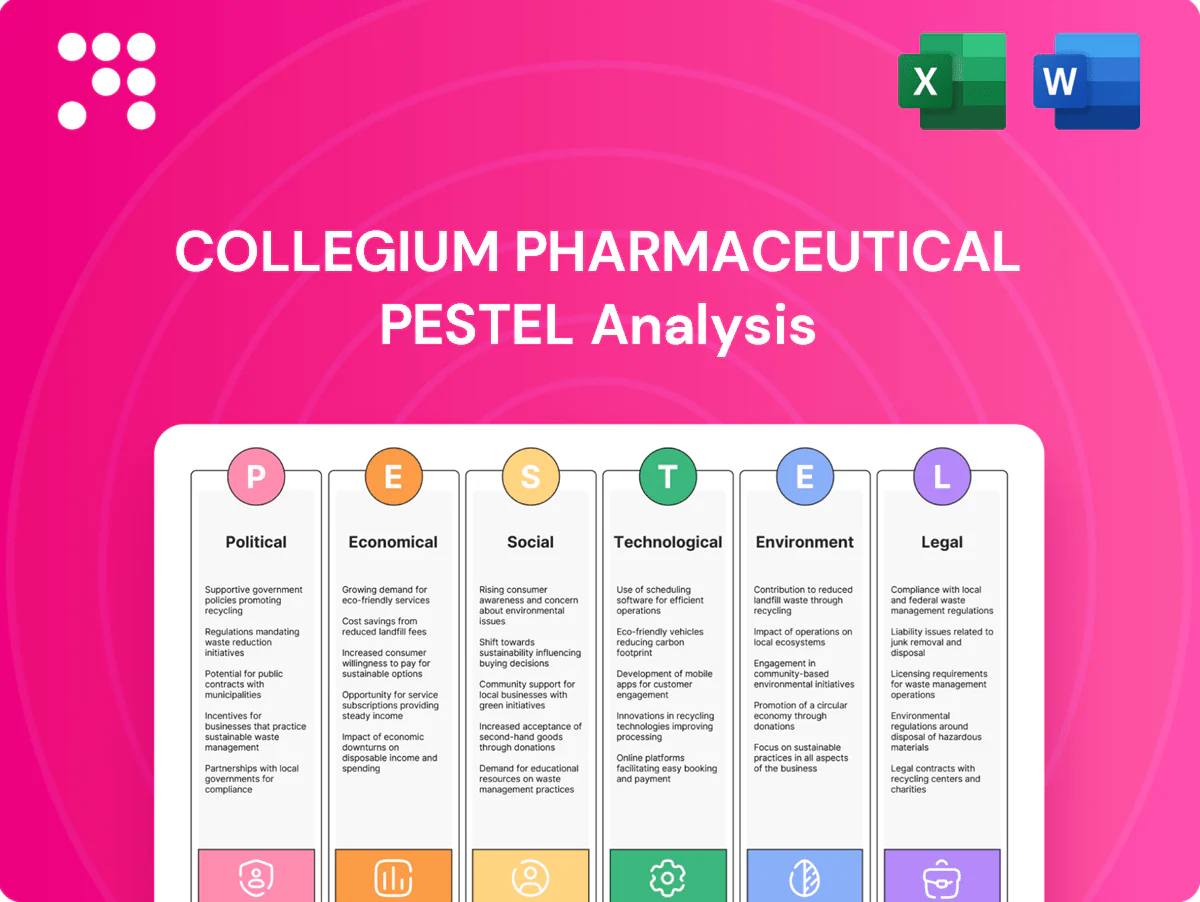
Collegium Pharmaceutical PESTLE Analysis

Skip the Research. Get the Strategy.
Our PESTLE Analysis of Collegium Pharmaceutical distills how political, economic, social, technological, legal and environmental forces shape its market position. It highlights regulatory risks, reimbursement trends and innovation drivers investors need to watch. Ideal for analysts and strategists—buy the full report to access the complete, actionable intelligence instantly.
Political factors

Opioid policy and national crisis response
Shifting federal and state priorities on opioid misuse—driven by a provisional ~110,000 US overdose deaths in 2023—have tightened prescribing controls, redirected funding, and hardened public perception. Heightened oversight can compress prescription volumes while favoring abuse-deterrent formulations such as Xtampza ER, improving market access for Collegium. Aligning with harm-reduction programs and state mitigation plans tied to the >$50 billion opioid settlement pool can secure payer and community support. Policy volatility, however, remains a commercialization risk.
Drug pricing scrutiny and affordability agendas
Political pressure to lower drug costs, including Medicare negotiation rules starting in 2026 that initially target up to 10 drugs, intensifies pricing talks with Medicare, Medicaid and commercial payers and can reduce net realized prices. Reference pricing and IRA-linked inflation rebates further compress margins for branded products. Demonstrating pharmacoeconomic value for abuse-deterrent formulations is critical to secure favorable coverage and lower formulary exclusion risk. Transparent pricing may mitigate reputational and payer pushback.

Reimbursement and public payer dynamics
Coverage decisions by CMS and state Medicaid programs—impacting roughly 48.5 million Medicare Part D enrollees (2024) and about 83.4 million Medicaid beneficiaries (2023)—strongly shape access to Collegium products; preferential formulary placement often requires outcomes and diversion-reduction data, while step therapy/prior authorization policies can materially slow uptake, making proactive payer engagement essential.

Regulatory alignment and cross-agency coordination
Coordination among FDA, DEA, and state boards shapes scheduling, annual DEA aggregate production quotas, and labeling decisions; FDA/DEA alignment in 2015 guidance established evidence standards for abuse-deterrent labeling. Changes in scheduling or quota rules can quickly shift supply and prescribing patterns. Collegium faces dependence on consistent interagency guidance to stabilize product access.
- Agencies: FDA, DEA, state boards
- Key fact: 2015 FDA ADF guidance sets evidence standard
- Mechanism: annual DEA aggregate production quotas
- Risk: scheduling/quota changes alter prescribing
Global trade and regulatory harmonization
Collegium's APIs and components rely heavily on global suppliers, with India and China major sources for pharmaceutical active ingredients; the FDA has repeatedly flagged supply-chain vulnerabilities that affect U.S. manufacturers. Divergent regulatory frameworks outside the U.S. complicate ex-U.S. expansion, while ICH and other harmonized guidelines can streamline multinational approvals. Political tensions and tariffs have been shown to increase procurement costs and extend lead times for pharma imports.
- Supply concentration: India/China major API hubs
- Regulatory: ICH aids harmonization
- Risk: geopolitical tensions raise costs/lead times
Tighter opioid policy and Medicare negotiation reshape abuse-deterrent drug market
Heightened federal/state focus on opioid misuse (≈110,000 US OD deaths in 2023) tightens prescribing and favors abuse-deterrent products like Xtampza ER while exposing Collegium to policy volatility. Medicare negotiation (from 2026, up to 10 drugs) and IRA rebates amplify pricing pressure; opioid settlement funds (> $50B) create payer/community engagement opportunities. Supply-chain risks persist given API reliance on India/China.
| Metric | Value |
|---|---|
| US OD deaths (2023) | ~110,000 |
| Opioid settlement pool | > $50B |
| Medicare Part D enrollees (2024) | 48.5M |
| Medicaid beneficiaries (2023) | 83.4M |
What is included in the product
 Detailed Word Document
Explores how macro-environmental factors—Political, Economic, Social, Technological, Environmental, and Legal—specifically impact Collegium Pharmaceutical, with data-backed trends and forward-looking insights to identify risks and opportunities for strategy and investor decision-making.

 Customizable Excel Spreadsheet
A clean, summarized PESTLE of Collegium Pharmaceutical, visually segmented by category for quick interpretation and easily droppable into presentations or shared across teams to support risk discussions and planning.
Economic factors

Payer mix and formulary access economics
Revenue concentration in a few large PBMs—top three PBMs control roughly four-fifths (~80%) of U.S. prescription lives—creates intense pricing pressure on Collegium. Winning preferred tiers can unlock meaningful volumes but often requires rebates commonly exceeding 30% of list price. Gross-to-net dynamics routinely shave realized prices by tens of percent. Market access excellence remains a primary economic lever driving net revenue.
Macro conditions and healthcare utilization
Employment and employer-sponsored insurance cycles (about 49% covered by employer plans, US unemployment ~3.8% in 2024) drive prescription volumes for Collegium. Inflation (US CPI ~3.4% in 2024) lifts COGS and SG&A, while Fed funds at 5.25–5.50% (mid-2025) raises financing costs. Chronic pain affects ~20% of US adults, providing stable baseline demand. Cash-strapped payers and Medicare budget pressure increase value-for-money scrutiny.

Generic competition and price erosion
Loss of exclusivity and therapeutic substitution can compress prices sharply: generics account for about 90% of U.S. dispensed prescriptions and multi‑entrant generic entry typically drives price declines of 70–95%. Abuse‑deterrent differentiation may slow but not stop erosion. Lifecycle management and line extensions are vital, and vigilant monitoring of ANDA filings and pipelines guides defensive strategies.

Supply chain costs and API availability
Volatile API pricing and freight increase input cost pressure on Collegium, squeezing margins for proprietary opioid and non-opioid formulations. Dual sourcing and inventory buffers lower disruption risk but raise working capital needs. Contract manufacturing agreements dictate flexibility and cost control through pricing clauses and minimums. Ongoing yield and throughput improvements preserve unit economics.
- API/freight volatility: margin pressure
- Dual sourcing: lowers disruption, ups capex
- CMO terms: affect agility/costs
- Yield/throughput: protects unit economics
Capital allocation, M&A, and pipeline ROI
Disciplined R&D spend must focus on high-probability, de-risked assets to preserve cash and maximize pipeline ROI; targeted investments in late-stage formulations reduce time-to-revenue. Strategic acquisitions or in-licensing can accelerate growth but introduce integration and execution risk that must be quantified pre-deal. DCF-driven portfolio pruning should remove low-NPV programs while share repurchases or debt paydown balance shareholder returns with balance-sheet resilience.
- Prioritize high-probability, late-stage R&D
- Use DCF to prune low-NPV assets
- Weigh M&A growth vs integration risk
- Consider buybacks/debt paydown for financial resilience
Tighter opioid policy and Medicare negotiation reshape abuse-deterrent drug market
High PBM concentration (~80% lives) forces rebates often >30% and gross‑to‑net erosion of ~20–40%, making market access the key revenue lever. Macro: US unemployment ~3.8% (2024), CPI ~3.4% (2024) and Fed funds 5.25–5.50% (mid‑2025) lift costs and financing. Generics ~90% of dispensed scripts; multi‑entrant entry can cut prices 70–95%, while API/freight volatility raises COGS.
| Metric | Value |
|---|---|
| PBM share (top3) | ~80% |
| Typical rebates | >30% |
| Gross‑to‑net | -20–40% |
| Unemployment (US 2024) | ~3.8% |
| CPI (2024) | ~3.4% |
| Fed funds (mid‑2025) | 5.25–5.50% |
| Generics dispensed | ~90% |
Same Document Delivered
Collegium Pharmaceutical PESTLE Analysis
The Collegium Pharmaceutical PESTLE Analysis shown here is the exact document you’ll receive after purchase—fully formatted, professionally structured, and ready to use. The layout, content, and structure visible in this preview are exactly what you’ll download immediately after checkout.

Skip the Research. Get the Strategy.
Our PESTLE Analysis of Collegium Pharmaceutical distills how political, economic, social, technological, legal and environmental forces shape its market position. It highlights regulatory risks, reimbursement trends and innovation drivers investors need to watch. Ideal for analysts and strategists—buy the full report to access the complete, actionable intelligence instantly.
Political factors
Opioid policy and national crisis response
Shifting federal and state priorities on opioid misuse—driven by a provisional ~110,000 US overdose deaths in 2023—have tightened prescribing controls, redirected funding, and hardened public perception. Heightened oversight can compress prescription volumes while favoring abuse-deterrent formulations such as Xtampza ER, improving market access for Collegium. Aligning with harm-reduction programs and state mitigation plans tied to the >$50 billion opioid settlement pool can secure payer and community support. Policy volatility, however, remains a commercialization risk.
Drug pricing scrutiny and affordability agendas
Political pressure to lower drug costs, including Medicare negotiation rules starting in 2026 that initially target up to 10 drugs, intensifies pricing talks with Medicare, Medicaid and commercial payers and can reduce net realized prices. Reference pricing and IRA-linked inflation rebates further compress margins for branded products. Demonstrating pharmacoeconomic value for abuse-deterrent formulations is critical to secure favorable coverage and lower formulary exclusion risk. Transparent pricing may mitigate reputational and payer pushback.
Reimbursement and public payer dynamics
Coverage decisions by CMS and state Medicaid programs—impacting roughly 48.5 million Medicare Part D enrollees (2024) and about 83.4 million Medicaid beneficiaries (2023)—strongly shape access to Collegium products; preferential formulary placement often requires outcomes and diversion-reduction data, while step therapy/prior authorization policies can materially slow uptake, making proactive payer engagement essential.
Regulatory alignment and cross-agency coordination
Coordination among FDA, DEA, and state boards shapes scheduling, annual DEA aggregate production quotas, and labeling decisions; FDA/DEA alignment in 2015 guidance established evidence standards for abuse-deterrent labeling. Changes in scheduling or quota rules can quickly shift supply and prescribing patterns. Collegium faces dependence on consistent interagency guidance to stabilize product access.
- Agencies: FDA, DEA, state boards
- Key fact: 2015 FDA ADF guidance sets evidence standard
- Mechanism: annual DEA aggregate production quotas
- Risk: scheduling/quota changes alter prescribing
Global trade and regulatory harmonization
Collegium's APIs and components rely heavily on global suppliers, with India and China major sources for pharmaceutical active ingredients; the FDA has repeatedly flagged supply-chain vulnerabilities that affect U.S. manufacturers. Divergent regulatory frameworks outside the U.S. complicate ex-U.S. expansion, while ICH and other harmonized guidelines can streamline multinational approvals. Political tensions and tariffs have been shown to increase procurement costs and extend lead times for pharma imports.
- Supply concentration: India/China major API hubs
- Regulatory: ICH aids harmonization
- Risk: geopolitical tensions raise costs/lead times
Tighter opioid policy and Medicare negotiation reshape abuse-deterrent drug market
Heightened federal/state focus on opioid misuse (≈110,000 US OD deaths in 2023) tightens prescribing and favors abuse-deterrent products like Xtampza ER while exposing Collegium to policy volatility. Medicare negotiation (from 2026, up to 10 drugs) and IRA rebates amplify pricing pressure; opioid settlement funds (> $50B) create payer/community engagement opportunities. Supply-chain risks persist given API reliance on India/China.
| Metric | Value |
|---|---|
| US OD deaths (2023) | ~110,000 |
| Opioid settlement pool | > $50B |
| Medicare Part D enrollees (2024) | 48.5M |
| Medicaid beneficiaries (2023) | 83.4M |
What is included in the product
Detailed Word Document
Explores how macro-environmental factors—Political, Economic, Social, Technological, Environmental, and Legal—specifically impact Collegium Pharmaceutical, with data-backed trends and forward-looking insights to identify risks and opportunities for strategy and investor decision-making.
Customizable Excel Spreadsheet
A clean, summarized PESTLE of Collegium Pharmaceutical, visually segmented by category for quick interpretation and easily droppable into presentations or shared across teams to support risk discussions and planning.
Economic factors
Payer mix and formulary access economics
Revenue concentration in a few large PBMs—top three PBMs control roughly four-fifths (~80%) of U.S. prescription lives—creates intense pricing pressure on Collegium. Winning preferred tiers can unlock meaningful volumes but often requires rebates commonly exceeding 30% of list price. Gross-to-net dynamics routinely shave realized prices by tens of percent. Market access excellence remains a primary economic lever driving net revenue.
Macro conditions and healthcare utilization
Employment and employer-sponsored insurance cycles (about 49% covered by employer plans, US unemployment ~3.8% in 2024) drive prescription volumes for Collegium. Inflation (US CPI ~3.4% in 2024) lifts COGS and SG&A, while Fed funds at 5.25–5.50% (mid-2025) raises financing costs. Chronic pain affects ~20% of US adults, providing stable baseline demand. Cash-strapped payers and Medicare budget pressure increase value-for-money scrutiny.
Generic competition and price erosion
Loss of exclusivity and therapeutic substitution can compress prices sharply: generics account for about 90% of U.S. dispensed prescriptions and multi‑entrant generic entry typically drives price declines of 70–95%. Abuse‑deterrent differentiation may slow but not stop erosion. Lifecycle management and line extensions are vital, and vigilant monitoring of ANDA filings and pipelines guides defensive strategies.
Supply chain costs and API availability
Volatile API pricing and freight increase input cost pressure on Collegium, squeezing margins for proprietary opioid and non-opioid formulations. Dual sourcing and inventory buffers lower disruption risk but raise working capital needs. Contract manufacturing agreements dictate flexibility and cost control through pricing clauses and minimums. Ongoing yield and throughput improvements preserve unit economics.
- API/freight volatility: margin pressure
- Dual sourcing: lowers disruption, ups capex
- CMO terms: affect agility/costs
- Yield/throughput: protects unit economics
Capital allocation, M&A, and pipeline ROI
Disciplined R&D spend must focus on high-probability, de-risked assets to preserve cash and maximize pipeline ROI; targeted investments in late-stage formulations reduce time-to-revenue. Strategic acquisitions or in-licensing can accelerate growth but introduce integration and execution risk that must be quantified pre-deal. DCF-driven portfolio pruning should remove low-NPV programs while share repurchases or debt paydown balance shareholder returns with balance-sheet resilience.
- Prioritize high-probability, late-stage R&D
- Use DCF to prune low-NPV assets
- Weigh M&A growth vs integration risk
- Consider buybacks/debt paydown for financial resilience
Tighter opioid policy and Medicare negotiation reshape abuse-deterrent drug market
High PBM concentration (~80% lives) forces rebates often >30% and gross‑to‑net erosion of ~20–40%, making market access the key revenue lever. Macro: US unemployment ~3.8% (2024), CPI ~3.4% (2024) and Fed funds 5.25–5.50% (mid‑2025) lift costs and financing. Generics ~90% of dispensed scripts; multi‑entrant entry can cut prices 70–95%, while API/freight volatility raises COGS.
| Metric | Value |
|---|---|
| PBM share (top3) | ~80% |
| Typical rebates | >30% |
| Gross‑to‑net | -20–40% |
| Unemployment (US 2024) | ~3.8% |
| CPI (2024) | ~3.4% |
| Fed funds (mid‑2025) | 5.25–5.50% |
| Generics dispensed | ~90% |
Same Document Delivered
Collegium Pharmaceutical PESTLE Analysis
The Collegium Pharmaceutical PESTLE Analysis shown here is the exact document you’ll receive after purchase—fully formatted, professionally structured, and ready to use. The layout, content, and structure visible in this preview are exactly what you’ll download immediately after checkout.
Description
Skip the Research. Get the Strategy.
Our PESTLE Analysis of Collegium Pharmaceutical distills how political, economic, social, technological, legal and environmental forces shape its market position. It highlights regulatory risks, reimbursement trends and innovation drivers investors need to watch. Ideal for analysts and strategists—buy the full report to access the complete, actionable intelligence instantly.
Political factors
Opioid policy and national crisis response
Shifting federal and state priorities on opioid misuse—driven by a provisional ~110,000 US overdose deaths in 2023—have tightened prescribing controls, redirected funding, and hardened public perception. Heightened oversight can compress prescription volumes while favoring abuse-deterrent formulations such as Xtampza ER, improving market access for Collegium. Aligning with harm-reduction programs and state mitigation plans tied to the >$50 billion opioid settlement pool can secure payer and community support. Policy volatility, however, remains a commercialization risk.
Drug pricing scrutiny and affordability agendas
Political pressure to lower drug costs, including Medicare negotiation rules starting in 2026 that initially target up to 10 drugs, intensifies pricing talks with Medicare, Medicaid and commercial payers and can reduce net realized prices. Reference pricing and IRA-linked inflation rebates further compress margins for branded products. Demonstrating pharmacoeconomic value for abuse-deterrent formulations is critical to secure favorable coverage and lower formulary exclusion risk. Transparent pricing may mitigate reputational and payer pushback.
Reimbursement and public payer dynamics
Coverage decisions by CMS and state Medicaid programs—impacting roughly 48.5 million Medicare Part D enrollees (2024) and about 83.4 million Medicaid beneficiaries (2023)—strongly shape access to Collegium products; preferential formulary placement often requires outcomes and diversion-reduction data, while step therapy/prior authorization policies can materially slow uptake, making proactive payer engagement essential.
Regulatory alignment and cross-agency coordination
Coordination among FDA, DEA, and state boards shapes scheduling, annual DEA aggregate production quotas, and labeling decisions; FDA/DEA alignment in 2015 guidance established evidence standards for abuse-deterrent labeling. Changes in scheduling or quota rules can quickly shift supply and prescribing patterns. Collegium faces dependence on consistent interagency guidance to stabilize product access.
- Agencies: FDA, DEA, state boards
- Key fact: 2015 FDA ADF guidance sets evidence standard
- Mechanism: annual DEA aggregate production quotas
- Risk: scheduling/quota changes alter prescribing
Global trade and regulatory harmonization
Collegium's APIs and components rely heavily on global suppliers, with India and China major sources for pharmaceutical active ingredients; the FDA has repeatedly flagged supply-chain vulnerabilities that affect U.S. manufacturers. Divergent regulatory frameworks outside the U.S. complicate ex-U.S. expansion, while ICH and other harmonized guidelines can streamline multinational approvals. Political tensions and tariffs have been shown to increase procurement costs and extend lead times for pharma imports.
- Supply concentration: India/China major API hubs
- Regulatory: ICH aids harmonization
- Risk: geopolitical tensions raise costs/lead times
Tighter opioid policy and Medicare negotiation reshape abuse-deterrent drug market
Heightened federal/state focus on opioid misuse (≈110,000 US OD deaths in 2023) tightens prescribing and favors abuse-deterrent products like Xtampza ER while exposing Collegium to policy volatility. Medicare negotiation (from 2026, up to 10 drugs) and IRA rebates amplify pricing pressure; opioid settlement funds (> $50B) create payer/community engagement opportunities. Supply-chain risks persist given API reliance on India/China.
| Metric | Value |
|---|---|
| US OD deaths (2023) | ~110,000 |
| Opioid settlement pool | > $50B |
| Medicare Part D enrollees (2024) | 48.5M |
| Medicaid beneficiaries (2023) | 83.4M |
What is included in the product
Detailed Word Document
Explores how macro-environmental factors—Political, Economic, Social, Technological, Environmental, and Legal—specifically impact Collegium Pharmaceutical, with data-backed trends and forward-looking insights to identify risks and opportunities for strategy and investor decision-making.
Customizable Excel Spreadsheet
A clean, summarized PESTLE of Collegium Pharmaceutical, visually segmented by category for quick interpretation and easily droppable into presentations or shared across teams to support risk discussions and planning.
Economic factors
Payer mix and formulary access economics
Revenue concentration in a few large PBMs—top three PBMs control roughly four-fifths (~80%) of U.S. prescription lives—creates intense pricing pressure on Collegium. Winning preferred tiers can unlock meaningful volumes but often requires rebates commonly exceeding 30% of list price. Gross-to-net dynamics routinely shave realized prices by tens of percent. Market access excellence remains a primary economic lever driving net revenue.
Macro conditions and healthcare utilization
Employment and employer-sponsored insurance cycles (about 49% covered by employer plans, US unemployment ~3.8% in 2024) drive prescription volumes for Collegium. Inflation (US CPI ~3.4% in 2024) lifts COGS and SG&A, while Fed funds at 5.25–5.50% (mid-2025) raises financing costs. Chronic pain affects ~20% of US adults, providing stable baseline demand. Cash-strapped payers and Medicare budget pressure increase value-for-money scrutiny.
Generic competition and price erosion
Loss of exclusivity and therapeutic substitution can compress prices sharply: generics account for about 90% of U.S. dispensed prescriptions and multi‑entrant generic entry typically drives price declines of 70–95%. Abuse‑deterrent differentiation may slow but not stop erosion. Lifecycle management and line extensions are vital, and vigilant monitoring of ANDA filings and pipelines guides defensive strategies.
Supply chain costs and API availability
Volatile API pricing and freight increase input cost pressure on Collegium, squeezing margins for proprietary opioid and non-opioid formulations. Dual sourcing and inventory buffers lower disruption risk but raise working capital needs. Contract manufacturing agreements dictate flexibility and cost control through pricing clauses and minimums. Ongoing yield and throughput improvements preserve unit economics.
- API/freight volatility: margin pressure
- Dual sourcing: lowers disruption, ups capex
- CMO terms: affect agility/costs
- Yield/throughput: protects unit economics
Capital allocation, M&A, and pipeline ROI
Disciplined R&D spend must focus on high-probability, de-risked assets to preserve cash and maximize pipeline ROI; targeted investments in late-stage formulations reduce time-to-revenue. Strategic acquisitions or in-licensing can accelerate growth but introduce integration and execution risk that must be quantified pre-deal. DCF-driven portfolio pruning should remove low-NPV programs while share repurchases or debt paydown balance shareholder returns with balance-sheet resilience.
- Prioritize high-probability, late-stage R&D
- Use DCF to prune low-NPV assets
- Weigh M&A growth vs integration risk
- Consider buybacks/debt paydown for financial resilience
Tighter opioid policy and Medicare negotiation reshape abuse-deterrent drug market
High PBM concentration (~80% lives) forces rebates often >30% and gross‑to‑net erosion of ~20–40%, making market access the key revenue lever. Macro: US unemployment ~3.8% (2024), CPI ~3.4% (2024) and Fed funds 5.25–5.50% (mid‑2025) lift costs and financing. Generics ~90% of dispensed scripts; multi‑entrant entry can cut prices 70–95%, while API/freight volatility raises COGS.
| Metric | Value |
|---|---|
| PBM share (top3) | ~80% |
| Typical rebates | >30% |
| Gross‑to‑net | -20–40% |
| Unemployment (US 2024) | ~3.8% |
| CPI (2024) | ~3.4% |
| Fed funds (mid‑2025) | 5.25–5.50% |
| Generics dispensed | ~90% |
Same Document Delivered
Collegium Pharmaceutical PESTLE Analysis
The Collegium Pharmaceutical PESTLE Analysis shown here is the exact document you’ll receive after purchase—fully formatted, professionally structured, and ready to use. The layout, content, and structure visible in this preview are exactly what you’ll download immediately after checkout.











