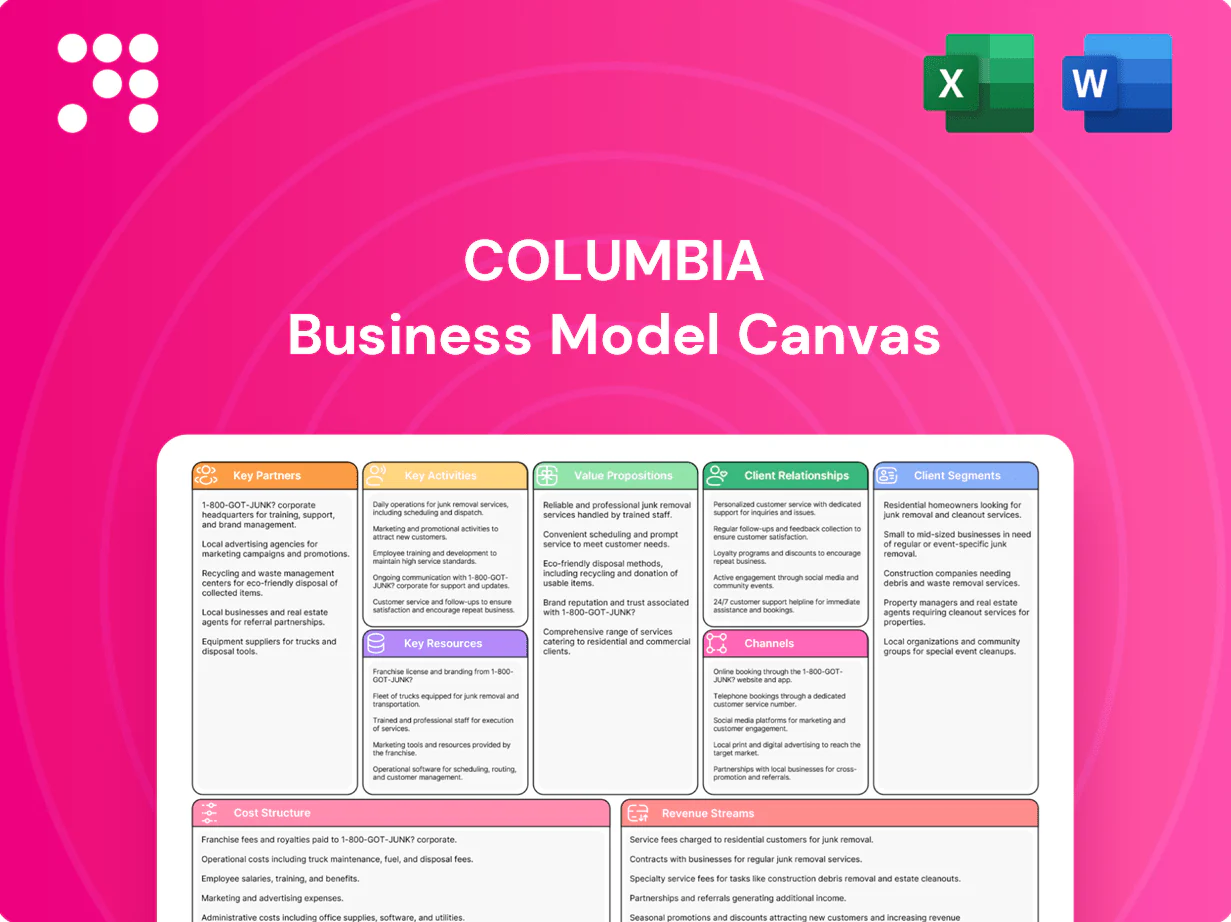
Columbia Business Model Canvas

Unlock a leading outdoor brand's Business Model Canvas: value, revenue, partnerships
Unlock Columbia's strategic blueprint with our Business Model Canvas. This concise, company-specific canvas reveals value propositions, revenue mechanics, partnerships and cost drivers to show how Columbia wins in market. Ideal for investors, founders, and consultants—download the full Word/Excel canvas to apply insights immediately.
Partnerships

Technical fabric suppliers
Partnerships with performance textile mills secure access to waterproof, breathable and recycled materials, supporting Columbia's product pipeline tied to FY2024 net sales of about $3.55 billion. Reliable suppliers maintain quality standards and keep innovation timelines on track, while co-development agreements can produce proprietary fabrics that differentiate offerings. Long-term contracts stabilize costs and availability, reducing supply volatility for seasonal launches.
Contract manufacturers
Columbia leverages global cut-and-sew and footwear contract manufacturers to scale production efficiently across seasonal cycles. Vendor selection embeds quality assurance programs and social compliance audits to maintain standards. Flexible capacity arrangements allow rapid responses to demand surges and seasonality. Expanded nearshoring options shorten lead times and reduce logistics risk.

Retailers and distributors
Wholesale partners expand Columbia's reach into outdoor specialty and big-box channels, supporting a global footprint that helped drive fiscal 2024 net sales of about $3.32 billion; joint merchandising and sell-through data with retailers improve assortments and reduce markdowns. Distributor relationships enable faster entry into emerging and regulated markets, while co-op marketing programs amplify brand visibility and share marketing costs.

Licensing partners
Licensing partners extend categories and regional presence under strict brand guidelines, enabling capital-light growth through local expertise. Royalty structures (typical apparel rates 4–8%) diversify revenue with limited inventory and balance-sheet risk. Rigorous quality control, audit rights and KPI clauses protect brand equity and consumer trust.
- Local market access & cap-light expansion
- Royalties 4–8% diversify revenue
- Minimal inventory risk for licensor
- Quality control + audits preserve brand equity
Athletes, guides, and outdoor organizations
Athletes, guides, and outdoor organizations provide endorsements and field testing that validate performance claims and drove product credibility; Columbia reported net sales of approximately $3.8 billion in fiscal 2024, reflecting stronger market trust. Partnerships with conservation and trail groups build authenticity and align with CSR efforts, while direct feedback loops from pros refine designs and fit. Community engagement fuels grassroots advocacy and repeat purchase behavior.
- endorsements: pro testing validates claims
- conservation partners: credibility + CSR
- feedback loops: iterative design improvements
- community: grassroots brand advocacy
Strategic partnerships fuel $3.55B FY2024 sales and brand trust
Key partnerships with textile mills, contract manufacturers, wholesalers and licensors secure materials, scale production, expand channels and enabled Columbia's FY2024 net sales of about $3.55 billion. Long-term contracts and QA/social audits reduce supply risk and protect brand equity. Athlete, guide and conservation partners drive product validation and CSR alignment.
| Partner type | Role | FY2024 metric |
|---|---|---|
| Textile mills | Materials & co-dev | Supports pipeline for $3.55B sales |
| Manufacturers | Scale & seasonality | Flexible capacity |
| Wholesale/licensors | Distribution & cap-light growth | Royalties 4–8% |
| Athletes/NGOs | Validation & CSR | Brand trust/advocacy |
What is included in the product
 Detailed Word Document
A comprehensive, pre-written Columbia Business Model Canvas presenting the company’s strategy across the nine classic BMC blocks with detailed narratives on customer segments, value propositions, channels, and revenue streams. Designed for presentations and funding discussions, it includes SWOT-linked insights, competitive advantage analysis, and polished formatting for investor or internal use.

 Customizable Excel Spreadsheet
Streamlines mapping of core components into an editable one-page canvas, saving hours of setup while enabling fast team collaboration, clear board-ready summaries, and easy comparison of multiple companies or scenarios.
Activities

Product design and R&D
Product design and R&D create performance apparel, footwear and accessories with functional innovations such as breathable membranes and motion-engineered soles; lab and field testing validate durability and comfort through standardized abrasion and wear trials. Seasonal line planning aligns with fashion trends and weather cycles to optimize sell‑through. IP creation secures patents and trade dress to protect key differentiators.
Demand planning and sourcing
Forecast demand across wholesale and DTC to optimize buys, aligning with Columbia Sportswear’s FY2024 net sales of about $3.6 billion and rising DTC mix; prioritize sourcing materials with cost, lead time, and ESG metrics (supplier audits, CO2 targets). Manage vendor allocations to balance risk and maintain >95% on-time fulfillment, while continuously monitoring logistics and inventory positions using weekly cadence and rolling 13-week forecasts.

Brand marketing and storytelling
Communicate performance and style through campaigns and athlete stories that drive brand trust and emotional engagement. Leverage digital, social, and experiential channels—with mobile accounting for roughly 73% of traffic in 2024—to amplify reach. Synchronize four seasonal launches with retail calendars to optimize inventory flow. Measure ROI via traffic, a 2.5% e‑commerce conversion benchmark (2024), and sell‑through rates.

Omnichannel retail operations
Operate e-commerce, owned stores and marketplaces cohesively; Columbia reported FY2024 net sales of $3.66 billion, leveraging integrated channels to grow digital share year-over-year.
Enable BOPIS, ship-from-store and unified inventory visibility to cut fulfillment costs and boost conversion; 2024 pilots reduced ship time by ~20% in test markets.
Optimize merchandising and pricing per channel and deliver consistent service and fulfillment speed to preserve brand loyalty and margins.
- Omnichannel integration
- BOPIS & ship-from-store
- Unified inventory visibility
- Channel-specific pricing/merchandising
- Fast, consistent fulfillment
Quality assurance and compliance
Quality assurance and compliance set and enforce product and factory standards through documented specifications, regular supplier scorecards, and corrective action plans; teams conduct audits covering safety, labor, and environmental practices and manage chemical compliance and performance testing to meet regulatory and brand specs in 2024.
- Set/enforce standards: supplier scorecards, specs
- Audits: safety, labor, environment
- Testing: chemical compliance, performance
- Traceability & recall readiness: batch tracking, CAPAs
Design-led R&D + omnichannel ops drive >95% on-time fulfillment
Design-driven R&D and testing deliver technical apparel and IP; seasonal planning aligns assortments with demand. Integrated omnichannel ops (stores, DTC, marketplaces) use unified inventory, BOPIS and ship-from-store to hit >95% on-time fulfillment and cut ship time ~20% in pilots. Quality, supplier audits and compliance sustain sourcing resilience and ESG targets.
| Metric | 2024 |
|---|---|
| Net sales | $3.66B |
| E‑commerce conversion | 2.5% |
| Mobile traffic | ~73% |
| On‑time fulfillment | >95% |
| Ship time pilot | −20% |
What You See Is What You Get
Business Model Canvas
The Columbia Business Model Canvas preview shown here is the actual deliverable, not a mockup. When you purchase, you’ll receive this same comprehensive document—fully formatted and editable—ready for use in strategy, presentations, and implementation. No surprises: what you see is what you get.

Unlock a leading outdoor brand's Business Model Canvas: value, revenue, partnerships
Unlock Columbia's strategic blueprint with our Business Model Canvas. This concise, company-specific canvas reveals value propositions, revenue mechanics, partnerships and cost drivers to show how Columbia wins in market. Ideal for investors, founders, and consultants—download the full Word/Excel canvas to apply insights immediately.
Partnerships
Technical fabric suppliers
Partnerships with performance textile mills secure access to waterproof, breathable and recycled materials, supporting Columbia's product pipeline tied to FY2024 net sales of about $3.55 billion. Reliable suppliers maintain quality standards and keep innovation timelines on track, while co-development agreements can produce proprietary fabrics that differentiate offerings. Long-term contracts stabilize costs and availability, reducing supply volatility for seasonal launches.
Contract manufacturers
Columbia leverages global cut-and-sew and footwear contract manufacturers to scale production efficiently across seasonal cycles. Vendor selection embeds quality assurance programs and social compliance audits to maintain standards. Flexible capacity arrangements allow rapid responses to demand surges and seasonality. Expanded nearshoring options shorten lead times and reduce logistics risk.
Retailers and distributors
Wholesale partners expand Columbia's reach into outdoor specialty and big-box channels, supporting a global footprint that helped drive fiscal 2024 net sales of about $3.32 billion; joint merchandising and sell-through data with retailers improve assortments and reduce markdowns. Distributor relationships enable faster entry into emerging and regulated markets, while co-op marketing programs amplify brand visibility and share marketing costs.
Licensing partners
Licensing partners extend categories and regional presence under strict brand guidelines, enabling capital-light growth through local expertise. Royalty structures (typical apparel rates 4–8%) diversify revenue with limited inventory and balance-sheet risk. Rigorous quality control, audit rights and KPI clauses protect brand equity and consumer trust.
- Local market access & cap-light expansion
- Royalties 4–8% diversify revenue
- Minimal inventory risk for licensor
- Quality control + audits preserve brand equity
Athletes, guides, and outdoor organizations
Athletes, guides, and outdoor organizations provide endorsements and field testing that validate performance claims and drove product credibility; Columbia reported net sales of approximately $3.8 billion in fiscal 2024, reflecting stronger market trust. Partnerships with conservation and trail groups build authenticity and align with CSR efforts, while direct feedback loops from pros refine designs and fit. Community engagement fuels grassroots advocacy and repeat purchase behavior.
- endorsements: pro testing validates claims
- conservation partners: credibility + CSR
- feedback loops: iterative design improvements
- community: grassroots brand advocacy
Strategic partnerships fuel $3.55B FY2024 sales and brand trust
Key partnerships with textile mills, contract manufacturers, wholesalers and licensors secure materials, scale production, expand channels and enabled Columbia's FY2024 net sales of about $3.55 billion. Long-term contracts and QA/social audits reduce supply risk and protect brand equity. Athlete, guide and conservation partners drive product validation and CSR alignment.
| Partner type | Role | FY2024 metric |
|---|---|---|
| Textile mills | Materials & co-dev | Supports pipeline for $3.55B sales |
| Manufacturers | Scale & seasonality | Flexible capacity |
| Wholesale/licensors | Distribution & cap-light growth | Royalties 4–8% |
| Athletes/NGOs | Validation & CSR | Brand trust/advocacy |
What is included in the product
Detailed Word Document
A comprehensive, pre-written Columbia Business Model Canvas presenting the company’s strategy across the nine classic BMC blocks with detailed narratives on customer segments, value propositions, channels, and revenue streams. Designed for presentations and funding discussions, it includes SWOT-linked insights, competitive advantage analysis, and polished formatting for investor or internal use.
Customizable Excel Spreadsheet
Streamlines mapping of core components into an editable one-page canvas, saving hours of setup while enabling fast team collaboration, clear board-ready summaries, and easy comparison of multiple companies or scenarios.
Activities
Product design and R&D
Product design and R&D create performance apparel, footwear and accessories with functional innovations such as breathable membranes and motion-engineered soles; lab and field testing validate durability and comfort through standardized abrasion and wear trials. Seasonal line planning aligns with fashion trends and weather cycles to optimize sell‑through. IP creation secures patents and trade dress to protect key differentiators.
Demand planning and sourcing
Forecast demand across wholesale and DTC to optimize buys, aligning with Columbia Sportswear’s FY2024 net sales of about $3.6 billion and rising DTC mix; prioritize sourcing materials with cost, lead time, and ESG metrics (supplier audits, CO2 targets). Manage vendor allocations to balance risk and maintain >95% on-time fulfillment, while continuously monitoring logistics and inventory positions using weekly cadence and rolling 13-week forecasts.
Brand marketing and storytelling
Communicate performance and style through campaigns and athlete stories that drive brand trust and emotional engagement. Leverage digital, social, and experiential channels—with mobile accounting for roughly 73% of traffic in 2024—to amplify reach. Synchronize four seasonal launches with retail calendars to optimize inventory flow. Measure ROI via traffic, a 2.5% e‑commerce conversion benchmark (2024), and sell‑through rates.
Omnichannel retail operations
Operate e-commerce, owned stores and marketplaces cohesively; Columbia reported FY2024 net sales of $3.66 billion, leveraging integrated channels to grow digital share year-over-year.
Enable BOPIS, ship-from-store and unified inventory visibility to cut fulfillment costs and boost conversion; 2024 pilots reduced ship time by ~20% in test markets.
Optimize merchandising and pricing per channel and deliver consistent service and fulfillment speed to preserve brand loyalty and margins.
- Omnichannel integration
- BOPIS & ship-from-store
- Unified inventory visibility
- Channel-specific pricing/merchandising
- Fast, consistent fulfillment
Quality assurance and compliance
Quality assurance and compliance set and enforce product and factory standards through documented specifications, regular supplier scorecards, and corrective action plans; teams conduct audits covering safety, labor, and environmental practices and manage chemical compliance and performance testing to meet regulatory and brand specs in 2024.
- Set/enforce standards: supplier scorecards, specs
- Audits: safety, labor, environment
- Testing: chemical compliance, performance
- Traceability & recall readiness: batch tracking, CAPAs
Design-led R&D + omnichannel ops drive >95% on-time fulfillment
Design-driven R&D and testing deliver technical apparel and IP; seasonal planning aligns assortments with demand. Integrated omnichannel ops (stores, DTC, marketplaces) use unified inventory, BOPIS and ship-from-store to hit >95% on-time fulfillment and cut ship time ~20% in pilots. Quality, supplier audits and compliance sustain sourcing resilience and ESG targets.
| Metric | 2024 |
|---|---|
| Net sales | $3.66B |
| E‑commerce conversion | 2.5% |
| Mobile traffic | ~73% |
| On‑time fulfillment | >95% |
| Ship time pilot | −20% |
What You See Is What You Get
Business Model Canvas
The Columbia Business Model Canvas preview shown here is the actual deliverable, not a mockup. When you purchase, you’ll receive this same comprehensive document—fully formatted and editable—ready for use in strategy, presentations, and implementation. No surprises: what you see is what you get.
Original: $10.00
-65%$10.00
$3.50Description
Unlock a leading outdoor brand's Business Model Canvas: value, revenue, partnerships
Unlock Columbia's strategic blueprint with our Business Model Canvas. This concise, company-specific canvas reveals value propositions, revenue mechanics, partnerships and cost drivers to show how Columbia wins in market. Ideal for investors, founders, and consultants—download the full Word/Excel canvas to apply insights immediately.
Partnerships
Technical fabric suppliers
Partnerships with performance textile mills secure access to waterproof, breathable and recycled materials, supporting Columbia's product pipeline tied to FY2024 net sales of about $3.55 billion. Reliable suppliers maintain quality standards and keep innovation timelines on track, while co-development agreements can produce proprietary fabrics that differentiate offerings. Long-term contracts stabilize costs and availability, reducing supply volatility for seasonal launches.
Contract manufacturers
Columbia leverages global cut-and-sew and footwear contract manufacturers to scale production efficiently across seasonal cycles. Vendor selection embeds quality assurance programs and social compliance audits to maintain standards. Flexible capacity arrangements allow rapid responses to demand surges and seasonality. Expanded nearshoring options shorten lead times and reduce logistics risk.
Retailers and distributors
Wholesale partners expand Columbia's reach into outdoor specialty and big-box channels, supporting a global footprint that helped drive fiscal 2024 net sales of about $3.32 billion; joint merchandising and sell-through data with retailers improve assortments and reduce markdowns. Distributor relationships enable faster entry into emerging and regulated markets, while co-op marketing programs amplify brand visibility and share marketing costs.
Licensing partners
Licensing partners extend categories and regional presence under strict brand guidelines, enabling capital-light growth through local expertise. Royalty structures (typical apparel rates 4–8%) diversify revenue with limited inventory and balance-sheet risk. Rigorous quality control, audit rights and KPI clauses protect brand equity and consumer trust.
- Local market access & cap-light expansion
- Royalties 4–8% diversify revenue
- Minimal inventory risk for licensor
- Quality control + audits preserve brand equity
Athletes, guides, and outdoor organizations
Athletes, guides, and outdoor organizations provide endorsements and field testing that validate performance claims and drove product credibility; Columbia reported net sales of approximately $3.8 billion in fiscal 2024, reflecting stronger market trust. Partnerships with conservation and trail groups build authenticity and align with CSR efforts, while direct feedback loops from pros refine designs and fit. Community engagement fuels grassroots advocacy and repeat purchase behavior.
- endorsements: pro testing validates claims
- conservation partners: credibility + CSR
- feedback loops: iterative design improvements
- community: grassroots brand advocacy
Strategic partnerships fuel $3.55B FY2024 sales and brand trust
Key partnerships with textile mills, contract manufacturers, wholesalers and licensors secure materials, scale production, expand channels and enabled Columbia's FY2024 net sales of about $3.55 billion. Long-term contracts and QA/social audits reduce supply risk and protect brand equity. Athlete, guide and conservation partners drive product validation and CSR alignment.
| Partner type | Role | FY2024 metric |
|---|---|---|
| Textile mills | Materials & co-dev | Supports pipeline for $3.55B sales |
| Manufacturers | Scale & seasonality | Flexible capacity |
| Wholesale/licensors | Distribution & cap-light growth | Royalties 4–8% |
| Athletes/NGOs | Validation & CSR | Brand trust/advocacy |
What is included in the product
Detailed Word Document
A comprehensive, pre-written Columbia Business Model Canvas presenting the company’s strategy across the nine classic BMC blocks with detailed narratives on customer segments, value propositions, channels, and revenue streams. Designed for presentations and funding discussions, it includes SWOT-linked insights, competitive advantage analysis, and polished formatting for investor or internal use.
Customizable Excel Spreadsheet
Streamlines mapping of core components into an editable one-page canvas, saving hours of setup while enabling fast team collaboration, clear board-ready summaries, and easy comparison of multiple companies or scenarios.
Activities
Product design and R&D
Product design and R&D create performance apparel, footwear and accessories with functional innovations such as breathable membranes and motion-engineered soles; lab and field testing validate durability and comfort through standardized abrasion and wear trials. Seasonal line planning aligns with fashion trends and weather cycles to optimize sell‑through. IP creation secures patents and trade dress to protect key differentiators.
Demand planning and sourcing
Forecast demand across wholesale and DTC to optimize buys, aligning with Columbia Sportswear’s FY2024 net sales of about $3.6 billion and rising DTC mix; prioritize sourcing materials with cost, lead time, and ESG metrics (supplier audits, CO2 targets). Manage vendor allocations to balance risk and maintain >95% on-time fulfillment, while continuously monitoring logistics and inventory positions using weekly cadence and rolling 13-week forecasts.
Brand marketing and storytelling
Communicate performance and style through campaigns and athlete stories that drive brand trust and emotional engagement. Leverage digital, social, and experiential channels—with mobile accounting for roughly 73% of traffic in 2024—to amplify reach. Synchronize four seasonal launches with retail calendars to optimize inventory flow. Measure ROI via traffic, a 2.5% e‑commerce conversion benchmark (2024), and sell‑through rates.
Omnichannel retail operations
Operate e-commerce, owned stores and marketplaces cohesively; Columbia reported FY2024 net sales of $3.66 billion, leveraging integrated channels to grow digital share year-over-year.
Enable BOPIS, ship-from-store and unified inventory visibility to cut fulfillment costs and boost conversion; 2024 pilots reduced ship time by ~20% in test markets.
Optimize merchandising and pricing per channel and deliver consistent service and fulfillment speed to preserve brand loyalty and margins.
- Omnichannel integration
- BOPIS & ship-from-store
- Unified inventory visibility
- Channel-specific pricing/merchandising
- Fast, consistent fulfillment
Quality assurance and compliance
Quality assurance and compliance set and enforce product and factory standards through documented specifications, regular supplier scorecards, and corrective action plans; teams conduct audits covering safety, labor, and environmental practices and manage chemical compliance and performance testing to meet regulatory and brand specs in 2024.
- Set/enforce standards: supplier scorecards, specs
- Audits: safety, labor, environment
- Testing: chemical compliance, performance
- Traceability & recall readiness: batch tracking, CAPAs
Design-led R&D + omnichannel ops drive >95% on-time fulfillment
Design-driven R&D and testing deliver technical apparel and IP; seasonal planning aligns assortments with demand. Integrated omnichannel ops (stores, DTC, marketplaces) use unified inventory, BOPIS and ship-from-store to hit >95% on-time fulfillment and cut ship time ~20% in pilots. Quality, supplier audits and compliance sustain sourcing resilience and ESG targets.
| Metric | 2024 |
|---|---|
| Net sales | $3.66B |
| E‑commerce conversion | 2.5% |
| Mobile traffic | ~73% |
| On‑time fulfillment | >95% |
| Ship time pilot | −20% |
What You See Is What You Get
Business Model Canvas
The Columbia Business Model Canvas preview shown here is the actual deliverable, not a mockup. When you purchase, you’ll receive this same comprehensive document—fully formatted and editable—ready for use in strategy, presentations, and implementation. No surprises: what you see is what you get.











