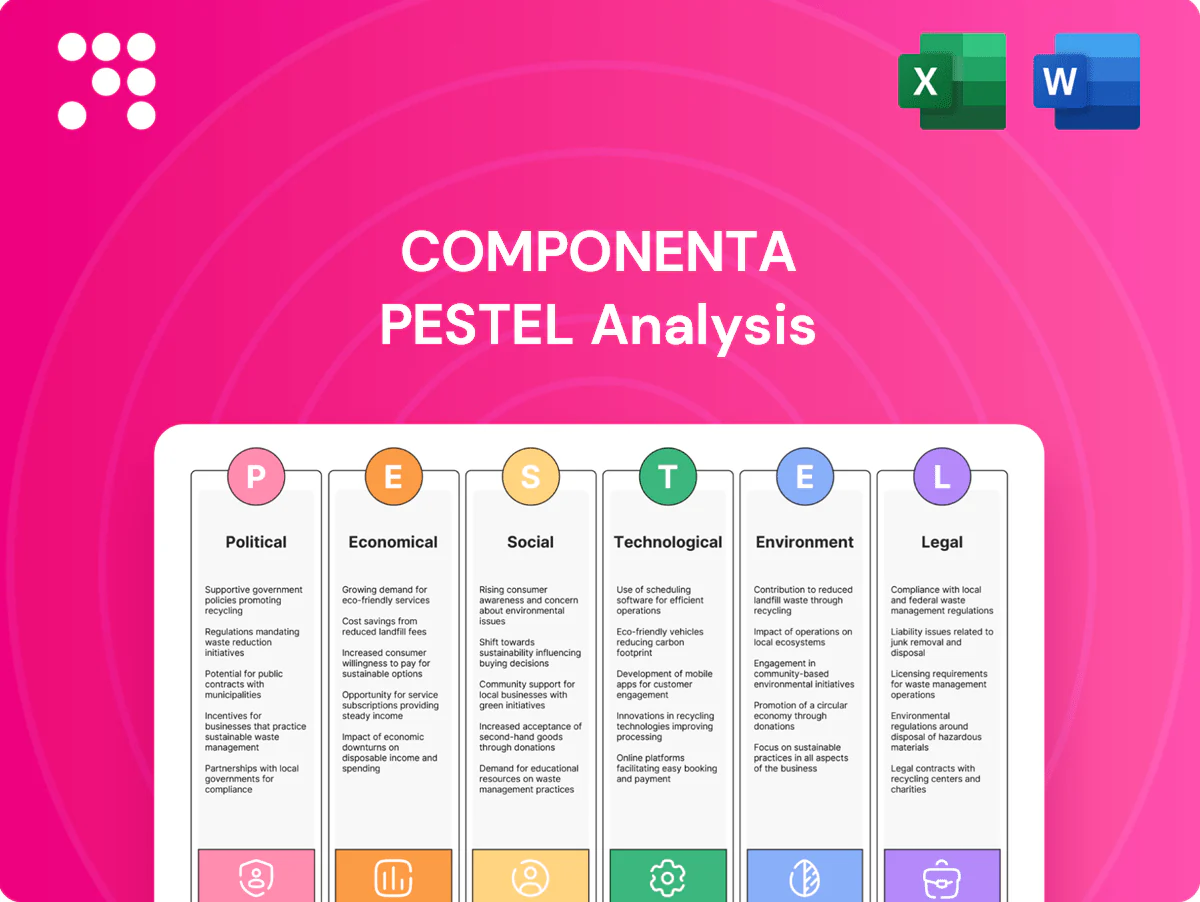
Componenta PESTLE Analysis

Make Smarter Strategic Decisions with a Complete PESTEL View
Our PESTLE Analysis for Componenta reveals how political shifts, economic cycles, and emerging technologies are reshaping its operating landscape, pinpointing risks and growth levers for investors and strategists. Concise, evidence-based insights help you anticipate regulatory and market moves that affect margins and supply chains. Purchase the full report to access the complete, editable analysis and actionable recommendations instantly.
Political factors

EU industrial and trade policy direction
Shifts in EU industrial strategy, notably the 2023 Critical Raw Materials Act with 2030 targets of 10% extraction, 40% processing and 15% recycling, plus Net‑Zero/green industrial measures, can reshape Componenta’s market access and competitiveness.
EU state aid regimes and IPCEI mechanisms enable large subsidies for regional metal processing while tariffs and anti‑dumping duties—historically reaching up to ~40%—directly affect input costs and sourcing.
Localization incentives across the bloc favor regional production footprints; monitoring Brussels initiatives is critical for timing investments and supply contracts.
Geopolitical supply chain stability
Geopolitical tensions can disrupt flows of iron ore (seaborne trade ~1.5 billion tonnes in 2023), scrap, alloys and energy, raising input cost volatility for foundries. Sanctions and export controls since 2022 have constrained specialized machinery and inputs for EU producers. Diversified suppliers and nearshoring reduced exposure; scenario planning preserves service levels to vehicle and machinery OEMs.

Public infrastructure and defense spending
Government capex cycles drive demand for heavy machinery components; the EU Recovery and Resilience Facility mobilized €723.8bn and national infrastructure plans increased public orders in 2023–24. Global military spending reached $2.4tn in 2023, supporting multi-year defense contracts. Procurement rules increasingly favor domestic/EU suppliers, so aligning capacity with public pipelines improves utilization.

Energy policy and subsidies
- EU industrial electricity ≈€0.14/kWh (2024)
- EU ETS ≈€90/t CO2 (2024–25)
- Innovation Fund & national grants accelerate electrification
- Long‑term PPAs reduce exposure to spot volatility
Environmental regulation tightening
- EU ETS price: €80–95/ton (2024–mid‑2025)
- Fit for 55: 55% GHG cut by 2030 (EU target)
- Capital intensity: high for abatement upgrades
- Early movers: easier permitting, stronger community support
EU green rules, high ETS power costs drive nearshoring, subsidies and procurement opportunities
EU policies (Critical Raw Materials Act, Fit for 55) reshape market access and favor nearshoring, affecting Componenta’s contracts and permits.
EU ETS ≈€90/t CO2 and industrial electricity ≈€0.14/kWh (2024) raise operating costs but unlock Innovation Fund and national grants for electrification.
State aid/IPCEI, anti‑dumping (up to ~40%) and public capex (RRF €723.8bn) create subsidy and procurement opportunities.
| Metric | Value |
|---|---|
| EU ETS | ≈€90/t (2024–25) |
| Power | ≈€0.14/kWh (2024) |
| RRF | €723.8bn |
| Anti‑dumping | up to ~40% |
What is included in the product
 Detailed Word Document
Explores how external macro-environmental factors uniquely affect Componenta across six dimensions—Political, Economic, Social, Technological, Environmental and Legal—using sector- and region-specific data and trends. Designed for executives, consultants and investors, it highlights threats, opportunities and forward-looking scenarios ready for inclusion in plans and decks.

 Customizable Excel Spreadsheet
Provides a clean, categorized PESTLE summary for Componenta, enabling quick reference in meetings and slide decks; editable notes let teams localize risks and opportunities, easing alignment and strategic decision‑making.
Economic factors

Cyclical demand in automotive and machinery
Cyclical demand in automotive, agriculture, construction and industrial segments drives sharp order volatility for Componenta, with global vehicle production around 80 million units in 2024 amplifying swings in casting orders. Inventory adjustments at OEMs quickly ripple into foundry volumes, forcing short lead-time changes. Componenta must balance flexible capacity with tight cost discipline, while diversification across segments smooths revenue and reduces exposure to any single cycle.
Raw material and energy cost swings
Iron scrap (~€300–450/t in 2024), pig iron and alloy premiums plus Nordic power (~€60–80/MWh in 2024) materially swing Componenta margins; input moves can change gross margins by several percentage points. Index-based pricing and hedging stabilize realized spreads, supplier partnerships secure material availability in tight markets, and continuous yield improvements offset input inflation.

Currency fluctuations and export exposure
FX moves alter Componenta’s competitiveness and the translation of foreign revenues, affecting margins on exported castings and machined parts. Natural hedges through local sourcing and production footprints reduce net exposure in volatile corridors. Financial hedging (forwards/options) protects margins on long-dated contracts. Contractual pricing clauses enable pass-through of raw-material and currency volatility to customers.

Interest rates and capex affordability
Higher policy rates (Fed funds ~5.25–5.50% in 2024–25) have lifted corporate WACC by roughly 100–200 bps, raising hurdle rates for furnace, machining and automation projects; customers often defer capital programs, shifting backlog timing by 3–12 months, while targeted high-IRR upgrades (IRR >15%) remain value accretive and public grants (EU RRF, US IRA) can materially improve project NPV.
- WACC +100–200bps
- Backlog delays 3–12 months
- High-IRR upgrades >15%
- Grants (EU RRF/US IRA) improve NPV
Labor availability and wage trends
Tight skilled-trade markets push wages higher and can cap Componenta’s output as foundry and machining cells face recruitment bottlenecks; Finnish manufacturing hourly labour costs rose about 4% y/y in 2024, pressuring margins. Apprenticeships and targeted upskilling programs in Finland have expanded capacity and stabilized productivity in metal trades. Automation investments in critical cells reduce cycle-time bottlenecks and labor dependency. Strong employer branding shortens recruitment lead times and lowers agency costs.
- Skilled-trade pressure: Finnish manufacturing labour costs +4% y/y (2024)
- Upskilling: apprenticeship expansion stabilizes productivity
- Automation: reduces critical-cell bottlenecks
- Employer branding: cuts recruitment lead times and costs
EU green rules, high ETS power costs drive nearshoring, subsidies and procurement opportunities
Cyclical demand (global vehicle prod ~80m in 2024) drives order volatility across automotive, agri, construction and industrial segments, requiring flexible capacity and cost control. Input swings (scrap €300–450/t; Nordic power €60–80/MWh in 2024) and FX materially move margins; hedging and index pricing mitigate risk. Higher rates (WACC +100–200bps) and Finnish labour +4% y/y (2024) tighten project economics.
| Metric | 2024/25 Value |
|---|---|
| Global vehicle prod | ~80m (2024) |
| Iron scrap | €300–450/t (2024) |
| Nordic power | €60–80/MWh (2024) |
| WACC move | +100–200bps |
| Finnish labour | +4% y/y (2024) |
Full Version Awaits
Componenta PESTLE Analysis
The Componenta PESTLE Analysis preview is the exact, fully formatted document you’ll receive after purchase—no placeholders or edits. The layout, content, and structure shown here are final and ready to download immediately after payment. This is the real file you’ll own and use for analysis and decision-making.

Make Smarter Strategic Decisions with a Complete PESTEL View
Our PESTLE Analysis for Componenta reveals how political shifts, economic cycles, and emerging technologies are reshaping its operating landscape, pinpointing risks and growth levers for investors and strategists. Concise, evidence-based insights help you anticipate regulatory and market moves that affect margins and supply chains. Purchase the full report to access the complete, editable analysis and actionable recommendations instantly.
Political factors
EU industrial and trade policy direction
Shifts in EU industrial strategy, notably the 2023 Critical Raw Materials Act with 2030 targets of 10% extraction, 40% processing and 15% recycling, plus Net‑Zero/green industrial measures, can reshape Componenta’s market access and competitiveness.
EU state aid regimes and IPCEI mechanisms enable large subsidies for regional metal processing while tariffs and anti‑dumping duties—historically reaching up to ~40%—directly affect input costs and sourcing.
Localization incentives across the bloc favor regional production footprints; monitoring Brussels initiatives is critical for timing investments and supply contracts.
Geopolitical supply chain stability
Geopolitical tensions can disrupt flows of iron ore (seaborne trade ~1.5 billion tonnes in 2023), scrap, alloys and energy, raising input cost volatility for foundries. Sanctions and export controls since 2022 have constrained specialized machinery and inputs for EU producers. Diversified suppliers and nearshoring reduced exposure; scenario planning preserves service levels to vehicle and machinery OEMs.
Public infrastructure and defense spending
Government capex cycles drive demand for heavy machinery components; the EU Recovery and Resilience Facility mobilized €723.8bn and national infrastructure plans increased public orders in 2023–24. Global military spending reached $2.4tn in 2023, supporting multi-year defense contracts. Procurement rules increasingly favor domestic/EU suppliers, so aligning capacity with public pipelines improves utilization.
Energy policy and subsidies
- EU industrial electricity ≈€0.14/kWh (2024)
- EU ETS ≈€90/t CO2 (2024–25)
- Innovation Fund & national grants accelerate electrification
- Long‑term PPAs reduce exposure to spot volatility
Environmental regulation tightening
- EU ETS price: €80–95/ton (2024–mid‑2025)
- Fit for 55: 55% GHG cut by 2030 (EU target)
- Capital intensity: high for abatement upgrades
- Early movers: easier permitting, stronger community support
EU green rules, high ETS power costs drive nearshoring, subsidies and procurement opportunities
EU policies (Critical Raw Materials Act, Fit for 55) reshape market access and favor nearshoring, affecting Componenta’s contracts and permits.
EU ETS ≈€90/t CO2 and industrial electricity ≈€0.14/kWh (2024) raise operating costs but unlock Innovation Fund and national grants for electrification.
State aid/IPCEI, anti‑dumping (up to ~40%) and public capex (RRF €723.8bn) create subsidy and procurement opportunities.
| Metric | Value |
|---|---|
| EU ETS | ≈€90/t (2024–25) |
| Power | ≈€0.14/kWh (2024) |
| RRF | €723.8bn |
| Anti‑dumping | up to ~40% |
What is included in the product
Detailed Word Document
Explores how external macro-environmental factors uniquely affect Componenta across six dimensions—Political, Economic, Social, Technological, Environmental and Legal—using sector- and region-specific data and trends. Designed for executives, consultants and investors, it highlights threats, opportunities and forward-looking scenarios ready for inclusion in plans and decks.
Customizable Excel Spreadsheet
Provides a clean, categorized PESTLE summary for Componenta, enabling quick reference in meetings and slide decks; editable notes let teams localize risks and opportunities, easing alignment and strategic decision‑making.
Economic factors
Cyclical demand in automotive and machinery
Cyclical demand in automotive, agriculture, construction and industrial segments drives sharp order volatility for Componenta, with global vehicle production around 80 million units in 2024 amplifying swings in casting orders. Inventory adjustments at OEMs quickly ripple into foundry volumes, forcing short lead-time changes. Componenta must balance flexible capacity with tight cost discipline, while diversification across segments smooths revenue and reduces exposure to any single cycle.
Raw material and energy cost swings
Iron scrap (~€300–450/t in 2024), pig iron and alloy premiums plus Nordic power (~€60–80/MWh in 2024) materially swing Componenta margins; input moves can change gross margins by several percentage points. Index-based pricing and hedging stabilize realized spreads, supplier partnerships secure material availability in tight markets, and continuous yield improvements offset input inflation.
Currency fluctuations and export exposure
FX moves alter Componenta’s competitiveness and the translation of foreign revenues, affecting margins on exported castings and machined parts. Natural hedges through local sourcing and production footprints reduce net exposure in volatile corridors. Financial hedging (forwards/options) protects margins on long-dated contracts. Contractual pricing clauses enable pass-through of raw-material and currency volatility to customers.
Interest rates and capex affordability
Higher policy rates (Fed funds ~5.25–5.50% in 2024–25) have lifted corporate WACC by roughly 100–200 bps, raising hurdle rates for furnace, machining and automation projects; customers often defer capital programs, shifting backlog timing by 3–12 months, while targeted high-IRR upgrades (IRR >15%) remain value accretive and public grants (EU RRF, US IRA) can materially improve project NPV.
- WACC +100–200bps
- Backlog delays 3–12 months
- High-IRR upgrades >15%
- Grants (EU RRF/US IRA) improve NPV
Labor availability and wage trends
Tight skilled-trade markets push wages higher and can cap Componenta’s output as foundry and machining cells face recruitment bottlenecks; Finnish manufacturing hourly labour costs rose about 4% y/y in 2024, pressuring margins. Apprenticeships and targeted upskilling programs in Finland have expanded capacity and stabilized productivity in metal trades. Automation investments in critical cells reduce cycle-time bottlenecks and labor dependency. Strong employer branding shortens recruitment lead times and lowers agency costs.
- Skilled-trade pressure: Finnish manufacturing labour costs +4% y/y (2024)
- Upskilling: apprenticeship expansion stabilizes productivity
- Automation: reduces critical-cell bottlenecks
- Employer branding: cuts recruitment lead times and costs
EU green rules, high ETS power costs drive nearshoring, subsidies and procurement opportunities
Cyclical demand (global vehicle prod ~80m in 2024) drives order volatility across automotive, agri, construction and industrial segments, requiring flexible capacity and cost control. Input swings (scrap €300–450/t; Nordic power €60–80/MWh in 2024) and FX materially move margins; hedging and index pricing mitigate risk. Higher rates (WACC +100–200bps) and Finnish labour +4% y/y (2024) tighten project economics.
| Metric | 2024/25 Value |
|---|---|
| Global vehicle prod | ~80m (2024) |
| Iron scrap | €300–450/t (2024) |
| Nordic power | €60–80/MWh (2024) |
| WACC move | +100–200bps |
| Finnish labour | +4% y/y (2024) |
Full Version Awaits
Componenta PESTLE Analysis
The Componenta PESTLE Analysis preview is the exact, fully formatted document you’ll receive after purchase—no placeholders or edits. The layout, content, and structure shown here are final and ready to download immediately after payment. This is the real file you’ll own and use for analysis and decision-making.
Description
Make Smarter Strategic Decisions with a Complete PESTEL View
Our PESTLE Analysis for Componenta reveals how political shifts, economic cycles, and emerging technologies are reshaping its operating landscape, pinpointing risks and growth levers for investors and strategists. Concise, evidence-based insights help you anticipate regulatory and market moves that affect margins and supply chains. Purchase the full report to access the complete, editable analysis and actionable recommendations instantly.
Political factors
EU industrial and trade policy direction
Shifts in EU industrial strategy, notably the 2023 Critical Raw Materials Act with 2030 targets of 10% extraction, 40% processing and 15% recycling, plus Net‑Zero/green industrial measures, can reshape Componenta’s market access and competitiveness.
EU state aid regimes and IPCEI mechanisms enable large subsidies for regional metal processing while tariffs and anti‑dumping duties—historically reaching up to ~40%—directly affect input costs and sourcing.
Localization incentives across the bloc favor regional production footprints; monitoring Brussels initiatives is critical for timing investments and supply contracts.
Geopolitical supply chain stability
Geopolitical tensions can disrupt flows of iron ore (seaborne trade ~1.5 billion tonnes in 2023), scrap, alloys and energy, raising input cost volatility for foundries. Sanctions and export controls since 2022 have constrained specialized machinery and inputs for EU producers. Diversified suppliers and nearshoring reduced exposure; scenario planning preserves service levels to vehicle and machinery OEMs.
Public infrastructure and defense spending
Government capex cycles drive demand for heavy machinery components; the EU Recovery and Resilience Facility mobilized €723.8bn and national infrastructure plans increased public orders in 2023–24. Global military spending reached $2.4tn in 2023, supporting multi-year defense contracts. Procurement rules increasingly favor domestic/EU suppliers, so aligning capacity with public pipelines improves utilization.
Energy policy and subsidies
- EU industrial electricity ≈€0.14/kWh (2024)
- EU ETS ≈€90/t CO2 (2024–25)
- Innovation Fund & national grants accelerate electrification
- Long‑term PPAs reduce exposure to spot volatility
Environmental regulation tightening
- EU ETS price: €80–95/ton (2024–mid‑2025)
- Fit for 55: 55% GHG cut by 2030 (EU target)
- Capital intensity: high for abatement upgrades
- Early movers: easier permitting, stronger community support
EU green rules, high ETS power costs drive nearshoring, subsidies and procurement opportunities
EU policies (Critical Raw Materials Act, Fit for 55) reshape market access and favor nearshoring, affecting Componenta’s contracts and permits.
EU ETS ≈€90/t CO2 and industrial electricity ≈€0.14/kWh (2024) raise operating costs but unlock Innovation Fund and national grants for electrification.
State aid/IPCEI, anti‑dumping (up to ~40%) and public capex (RRF €723.8bn) create subsidy and procurement opportunities.
| Metric | Value |
|---|---|
| EU ETS | ≈€90/t (2024–25) |
| Power | ≈€0.14/kWh (2024) |
| RRF | €723.8bn |
| Anti‑dumping | up to ~40% |
What is included in the product
Detailed Word Document
Explores how external macro-environmental factors uniquely affect Componenta across six dimensions—Political, Economic, Social, Technological, Environmental and Legal—using sector- and region-specific data and trends. Designed for executives, consultants and investors, it highlights threats, opportunities and forward-looking scenarios ready for inclusion in plans and decks.
Customizable Excel Spreadsheet
Provides a clean, categorized PESTLE summary for Componenta, enabling quick reference in meetings and slide decks; editable notes let teams localize risks and opportunities, easing alignment and strategic decision‑making.
Economic factors
Cyclical demand in automotive and machinery
Cyclical demand in automotive, agriculture, construction and industrial segments drives sharp order volatility for Componenta, with global vehicle production around 80 million units in 2024 amplifying swings in casting orders. Inventory adjustments at OEMs quickly ripple into foundry volumes, forcing short lead-time changes. Componenta must balance flexible capacity with tight cost discipline, while diversification across segments smooths revenue and reduces exposure to any single cycle.
Raw material and energy cost swings
Iron scrap (~€300–450/t in 2024), pig iron and alloy premiums plus Nordic power (~€60–80/MWh in 2024) materially swing Componenta margins; input moves can change gross margins by several percentage points. Index-based pricing and hedging stabilize realized spreads, supplier partnerships secure material availability in tight markets, and continuous yield improvements offset input inflation.
Currency fluctuations and export exposure
FX moves alter Componenta’s competitiveness and the translation of foreign revenues, affecting margins on exported castings and machined parts. Natural hedges through local sourcing and production footprints reduce net exposure in volatile corridors. Financial hedging (forwards/options) protects margins on long-dated contracts. Contractual pricing clauses enable pass-through of raw-material and currency volatility to customers.
Interest rates and capex affordability
Higher policy rates (Fed funds ~5.25–5.50% in 2024–25) have lifted corporate WACC by roughly 100–200 bps, raising hurdle rates for furnace, machining and automation projects; customers often defer capital programs, shifting backlog timing by 3–12 months, while targeted high-IRR upgrades (IRR >15%) remain value accretive and public grants (EU RRF, US IRA) can materially improve project NPV.
- WACC +100–200bps
- Backlog delays 3–12 months
- High-IRR upgrades >15%
- Grants (EU RRF/US IRA) improve NPV
Labor availability and wage trends
Tight skilled-trade markets push wages higher and can cap Componenta’s output as foundry and machining cells face recruitment bottlenecks; Finnish manufacturing hourly labour costs rose about 4% y/y in 2024, pressuring margins. Apprenticeships and targeted upskilling programs in Finland have expanded capacity and stabilized productivity in metal trades. Automation investments in critical cells reduce cycle-time bottlenecks and labor dependency. Strong employer branding shortens recruitment lead times and lowers agency costs.
- Skilled-trade pressure: Finnish manufacturing labour costs +4% y/y (2024)
- Upskilling: apprenticeship expansion stabilizes productivity
- Automation: reduces critical-cell bottlenecks
- Employer branding: cuts recruitment lead times and costs
EU green rules, high ETS power costs drive nearshoring, subsidies and procurement opportunities
Cyclical demand (global vehicle prod ~80m in 2024) drives order volatility across automotive, agri, construction and industrial segments, requiring flexible capacity and cost control. Input swings (scrap €300–450/t; Nordic power €60–80/MWh in 2024) and FX materially move margins; hedging and index pricing mitigate risk. Higher rates (WACC +100–200bps) and Finnish labour +4% y/y (2024) tighten project economics.
| Metric | 2024/25 Value |
|---|---|
| Global vehicle prod | ~80m (2024) |
| Iron scrap | €300–450/t (2024) |
| Nordic power | €60–80/MWh (2024) |
| WACC move | +100–200bps |
| Finnish labour | +4% y/y (2024) |
Full Version Awaits
Componenta PESTLE Analysis
The Componenta PESTLE Analysis preview is the exact, fully formatted document you’ll receive after purchase—no placeholders or edits. The layout, content, and structure shown here are final and ready to download immediately after payment. This is the real file you’ll own and use for analysis and decision-making.











