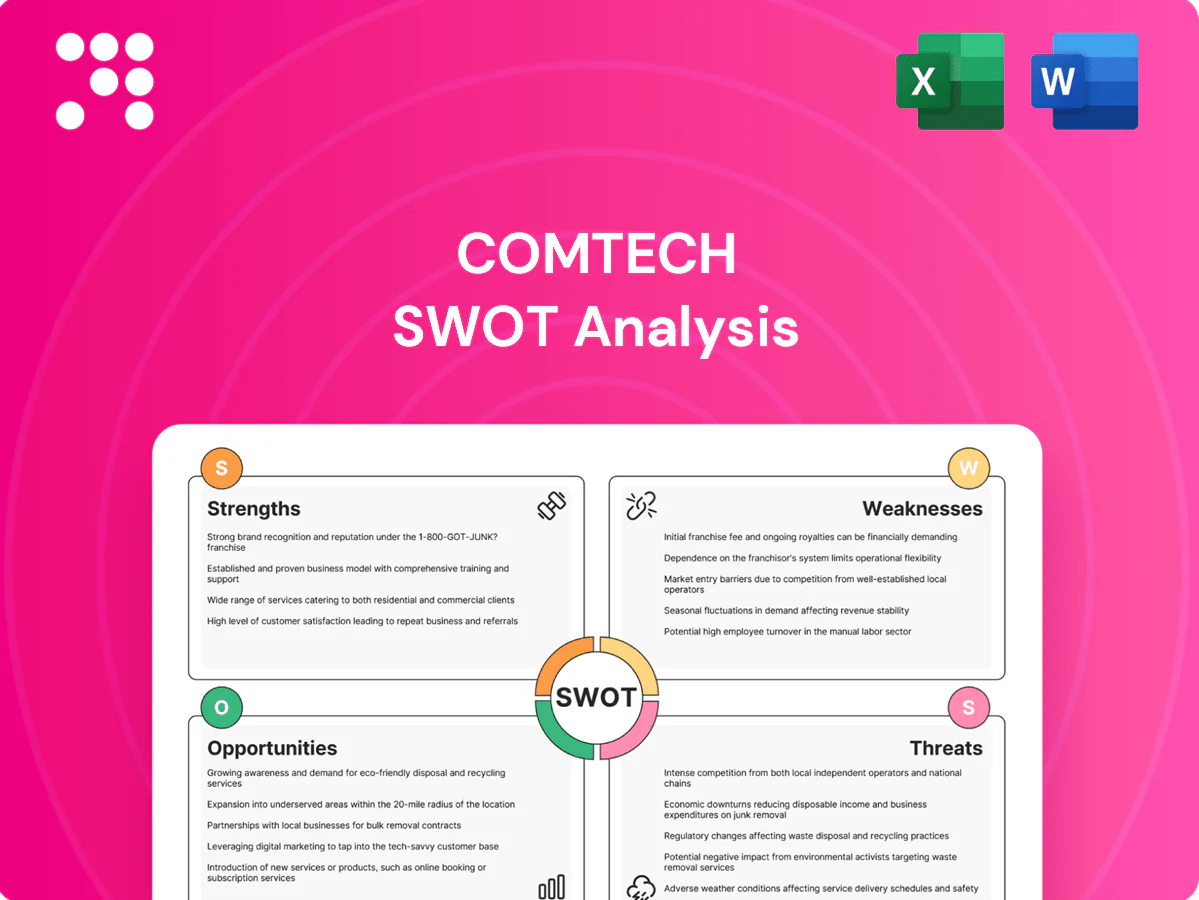
Comtech SWOT Analysis

Go Beyond the Preview—Access the Full Strategic Report
Comtech's SWOT reveals resilient niche strengths in satellite and secure communications, coupled with growth opportunities in 5G and defense contracts, but faces supply-chain pressures and competitive tech risks; our concise preview highlights key takeaways and strategic implications. Want deeper financial context, editable matrices, and actionable recommendations? Purchase the full SWOT analysis for a professionally formatted Word and Excel package to inform investments and strategy.
Strengths

Diverse comms portfolio
Comtech spans satellite and terrestrial wireless, reducing reliance on a single technology cycle and supporting a 2024 revenue mix across multiple end markets (company reported FY2024 revenue of approximately $420 million and a backlog near $300 million). This breadth enables bundling of hardware, software and services to deliver differentiated solutions and capture higher-margin contracts. Cross-selling leverages commercial and government footprints, enhancing resilience through market fluctuations.
Mission‑critical focus
Comtech (ticker CMTL) supplies mission‑critical systems for public safety, NG911, secure wireless and defense where reliability is mandatory; high certification barriers and switching costs create sticky customer relationships. Proven performance in extreme conditions improves win rates and supports premium pricing and multi‑year contracts.

Government and commercial reach
Serving both government and commercial customers diversifies Comtech’s revenue and pipeline, reducing single-market dependency. Government programs provide multi‑year contract visibility while commercial deals offer upside and growth optionality. Dual exposure smooths revenue across budget cycles and economic swings and expands partner ecosystems and technology channels.

NG911 and LBS capabilities
Next‑gen 911 and LBS align with regulatory mandates and public safety modernization, supporting agency migration to IP‑based systems. Accurate routing and location underpin life‑critical use cases, increasing technical and regulatory barriers to entry; over 80% of 911 calls now originate from mobile phones (FCC). Software platforms create recurring revenue streams and the domain expertise strengthens Comtech’s credibility with agencies and carriers.
- Regulatory alignment
- Life‑critical routing = high barriers
- Recurring software revenue
- Strengthened agency/carrier trust
IP and engineering depth
Comtech’s heritage in RF engineering, SATCOM modem platforms and secure protocols creates a defensible IP base that underpins long-term customer relationships and government approvals.
Deep engineering teams enable rapid customization for complex RFPs, while certification expertise shortens deployment timelines for defense and telecom customers.
Ongoing R&D investment sustains product roadmaps and competitive moats across satellite and secure communications markets.
- tick: CMTL
- strength: RF + SATCOM IP
- advantage: rapid customization
- benefit: certification speed
- moat: continuous R&D
Diversified SATCOM and secure wireless mix fuels $420M FY2024 revenue, $300M backlog
Comtech's diversified satellite and terrestrial portfolio drove FY2024 revenue of ~$420M and backlog near $300M, enabling bundled hardware/software/services and higher-margin contracts. Mission-critical NG911, secure wireless and defense positions create high switching costs, recurring software revenue and sticky customer relationships. Deep RF/SATCOM IP, rapid customization and sustained R&D underpin multi-year government and commercial wins.
| Metric | Value |
|---|---|
| Ticker | CMTL |
| FY2024 revenue | $420M |
| Backlog | $300M |
| Core markets | NG911, SATCOM, secure wireless, defense |
What is included in the product
 Detailed Word Document
Provides a concise strategic overview of Comtech’s strengths, weaknesses, opportunities, and threats, highlighting its technological capabilities and market positioning, growth prospects in satellite, wireless and cybersecurity, operational and financial vulnerabilities, competitive pressures, and regulatory and market risks shaping future performance.

 Customizable Excel Spreadsheet
Provides a concise SWOT matrix for Comtech to quickly identify strengths, weaknesses, opportunities, and threats, easing cross-team alignment and accelerating strategic decision-making.
Weaknesses

Contract concentration
Dependence on large government programs makes Comtech's revenue lumpy, with the top five customers historically representing roughly 50% of sales, concentrating risk. Cancellations, protests or schedule delays can materially swing quarterly results and backlog. Heavy compliance (FAR, ITAR, CMMC) raises program costs and complexity. A few key customers also exert pricing leverage, pressuring margins.
Long sales and deployment cycles
Mission‑critical projects often require 12–36 months for procurement, testing and integration, with milestone billing that can delay cash conversion by 6–18 months; when awards slip forecasting volatility increases and working capital needs frequently rise by double‑digit millions during build phases.

Scale vs larger rivals
Competing with primes and hyperscale vendors compresses Comtech margins as larger rivals use scale to underprice bids. Big players can outspend on R&D—many defense primes report R&D budgets above $1B—and deploy aggressive pricing. Customer perception often favors incumbents with broader portfolios, and procurement risk rises as bundled mega‑solutions (AWS/Azure/GCP ~70% of cloud IaaS/PaaS market in 2024) are preferred.

Product/portfolio complexity
Comtech's broad product and portfolio breadth increases support, integration, and lifecycle management burdens, raising per-unit operating costs and stretching specialized engineering resources. Fragmentation across multiple platforms dilutes marketing clarity and channel messaging, making go-to-market efforts less efficient. Overlap between product lines creates internal prioritization conflicts and elevates the risk of execution slippage on key programs.
- Support & lifecycle burden
- Marketing dilution
- Internal prioritization conflicts
- Higher execution slippage risk
Capital intensity
Comtech's capital intensity forces continuous capex and inventory buildup for hardware and infrastructure programs, constraining free cash flow and working capital flexibility. Supply-chain buffers and long lead times tie up cash and increase carrying costs, while testing and certification impose fixed overhead before revenue recognition. Program returns depend heavily on maintaining high utilization and uninterrupted program continuity, making profitability cyclical and sensitive to contract timing.
- High capex needs
- Inventory ties up cash
- Fixed testing/certification costs
- Returns hinge on utilization and program continuity
Govt dependence (50%) and 12–36m procurements cause lumpy revenue, margin squeeze
Dependence on large government programs (top 5 ≈50% of sales) and long procurement cycles (12–36 months) creates lumpy revenue and backlog risk; milestone billing delays cash conversion 6–18 months. Competitive pressure from primes and hyperscalers (AWS/Azure/GCP ≈70% IaaS/PaaS share in 2024) compresses margins. High compliance, capex and inventory tie-up raise program costs and working‑capital needs.
| Metric | Value |
|---|---|
| Top‑5 customers | ≈50% of sales |
| Procurement cycle | 12–36 months |
| Cash conversion lag | 6–18 months |
| Cloud IaaS/PaaS (2024) | ≈70% market share |
What You See Is What You Get
Comtech SWOT Analysis
This is the actual Comtech SWOT analysis document you’ll receive upon purchase—no surprises, just professional quality. The preview below is taken directly from the full report; buying unlocks the complete, editable version. You’re viewing a live excerpt of the real file ready for download after checkout.

Go Beyond the Preview—Access the Full Strategic Report
Comtech's SWOT reveals resilient niche strengths in satellite and secure communications, coupled with growth opportunities in 5G and defense contracts, but faces supply-chain pressures and competitive tech risks; our concise preview highlights key takeaways and strategic implications. Want deeper financial context, editable matrices, and actionable recommendations? Purchase the full SWOT analysis for a professionally formatted Word and Excel package to inform investments and strategy.
Strengths
Diverse comms portfolio
Comtech spans satellite and terrestrial wireless, reducing reliance on a single technology cycle and supporting a 2024 revenue mix across multiple end markets (company reported FY2024 revenue of approximately $420 million and a backlog near $300 million). This breadth enables bundling of hardware, software and services to deliver differentiated solutions and capture higher-margin contracts. Cross-selling leverages commercial and government footprints, enhancing resilience through market fluctuations.
Mission‑critical focus
Comtech (ticker CMTL) supplies mission‑critical systems for public safety, NG911, secure wireless and defense where reliability is mandatory; high certification barriers and switching costs create sticky customer relationships. Proven performance in extreme conditions improves win rates and supports premium pricing and multi‑year contracts.
Government and commercial reach
Serving both government and commercial customers diversifies Comtech’s revenue and pipeline, reducing single-market dependency. Government programs provide multi‑year contract visibility while commercial deals offer upside and growth optionality. Dual exposure smooths revenue across budget cycles and economic swings and expands partner ecosystems and technology channels.
NG911 and LBS capabilities
Next‑gen 911 and LBS align with regulatory mandates and public safety modernization, supporting agency migration to IP‑based systems. Accurate routing and location underpin life‑critical use cases, increasing technical and regulatory barriers to entry; over 80% of 911 calls now originate from mobile phones (FCC). Software platforms create recurring revenue streams and the domain expertise strengthens Comtech’s credibility with agencies and carriers.
- Regulatory alignment
- Life‑critical routing = high barriers
- Recurring software revenue
- Strengthened agency/carrier trust
IP and engineering depth
Comtech’s heritage in RF engineering, SATCOM modem platforms and secure protocols creates a defensible IP base that underpins long-term customer relationships and government approvals.
Deep engineering teams enable rapid customization for complex RFPs, while certification expertise shortens deployment timelines for defense and telecom customers.
Ongoing R&D investment sustains product roadmaps and competitive moats across satellite and secure communications markets.
- tick: CMTL
- strength: RF + SATCOM IP
- advantage: rapid customization
- benefit: certification speed
- moat: continuous R&D
Diversified SATCOM and secure wireless mix fuels $420M FY2024 revenue, $300M backlog
Comtech's diversified satellite and terrestrial portfolio drove FY2024 revenue of ~$420M and backlog near $300M, enabling bundled hardware/software/services and higher-margin contracts. Mission-critical NG911, secure wireless and defense positions create high switching costs, recurring software revenue and sticky customer relationships. Deep RF/SATCOM IP, rapid customization and sustained R&D underpin multi-year government and commercial wins.
| Metric | Value |
|---|---|
| Ticker | CMTL |
| FY2024 revenue | $420M |
| Backlog | $300M |
| Core markets | NG911, SATCOM, secure wireless, defense |
What is included in the product
Detailed Word Document
Provides a concise strategic overview of Comtech’s strengths, weaknesses, opportunities, and threats, highlighting its technological capabilities and market positioning, growth prospects in satellite, wireless and cybersecurity, operational and financial vulnerabilities, competitive pressures, and regulatory and market risks shaping future performance.
Customizable Excel Spreadsheet
Provides a concise SWOT matrix for Comtech to quickly identify strengths, weaknesses, opportunities, and threats, easing cross-team alignment and accelerating strategic decision-making.
Weaknesses
Contract concentration
Dependence on large government programs makes Comtech's revenue lumpy, with the top five customers historically representing roughly 50% of sales, concentrating risk. Cancellations, protests or schedule delays can materially swing quarterly results and backlog. Heavy compliance (FAR, ITAR, CMMC) raises program costs and complexity. A few key customers also exert pricing leverage, pressuring margins.
Long sales and deployment cycles
Mission‑critical projects often require 12–36 months for procurement, testing and integration, with milestone billing that can delay cash conversion by 6–18 months; when awards slip forecasting volatility increases and working capital needs frequently rise by double‑digit millions during build phases.
Scale vs larger rivals
Competing with primes and hyperscale vendors compresses Comtech margins as larger rivals use scale to underprice bids. Big players can outspend on R&D—many defense primes report R&D budgets above $1B—and deploy aggressive pricing. Customer perception often favors incumbents with broader portfolios, and procurement risk rises as bundled mega‑solutions (AWS/Azure/GCP ~70% of cloud IaaS/PaaS market in 2024) are preferred.
Product/portfolio complexity
Comtech's broad product and portfolio breadth increases support, integration, and lifecycle management burdens, raising per-unit operating costs and stretching specialized engineering resources. Fragmentation across multiple platforms dilutes marketing clarity and channel messaging, making go-to-market efforts less efficient. Overlap between product lines creates internal prioritization conflicts and elevates the risk of execution slippage on key programs.
- Support & lifecycle burden
- Marketing dilution
- Internal prioritization conflicts
- Higher execution slippage risk
Capital intensity
Comtech's capital intensity forces continuous capex and inventory buildup for hardware and infrastructure programs, constraining free cash flow and working capital flexibility. Supply-chain buffers and long lead times tie up cash and increase carrying costs, while testing and certification impose fixed overhead before revenue recognition. Program returns depend heavily on maintaining high utilization and uninterrupted program continuity, making profitability cyclical and sensitive to contract timing.
- High capex needs
- Inventory ties up cash
- Fixed testing/certification costs
- Returns hinge on utilization and program continuity
Govt dependence (50%) and 12–36m procurements cause lumpy revenue, margin squeeze
Dependence on large government programs (top 5 ≈50% of sales) and long procurement cycles (12–36 months) creates lumpy revenue and backlog risk; milestone billing delays cash conversion 6–18 months. Competitive pressure from primes and hyperscalers (AWS/Azure/GCP ≈70% IaaS/PaaS share in 2024) compresses margins. High compliance, capex and inventory tie-up raise program costs and working‑capital needs.
| Metric | Value |
|---|---|
| Top‑5 customers | ≈50% of sales |
| Procurement cycle | 12–36 months |
| Cash conversion lag | 6–18 months |
| Cloud IaaS/PaaS (2024) | ≈70% market share |
What You See Is What You Get
Comtech SWOT Analysis
This is the actual Comtech SWOT analysis document you’ll receive upon purchase—no surprises, just professional quality. The preview below is taken directly from the full report; buying unlocks the complete, editable version. You’re viewing a live excerpt of the real file ready for download after checkout.
Original: $10.00
-65%$10.00
$3.50Description
Go Beyond the Preview—Access the Full Strategic Report
Comtech's SWOT reveals resilient niche strengths in satellite and secure communications, coupled with growth opportunities in 5G and defense contracts, but faces supply-chain pressures and competitive tech risks; our concise preview highlights key takeaways and strategic implications. Want deeper financial context, editable matrices, and actionable recommendations? Purchase the full SWOT analysis for a professionally formatted Word and Excel package to inform investments and strategy.
Strengths
Diverse comms portfolio
Comtech spans satellite and terrestrial wireless, reducing reliance on a single technology cycle and supporting a 2024 revenue mix across multiple end markets (company reported FY2024 revenue of approximately $420 million and a backlog near $300 million). This breadth enables bundling of hardware, software and services to deliver differentiated solutions and capture higher-margin contracts. Cross-selling leverages commercial and government footprints, enhancing resilience through market fluctuations.
Mission‑critical focus
Comtech (ticker CMTL) supplies mission‑critical systems for public safety, NG911, secure wireless and defense where reliability is mandatory; high certification barriers and switching costs create sticky customer relationships. Proven performance in extreme conditions improves win rates and supports premium pricing and multi‑year contracts.
Government and commercial reach
Serving both government and commercial customers diversifies Comtech’s revenue and pipeline, reducing single-market dependency. Government programs provide multi‑year contract visibility while commercial deals offer upside and growth optionality. Dual exposure smooths revenue across budget cycles and economic swings and expands partner ecosystems and technology channels.
NG911 and LBS capabilities
Next‑gen 911 and LBS align with regulatory mandates and public safety modernization, supporting agency migration to IP‑based systems. Accurate routing and location underpin life‑critical use cases, increasing technical and regulatory barriers to entry; over 80% of 911 calls now originate from mobile phones (FCC). Software platforms create recurring revenue streams and the domain expertise strengthens Comtech’s credibility with agencies and carriers.
- Regulatory alignment
- Life‑critical routing = high barriers
- Recurring software revenue
- Strengthened agency/carrier trust
IP and engineering depth
Comtech’s heritage in RF engineering, SATCOM modem platforms and secure protocols creates a defensible IP base that underpins long-term customer relationships and government approvals.
Deep engineering teams enable rapid customization for complex RFPs, while certification expertise shortens deployment timelines for defense and telecom customers.
Ongoing R&D investment sustains product roadmaps and competitive moats across satellite and secure communications markets.
- tick: CMTL
- strength: RF + SATCOM IP
- advantage: rapid customization
- benefit: certification speed
- moat: continuous R&D
Diversified SATCOM and secure wireless mix fuels $420M FY2024 revenue, $300M backlog
Comtech's diversified satellite and terrestrial portfolio drove FY2024 revenue of ~$420M and backlog near $300M, enabling bundled hardware/software/services and higher-margin contracts. Mission-critical NG911, secure wireless and defense positions create high switching costs, recurring software revenue and sticky customer relationships. Deep RF/SATCOM IP, rapid customization and sustained R&D underpin multi-year government and commercial wins.
| Metric | Value |
|---|---|
| Ticker | CMTL |
| FY2024 revenue | $420M |
| Backlog | $300M |
| Core markets | NG911, SATCOM, secure wireless, defense |
What is included in the product
Detailed Word Document
Provides a concise strategic overview of Comtech’s strengths, weaknesses, opportunities, and threats, highlighting its technological capabilities and market positioning, growth prospects in satellite, wireless and cybersecurity, operational and financial vulnerabilities, competitive pressures, and regulatory and market risks shaping future performance.
Customizable Excel Spreadsheet
Provides a concise SWOT matrix for Comtech to quickly identify strengths, weaknesses, opportunities, and threats, easing cross-team alignment and accelerating strategic decision-making.
Weaknesses
Contract concentration
Dependence on large government programs makes Comtech's revenue lumpy, with the top five customers historically representing roughly 50% of sales, concentrating risk. Cancellations, protests or schedule delays can materially swing quarterly results and backlog. Heavy compliance (FAR, ITAR, CMMC) raises program costs and complexity. A few key customers also exert pricing leverage, pressuring margins.
Long sales and deployment cycles
Mission‑critical projects often require 12–36 months for procurement, testing and integration, with milestone billing that can delay cash conversion by 6–18 months; when awards slip forecasting volatility increases and working capital needs frequently rise by double‑digit millions during build phases.
Scale vs larger rivals
Competing with primes and hyperscale vendors compresses Comtech margins as larger rivals use scale to underprice bids. Big players can outspend on R&D—many defense primes report R&D budgets above $1B—and deploy aggressive pricing. Customer perception often favors incumbents with broader portfolios, and procurement risk rises as bundled mega‑solutions (AWS/Azure/GCP ~70% of cloud IaaS/PaaS market in 2024) are preferred.
Product/portfolio complexity
Comtech's broad product and portfolio breadth increases support, integration, and lifecycle management burdens, raising per-unit operating costs and stretching specialized engineering resources. Fragmentation across multiple platforms dilutes marketing clarity and channel messaging, making go-to-market efforts less efficient. Overlap between product lines creates internal prioritization conflicts and elevates the risk of execution slippage on key programs.
- Support & lifecycle burden
- Marketing dilution
- Internal prioritization conflicts
- Higher execution slippage risk
Capital intensity
Comtech's capital intensity forces continuous capex and inventory buildup for hardware and infrastructure programs, constraining free cash flow and working capital flexibility. Supply-chain buffers and long lead times tie up cash and increase carrying costs, while testing and certification impose fixed overhead before revenue recognition. Program returns depend heavily on maintaining high utilization and uninterrupted program continuity, making profitability cyclical and sensitive to contract timing.
- High capex needs
- Inventory ties up cash
- Fixed testing/certification costs
- Returns hinge on utilization and program continuity
Govt dependence (50%) and 12–36m procurements cause lumpy revenue, margin squeeze
Dependence on large government programs (top 5 ≈50% of sales) and long procurement cycles (12–36 months) creates lumpy revenue and backlog risk; milestone billing delays cash conversion 6–18 months. Competitive pressure from primes and hyperscalers (AWS/Azure/GCP ≈70% IaaS/PaaS share in 2024) compresses margins. High compliance, capex and inventory tie-up raise program costs and working‑capital needs.
| Metric | Value |
|---|---|
| Top‑5 customers | ≈50% of sales |
| Procurement cycle | 12–36 months |
| Cash conversion lag | 6–18 months |
| Cloud IaaS/PaaS (2024) | ≈70% market share |
What You See Is What You Get
Comtech SWOT Analysis
This is the actual Comtech SWOT analysis document you’ll receive upon purchase—no surprises, just professional quality. The preview below is taken directly from the full report; buying unlocks the complete, editable version. You’re viewing a live excerpt of the real file ready for download after checkout.











