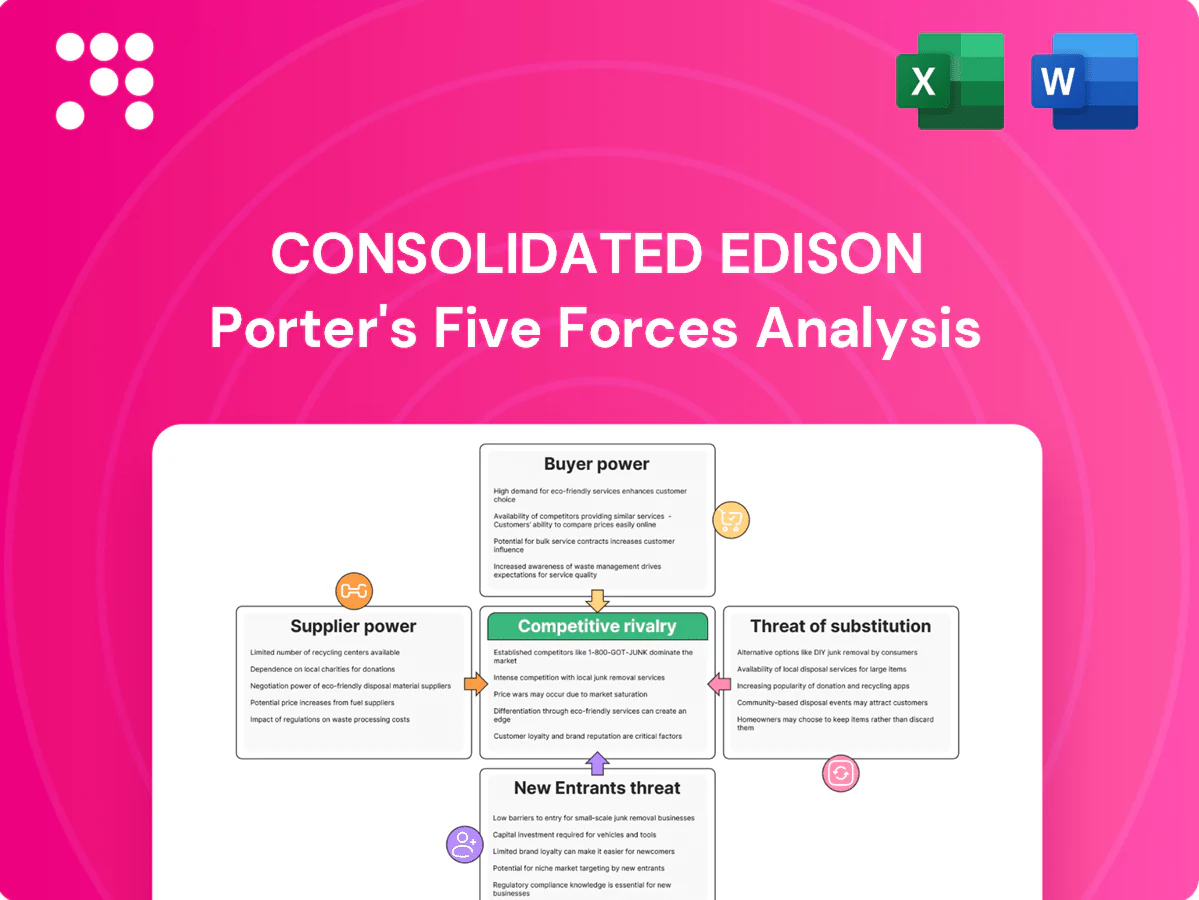
Consolidated Edison Porter's Five Forces Analysis

From Overview to Strategy Blueprint
Consolidated Edison faces limited threat of new entrants due to high infrastructure costs and regulation, moderate supplier leverage for fuel and equipment, and relatively low buyer power from captive utility customers, while rivalry is steady with other regulated utilities and substitute threats come from distributed generation and efficiency technologies. This preview is just the beginning. The full analysis provides a complete strategic snapshot with force-by-force ratings, visuals, and business implications tailored to Consolidated Edison.
Suppliers Bargaining Power

Fuel and commodity vendors
Con Edison depends heavily on natural gas and purchased power, which gives upstream fuel suppliers leverage during price spikes or pipeline constraints; however, NYPSC-regulated cost recovery and long-term contracts/hedging blunt that influence. Regional Northeast pipeline bottlenecks have periodically strengthened supplier bargaining positions. Expanding renewables and bilateral PPAs further mitigate exposure.
Grid equipment OEMs
Transformers, cables, breakers and advanced meters are sourced from a concentrated set of OEMs with 2024 lead times commonly 12–18 months for large transformers, tightening supplier leverage. Customization and limited global capacity increase switching costs and bargaining power. Con Edison’s multi-year procurement frameworks and scale (annual capex ~ $3–4bn) partially offset supplier power. New York regulatory support for resiliency capex allows easier pass-through of higher input costs.

Skilled labor and unions
Specialized union labor, largely represented by IBEW and other locals, is critical to Con Edison's safe operations and gives suppliers meaningful bargaining power; Consolidated Edison reported about 14,600 employees in its 2023 10-K, many unionized going into 2024. Wage, benefit and work-rule negotiations materially affect O&M costs and project timelines. Shortages in electricians, linemen and gas technicians tighten labor markets and raise premium pay. Targeted workforce development and selective automation (metering, diagnostics) can slowly rebalance leverage.

EPC and construction contractors
Large substation, undergrounding and transmission projects rely on a small pool of qualified EPC contractors, giving suppliers leverage as limited bidders and contractor backlogs push up premiums; staging multi-year procurement and competitive bidding reduce price pressure while performance incentives and risk-sharing clauses align contractor outcomes with Con Edison cost control.
- Limited qualified bidders raise contractor power
- Project backlogs increase premiums
- Multi-year pipelines + competitive bids lower costs
- Incentives and risk-sharing align performance
Renewable and storage suppliers
The bargaining power of renewable and storage suppliers for Consolidated Edison is elevated as inverters, batteries and interconnection services are concentrated among a few global vendors (top 5 ~60–70% share in 2023–24), and lithium-ion pack prices fell to about 120 USD/kWh in 2024, but raw material volatility sustains pricing power; standardization and multi-sourcing plus policy incentives and ~8–10% annual cost declines are reducing dependence.
- Concentration: top vendors ~60–70%
- Battery cost: ~120 USD/kWh (2024)
- Cost decline: ~8–10% p.a.
- Mitigation: standardization, multi-sourcing, policy support
Supplier power: fuel spikes vs regulatory hedges; labor 14,600; battery $120/kWh
Supplier power varies: fuel suppliers have leverage during gas price spikes but NYPSC cost recovery and hedges limit impact.
OEMs (transformers 12–18 month lead) and EPCs exert power; Con Edison scale and multi-year procurement (capex ~ $3–4bn) mitigate it.
Union labor (~14,600 employees in 2023) and concentrated renewables vendors (top 5 ~60–70%; battery ~120 USD/kWh in 2024) sustain supplier bargaining.
| Metric | 2023–24 |
|---|---|
| Employees | ~14,600 |
| Capex | $3–4bn |
| Transformer lead time | 12–18 mo |
| Battery cost | $120/kWh |
| Top vendors (renewables) | 60–70% |
What is included in the product
 Detailed Word Document
Concise Porter’s Five Forces analysis for Consolidated Edison revealing competitive rivalry, supplier and buyer power, threat of substitutes and new entrants, and regulatory/technological pressures shaping its pricing, margins, and strategic resilience.

 Customizable Excel Spreadsheet
One-sheet Consolidated Edison Porter’s Five Forces that instantly highlights regulatory, supplier, and competitor pressures with a clean radar chart—perfect for quick boardroom decisions; easily swap inputs or scenarios (rate changes, renewables entry) to see real-time strategic impacts without complex tools.
Customers Bargaining Power

Captive distribution customers
Con Edison is a captive distributor serving about 3.5 million electric and 1.1 million gas customers, so individual customer bargaining power is limited. The New York Public Service Commission sets rates and service standards, effectively substituting regulatory oversight for direct customer leverage. Decoupling mechanisms in rate plans reduce revenue sensitivity to usage swings, while PSC service quality metrics and complaint processes (tracked in regular reports) still influence outcomes.
Large C&I accounts
Major large C&I accounts can leverage detailed interval data and load shape to negotiate service classes and adopt demand response, on-site generation, and efficiency measures to lower bills; Con Edison serves about 3.5 million customers (2024), with C&I representing a small share of accounts but outsized revenue influence. Their ability to shift load gives them greater bargaining power than residential users, and targeted retention programs are used to manage these relationships.

ESCO choice and supply competition
Retail ESCOs (about 85 licensed in New York as of 2024) provide commodity alternatives that modestly expand buyer options, but Con Edison retains delivery charges—roughly half of a typical residential bill—so full switching power is limited; New York Public Service Commission guardrails on marketing, pricing disclosures and enrollment constrain ESCO offerings, yielding moderate buyer leverage on supply and low leverage on delivery.

DER-enabled customers
Rooftop solar, behind-the-meter batteries and smart building controls let Con Edison customers materially cut grid dependence; residential PV installed costs fell to about $2.5/W in 2024 and lithium-ion battery pack prices averaged roughly $140/kWh in 2024, boosting self-supply economics. Time-of-use tariffs and demand-response programs increase customers’ negotiating posture on rates and enrollment terms, while slow interconnection timelines and upfront economics remain gatekeepers to adoption. As DER costs decline and aggregation via VPPs scales, customer leverage over rates and program design rises.
- DER cost: residential PV ~ $2.5/W (2024)
- Battery price: ~ $140/kWh (2024)
- Barrier: interconnection timelines and upfront economics
- Driver: TOU tariffs, demand flexibility, VPP aggregation
Affordability and policy influence
Public pressure over affordability and climate goals channels through regulators and legislators, constraining allowed returns and shaping rate design via 2024 regulatory reviews and rate cases; Con Edison must navigate these policy-driven constraints when setting prices.
Low-income protections and energy-efficiency mandates in New York amplify indirect buyer power, forcing billing structures and program costs that shift recovery timelines.
Con Edison must balance recovery needs with customer priorities and legislative mandates, aligning investment plans with 2024 policy signals to avoid regulatory pushback.
- Regulatory pressure: 2024 rate cases shape allowed returns
- Affordability: low-income protections increase demand for subsidies
- Climate mandates: efficiency programs reduce volumetric sales
- Utility challenge: align cost recovery with policy and customer priorities
Major utility's captive delivery revenue under pressure from DER economics and ESCO competition
Con Edison faces limited individual customer bargaining power with ~3.5M electric and ~1.1M gas customers; delivery charges (~50% of residential bill) remain noncontestable. C&I accounts are few but revenue‑significant; ESCO choice (~85 licensed in NY, 2024) constrains commodity margins. DER economics (residential PV ~$2.5/W; batteries ~$140/kWh, 2024) and policy pressures raise collective buyer leverage over rates and programs.
| Metric | 2024 Value |
|---|---|
| Electric customers | ~3.5M |
| Gas customers | ~1.1M |
| ESCOs (NY) | ~85 |
| Delivery share of bill | ~50% |
| Residential PV cost | $2.5/W |
| Battery pack price | $140/kWh |
Preview the Actual Deliverable
Consolidated Edison Porter's Five Forces Analysis
This preview shows the exact Consolidated Edison Porter's Five Forces analysis you'll receive—no surprises, fully formatted and ready to use. It assesses industry rivalry, supplier and buyer power, threat of substitutes, and barriers to entry with insights tailored to ConEd's regulated utility context. Once purchased, you'll get instant access to this same comprehensive file for download.

From Overview to Strategy Blueprint
Consolidated Edison faces limited threat of new entrants due to high infrastructure costs and regulation, moderate supplier leverage for fuel and equipment, and relatively low buyer power from captive utility customers, while rivalry is steady with other regulated utilities and substitute threats come from distributed generation and efficiency technologies. This preview is just the beginning. The full analysis provides a complete strategic snapshot with force-by-force ratings, visuals, and business implications tailored to Consolidated Edison.
Suppliers Bargaining Power
Fuel and commodity vendors
Con Edison depends heavily on natural gas and purchased power, which gives upstream fuel suppliers leverage during price spikes or pipeline constraints; however, NYPSC-regulated cost recovery and long-term contracts/hedging blunt that influence. Regional Northeast pipeline bottlenecks have periodically strengthened supplier bargaining positions. Expanding renewables and bilateral PPAs further mitigate exposure.
Grid equipment OEMs
Transformers, cables, breakers and advanced meters are sourced from a concentrated set of OEMs with 2024 lead times commonly 12–18 months for large transformers, tightening supplier leverage. Customization and limited global capacity increase switching costs and bargaining power. Con Edison’s multi-year procurement frameworks and scale (annual capex ~ $3–4bn) partially offset supplier power. New York regulatory support for resiliency capex allows easier pass-through of higher input costs.
Skilled labor and unions
Specialized union labor, largely represented by IBEW and other locals, is critical to Con Edison's safe operations and gives suppliers meaningful bargaining power; Consolidated Edison reported about 14,600 employees in its 2023 10-K, many unionized going into 2024. Wage, benefit and work-rule negotiations materially affect O&M costs and project timelines. Shortages in electricians, linemen and gas technicians tighten labor markets and raise premium pay. Targeted workforce development and selective automation (metering, diagnostics) can slowly rebalance leverage.
EPC and construction contractors
Large substation, undergrounding and transmission projects rely on a small pool of qualified EPC contractors, giving suppliers leverage as limited bidders and contractor backlogs push up premiums; staging multi-year procurement and competitive bidding reduce price pressure while performance incentives and risk-sharing clauses align contractor outcomes with Con Edison cost control.
- Limited qualified bidders raise contractor power
- Project backlogs increase premiums
- Multi-year pipelines + competitive bids lower costs
- Incentives and risk-sharing align performance
Renewable and storage suppliers
The bargaining power of renewable and storage suppliers for Consolidated Edison is elevated as inverters, batteries and interconnection services are concentrated among a few global vendors (top 5 ~60–70% share in 2023–24), and lithium-ion pack prices fell to about 120 USD/kWh in 2024, but raw material volatility sustains pricing power; standardization and multi-sourcing plus policy incentives and ~8–10% annual cost declines are reducing dependence.
- Concentration: top vendors ~60–70%
- Battery cost: ~120 USD/kWh (2024)
- Cost decline: ~8–10% p.a.
- Mitigation: standardization, multi-sourcing, policy support
Supplier power: fuel spikes vs regulatory hedges; labor 14,600; battery $120/kWh
Supplier power varies: fuel suppliers have leverage during gas price spikes but NYPSC cost recovery and hedges limit impact.
OEMs (transformers 12–18 month lead) and EPCs exert power; Con Edison scale and multi-year procurement (capex ~ $3–4bn) mitigate it.
Union labor (~14,600 employees in 2023) and concentrated renewables vendors (top 5 ~60–70%; battery ~120 USD/kWh in 2024) sustain supplier bargaining.
| Metric | 2023–24 |
|---|---|
| Employees | ~14,600 |
| Capex | $3–4bn |
| Transformer lead time | 12–18 mo |
| Battery cost | $120/kWh |
| Top vendors (renewables) | 60–70% |
What is included in the product
Detailed Word Document
Concise Porter’s Five Forces analysis for Consolidated Edison revealing competitive rivalry, supplier and buyer power, threat of substitutes and new entrants, and regulatory/technological pressures shaping its pricing, margins, and strategic resilience.
Customizable Excel Spreadsheet
One-sheet Consolidated Edison Porter’s Five Forces that instantly highlights regulatory, supplier, and competitor pressures with a clean radar chart—perfect for quick boardroom decisions; easily swap inputs or scenarios (rate changes, renewables entry) to see real-time strategic impacts without complex tools.
Customers Bargaining Power
Captive distribution customers
Con Edison is a captive distributor serving about 3.5 million electric and 1.1 million gas customers, so individual customer bargaining power is limited. The New York Public Service Commission sets rates and service standards, effectively substituting regulatory oversight for direct customer leverage. Decoupling mechanisms in rate plans reduce revenue sensitivity to usage swings, while PSC service quality metrics and complaint processes (tracked in regular reports) still influence outcomes.
Large C&I accounts
Major large C&I accounts can leverage detailed interval data and load shape to negotiate service classes and adopt demand response, on-site generation, and efficiency measures to lower bills; Con Edison serves about 3.5 million customers (2024), with C&I representing a small share of accounts but outsized revenue influence. Their ability to shift load gives them greater bargaining power than residential users, and targeted retention programs are used to manage these relationships.
ESCO choice and supply competition
Retail ESCOs (about 85 licensed in New York as of 2024) provide commodity alternatives that modestly expand buyer options, but Con Edison retains delivery charges—roughly half of a typical residential bill—so full switching power is limited; New York Public Service Commission guardrails on marketing, pricing disclosures and enrollment constrain ESCO offerings, yielding moderate buyer leverage on supply and low leverage on delivery.
DER-enabled customers
Rooftop solar, behind-the-meter batteries and smart building controls let Con Edison customers materially cut grid dependence; residential PV installed costs fell to about $2.5/W in 2024 and lithium-ion battery pack prices averaged roughly $140/kWh in 2024, boosting self-supply economics. Time-of-use tariffs and demand-response programs increase customers’ negotiating posture on rates and enrollment terms, while slow interconnection timelines and upfront economics remain gatekeepers to adoption. As DER costs decline and aggregation via VPPs scales, customer leverage over rates and program design rises.
- DER cost: residential PV ~ $2.5/W (2024)
- Battery price: ~ $140/kWh (2024)
- Barrier: interconnection timelines and upfront economics
- Driver: TOU tariffs, demand flexibility, VPP aggregation
Affordability and policy influence
Public pressure over affordability and climate goals channels through regulators and legislators, constraining allowed returns and shaping rate design via 2024 regulatory reviews and rate cases; Con Edison must navigate these policy-driven constraints when setting prices.
Low-income protections and energy-efficiency mandates in New York amplify indirect buyer power, forcing billing structures and program costs that shift recovery timelines.
Con Edison must balance recovery needs with customer priorities and legislative mandates, aligning investment plans with 2024 policy signals to avoid regulatory pushback.
- Regulatory pressure: 2024 rate cases shape allowed returns
- Affordability: low-income protections increase demand for subsidies
- Climate mandates: efficiency programs reduce volumetric sales
- Utility challenge: align cost recovery with policy and customer priorities
Major utility's captive delivery revenue under pressure from DER economics and ESCO competition
Con Edison faces limited individual customer bargaining power with ~3.5M electric and ~1.1M gas customers; delivery charges (~50% of residential bill) remain noncontestable. C&I accounts are few but revenue‑significant; ESCO choice (~85 licensed in NY, 2024) constrains commodity margins. DER economics (residential PV ~$2.5/W; batteries ~$140/kWh, 2024) and policy pressures raise collective buyer leverage over rates and programs.
| Metric | 2024 Value |
|---|---|
| Electric customers | ~3.5M |
| Gas customers | ~1.1M |
| ESCOs (NY) | ~85 |
| Delivery share of bill | ~50% |
| Residential PV cost | $2.5/W |
| Battery pack price | $140/kWh |
Preview the Actual Deliverable
Consolidated Edison Porter's Five Forces Analysis
This preview shows the exact Consolidated Edison Porter's Five Forces analysis you'll receive—no surprises, fully formatted and ready to use. It assesses industry rivalry, supplier and buyer power, threat of substitutes, and barriers to entry with insights tailored to ConEd's regulated utility context. Once purchased, you'll get instant access to this same comprehensive file for download.
Description
From Overview to Strategy Blueprint
Consolidated Edison faces limited threat of new entrants due to high infrastructure costs and regulation, moderate supplier leverage for fuel and equipment, and relatively low buyer power from captive utility customers, while rivalry is steady with other regulated utilities and substitute threats come from distributed generation and efficiency technologies. This preview is just the beginning. The full analysis provides a complete strategic snapshot with force-by-force ratings, visuals, and business implications tailored to Consolidated Edison.
Suppliers Bargaining Power
Fuel and commodity vendors
Con Edison depends heavily on natural gas and purchased power, which gives upstream fuel suppliers leverage during price spikes or pipeline constraints; however, NYPSC-regulated cost recovery and long-term contracts/hedging blunt that influence. Regional Northeast pipeline bottlenecks have periodically strengthened supplier bargaining positions. Expanding renewables and bilateral PPAs further mitigate exposure.
Grid equipment OEMs
Transformers, cables, breakers and advanced meters are sourced from a concentrated set of OEMs with 2024 lead times commonly 12–18 months for large transformers, tightening supplier leverage. Customization and limited global capacity increase switching costs and bargaining power. Con Edison’s multi-year procurement frameworks and scale (annual capex ~ $3–4bn) partially offset supplier power. New York regulatory support for resiliency capex allows easier pass-through of higher input costs.
Skilled labor and unions
Specialized union labor, largely represented by IBEW and other locals, is critical to Con Edison's safe operations and gives suppliers meaningful bargaining power; Consolidated Edison reported about 14,600 employees in its 2023 10-K, many unionized going into 2024. Wage, benefit and work-rule negotiations materially affect O&M costs and project timelines. Shortages in electricians, linemen and gas technicians tighten labor markets and raise premium pay. Targeted workforce development and selective automation (metering, diagnostics) can slowly rebalance leverage.
EPC and construction contractors
Large substation, undergrounding and transmission projects rely on a small pool of qualified EPC contractors, giving suppliers leverage as limited bidders and contractor backlogs push up premiums; staging multi-year procurement and competitive bidding reduce price pressure while performance incentives and risk-sharing clauses align contractor outcomes with Con Edison cost control.
- Limited qualified bidders raise contractor power
- Project backlogs increase premiums
- Multi-year pipelines + competitive bids lower costs
- Incentives and risk-sharing align performance
Renewable and storage suppliers
The bargaining power of renewable and storage suppliers for Consolidated Edison is elevated as inverters, batteries and interconnection services are concentrated among a few global vendors (top 5 ~60–70% share in 2023–24), and lithium-ion pack prices fell to about 120 USD/kWh in 2024, but raw material volatility sustains pricing power; standardization and multi-sourcing plus policy incentives and ~8–10% annual cost declines are reducing dependence.
- Concentration: top vendors ~60–70%
- Battery cost: ~120 USD/kWh (2024)
- Cost decline: ~8–10% p.a.
- Mitigation: standardization, multi-sourcing, policy support
Supplier power: fuel spikes vs regulatory hedges; labor 14,600; battery $120/kWh
Supplier power varies: fuel suppliers have leverage during gas price spikes but NYPSC cost recovery and hedges limit impact.
OEMs (transformers 12–18 month lead) and EPCs exert power; Con Edison scale and multi-year procurement (capex ~ $3–4bn) mitigate it.
Union labor (~14,600 employees in 2023) and concentrated renewables vendors (top 5 ~60–70%; battery ~120 USD/kWh in 2024) sustain supplier bargaining.
| Metric | 2023–24 |
|---|---|
| Employees | ~14,600 |
| Capex | $3–4bn |
| Transformer lead time | 12–18 mo |
| Battery cost | $120/kWh |
| Top vendors (renewables) | 60–70% |
What is included in the product
Detailed Word Document
Concise Porter’s Five Forces analysis for Consolidated Edison revealing competitive rivalry, supplier and buyer power, threat of substitutes and new entrants, and regulatory/technological pressures shaping its pricing, margins, and strategic resilience.
Customizable Excel Spreadsheet
One-sheet Consolidated Edison Porter’s Five Forces that instantly highlights regulatory, supplier, and competitor pressures with a clean radar chart—perfect for quick boardroom decisions; easily swap inputs or scenarios (rate changes, renewables entry) to see real-time strategic impacts without complex tools.
Customers Bargaining Power
Captive distribution customers
Con Edison is a captive distributor serving about 3.5 million electric and 1.1 million gas customers, so individual customer bargaining power is limited. The New York Public Service Commission sets rates and service standards, effectively substituting regulatory oversight for direct customer leverage. Decoupling mechanisms in rate plans reduce revenue sensitivity to usage swings, while PSC service quality metrics and complaint processes (tracked in regular reports) still influence outcomes.
Large C&I accounts
Major large C&I accounts can leverage detailed interval data and load shape to negotiate service classes and adopt demand response, on-site generation, and efficiency measures to lower bills; Con Edison serves about 3.5 million customers (2024), with C&I representing a small share of accounts but outsized revenue influence. Their ability to shift load gives them greater bargaining power than residential users, and targeted retention programs are used to manage these relationships.
ESCO choice and supply competition
Retail ESCOs (about 85 licensed in New York as of 2024) provide commodity alternatives that modestly expand buyer options, but Con Edison retains delivery charges—roughly half of a typical residential bill—so full switching power is limited; New York Public Service Commission guardrails on marketing, pricing disclosures and enrollment constrain ESCO offerings, yielding moderate buyer leverage on supply and low leverage on delivery.
DER-enabled customers
Rooftop solar, behind-the-meter batteries and smart building controls let Con Edison customers materially cut grid dependence; residential PV installed costs fell to about $2.5/W in 2024 and lithium-ion battery pack prices averaged roughly $140/kWh in 2024, boosting self-supply economics. Time-of-use tariffs and demand-response programs increase customers’ negotiating posture on rates and enrollment terms, while slow interconnection timelines and upfront economics remain gatekeepers to adoption. As DER costs decline and aggregation via VPPs scales, customer leverage over rates and program design rises.
- DER cost: residential PV ~ $2.5/W (2024)
- Battery price: ~ $140/kWh (2024)
- Barrier: interconnection timelines and upfront economics
- Driver: TOU tariffs, demand flexibility, VPP aggregation
Affordability and policy influence
Public pressure over affordability and climate goals channels through regulators and legislators, constraining allowed returns and shaping rate design via 2024 regulatory reviews and rate cases; Con Edison must navigate these policy-driven constraints when setting prices.
Low-income protections and energy-efficiency mandates in New York amplify indirect buyer power, forcing billing structures and program costs that shift recovery timelines.
Con Edison must balance recovery needs with customer priorities and legislative mandates, aligning investment plans with 2024 policy signals to avoid regulatory pushback.
- Regulatory pressure: 2024 rate cases shape allowed returns
- Affordability: low-income protections increase demand for subsidies
- Climate mandates: efficiency programs reduce volumetric sales
- Utility challenge: align cost recovery with policy and customer priorities
Major utility's captive delivery revenue under pressure from DER economics and ESCO competition
Con Edison faces limited individual customer bargaining power with ~3.5M electric and ~1.1M gas customers; delivery charges (~50% of residential bill) remain noncontestable. C&I accounts are few but revenue‑significant; ESCO choice (~85 licensed in NY, 2024) constrains commodity margins. DER economics (residential PV ~$2.5/W; batteries ~$140/kWh, 2024) and policy pressures raise collective buyer leverage over rates and programs.
| Metric | 2024 Value |
|---|---|
| Electric customers | ~3.5M |
| Gas customers | ~1.1M |
| ESCOs (NY) | ~85 |
| Delivery share of bill | ~50% |
| Residential PV cost | $2.5/W |
| Battery pack price | $140/kWh |
Preview the Actual Deliverable
Consolidated Edison Porter's Five Forces Analysis
This preview shows the exact Consolidated Edison Porter's Five Forces analysis you'll receive—no surprises, fully formatted and ready to use. It assesses industry rivalry, supplier and buyer power, threat of substitutes, and barriers to entry with insights tailored to ConEd's regulated utility context. Once purchased, you'll get instant access to this same comprehensive file for download.











