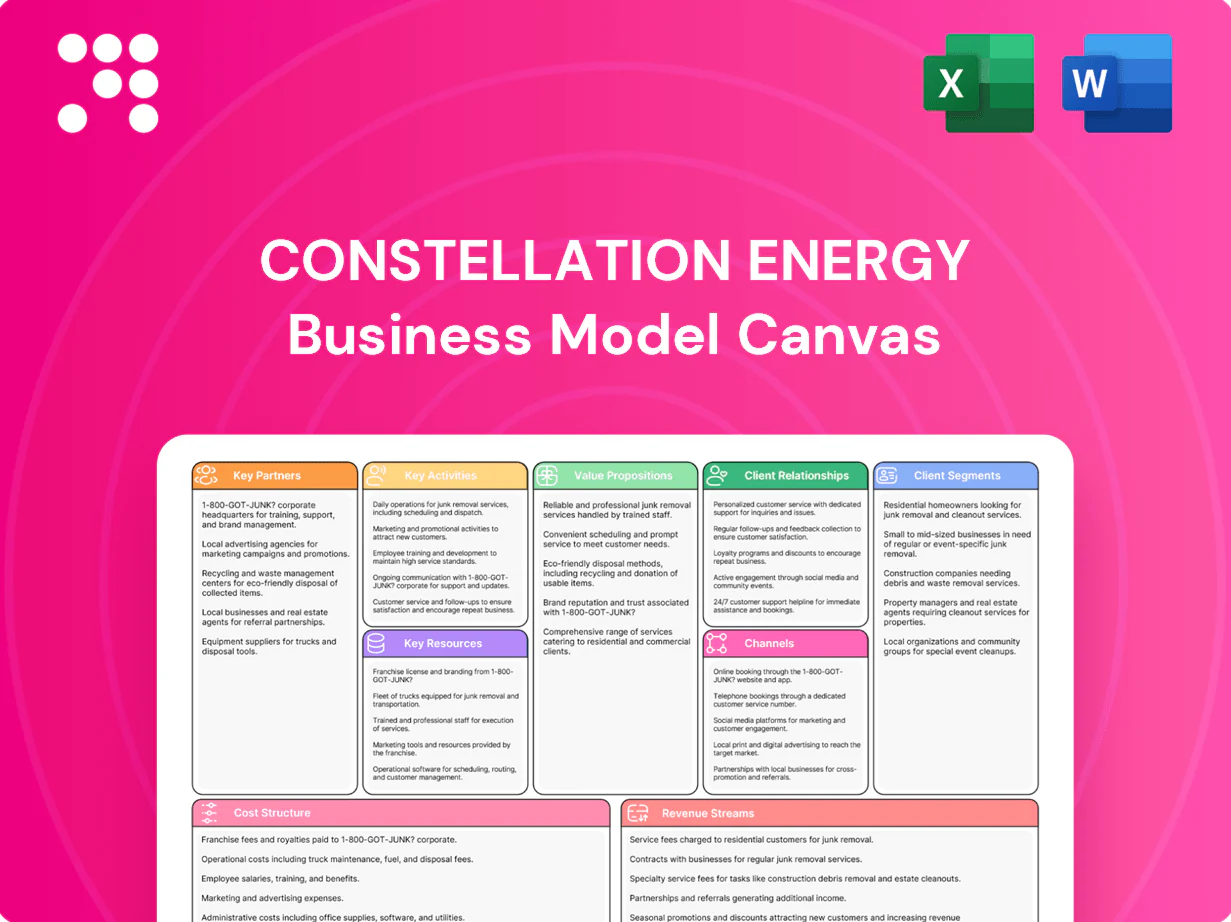
Constellation Energy Business Model Canvas

Unlock the strategic Business Model Canvas for a leading energy company
Unlock the full strategic blueprint behind Constellation Energy’s business model. This in-depth Business Model Canvas reveals how the company creates value, scales operations, and sustains competitive advantage. Ideal for investors, consultants, and founders seeking actionable insights. Download the complete Word/Excel canvas to apply these lessons directly.
Partnerships

Nuclear fuel and enrichment suppliers
Strategic relationships with uranium miners, converters and enrichers secure reliable fuel for Constellation’s baseload nuclear units, insulating operations from market shocks as spot uranium traded near 100 USD/lb in 2024. Multi-year contracts (commonly 3–10 years) dampen price volatility and supply risk. Ongoing technical collaboration verifies fuel performance and regulatory compliance, making these partners essential to uptime and cost predictability.
Grid operators, utilities, and transmission owners
Coordination with ISOs/RTOs (PJM, NYISO, MISO) and transmission owners enables dispatch, scheduling, and reliable interconnection across networks that cover about 65% of U.S. load. Partnerships support capacity accreditation and participation in ancillary services, unlocking revenue streams for Constellation’s roughly 38 GW generation fleet. Joint planning improves congestion management and grid resilience, ensuring market access and system reliability.

OEMs and technology providers
Alliances with turbine, reactor and control-system OEMs support performance, safety and life-extension consistent with NRC license renewals to 80 years; industry life‑extension programs routinely add 20+ years to asset lives. Advanced analytics and cybersecurity partners cut unplanned outages and improve risk management (predictive maintenance can reduce failures by ~30%). Pilot projects with storage and DER platforms (scaling across the U.S. in the 2022–24 period) expand operational flexibility, while technology roadmaps ensure upgrades meet evolving regulatory standards.

Regulators and government agencies
Close engagement with federal and state bodies supports licensing, compliance, and access to incentives; the Inflation Reduction Act's roughly $369 billion for energy and climate programs (2024) materially expands tax-credit opportunities. Public-private programs and DOE initiatives de-risk clean energy investments and enable Constellation to scale. Collaboration allows participation in clean credits and grid resilience initiatives while transparent relationships build trust and align policy.
- Regulatory engagement: licensing & compliance
- IRA ~ $369B: expanded tax credits
- Public-private de-risking: loan/guarantee programs
- Clean credits & resilience participation
- Transparent relationships = policy alignment
Renewable developers and PPA counterparties
Co-development and offtake agreements with renewable developers expand Constellation’s carbon-free portfolio and, as of 2024, support over 8 GW of contracted clean capacity, broadening market exposure and supply diversity. Long-term PPAs deliver predictable cash flows and price stability, locking in revenue streams over 10- to 20-year terms. Joint optimization of intermittent and firm resources enables more reliable 24/7 clean supply while partners gain from Constellation’s scale and national market reach.
- Co-development: expands carbon-free capacity (2024 contracted >8 GW)
- Long-term PPAs: 10–20 year revenue visibility
- Joint optimization: enhances 24/7 reliability
- Partner benefit: access to Constellation scale and market reach
Fuel contracts and ISO coordination secure supply and dispatch for 38 GW
Strategic fuel contracts with miners/enrichers secure supply amid spot uranium ~100 USD/lb in 2024, typically via 3–10 year deals.
Coordination with ISOs/RTOs (covering ~65% U.S. load) and transmission owners enables dispatch and ancillary revenues for Constellation’s ~38 GW fleet.
OEM, analytics, storage and federal partners (IRA ~369B) support life‑extensions to 80 years, ~30% fewer failures, and >8 GW contracted clean capacity (2024).
| Partner Type | 2024 Key Metric |
|---|---|
| Fuel suppliers | U3O8 ~100 USD/lb |
| ISOs/RTOs | ~65% U.S. load |
| Fleet | ~38 GW |
| Clean PPAs | >8 GW |
What is included in the product
 Detailed Word Document
A comprehensive Business Model Canvas tailored to Constellation Energy’s strategy, detailing customer segments, channels, value propositions and revenue streams across the nine BMC blocks with insights on operations, competitive advantages and linked SWOT analysis for investor-ready presentations.

 Customizable Excel Spreadsheet
Streamlines Constellation Energy’s complex value chain into an editable one-page canvas to quickly pinpoint operational bottlenecks, regulatory risks, and revenue levers for teams, saving hours of analysis and enabling faster strategic decision-making.
Activities

Operate and optimize nuclear and renewable fleet
Daily dispatch, outage planning, and performance tuning keep Constellation units online and safe, supporting U.S. nuclear fleet capacity factors around 92.6% (EIA 2023). Predictive maintenance programs cut unplanned downtime roughly 20%, lowering O&M costs and outage risk. Incremental heat-rate and capacity-factor gains (even 1–2%) materially boost margins per MWh and overall unit economics. Rigorous compliance procedures underpin reliable operations.
Energy trading, hedging, and risk management
Structured hedges and long‑term power purchase agreements (PPAs) stabilize Constellation’s revenues and customer prices by locking margins and limiting spot exposure. Portfolio optimization balances its roughly 34 GW generation fleet with load obligations to maximize value. Active credit, market, and operational risk controls reduce counterpart and delivery risk. Participation across power and gas markets enhances margin capture through hedged basis and volumetric strategies.

Customer supply, billing, and portfolio solutions
Load forecasting, procurement, and scheduling align to meet retail and C&I needs, leveraging Constellation’s ~34 GW generation fleet and supply to roughly 2 million customers to balance peak exposure. Accurate billing and timely settlements—critical as utilities report <1% billing error rates industry-wide—build trust and retention. Tailored time-of-use and sustainability products (green tariffs, RECs) plus continuous service improvement reduce churn and boost lifetime value.

Asset upgrades, life-extension, and compliance
Capital projects extend asset life and raise safety margins, with NRC license renewals adding up to 20 years of operation; historical NRC uprates have increased plant capacity by as much as 20%. Uprates and digital control retrofits boost output and operational flexibility, often improving heat-rate and ramping; IRA-era production tax credits (post-2022) preserve incentives tied to compliance. Standardized processes and routine audits reduce compliance risk and protect licenses.
- Capital projects: life extension, safety
- Uprates/digital: +output, flexibility (NRC uprates up to 20%)
- Regulatory: license renewals +20 years, audits preserve incentives
- Standardization: lower compliance risk
Energy management and decarbonization services
- Advisory + programs: up to 15% bill reduction (2024)
- Peak load reduction: 10-25% per event (2024)
- 24/7 matching adoption: ~35% growth (2024)
- Onsite solar/storage/microgrids: resilience + verified M&V
~34 GW fleet: predictive maintenance cuts unplanned downtime ~20%
Daily dispatch, outage planning, and predictive maintenance keep Constellation’s ~34 GW fleet reliable (U.S. nuclear avg capacity factor 92.6% EIA 2023), cutting unplanned downtime ~20% and improving margins via 1–2% heat-rate gains. Structured hedges, PPAs, and portfolio optimization stabilize revenue for ~2 million customers. Decarbonization services and pilots (2024) delivered up to 15% bill cuts and 10–25% peak shaving; 24/7 matching adoption +35% (2024).
| Metric | Value |
|---|---|
| Fleet | ~34 GW |
| Customers | ~2M |
| Capacity factor | 92.6% (EIA 2023) |
| Unplanned downtime reduction | ~20% |
| Pilot bill reduction (2024) | Up to 15% |
Preview Before You Purchase
Business Model Canvas
The Constellation Energy Business Model Canvas preview on this page is the actual deliverable, not a mockup. When you purchase, you’ll receive this exact document with all content included. The file is ready-to-edit for presentation or analysis in Word and Excel formats. No surprises—what you see is what you get.

Unlock the strategic Business Model Canvas for a leading energy company
Unlock the full strategic blueprint behind Constellation Energy’s business model. This in-depth Business Model Canvas reveals how the company creates value, scales operations, and sustains competitive advantage. Ideal for investors, consultants, and founders seeking actionable insights. Download the complete Word/Excel canvas to apply these lessons directly.
Partnerships
Nuclear fuel and enrichment suppliers
Strategic relationships with uranium miners, converters and enrichers secure reliable fuel for Constellation’s baseload nuclear units, insulating operations from market shocks as spot uranium traded near 100 USD/lb in 2024. Multi-year contracts (commonly 3–10 years) dampen price volatility and supply risk. Ongoing technical collaboration verifies fuel performance and regulatory compliance, making these partners essential to uptime and cost predictability.
Grid operators, utilities, and transmission owners
Coordination with ISOs/RTOs (PJM, NYISO, MISO) and transmission owners enables dispatch, scheduling, and reliable interconnection across networks that cover about 65% of U.S. load. Partnerships support capacity accreditation and participation in ancillary services, unlocking revenue streams for Constellation’s roughly 38 GW generation fleet. Joint planning improves congestion management and grid resilience, ensuring market access and system reliability.
OEMs and technology providers
Alliances with turbine, reactor and control-system OEMs support performance, safety and life-extension consistent with NRC license renewals to 80 years; industry life‑extension programs routinely add 20+ years to asset lives. Advanced analytics and cybersecurity partners cut unplanned outages and improve risk management (predictive maintenance can reduce failures by ~30%). Pilot projects with storage and DER platforms (scaling across the U.S. in the 2022–24 period) expand operational flexibility, while technology roadmaps ensure upgrades meet evolving regulatory standards.
Regulators and government agencies
Close engagement with federal and state bodies supports licensing, compliance, and access to incentives; the Inflation Reduction Act's roughly $369 billion for energy and climate programs (2024) materially expands tax-credit opportunities. Public-private programs and DOE initiatives de-risk clean energy investments and enable Constellation to scale. Collaboration allows participation in clean credits and grid resilience initiatives while transparent relationships build trust and align policy.
- Regulatory engagement: licensing & compliance
- IRA ~ $369B: expanded tax credits
- Public-private de-risking: loan/guarantee programs
- Clean credits & resilience participation
- Transparent relationships = policy alignment
Renewable developers and PPA counterparties
Co-development and offtake agreements with renewable developers expand Constellation’s carbon-free portfolio and, as of 2024, support over 8 GW of contracted clean capacity, broadening market exposure and supply diversity. Long-term PPAs deliver predictable cash flows and price stability, locking in revenue streams over 10- to 20-year terms. Joint optimization of intermittent and firm resources enables more reliable 24/7 clean supply while partners gain from Constellation’s scale and national market reach.
- Co-development: expands carbon-free capacity (2024 contracted >8 GW)
- Long-term PPAs: 10–20 year revenue visibility
- Joint optimization: enhances 24/7 reliability
- Partner benefit: access to Constellation scale and market reach
Fuel contracts and ISO coordination secure supply and dispatch for 38 GW
Strategic fuel contracts with miners/enrichers secure supply amid spot uranium ~100 USD/lb in 2024, typically via 3–10 year deals.
Coordination with ISOs/RTOs (covering ~65% U.S. load) and transmission owners enables dispatch and ancillary revenues for Constellation’s ~38 GW fleet.
OEM, analytics, storage and federal partners (IRA ~369B) support life‑extensions to 80 years, ~30% fewer failures, and >8 GW contracted clean capacity (2024).
| Partner Type | 2024 Key Metric |
|---|---|
| Fuel suppliers | U3O8 ~100 USD/lb |
| ISOs/RTOs | ~65% U.S. load |
| Fleet | ~38 GW |
| Clean PPAs | >8 GW |
What is included in the product
Detailed Word Document
A comprehensive Business Model Canvas tailored to Constellation Energy’s strategy, detailing customer segments, channels, value propositions and revenue streams across the nine BMC blocks with insights on operations, competitive advantages and linked SWOT analysis for investor-ready presentations.
Customizable Excel Spreadsheet
Streamlines Constellation Energy’s complex value chain into an editable one-page canvas to quickly pinpoint operational bottlenecks, regulatory risks, and revenue levers for teams, saving hours of analysis and enabling faster strategic decision-making.
Activities
Operate and optimize nuclear and renewable fleet
Daily dispatch, outage planning, and performance tuning keep Constellation units online and safe, supporting U.S. nuclear fleet capacity factors around 92.6% (EIA 2023). Predictive maintenance programs cut unplanned downtime roughly 20%, lowering O&M costs and outage risk. Incremental heat-rate and capacity-factor gains (even 1–2%) materially boost margins per MWh and overall unit economics. Rigorous compliance procedures underpin reliable operations.
Energy trading, hedging, and risk management
Structured hedges and long‑term power purchase agreements (PPAs) stabilize Constellation’s revenues and customer prices by locking margins and limiting spot exposure. Portfolio optimization balances its roughly 34 GW generation fleet with load obligations to maximize value. Active credit, market, and operational risk controls reduce counterpart and delivery risk. Participation across power and gas markets enhances margin capture through hedged basis and volumetric strategies.
Customer supply, billing, and portfolio solutions
Load forecasting, procurement, and scheduling align to meet retail and C&I needs, leveraging Constellation’s ~34 GW generation fleet and supply to roughly 2 million customers to balance peak exposure. Accurate billing and timely settlements—critical as utilities report <1% billing error rates industry-wide—build trust and retention. Tailored time-of-use and sustainability products (green tariffs, RECs) plus continuous service improvement reduce churn and boost lifetime value.
Asset upgrades, life-extension, and compliance
Capital projects extend asset life and raise safety margins, with NRC license renewals adding up to 20 years of operation; historical NRC uprates have increased plant capacity by as much as 20%. Uprates and digital control retrofits boost output and operational flexibility, often improving heat-rate and ramping; IRA-era production tax credits (post-2022) preserve incentives tied to compliance. Standardized processes and routine audits reduce compliance risk and protect licenses.
- Capital projects: life extension, safety
- Uprates/digital: +output, flexibility (NRC uprates up to 20%)
- Regulatory: license renewals +20 years, audits preserve incentives
- Standardization: lower compliance risk
Energy management and decarbonization services
- Advisory + programs: up to 15% bill reduction (2024)
- Peak load reduction: 10-25% per event (2024)
- 24/7 matching adoption: ~35% growth (2024)
- Onsite solar/storage/microgrids: resilience + verified M&V
~34 GW fleet: predictive maintenance cuts unplanned downtime ~20%
Daily dispatch, outage planning, and predictive maintenance keep Constellation’s ~34 GW fleet reliable (U.S. nuclear avg capacity factor 92.6% EIA 2023), cutting unplanned downtime ~20% and improving margins via 1–2% heat-rate gains. Structured hedges, PPAs, and portfolio optimization stabilize revenue for ~2 million customers. Decarbonization services and pilots (2024) delivered up to 15% bill cuts and 10–25% peak shaving; 24/7 matching adoption +35% (2024).
| Metric | Value |
|---|---|
| Fleet | ~34 GW |
| Customers | ~2M |
| Capacity factor | 92.6% (EIA 2023) |
| Unplanned downtime reduction | ~20% |
| Pilot bill reduction (2024) | Up to 15% |
Preview Before You Purchase
Business Model Canvas
The Constellation Energy Business Model Canvas preview on this page is the actual deliverable, not a mockup. When you purchase, you’ll receive this exact document with all content included. The file is ready-to-edit for presentation or analysis in Word and Excel formats. No surprises—what you see is what you get.
Original: $10.00
-65%$10.00
$3.50Description
Unlock the strategic Business Model Canvas for a leading energy company
Unlock the full strategic blueprint behind Constellation Energy’s business model. This in-depth Business Model Canvas reveals how the company creates value, scales operations, and sustains competitive advantage. Ideal for investors, consultants, and founders seeking actionable insights. Download the complete Word/Excel canvas to apply these lessons directly.
Partnerships
Nuclear fuel and enrichment suppliers
Strategic relationships with uranium miners, converters and enrichers secure reliable fuel for Constellation’s baseload nuclear units, insulating operations from market shocks as spot uranium traded near 100 USD/lb in 2024. Multi-year contracts (commonly 3–10 years) dampen price volatility and supply risk. Ongoing technical collaboration verifies fuel performance and regulatory compliance, making these partners essential to uptime and cost predictability.
Grid operators, utilities, and transmission owners
Coordination with ISOs/RTOs (PJM, NYISO, MISO) and transmission owners enables dispatch, scheduling, and reliable interconnection across networks that cover about 65% of U.S. load. Partnerships support capacity accreditation and participation in ancillary services, unlocking revenue streams for Constellation’s roughly 38 GW generation fleet. Joint planning improves congestion management and grid resilience, ensuring market access and system reliability.
OEMs and technology providers
Alliances with turbine, reactor and control-system OEMs support performance, safety and life-extension consistent with NRC license renewals to 80 years; industry life‑extension programs routinely add 20+ years to asset lives. Advanced analytics and cybersecurity partners cut unplanned outages and improve risk management (predictive maintenance can reduce failures by ~30%). Pilot projects with storage and DER platforms (scaling across the U.S. in the 2022–24 period) expand operational flexibility, while technology roadmaps ensure upgrades meet evolving regulatory standards.
Regulators and government agencies
Close engagement with federal and state bodies supports licensing, compliance, and access to incentives; the Inflation Reduction Act's roughly $369 billion for energy and climate programs (2024) materially expands tax-credit opportunities. Public-private programs and DOE initiatives de-risk clean energy investments and enable Constellation to scale. Collaboration allows participation in clean credits and grid resilience initiatives while transparent relationships build trust and align policy.
- Regulatory engagement: licensing & compliance
- IRA ~ $369B: expanded tax credits
- Public-private de-risking: loan/guarantee programs
- Clean credits & resilience participation
- Transparent relationships = policy alignment
Renewable developers and PPA counterparties
Co-development and offtake agreements with renewable developers expand Constellation’s carbon-free portfolio and, as of 2024, support over 8 GW of contracted clean capacity, broadening market exposure and supply diversity. Long-term PPAs deliver predictable cash flows and price stability, locking in revenue streams over 10- to 20-year terms. Joint optimization of intermittent and firm resources enables more reliable 24/7 clean supply while partners gain from Constellation’s scale and national market reach.
- Co-development: expands carbon-free capacity (2024 contracted >8 GW)
- Long-term PPAs: 10–20 year revenue visibility
- Joint optimization: enhances 24/7 reliability
- Partner benefit: access to Constellation scale and market reach
Fuel contracts and ISO coordination secure supply and dispatch for 38 GW
Strategic fuel contracts with miners/enrichers secure supply amid spot uranium ~100 USD/lb in 2024, typically via 3–10 year deals.
Coordination with ISOs/RTOs (covering ~65% U.S. load) and transmission owners enables dispatch and ancillary revenues for Constellation’s ~38 GW fleet.
OEM, analytics, storage and federal partners (IRA ~369B) support life‑extensions to 80 years, ~30% fewer failures, and >8 GW contracted clean capacity (2024).
| Partner Type | 2024 Key Metric |
|---|---|
| Fuel suppliers | U3O8 ~100 USD/lb |
| ISOs/RTOs | ~65% U.S. load |
| Fleet | ~38 GW |
| Clean PPAs | >8 GW |
What is included in the product
Detailed Word Document
A comprehensive Business Model Canvas tailored to Constellation Energy’s strategy, detailing customer segments, channels, value propositions and revenue streams across the nine BMC blocks with insights on operations, competitive advantages and linked SWOT analysis for investor-ready presentations.
Customizable Excel Spreadsheet
Streamlines Constellation Energy’s complex value chain into an editable one-page canvas to quickly pinpoint operational bottlenecks, regulatory risks, and revenue levers for teams, saving hours of analysis and enabling faster strategic decision-making.
Activities
Operate and optimize nuclear and renewable fleet
Daily dispatch, outage planning, and performance tuning keep Constellation units online and safe, supporting U.S. nuclear fleet capacity factors around 92.6% (EIA 2023). Predictive maintenance programs cut unplanned downtime roughly 20%, lowering O&M costs and outage risk. Incremental heat-rate and capacity-factor gains (even 1–2%) materially boost margins per MWh and overall unit economics. Rigorous compliance procedures underpin reliable operations.
Energy trading, hedging, and risk management
Structured hedges and long‑term power purchase agreements (PPAs) stabilize Constellation’s revenues and customer prices by locking margins and limiting spot exposure. Portfolio optimization balances its roughly 34 GW generation fleet with load obligations to maximize value. Active credit, market, and operational risk controls reduce counterpart and delivery risk. Participation across power and gas markets enhances margin capture through hedged basis and volumetric strategies.
Customer supply, billing, and portfolio solutions
Load forecasting, procurement, and scheduling align to meet retail and C&I needs, leveraging Constellation’s ~34 GW generation fleet and supply to roughly 2 million customers to balance peak exposure. Accurate billing and timely settlements—critical as utilities report <1% billing error rates industry-wide—build trust and retention. Tailored time-of-use and sustainability products (green tariffs, RECs) plus continuous service improvement reduce churn and boost lifetime value.
Asset upgrades, life-extension, and compliance
Capital projects extend asset life and raise safety margins, with NRC license renewals adding up to 20 years of operation; historical NRC uprates have increased plant capacity by as much as 20%. Uprates and digital control retrofits boost output and operational flexibility, often improving heat-rate and ramping; IRA-era production tax credits (post-2022) preserve incentives tied to compliance. Standardized processes and routine audits reduce compliance risk and protect licenses.
- Capital projects: life extension, safety
- Uprates/digital: +output, flexibility (NRC uprates up to 20%)
- Regulatory: license renewals +20 years, audits preserve incentives
- Standardization: lower compliance risk
Energy management and decarbonization services
- Advisory + programs: up to 15% bill reduction (2024)
- Peak load reduction: 10-25% per event (2024)
- 24/7 matching adoption: ~35% growth (2024)
- Onsite solar/storage/microgrids: resilience + verified M&V
~34 GW fleet: predictive maintenance cuts unplanned downtime ~20%
Daily dispatch, outage planning, and predictive maintenance keep Constellation’s ~34 GW fleet reliable (U.S. nuclear avg capacity factor 92.6% EIA 2023), cutting unplanned downtime ~20% and improving margins via 1–2% heat-rate gains. Structured hedges, PPAs, and portfolio optimization stabilize revenue for ~2 million customers. Decarbonization services and pilots (2024) delivered up to 15% bill cuts and 10–25% peak shaving; 24/7 matching adoption +35% (2024).
| Metric | Value |
|---|---|
| Fleet | ~34 GW |
| Customers | ~2M |
| Capacity factor | 92.6% (EIA 2023) |
| Unplanned downtime reduction | ~20% |
| Pilot bill reduction (2024) | Up to 15% |
Preview Before You Purchase
Business Model Canvas
The Constellation Energy Business Model Canvas preview on this page is the actual deliverable, not a mockup. When you purchase, you’ll receive this exact document with all content included. The file is ready-to-edit for presentation or analysis in Word and Excel formats. No surprises—what you see is what you get.











