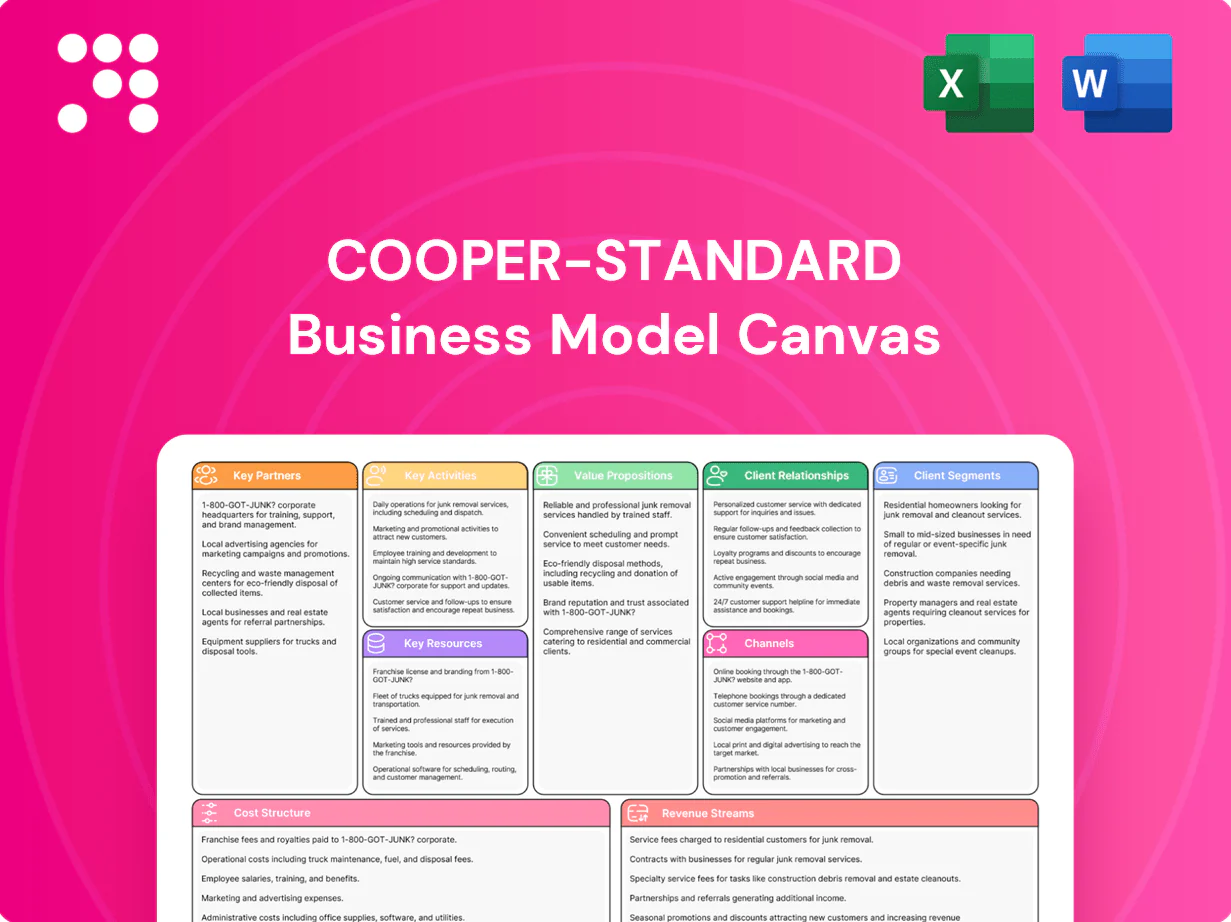
Cooper-Standard Business Model Canvas

Unlock the full strategic blueprint behind Cooper-Standard’s business model with our concise Business Model Canvas—3–5 sentences that map value propositions, key partners, and revenue streams to reveal how the company competes and scales. Ideal for investors, consultants, and founders seeking actionable insights; download the complete Word and Excel files to use instantly.
Partnerships

Global automotive OEM alliances
Strategic alliances with major OEMs such as Ford, GM, Stellantis and Volkswagen secure platform awards and multi-year volumes (typically 5–7 year programs), while early engagement in 2024 vehicle programs aligns specifications and cost targets. Joint planning supports global launch synchronization and continuous improvement, underpinning stable demand and coherent engineering roadmaps.
Advanced materials and chemical suppliers
Partnerships with polymer, elastomer and additive providers enable tailored performance formulations, while co-development programs accelerate lightweighting, durability and NVH improvements through joint R&D. Multi-year supply and price agreements (commonly 3–5 years) reduce raw-material volatility risk and protect margins. Ongoing technical support ensures consistent compounding, quality control and regulatory compliance in production.

Tooling, equipment, and automation providers
Collaboration with extrusion, molding and assembly equipment partners optimizes throughput, with automation often cutting cycle times 20–40% and defect rates materially lower. Custom tooling and integrated automation improve precision, while predictive maintenance (industry studies show 20–50% downtime reduction) and targeted upgrades sustain OEE and quality. Joint trials and co-validation have shortened ramp-up and PPAP timelines by roughly 25% in recent supplier programs.

Logistics and JIT/JIS service partners
Integrated logistics partners enable Cooper-Standard to deliver JIT/JIS parts with regional hubs cutting lead times by ~35% and inventory buffers by ~30% in 2024 pilot programs; real-time tracking (adoption ~85% across plants in 2024) improves visibility and reduces response times, while co-located logistics and sequencing services lowered customer line-stoppage incidents by ~60%.
- JIT/JIS support: regional hubs → -35% lead time
- Inventory buffers: -30% (2024 pilots)
- Real-time tracking: ~85% adoption (2024)
- Co-located services: -60% line stoppages
Testing labs and academic/R&D institutions
Testing labs and academic/R&D institutions independently validate Cooper-Standard component performance, emissions conformity, and regulatory compliance using ISO/IEC 17025-accredited methods, strengthening market acceptance and reducing product recall risk. University collaborations grant access to emerging materials science and process innovations and leverage public R&D funding streams such as SBIR/STTR to offset costs. Shared research partnerships compress development timelines and lower prototyping expenses while independent certification enhances customer confidence and procurement approvals.
- ISO/IEC 17025: independent lab accreditation
- SBIR/STTR: public R&D funding leverage
- Lowered development costs: shared research
- Stronger procurement: independent certification
OEMs: $1.2bn, 5–7yr, -35% lead time
OEM alliances (Ford, GM, Stellantis, VW) secure 5–7 year platform awards and ~$1.2bn contract pipeline (2024).
Material and equipment partners cut cycle times 20–40% and protect margins via 3–5 year supply contracts.
Logistics, testing and academic partners enabled 35% lead-time, 30% inventory and 60% line-stoppage improvements in 2024 pilots.
| Partner | Metric | 2024 |
|---|---|---|
| OEMs | Program length | 5–7 yr |
| Logistics | Lead time | -35% |
| Tracking | Adoption | ~85% |
What is included in the product
 Detailed Word Document
A comprehensive Cooper‑Standard Business Model Canvas detailing customer segments, value propositions, channels, revenue streams and key resources/partners across the 9 classic blocks, reflecting real-world operations and strategic plans; includes competitive advantages, SWOT-linked insights and polished narrative ideal for presentations, investor discussions and validation of business decisions.

 Customizable Excel Spreadsheet
Condenses Cooper-Standard’s complex automotive supplier model into a single, editable page to quickly spot supply-chain, product and customer pain points; ideal for fast decision-making and cross-team alignment.
Activities

Design and co-engineering of sealing and fluid systems
Collaborative engineering with OEMs tailors sealing and fluid systems to platform requirements, aligning materials, tolerances, and integration points. DFMEA, CAE, and CAD workflows identify failure modes and optimize performance through iterative simulation and detailed drawings. Rapid prototyping accelerates validation cycles and reduces time-to-production. Rigorous engineering change management maintains traceability, quality, and audit readiness.
Materials compounding and formulation development
Custom elastomer and polymer blends are engineered to meet temperature, chemical and NVH specifications for automotive applications, tested under IATF 16949 quality protocols and NVH measurement standards. Lab-scale trials generate scalable production recipes validated on pilot lines using statistical process control. Formulations embed regional regulations such as REACH and RoHS, with continuous improvement targeting lower cost, reduced weight and enhanced durability.

High-volume manufacturing and assembly
Extrusion, molding, braiding and automated assembly lines deliver consistent output, supporting throughput targets of thousands of parts per day while maintaining lean cycle times. Lean practices and automation boost productivity and quality, aiming toward Six Sigma performance (3.4 defects per million opportunities). Inline SPC and CMM inspections maintain dimensional and functional integrity in real time. Flexible cells enable multi-platform sequencing across up to six vehicle architectures.

Quality assurance and validation testing
- PPAP/APQP readiness
- Environmental, pressure, endurance testing
- SPC + traceability
- Customer audits & certifications
Global supply chain and program management
Synchronized planning aligns materials, tooling and capacity with customer ramps, reducing lead-time variance and improving on-time launch rates; risk management mitigates shortages and logistics disruptions, a top-3 supply risk in the 2024 World Economic Forum assessment. Cross-functional teams drive cost, timing and performance KPIs, while continuous supplier development strengthens resilience and quality.
- Program sync: aligns demand, tooling, capacity
- Risk mgmt: mitigates shortages/logistics shocks
- KPIs: cost, timing, performance
- Supplier dev: resilience & quality
Collaborative OEM sealing: DFMEA, CAE, rapid prototyping and Six Sigma production
Collaborative engineering with OEMs delivers tailored sealing and fluid systems using DFMEA, CAE and rapid prototyping to shorten validation cycles. Manufacturing (extrusion, molding, automated assembly) targets thousands of parts/day with Six Sigma ambition (3.4 DPMO) and SPC/CMM inline checks. QA uses PPAP/APQP and IATF 16949-certified plants (2024) with ~11,000 employees (2023).
| Metric | Value |
|---|---|
| Employees (2023) | ~11,000 |
| IATF 16949 plants (2024) | Widespread |
| Throughput | Thousands/day |
| DPMO target | 3.4 |
Preview Before You Purchase
Business Model Canvas
The Cooper-Standard Business Model Canvas shown here is the actual document you’ll receive—not a mockup or sample. It’s a live snapshot of the final deliverable, formatted for immediate use. After purchase you’ll download this exact file, complete and editable in Word and Excel. No placeholders, no surprises—what you preview is what you get.

Unlock the full strategic blueprint behind Cooper-Standard’s business model with our concise Business Model Canvas—3–5 sentences that map value propositions, key partners, and revenue streams to reveal how the company competes and scales. Ideal for investors, consultants, and founders seeking actionable insights; download the complete Word and Excel files to use instantly.
Partnerships
Global automotive OEM alliances
Strategic alliances with major OEMs such as Ford, GM, Stellantis and Volkswagen secure platform awards and multi-year volumes (typically 5–7 year programs), while early engagement in 2024 vehicle programs aligns specifications and cost targets. Joint planning supports global launch synchronization and continuous improvement, underpinning stable demand and coherent engineering roadmaps.
Advanced materials and chemical suppliers
Partnerships with polymer, elastomer and additive providers enable tailored performance formulations, while co-development programs accelerate lightweighting, durability and NVH improvements through joint R&D. Multi-year supply and price agreements (commonly 3–5 years) reduce raw-material volatility risk and protect margins. Ongoing technical support ensures consistent compounding, quality control and regulatory compliance in production.
Tooling, equipment, and automation providers
Collaboration with extrusion, molding and assembly equipment partners optimizes throughput, with automation often cutting cycle times 20–40% and defect rates materially lower. Custom tooling and integrated automation improve precision, while predictive maintenance (industry studies show 20–50% downtime reduction) and targeted upgrades sustain OEE and quality. Joint trials and co-validation have shortened ramp-up and PPAP timelines by roughly 25% in recent supplier programs.
Logistics and JIT/JIS service partners
Integrated logistics partners enable Cooper-Standard to deliver JIT/JIS parts with regional hubs cutting lead times by ~35% and inventory buffers by ~30% in 2024 pilot programs; real-time tracking (adoption ~85% across plants in 2024) improves visibility and reduces response times, while co-located logistics and sequencing services lowered customer line-stoppage incidents by ~60%.
- JIT/JIS support: regional hubs → -35% lead time
- Inventory buffers: -30% (2024 pilots)
- Real-time tracking: ~85% adoption (2024)
- Co-located services: -60% line stoppages
Testing labs and academic/R&D institutions
Testing labs and academic/R&D institutions independently validate Cooper-Standard component performance, emissions conformity, and regulatory compliance using ISO/IEC 17025-accredited methods, strengthening market acceptance and reducing product recall risk. University collaborations grant access to emerging materials science and process innovations and leverage public R&D funding streams such as SBIR/STTR to offset costs. Shared research partnerships compress development timelines and lower prototyping expenses while independent certification enhances customer confidence and procurement approvals.
- ISO/IEC 17025: independent lab accreditation
- SBIR/STTR: public R&D funding leverage
- Lowered development costs: shared research
- Stronger procurement: independent certification
OEMs: $1.2bn, 5–7yr, -35% lead time
OEM alliances (Ford, GM, Stellantis, VW) secure 5–7 year platform awards and ~$1.2bn contract pipeline (2024).
Material and equipment partners cut cycle times 20–40% and protect margins via 3–5 year supply contracts.
Logistics, testing and academic partners enabled 35% lead-time, 30% inventory and 60% line-stoppage improvements in 2024 pilots.
| Partner | Metric | 2024 |
|---|---|---|
| OEMs | Program length | 5–7 yr |
| Logistics | Lead time | -35% |
| Tracking | Adoption | ~85% |
What is included in the product
Detailed Word Document
A comprehensive Cooper‑Standard Business Model Canvas detailing customer segments, value propositions, channels, revenue streams and key resources/partners across the 9 classic blocks, reflecting real-world operations and strategic plans; includes competitive advantages, SWOT-linked insights and polished narrative ideal for presentations, investor discussions and validation of business decisions.
Customizable Excel Spreadsheet
Condenses Cooper-Standard’s complex automotive supplier model into a single, editable page to quickly spot supply-chain, product and customer pain points; ideal for fast decision-making and cross-team alignment.
Activities
Design and co-engineering of sealing and fluid systems
Collaborative engineering with OEMs tailors sealing and fluid systems to platform requirements, aligning materials, tolerances, and integration points. DFMEA, CAE, and CAD workflows identify failure modes and optimize performance through iterative simulation and detailed drawings. Rapid prototyping accelerates validation cycles and reduces time-to-production. Rigorous engineering change management maintains traceability, quality, and audit readiness.
Materials compounding and formulation development
Custom elastomer and polymer blends are engineered to meet temperature, chemical and NVH specifications for automotive applications, tested under IATF 16949 quality protocols and NVH measurement standards. Lab-scale trials generate scalable production recipes validated on pilot lines using statistical process control. Formulations embed regional regulations such as REACH and RoHS, with continuous improvement targeting lower cost, reduced weight and enhanced durability.
High-volume manufacturing and assembly
Extrusion, molding, braiding and automated assembly lines deliver consistent output, supporting throughput targets of thousands of parts per day while maintaining lean cycle times. Lean practices and automation boost productivity and quality, aiming toward Six Sigma performance (3.4 defects per million opportunities). Inline SPC and CMM inspections maintain dimensional and functional integrity in real time. Flexible cells enable multi-platform sequencing across up to six vehicle architectures.
Quality assurance and validation testing
- PPAP/APQP readiness
- Environmental, pressure, endurance testing
- SPC + traceability
- Customer audits & certifications
Global supply chain and program management
Synchronized planning aligns materials, tooling and capacity with customer ramps, reducing lead-time variance and improving on-time launch rates; risk management mitigates shortages and logistics disruptions, a top-3 supply risk in the 2024 World Economic Forum assessment. Cross-functional teams drive cost, timing and performance KPIs, while continuous supplier development strengthens resilience and quality.
- Program sync: aligns demand, tooling, capacity
- Risk mgmt: mitigates shortages/logistics shocks
- KPIs: cost, timing, performance
- Supplier dev: resilience & quality
Collaborative OEM sealing: DFMEA, CAE, rapid prototyping and Six Sigma production
Collaborative engineering with OEMs delivers tailored sealing and fluid systems using DFMEA, CAE and rapid prototyping to shorten validation cycles. Manufacturing (extrusion, molding, automated assembly) targets thousands of parts/day with Six Sigma ambition (3.4 DPMO) and SPC/CMM inline checks. QA uses PPAP/APQP and IATF 16949-certified plants (2024) with ~11,000 employees (2023).
| Metric | Value |
|---|---|
| Employees (2023) | ~11,000 |
| IATF 16949 plants (2024) | Widespread |
| Throughput | Thousands/day |
| DPMO target | 3.4 |
Preview Before You Purchase
Business Model Canvas
The Cooper-Standard Business Model Canvas shown here is the actual document you’ll receive—not a mockup or sample. It’s a live snapshot of the final deliverable, formatted for immediate use. After purchase you’ll download this exact file, complete and editable in Word and Excel. No placeholders, no surprises—what you preview is what you get.
Original: $10.00
-65%$10.00
$3.50Description
Unlock the full strategic blueprint behind Cooper-Standard’s business model with our concise Business Model Canvas—3–5 sentences that map value propositions, key partners, and revenue streams to reveal how the company competes and scales. Ideal for investors, consultants, and founders seeking actionable insights; download the complete Word and Excel files to use instantly.
Partnerships
Global automotive OEM alliances
Strategic alliances with major OEMs such as Ford, GM, Stellantis and Volkswagen secure platform awards and multi-year volumes (typically 5–7 year programs), while early engagement in 2024 vehicle programs aligns specifications and cost targets. Joint planning supports global launch synchronization and continuous improvement, underpinning stable demand and coherent engineering roadmaps.
Advanced materials and chemical suppliers
Partnerships with polymer, elastomer and additive providers enable tailored performance formulations, while co-development programs accelerate lightweighting, durability and NVH improvements through joint R&D. Multi-year supply and price agreements (commonly 3–5 years) reduce raw-material volatility risk and protect margins. Ongoing technical support ensures consistent compounding, quality control and regulatory compliance in production.
Tooling, equipment, and automation providers
Collaboration with extrusion, molding and assembly equipment partners optimizes throughput, with automation often cutting cycle times 20–40% and defect rates materially lower. Custom tooling and integrated automation improve precision, while predictive maintenance (industry studies show 20–50% downtime reduction) and targeted upgrades sustain OEE and quality. Joint trials and co-validation have shortened ramp-up and PPAP timelines by roughly 25% in recent supplier programs.
Logistics and JIT/JIS service partners
Integrated logistics partners enable Cooper-Standard to deliver JIT/JIS parts with regional hubs cutting lead times by ~35% and inventory buffers by ~30% in 2024 pilot programs; real-time tracking (adoption ~85% across plants in 2024) improves visibility and reduces response times, while co-located logistics and sequencing services lowered customer line-stoppage incidents by ~60%.
- JIT/JIS support: regional hubs → -35% lead time
- Inventory buffers: -30% (2024 pilots)
- Real-time tracking: ~85% adoption (2024)
- Co-located services: -60% line stoppages
Testing labs and academic/R&D institutions
Testing labs and academic/R&D institutions independently validate Cooper-Standard component performance, emissions conformity, and regulatory compliance using ISO/IEC 17025-accredited methods, strengthening market acceptance and reducing product recall risk. University collaborations grant access to emerging materials science and process innovations and leverage public R&D funding streams such as SBIR/STTR to offset costs. Shared research partnerships compress development timelines and lower prototyping expenses while independent certification enhances customer confidence and procurement approvals.
- ISO/IEC 17025: independent lab accreditation
- SBIR/STTR: public R&D funding leverage
- Lowered development costs: shared research
- Stronger procurement: independent certification
OEMs: $1.2bn, 5–7yr, -35% lead time
OEM alliances (Ford, GM, Stellantis, VW) secure 5–7 year platform awards and ~$1.2bn contract pipeline (2024).
Material and equipment partners cut cycle times 20–40% and protect margins via 3–5 year supply contracts.
Logistics, testing and academic partners enabled 35% lead-time, 30% inventory and 60% line-stoppage improvements in 2024 pilots.
| Partner | Metric | 2024 |
|---|---|---|
| OEMs | Program length | 5–7 yr |
| Logistics | Lead time | -35% |
| Tracking | Adoption | ~85% |
What is included in the product
Detailed Word Document
A comprehensive Cooper‑Standard Business Model Canvas detailing customer segments, value propositions, channels, revenue streams and key resources/partners across the 9 classic blocks, reflecting real-world operations and strategic plans; includes competitive advantages, SWOT-linked insights and polished narrative ideal for presentations, investor discussions and validation of business decisions.
Customizable Excel Spreadsheet
Condenses Cooper-Standard’s complex automotive supplier model into a single, editable page to quickly spot supply-chain, product and customer pain points; ideal for fast decision-making and cross-team alignment.
Activities
Design and co-engineering of sealing and fluid systems
Collaborative engineering with OEMs tailors sealing and fluid systems to platform requirements, aligning materials, tolerances, and integration points. DFMEA, CAE, and CAD workflows identify failure modes and optimize performance through iterative simulation and detailed drawings. Rapid prototyping accelerates validation cycles and reduces time-to-production. Rigorous engineering change management maintains traceability, quality, and audit readiness.
Materials compounding and formulation development
Custom elastomer and polymer blends are engineered to meet temperature, chemical and NVH specifications for automotive applications, tested under IATF 16949 quality protocols and NVH measurement standards. Lab-scale trials generate scalable production recipes validated on pilot lines using statistical process control. Formulations embed regional regulations such as REACH and RoHS, with continuous improvement targeting lower cost, reduced weight and enhanced durability.
High-volume manufacturing and assembly
Extrusion, molding, braiding and automated assembly lines deliver consistent output, supporting throughput targets of thousands of parts per day while maintaining lean cycle times. Lean practices and automation boost productivity and quality, aiming toward Six Sigma performance (3.4 defects per million opportunities). Inline SPC and CMM inspections maintain dimensional and functional integrity in real time. Flexible cells enable multi-platform sequencing across up to six vehicle architectures.
Quality assurance and validation testing
- PPAP/APQP readiness
- Environmental, pressure, endurance testing
- SPC + traceability
- Customer audits & certifications
Global supply chain and program management
Synchronized planning aligns materials, tooling and capacity with customer ramps, reducing lead-time variance and improving on-time launch rates; risk management mitigates shortages and logistics disruptions, a top-3 supply risk in the 2024 World Economic Forum assessment. Cross-functional teams drive cost, timing and performance KPIs, while continuous supplier development strengthens resilience and quality.
- Program sync: aligns demand, tooling, capacity
- Risk mgmt: mitigates shortages/logistics shocks
- KPIs: cost, timing, performance
- Supplier dev: resilience & quality
Collaborative OEM sealing: DFMEA, CAE, rapid prototyping and Six Sigma production
Collaborative engineering with OEMs delivers tailored sealing and fluid systems using DFMEA, CAE and rapid prototyping to shorten validation cycles. Manufacturing (extrusion, molding, automated assembly) targets thousands of parts/day with Six Sigma ambition (3.4 DPMO) and SPC/CMM inline checks. QA uses PPAP/APQP and IATF 16949-certified plants (2024) with ~11,000 employees (2023).
| Metric | Value |
|---|---|
| Employees (2023) | ~11,000 |
| IATF 16949 plants (2024) | Widespread |
| Throughput | Thousands/day |
| DPMO target | 3.4 |
Preview Before You Purchase
Business Model Canvas
The Cooper-Standard Business Model Canvas shown here is the actual document you’ll receive—not a mockup or sample. It’s a live snapshot of the final deliverable, formatted for immediate use. After purchase you’ll download this exact file, complete and editable in Word and Excel. No placeholders, no surprises—what you preview is what you get.











