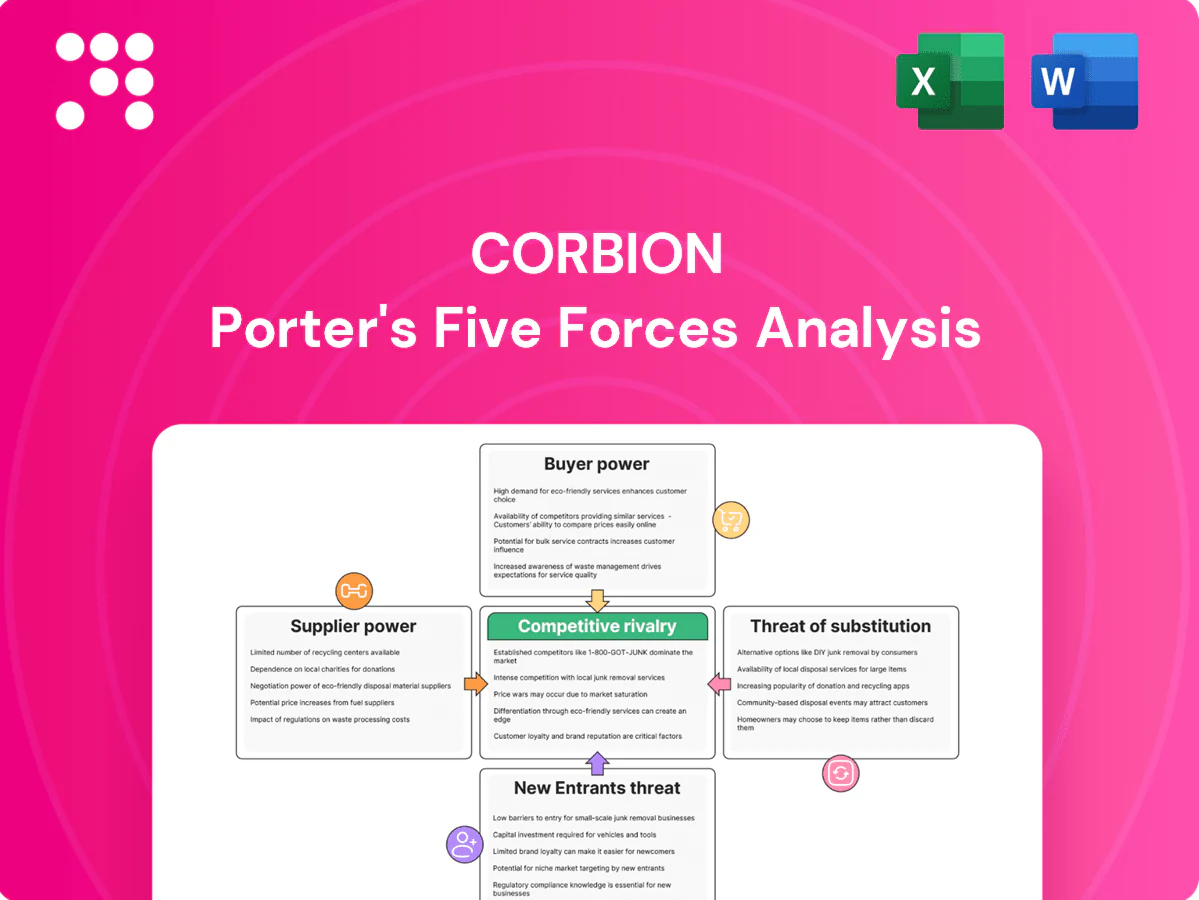
Corbion Porter's Five Forces Analysis

Elevate Your Analysis with the Complete Porter's Five Forces Analysis
Corbion faces distinct competitive pressures across supplier leverage, buyer power, substitute threats and regulatory intensity that shape its margin potential and strategic choices. This snapshot highlights key dynamics and likely vulnerabilities. For force-by-force ratings, visuals and actionable implications, unlock the full Porter's Five Forces Analysis to inform investment or strategic decisions.
Suppliers Bargaining Power

Fermentation feedstock concentration
Corbion depends on sugar, corn and other carbohydrate feedstocks for lactic acid fermentation, often sourced from a concentrated set of agro-processors, so supplier disruptions and 2022–2024 commodity volatility have tightened margins. Long-term contracts and sourcing across regions reduce but do not eliminate exposure. Certification demands (non-GMO, sustainable) further shrink the pool of qualified suppliers.
Specialty enzymes and nutrients
Functional enzyme blends and fermentation nutrients come from specialized suppliers with proprietary IP, and top suppliers command the majority of market share; switching triggers process revalidation that often takes months and can cost >$100,000, raising switching costs. Volume leverage can secure discounts, but high customization sustains supplier power; dual-sourcing is possible but commonly reduces operational efficiency and raises costs.

Biotech equipment and consumables
Reactors, membrane systems and filtration media are concentrated among a few global OEMs (5–7 firms), giving suppliers significant leverage. Lead times commonly span 12–24 weeks and after-sales service plus spare-parts scarcity increase operational dependence. Stringent qualification standards and downtime risks raise switching barriers, even though framework agreements typically moderate price volatility without creating full lock-in.

Sustainability-compliant inputs
Customers increasingly require certified sustainable inputs, constraining Corbion to compliant suppliers and narrowing the pool which can push input costs higher; in 2024 Corbion reported revenue near €1.5bn, reinforcing its buying power and sustainability credibility. Corbion’s scale and ESG reputation attract aligned partners, and joint procurement and supplier programs help lock volumes and hedge ESG risks.
- Restricted supplier pool
- Upward cost pressure
- Scale + reputation = partner attraction
- Joint programs secure volumes, reduce ESG risk
Energy and logistics exposure
Corbion faces high supplier leverage from energy-intensive fermentation and global shipping; Brent crude averaged about 85 USD/bbl in H1 2024 and container rates remained elevated versus pre‑pandemic levels, amplifying exposure to utilities and carriers. Price spikes and capacity constraints in 2024 raised short-term input cost volatility and carrier leverage. Onsite energy projects and modal flexibility—plus a geographically diversified production footprint—reduce this supplier risk.
- Energy cost sensitivity: higher with fermentation processes
- Logistics pressure: elevated container and fuel costs in 2024
- Mitigants: onsite energy, modal flexibility, geographic diversification
Scale €1.5bn offsets supplier leverage amid energy, commodity volatility
Corbion relies on concentrated agro-processors for sugar/corn; 2022–24 commodity volatility tightened margins. Key enzyme and nutrient suppliers hold proprietary IP, switching often costs >€100,000 and requires 12–24 week revalidation. Capital OEMs (5–7 firms) and elevated 2024 energy/logistics costs (Brent ~85 USD/bbl H1 2024) increase supplier leverage, while Corbion scale (€1.5bn 2024) and joint programs mitigate.
| Metric | Value | Impact |
|---|---|---|
| 2024 revenue | €1.5bn | Buying power |
| Brent H1 2024 | $85/bbl | Energy cost pressure |
| OEMs | 5–7 | Equipment leverage |
| Switching cost | >€100,000 | High switching barrier |
What is included in the product
 Detailed Word Document
Uncovers key drivers of competition, buyer and supplier power, threat of substitutes and new entrants for Corbion, highlighting disruptive forces and emerging risks to market share and profitability.

 Customizable Excel Spreadsheet
A concise Porter's Five Forces snapshot for Corbion that quickly pinpoints competitive pressures and relieves analysis bottlenecks, ready to drop into decks or strategy sessions.
Customers Bargaining Power

Concentrated food multinationals
Concentrated food multinationals buy emulsifiers and lactic derivatives at scale and exert strong price pressure, often threatening backward integration or switching suppliers. Long qualification cycles (months–years) create stickiness but slow pricing resets. Corbion leans on value-in-use and co-development to protect margins; in 2024 the global food & beverage market exceeded $2.1 trillion, amplifying buyer leverage.
Pharma and medical-grade standards
Pharma buyers require high-purity lactic acid and PLA intermediates with >99.5% purity and strict QA including GMP, ISO 13485 and annual audits.
Such certifications and documented audits create high switching costs, moderating buyer power despite buyers often ordering 100s–1,000s tonnes annually that justify price pressure and service demands.
Reliability, on-time delivery and regulatory compliance (batch traceability, COA) become key bargaining chips for Corbion.

Bioplastics OEMs and converters
Bioplastics OEMs and converters exert medium-high bargaining power: PLA value chains are highly sensitive to resin performance and price, and the global PLA capacity reached about 0.6 Mt in 2024, keeping buyers alert to cost-performance trade-offs. Buyers routinely benchmark PLA against rival biopolymers and fossil plastics, which drove purchasing shifts during 2022–23 oil-price volatility. Long-term offtakes reduce spot volatility but often tie resin prices to feedstock indices, and technical support and application development services frequently lock in customers beyond pure price considerations.

Private labels and mid-market
Mid-market food, HPC and animal nutrition buyers are fragmented, limiting collective bargaining; many trade smaller volumes for speed and formulation support, with Corbion-like suppliers shifting value from price/kg to functionality. Private-label growth in Europe (~35–40% share in many markets in 2023) reinforces demand for bundled solutions and digital services that lock in loyalty through reliable lead times.
- Fragmentation: lower collective power
- Trade profile: smaller volumes, faster cycles
- Value shift: price/kg → functionality
- Retention: digital services + reliable lead times
ESG-driven procurement
Buyers increasingly require traceability and lower carbon intensity, driving ESG-driven procurement that elevates Corbion’s sustainable-bioportfolio as a differentiator; Corbion’s lower-carbon ingredients and transparency help soften price bargaining despite cost pressure. Buyers can leverage competing green claims to push prices down, but Corbion’s published LCA data and certification in 2024 support defending premium pricing.
- Traceability demand: 70% of procurement teams prioritized sustainability in 2024 surveys
- Price defense: verified LCA data enables premium retention
- Risk: greenwashing by competitors weakens bargaining position
Scale buyers press margins; supplier defends with co-development, LCA-backed premiums, LT contracts
Large food multinationals and PLA converters exert high bargaining power via scale and threat of backward integration; Corbion counters with co‑development, LT contracts and premium LCA-backed pricing. Pharma customers have moderated power due to >99.5% purity and GMP/ISO requirements. Mid-market buyers are fragmented, shifting value to functionality and services.
| Buyer segment | Power | Key metrics (2024) |
|---|---|---|
| Food multinationals | High | Global F&B > $2.1T; orders 100s–1,000s t |
| Pharma | Moderate | >99.5% purity, GMP/ISO audits |
| PLA OEMs | Medium‑High | PLA capacity ~0.6 Mt |
| Mid‑market | Low‑Medium | EU private‑label 35–40% |
What You See Is What You Get
Corbion Porter's Five Forces Analysis
This preview shows the exact Corbion Porter’s Five Forces analysis you'll receive after purchase—no placeholders. It’s the same professionally formatted document available for instant download. Use it immediately for strategy, valuation, or competitive insight. No samples, just the final deliverable.

Elevate Your Analysis with the Complete Porter's Five Forces Analysis
Corbion faces distinct competitive pressures across supplier leverage, buyer power, substitute threats and regulatory intensity that shape its margin potential and strategic choices. This snapshot highlights key dynamics and likely vulnerabilities. For force-by-force ratings, visuals and actionable implications, unlock the full Porter's Five Forces Analysis to inform investment or strategic decisions.
Suppliers Bargaining Power
Fermentation feedstock concentration
Corbion depends on sugar, corn and other carbohydrate feedstocks for lactic acid fermentation, often sourced from a concentrated set of agro-processors, so supplier disruptions and 2022–2024 commodity volatility have tightened margins. Long-term contracts and sourcing across regions reduce but do not eliminate exposure. Certification demands (non-GMO, sustainable) further shrink the pool of qualified suppliers.
Specialty enzymes and nutrients
Functional enzyme blends and fermentation nutrients come from specialized suppliers with proprietary IP, and top suppliers command the majority of market share; switching triggers process revalidation that often takes months and can cost >$100,000, raising switching costs. Volume leverage can secure discounts, but high customization sustains supplier power; dual-sourcing is possible but commonly reduces operational efficiency and raises costs.
Biotech equipment and consumables
Reactors, membrane systems and filtration media are concentrated among a few global OEMs (5–7 firms), giving suppliers significant leverage. Lead times commonly span 12–24 weeks and after-sales service plus spare-parts scarcity increase operational dependence. Stringent qualification standards and downtime risks raise switching barriers, even though framework agreements typically moderate price volatility without creating full lock-in.
Sustainability-compliant inputs
Customers increasingly require certified sustainable inputs, constraining Corbion to compliant suppliers and narrowing the pool which can push input costs higher; in 2024 Corbion reported revenue near €1.5bn, reinforcing its buying power and sustainability credibility. Corbion’s scale and ESG reputation attract aligned partners, and joint procurement and supplier programs help lock volumes and hedge ESG risks.
- Restricted supplier pool
- Upward cost pressure
- Scale + reputation = partner attraction
- Joint programs secure volumes, reduce ESG risk
Energy and logistics exposure
Corbion faces high supplier leverage from energy-intensive fermentation and global shipping; Brent crude averaged about 85 USD/bbl in H1 2024 and container rates remained elevated versus pre‑pandemic levels, amplifying exposure to utilities and carriers. Price spikes and capacity constraints in 2024 raised short-term input cost volatility and carrier leverage. Onsite energy projects and modal flexibility—plus a geographically diversified production footprint—reduce this supplier risk.
- Energy cost sensitivity: higher with fermentation processes
- Logistics pressure: elevated container and fuel costs in 2024
- Mitigants: onsite energy, modal flexibility, geographic diversification
Scale €1.5bn offsets supplier leverage amid energy, commodity volatility
Corbion relies on concentrated agro-processors for sugar/corn; 2022–24 commodity volatility tightened margins. Key enzyme and nutrient suppliers hold proprietary IP, switching often costs >€100,000 and requires 12–24 week revalidation. Capital OEMs (5–7 firms) and elevated 2024 energy/logistics costs (Brent ~85 USD/bbl H1 2024) increase supplier leverage, while Corbion scale (€1.5bn 2024) and joint programs mitigate.
| Metric | Value | Impact |
|---|---|---|
| 2024 revenue | €1.5bn | Buying power |
| Brent H1 2024 | $85/bbl | Energy cost pressure |
| OEMs | 5–7 | Equipment leverage |
| Switching cost | >€100,000 | High switching barrier |
What is included in the product
Detailed Word Document
Uncovers key drivers of competition, buyer and supplier power, threat of substitutes and new entrants for Corbion, highlighting disruptive forces and emerging risks to market share and profitability.
Customizable Excel Spreadsheet
A concise Porter's Five Forces snapshot for Corbion that quickly pinpoints competitive pressures and relieves analysis bottlenecks, ready to drop into decks or strategy sessions.
Customers Bargaining Power
Concentrated food multinationals
Concentrated food multinationals buy emulsifiers and lactic derivatives at scale and exert strong price pressure, often threatening backward integration or switching suppliers. Long qualification cycles (months–years) create stickiness but slow pricing resets. Corbion leans on value-in-use and co-development to protect margins; in 2024 the global food & beverage market exceeded $2.1 trillion, amplifying buyer leverage.
Pharma and medical-grade standards
Pharma buyers require high-purity lactic acid and PLA intermediates with >99.5% purity and strict QA including GMP, ISO 13485 and annual audits.
Such certifications and documented audits create high switching costs, moderating buyer power despite buyers often ordering 100s–1,000s tonnes annually that justify price pressure and service demands.
Reliability, on-time delivery and regulatory compliance (batch traceability, COA) become key bargaining chips for Corbion.
Bioplastics OEMs and converters
Bioplastics OEMs and converters exert medium-high bargaining power: PLA value chains are highly sensitive to resin performance and price, and the global PLA capacity reached about 0.6 Mt in 2024, keeping buyers alert to cost-performance trade-offs. Buyers routinely benchmark PLA against rival biopolymers and fossil plastics, which drove purchasing shifts during 2022–23 oil-price volatility. Long-term offtakes reduce spot volatility but often tie resin prices to feedstock indices, and technical support and application development services frequently lock in customers beyond pure price considerations.
Private labels and mid-market
Mid-market food, HPC and animal nutrition buyers are fragmented, limiting collective bargaining; many trade smaller volumes for speed and formulation support, with Corbion-like suppliers shifting value from price/kg to functionality. Private-label growth in Europe (~35–40% share in many markets in 2023) reinforces demand for bundled solutions and digital services that lock in loyalty through reliable lead times.
- Fragmentation: lower collective power
- Trade profile: smaller volumes, faster cycles
- Value shift: price/kg → functionality
- Retention: digital services + reliable lead times
ESG-driven procurement
Buyers increasingly require traceability and lower carbon intensity, driving ESG-driven procurement that elevates Corbion’s sustainable-bioportfolio as a differentiator; Corbion’s lower-carbon ingredients and transparency help soften price bargaining despite cost pressure. Buyers can leverage competing green claims to push prices down, but Corbion’s published LCA data and certification in 2024 support defending premium pricing.
- Traceability demand: 70% of procurement teams prioritized sustainability in 2024 surveys
- Price defense: verified LCA data enables premium retention
- Risk: greenwashing by competitors weakens bargaining position
Scale buyers press margins; supplier defends with co-development, LCA-backed premiums, LT contracts
Large food multinationals and PLA converters exert high bargaining power via scale and threat of backward integration; Corbion counters with co‑development, LT contracts and premium LCA-backed pricing. Pharma customers have moderated power due to >99.5% purity and GMP/ISO requirements. Mid-market buyers are fragmented, shifting value to functionality and services.
| Buyer segment | Power | Key metrics (2024) |
|---|---|---|
| Food multinationals | High | Global F&B > $2.1T; orders 100s–1,000s t |
| Pharma | Moderate | >99.5% purity, GMP/ISO audits |
| PLA OEMs | Medium‑High | PLA capacity ~0.6 Mt |
| Mid‑market | Low‑Medium | EU private‑label 35–40% |
What You See Is What You Get
Corbion Porter's Five Forces Analysis
This preview shows the exact Corbion Porter’s Five Forces analysis you'll receive after purchase—no placeholders. It’s the same professionally formatted document available for instant download. Use it immediately for strategy, valuation, or competitive insight. No samples, just the final deliverable.
Original: $10.00
-65%$10.00
$3.50Description
Elevate Your Analysis with the Complete Porter's Five Forces Analysis
Corbion faces distinct competitive pressures across supplier leverage, buyer power, substitute threats and regulatory intensity that shape its margin potential and strategic choices. This snapshot highlights key dynamics and likely vulnerabilities. For force-by-force ratings, visuals and actionable implications, unlock the full Porter's Five Forces Analysis to inform investment or strategic decisions.
Suppliers Bargaining Power
Fermentation feedstock concentration
Corbion depends on sugar, corn and other carbohydrate feedstocks for lactic acid fermentation, often sourced from a concentrated set of agro-processors, so supplier disruptions and 2022–2024 commodity volatility have tightened margins. Long-term contracts and sourcing across regions reduce but do not eliminate exposure. Certification demands (non-GMO, sustainable) further shrink the pool of qualified suppliers.
Specialty enzymes and nutrients
Functional enzyme blends and fermentation nutrients come from specialized suppliers with proprietary IP, and top suppliers command the majority of market share; switching triggers process revalidation that often takes months and can cost >$100,000, raising switching costs. Volume leverage can secure discounts, but high customization sustains supplier power; dual-sourcing is possible but commonly reduces operational efficiency and raises costs.
Biotech equipment and consumables
Reactors, membrane systems and filtration media are concentrated among a few global OEMs (5–7 firms), giving suppliers significant leverage. Lead times commonly span 12–24 weeks and after-sales service plus spare-parts scarcity increase operational dependence. Stringent qualification standards and downtime risks raise switching barriers, even though framework agreements typically moderate price volatility without creating full lock-in.
Sustainability-compliant inputs
Customers increasingly require certified sustainable inputs, constraining Corbion to compliant suppliers and narrowing the pool which can push input costs higher; in 2024 Corbion reported revenue near €1.5bn, reinforcing its buying power and sustainability credibility. Corbion’s scale and ESG reputation attract aligned partners, and joint procurement and supplier programs help lock volumes and hedge ESG risks.
- Restricted supplier pool
- Upward cost pressure
- Scale + reputation = partner attraction
- Joint programs secure volumes, reduce ESG risk
Energy and logistics exposure
Corbion faces high supplier leverage from energy-intensive fermentation and global shipping; Brent crude averaged about 85 USD/bbl in H1 2024 and container rates remained elevated versus pre‑pandemic levels, amplifying exposure to utilities and carriers. Price spikes and capacity constraints in 2024 raised short-term input cost volatility and carrier leverage. Onsite energy projects and modal flexibility—plus a geographically diversified production footprint—reduce this supplier risk.
- Energy cost sensitivity: higher with fermentation processes
- Logistics pressure: elevated container and fuel costs in 2024
- Mitigants: onsite energy, modal flexibility, geographic diversification
Scale €1.5bn offsets supplier leverage amid energy, commodity volatility
Corbion relies on concentrated agro-processors for sugar/corn; 2022–24 commodity volatility tightened margins. Key enzyme and nutrient suppliers hold proprietary IP, switching often costs >€100,000 and requires 12–24 week revalidation. Capital OEMs (5–7 firms) and elevated 2024 energy/logistics costs (Brent ~85 USD/bbl H1 2024) increase supplier leverage, while Corbion scale (€1.5bn 2024) and joint programs mitigate.
| Metric | Value | Impact |
|---|---|---|
| 2024 revenue | €1.5bn | Buying power |
| Brent H1 2024 | $85/bbl | Energy cost pressure |
| OEMs | 5–7 | Equipment leverage |
| Switching cost | >€100,000 | High switching barrier |
What is included in the product
Detailed Word Document
Uncovers key drivers of competition, buyer and supplier power, threat of substitutes and new entrants for Corbion, highlighting disruptive forces and emerging risks to market share and profitability.
Customizable Excel Spreadsheet
A concise Porter's Five Forces snapshot for Corbion that quickly pinpoints competitive pressures and relieves analysis bottlenecks, ready to drop into decks or strategy sessions.
Customers Bargaining Power
Concentrated food multinationals
Concentrated food multinationals buy emulsifiers and lactic derivatives at scale and exert strong price pressure, often threatening backward integration or switching suppliers. Long qualification cycles (months–years) create stickiness but slow pricing resets. Corbion leans on value-in-use and co-development to protect margins; in 2024 the global food & beverage market exceeded $2.1 trillion, amplifying buyer leverage.
Pharma and medical-grade standards
Pharma buyers require high-purity lactic acid and PLA intermediates with >99.5% purity and strict QA including GMP, ISO 13485 and annual audits.
Such certifications and documented audits create high switching costs, moderating buyer power despite buyers often ordering 100s–1,000s tonnes annually that justify price pressure and service demands.
Reliability, on-time delivery and regulatory compliance (batch traceability, COA) become key bargaining chips for Corbion.
Bioplastics OEMs and converters
Bioplastics OEMs and converters exert medium-high bargaining power: PLA value chains are highly sensitive to resin performance and price, and the global PLA capacity reached about 0.6 Mt in 2024, keeping buyers alert to cost-performance trade-offs. Buyers routinely benchmark PLA against rival biopolymers and fossil plastics, which drove purchasing shifts during 2022–23 oil-price volatility. Long-term offtakes reduce spot volatility but often tie resin prices to feedstock indices, and technical support and application development services frequently lock in customers beyond pure price considerations.
Private labels and mid-market
Mid-market food, HPC and animal nutrition buyers are fragmented, limiting collective bargaining; many trade smaller volumes for speed and formulation support, with Corbion-like suppliers shifting value from price/kg to functionality. Private-label growth in Europe (~35–40% share in many markets in 2023) reinforces demand for bundled solutions and digital services that lock in loyalty through reliable lead times.
- Fragmentation: lower collective power
- Trade profile: smaller volumes, faster cycles
- Value shift: price/kg → functionality
- Retention: digital services + reliable lead times
ESG-driven procurement
Buyers increasingly require traceability and lower carbon intensity, driving ESG-driven procurement that elevates Corbion’s sustainable-bioportfolio as a differentiator; Corbion’s lower-carbon ingredients and transparency help soften price bargaining despite cost pressure. Buyers can leverage competing green claims to push prices down, but Corbion’s published LCA data and certification in 2024 support defending premium pricing.
- Traceability demand: 70% of procurement teams prioritized sustainability in 2024 surveys
- Price defense: verified LCA data enables premium retention
- Risk: greenwashing by competitors weakens bargaining position
Scale buyers press margins; supplier defends with co-development, LCA-backed premiums, LT contracts
Large food multinationals and PLA converters exert high bargaining power via scale and threat of backward integration; Corbion counters with co‑development, LT contracts and premium LCA-backed pricing. Pharma customers have moderated power due to >99.5% purity and GMP/ISO requirements. Mid-market buyers are fragmented, shifting value to functionality and services.
| Buyer segment | Power | Key metrics (2024) |
|---|---|---|
| Food multinationals | High | Global F&B > $2.1T; orders 100s–1,000s t |
| Pharma | Moderate | >99.5% purity, GMP/ISO audits |
| PLA OEMs | Medium‑High | PLA capacity ~0.6 Mt |
| Mid‑market | Low‑Medium | EU private‑label 35–40% |
What You See Is What You Get
Corbion Porter's Five Forces Analysis
This preview shows the exact Corbion Porter’s Five Forces analysis you'll receive after purchase—no placeholders. It’s the same professionally formatted document available for instant download. Use it immediately for strategy, valuation, or competitive insight. No samples, just the final deliverable.











