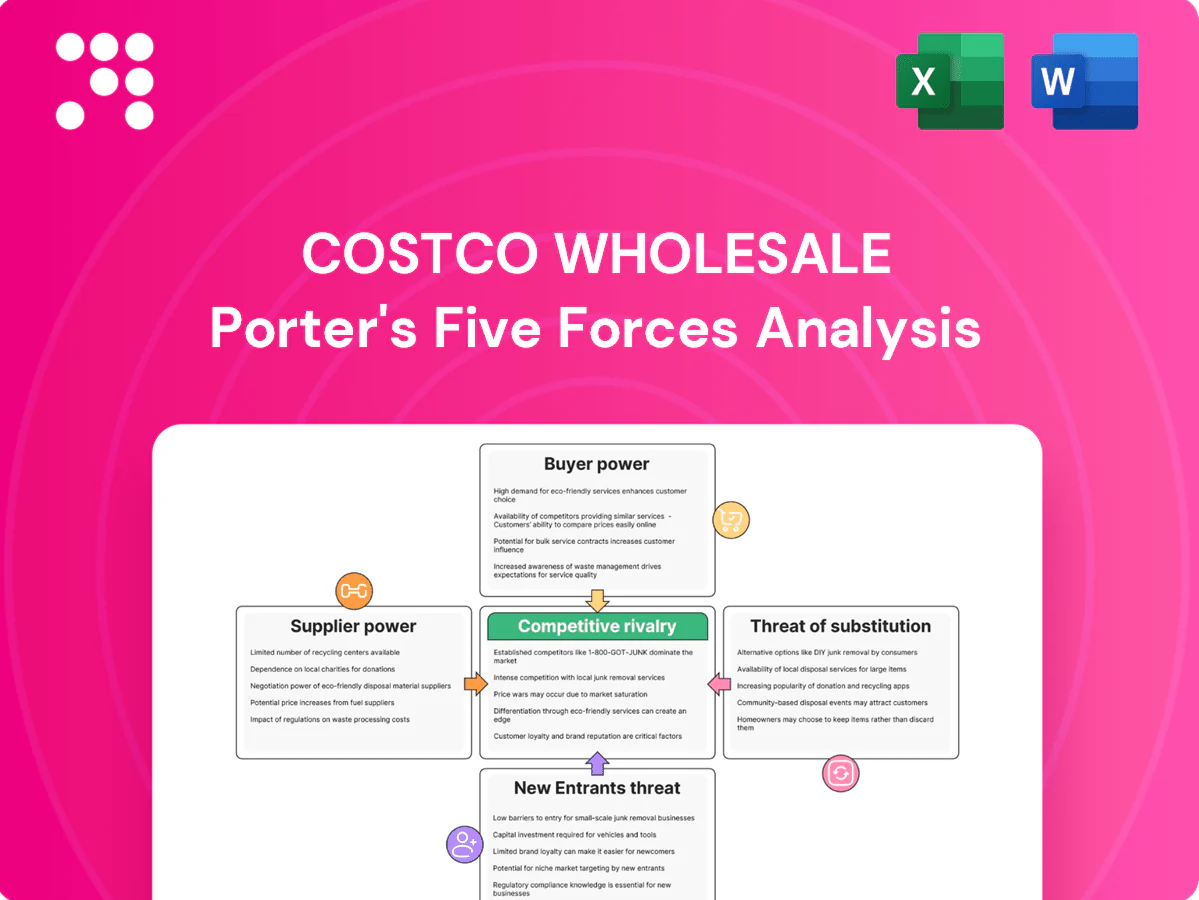
Costco Wholesale Porter's Five Forces Analysis

Don't Miss the Bigger Picture
Costco's scale, low margins, and membership model mute supplier and buyer power but intensify rivalry and raise barriers for entrants, while e-commerce and value-focused substitutes pose evolving threats. This snapshot highlights key competitive tensions and strategic levers driving Costco's resilience. This brief snapshot only scratches the surface. Unlock the full Porter's Five Forces Analysis to explore Costco Wholesale’s competitive dynamics, market pressures, and strategic advantages in detail.
Suppliers Bargaining Power

Scale purchasing concentrates leverage
Costco’s massive volumes and tight assortment—about 4,000 SKUs—generate outsized orders few retailers can match, supported by over $200 billion in net sales in FY2024. That scale enables Costco to extract lower prices, longer payment terms and favorable slotting. Suppliers that resist risk losing large, predictable demand and scale economics. Result: supplier bargaining power is generally moderated.
Private label Kirkland reduces dependence
Kirkland Signature substitutes national brands and disciplines pricing, giving Costco a credible threat to switch away from high‑cost suppliers; in FY2024 Costco reported about $254.6 billion in net sales, enabling scale to pressure supplier margins and slotting fees. Kirkland’s expanding assortment diversifies sourcing and reduces supplier bargaining power by providing alternative volume channels.

Consolidated categories can elevate power
In consolidated categories like soft drinks and diapers, dominant suppliers (Coca‑Cola and PepsiCo hold roughly 70% of US carbonated soft drinks) keep bargaining power, and strong brand equity plus limited substitutes constrain Costco’s leverage. Costco’s selective SKU strategy — roughly 3,700 SKUs per warehouse and about 860 warehouses in 2024 — concentrates buying power but still forces higher trade spend on key brands. The net effect therefore varies markedly by category and supplier.

Rapid turnover, predictable demand appeal
High inventory turns and steady member traffic lower suppliers’ forecasting risk, and with Costco operating 861 warehouses worldwide in 2024 suppliers gain predictable velocity and rapid cash conversion. Suppliers often accept tighter margins to secure volume and faster receivables, while Costco’s favorable working-capital dynamics reduce suppliers’ need for price concessions, tempering supplier pushback.
- Lower forecasting risk
- Tighter margins for velocity
- Improved supplier cash conversion
Compliance and data transparency demands
Costco enforces strict quality, packaging and cost-visibility requirements, offering compliant suppliers national exposure while delisting noncompliant vendors; these controls increase Costco’s ability to switch suppliers and compress supplier margins, reinforcing buyer dominance in negotiations as of 2024 given its scale and ~90%+ membership renewal strength.
- Strict standards = increased supplier churn
- Compliance grants national exposure
- Delisting risk strengthens Costco’s bargaining power
Retail buying power: $254.6B sales, 861 warehouses compress supplier margins
Costco’s scale (FY2024 net sales $254.6B; 861 warehouses; ~4,000 SKUs) tempers supplier power by extracting lower prices, longer terms and switching via Kirkland Signature. Category leaders (Coca‑Cola/Pepsi ~70% soft drink share) retain leverage in key segments. High turns, ~90%+ renewal, and strict compliance further compress supplier margins, though power varies by category.
| Metric | 2024 Value |
|---|---|
| Net sales | $254.6B |
| Warehouses | 861 |
| SKUs per warehouse | ~3,700–4,000 |
| Membership renewal | ~90%+ |
| Soft drink share (Coke/Pepsi) | ~70% |
What is included in the product
 Detailed Word Document
Tailored Porter’s Five Forces analysis for Costco Wholesale that uncovers competitive drivers, buyer and supplier power, threat of substitutes and new entrants, and highlights disruptive forces and strategic advantages protecting its margin and market share for investor, strategic, or academic use.

 Customizable Excel Spreadsheet
A concise, one-sheet Porter’s Five Forces for Costco—instantly visualize supplier, buyer, entrant, substitute, and rivalry pressures with an editable radar chart and slide-ready output to streamline strategic decisions.
Customers Bargaining Power

Members are price sensitive and value driven
Costco’s core promise of lowest total cost makes members highly price aware; any price drift risks churn at renewal—the retailer reported a roughly 90% membership renewal rate in 2024. Transparent price leadership limits Costco’s pricing latitude, while buyer power shows through renewals and visible basket shifts that directly affect same-store sales and membership revenue (over $4 billion in 2024).
Membership model locks in loyalty
Costco’s $60/$120 membership fees create sunk costs that drive repeat visits and blunt individual bargaining, supported by about a 90%+ U.S./Canada renewal rate in FY2024. Upfront revenue — roughly $6 billion in membership fees in fiscal 2024 — underpins loyalty while Executive upgrades boost spend. Members’ high value expectations constrain pricing and discipline Costco’s thin margins.

Limited SKU choice reduces switching within-trip
Costco's scarce assortment—roughly 4,000 SKUs versus about 40,000 at conventional supermarkets—narrows on-the-spot alternatives and moderates in-store buyer power. Treasure-hunt and impulse dynamics encourage purchases despite limited choice, reducing strict price comparisons during trips. Still, shoppers increasingly cross-shop online for specs and ratings, while external price benchmarks sustain pricing pressure.

Omnichannel transparency heightens comparison
Online marketplaces enable instant price checks on branded items, and with Amazon holding about 38% of US e‑commerce in 2024 shoppers can arbitrage across Amazon, Walmart and Target, forcing Costco to compete on pack size and total value; digital transparency thus increases buyer leverage.
- Online price checks rise
- Amazon ~38% US e‑commerce (2024)
- Costco competes on pack size/value
B2B and institutional buyers add volume influence
B2B and institutional buyers—small businesses, restaurants, schools—buy in bulk and are highly cost focused; their price elasticity means even modest price moves shift orders, creating aggregate volume pressure on Costco despite few individually dominant buyers. In 2024 Costco operated about 849 warehouses globally, using scale and Kirkland private label (roughly 20% of assortments) plus logistic efficiency to blunt buyer leverage.
- Bulk buyers: high elasticity
- Aggregate volume pressures pricing
- Costco scale: ~849 warehouses (2024)
- Private label/efficiency offset power
~90%+ renewals and $6B fees build strong loyalty despite thin margins and online price checks
Costco’s ~90%+ membership renewal rate in 2024 and roughly $6.0B in membership revenue create strong sunk-cost loyalty that limits individual bargaining. Transparent low-price positioning and thin margins cap pricing flexibility, while online price checks (Amazon ~38% US e‑commerce 2024) raise buyer leverage. Limited SKU count (~4,000) and Kirkland (~20% assortment) reduce on-trip substitutes but bulk B2B buyers exert aggregate volume pressure across ~849 warehouses (2024).
| Metric | 2024 |
|---|---|
| Membership renewal | ~90%+ |
| Membership revenue | $6.0B |
| Warehouses | ~849 |
| SKUs | ~4,000 |
| Private label | ~20% |
| Amazon e‑commerce share | ~38% |
Full Version Awaits
Costco Wholesale Porter's Five Forces Analysis
This Porter’s Five Forces analysis of Costco Wholesale evaluates competitive rivalry, supplier and buyer power, and the threats of new entrants and substitutes to clarify strategic pressures on margins and growth. This preview is the exact, fully formatted document you will receive immediately after purchase—no placeholders. It’s ready to download and use for investment, strategic planning, or academic purposes. What you see here is precisely what you’ll get.

Don't Miss the Bigger Picture
Costco's scale, low margins, and membership model mute supplier and buyer power but intensify rivalry and raise barriers for entrants, while e-commerce and value-focused substitutes pose evolving threats. This snapshot highlights key competitive tensions and strategic levers driving Costco's resilience. This brief snapshot only scratches the surface. Unlock the full Porter's Five Forces Analysis to explore Costco Wholesale’s competitive dynamics, market pressures, and strategic advantages in detail.
Suppliers Bargaining Power
Scale purchasing concentrates leverage
Costco’s massive volumes and tight assortment—about 4,000 SKUs—generate outsized orders few retailers can match, supported by over $200 billion in net sales in FY2024. That scale enables Costco to extract lower prices, longer payment terms and favorable slotting. Suppliers that resist risk losing large, predictable demand and scale economics. Result: supplier bargaining power is generally moderated.
Private label Kirkland reduces dependence
Kirkland Signature substitutes national brands and disciplines pricing, giving Costco a credible threat to switch away from high‑cost suppliers; in FY2024 Costco reported about $254.6 billion in net sales, enabling scale to pressure supplier margins and slotting fees. Kirkland’s expanding assortment diversifies sourcing and reduces supplier bargaining power by providing alternative volume channels.
Consolidated categories can elevate power
In consolidated categories like soft drinks and diapers, dominant suppliers (Coca‑Cola and PepsiCo hold roughly 70% of US carbonated soft drinks) keep bargaining power, and strong brand equity plus limited substitutes constrain Costco’s leverage. Costco’s selective SKU strategy — roughly 3,700 SKUs per warehouse and about 860 warehouses in 2024 — concentrates buying power but still forces higher trade spend on key brands. The net effect therefore varies markedly by category and supplier.
Rapid turnover, predictable demand appeal
High inventory turns and steady member traffic lower suppliers’ forecasting risk, and with Costco operating 861 warehouses worldwide in 2024 suppliers gain predictable velocity and rapid cash conversion. Suppliers often accept tighter margins to secure volume and faster receivables, while Costco’s favorable working-capital dynamics reduce suppliers’ need for price concessions, tempering supplier pushback.
- Lower forecasting risk
- Tighter margins for velocity
- Improved supplier cash conversion
Compliance and data transparency demands
Costco enforces strict quality, packaging and cost-visibility requirements, offering compliant suppliers national exposure while delisting noncompliant vendors; these controls increase Costco’s ability to switch suppliers and compress supplier margins, reinforcing buyer dominance in negotiations as of 2024 given its scale and ~90%+ membership renewal strength.
- Strict standards = increased supplier churn
- Compliance grants national exposure
- Delisting risk strengthens Costco’s bargaining power
Retail buying power: $254.6B sales, 861 warehouses compress supplier margins
Costco’s scale (FY2024 net sales $254.6B; 861 warehouses; ~4,000 SKUs) tempers supplier power by extracting lower prices, longer terms and switching via Kirkland Signature. Category leaders (Coca‑Cola/Pepsi ~70% soft drink share) retain leverage in key segments. High turns, ~90%+ renewal, and strict compliance further compress supplier margins, though power varies by category.
| Metric | 2024 Value |
|---|---|
| Net sales | $254.6B |
| Warehouses | 861 |
| SKUs per warehouse | ~3,700–4,000 |
| Membership renewal | ~90%+ |
| Soft drink share (Coke/Pepsi) | ~70% |
What is included in the product
Detailed Word Document
Tailored Porter’s Five Forces analysis for Costco Wholesale that uncovers competitive drivers, buyer and supplier power, threat of substitutes and new entrants, and highlights disruptive forces and strategic advantages protecting its margin and market share for investor, strategic, or academic use.
Customizable Excel Spreadsheet
A concise, one-sheet Porter’s Five Forces for Costco—instantly visualize supplier, buyer, entrant, substitute, and rivalry pressures with an editable radar chart and slide-ready output to streamline strategic decisions.
Customers Bargaining Power
Members are price sensitive and value driven
Costco’s core promise of lowest total cost makes members highly price aware; any price drift risks churn at renewal—the retailer reported a roughly 90% membership renewal rate in 2024. Transparent price leadership limits Costco’s pricing latitude, while buyer power shows through renewals and visible basket shifts that directly affect same-store sales and membership revenue (over $4 billion in 2024).
Membership model locks in loyalty
Costco’s $60/$120 membership fees create sunk costs that drive repeat visits and blunt individual bargaining, supported by about a 90%+ U.S./Canada renewal rate in FY2024. Upfront revenue — roughly $6 billion in membership fees in fiscal 2024 — underpins loyalty while Executive upgrades boost spend. Members’ high value expectations constrain pricing and discipline Costco’s thin margins.
Limited SKU choice reduces switching within-trip
Costco's scarce assortment—roughly 4,000 SKUs versus about 40,000 at conventional supermarkets—narrows on-the-spot alternatives and moderates in-store buyer power. Treasure-hunt and impulse dynamics encourage purchases despite limited choice, reducing strict price comparisons during trips. Still, shoppers increasingly cross-shop online for specs and ratings, while external price benchmarks sustain pricing pressure.
Omnichannel transparency heightens comparison
Online marketplaces enable instant price checks on branded items, and with Amazon holding about 38% of US e‑commerce in 2024 shoppers can arbitrage across Amazon, Walmart and Target, forcing Costco to compete on pack size and total value; digital transparency thus increases buyer leverage.
- Online price checks rise
- Amazon ~38% US e‑commerce (2024)
- Costco competes on pack size/value
B2B and institutional buyers add volume influence
B2B and institutional buyers—small businesses, restaurants, schools—buy in bulk and are highly cost focused; their price elasticity means even modest price moves shift orders, creating aggregate volume pressure on Costco despite few individually dominant buyers. In 2024 Costco operated about 849 warehouses globally, using scale and Kirkland private label (roughly 20% of assortments) plus logistic efficiency to blunt buyer leverage.
- Bulk buyers: high elasticity
- Aggregate volume pressures pricing
- Costco scale: ~849 warehouses (2024)
- Private label/efficiency offset power
~90%+ renewals and $6B fees build strong loyalty despite thin margins and online price checks
Costco’s ~90%+ membership renewal rate in 2024 and roughly $6.0B in membership revenue create strong sunk-cost loyalty that limits individual bargaining. Transparent low-price positioning and thin margins cap pricing flexibility, while online price checks (Amazon ~38% US e‑commerce 2024) raise buyer leverage. Limited SKU count (~4,000) and Kirkland (~20% assortment) reduce on-trip substitutes but bulk B2B buyers exert aggregate volume pressure across ~849 warehouses (2024).
| Metric | 2024 |
|---|---|
| Membership renewal | ~90%+ |
| Membership revenue | $6.0B |
| Warehouses | ~849 |
| SKUs | ~4,000 |
| Private label | ~20% |
| Amazon e‑commerce share | ~38% |
Full Version Awaits
Costco Wholesale Porter's Five Forces Analysis
This Porter’s Five Forces analysis of Costco Wholesale evaluates competitive rivalry, supplier and buyer power, and the threats of new entrants and substitutes to clarify strategic pressures on margins and growth. This preview is the exact, fully formatted document you will receive immediately after purchase—no placeholders. It’s ready to download and use for investment, strategic planning, or academic purposes. What you see here is precisely what you’ll get.
Original: $10.00
-65%$10.00
$3.50Description
Don't Miss the Bigger Picture
Costco's scale, low margins, and membership model mute supplier and buyer power but intensify rivalry and raise barriers for entrants, while e-commerce and value-focused substitutes pose evolving threats. This snapshot highlights key competitive tensions and strategic levers driving Costco's resilience. This brief snapshot only scratches the surface. Unlock the full Porter's Five Forces Analysis to explore Costco Wholesale’s competitive dynamics, market pressures, and strategic advantages in detail.
Suppliers Bargaining Power
Scale purchasing concentrates leverage
Costco’s massive volumes and tight assortment—about 4,000 SKUs—generate outsized orders few retailers can match, supported by over $200 billion in net sales in FY2024. That scale enables Costco to extract lower prices, longer payment terms and favorable slotting. Suppliers that resist risk losing large, predictable demand and scale economics. Result: supplier bargaining power is generally moderated.
Private label Kirkland reduces dependence
Kirkland Signature substitutes national brands and disciplines pricing, giving Costco a credible threat to switch away from high‑cost suppliers; in FY2024 Costco reported about $254.6 billion in net sales, enabling scale to pressure supplier margins and slotting fees. Kirkland’s expanding assortment diversifies sourcing and reduces supplier bargaining power by providing alternative volume channels.
Consolidated categories can elevate power
In consolidated categories like soft drinks and diapers, dominant suppliers (Coca‑Cola and PepsiCo hold roughly 70% of US carbonated soft drinks) keep bargaining power, and strong brand equity plus limited substitutes constrain Costco’s leverage. Costco’s selective SKU strategy — roughly 3,700 SKUs per warehouse and about 860 warehouses in 2024 — concentrates buying power but still forces higher trade spend on key brands. The net effect therefore varies markedly by category and supplier.
Rapid turnover, predictable demand appeal
High inventory turns and steady member traffic lower suppliers’ forecasting risk, and with Costco operating 861 warehouses worldwide in 2024 suppliers gain predictable velocity and rapid cash conversion. Suppliers often accept tighter margins to secure volume and faster receivables, while Costco’s favorable working-capital dynamics reduce suppliers’ need for price concessions, tempering supplier pushback.
- Lower forecasting risk
- Tighter margins for velocity
- Improved supplier cash conversion
Compliance and data transparency demands
Costco enforces strict quality, packaging and cost-visibility requirements, offering compliant suppliers national exposure while delisting noncompliant vendors; these controls increase Costco’s ability to switch suppliers and compress supplier margins, reinforcing buyer dominance in negotiations as of 2024 given its scale and ~90%+ membership renewal strength.
- Strict standards = increased supplier churn
- Compliance grants national exposure
- Delisting risk strengthens Costco’s bargaining power
Retail buying power: $254.6B sales, 861 warehouses compress supplier margins
Costco’s scale (FY2024 net sales $254.6B; 861 warehouses; ~4,000 SKUs) tempers supplier power by extracting lower prices, longer terms and switching via Kirkland Signature. Category leaders (Coca‑Cola/Pepsi ~70% soft drink share) retain leverage in key segments. High turns, ~90%+ renewal, and strict compliance further compress supplier margins, though power varies by category.
| Metric | 2024 Value |
|---|---|
| Net sales | $254.6B |
| Warehouses | 861 |
| SKUs per warehouse | ~3,700–4,000 |
| Membership renewal | ~90%+ |
| Soft drink share (Coke/Pepsi) | ~70% |
What is included in the product
Detailed Word Document
Tailored Porter’s Five Forces analysis for Costco Wholesale that uncovers competitive drivers, buyer and supplier power, threat of substitutes and new entrants, and highlights disruptive forces and strategic advantages protecting its margin and market share for investor, strategic, or academic use.
Customizable Excel Spreadsheet
A concise, one-sheet Porter’s Five Forces for Costco—instantly visualize supplier, buyer, entrant, substitute, and rivalry pressures with an editable radar chart and slide-ready output to streamline strategic decisions.
Customers Bargaining Power
Members are price sensitive and value driven
Costco’s core promise of lowest total cost makes members highly price aware; any price drift risks churn at renewal—the retailer reported a roughly 90% membership renewal rate in 2024. Transparent price leadership limits Costco’s pricing latitude, while buyer power shows through renewals and visible basket shifts that directly affect same-store sales and membership revenue (over $4 billion in 2024).
Membership model locks in loyalty
Costco’s $60/$120 membership fees create sunk costs that drive repeat visits and blunt individual bargaining, supported by about a 90%+ U.S./Canada renewal rate in FY2024. Upfront revenue — roughly $6 billion in membership fees in fiscal 2024 — underpins loyalty while Executive upgrades boost spend. Members’ high value expectations constrain pricing and discipline Costco’s thin margins.
Limited SKU choice reduces switching within-trip
Costco's scarce assortment—roughly 4,000 SKUs versus about 40,000 at conventional supermarkets—narrows on-the-spot alternatives and moderates in-store buyer power. Treasure-hunt and impulse dynamics encourage purchases despite limited choice, reducing strict price comparisons during trips. Still, shoppers increasingly cross-shop online for specs and ratings, while external price benchmarks sustain pricing pressure.
Omnichannel transparency heightens comparison
Online marketplaces enable instant price checks on branded items, and with Amazon holding about 38% of US e‑commerce in 2024 shoppers can arbitrage across Amazon, Walmart and Target, forcing Costco to compete on pack size and total value; digital transparency thus increases buyer leverage.
- Online price checks rise
- Amazon ~38% US e‑commerce (2024)
- Costco competes on pack size/value
B2B and institutional buyers add volume influence
B2B and institutional buyers—small businesses, restaurants, schools—buy in bulk and are highly cost focused; their price elasticity means even modest price moves shift orders, creating aggregate volume pressure on Costco despite few individually dominant buyers. In 2024 Costco operated about 849 warehouses globally, using scale and Kirkland private label (roughly 20% of assortments) plus logistic efficiency to blunt buyer leverage.
- Bulk buyers: high elasticity
- Aggregate volume pressures pricing
- Costco scale: ~849 warehouses (2024)
- Private label/efficiency offset power
~90%+ renewals and $6B fees build strong loyalty despite thin margins and online price checks
Costco’s ~90%+ membership renewal rate in 2024 and roughly $6.0B in membership revenue create strong sunk-cost loyalty that limits individual bargaining. Transparent low-price positioning and thin margins cap pricing flexibility, while online price checks (Amazon ~38% US e‑commerce 2024) raise buyer leverage. Limited SKU count (~4,000) and Kirkland (~20% assortment) reduce on-trip substitutes but bulk B2B buyers exert aggregate volume pressure across ~849 warehouses (2024).
| Metric | 2024 |
|---|---|
| Membership renewal | ~90%+ |
| Membership revenue | $6.0B |
| Warehouses | ~849 |
| SKUs | ~4,000 |
| Private label | ~20% |
| Amazon e‑commerce share | ~38% |
Full Version Awaits
Costco Wholesale Porter's Five Forces Analysis
This Porter’s Five Forces analysis of Costco Wholesale evaluates competitive rivalry, supplier and buyer power, and the threats of new entrants and substitutes to clarify strategic pressures on margins and growth. This preview is the exact, fully formatted document you will receive immediately after purchase—no placeholders. It’s ready to download and use for investment, strategic planning, or academic purposes. What you see here is precisely what you’ll get.











