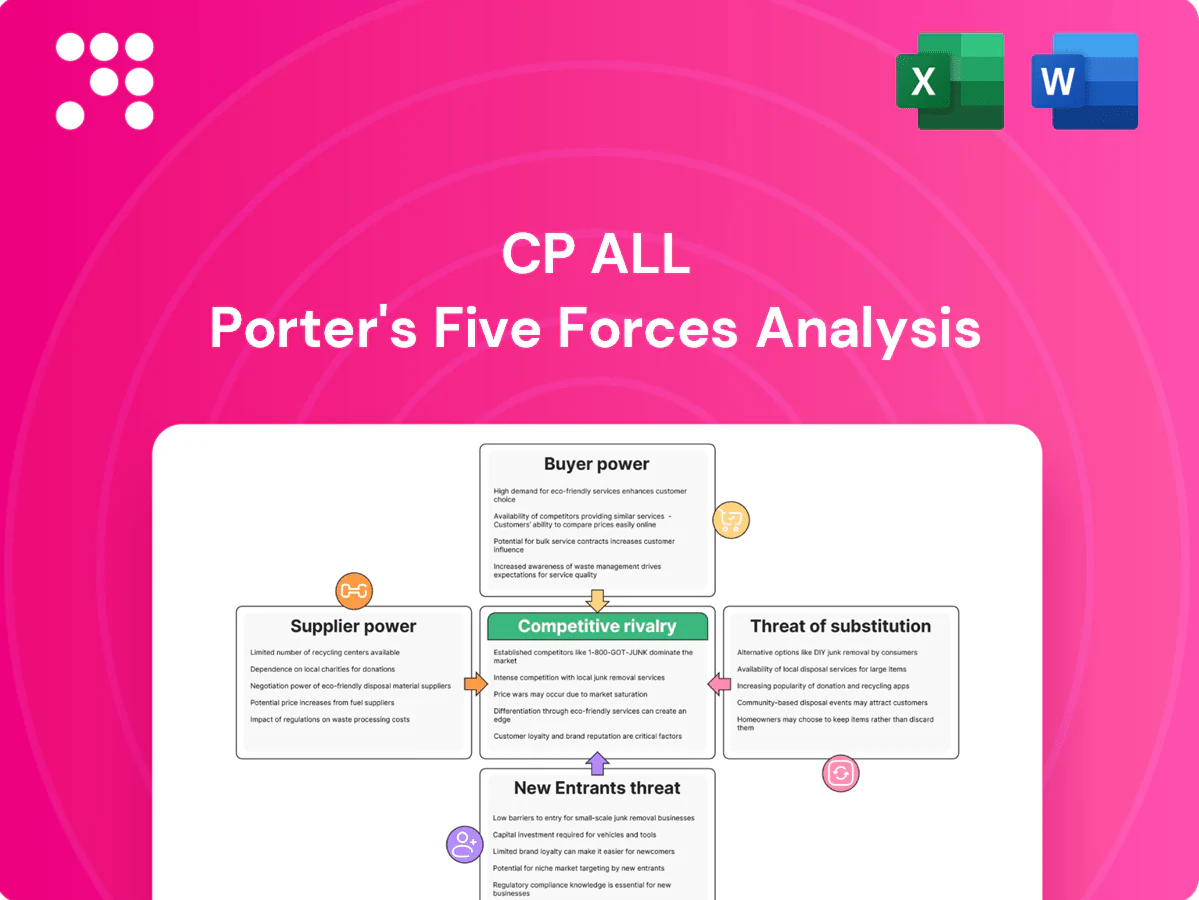
CP All Porter's Five Forces Analysis

Don't Miss the Bigger Picture
CP All faces intense competitive rivalry, shifting supplier dynamics, and evolving consumer power that shape its convenience retail edge; this brief snapshot highlights key pressures but omits force-by-force nuance. Unlock the full Porter’s Five Forces Analysis to see detailed ratings, visuals, and strategic implications tailored to CP All. Get the complete, consultant-grade report to guide investment and strategy decisions.
Suppliers Bargaining Power

Diversified supplier base
CP All sources from numerous FMCG, fresh and local vendors across Thailand, supporting its network of over 14,000 stores nationwide in 2024 and diluting individual supplier influence. Multi-sourcing and category redundancy lower switching risk and bargaining costs. Specialty and imported items retain niche supplier leverage for certain SKUs. Long-term framework agreements and consignment programs help stabilize terms and ensure supply assurance.
Scale-driven purchasing leverage
Mass volumes from over 14,000 7-Eleven stores and 100+ Makro outlets give CP All pronounced leverage on price and payment terms, enabling centralized procurement and category management to drive better margins. National reach and consistent sell-through limit supplier resistance, while bulk buys and real-time POS data-sharing programs push supplier terms toward CP All—reflected in improved gross margin resilience versus peers in 2024.

Private labels and vertical capabilities
CP All’s expansion of own brands in food and essentials reduces reliance on branded suppliers and captures higher margin sales across its network of over 14,000 stores as of 2024. Its in-house manufacturing and distribution arms act as upstream substitutes, weakening supplier bargaining power. Private labels exert downward pressure on branded pricing and slotting fees, though consistent quality and brand trust remain execution risks for scaling private-label penetration.

Cold chain and fresh logistics dependence
Ready-to-eat and fresh categories force CP All to rely on reliable cold-chain partners and specialized inputs; specialized packaging and regulatory compliance elevate supplier bargaining power in these niches. CP All’s scale—over 14,000 stores nationwide in 2024—reduces but does not remove this dependence, and any cold-chain disruption can quickly ripple across operations and SKU availability.
- Cold-chain reliance increases supplier leverage
- Specialized packaging/compliance raises costs
- Scale (14,000+ stores in 2024) mitigates but not eliminates risk
- Disruptions cause nationwide SKU shortages
Non-merch suppliers: landlords and utilities
Rents for prime urban sites act as a supplier-like fixed cost for CP All, which operated 14,000+ 7‑Eleven stores in 2024; energy, payment rails and delivery platforms add recurring cost pressure. Long leases and multi-site bargaining secure lower rates but reduce flexibility to exit unprofitable locations. Cost inflation in utilities and fees can compress margins despite merchandising scale.
14K+ stores boost buying power; private label rises, rents and cold-chain squeeze margins
CP All’s 14,000+ stores in 2024 give strong procurement leverage, lowering supplier price and payment power. Private-label expansion and centralized category management further weaken branded suppliers, while specialty/imported SKUs and cold-chain inputs retain niche leverage. Fixed costs like prime rents and utilities act as supplier-like pressures on margins.
| Metric | 2024 |
|---|---|
| Store count | 14,000+ |
| Private-label scale | Growing (national rollout) |
| Key risks | Cold-chain, specialty imports, rents |
What is included in the product
 Detailed Word Document
Uncovers key drivers of competition, buyer and supplier power, threat of new entrants and substitutes, and intensity of rivalry specific to CP All, identifying emerging disruptions and strategic levers to protect market share.

 Customizable Excel Spreadsheet
A concise one-sheet Porter's Five Forces for CP All that highlights retail-specific pressures, with customizable pressure sliders and instant spider chart visualization—ready for pitch decks or board decisions; no macros, easy to edit and integrate into dashboards.
Customers Bargaining Power

Highly fragmented retail customers
Millions of small-ticket shoppers dilute individual bargaining power, as CP All operates over 14,000 stores nationwide (2024) serving millions of daily customers. Convenience, proximity and speed prioritize availability over price haggling, with average basket sizes remaining low. Small basket values limit leverage per transaction, yet aggregate price sensitivity drives frequent promotions and tuned assortment strategies.
Low switching costs across formats
Shoppers can quickly shift to rival convenience chains, supermarkets or mom-and-pop shops, increasing customer bargaining power. CP All's network of over 14,000 7-Eleven stores in 2024 makes locations ubiquitous, reducing travel friction and intensifying comparative choice. Mobile apps and digital promos heighten price and promotion transparency, raising price sensitivity. Maintaining consistent assortment and high on-shelf availability is essential to curb switching.

Makro’s SME and HORECA buyers
Makro’s SME and HORECA buyers purchase in bulk and intensely negotiate prices and service terms, boosting buyer power; SMEs represent 99.7% of Thai enterprises and ~43% of GDP (2024), making contract pricing, credit lines and delivery SLAs key differentiators, with retention hinging on reliability and total cost of ownership.

Loyalty programs and ecosystems
CP All’s membership, points and app ordering erect friction for switching by bundling rewards across ~14,000 7‑Eleven stores in Thailand (2024) and Makro channels; personalized, data‑driven offers shift emphasis from price to tailored value and can drive measurable basket uplift. Cross‑format benefits deepen engagement while execution quality—timing, relevancy and app UX—determines stickiness and net sales upside.
- Membership scale: >14,000 stores (2024)
- Switching cost: points + app ordering
- Personalization: reduces price sensitivity
- Cross-format: 7‑Eleven + Makro loyalty
- Execution: UX and targeting drive uplift
Health, quality, and ESG expectations
- Demand: freshness, safety, sustainability
- Impact: assortment and compliance upgrades
- Premiumization: must justify price
- Driver: transparent labels and certifications
14,000+ stores amplify SME bargaining; loyalty apps increase switching costs
CP All serves over 14,000 stores (2024), diluting individual customer leverage but creating high aggregate price sensitivity that drives promotions. SMEs/HORECA buyers (SMEs = 99.7% of Thai firms, ~43% GDP) exert strong negotiating power on Makro bulk terms. Loyalty, app promotions and cross‑format rewards raise switching costs and shift competition toward service and assortment.
| Metric | 2024 Value | Impact |
|---|---|---|
| Store count | 14,000+ | Low individual, high aggregate power |
| SME share | 99.7% firms; ~43% GDP | High B2B bargaining |
| Loyalty reach | Cross‑format app | Higher switching cost |
What You See Is What You Get
CP All Porter's Five Forces Analysis
This preview shows the exact CP All Porter's Five Forces Analysis you'll receive immediately after purchase—no placeholders or mockups. The document displayed is fully formatted, professionally written and ready for download and use the moment you buy. You're looking at the actual deliverable; instant access is provided with no surprises.

Don't Miss the Bigger Picture
CP All faces intense competitive rivalry, shifting supplier dynamics, and evolving consumer power that shape its convenience retail edge; this brief snapshot highlights key pressures but omits force-by-force nuance. Unlock the full Porter’s Five Forces Analysis to see detailed ratings, visuals, and strategic implications tailored to CP All. Get the complete, consultant-grade report to guide investment and strategy decisions.
Suppliers Bargaining Power
Diversified supplier base
CP All sources from numerous FMCG, fresh and local vendors across Thailand, supporting its network of over 14,000 stores nationwide in 2024 and diluting individual supplier influence. Multi-sourcing and category redundancy lower switching risk and bargaining costs. Specialty and imported items retain niche supplier leverage for certain SKUs. Long-term framework agreements and consignment programs help stabilize terms and ensure supply assurance.
Scale-driven purchasing leverage
Mass volumes from over 14,000 7-Eleven stores and 100+ Makro outlets give CP All pronounced leverage on price and payment terms, enabling centralized procurement and category management to drive better margins. National reach and consistent sell-through limit supplier resistance, while bulk buys and real-time POS data-sharing programs push supplier terms toward CP All—reflected in improved gross margin resilience versus peers in 2024.
Private labels and vertical capabilities
CP All’s expansion of own brands in food and essentials reduces reliance on branded suppliers and captures higher margin sales across its network of over 14,000 stores as of 2024. Its in-house manufacturing and distribution arms act as upstream substitutes, weakening supplier bargaining power. Private labels exert downward pressure on branded pricing and slotting fees, though consistent quality and brand trust remain execution risks for scaling private-label penetration.
Cold chain and fresh logistics dependence
Ready-to-eat and fresh categories force CP All to rely on reliable cold-chain partners and specialized inputs; specialized packaging and regulatory compliance elevate supplier bargaining power in these niches. CP All’s scale—over 14,000 stores nationwide in 2024—reduces but does not remove this dependence, and any cold-chain disruption can quickly ripple across operations and SKU availability.
- Cold-chain reliance increases supplier leverage
- Specialized packaging/compliance raises costs
- Scale (14,000+ stores in 2024) mitigates but not eliminates risk
- Disruptions cause nationwide SKU shortages
Non-merch suppliers: landlords and utilities
Rents for prime urban sites act as a supplier-like fixed cost for CP All, which operated 14,000+ 7‑Eleven stores in 2024; energy, payment rails and delivery platforms add recurring cost pressure. Long leases and multi-site bargaining secure lower rates but reduce flexibility to exit unprofitable locations. Cost inflation in utilities and fees can compress margins despite merchandising scale.
14K+ stores boost buying power; private label rises, rents and cold-chain squeeze margins
CP All’s 14,000+ stores in 2024 give strong procurement leverage, lowering supplier price and payment power. Private-label expansion and centralized category management further weaken branded suppliers, while specialty/imported SKUs and cold-chain inputs retain niche leverage. Fixed costs like prime rents and utilities act as supplier-like pressures on margins.
| Metric | 2024 |
|---|---|
| Store count | 14,000+ |
| Private-label scale | Growing (national rollout) |
| Key risks | Cold-chain, specialty imports, rents |
What is included in the product
Detailed Word Document
Uncovers key drivers of competition, buyer and supplier power, threat of new entrants and substitutes, and intensity of rivalry specific to CP All, identifying emerging disruptions and strategic levers to protect market share.
Customizable Excel Spreadsheet
A concise one-sheet Porter's Five Forces for CP All that highlights retail-specific pressures, with customizable pressure sliders and instant spider chart visualization—ready for pitch decks or board decisions; no macros, easy to edit and integrate into dashboards.
Customers Bargaining Power
Highly fragmented retail customers
Millions of small-ticket shoppers dilute individual bargaining power, as CP All operates over 14,000 stores nationwide (2024) serving millions of daily customers. Convenience, proximity and speed prioritize availability over price haggling, with average basket sizes remaining low. Small basket values limit leverage per transaction, yet aggregate price sensitivity drives frequent promotions and tuned assortment strategies.
Low switching costs across formats
Shoppers can quickly shift to rival convenience chains, supermarkets or mom-and-pop shops, increasing customer bargaining power. CP All's network of over 14,000 7-Eleven stores in 2024 makes locations ubiquitous, reducing travel friction and intensifying comparative choice. Mobile apps and digital promos heighten price and promotion transparency, raising price sensitivity. Maintaining consistent assortment and high on-shelf availability is essential to curb switching.
Makro’s SME and HORECA buyers
Makro’s SME and HORECA buyers purchase in bulk and intensely negotiate prices and service terms, boosting buyer power; SMEs represent 99.7% of Thai enterprises and ~43% of GDP (2024), making contract pricing, credit lines and delivery SLAs key differentiators, with retention hinging on reliability and total cost of ownership.
Loyalty programs and ecosystems
CP All’s membership, points and app ordering erect friction for switching by bundling rewards across ~14,000 7‑Eleven stores in Thailand (2024) and Makro channels; personalized, data‑driven offers shift emphasis from price to tailored value and can drive measurable basket uplift. Cross‑format benefits deepen engagement while execution quality—timing, relevancy and app UX—determines stickiness and net sales upside.
- Membership scale: >14,000 stores (2024)
- Switching cost: points + app ordering
- Personalization: reduces price sensitivity
- Cross-format: 7‑Eleven + Makro loyalty
- Execution: UX and targeting drive uplift
Health, quality, and ESG expectations
- Demand: freshness, safety, sustainability
- Impact: assortment and compliance upgrades
- Premiumization: must justify price
- Driver: transparent labels and certifications
14,000+ stores amplify SME bargaining; loyalty apps increase switching costs
CP All serves over 14,000 stores (2024), diluting individual customer leverage but creating high aggregate price sensitivity that drives promotions. SMEs/HORECA buyers (SMEs = 99.7% of Thai firms, ~43% GDP) exert strong negotiating power on Makro bulk terms. Loyalty, app promotions and cross‑format rewards raise switching costs and shift competition toward service and assortment.
| Metric | 2024 Value | Impact |
|---|---|---|
| Store count | 14,000+ | Low individual, high aggregate power |
| SME share | 99.7% firms; ~43% GDP | High B2B bargaining |
| Loyalty reach | Cross‑format app | Higher switching cost |
What You See Is What You Get
CP All Porter's Five Forces Analysis
This preview shows the exact CP All Porter's Five Forces Analysis you'll receive immediately after purchase—no placeholders or mockups. The document displayed is fully formatted, professionally written and ready for download and use the moment you buy. You're looking at the actual deliverable; instant access is provided with no surprises.
Original: $10.00
-65%$10.00
$3.50Description
Don't Miss the Bigger Picture
CP All faces intense competitive rivalry, shifting supplier dynamics, and evolving consumer power that shape its convenience retail edge; this brief snapshot highlights key pressures but omits force-by-force nuance. Unlock the full Porter’s Five Forces Analysis to see detailed ratings, visuals, and strategic implications tailored to CP All. Get the complete, consultant-grade report to guide investment and strategy decisions.
Suppliers Bargaining Power
Diversified supplier base
CP All sources from numerous FMCG, fresh and local vendors across Thailand, supporting its network of over 14,000 stores nationwide in 2024 and diluting individual supplier influence. Multi-sourcing and category redundancy lower switching risk and bargaining costs. Specialty and imported items retain niche supplier leverage for certain SKUs. Long-term framework agreements and consignment programs help stabilize terms and ensure supply assurance.
Scale-driven purchasing leverage
Mass volumes from over 14,000 7-Eleven stores and 100+ Makro outlets give CP All pronounced leverage on price and payment terms, enabling centralized procurement and category management to drive better margins. National reach and consistent sell-through limit supplier resistance, while bulk buys and real-time POS data-sharing programs push supplier terms toward CP All—reflected in improved gross margin resilience versus peers in 2024.
Private labels and vertical capabilities
CP All’s expansion of own brands in food and essentials reduces reliance on branded suppliers and captures higher margin sales across its network of over 14,000 stores as of 2024. Its in-house manufacturing and distribution arms act as upstream substitutes, weakening supplier bargaining power. Private labels exert downward pressure on branded pricing and slotting fees, though consistent quality and brand trust remain execution risks for scaling private-label penetration.
Cold chain and fresh logistics dependence
Ready-to-eat and fresh categories force CP All to rely on reliable cold-chain partners and specialized inputs; specialized packaging and regulatory compliance elevate supplier bargaining power in these niches. CP All’s scale—over 14,000 stores nationwide in 2024—reduces but does not remove this dependence, and any cold-chain disruption can quickly ripple across operations and SKU availability.
- Cold-chain reliance increases supplier leverage
- Specialized packaging/compliance raises costs
- Scale (14,000+ stores in 2024) mitigates but not eliminates risk
- Disruptions cause nationwide SKU shortages
Non-merch suppliers: landlords and utilities
Rents for prime urban sites act as a supplier-like fixed cost for CP All, which operated 14,000+ 7‑Eleven stores in 2024; energy, payment rails and delivery platforms add recurring cost pressure. Long leases and multi-site bargaining secure lower rates but reduce flexibility to exit unprofitable locations. Cost inflation in utilities and fees can compress margins despite merchandising scale.
14K+ stores boost buying power; private label rises, rents and cold-chain squeeze margins
CP All’s 14,000+ stores in 2024 give strong procurement leverage, lowering supplier price and payment power. Private-label expansion and centralized category management further weaken branded suppliers, while specialty/imported SKUs and cold-chain inputs retain niche leverage. Fixed costs like prime rents and utilities act as supplier-like pressures on margins.
| Metric | 2024 |
|---|---|
| Store count | 14,000+ |
| Private-label scale | Growing (national rollout) |
| Key risks | Cold-chain, specialty imports, rents |
What is included in the product
Detailed Word Document
Uncovers key drivers of competition, buyer and supplier power, threat of new entrants and substitutes, and intensity of rivalry specific to CP All, identifying emerging disruptions and strategic levers to protect market share.
Customizable Excel Spreadsheet
A concise one-sheet Porter's Five Forces for CP All that highlights retail-specific pressures, with customizable pressure sliders and instant spider chart visualization—ready for pitch decks or board decisions; no macros, easy to edit and integrate into dashboards.
Customers Bargaining Power
Highly fragmented retail customers
Millions of small-ticket shoppers dilute individual bargaining power, as CP All operates over 14,000 stores nationwide (2024) serving millions of daily customers. Convenience, proximity and speed prioritize availability over price haggling, with average basket sizes remaining low. Small basket values limit leverage per transaction, yet aggregate price sensitivity drives frequent promotions and tuned assortment strategies.
Low switching costs across formats
Shoppers can quickly shift to rival convenience chains, supermarkets or mom-and-pop shops, increasing customer bargaining power. CP All's network of over 14,000 7-Eleven stores in 2024 makes locations ubiquitous, reducing travel friction and intensifying comparative choice. Mobile apps and digital promos heighten price and promotion transparency, raising price sensitivity. Maintaining consistent assortment and high on-shelf availability is essential to curb switching.
Makro’s SME and HORECA buyers
Makro’s SME and HORECA buyers purchase in bulk and intensely negotiate prices and service terms, boosting buyer power; SMEs represent 99.7% of Thai enterprises and ~43% of GDP (2024), making contract pricing, credit lines and delivery SLAs key differentiators, with retention hinging on reliability and total cost of ownership.
Loyalty programs and ecosystems
CP All’s membership, points and app ordering erect friction for switching by bundling rewards across ~14,000 7‑Eleven stores in Thailand (2024) and Makro channels; personalized, data‑driven offers shift emphasis from price to tailored value and can drive measurable basket uplift. Cross‑format benefits deepen engagement while execution quality—timing, relevancy and app UX—determines stickiness and net sales upside.
- Membership scale: >14,000 stores (2024)
- Switching cost: points + app ordering
- Personalization: reduces price sensitivity
- Cross-format: 7‑Eleven + Makro loyalty
- Execution: UX and targeting drive uplift
Health, quality, and ESG expectations
- Demand: freshness, safety, sustainability
- Impact: assortment and compliance upgrades
- Premiumization: must justify price
- Driver: transparent labels and certifications
14,000+ stores amplify SME bargaining; loyalty apps increase switching costs
CP All serves over 14,000 stores (2024), diluting individual customer leverage but creating high aggregate price sensitivity that drives promotions. SMEs/HORECA buyers (SMEs = 99.7% of Thai firms, ~43% GDP) exert strong negotiating power on Makro bulk terms. Loyalty, app promotions and cross‑format rewards raise switching costs and shift competition toward service and assortment.
| Metric | 2024 Value | Impact |
|---|---|---|
| Store count | 14,000+ | Low individual, high aggregate power |
| SME share | 99.7% firms; ~43% GDP | High B2B bargaining |
| Loyalty reach | Cross‑format app | Higher switching cost |
What You See Is What You Get
CP All Porter's Five Forces Analysis
This preview shows the exact CP All Porter's Five Forces Analysis you'll receive immediately after purchase—no placeholders or mockups. The document displayed is fully formatted, professionally written and ready for download and use the moment you buy. You're looking at the actual deliverable; instant access is provided with no surprises.











