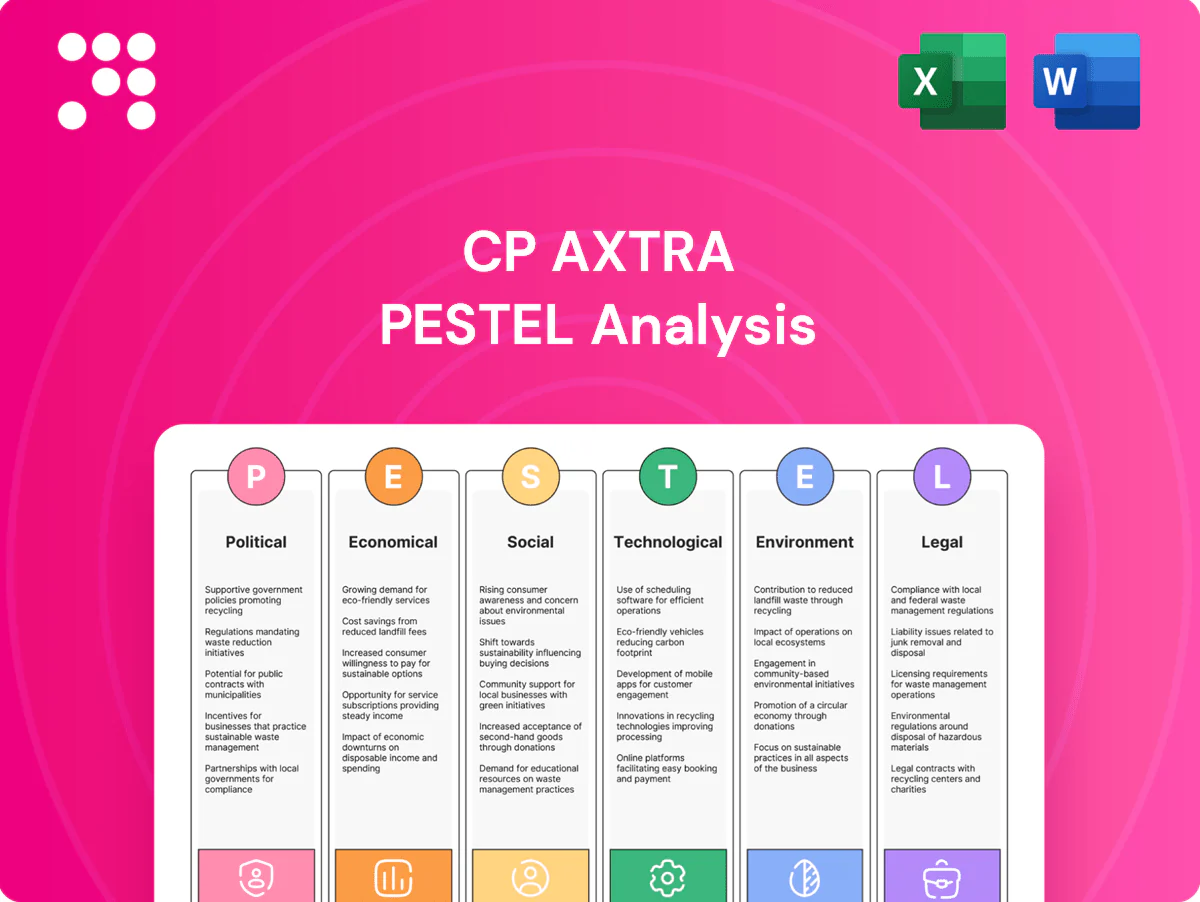
CP Axtra PESTLE Analysis

Your Shortcut to Market Insight Starts Here
Unlock strategic clarity with our CP Axtra PESTLE Analysis—three to five expert-level insights into political, economic, social, technological, legal, and environmental forces shaping the company's future. Perfect for investors, consultants, and planners, it’s fully researched and ready to use. Purchase the full report to access actionable intelligence and customizable formats for immediate decision-making.
Political factors

Thailand retail policy and government stability
Government priorities on consumer prices, SME support, and retail competition shape CP Axtra’s operating landscape, intensified after the September 2023 change in government and ensuing cabinet directives from the Ministry of Commerce and Department of Internal Trade. Policy shifts post-election can alter trade hours, pricing oversight, or subsidies and thus consumer demand and margins. Political stability enables multi-year expansion planning and capex; uncertainty delays permits and store rollouts. Close monitoring of cabinet agendas and trade ministry directives is essential.
SME and informal sector formalization
SME formalization programs can expand Makro’s member base as SMEs — which represent about 90% of businesses and 50% of employment globally (World Bank) and over 99% of firms in the Philippines (PSA) — move into the formal market. Tax incentives and public procurement set-asides for SMEs tend to boost wholesale volumes, while tighter compliance and licensing costs can reduce micro-merchants’ purchasing power. CP Axtra can align loyalty tiers and tailored credit terms with government SME initiatives to capture new formalized buyers.

Food security and import policies
Tariffs, quotas and sanitary rules (tariffs on meat frequently exceed 20% in many markets) materially affect CP Axtra assortment and costs, while domestic producer protection can raise input prices. Liberalization opens wider sourcing and cost relief; over 30+ countries introduced new import curbs since 2020, causing sudden disruptions. Robust multi-country sourcing and compliance readiness significantly reduce such shocks.

Infrastructure and regional integration
Public investment in logistics corridors, ports and cold chain, such as Thailand's Eastern Economic Corridor projects (~1.5 trillion baht), raises distribution efficiency and reduces spoilage; ASEAN trade facilitation and Single Window rollouts, which ADB estimates can cut trade costs by up to 15%, ease cross-border procurement and private-label manufacturing. Delays in public works sustain transport costs and shrink margins; CP Axtra benefits from locating DCs near improved corridors by lowering lead times and inventory holding.
- Public investment: EEC ~1.5 trillion baht
- Trade facilitation: up to 15% trade-cost reduction (ADB)
- Risk: project delays → higher transport costs, compressed margins
- Opportunity: DCs near corridors → faster distribution, lower inventory
Public health and crisis response
Government pandemic and animal‑disease responses have cut store footfall by up to 60% in peak lockdowns and driven widespread supply disruptions, with reported stock‑out spikes in grocery and FMCG during 2020–22. Mandates on hygiene, distancing and tracing raised compliance costs (commonly reported at roughly 1–3% of operating expenses) while restoring consumer confidence. Emergency price controls in some markets capped margins to below 10% on essentials, and firms with crisis‑ready SOPs recovered sales and protected brand equity faster.
- footfall drop: up to 60% in peak lockdowns
- compliance cost: ~1–3% of operating expenses
- stock‑outs: major spikes in 2020–22
- price caps: essentials margins often <10%
- SOPs: faster sales recovery, preserved brand equity
Price controls and tariffs reshape sourcing; SME formalization ~90%
Government directives since Sept 2023 tightened price oversight and SME support, affecting trading hours, margins and capex; political stability enables multi‑year rollouts while uncertainty delays permits. SME formalization (≈90% of firms globally; >99% in Philippines) expands Makro membership but raises compliance costs. Tariffs/import curbs (30+ countries since 2020) and EEC investment (~1.5 trillion baht) materially shift sourcing and logistics.
| Metric | Value |
|---|---|
| EEC capex | ~1.5 trillion baht |
| SME share | ~90% firms global; >99% PH |
| Import curbs since 2020 | 30+ countries |
What is included in the product
 Detailed Word Document
Provides a data-driven PESTLE review of CP Axtra across Political, Economic, Social, Technological, Environmental and Legal dimensions, highlighting region- and industry-specific risks and opportunities; designed for executives and investors with forward-looking insights and clean, presentation-ready formatting.

 Customizable Excel Spreadsheet
CP Axtra's PESTLE delivers a clean, visually segmented summary that removes complexity—easy to edit, share, and drop into presentations—so teams can quickly align on external risks and market positioning during planning sessions.
Economic factors

Consumer spending and income trends
Household income growth boosts Lotus’s basket size and Makro ticket values as Thai consumer spending expanded about 3.5% in 2024, while household debt remained high near 90% of GDP, shifting price-sensitive shoppers to value formats and private labels. Wage gains of roughly 3–4% in 2024 supported discretionary categories but raised store operating costs. Dynamic pricing and mix management have been used to defend margins.
Inflation and input costs
Food inflation (FAO Food Price Index ~118 in 2024) shifts category mix and purchase frequency while energy costs (Brent ~85 USD/bbl in 2024) inflate logistics and refrigeration. Persistent inflation keeps price perception weak versus wet markets and discounters, pressuring basket value. Aggressive supplier negotiations and scale sourcing are essential to protect gross margins. Tight shrink control and waste reduction help offset cost volatility.

Baht volatility and FX exposure
Baht volatility—about a 6% depreciation versus USD in 2024—increases costs for imported SKUs, foreign-denominated CAPEX and leases, squeezing margins and prompting retail price hikes. Hedging and localizing supply chains reduce FX risk. Price ladders and tiered brands help maintain affordability.

Tourism and HORECA demand
Tourism cycles strongly drive HORECA demand for Makro: UNWTO reports international arrivals recovered to about 88% of 2019 levels in 2023 and approached 95% in 2024, lifting bulk purchases during recovery phases while downturns compress orders and raise credit risk for suppliers.
- Seasonality: agile inventory & staffing required
- Credit risk: higher in downturns
- B2B promos: capture returning demand
Credit conditions and SME liquidity
Tighter credit and higher policy rates (eg US fed funds ~5.25–5.50% and ECB deposit ~4% in 2024) squeeze SME cash flow and cut purchasing power. Extended terms or BNPL lift sales but raise receivables and default exposure. Lender partnerships can share risk and widen access. Rigorous credit scoring and collateral preserve working capital.
- Higher rates: reduced purchasing and tighter margins
- BNPL/terms: sales up, receivables risk up
- Partnerships: risk-sharing, broader funding
- Underwriting: strict scoring and collateral to protect liquidity
Price controls and tariffs reshape sourcing; SME formalization ~90%
Household income +3.5% (2024) lifted basket sizes while household debt ~90% GDP kept shoppers price-sensitive; wages +3–4% raised costs. Food inflation (FAO ~118) and Brent ~$85/bbl (2024) raised logistics; Baht -6% vs USD increased import/CAPEX costs. Tourism ~95% of 2019 arrivals (2024) boosted HORECA; policy rates US 5.25–5.50% tightened SME liquidity.
| Metric | 2024 |
|---|---|
| Income growth | +3.5% |
| Household debt | ~90% GDP |
| FAO Index | ~118 |
| Brent | ~$85/bbl |
| Baht USD | -6% |
| Tourism | ~95% of 2019 |
| Policy rate (US) | 5.25–5.50% |
Same Document Delivered
CP Axtra PESTLE Analysis
The preview shown is the exact CP Axtra PESTLE Analysis document you’ll receive after purchase—fully formatted and ready to use. The layout, content, and structure match the downloadable file with no placeholders or surprises. After checkout you’ll instantly receive this same professionally structured file.

Your Shortcut to Market Insight Starts Here
Unlock strategic clarity with our CP Axtra PESTLE Analysis—three to five expert-level insights into political, economic, social, technological, legal, and environmental forces shaping the company's future. Perfect for investors, consultants, and planners, it’s fully researched and ready to use. Purchase the full report to access actionable intelligence and customizable formats for immediate decision-making.
Political factors
Thailand retail policy and government stability
Government priorities on consumer prices, SME support, and retail competition shape CP Axtra’s operating landscape, intensified after the September 2023 change in government and ensuing cabinet directives from the Ministry of Commerce and Department of Internal Trade. Policy shifts post-election can alter trade hours, pricing oversight, or subsidies and thus consumer demand and margins. Political stability enables multi-year expansion planning and capex; uncertainty delays permits and store rollouts. Close monitoring of cabinet agendas and trade ministry directives is essential.
SME and informal sector formalization
SME formalization programs can expand Makro’s member base as SMEs — which represent about 90% of businesses and 50% of employment globally (World Bank) and over 99% of firms in the Philippines (PSA) — move into the formal market. Tax incentives and public procurement set-asides for SMEs tend to boost wholesale volumes, while tighter compliance and licensing costs can reduce micro-merchants’ purchasing power. CP Axtra can align loyalty tiers and tailored credit terms with government SME initiatives to capture new formalized buyers.
Food security and import policies
Tariffs, quotas and sanitary rules (tariffs on meat frequently exceed 20% in many markets) materially affect CP Axtra assortment and costs, while domestic producer protection can raise input prices. Liberalization opens wider sourcing and cost relief; over 30+ countries introduced new import curbs since 2020, causing sudden disruptions. Robust multi-country sourcing and compliance readiness significantly reduce such shocks.
Infrastructure and regional integration
Public investment in logistics corridors, ports and cold chain, such as Thailand's Eastern Economic Corridor projects (~1.5 trillion baht), raises distribution efficiency and reduces spoilage; ASEAN trade facilitation and Single Window rollouts, which ADB estimates can cut trade costs by up to 15%, ease cross-border procurement and private-label manufacturing. Delays in public works sustain transport costs and shrink margins; CP Axtra benefits from locating DCs near improved corridors by lowering lead times and inventory holding.
- Public investment: EEC ~1.5 trillion baht
- Trade facilitation: up to 15% trade-cost reduction (ADB)
- Risk: project delays → higher transport costs, compressed margins
- Opportunity: DCs near corridors → faster distribution, lower inventory
Public health and crisis response
Government pandemic and animal‑disease responses have cut store footfall by up to 60% in peak lockdowns and driven widespread supply disruptions, with reported stock‑out spikes in grocery and FMCG during 2020–22. Mandates on hygiene, distancing and tracing raised compliance costs (commonly reported at roughly 1–3% of operating expenses) while restoring consumer confidence. Emergency price controls in some markets capped margins to below 10% on essentials, and firms with crisis‑ready SOPs recovered sales and protected brand equity faster.
- footfall drop: up to 60% in peak lockdowns
- compliance cost: ~1–3% of operating expenses
- stock‑outs: major spikes in 2020–22
- price caps: essentials margins often <10%
- SOPs: faster sales recovery, preserved brand equity
Price controls and tariffs reshape sourcing; SME formalization ~90%
Government directives since Sept 2023 tightened price oversight and SME support, affecting trading hours, margins and capex; political stability enables multi‑year rollouts while uncertainty delays permits. SME formalization (≈90% of firms globally; >99% in Philippines) expands Makro membership but raises compliance costs. Tariffs/import curbs (30+ countries since 2020) and EEC investment (~1.5 trillion baht) materially shift sourcing and logistics.
| Metric | Value |
|---|---|
| EEC capex | ~1.5 trillion baht |
| SME share | ~90% firms global; >99% PH |
| Import curbs since 2020 | 30+ countries |
What is included in the product
Detailed Word Document
Provides a data-driven PESTLE review of CP Axtra across Political, Economic, Social, Technological, Environmental and Legal dimensions, highlighting region- and industry-specific risks and opportunities; designed for executives and investors with forward-looking insights and clean, presentation-ready formatting.
Customizable Excel Spreadsheet
CP Axtra's PESTLE delivers a clean, visually segmented summary that removes complexity—easy to edit, share, and drop into presentations—so teams can quickly align on external risks and market positioning during planning sessions.
Economic factors
Consumer spending and income trends
Household income growth boosts Lotus’s basket size and Makro ticket values as Thai consumer spending expanded about 3.5% in 2024, while household debt remained high near 90% of GDP, shifting price-sensitive shoppers to value formats and private labels. Wage gains of roughly 3–4% in 2024 supported discretionary categories but raised store operating costs. Dynamic pricing and mix management have been used to defend margins.
Inflation and input costs
Food inflation (FAO Food Price Index ~118 in 2024) shifts category mix and purchase frequency while energy costs (Brent ~85 USD/bbl in 2024) inflate logistics and refrigeration. Persistent inflation keeps price perception weak versus wet markets and discounters, pressuring basket value. Aggressive supplier negotiations and scale sourcing are essential to protect gross margins. Tight shrink control and waste reduction help offset cost volatility.
Baht volatility and FX exposure
Baht volatility—about a 6% depreciation versus USD in 2024—increases costs for imported SKUs, foreign-denominated CAPEX and leases, squeezing margins and prompting retail price hikes. Hedging and localizing supply chains reduce FX risk. Price ladders and tiered brands help maintain affordability.
Tourism and HORECA demand
Tourism cycles strongly drive HORECA demand for Makro: UNWTO reports international arrivals recovered to about 88% of 2019 levels in 2023 and approached 95% in 2024, lifting bulk purchases during recovery phases while downturns compress orders and raise credit risk for suppliers.
- Seasonality: agile inventory & staffing required
- Credit risk: higher in downturns
- B2B promos: capture returning demand
Credit conditions and SME liquidity
Tighter credit and higher policy rates (eg US fed funds ~5.25–5.50% and ECB deposit ~4% in 2024) squeeze SME cash flow and cut purchasing power. Extended terms or BNPL lift sales but raise receivables and default exposure. Lender partnerships can share risk and widen access. Rigorous credit scoring and collateral preserve working capital.
- Higher rates: reduced purchasing and tighter margins
- BNPL/terms: sales up, receivables risk up
- Partnerships: risk-sharing, broader funding
- Underwriting: strict scoring and collateral to protect liquidity
Price controls and tariffs reshape sourcing; SME formalization ~90%
Household income +3.5% (2024) lifted basket sizes while household debt ~90% GDP kept shoppers price-sensitive; wages +3–4% raised costs. Food inflation (FAO ~118) and Brent ~$85/bbl (2024) raised logistics; Baht -6% vs USD increased import/CAPEX costs. Tourism ~95% of 2019 arrivals (2024) boosted HORECA; policy rates US 5.25–5.50% tightened SME liquidity.
| Metric | 2024 |
|---|---|
| Income growth | +3.5% |
| Household debt | ~90% GDP |
| FAO Index | ~118 |
| Brent | ~$85/bbl |
| Baht USD | -6% |
| Tourism | ~95% of 2019 |
| Policy rate (US) | 5.25–5.50% |
Same Document Delivered
CP Axtra PESTLE Analysis
The preview shown is the exact CP Axtra PESTLE Analysis document you’ll receive after purchase—fully formatted and ready to use. The layout, content, and structure match the downloadable file with no placeholders or surprises. After checkout you’ll instantly receive this same professionally structured file.
Original: $10.00
-65%$10.00
$3.50Description
Your Shortcut to Market Insight Starts Here
Unlock strategic clarity with our CP Axtra PESTLE Analysis—three to five expert-level insights into political, economic, social, technological, legal, and environmental forces shaping the company's future. Perfect for investors, consultants, and planners, it’s fully researched and ready to use. Purchase the full report to access actionable intelligence and customizable formats for immediate decision-making.
Political factors
Thailand retail policy and government stability
Government priorities on consumer prices, SME support, and retail competition shape CP Axtra’s operating landscape, intensified after the September 2023 change in government and ensuing cabinet directives from the Ministry of Commerce and Department of Internal Trade. Policy shifts post-election can alter trade hours, pricing oversight, or subsidies and thus consumer demand and margins. Political stability enables multi-year expansion planning and capex; uncertainty delays permits and store rollouts. Close monitoring of cabinet agendas and trade ministry directives is essential.
SME and informal sector formalization
SME formalization programs can expand Makro’s member base as SMEs — which represent about 90% of businesses and 50% of employment globally (World Bank) and over 99% of firms in the Philippines (PSA) — move into the formal market. Tax incentives and public procurement set-asides for SMEs tend to boost wholesale volumes, while tighter compliance and licensing costs can reduce micro-merchants’ purchasing power. CP Axtra can align loyalty tiers and tailored credit terms with government SME initiatives to capture new formalized buyers.
Food security and import policies
Tariffs, quotas and sanitary rules (tariffs on meat frequently exceed 20% in many markets) materially affect CP Axtra assortment and costs, while domestic producer protection can raise input prices. Liberalization opens wider sourcing and cost relief; over 30+ countries introduced new import curbs since 2020, causing sudden disruptions. Robust multi-country sourcing and compliance readiness significantly reduce such shocks.
Infrastructure and regional integration
Public investment in logistics corridors, ports and cold chain, such as Thailand's Eastern Economic Corridor projects (~1.5 trillion baht), raises distribution efficiency and reduces spoilage; ASEAN trade facilitation and Single Window rollouts, which ADB estimates can cut trade costs by up to 15%, ease cross-border procurement and private-label manufacturing. Delays in public works sustain transport costs and shrink margins; CP Axtra benefits from locating DCs near improved corridors by lowering lead times and inventory holding.
- Public investment: EEC ~1.5 trillion baht
- Trade facilitation: up to 15% trade-cost reduction (ADB)
- Risk: project delays → higher transport costs, compressed margins
- Opportunity: DCs near corridors → faster distribution, lower inventory
Public health and crisis response
Government pandemic and animal‑disease responses have cut store footfall by up to 60% in peak lockdowns and driven widespread supply disruptions, with reported stock‑out spikes in grocery and FMCG during 2020–22. Mandates on hygiene, distancing and tracing raised compliance costs (commonly reported at roughly 1–3% of operating expenses) while restoring consumer confidence. Emergency price controls in some markets capped margins to below 10% on essentials, and firms with crisis‑ready SOPs recovered sales and protected brand equity faster.
- footfall drop: up to 60% in peak lockdowns
- compliance cost: ~1–3% of operating expenses
- stock‑outs: major spikes in 2020–22
- price caps: essentials margins often <10%
- SOPs: faster sales recovery, preserved brand equity
Price controls and tariffs reshape sourcing; SME formalization ~90%
Government directives since Sept 2023 tightened price oversight and SME support, affecting trading hours, margins and capex; political stability enables multi‑year rollouts while uncertainty delays permits. SME formalization (≈90% of firms globally; >99% in Philippines) expands Makro membership but raises compliance costs. Tariffs/import curbs (30+ countries since 2020) and EEC investment (~1.5 trillion baht) materially shift sourcing and logistics.
| Metric | Value |
|---|---|
| EEC capex | ~1.5 trillion baht |
| SME share | ~90% firms global; >99% PH |
| Import curbs since 2020 | 30+ countries |
What is included in the product
Detailed Word Document
Provides a data-driven PESTLE review of CP Axtra across Political, Economic, Social, Technological, Environmental and Legal dimensions, highlighting region- and industry-specific risks and opportunities; designed for executives and investors with forward-looking insights and clean, presentation-ready formatting.
Customizable Excel Spreadsheet
CP Axtra's PESTLE delivers a clean, visually segmented summary that removes complexity—easy to edit, share, and drop into presentations—so teams can quickly align on external risks and market positioning during planning sessions.
Economic factors
Consumer spending and income trends
Household income growth boosts Lotus’s basket size and Makro ticket values as Thai consumer spending expanded about 3.5% in 2024, while household debt remained high near 90% of GDP, shifting price-sensitive shoppers to value formats and private labels. Wage gains of roughly 3–4% in 2024 supported discretionary categories but raised store operating costs. Dynamic pricing and mix management have been used to defend margins.
Inflation and input costs
Food inflation (FAO Food Price Index ~118 in 2024) shifts category mix and purchase frequency while energy costs (Brent ~85 USD/bbl in 2024) inflate logistics and refrigeration. Persistent inflation keeps price perception weak versus wet markets and discounters, pressuring basket value. Aggressive supplier negotiations and scale sourcing are essential to protect gross margins. Tight shrink control and waste reduction help offset cost volatility.
Baht volatility and FX exposure
Baht volatility—about a 6% depreciation versus USD in 2024—increases costs for imported SKUs, foreign-denominated CAPEX and leases, squeezing margins and prompting retail price hikes. Hedging and localizing supply chains reduce FX risk. Price ladders and tiered brands help maintain affordability.
Tourism and HORECA demand
Tourism cycles strongly drive HORECA demand for Makro: UNWTO reports international arrivals recovered to about 88% of 2019 levels in 2023 and approached 95% in 2024, lifting bulk purchases during recovery phases while downturns compress orders and raise credit risk for suppliers.
- Seasonality: agile inventory & staffing required
- Credit risk: higher in downturns
- B2B promos: capture returning demand
Credit conditions and SME liquidity
Tighter credit and higher policy rates (eg US fed funds ~5.25–5.50% and ECB deposit ~4% in 2024) squeeze SME cash flow and cut purchasing power. Extended terms or BNPL lift sales but raise receivables and default exposure. Lender partnerships can share risk and widen access. Rigorous credit scoring and collateral preserve working capital.
- Higher rates: reduced purchasing and tighter margins
- BNPL/terms: sales up, receivables risk up
- Partnerships: risk-sharing, broader funding
- Underwriting: strict scoring and collateral to protect liquidity
Price controls and tariffs reshape sourcing; SME formalization ~90%
Household income +3.5% (2024) lifted basket sizes while household debt ~90% GDP kept shoppers price-sensitive; wages +3–4% raised costs. Food inflation (FAO ~118) and Brent ~$85/bbl (2024) raised logistics; Baht -6% vs USD increased import/CAPEX costs. Tourism ~95% of 2019 arrivals (2024) boosted HORECA; policy rates US 5.25–5.50% tightened SME liquidity.
| Metric | 2024 |
|---|---|
| Income growth | +3.5% |
| Household debt | ~90% GDP |
| FAO Index | ~118 |
| Brent | ~$85/bbl |
| Baht USD | -6% |
| Tourism | ~95% of 2019 |
| Policy rate (US) | 5.25–5.50% |
Same Document Delivered
CP Axtra PESTLE Analysis
The preview shown is the exact CP Axtra PESTLE Analysis document you’ll receive after purchase—fully formatted and ready to use. The layout, content, and structure match the downloadable file with no placeholders or surprises. After checkout you’ll instantly receive this same professionally structured file.











