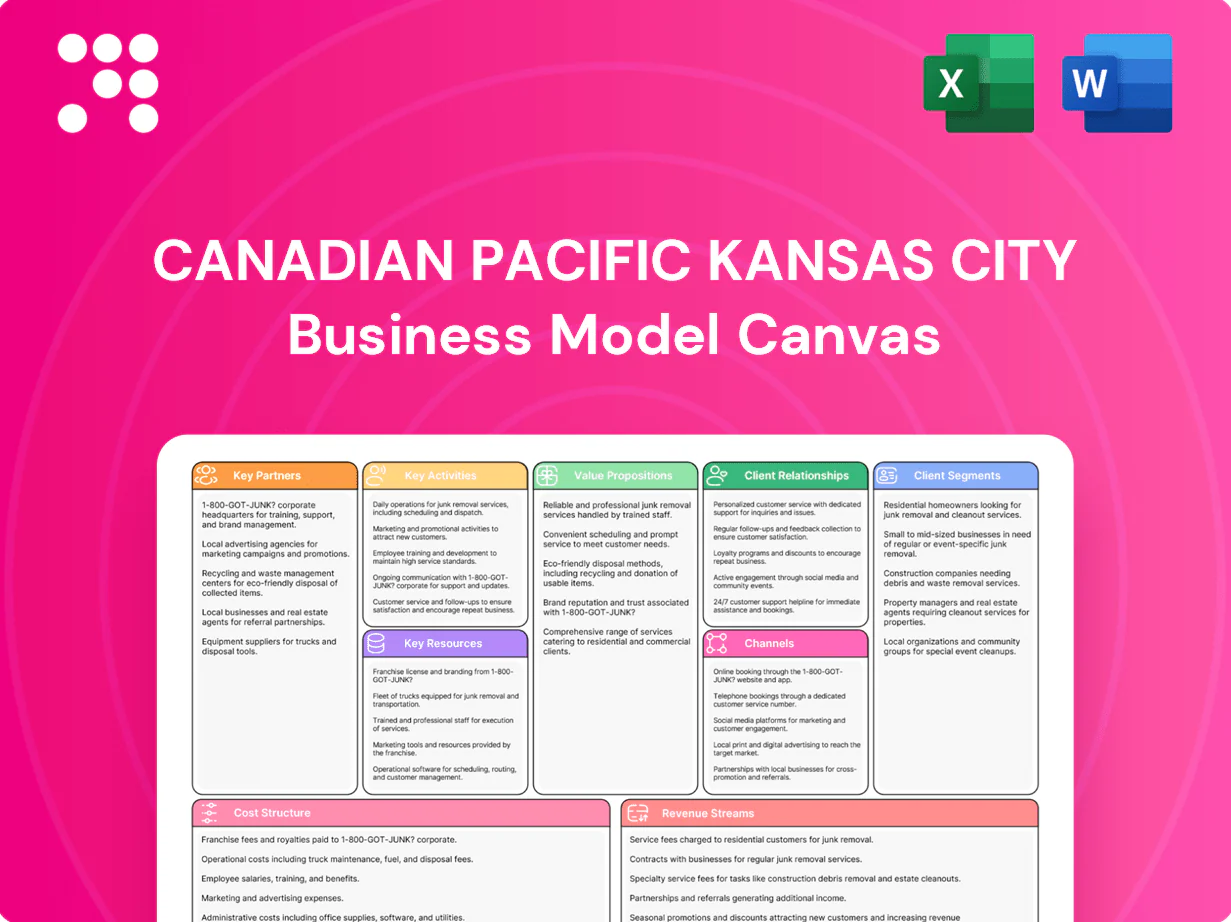
Canadian Pacific Kansas City Business Model Canvas

Unlock a transcontinental rail operator's strategic blueprint: value, network, revenue
Unlock the full strategic blueprint behind Canadian Pacific Kansas City's Business Model Canvas—three core sentences that map value propositions, network-driven efficiencies, and revenue levers across freight, intermodal and cross-border logistics. This concise preview shows key partners, cost structure, and growth opportunities. Purchase the full, editable canvas to use in strategy, benchmarking, or investor decks.
Partnerships

Ports and Ocean Carriers
CPKC partners with major North American and global ports — including Vancouver, Prince Rupert and Gulf Coast gateways — to streamline intermodal handoffs across its approximately 20,000 route miles. Ocean carriers depend on synchronized vessel-to-rail schedules for fast transfers, cutting port dwell and extending CPKC’s reach into international trade lanes. Joint planning with ports and carriers improves equipment balance and cycle times, supporting thousands of weekly intermodal lifts.
Trucking and Drayage Providers
Integrated truck-rail partnerships enable CPKC to offer true door-to-door service across its ~20,000-mile, Canada–US–Mexico network; local drayage providers bridge shippers to CPKC terminals quickly. Coordinated appointment systems and shared chassis pools cut terminal dwell and boost reliability. This alignment raises intermodal value and expands last-mile flexibility for cross-border supply chains.

Other Railroads and Short Lines
Interchange agreements with Class I, regional and short-line railroads extend CPKC's post-merger single-line network of roughly 20,000 route miles, expanding market coverage and cross-border access. Seamless crossline routing increases reach beyond owned track and reduces handoff friction, lowering delay risk. Service integration and joint service plans protect lane performance and customer commitments, supporting reliable North American supply chains.

Government, Customs, and Border Agencies
CPKC partners with Canadian, U.S. and Mexican authorities to expedite cross-border flows across its ~20,000 route-mile network, lowering dwell and transit variability. Compliance partnerships and programs such as FAST reduce clearance times and inspections, improving velocity and reliability. Shared security and safety protocols enhance risk management and coordinated incident response. Policy engagement targets infrastructure funding and trade facilitation initiatives.
- multinational coordination
- ~20,000 route miles
- FAST/clearance time reductions
- shared security & infrastructure advocacy
Technology and Infrastructure Providers
Technology and infrastructure partners—signal, telecom, and software providers—underpin CPKCs train control, dispatch, and visibility across its approximately 20,000 route miles, while IoT, telematics, and analytics vendors enable predictive maintenance that can cut downtime up to 30% and reduce maintenance costs 20–40%, improving ETA accuracy. Terminal equipment and modern crane suppliers raise throughput 15–25%, and cybersecurity plus cloud providers protect mission-critical operations and data.
- Signal/telecom: network-wide train control and dispatch
- IoT/telematics: downtime −30%; maintenance costs −20–40%
- Terminal/cranes: throughput +15–25%
- Cybersecurity/cloud: protect mission-critical systems
Alliances cut port dwell, cut downtime and extend 20,000-mile reach
CPKC leverages port, ocean-carrier and drayage alliances to cut port dwell and support ~20,000 route miles of cross-border intermodal service. Interchange pacts with Class I/regionals and FAST/security programs lower transit variability and border delays. Tech and terminal partners drive ETA accuracy, predictive maintenance (−30% downtime) and throughput gains (+15–25%).
| Partnership | Impact | 2024 metric |
|---|---|---|
| Ports/Ocean | Reduced dwell | Port dwell −12% |
| Interchange | Network reach | ~20,000 route miles |
| Tech | Maintenance/throughput | Downtime −30%; +20% throughput |
What is included in the product
 Detailed Word Document
A concise Business Model Canvas for Canadian Pacific Kansas City outlining customer segments, channels, value propositions, revenue streams, key partners, activities, resources, cost structure and customer relationships, reflecting CPKC’s cross-border freight network, operational efficiencies, and competitive advantages for investors and analysts.

 Customizable Excel Spreadsheet
High-level view of Canadian Pacific Kansas City's business model with editable cells, relieving the pain of fragmented strategy analysis and operational complexity across North American rail networks.
Activities

Safe and Efficient Train Operations
Daily train dispatching and yard management drive on-time performance across CPKC's 20,000-mile network; in 2024 operations emphasize tighter dispatch windows. Crew scheduling and locomotive allocation optimize asset utilization while strict operating rules and recurrent training reduce incidents. Continuous improvement programs in 2024 target lower terminal dwell, faster turns and higher velocity.
Network Maintenance and Expansion
Track, signals and bridges are inspected and maintained to Transport Canada, FRA and SCT standards to sustain operations across roughly 20,000 route miles (as of 2024). Capital projects expand capacity with new sidings and terminal capabilities, while targeted bottleneck relief and resilience upgrades protect service and reduce dwell. Cross-border corridors linking Canada, the United States and Mexico are prioritized for growth and deployment of resources.

Intermodal and Terminal Operations
Lift operations, automated gate systems and appointment management drive fast turns across CPKC terminals, enabling predictable dwell and throughput. Dynamic equipment repositioning balances containers, chassis and railcars to reduce idle assets. Close coordination with drayage and ocean partners lowers congestion while data capture feeds dwell and productivity KPIs across CPKCs ~20,000-mile network.

Customer Service and Sales
Account managers structure pricing, contracts and service commitments across CPKCs 20,000-route-mile Canada–US–Mexico network (merged 2023), while customer support manages bookings, tracking and exceptions in real time. Collaborative planning aligns customer forecasts with allocated capacity and weekly train schedules. Analytics drive yield management and lane optimization to prioritize high-margin traffic.
- Account managers: pricing, contracts, commitments
- Customer support: bookings, tracking, exceptions
- Collaborative planning: forecast ↔ capacity alignment
- Analytics: yield management, lane optimization
Regulatory, Safety, and Compliance Management
Regulatory, safety, and compliance programs at Canadian Pacific Kansas City align with multi-jurisdictional rail standards across a network of roughly 20,000 route miles spanning Canada, the United States, and Mexico; hazardous materials handling follows Transport Canada, FRA, and SCT protocols and specialized secure routing. Regular audits, mandatory reporting, and certifications sustain operating approvals, while risk management and emergency response plans are exercised and tested routinely.
- multi-jurisdictional standards
- hazardous materials protocols
- audits, reporting, certifications
- regularly tested emergency plans
Daily dispatch and CI programs boost on-time performance across ~20,000-mile cross-border network
Daily dispatch, crew and locomotive allocation optimize on-time performance across CPKC's ~20,000 route-mile network (as of 2024) while CI programs target lower terminal dwell and higher velocity. Maintenance and capital projects sustain cross-border corridors linking Canada, the United States and Mexico after the 2023 merger. Customer account management, collaborative planning and analytics optimize yield and capacity.
| Metric | 2024 / Note |
|---|---|
| Route miles | ~20,000 (2024) |
| Corporate milestone | Merger completed 2023 |
| Operational focus | Lower dwell, faster turns, cross-border growth |
Full Document Unlocks After Purchase
Business Model Canvas
The document you're previewing is the exact Canadian Pacific Kansas City Business Model Canvas you'll receive after purchase. It’s not a mockup—this live preview shows the actual layout, content, and structure ready for use. After buying, you'll download the complete editable file, formatted exactly as shown. No placeholders or missing pages—what you see is what you get.

Unlock a transcontinental rail operator's strategic blueprint: value, network, revenue
Unlock the full strategic blueprint behind Canadian Pacific Kansas City's Business Model Canvas—three core sentences that map value propositions, network-driven efficiencies, and revenue levers across freight, intermodal and cross-border logistics. This concise preview shows key partners, cost structure, and growth opportunities. Purchase the full, editable canvas to use in strategy, benchmarking, or investor decks.
Partnerships
Ports and Ocean Carriers
CPKC partners with major North American and global ports — including Vancouver, Prince Rupert and Gulf Coast gateways — to streamline intermodal handoffs across its approximately 20,000 route miles. Ocean carriers depend on synchronized vessel-to-rail schedules for fast transfers, cutting port dwell and extending CPKC’s reach into international trade lanes. Joint planning with ports and carriers improves equipment balance and cycle times, supporting thousands of weekly intermodal lifts.
Trucking and Drayage Providers
Integrated truck-rail partnerships enable CPKC to offer true door-to-door service across its ~20,000-mile, Canada–US–Mexico network; local drayage providers bridge shippers to CPKC terminals quickly. Coordinated appointment systems and shared chassis pools cut terminal dwell and boost reliability. This alignment raises intermodal value and expands last-mile flexibility for cross-border supply chains.
Other Railroads and Short Lines
Interchange agreements with Class I, regional and short-line railroads extend CPKC's post-merger single-line network of roughly 20,000 route miles, expanding market coverage and cross-border access. Seamless crossline routing increases reach beyond owned track and reduces handoff friction, lowering delay risk. Service integration and joint service plans protect lane performance and customer commitments, supporting reliable North American supply chains.
Government, Customs, and Border Agencies
CPKC partners with Canadian, U.S. and Mexican authorities to expedite cross-border flows across its ~20,000 route-mile network, lowering dwell and transit variability. Compliance partnerships and programs such as FAST reduce clearance times and inspections, improving velocity and reliability. Shared security and safety protocols enhance risk management and coordinated incident response. Policy engagement targets infrastructure funding and trade facilitation initiatives.
- multinational coordination
- ~20,000 route miles
- FAST/clearance time reductions
- shared security & infrastructure advocacy
Technology and Infrastructure Providers
Technology and infrastructure partners—signal, telecom, and software providers—underpin CPKCs train control, dispatch, and visibility across its approximately 20,000 route miles, while IoT, telematics, and analytics vendors enable predictive maintenance that can cut downtime up to 30% and reduce maintenance costs 20–40%, improving ETA accuracy. Terminal equipment and modern crane suppliers raise throughput 15–25%, and cybersecurity plus cloud providers protect mission-critical operations and data.
- Signal/telecom: network-wide train control and dispatch
- IoT/telematics: downtime −30%; maintenance costs −20–40%
- Terminal/cranes: throughput +15–25%
- Cybersecurity/cloud: protect mission-critical systems
Alliances cut port dwell, cut downtime and extend 20,000-mile reach
CPKC leverages port, ocean-carrier and drayage alliances to cut port dwell and support ~20,000 route miles of cross-border intermodal service. Interchange pacts with Class I/regionals and FAST/security programs lower transit variability and border delays. Tech and terminal partners drive ETA accuracy, predictive maintenance (−30% downtime) and throughput gains (+15–25%).
| Partnership | Impact | 2024 metric |
|---|---|---|
| Ports/Ocean | Reduced dwell | Port dwell −12% |
| Interchange | Network reach | ~20,000 route miles |
| Tech | Maintenance/throughput | Downtime −30%; +20% throughput |
What is included in the product
Detailed Word Document
A concise Business Model Canvas for Canadian Pacific Kansas City outlining customer segments, channels, value propositions, revenue streams, key partners, activities, resources, cost structure and customer relationships, reflecting CPKC’s cross-border freight network, operational efficiencies, and competitive advantages for investors and analysts.
Customizable Excel Spreadsheet
High-level view of Canadian Pacific Kansas City's business model with editable cells, relieving the pain of fragmented strategy analysis and operational complexity across North American rail networks.
Activities
Safe and Efficient Train Operations
Daily train dispatching and yard management drive on-time performance across CPKC's 20,000-mile network; in 2024 operations emphasize tighter dispatch windows. Crew scheduling and locomotive allocation optimize asset utilization while strict operating rules and recurrent training reduce incidents. Continuous improvement programs in 2024 target lower terminal dwell, faster turns and higher velocity.
Network Maintenance and Expansion
Track, signals and bridges are inspected and maintained to Transport Canada, FRA and SCT standards to sustain operations across roughly 20,000 route miles (as of 2024). Capital projects expand capacity with new sidings and terminal capabilities, while targeted bottleneck relief and resilience upgrades protect service and reduce dwell. Cross-border corridors linking Canada, the United States and Mexico are prioritized for growth and deployment of resources.
Intermodal and Terminal Operations
Lift operations, automated gate systems and appointment management drive fast turns across CPKC terminals, enabling predictable dwell and throughput. Dynamic equipment repositioning balances containers, chassis and railcars to reduce idle assets. Close coordination with drayage and ocean partners lowers congestion while data capture feeds dwell and productivity KPIs across CPKCs ~20,000-mile network.
Customer Service and Sales
Account managers structure pricing, contracts and service commitments across CPKCs 20,000-route-mile Canada–US–Mexico network (merged 2023), while customer support manages bookings, tracking and exceptions in real time. Collaborative planning aligns customer forecasts with allocated capacity and weekly train schedules. Analytics drive yield management and lane optimization to prioritize high-margin traffic.
- Account managers: pricing, contracts, commitments
- Customer support: bookings, tracking, exceptions
- Collaborative planning: forecast ↔ capacity alignment
- Analytics: yield management, lane optimization
Regulatory, Safety, and Compliance Management
Regulatory, safety, and compliance programs at Canadian Pacific Kansas City align with multi-jurisdictional rail standards across a network of roughly 20,000 route miles spanning Canada, the United States, and Mexico; hazardous materials handling follows Transport Canada, FRA, and SCT protocols and specialized secure routing. Regular audits, mandatory reporting, and certifications sustain operating approvals, while risk management and emergency response plans are exercised and tested routinely.
- multi-jurisdictional standards
- hazardous materials protocols
- audits, reporting, certifications
- regularly tested emergency plans
Daily dispatch and CI programs boost on-time performance across ~20,000-mile cross-border network
Daily dispatch, crew and locomotive allocation optimize on-time performance across CPKC's ~20,000 route-mile network (as of 2024) while CI programs target lower terminal dwell and higher velocity. Maintenance and capital projects sustain cross-border corridors linking Canada, the United States and Mexico after the 2023 merger. Customer account management, collaborative planning and analytics optimize yield and capacity.
| Metric | 2024 / Note |
|---|---|
| Route miles | ~20,000 (2024) |
| Corporate milestone | Merger completed 2023 |
| Operational focus | Lower dwell, faster turns, cross-border growth |
Full Document Unlocks After Purchase
Business Model Canvas
The document you're previewing is the exact Canadian Pacific Kansas City Business Model Canvas you'll receive after purchase. It’s not a mockup—this live preview shows the actual layout, content, and structure ready for use. After buying, you'll download the complete editable file, formatted exactly as shown. No placeholders or missing pages—what you see is what you get.
Description
Unlock a transcontinental rail operator's strategic blueprint: value, network, revenue
Unlock the full strategic blueprint behind Canadian Pacific Kansas City's Business Model Canvas—three core sentences that map value propositions, network-driven efficiencies, and revenue levers across freight, intermodal and cross-border logistics. This concise preview shows key partners, cost structure, and growth opportunities. Purchase the full, editable canvas to use in strategy, benchmarking, or investor decks.
Partnerships
Ports and Ocean Carriers
CPKC partners with major North American and global ports — including Vancouver, Prince Rupert and Gulf Coast gateways — to streamline intermodal handoffs across its approximately 20,000 route miles. Ocean carriers depend on synchronized vessel-to-rail schedules for fast transfers, cutting port dwell and extending CPKC’s reach into international trade lanes. Joint planning with ports and carriers improves equipment balance and cycle times, supporting thousands of weekly intermodal lifts.
Trucking and Drayage Providers
Integrated truck-rail partnerships enable CPKC to offer true door-to-door service across its ~20,000-mile, Canada–US–Mexico network; local drayage providers bridge shippers to CPKC terminals quickly. Coordinated appointment systems and shared chassis pools cut terminal dwell and boost reliability. This alignment raises intermodal value and expands last-mile flexibility for cross-border supply chains.
Other Railroads and Short Lines
Interchange agreements with Class I, regional and short-line railroads extend CPKC's post-merger single-line network of roughly 20,000 route miles, expanding market coverage and cross-border access. Seamless crossline routing increases reach beyond owned track and reduces handoff friction, lowering delay risk. Service integration and joint service plans protect lane performance and customer commitments, supporting reliable North American supply chains.
Government, Customs, and Border Agencies
CPKC partners with Canadian, U.S. and Mexican authorities to expedite cross-border flows across its ~20,000 route-mile network, lowering dwell and transit variability. Compliance partnerships and programs such as FAST reduce clearance times and inspections, improving velocity and reliability. Shared security and safety protocols enhance risk management and coordinated incident response. Policy engagement targets infrastructure funding and trade facilitation initiatives.
- multinational coordination
- ~20,000 route miles
- FAST/clearance time reductions
- shared security & infrastructure advocacy
Technology and Infrastructure Providers
Technology and infrastructure partners—signal, telecom, and software providers—underpin CPKCs train control, dispatch, and visibility across its approximately 20,000 route miles, while IoT, telematics, and analytics vendors enable predictive maintenance that can cut downtime up to 30% and reduce maintenance costs 20–40%, improving ETA accuracy. Terminal equipment and modern crane suppliers raise throughput 15–25%, and cybersecurity plus cloud providers protect mission-critical operations and data.
- Signal/telecom: network-wide train control and dispatch
- IoT/telematics: downtime −30%; maintenance costs −20–40%
- Terminal/cranes: throughput +15–25%
- Cybersecurity/cloud: protect mission-critical systems
Alliances cut port dwell, cut downtime and extend 20,000-mile reach
CPKC leverages port, ocean-carrier and drayage alliances to cut port dwell and support ~20,000 route miles of cross-border intermodal service. Interchange pacts with Class I/regionals and FAST/security programs lower transit variability and border delays. Tech and terminal partners drive ETA accuracy, predictive maintenance (−30% downtime) and throughput gains (+15–25%).
| Partnership | Impact | 2024 metric |
|---|---|---|
| Ports/Ocean | Reduced dwell | Port dwell −12% |
| Interchange | Network reach | ~20,000 route miles |
| Tech | Maintenance/throughput | Downtime −30%; +20% throughput |
What is included in the product
Detailed Word Document
A concise Business Model Canvas for Canadian Pacific Kansas City outlining customer segments, channels, value propositions, revenue streams, key partners, activities, resources, cost structure and customer relationships, reflecting CPKC’s cross-border freight network, operational efficiencies, and competitive advantages for investors and analysts.
Customizable Excel Spreadsheet
High-level view of Canadian Pacific Kansas City's business model with editable cells, relieving the pain of fragmented strategy analysis and operational complexity across North American rail networks.
Activities
Safe and Efficient Train Operations
Daily train dispatching and yard management drive on-time performance across CPKC's 20,000-mile network; in 2024 operations emphasize tighter dispatch windows. Crew scheduling and locomotive allocation optimize asset utilization while strict operating rules and recurrent training reduce incidents. Continuous improvement programs in 2024 target lower terminal dwell, faster turns and higher velocity.
Network Maintenance and Expansion
Track, signals and bridges are inspected and maintained to Transport Canada, FRA and SCT standards to sustain operations across roughly 20,000 route miles (as of 2024). Capital projects expand capacity with new sidings and terminal capabilities, while targeted bottleneck relief and resilience upgrades protect service and reduce dwell. Cross-border corridors linking Canada, the United States and Mexico are prioritized for growth and deployment of resources.
Intermodal and Terminal Operations
Lift operations, automated gate systems and appointment management drive fast turns across CPKC terminals, enabling predictable dwell and throughput. Dynamic equipment repositioning balances containers, chassis and railcars to reduce idle assets. Close coordination with drayage and ocean partners lowers congestion while data capture feeds dwell and productivity KPIs across CPKCs ~20,000-mile network.
Customer Service and Sales
Account managers structure pricing, contracts and service commitments across CPKCs 20,000-route-mile Canada–US–Mexico network (merged 2023), while customer support manages bookings, tracking and exceptions in real time. Collaborative planning aligns customer forecasts with allocated capacity and weekly train schedules. Analytics drive yield management and lane optimization to prioritize high-margin traffic.
- Account managers: pricing, contracts, commitments
- Customer support: bookings, tracking, exceptions
- Collaborative planning: forecast ↔ capacity alignment
- Analytics: yield management, lane optimization
Regulatory, Safety, and Compliance Management
Regulatory, safety, and compliance programs at Canadian Pacific Kansas City align with multi-jurisdictional rail standards across a network of roughly 20,000 route miles spanning Canada, the United States, and Mexico; hazardous materials handling follows Transport Canada, FRA, and SCT protocols and specialized secure routing. Regular audits, mandatory reporting, and certifications sustain operating approvals, while risk management and emergency response plans are exercised and tested routinely.
- multi-jurisdictional standards
- hazardous materials protocols
- audits, reporting, certifications
- regularly tested emergency plans
Daily dispatch and CI programs boost on-time performance across ~20,000-mile cross-border network
Daily dispatch, crew and locomotive allocation optimize on-time performance across CPKC's ~20,000 route-mile network (as of 2024) while CI programs target lower terminal dwell and higher velocity. Maintenance and capital projects sustain cross-border corridors linking Canada, the United States and Mexico after the 2023 merger. Customer account management, collaborative planning and analytics optimize yield and capacity.
| Metric | 2024 / Note |
|---|---|
| Route miles | ~20,000 (2024) |
| Corporate milestone | Merger completed 2023 |
| Operational focus | Lower dwell, faster turns, cross-border growth |
Full Document Unlocks After Purchase
Business Model Canvas
The document you're previewing is the exact Canadian Pacific Kansas City Business Model Canvas you'll receive after purchase. It’s not a mockup—this live preview shows the actual layout, content, and structure ready for use. After buying, you'll download the complete editable file, formatted exactly as shown. No placeholders or missing pages—what you see is what you get.











