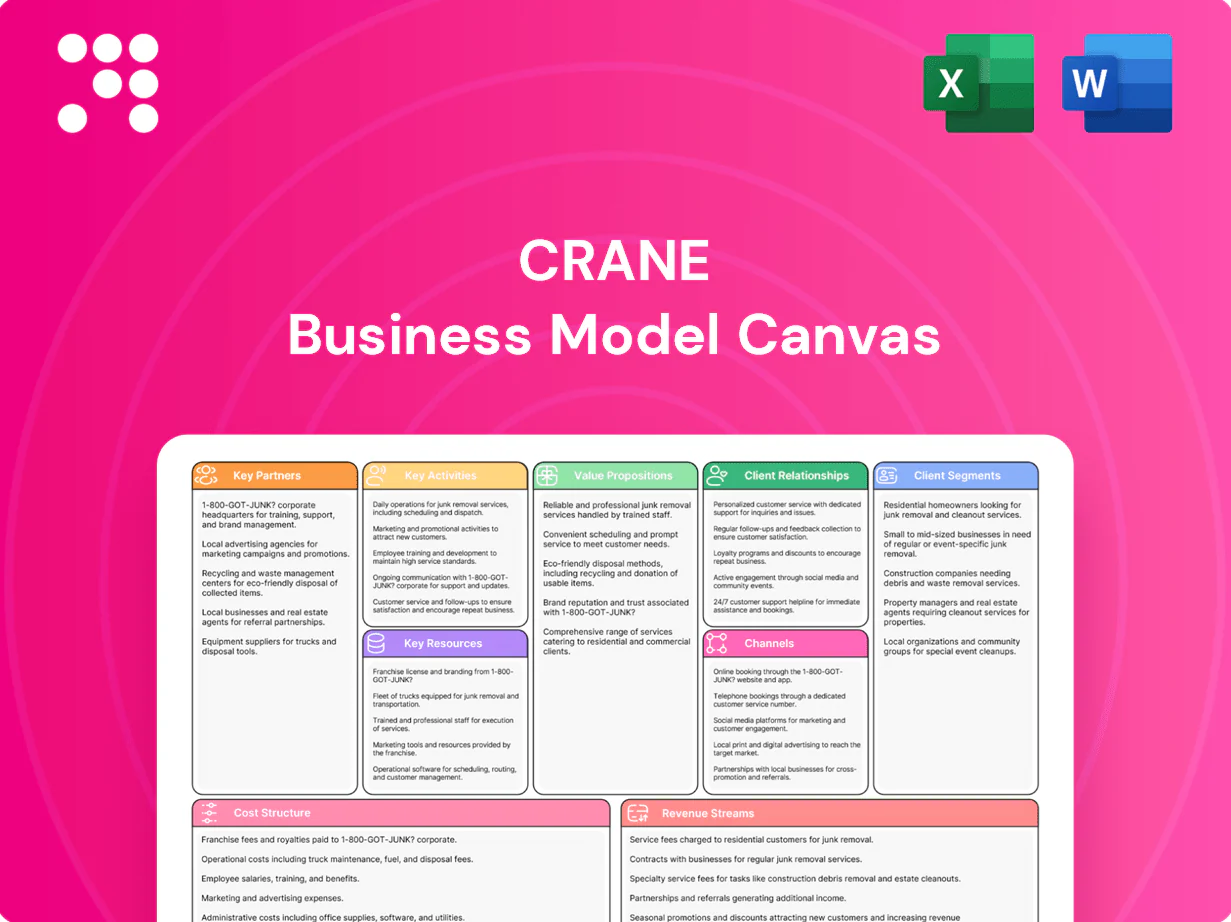
Crane Business Model Canvas

Unlock a compact Business Model Canvas: value, customers, revenue, growth levers
Unlock the strategic blueprint behind Crane with our concise Business Model Canvas preview — see how value is created, customers are targeted, and revenue streams scale. This snapshot highlights key partnerships, cost drivers, and growth levers to inform smarter decisions. Purchase the full, editable Canvas in Word and Excel for a complete, actionable plan.
Partnerships

Tier-1 aerospace OEM alliances
Collaborations with Tier-1 OEMs like Airbus and Boeing (combined ~85% share of large commercial jet deliveries in 2024) ensure spec alignment and preferred-supplier status, while joint development programs de-risk certification and accelerate time-to-market. Multi-year supply agreements stabilize demand visibility and enable shared cost-reduction initiatives; they also underpin aftermarket provisioning and PMA strategies to capture spare-parts revenue.
Industrial distributors and system integrators
In 2024 channel partners extended Crane’s reach into fragmented process industries and regional markets, providing local inventory and service presence. System integrators bundle pumps, valves and controls into turnkey skids, increasing solution value and accelerating project timelines. Co-marketing and technical training programs improved pull-through and spec adoption. Performance-based agreements align incentives on uptime and total cost of ownership.

Advanced materials and component suppliers
Sourcing high-spec alloys, composites, seals and electronics—often with 12–20 week lead times in 2024—underpins reliability and regulatory compliance. Strategic suppliers run VAVE and quality programs that typically yield 5–10% part-cost reductions. Dual-sourcing and long-term contracts securing roughly 60–70% of capacity stabilize pricing. Joint supplier–OEM testing lowers field-failure rates by up to ~30% under harsh conditions.

R&D institutes and certification bodies
Partnerships with universities and labs accelerate innovation in aerostructures, braking systems and corrosion‑resistant materials while engagement with FAA, EASA, API and ASME ensures standards adherence; early regulator involvement streamlines certifications (commonly 2–4 years for complex subassemblies) and audits, and shared testbeds have been shown to cut development cycle time and cost by roughly 20–30% (2024 industry surveys).
- R&D scale: joint labs, pilot projects
- Regulatory: FAA/EASA pre-cert meetings
- Standards: API/ASME compliance
- Efficiency: shared testbeds → ~20–30% time/cost reduction
Digital and IoT technology partners
Alliances with sensor, analytics, and cloud providers enable predictive maintenance and remote monitoring, with McKinsey 2024 noting predictive maintenance can cut maintenance costs 10–40% and unplanned downtime up to 50%. Data platforms integrate telemetry across installed bases in process plants and aircraft systems, aggregating fleets and legacy assets for fleet-wide insights. Co-developed algorithms improve asset-health scoring while cybersecurity partners secure OT/IT interfaces and firmware updates.
OEM alliances (Airbus/Boeing ~85%) lock supplier 60–70% capacity
OEM alliances (Airbus/Boeing ~85% share of large-jet deliveries in 2024) secure preferred‑supplier status and speed certification. Long‑term supplier contracts lock ~60–70% capacity, enabling 5–10% part‑cost VAVE gains. Tech partners deliver predictive‑maintenance savings (10–40% cost reduction; downtime cut up to 50%). Regulator/uni testbeds cut development time/cost ~20–30%.
| Partner type | 2024 metric | Primary impact |
|---|---|---|
| OEMs | Airbus+Boeing ~85% | Preferred sourcing/cert |
| Suppliers | 60–70% capacity | Price stability, 5–10% VAVE |
| Tech | 10–40% cost; ↓upto50% downtime | Predictive maintenance |
| Regulators/Unis | 20–30% dev ↓ | Faster certification |
What is included in the product
 Detailed Word Document
A comprehensive, pre-written Crane Business Model Canvas that maps customer segments, channels, value propositions and activities across the 9 classic BMC blocks with narrative, competitive analysis, SWOT linkage and polished design for investor presentations and strategic validation.

 Customizable Excel Spreadsheet
One-page, editable Business Model Canvas that condenses strategy into a clean, shareable layout to save hours of formatting and help teams quickly identify core components. Ideal for rapid brainstorming, boardroom-ready summaries, and side-by-side company comparisons.
Activities

Design and engineering of critical components
Mechanical, electrical and materials engineering collaborate to tailor crane components to demanding specs, supporting a global crane market estimated at USD 36 billion in 2024. DFMEA/PFMEA and simulation drive early detection to reduce failures and rework. Rapid prototyping and validation prove performance in extreme environments. Robust configuration management handles complex customer specifications and variants.
Precision manufacturing and assembly
Lean methods and Six Sigma (target 3.4 DPMO) plus advanced CNC machining achieve tight tolerances often within ±0.01 mm, boosting throughput up to 20–30% in 2024 implementations. Core special processes—heat treatment, PVD/ceramic coatings, and structural bonding—are run to NADCAP/ISO standards. Automated 100% inline testing and digital traceability (RFID/serialized records) ensure compliance and rapid root-cause analysis. Flexible manufacturing cells enable low-to-medium volume, high-mix runs with changeover times under 30 minutes.

Certification, compliance, and quality management
Adherence to AS9100, ISO 9001, ISO 14001 and NADCAP is mandatory for Crane to serve aerospace and industrial OEMs; major OEMs require annual surveillance audits and triennial recertification. Audit readiness and strict document control protect market access and reduce contract loss risk with key customers. Supplier quality engineering pushes standards across hundreds of suppliers to prevent upstream failures. Continuous improvement programs (Lean/Six Sigma) target measurable defect and reliability gains.

Aftermarket services and MRO support
Spare parts, repair and field service sustain crane uptime; 2024 studies show data-driven predictive maintenance cuts downtime up to 50% and maintenance costs 10–40%. Service bulletins and upgrades can extend asset life 15–25%, while exchange programs and certified repair stations reduce downtime by as much as 60%.
- Spare parts: sustain uptime
- Predictive maintenance: −10–40% cost, −50% downtime (2024)
- Service bulletins/upgrades: +15–25% asset life
- Exchange/repair stations: −up to 60% downtime
Customer application engineering and solution selling
- team-size: 12 (2024)
- onsite savings: 8–20% (2024)
- de-risking: commissioning delays −40% (2024)
- operator adoption: 85% (2024)
Precision fuels USD 36B cranes: ±0.01 mm, −50% downtime
Mechanical, electrical and materials engineering tailor crane components for a global market of USD 36 billion (2024). Lean/Six Sigma and advanced CNC yield ±0.01 mm tolerances and throughput +20–30% (2024). Predictive maintenance cuts downtime −50% and services extend asset life +15–25%.
| Metric | 2024 |
|---|---|
| Market size | USD 36B |
| Tolerance | ±0.01 mm |
| Throughput gain | +20–30% |
| Downtime reduction | −50% |
| Asset life extension | +15–25% |
| Team size (CAE) | 12 |
Delivered as Displayed
Business Model Canvas
The preview you see is the actual Crane Business Model Canvas, not a mockup, and displays the same content and layout you'll receive after purchase. When you buy, you'll get the complete, editable file exactly as shown. Ready for presentation, editing, and implementation—no surprises.

Unlock a compact Business Model Canvas: value, customers, revenue, growth levers
Unlock the strategic blueprint behind Crane with our concise Business Model Canvas preview — see how value is created, customers are targeted, and revenue streams scale. This snapshot highlights key partnerships, cost drivers, and growth levers to inform smarter decisions. Purchase the full, editable Canvas in Word and Excel for a complete, actionable plan.
Partnerships
Tier-1 aerospace OEM alliances
Collaborations with Tier-1 OEMs like Airbus and Boeing (combined ~85% share of large commercial jet deliveries in 2024) ensure spec alignment and preferred-supplier status, while joint development programs de-risk certification and accelerate time-to-market. Multi-year supply agreements stabilize demand visibility and enable shared cost-reduction initiatives; they also underpin aftermarket provisioning and PMA strategies to capture spare-parts revenue.
Industrial distributors and system integrators
In 2024 channel partners extended Crane’s reach into fragmented process industries and regional markets, providing local inventory and service presence. System integrators bundle pumps, valves and controls into turnkey skids, increasing solution value and accelerating project timelines. Co-marketing and technical training programs improved pull-through and spec adoption. Performance-based agreements align incentives on uptime and total cost of ownership.
Advanced materials and component suppliers
Sourcing high-spec alloys, composites, seals and electronics—often with 12–20 week lead times in 2024—underpins reliability and regulatory compliance. Strategic suppliers run VAVE and quality programs that typically yield 5–10% part-cost reductions. Dual-sourcing and long-term contracts securing roughly 60–70% of capacity stabilize pricing. Joint supplier–OEM testing lowers field-failure rates by up to ~30% under harsh conditions.
R&D institutes and certification bodies
Partnerships with universities and labs accelerate innovation in aerostructures, braking systems and corrosion‑resistant materials while engagement with FAA, EASA, API and ASME ensures standards adherence; early regulator involvement streamlines certifications (commonly 2–4 years for complex subassemblies) and audits, and shared testbeds have been shown to cut development cycle time and cost by roughly 20–30% (2024 industry surveys).
- R&D scale: joint labs, pilot projects
- Regulatory: FAA/EASA pre-cert meetings
- Standards: API/ASME compliance
- Efficiency: shared testbeds → ~20–30% time/cost reduction
Digital and IoT technology partners
Alliances with sensor, analytics, and cloud providers enable predictive maintenance and remote monitoring, with McKinsey 2024 noting predictive maintenance can cut maintenance costs 10–40% and unplanned downtime up to 50%. Data platforms integrate telemetry across installed bases in process plants and aircraft systems, aggregating fleets and legacy assets for fleet-wide insights. Co-developed algorithms improve asset-health scoring while cybersecurity partners secure OT/IT interfaces and firmware updates.
OEM alliances (Airbus/Boeing ~85%) lock supplier 60–70% capacity
OEM alliances (Airbus/Boeing ~85% share of large-jet deliveries in 2024) secure preferred‑supplier status and speed certification. Long‑term supplier contracts lock ~60–70% capacity, enabling 5–10% part‑cost VAVE gains. Tech partners deliver predictive‑maintenance savings (10–40% cost reduction; downtime cut up to 50%). Regulator/uni testbeds cut development time/cost ~20–30%.
| Partner type | 2024 metric | Primary impact |
|---|---|---|
| OEMs | Airbus+Boeing ~85% | Preferred sourcing/cert |
| Suppliers | 60–70% capacity | Price stability, 5–10% VAVE |
| Tech | 10–40% cost; ↓upto50% downtime | Predictive maintenance |
| Regulators/Unis | 20–30% dev ↓ | Faster certification |
What is included in the product
Detailed Word Document
A comprehensive, pre-written Crane Business Model Canvas that maps customer segments, channels, value propositions and activities across the 9 classic BMC blocks with narrative, competitive analysis, SWOT linkage and polished design for investor presentations and strategic validation.
Customizable Excel Spreadsheet
One-page, editable Business Model Canvas that condenses strategy into a clean, shareable layout to save hours of formatting and help teams quickly identify core components. Ideal for rapid brainstorming, boardroom-ready summaries, and side-by-side company comparisons.
Activities
Design and engineering of critical components
Mechanical, electrical and materials engineering collaborate to tailor crane components to demanding specs, supporting a global crane market estimated at USD 36 billion in 2024. DFMEA/PFMEA and simulation drive early detection to reduce failures and rework. Rapid prototyping and validation prove performance in extreme environments. Robust configuration management handles complex customer specifications and variants.
Precision manufacturing and assembly
Lean methods and Six Sigma (target 3.4 DPMO) plus advanced CNC machining achieve tight tolerances often within ±0.01 mm, boosting throughput up to 20–30% in 2024 implementations. Core special processes—heat treatment, PVD/ceramic coatings, and structural bonding—are run to NADCAP/ISO standards. Automated 100% inline testing and digital traceability (RFID/serialized records) ensure compliance and rapid root-cause analysis. Flexible manufacturing cells enable low-to-medium volume, high-mix runs with changeover times under 30 minutes.
Certification, compliance, and quality management
Adherence to AS9100, ISO 9001, ISO 14001 and NADCAP is mandatory for Crane to serve aerospace and industrial OEMs; major OEMs require annual surveillance audits and triennial recertification. Audit readiness and strict document control protect market access and reduce contract loss risk with key customers. Supplier quality engineering pushes standards across hundreds of suppliers to prevent upstream failures. Continuous improvement programs (Lean/Six Sigma) target measurable defect and reliability gains.
Aftermarket services and MRO support
Spare parts, repair and field service sustain crane uptime; 2024 studies show data-driven predictive maintenance cuts downtime up to 50% and maintenance costs 10–40%. Service bulletins and upgrades can extend asset life 15–25%, while exchange programs and certified repair stations reduce downtime by as much as 60%.
- Spare parts: sustain uptime
- Predictive maintenance: −10–40% cost, −50% downtime (2024)
- Service bulletins/upgrades: +15–25% asset life
- Exchange/repair stations: −up to 60% downtime
Customer application engineering and solution selling
- team-size: 12 (2024)
- onsite savings: 8–20% (2024)
- de-risking: commissioning delays −40% (2024)
- operator adoption: 85% (2024)
Precision fuels USD 36B cranes: ±0.01 mm, −50% downtime
Mechanical, electrical and materials engineering tailor crane components for a global market of USD 36 billion (2024). Lean/Six Sigma and advanced CNC yield ±0.01 mm tolerances and throughput +20–30% (2024). Predictive maintenance cuts downtime −50% and services extend asset life +15–25%.
| Metric | 2024 |
|---|---|
| Market size | USD 36B |
| Tolerance | ±0.01 mm |
| Throughput gain | +20–30% |
| Downtime reduction | −50% |
| Asset life extension | +15–25% |
| Team size (CAE) | 12 |
Delivered as Displayed
Business Model Canvas
The preview you see is the actual Crane Business Model Canvas, not a mockup, and displays the same content and layout you'll receive after purchase. When you buy, you'll get the complete, editable file exactly as shown. Ready for presentation, editing, and implementation—no surprises.
Description
Unlock a compact Business Model Canvas: value, customers, revenue, growth levers
Unlock the strategic blueprint behind Crane with our concise Business Model Canvas preview — see how value is created, customers are targeted, and revenue streams scale. This snapshot highlights key partnerships, cost drivers, and growth levers to inform smarter decisions. Purchase the full, editable Canvas in Word and Excel for a complete, actionable plan.
Partnerships
Tier-1 aerospace OEM alliances
Collaborations with Tier-1 OEMs like Airbus and Boeing (combined ~85% share of large commercial jet deliveries in 2024) ensure spec alignment and preferred-supplier status, while joint development programs de-risk certification and accelerate time-to-market. Multi-year supply agreements stabilize demand visibility and enable shared cost-reduction initiatives; they also underpin aftermarket provisioning and PMA strategies to capture spare-parts revenue.
Industrial distributors and system integrators
In 2024 channel partners extended Crane’s reach into fragmented process industries and regional markets, providing local inventory and service presence. System integrators bundle pumps, valves and controls into turnkey skids, increasing solution value and accelerating project timelines. Co-marketing and technical training programs improved pull-through and spec adoption. Performance-based agreements align incentives on uptime and total cost of ownership.
Advanced materials and component suppliers
Sourcing high-spec alloys, composites, seals and electronics—often with 12–20 week lead times in 2024—underpins reliability and regulatory compliance. Strategic suppliers run VAVE and quality programs that typically yield 5–10% part-cost reductions. Dual-sourcing and long-term contracts securing roughly 60–70% of capacity stabilize pricing. Joint supplier–OEM testing lowers field-failure rates by up to ~30% under harsh conditions.
R&D institutes and certification bodies
Partnerships with universities and labs accelerate innovation in aerostructures, braking systems and corrosion‑resistant materials while engagement with FAA, EASA, API and ASME ensures standards adherence; early regulator involvement streamlines certifications (commonly 2–4 years for complex subassemblies) and audits, and shared testbeds have been shown to cut development cycle time and cost by roughly 20–30% (2024 industry surveys).
- R&D scale: joint labs, pilot projects
- Regulatory: FAA/EASA pre-cert meetings
- Standards: API/ASME compliance
- Efficiency: shared testbeds → ~20–30% time/cost reduction
Digital and IoT technology partners
Alliances with sensor, analytics, and cloud providers enable predictive maintenance and remote monitoring, with McKinsey 2024 noting predictive maintenance can cut maintenance costs 10–40% and unplanned downtime up to 50%. Data platforms integrate telemetry across installed bases in process plants and aircraft systems, aggregating fleets and legacy assets for fleet-wide insights. Co-developed algorithms improve asset-health scoring while cybersecurity partners secure OT/IT interfaces and firmware updates.
OEM alliances (Airbus/Boeing ~85%) lock supplier 60–70% capacity
OEM alliances (Airbus/Boeing ~85% share of large-jet deliveries in 2024) secure preferred‑supplier status and speed certification. Long‑term supplier contracts lock ~60–70% capacity, enabling 5–10% part‑cost VAVE gains. Tech partners deliver predictive‑maintenance savings (10–40% cost reduction; downtime cut up to 50%). Regulator/uni testbeds cut development time/cost ~20–30%.
| Partner type | 2024 metric | Primary impact |
|---|---|---|
| OEMs | Airbus+Boeing ~85% | Preferred sourcing/cert |
| Suppliers | 60–70% capacity | Price stability, 5–10% VAVE |
| Tech | 10–40% cost; ↓upto50% downtime | Predictive maintenance |
| Regulators/Unis | 20–30% dev ↓ | Faster certification |
What is included in the product
Detailed Word Document
A comprehensive, pre-written Crane Business Model Canvas that maps customer segments, channels, value propositions and activities across the 9 classic BMC blocks with narrative, competitive analysis, SWOT linkage and polished design for investor presentations and strategic validation.
Customizable Excel Spreadsheet
One-page, editable Business Model Canvas that condenses strategy into a clean, shareable layout to save hours of formatting and help teams quickly identify core components. Ideal for rapid brainstorming, boardroom-ready summaries, and side-by-side company comparisons.
Activities
Design and engineering of critical components
Mechanical, electrical and materials engineering collaborate to tailor crane components to demanding specs, supporting a global crane market estimated at USD 36 billion in 2024. DFMEA/PFMEA and simulation drive early detection to reduce failures and rework. Rapid prototyping and validation prove performance in extreme environments. Robust configuration management handles complex customer specifications and variants.
Precision manufacturing and assembly
Lean methods and Six Sigma (target 3.4 DPMO) plus advanced CNC machining achieve tight tolerances often within ±0.01 mm, boosting throughput up to 20–30% in 2024 implementations. Core special processes—heat treatment, PVD/ceramic coatings, and structural bonding—are run to NADCAP/ISO standards. Automated 100% inline testing and digital traceability (RFID/serialized records) ensure compliance and rapid root-cause analysis. Flexible manufacturing cells enable low-to-medium volume, high-mix runs with changeover times under 30 minutes.
Certification, compliance, and quality management
Adherence to AS9100, ISO 9001, ISO 14001 and NADCAP is mandatory for Crane to serve aerospace and industrial OEMs; major OEMs require annual surveillance audits and triennial recertification. Audit readiness and strict document control protect market access and reduce contract loss risk with key customers. Supplier quality engineering pushes standards across hundreds of suppliers to prevent upstream failures. Continuous improvement programs (Lean/Six Sigma) target measurable defect and reliability gains.
Aftermarket services and MRO support
Spare parts, repair and field service sustain crane uptime; 2024 studies show data-driven predictive maintenance cuts downtime up to 50% and maintenance costs 10–40%. Service bulletins and upgrades can extend asset life 15–25%, while exchange programs and certified repair stations reduce downtime by as much as 60%.
- Spare parts: sustain uptime
- Predictive maintenance: −10–40% cost, −50% downtime (2024)
- Service bulletins/upgrades: +15–25% asset life
- Exchange/repair stations: −up to 60% downtime
Customer application engineering and solution selling
- team-size: 12 (2024)
- onsite savings: 8–20% (2024)
- de-risking: commissioning delays −40% (2024)
- operator adoption: 85% (2024)
Precision fuels USD 36B cranes: ±0.01 mm, −50% downtime
Mechanical, electrical and materials engineering tailor crane components for a global market of USD 36 billion (2024). Lean/Six Sigma and advanced CNC yield ±0.01 mm tolerances and throughput +20–30% (2024). Predictive maintenance cuts downtime −50% and services extend asset life +15–25%.
| Metric | 2024 |
|---|---|
| Market size | USD 36B |
| Tolerance | ±0.01 mm |
| Throughput gain | +20–30% |
| Downtime reduction | −50% |
| Asset life extension | +15–25% |
| Team size (CAE) | 12 |
Delivered as Displayed
Business Model Canvas
The preview you see is the actual Crane Business Model Canvas, not a mockup, and displays the same content and layout you'll receive after purchase. When you buy, you'll get the complete, editable file exactly as shown. Ready for presentation, editing, and implementation—no surprises.











