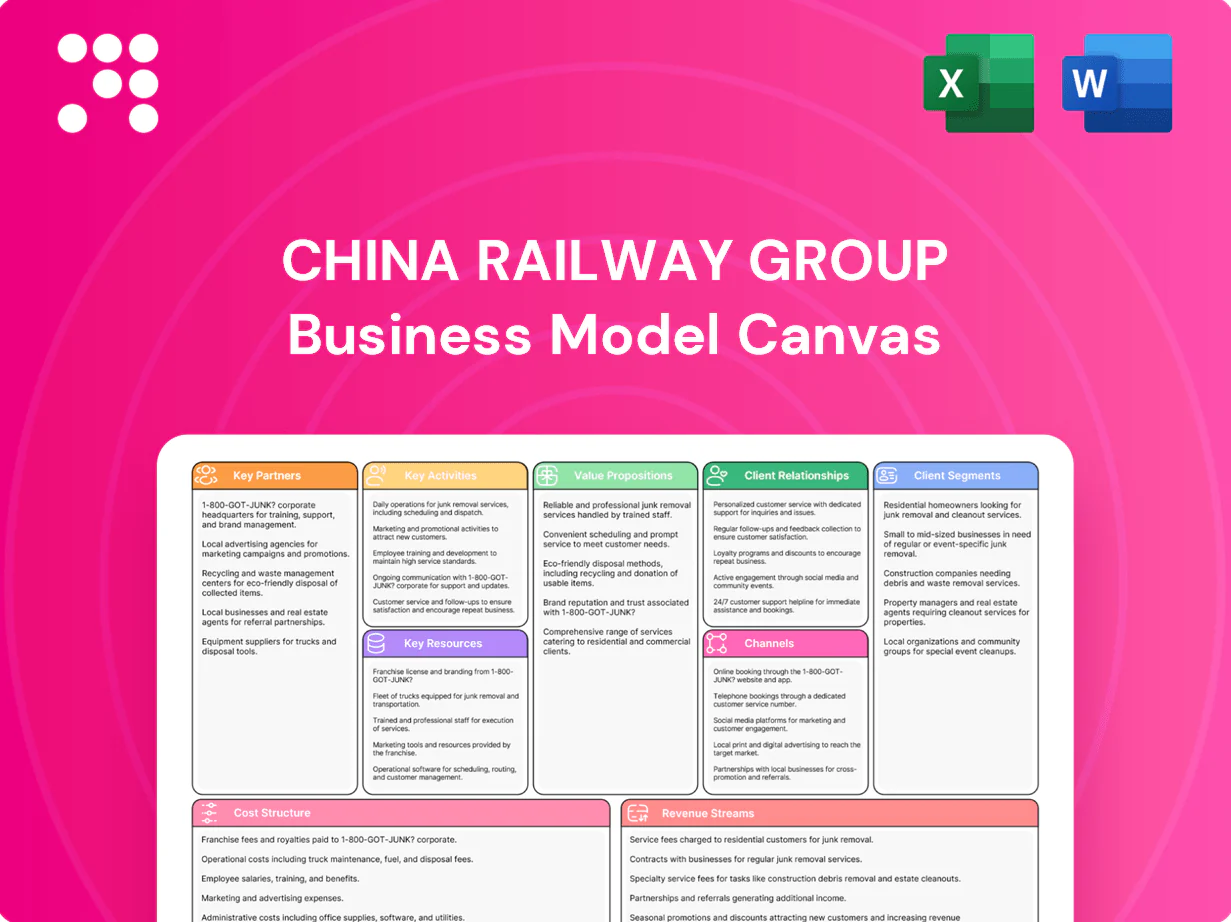
China Railway Group Business Model Canvas

Unlock the strategic Business Model Canvas: segments, value propositions, revenue drivers
Unlock the full strategic blueprint behind China Railway Group with our Business Model Canvas—three to five clear sentences map customer segments, value propositions, and revenue drivers. This concise, actionable canvas reveals partnerships, cost structure, and growth levers to benchmark or adapt. Purchase the complete Word/Excel package for a ready-to-use, section-by-section strategic tool.
Partnerships

Government agencies and SOEs
Partnering with national, provincial and municipal authorities secures access to large infrastructure pipelines and land approvals. State-owned rail and transit operators provide long-term project visibility and operating interfaces. These relationships enable policy alignment, funding coordination and streamlined permitting, and help structure PPPs and concessions under supportive regulatory frameworks. China’s rail network reached about 154,000 km by end-2023, underscoring pipeline scale.
Multilateral banks and commercial financiers
Development banks and export credit agencies (eg China Exim Bank, AIIB) de-risk mega-projects via sovereign-backed loans—AIIB approvals surpassed 38 billion USD by 2024—while commercial banks and bond markets supply working capital, guarantees and performance bonds for construction cycles. Blended finance and EPC+F structures lower sponsor equity and boost bid competitiveness. Financial partners also enable currency hedging and secure payment flows for cross-border projects.

Technology and equipment suppliers
OEMs for rolling stock subsystems, TBMs, signaling and electrification augment in-house capabilities, enabling rapid deployment and lifecycle support. Digital vendors supply BIM, GIS and project controls to deliver integrated schedules, cost and risk management across multimodal projects. Co-development with suppliers accelerates innovation and drives technical standardization across corridors. Preferred supplier agreements shorten lead times, lower unit costs and strengthen quality assurance.

Local contractors and JV consortiums
Joint ventures with local firms satisfy localization and content requirements and in 2024 commonly delivered 40–60% local content on Africa and Southeast Asia projects, speeding permitting and labor mobilization. Consortiums pool technical, financing and risk capacities for complex EPC, EPCF and design-build bids, while subcontractor networks boost peak capacity and regional coverage for rapid execution.
- Localization: JVs enable 40–60% local content (2024)
- Market access: faster permitting and workforce mobilization
- Consortiums: combine EPC, financing, design strengths
- Subcontractors: scale peak capacity and extend regional reach
Universities and research institutes
Academic partnerships support advanced geotechnical research, materials science, and tunneling methods, and incubate talent pipelines while standardizing training; collaborative labs drive patents and construction tech such as prefabrication and digital twins, strengthening technical credibility in competitive tenders.
- Research: advanced geotechnics, materials, tunneling
- Talent: standardized training, recruitment pipeline
- Innovation: joint labs, patents, prefab & digital twin tech
- Commercial: stronger bid competitiveness
Partnerships and de-risked finance unlock China rail projects with localised execution
Partnerships with national and local authorities secure project pipelines and permits, leveraging China’s 154,000 km rail network (end‑2023). Development banks and export credit agencies de‑risk projects (AIIB approvals >38 bn USD by 2024) and enable EPC+F structures. OEMs, digital vendors and JVs deliver localization (40–60% local content in 2024), innovation and execution scale.
| Metric | Value |
|---|---|
| China rail network | 154,000 km (end‑2023) |
| AIIB approvals | >38 bn USD (by 2024) |
| Localization | 40–60% (2024) |
| Financing model | EPC, EPC+F, sovereign loans |
What is included in the product
 Detailed Word Document
Comprehensive Business Model Canvas for China Railway Group detailing customer segments, channels, value propositions, revenue streams, key resources, activities, partners, cost structure and governance; reflects real-world operations, competitive advantages, risks and strategic opportunities for investors and analysts.

 Customizable Excel Spreadsheet
High-level view of China Railway Group’s business model with editable cells—streamlines complex infrastructure, contracting and supply‑chain relationships into a one-page, shareable format to save hours and align teams for project bidding and stakeholder reporting.
Activities

EPC/EPCM project delivery
End-to-end EPC/EPCM is China Railway Group’s core execution model, delivering engineering, procurement and construction with program management to control scope, schedule and cost; risk management spans HSE, quality and claims while commissioning and handover lock performance guarantees; 2024 order backlog exceeded RMB 1 trillion, underpinned by large-scale rail and urban transit contracts.
Survey, design, and consulting
Upfront geotechnical surveys and feasibility studies de-risk alignment and construction methods for projects within China’s 42,000 km high-speed rail network (end-2023), reducing unforeseen ground risks and delays. Detailed design integrates civil, MEP, signaling and systems to meet national standards and interface requirements. Value engineering targets lifecycle cost reductions and schedule acceleration, while advisory services guide clients on procurement, PPP structuring and compliance.

Manufacturing and prefabrication
Production of TBMs, track components, slabs and steel structures gives China Railway Group vertical integration, supporting a TBM fleet of over 200 machines and nationwide prefab capacity tied to China’s 42,000 km high-speed network. Prefab yards enable modular bridges, tunnel segments and stations, cutting onsite assembly time by about 30% and reducing material waste roughly 20%. Factory-controlled quality lowers defect rates and improves durability and safety through standardized processes.

Operations, maintenance, and concessions
Lifecycle O&M extends customer relationships beyond construction, with China Railway Group reporting expanded service contracts in 2024 that increased recurring service revenue and customer retention; concession management provides predictable cashflows and aligns operator-investor incentives. Predictive maintenance — using condition monitoring and digital twins deployed across projects in 2024 — reduced unplanned downtime and improved asset life. Performance KPIs (availability, reliability, safety) are tracked daily to meet >99.9% availability targets on key corridors.
- O&M lifecycle: extended service revenue
- Concessions: recurring cashflows, aligned incentives
- Predictive maintenance: condition monitoring, digital twins
- KPIs: availability, reliability, safety (>99.9% target)
Real estate and TOD development
China Railway Group leverages transit-oriented development to monetize station areas and air rights, with property and TOD-related income accounting for about 12% of group revenue in 2024, supporting cash flow and project finance. Mixed-use developments boost ridership and urban vitality, with case studies showing ridership uplifts near TOD nodes of roughly 10–15%. Land value capture instruments and joint ventures co-fund infrastructure while asset sales and leasing diversify recurring income.
- Station-area monetization: air rights
- Ridership uplift: ~10–15%
- Revenue share: ~12% (2024)
- Funding: land value capture, JV, asset sales/leasing
Integrated EPCM and TOD drive recurring cashflows; 2024 backlog >RMB 1 trillion
End-to-end EPC/EPCM with risk-controlled commissioning underpins execution; 2024 order backlog >RMB 1 trillion. Vertical integration (TBM fleet 200+, prefab yards) cuts onsite time ~30% and waste ~20%. Lifecycle O&M, concessions and TOD (12% revenue 2024) drive recurring cashflows; predictive maintenance and digital twins rolled out in 2024 to meet >99.9% availability targets.
| Metric | Value |
|---|---|
| Order backlog (2024) | >RMB 1 trillion |
| TBM fleet | 200+ |
| High-speed network | 42,000 km (end-2023) |
| TOD revenue (2024) | ~12% |
| Availability target | >99.9% |
Full Version Awaits
Business Model Canvas
The China Railway Group Business Model Canvas you see is the actual deliverable, not a mockup; it’s a direct snapshot of the file you’ll receive after purchase. When you complete your order you’ll get this same professional, ready-to-use document in editable Word and Excel formats. No surprises—what you preview is what you’ll own.

Unlock the strategic Business Model Canvas: segments, value propositions, revenue drivers
Unlock the full strategic blueprint behind China Railway Group with our Business Model Canvas—three to five clear sentences map customer segments, value propositions, and revenue drivers. This concise, actionable canvas reveals partnerships, cost structure, and growth levers to benchmark or adapt. Purchase the complete Word/Excel package for a ready-to-use, section-by-section strategic tool.
Partnerships
Government agencies and SOEs
Partnering with national, provincial and municipal authorities secures access to large infrastructure pipelines and land approvals. State-owned rail and transit operators provide long-term project visibility and operating interfaces. These relationships enable policy alignment, funding coordination and streamlined permitting, and help structure PPPs and concessions under supportive regulatory frameworks. China’s rail network reached about 154,000 km by end-2023, underscoring pipeline scale.
Multilateral banks and commercial financiers
Development banks and export credit agencies (eg China Exim Bank, AIIB) de-risk mega-projects via sovereign-backed loans—AIIB approvals surpassed 38 billion USD by 2024—while commercial banks and bond markets supply working capital, guarantees and performance bonds for construction cycles. Blended finance and EPC+F structures lower sponsor equity and boost bid competitiveness. Financial partners also enable currency hedging and secure payment flows for cross-border projects.
Technology and equipment suppliers
OEMs for rolling stock subsystems, TBMs, signaling and electrification augment in-house capabilities, enabling rapid deployment and lifecycle support. Digital vendors supply BIM, GIS and project controls to deliver integrated schedules, cost and risk management across multimodal projects. Co-development with suppliers accelerates innovation and drives technical standardization across corridors. Preferred supplier agreements shorten lead times, lower unit costs and strengthen quality assurance.
Local contractors and JV consortiums
Joint ventures with local firms satisfy localization and content requirements and in 2024 commonly delivered 40–60% local content on Africa and Southeast Asia projects, speeding permitting and labor mobilization. Consortiums pool technical, financing and risk capacities for complex EPC, EPCF and design-build bids, while subcontractor networks boost peak capacity and regional coverage for rapid execution.
- Localization: JVs enable 40–60% local content (2024)
- Market access: faster permitting and workforce mobilization
- Consortiums: combine EPC, financing, design strengths
- Subcontractors: scale peak capacity and extend regional reach
Universities and research institutes
Academic partnerships support advanced geotechnical research, materials science, and tunneling methods, and incubate talent pipelines while standardizing training; collaborative labs drive patents and construction tech such as prefabrication and digital twins, strengthening technical credibility in competitive tenders.
- Research: advanced geotechnics, materials, tunneling
- Talent: standardized training, recruitment pipeline
- Innovation: joint labs, patents, prefab & digital twin tech
- Commercial: stronger bid competitiveness
Partnerships and de-risked finance unlock China rail projects with localised execution
Partnerships with national and local authorities secure project pipelines and permits, leveraging China’s 154,000 km rail network (end‑2023). Development banks and export credit agencies de‑risk projects (AIIB approvals >38 bn USD by 2024) and enable EPC+F structures. OEMs, digital vendors and JVs deliver localization (40–60% local content in 2024), innovation and execution scale.
| Metric | Value |
|---|---|
| China rail network | 154,000 km (end‑2023) |
| AIIB approvals | >38 bn USD (by 2024) |
| Localization | 40–60% (2024) |
| Financing model | EPC, EPC+F, sovereign loans |
What is included in the product
Detailed Word Document
Comprehensive Business Model Canvas for China Railway Group detailing customer segments, channels, value propositions, revenue streams, key resources, activities, partners, cost structure and governance; reflects real-world operations, competitive advantages, risks and strategic opportunities for investors and analysts.
Customizable Excel Spreadsheet
High-level view of China Railway Group’s business model with editable cells—streamlines complex infrastructure, contracting and supply‑chain relationships into a one-page, shareable format to save hours and align teams for project bidding and stakeholder reporting.
Activities
EPC/EPCM project delivery
End-to-end EPC/EPCM is China Railway Group’s core execution model, delivering engineering, procurement and construction with program management to control scope, schedule and cost; risk management spans HSE, quality and claims while commissioning and handover lock performance guarantees; 2024 order backlog exceeded RMB 1 trillion, underpinned by large-scale rail and urban transit contracts.
Survey, design, and consulting
Upfront geotechnical surveys and feasibility studies de-risk alignment and construction methods for projects within China’s 42,000 km high-speed rail network (end-2023), reducing unforeseen ground risks and delays. Detailed design integrates civil, MEP, signaling and systems to meet national standards and interface requirements. Value engineering targets lifecycle cost reductions and schedule acceleration, while advisory services guide clients on procurement, PPP structuring and compliance.
Manufacturing and prefabrication
Production of TBMs, track components, slabs and steel structures gives China Railway Group vertical integration, supporting a TBM fleet of over 200 machines and nationwide prefab capacity tied to China’s 42,000 km high-speed network. Prefab yards enable modular bridges, tunnel segments and stations, cutting onsite assembly time by about 30% and reducing material waste roughly 20%. Factory-controlled quality lowers defect rates and improves durability and safety through standardized processes.
Operations, maintenance, and concessions
Lifecycle O&M extends customer relationships beyond construction, with China Railway Group reporting expanded service contracts in 2024 that increased recurring service revenue and customer retention; concession management provides predictable cashflows and aligns operator-investor incentives. Predictive maintenance — using condition monitoring and digital twins deployed across projects in 2024 — reduced unplanned downtime and improved asset life. Performance KPIs (availability, reliability, safety) are tracked daily to meet >99.9% availability targets on key corridors.
- O&M lifecycle: extended service revenue
- Concessions: recurring cashflows, aligned incentives
- Predictive maintenance: condition monitoring, digital twins
- KPIs: availability, reliability, safety (>99.9% target)
Real estate and TOD development
China Railway Group leverages transit-oriented development to monetize station areas and air rights, with property and TOD-related income accounting for about 12% of group revenue in 2024, supporting cash flow and project finance. Mixed-use developments boost ridership and urban vitality, with case studies showing ridership uplifts near TOD nodes of roughly 10–15%. Land value capture instruments and joint ventures co-fund infrastructure while asset sales and leasing diversify recurring income.
- Station-area monetization: air rights
- Ridership uplift: ~10–15%
- Revenue share: ~12% (2024)
- Funding: land value capture, JV, asset sales/leasing
Integrated EPCM and TOD drive recurring cashflows; 2024 backlog >RMB 1 trillion
End-to-end EPC/EPCM with risk-controlled commissioning underpins execution; 2024 order backlog >RMB 1 trillion. Vertical integration (TBM fleet 200+, prefab yards) cuts onsite time ~30% and waste ~20%. Lifecycle O&M, concessions and TOD (12% revenue 2024) drive recurring cashflows; predictive maintenance and digital twins rolled out in 2024 to meet >99.9% availability targets.
| Metric | Value |
|---|---|
| Order backlog (2024) | >RMB 1 trillion |
| TBM fleet | 200+ |
| High-speed network | 42,000 km (end-2023) |
| TOD revenue (2024) | ~12% |
| Availability target | >99.9% |
Full Version Awaits
Business Model Canvas
The China Railway Group Business Model Canvas you see is the actual deliverable, not a mockup; it’s a direct snapshot of the file you’ll receive after purchase. When you complete your order you’ll get this same professional, ready-to-use document in editable Word and Excel formats. No surprises—what you preview is what you’ll own.
Original: $10.00
-65%$10.00
$3.50Description
Unlock the strategic Business Model Canvas: segments, value propositions, revenue drivers
Unlock the full strategic blueprint behind China Railway Group with our Business Model Canvas—three to five clear sentences map customer segments, value propositions, and revenue drivers. This concise, actionable canvas reveals partnerships, cost structure, and growth levers to benchmark or adapt. Purchase the complete Word/Excel package for a ready-to-use, section-by-section strategic tool.
Partnerships
Government agencies and SOEs
Partnering with national, provincial and municipal authorities secures access to large infrastructure pipelines and land approvals. State-owned rail and transit operators provide long-term project visibility and operating interfaces. These relationships enable policy alignment, funding coordination and streamlined permitting, and help structure PPPs and concessions under supportive regulatory frameworks. China’s rail network reached about 154,000 km by end-2023, underscoring pipeline scale.
Multilateral banks and commercial financiers
Development banks and export credit agencies (eg China Exim Bank, AIIB) de-risk mega-projects via sovereign-backed loans—AIIB approvals surpassed 38 billion USD by 2024—while commercial banks and bond markets supply working capital, guarantees and performance bonds for construction cycles. Blended finance and EPC+F structures lower sponsor equity and boost bid competitiveness. Financial partners also enable currency hedging and secure payment flows for cross-border projects.
Technology and equipment suppliers
OEMs for rolling stock subsystems, TBMs, signaling and electrification augment in-house capabilities, enabling rapid deployment and lifecycle support. Digital vendors supply BIM, GIS and project controls to deliver integrated schedules, cost and risk management across multimodal projects. Co-development with suppliers accelerates innovation and drives technical standardization across corridors. Preferred supplier agreements shorten lead times, lower unit costs and strengthen quality assurance.
Local contractors and JV consortiums
Joint ventures with local firms satisfy localization and content requirements and in 2024 commonly delivered 40–60% local content on Africa and Southeast Asia projects, speeding permitting and labor mobilization. Consortiums pool technical, financing and risk capacities for complex EPC, EPCF and design-build bids, while subcontractor networks boost peak capacity and regional coverage for rapid execution.
- Localization: JVs enable 40–60% local content (2024)
- Market access: faster permitting and workforce mobilization
- Consortiums: combine EPC, financing, design strengths
- Subcontractors: scale peak capacity and extend regional reach
Universities and research institutes
Academic partnerships support advanced geotechnical research, materials science, and tunneling methods, and incubate talent pipelines while standardizing training; collaborative labs drive patents and construction tech such as prefabrication and digital twins, strengthening technical credibility in competitive tenders.
- Research: advanced geotechnics, materials, tunneling
- Talent: standardized training, recruitment pipeline
- Innovation: joint labs, patents, prefab & digital twin tech
- Commercial: stronger bid competitiveness
Partnerships and de-risked finance unlock China rail projects with localised execution
Partnerships with national and local authorities secure project pipelines and permits, leveraging China’s 154,000 km rail network (end‑2023). Development banks and export credit agencies de‑risk projects (AIIB approvals >38 bn USD by 2024) and enable EPC+F structures. OEMs, digital vendors and JVs deliver localization (40–60% local content in 2024), innovation and execution scale.
| Metric | Value |
|---|---|
| China rail network | 154,000 km (end‑2023) |
| AIIB approvals | >38 bn USD (by 2024) |
| Localization | 40–60% (2024) |
| Financing model | EPC, EPC+F, sovereign loans |
What is included in the product
Detailed Word Document
Comprehensive Business Model Canvas for China Railway Group detailing customer segments, channels, value propositions, revenue streams, key resources, activities, partners, cost structure and governance; reflects real-world operations, competitive advantages, risks and strategic opportunities for investors and analysts.
Customizable Excel Spreadsheet
High-level view of China Railway Group’s business model with editable cells—streamlines complex infrastructure, contracting and supply‑chain relationships into a one-page, shareable format to save hours and align teams for project bidding and stakeholder reporting.
Activities
EPC/EPCM project delivery
End-to-end EPC/EPCM is China Railway Group’s core execution model, delivering engineering, procurement and construction with program management to control scope, schedule and cost; risk management spans HSE, quality and claims while commissioning and handover lock performance guarantees; 2024 order backlog exceeded RMB 1 trillion, underpinned by large-scale rail and urban transit contracts.
Survey, design, and consulting
Upfront geotechnical surveys and feasibility studies de-risk alignment and construction methods for projects within China’s 42,000 km high-speed rail network (end-2023), reducing unforeseen ground risks and delays. Detailed design integrates civil, MEP, signaling and systems to meet national standards and interface requirements. Value engineering targets lifecycle cost reductions and schedule acceleration, while advisory services guide clients on procurement, PPP structuring and compliance.
Manufacturing and prefabrication
Production of TBMs, track components, slabs and steel structures gives China Railway Group vertical integration, supporting a TBM fleet of over 200 machines and nationwide prefab capacity tied to China’s 42,000 km high-speed network. Prefab yards enable modular bridges, tunnel segments and stations, cutting onsite assembly time by about 30% and reducing material waste roughly 20%. Factory-controlled quality lowers defect rates and improves durability and safety through standardized processes.
Operations, maintenance, and concessions
Lifecycle O&M extends customer relationships beyond construction, with China Railway Group reporting expanded service contracts in 2024 that increased recurring service revenue and customer retention; concession management provides predictable cashflows and aligns operator-investor incentives. Predictive maintenance — using condition monitoring and digital twins deployed across projects in 2024 — reduced unplanned downtime and improved asset life. Performance KPIs (availability, reliability, safety) are tracked daily to meet >99.9% availability targets on key corridors.
- O&M lifecycle: extended service revenue
- Concessions: recurring cashflows, aligned incentives
- Predictive maintenance: condition monitoring, digital twins
- KPIs: availability, reliability, safety (>99.9% target)
Real estate and TOD development
China Railway Group leverages transit-oriented development to monetize station areas and air rights, with property and TOD-related income accounting for about 12% of group revenue in 2024, supporting cash flow and project finance. Mixed-use developments boost ridership and urban vitality, with case studies showing ridership uplifts near TOD nodes of roughly 10–15%. Land value capture instruments and joint ventures co-fund infrastructure while asset sales and leasing diversify recurring income.
- Station-area monetization: air rights
- Ridership uplift: ~10–15%
- Revenue share: ~12% (2024)
- Funding: land value capture, JV, asset sales/leasing
Integrated EPCM and TOD drive recurring cashflows; 2024 backlog >RMB 1 trillion
End-to-end EPC/EPCM with risk-controlled commissioning underpins execution; 2024 order backlog >RMB 1 trillion. Vertical integration (TBM fleet 200+, prefab yards) cuts onsite time ~30% and waste ~20%. Lifecycle O&M, concessions and TOD (12% revenue 2024) drive recurring cashflows; predictive maintenance and digital twins rolled out in 2024 to meet >99.9% availability targets.
| Metric | Value |
|---|---|
| Order backlog (2024) | >RMB 1 trillion |
| TBM fleet | 200+ |
| High-speed network | 42,000 km (end-2023) |
| TOD revenue (2024) | ~12% |
| Availability target | >99.9% |
Full Version Awaits
Business Model Canvas
The China Railway Group Business Model Canvas you see is the actual deliverable, not a mockup; it’s a direct snapshot of the file you’ll receive after purchase. When you complete your order you’ll get this same professional, ready-to-use document in editable Word and Excel formats. No surprises—what you preview is what you’ll own.











