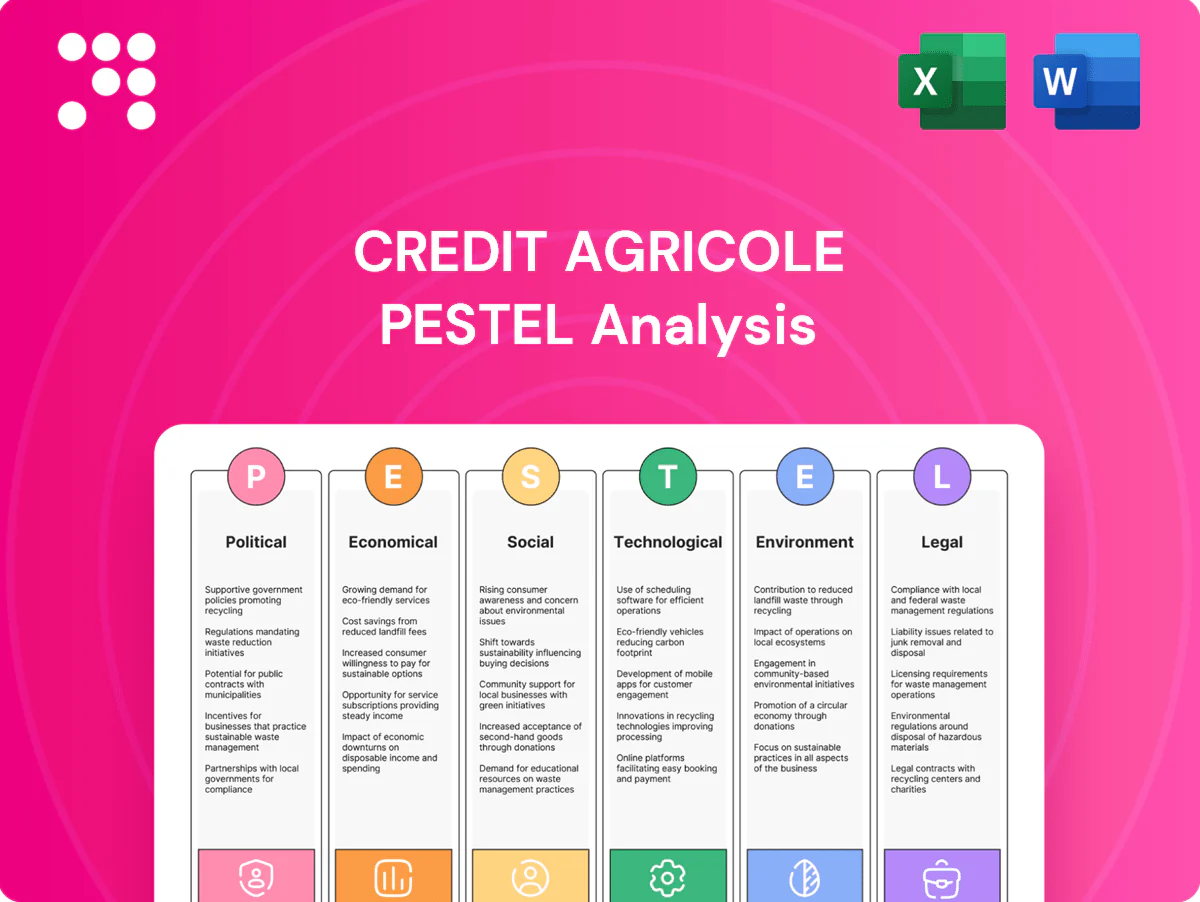
Credit Agricole PESTLE Analysis

Skip the Research. Get the Strategy.
Discover how political shifts, economic cycles, and regulatory pressures are shaping Crédit Agricole's strategic outlook in our concise PESTLE summary. This actionable snapshot highlights risks and growth levers for investors and strategists. Purchase the full PESTLE to access the detailed, ready-to-use analysis and start making better decisions today.
Political factors

EU policy and Banking Union influences
EU-level supervision via the ECB/SSM enforces harmonized capital and liquidity standards (LCR minimum 100%) that shape Crédit Agricole’s risk appetite across a €2.1tn balance sheet (end-2024), while SREP outcomes drive CET1 targets and buffers. Policy drives like the Capital Markets Union and cross-border integration expand product and funding channels. Changes in Brussels or Paris leadership can shift regulatory timelines and priorities. Strategic planning must anticipate policy cycles and consultation outcomes.
French government stance and cooperative sector support
As a flagship cooperative bank serving about 50 million customers and managing roughly €2 trillion in assets, Crédit Agricole operates in a policy environment favoring mutual and regional banking. Government initiatives on SME financing, housing and agriculture — e.g., state-backed PGE loans of about €120bn in 2020–21 — can steer targeted lending. Political pressure may rise in downturns to maintain credit supply, while public-private guarantee programs reduce risk but increase compliance burdens.

Geopolitical tensions, sanctions, and fragmentation
Sanctions on Russia and Iran and evolving export controls have tightened CIB flows, trade finance and KYC, with EU imports from Russia falling over 60% in 2022, reshaping trade corridors. Supply‑chain reshoring and EU strategic autonomy are re-routing capital and sector exposure toward near‑shoring hubs. Heightened geopolitical risk raises counterparty and country limits, making scenario planning for fragmentation and energy security essential.

Public spending, green industrial policy, and subsidies
EU Green Deal targets imply roughly €520bn/yr investment to 2030 for the energy transition; IPCEI Clean Hydrogen mobilized about €6.9bn public support and national subsidy schemes add tens of billions, catalyzing financing demand. Crédit Agricole can originate and structure blended finance using public guarantees, but political shifts could alter subsidy durability and project bankability; alignment with policy banks (EIB, KfW) enhances pipeline visibility.
- EU scale: ~€520bn/yr to 2030
- IPCEI example: ~€6.9bn public support
- Role: blended finance + public guarantees
- Risk: political shifts affect subsidy durability; align with policy banks
Local political stability across international footprint
Local political cycles in Italy, Poland and other markets drive tax, labor and banking levy changes that can alter Credit Agricole’s margins; Italy-Germany 10y spread averaged about 180 basis points in 2024 while Poland’s spread averaged ~210 bps, raising funding and collateral haircut pressure.
Populist swings have led to mortgage rule interventions and fee caps in several CE markets, increasing regulatory risk; geographic diversification reduces shock exposure but raises monitoring and compliance complexity.
- sovereign-spreads: Italy ~180bps (2024), Poland ~210bps (2024)
- funding-costs: higher spreads → wider funding margin pressure
- policy-risk: mortgage caps/populist interventions
- mitigation: diversification vs monitoring burden
ECB/SSM reshape capital risk for major French bank, €2.1tn B/S
ECB/SSM supervision sets capital/liquidity norms shaping Crédit Agricole’s risk across a €2.1tn balance sheet (end‑2024).
State actions (SME/housing/agri support, PGE ~€120bn 2020–21) and EU Green Deal (€520bn/yr to 2030; IPCEI €6.9bn) drive lending and blended‑finance demand.
Sovereign spreads: Italy ~180bps, Poland ~210bps (2024); sanctions and reshoring raise country limits and compliance costs.
| Factor | 2024/2025 metric |
|---|---|
| Balance sheet | €2.1tn (end‑2024) |
| Customers | ~50m |
| Italy spread | ~180bps (2024) |
| Poland spread | ~210bps (2024) |
| Green Deal | ~€520bn/yr to 2030 |
What is included in the product
 Detailed Word Document
Explores how macro-environmental forces uniquely affect Crédit Agricole across six dimensions—Political, Economic, Social, Technological, Environmental, and Legal—using current data and trends to identify risks and opportunities. Delivered in clean, actionable format with forward-looking insights to inform strategy, investor communications, and scenario planning.

 Customizable Excel Spreadsheet
A concise, visually segmented Crédit Agricole PESTLE summary that’s easily dropped into presentations or shared across teams, enabling quick alignment on external risks, regulatory shifts and market positioning during planning sessions.
Economic factors

Interest rate cycle and NIM sensitivity
ECB rate normalization (policy rate ~3.75–4.00% in H1 2025) raises deposit betas and drives asset repricing, widening margins initially but making NIM highly sensitive to rapid cuts which can compress NIM by several dozen bps. Sticky eurozone inflation (still ~2.5% mid‑2025) supports higher‑for‑longer rates, boosting margins but stressing credit quality. Hedging strategies and loan/product mix are critical to stabilize earnings, while ALM must monitor behavioral deposit shifts and beta pass‑through.
Eurozone growth and credit demand
Eurozone GDP grew 0.6% in 2024 with a 2025 projection of 1.2% (IMF WEO Apr 2024), so household consumption, capex and construction cycles remain key drivers of retail and SME lending volumes. Weak growth suppresses fee income and elevates cost of risk, while recovery lifts mutual fund and insurance inflows and CIB pipelines. Pronounced country divergence forces granular allocation of risk-weighted assets by loan type and geography.

Credit quality, NPLs, and sectoral exposure
Crédit Agricole faces concentrated credit risk as energy‑intensive SMEs, real estate and agriculture absorb cost and climate shocks; Group gross NPLs remained low at about 1.6% while Stage‑2 exposures rose c.12% year‑on‑year, pressuring IFRS 9 staging and provisions. Workout capability and tighter collateral policies will drive ultimate loss severity, even as the Group’s CET1 ratio near 16.3% cushions shocks. Counter‑cyclical buffers in France remain at 0%, limiting automatic lending relief in stress.

Market volatility and fee-sensitive businesses
Asset management and insurance inflows at Crédit Agricole closely track market performance and risk appetite; volatility tends to boost trading income while suppressing primary issuance and fee-sensitive flows. A balanced bancassurance model and diversified CIB activities reduce cyclicality; liquidity and collateral management become critical when stress spikes, especially after ECB deposit rate rose to about 4% in 2024.
- Volatility: boosts trading, hurts issuance
- Bancassurance+CIB: cushions earnings
- Liquidity/collateral: vital in 2024 rate regime ~4%
FX and funding conditions
Non-euro exposures in Global CIB and asset management contribute material FX earnings and raise currency risk; Crédit Agricole reported around 30% of CIB revenues from non-euro activities in 2024, creating both diversification and hedging needs.
Covered bonds, senior preferred/non‑preferred and green bond issuance shape funding mix; 2024 issuance helped maintain liquidity despite spread widening that pushed funding costs and transfer pricing up by several dozen basis points.
- Non-euro income ~30% (2024)
- Covered/green bonds central to funding
- Spread widening = higher transfer pricing (dozens bps)
- Diversified investor base supports resilience
ECB/SSM reshape capital risk for major French bank, €2.1tn B/S
ECB policy ~3.75–4.00% (H1 2025) and sticky inflation ~2.5% keep rates higher‑for‑longer, widening margins but raising NIM sensitivity and credit risk; Eurozone GDP ~1.2% in 2025 supports selective loan growth. Crédit Agricole CET1 ~16.3%, gross NPL ~1.6%, Stage‑2 +12% Y/Y; non‑euro CIB revenues ~30% (2024), funding costs up by several dozen bps.
| Metric | Value |
|---|---|
| ECB rate | 3.75–4.00% |
| EZ GDP 2025 | 1.2% |
| CET1 | 16.3% |
| Gross NPL | 1.6% |
What You See Is What You Get
Credit Agricole PESTLE Analysis
The preview shown here is the exact Credit Agricole PESTLE Analysis document you’ll receive after purchase—fully formatted and ready to use. The layout, content, and structure visible are the final version with no placeholders. After payment you’ll instantly download this exact, professionally structured file.

Skip the Research. Get the Strategy.
Discover how political shifts, economic cycles, and regulatory pressures are shaping Crédit Agricole's strategic outlook in our concise PESTLE summary. This actionable snapshot highlights risks and growth levers for investors and strategists. Purchase the full PESTLE to access the detailed, ready-to-use analysis and start making better decisions today.
Political factors
EU policy and Banking Union influences
EU-level supervision via the ECB/SSM enforces harmonized capital and liquidity standards (LCR minimum 100%) that shape Crédit Agricole’s risk appetite across a €2.1tn balance sheet (end-2024), while SREP outcomes drive CET1 targets and buffers. Policy drives like the Capital Markets Union and cross-border integration expand product and funding channels. Changes in Brussels or Paris leadership can shift regulatory timelines and priorities. Strategic planning must anticipate policy cycles and consultation outcomes.
French government stance and cooperative sector support
As a flagship cooperative bank serving about 50 million customers and managing roughly €2 trillion in assets, Crédit Agricole operates in a policy environment favoring mutual and regional banking. Government initiatives on SME financing, housing and agriculture — e.g., state-backed PGE loans of about €120bn in 2020–21 — can steer targeted lending. Political pressure may rise in downturns to maintain credit supply, while public-private guarantee programs reduce risk but increase compliance burdens.
Geopolitical tensions, sanctions, and fragmentation
Sanctions on Russia and Iran and evolving export controls have tightened CIB flows, trade finance and KYC, with EU imports from Russia falling over 60% in 2022, reshaping trade corridors. Supply‑chain reshoring and EU strategic autonomy are re-routing capital and sector exposure toward near‑shoring hubs. Heightened geopolitical risk raises counterparty and country limits, making scenario planning for fragmentation and energy security essential.
Public spending, green industrial policy, and subsidies
EU Green Deal targets imply roughly €520bn/yr investment to 2030 for the energy transition; IPCEI Clean Hydrogen mobilized about €6.9bn public support and national subsidy schemes add tens of billions, catalyzing financing demand. Crédit Agricole can originate and structure blended finance using public guarantees, but political shifts could alter subsidy durability and project bankability; alignment with policy banks (EIB, KfW) enhances pipeline visibility.
- EU scale: ~€520bn/yr to 2030
- IPCEI example: ~€6.9bn public support
- Role: blended finance + public guarantees
- Risk: political shifts affect subsidy durability; align with policy banks
Local political stability across international footprint
Local political cycles in Italy, Poland and other markets drive tax, labor and banking levy changes that can alter Credit Agricole’s margins; Italy-Germany 10y spread averaged about 180 basis points in 2024 while Poland’s spread averaged ~210 bps, raising funding and collateral haircut pressure.
Populist swings have led to mortgage rule interventions and fee caps in several CE markets, increasing regulatory risk; geographic diversification reduces shock exposure but raises monitoring and compliance complexity.
- sovereign-spreads: Italy ~180bps (2024), Poland ~210bps (2024)
- funding-costs: higher spreads → wider funding margin pressure
- policy-risk: mortgage caps/populist interventions
- mitigation: diversification vs monitoring burden
ECB/SSM reshape capital risk for major French bank, €2.1tn B/S
ECB/SSM supervision sets capital/liquidity norms shaping Crédit Agricole’s risk across a €2.1tn balance sheet (end‑2024).
State actions (SME/housing/agri support, PGE ~€120bn 2020–21) and EU Green Deal (€520bn/yr to 2030; IPCEI €6.9bn) drive lending and blended‑finance demand.
Sovereign spreads: Italy ~180bps, Poland ~210bps (2024); sanctions and reshoring raise country limits and compliance costs.
| Factor | 2024/2025 metric |
|---|---|
| Balance sheet | €2.1tn (end‑2024) |
| Customers | ~50m |
| Italy spread | ~180bps (2024) |
| Poland spread | ~210bps (2024) |
| Green Deal | ~€520bn/yr to 2030 |
What is included in the product
Detailed Word Document
Explores how macro-environmental forces uniquely affect Crédit Agricole across six dimensions—Political, Economic, Social, Technological, Environmental, and Legal—using current data and trends to identify risks and opportunities. Delivered in clean, actionable format with forward-looking insights to inform strategy, investor communications, and scenario planning.
Customizable Excel Spreadsheet
A concise, visually segmented Crédit Agricole PESTLE summary that’s easily dropped into presentations or shared across teams, enabling quick alignment on external risks, regulatory shifts and market positioning during planning sessions.
Economic factors
Interest rate cycle and NIM sensitivity
ECB rate normalization (policy rate ~3.75–4.00% in H1 2025) raises deposit betas and drives asset repricing, widening margins initially but making NIM highly sensitive to rapid cuts which can compress NIM by several dozen bps. Sticky eurozone inflation (still ~2.5% mid‑2025) supports higher‑for‑longer rates, boosting margins but stressing credit quality. Hedging strategies and loan/product mix are critical to stabilize earnings, while ALM must monitor behavioral deposit shifts and beta pass‑through.
Eurozone growth and credit demand
Eurozone GDP grew 0.6% in 2024 with a 2025 projection of 1.2% (IMF WEO Apr 2024), so household consumption, capex and construction cycles remain key drivers of retail and SME lending volumes. Weak growth suppresses fee income and elevates cost of risk, while recovery lifts mutual fund and insurance inflows and CIB pipelines. Pronounced country divergence forces granular allocation of risk-weighted assets by loan type and geography.
Credit quality, NPLs, and sectoral exposure
Crédit Agricole faces concentrated credit risk as energy‑intensive SMEs, real estate and agriculture absorb cost and climate shocks; Group gross NPLs remained low at about 1.6% while Stage‑2 exposures rose c.12% year‑on‑year, pressuring IFRS 9 staging and provisions. Workout capability and tighter collateral policies will drive ultimate loss severity, even as the Group’s CET1 ratio near 16.3% cushions shocks. Counter‑cyclical buffers in France remain at 0%, limiting automatic lending relief in stress.
Market volatility and fee-sensitive businesses
Asset management and insurance inflows at Crédit Agricole closely track market performance and risk appetite; volatility tends to boost trading income while suppressing primary issuance and fee-sensitive flows. A balanced bancassurance model and diversified CIB activities reduce cyclicality; liquidity and collateral management become critical when stress spikes, especially after ECB deposit rate rose to about 4% in 2024.
- Volatility: boosts trading, hurts issuance
- Bancassurance+CIB: cushions earnings
- Liquidity/collateral: vital in 2024 rate regime ~4%
FX and funding conditions
Non-euro exposures in Global CIB and asset management contribute material FX earnings and raise currency risk; Crédit Agricole reported around 30% of CIB revenues from non-euro activities in 2024, creating both diversification and hedging needs.
Covered bonds, senior preferred/non‑preferred and green bond issuance shape funding mix; 2024 issuance helped maintain liquidity despite spread widening that pushed funding costs and transfer pricing up by several dozen basis points.
- Non-euro income ~30% (2024)
- Covered/green bonds central to funding
- Spread widening = higher transfer pricing (dozens bps)
- Diversified investor base supports resilience
ECB/SSM reshape capital risk for major French bank, €2.1tn B/S
ECB policy ~3.75–4.00% (H1 2025) and sticky inflation ~2.5% keep rates higher‑for‑longer, widening margins but raising NIM sensitivity and credit risk; Eurozone GDP ~1.2% in 2025 supports selective loan growth. Crédit Agricole CET1 ~16.3%, gross NPL ~1.6%, Stage‑2 +12% Y/Y; non‑euro CIB revenues ~30% (2024), funding costs up by several dozen bps.
| Metric | Value |
|---|---|
| ECB rate | 3.75–4.00% |
| EZ GDP 2025 | 1.2% |
| CET1 | 16.3% |
| Gross NPL | 1.6% |
What You See Is What You Get
Credit Agricole PESTLE Analysis
The preview shown here is the exact Credit Agricole PESTLE Analysis document you’ll receive after purchase—fully formatted and ready to use. The layout, content, and structure visible are the final version with no placeholders. After payment you’ll instantly download this exact, professionally structured file.
Original: $10.00
-65%$10.00
$3.50Description
Skip the Research. Get the Strategy.
Discover how political shifts, economic cycles, and regulatory pressures are shaping Crédit Agricole's strategic outlook in our concise PESTLE summary. This actionable snapshot highlights risks and growth levers for investors and strategists. Purchase the full PESTLE to access the detailed, ready-to-use analysis and start making better decisions today.
Political factors
EU policy and Banking Union influences
EU-level supervision via the ECB/SSM enforces harmonized capital and liquidity standards (LCR minimum 100%) that shape Crédit Agricole’s risk appetite across a €2.1tn balance sheet (end-2024), while SREP outcomes drive CET1 targets and buffers. Policy drives like the Capital Markets Union and cross-border integration expand product and funding channels. Changes in Brussels or Paris leadership can shift regulatory timelines and priorities. Strategic planning must anticipate policy cycles and consultation outcomes.
French government stance and cooperative sector support
As a flagship cooperative bank serving about 50 million customers and managing roughly €2 trillion in assets, Crédit Agricole operates in a policy environment favoring mutual and regional banking. Government initiatives on SME financing, housing and agriculture — e.g., state-backed PGE loans of about €120bn in 2020–21 — can steer targeted lending. Political pressure may rise in downturns to maintain credit supply, while public-private guarantee programs reduce risk but increase compliance burdens.
Geopolitical tensions, sanctions, and fragmentation
Sanctions on Russia and Iran and evolving export controls have tightened CIB flows, trade finance and KYC, with EU imports from Russia falling over 60% in 2022, reshaping trade corridors. Supply‑chain reshoring and EU strategic autonomy are re-routing capital and sector exposure toward near‑shoring hubs. Heightened geopolitical risk raises counterparty and country limits, making scenario planning for fragmentation and energy security essential.
Public spending, green industrial policy, and subsidies
EU Green Deal targets imply roughly €520bn/yr investment to 2030 for the energy transition; IPCEI Clean Hydrogen mobilized about €6.9bn public support and national subsidy schemes add tens of billions, catalyzing financing demand. Crédit Agricole can originate and structure blended finance using public guarantees, but political shifts could alter subsidy durability and project bankability; alignment with policy banks (EIB, KfW) enhances pipeline visibility.
- EU scale: ~€520bn/yr to 2030
- IPCEI example: ~€6.9bn public support
- Role: blended finance + public guarantees
- Risk: political shifts affect subsidy durability; align with policy banks
Local political stability across international footprint
Local political cycles in Italy, Poland and other markets drive tax, labor and banking levy changes that can alter Credit Agricole’s margins; Italy-Germany 10y spread averaged about 180 basis points in 2024 while Poland’s spread averaged ~210 bps, raising funding and collateral haircut pressure.
Populist swings have led to mortgage rule interventions and fee caps in several CE markets, increasing regulatory risk; geographic diversification reduces shock exposure but raises monitoring and compliance complexity.
- sovereign-spreads: Italy ~180bps (2024), Poland ~210bps (2024)
- funding-costs: higher spreads → wider funding margin pressure
- policy-risk: mortgage caps/populist interventions
- mitigation: diversification vs monitoring burden
ECB/SSM reshape capital risk for major French bank, €2.1tn B/S
ECB/SSM supervision sets capital/liquidity norms shaping Crédit Agricole’s risk across a €2.1tn balance sheet (end‑2024).
State actions (SME/housing/agri support, PGE ~€120bn 2020–21) and EU Green Deal (€520bn/yr to 2030; IPCEI €6.9bn) drive lending and blended‑finance demand.
Sovereign spreads: Italy ~180bps, Poland ~210bps (2024); sanctions and reshoring raise country limits and compliance costs.
| Factor | 2024/2025 metric |
|---|---|
| Balance sheet | €2.1tn (end‑2024) |
| Customers | ~50m |
| Italy spread | ~180bps (2024) |
| Poland spread | ~210bps (2024) |
| Green Deal | ~€520bn/yr to 2030 |
What is included in the product
Detailed Word Document
Explores how macro-environmental forces uniquely affect Crédit Agricole across six dimensions—Political, Economic, Social, Technological, Environmental, and Legal—using current data and trends to identify risks and opportunities. Delivered in clean, actionable format with forward-looking insights to inform strategy, investor communications, and scenario planning.
Customizable Excel Spreadsheet
A concise, visually segmented Crédit Agricole PESTLE summary that’s easily dropped into presentations or shared across teams, enabling quick alignment on external risks, regulatory shifts and market positioning during planning sessions.
Economic factors
Interest rate cycle and NIM sensitivity
ECB rate normalization (policy rate ~3.75–4.00% in H1 2025) raises deposit betas and drives asset repricing, widening margins initially but making NIM highly sensitive to rapid cuts which can compress NIM by several dozen bps. Sticky eurozone inflation (still ~2.5% mid‑2025) supports higher‑for‑longer rates, boosting margins but stressing credit quality. Hedging strategies and loan/product mix are critical to stabilize earnings, while ALM must monitor behavioral deposit shifts and beta pass‑through.
Eurozone growth and credit demand
Eurozone GDP grew 0.6% in 2024 with a 2025 projection of 1.2% (IMF WEO Apr 2024), so household consumption, capex and construction cycles remain key drivers of retail and SME lending volumes. Weak growth suppresses fee income and elevates cost of risk, while recovery lifts mutual fund and insurance inflows and CIB pipelines. Pronounced country divergence forces granular allocation of risk-weighted assets by loan type and geography.
Credit quality, NPLs, and sectoral exposure
Crédit Agricole faces concentrated credit risk as energy‑intensive SMEs, real estate and agriculture absorb cost and climate shocks; Group gross NPLs remained low at about 1.6% while Stage‑2 exposures rose c.12% year‑on‑year, pressuring IFRS 9 staging and provisions. Workout capability and tighter collateral policies will drive ultimate loss severity, even as the Group’s CET1 ratio near 16.3% cushions shocks. Counter‑cyclical buffers in France remain at 0%, limiting automatic lending relief in stress.
Market volatility and fee-sensitive businesses
Asset management and insurance inflows at Crédit Agricole closely track market performance and risk appetite; volatility tends to boost trading income while suppressing primary issuance and fee-sensitive flows. A balanced bancassurance model and diversified CIB activities reduce cyclicality; liquidity and collateral management become critical when stress spikes, especially after ECB deposit rate rose to about 4% in 2024.
- Volatility: boosts trading, hurts issuance
- Bancassurance+CIB: cushions earnings
- Liquidity/collateral: vital in 2024 rate regime ~4%
FX and funding conditions
Non-euro exposures in Global CIB and asset management contribute material FX earnings and raise currency risk; Crédit Agricole reported around 30% of CIB revenues from non-euro activities in 2024, creating both diversification and hedging needs.
Covered bonds, senior preferred/non‑preferred and green bond issuance shape funding mix; 2024 issuance helped maintain liquidity despite spread widening that pushed funding costs and transfer pricing up by several dozen basis points.
- Non-euro income ~30% (2024)
- Covered/green bonds central to funding
- Spread widening = higher transfer pricing (dozens bps)
- Diversified investor base supports resilience
ECB/SSM reshape capital risk for major French bank, €2.1tn B/S
ECB policy ~3.75–4.00% (H1 2025) and sticky inflation ~2.5% keep rates higher‑for‑longer, widening margins but raising NIM sensitivity and credit risk; Eurozone GDP ~1.2% in 2025 supports selective loan growth. Crédit Agricole CET1 ~16.3%, gross NPL ~1.6%, Stage‑2 +12% Y/Y; non‑euro CIB revenues ~30% (2024), funding costs up by several dozen bps.
| Metric | Value |
|---|---|
| ECB rate | 3.75–4.00% |
| EZ GDP 2025 | 1.2% |
| CET1 | 16.3% |
| Gross NPL | 1.6% |
What You See Is What You Get
Credit Agricole PESTLE Analysis
The preview shown here is the exact Credit Agricole PESTLE Analysis document you’ll receive after purchase—fully formatted and ready to use. The layout, content, and structure visible are the final version with no placeholders. After payment you’ll instantly download this exact, professionally structured file.











