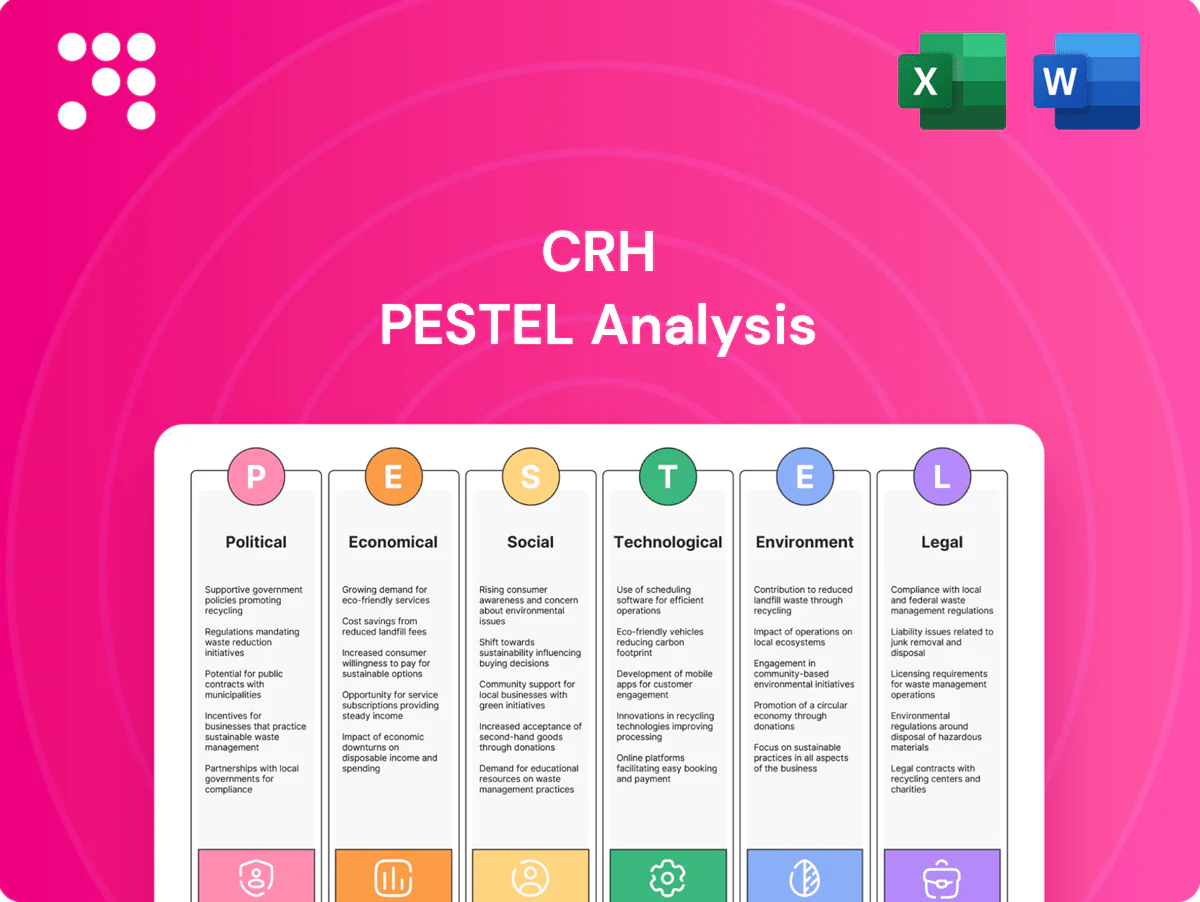
CRH PESTLE Analysis

Make Smarter Strategic Decisions with a Complete PESTEL View
Gain a competitive edge with our PESTLE analysis of CRH. We unpack political, economic, social, technological, legal and environmental forces shaping CRH's strategy and risk profile. Ready-made, actionable and editable—buy the full report for the complete deep-dive and instant download.
Political factors

Infrastructure spending
Public budgets and stimulus plans such as the 2021 IIJA (total package ~$1.2 trillion, including ~$110 billion for roads and bridges) directly drive demand for aggregates, asphalt and concrete that CRH supplies.
CRH, with roughly 60% of revenues from North America, benefits from multi‑year federal and state road, bridge and utilities programs that create predictable backlog.
Shifts in fiscal priorities can accelerate or delay that backlog, so close alignment with regional DOTs and municipalities is critical.
Permitting and zoning
Quarrying and cement plant permits are politically sensitive across CRHs footprint in 30 countries and often require formal environmental impact assessments and local approvals.
Timelines and permit conditions vary by jurisdiction, affecting capacity additions and M&A due diligence and can extend from months to years.
Community opposition has led to political intervention, moratoria or legal challenges in several high-profile projects.
Early stakeholder engagement, transparent EIA processes and community agreements materially reduce project and regulatory risk.

Trade and tariffs
Import duties on cement, clinker and steel inputs materially influence CRH cost positions, raising landed costs in high-tariff markets and squeezing margins. Cross-border flows of materials and finished products remain exposed to geopolitical tensions and sanctions, disrupting supply chains. Local content rules in many jurisdictions force adaptations to bidding strategies and partnerships. Diversified sourcing and regional production mitigate policy shocks.

Decentralized governance
Decentralized governance forces CRH’s local model to align with federal, state and municipal rules across ~31 operating countries; regional procurement priorities vary materially and the US Bipartisan Infrastructure Law (~1.2 trillion USD) and EU green procurement drives reshape demand. Political turnover shifts funding pipelines and ESG criteria, so CRH must use agile pricing and product-mix management to protect margins; FY2024 revenues ~31.0 billion EUR amplify exposure.
- geo: ~31 countries
- FY2024 rev: ~31.0bn EUR
- US infra: ~1.2tn USD
- need: agile pricing & mix
Public‑private partnerships
Public‑private partnership frameworks shape project scale, risk allocation and delivery timelines, with the US Infrastructure Investment and Jobs Act ($550 billion) and the EU InvestEU guarantee (€26 billion) directly expanding megaproject pipelines since 2021–25. Contract structure in PPPs shifts working capital needs from owners to operators and lengthens cash conversion cycles. CRH compliance record and prior PPP wins materially improve award probability in regulated tendering.
- PPP frameworks: determine project size, risk split, timelines
- Political support: IIJA $550bn / InvestEU €26bn unlocks pipelines
- Contracts: affect working capital and cash conversion
- Compliance: strong track record raises award success
US infrastructure boost increases aggregates demand; NA exposure raises fiscal risk
Public budgets (IIJA ~$1.2tn; US roads/bridges ~110bn) and PPP pipelines boost CRH aggregates and asphalt demand.
~60% North America exposure and FY2024 rev ~31.0bn EUR create predictable backlog but heighten fiscal-policy risk.
Permitting, local opposition and tariffs (cement/steel) extend project timelines and squeeze margins.
| Metric | Value |
|---|---|
| Countries | ~31 |
| FY2024 rev | ~31.0bn EUR |
| US infra | ~$1.2tn |
What is included in the product
 Detailed Word Document
Explores how external macro-environmental factors uniquely affect CRH across Political, Economic, Social, Technological, Environmental and Legal dimensions, with data-driven trends and region-specific examples. Designed for executives and investors, it delivers forward-looking insights, clear formatting for reports and scenario planning to surface risks and opportunities.

 Customizable Excel Spreadsheet
Provides a clean, shareable CRH PESTLE summary, visually segmented by category and written in simple language so teams can quickly align on external risks and strategic implications during meetings or client reports.
Economic factors

Construction cycles
Construction cycles drive CRH volumes across residential, non‑residential and infrastructure demand; CRH’s footprint in 30+ countries and broad product mix smooths regional volatility. Downturns compress prices and plant utilisation, while upswings strain quarry and asphalt capacity. Backlog and order‑book visibility, typically 6–18 months on large infrastructure projects, guides capex pacing and short‑term capacity deployment.
Interest rates
Higher policy rates (US fed funds ~5.25–5.50% in 2024–25) cool housing and commercial starts but can preserve public infrastructure spend, moderating demand for CRH products. Rising financing costs constrain developer activity and raise CRH’s nominal borrowing cost against reported net debt roughly €4.5bn (2024). Rate trajectories influence M&A affordability; CRH uses hedging and strict return thresholds to protect ROIC.

Energy and input costs
Fuel, electricity and petcoke drive roughly 30% of cement and asphalt operating costs, making CRH exposed to energy price swings that in 2024 pushed many operators to apply surcharges and dynamic pricing. Deploying alternative fuels and long‑term power PPAs has reduced volatility and supported margins; CRH’s procurement scale across 29 countries enables cost arbitrage and bulk buying advantages.

Labor and productivity
Tight skilled‑trade markets are elevating wage inflation and subcontractor rates; 83% of US contractors reported difficulty hiring in the AGC 2024 survey and CRH noted labour cost pressure in 2024 (~mid single‑digits). Investment in productivity tools and automation preserves throughput, strong safety performance cuts downtime and cost, and targeted workforce development sustains local resilience.
- Skilled‑trade tightness: AGC 2024 — 83% firms report hiring difficulty
- Wage inflation: CRH observed mid single‑digit labour cost pressure in 2024
- Productivity/automation: protects throughput and margins
- Safety & training: reduces downtime; supports local workforce resilience
FX and portfolio mix
CRH’s multi‑currency earnings expose it to translation and transaction risk across Europe and North America; localized pricing constrains full pass‑through of currency shifts, pressuring margins in weaker FX environments. Portfolio rotation toward higher‑margin geographies and products rebalances growth and margin profiles, while natural hedges and active derivatives programs reduce volatility in reported results.
- multi-currency exposure
- limited pricing pass-through
- portfolio rotation = margin/growth rebalance
- natural hedges + derivatives lower volatility
US infrastructure boost increases aggregates demand; NA exposure raises fiscal risk
Construction cycles drive volumes across 30+ countries; backlog (~6–18 months) guides capex and capacity. Rates (US fed funds ~5.25–5.50% in 2024–25) cool private demand but sustain public spend; net debt ~€4.5bn affects financing costs and M&A. Energy ~30% of cement/asphalt costs; labour pressure (AGC hiring 83%/CRH mid single‑digit wage inflation) squeezes margins, offset by automation and procurement scale.
| Metric | 2024/25 |
|---|---|
| Net debt | €4.5bn |
| Fed funds | 5.25–5.50% |
| Energy share | ~30% |
| AGC hiring | 83% |
| Labour inflation | mid single‑digits |
Same Document Delivered
CRH PESTLE Analysis
The CRH PESTLE Analysis preview shown here is the exact document you’ll receive after purchase—fully formatted and ready to use. It presents comprehensive political, economic, social, technological, legal, and environmental insights specific to CRH, with no placeholders or teasers. The layout, content, and structure visible here are exactly what you’ll be able to download immediately after buying.

Make Smarter Strategic Decisions with a Complete PESTEL View
Gain a competitive edge with our PESTLE analysis of CRH. We unpack political, economic, social, technological, legal and environmental forces shaping CRH's strategy and risk profile. Ready-made, actionable and editable—buy the full report for the complete deep-dive and instant download.
Political factors
Infrastructure spending
Public budgets and stimulus plans such as the 2021 IIJA (total package ~$1.2 trillion, including ~$110 billion for roads and bridges) directly drive demand for aggregates, asphalt and concrete that CRH supplies.
CRH, with roughly 60% of revenues from North America, benefits from multi‑year federal and state road, bridge and utilities programs that create predictable backlog.
Shifts in fiscal priorities can accelerate or delay that backlog, so close alignment with regional DOTs and municipalities is critical.
Permitting and zoning
Quarrying and cement plant permits are politically sensitive across CRHs footprint in 30 countries and often require formal environmental impact assessments and local approvals.
Timelines and permit conditions vary by jurisdiction, affecting capacity additions and M&A due diligence and can extend from months to years.
Community opposition has led to political intervention, moratoria or legal challenges in several high-profile projects.
Early stakeholder engagement, transparent EIA processes and community agreements materially reduce project and regulatory risk.
Trade and tariffs
Import duties on cement, clinker and steel inputs materially influence CRH cost positions, raising landed costs in high-tariff markets and squeezing margins. Cross-border flows of materials and finished products remain exposed to geopolitical tensions and sanctions, disrupting supply chains. Local content rules in many jurisdictions force adaptations to bidding strategies and partnerships. Diversified sourcing and regional production mitigate policy shocks.
Decentralized governance
Decentralized governance forces CRH’s local model to align with federal, state and municipal rules across ~31 operating countries; regional procurement priorities vary materially and the US Bipartisan Infrastructure Law (~1.2 trillion USD) and EU green procurement drives reshape demand. Political turnover shifts funding pipelines and ESG criteria, so CRH must use agile pricing and product-mix management to protect margins; FY2024 revenues ~31.0 billion EUR amplify exposure.
- geo: ~31 countries
- FY2024 rev: ~31.0bn EUR
- US infra: ~1.2tn USD
- need: agile pricing & mix
Public‑private partnerships
Public‑private partnership frameworks shape project scale, risk allocation and delivery timelines, with the US Infrastructure Investment and Jobs Act ($550 billion) and the EU InvestEU guarantee (€26 billion) directly expanding megaproject pipelines since 2021–25. Contract structure in PPPs shifts working capital needs from owners to operators and lengthens cash conversion cycles. CRH compliance record and prior PPP wins materially improve award probability in regulated tendering.
- PPP frameworks: determine project size, risk split, timelines
- Political support: IIJA $550bn / InvestEU €26bn unlocks pipelines
- Contracts: affect working capital and cash conversion
- Compliance: strong track record raises award success
US infrastructure boost increases aggregates demand; NA exposure raises fiscal risk
Public budgets (IIJA ~$1.2tn; US roads/bridges ~110bn) and PPP pipelines boost CRH aggregates and asphalt demand.
~60% North America exposure and FY2024 rev ~31.0bn EUR create predictable backlog but heighten fiscal-policy risk.
Permitting, local opposition and tariffs (cement/steel) extend project timelines and squeeze margins.
| Metric | Value |
|---|---|
| Countries | ~31 |
| FY2024 rev | ~31.0bn EUR |
| US infra | ~$1.2tn |
What is included in the product
Detailed Word Document
Explores how external macro-environmental factors uniquely affect CRH across Political, Economic, Social, Technological, Environmental and Legal dimensions, with data-driven trends and region-specific examples. Designed for executives and investors, it delivers forward-looking insights, clear formatting for reports and scenario planning to surface risks and opportunities.
Customizable Excel Spreadsheet
Provides a clean, shareable CRH PESTLE summary, visually segmented by category and written in simple language so teams can quickly align on external risks and strategic implications during meetings or client reports.
Economic factors
Construction cycles
Construction cycles drive CRH volumes across residential, non‑residential and infrastructure demand; CRH’s footprint in 30+ countries and broad product mix smooths regional volatility. Downturns compress prices and plant utilisation, while upswings strain quarry and asphalt capacity. Backlog and order‑book visibility, typically 6–18 months on large infrastructure projects, guides capex pacing and short‑term capacity deployment.
Interest rates
Higher policy rates (US fed funds ~5.25–5.50% in 2024–25) cool housing and commercial starts but can preserve public infrastructure spend, moderating demand for CRH products. Rising financing costs constrain developer activity and raise CRH’s nominal borrowing cost against reported net debt roughly €4.5bn (2024). Rate trajectories influence M&A affordability; CRH uses hedging and strict return thresholds to protect ROIC.
Energy and input costs
Fuel, electricity and petcoke drive roughly 30% of cement and asphalt operating costs, making CRH exposed to energy price swings that in 2024 pushed many operators to apply surcharges and dynamic pricing. Deploying alternative fuels and long‑term power PPAs has reduced volatility and supported margins; CRH’s procurement scale across 29 countries enables cost arbitrage and bulk buying advantages.
Labor and productivity
Tight skilled‑trade markets are elevating wage inflation and subcontractor rates; 83% of US contractors reported difficulty hiring in the AGC 2024 survey and CRH noted labour cost pressure in 2024 (~mid single‑digits). Investment in productivity tools and automation preserves throughput, strong safety performance cuts downtime and cost, and targeted workforce development sustains local resilience.
- Skilled‑trade tightness: AGC 2024 — 83% firms report hiring difficulty
- Wage inflation: CRH observed mid single‑digit labour cost pressure in 2024
- Productivity/automation: protects throughput and margins
- Safety & training: reduces downtime; supports local workforce resilience
FX and portfolio mix
CRH’s multi‑currency earnings expose it to translation and transaction risk across Europe and North America; localized pricing constrains full pass‑through of currency shifts, pressuring margins in weaker FX environments. Portfolio rotation toward higher‑margin geographies and products rebalances growth and margin profiles, while natural hedges and active derivatives programs reduce volatility in reported results.
- multi-currency exposure
- limited pricing pass-through
- portfolio rotation = margin/growth rebalance
- natural hedges + derivatives lower volatility
US infrastructure boost increases aggregates demand; NA exposure raises fiscal risk
Construction cycles drive volumes across 30+ countries; backlog (~6–18 months) guides capex and capacity. Rates (US fed funds ~5.25–5.50% in 2024–25) cool private demand but sustain public spend; net debt ~€4.5bn affects financing costs and M&A. Energy ~30% of cement/asphalt costs; labour pressure (AGC hiring 83%/CRH mid single‑digit wage inflation) squeezes margins, offset by automation and procurement scale.
| Metric | 2024/25 |
|---|---|
| Net debt | €4.5bn |
| Fed funds | 5.25–5.50% |
| Energy share | ~30% |
| AGC hiring | 83% |
| Labour inflation | mid single‑digits |
Same Document Delivered
CRH PESTLE Analysis
The CRH PESTLE Analysis preview shown here is the exact document you’ll receive after purchase—fully formatted and ready to use. It presents comprehensive political, economic, social, technological, legal, and environmental insights specific to CRH, with no placeholders or teasers. The layout, content, and structure visible here are exactly what you’ll be able to download immediately after buying.
Original: $10.00
-65%$10.00
$3.50Description
Make Smarter Strategic Decisions with a Complete PESTEL View
Gain a competitive edge with our PESTLE analysis of CRH. We unpack political, economic, social, technological, legal and environmental forces shaping CRH's strategy and risk profile. Ready-made, actionable and editable—buy the full report for the complete deep-dive and instant download.
Political factors
Infrastructure spending
Public budgets and stimulus plans such as the 2021 IIJA (total package ~$1.2 trillion, including ~$110 billion for roads and bridges) directly drive demand for aggregates, asphalt and concrete that CRH supplies.
CRH, with roughly 60% of revenues from North America, benefits from multi‑year federal and state road, bridge and utilities programs that create predictable backlog.
Shifts in fiscal priorities can accelerate or delay that backlog, so close alignment with regional DOTs and municipalities is critical.
Permitting and zoning
Quarrying and cement plant permits are politically sensitive across CRHs footprint in 30 countries and often require formal environmental impact assessments and local approvals.
Timelines and permit conditions vary by jurisdiction, affecting capacity additions and M&A due diligence and can extend from months to years.
Community opposition has led to political intervention, moratoria or legal challenges in several high-profile projects.
Early stakeholder engagement, transparent EIA processes and community agreements materially reduce project and regulatory risk.
Trade and tariffs
Import duties on cement, clinker and steel inputs materially influence CRH cost positions, raising landed costs in high-tariff markets and squeezing margins. Cross-border flows of materials and finished products remain exposed to geopolitical tensions and sanctions, disrupting supply chains. Local content rules in many jurisdictions force adaptations to bidding strategies and partnerships. Diversified sourcing and regional production mitigate policy shocks.
Decentralized governance
Decentralized governance forces CRH’s local model to align with federal, state and municipal rules across ~31 operating countries; regional procurement priorities vary materially and the US Bipartisan Infrastructure Law (~1.2 trillion USD) and EU green procurement drives reshape demand. Political turnover shifts funding pipelines and ESG criteria, so CRH must use agile pricing and product-mix management to protect margins; FY2024 revenues ~31.0 billion EUR amplify exposure.
- geo: ~31 countries
- FY2024 rev: ~31.0bn EUR
- US infra: ~1.2tn USD
- need: agile pricing & mix
Public‑private partnerships
Public‑private partnership frameworks shape project scale, risk allocation and delivery timelines, with the US Infrastructure Investment and Jobs Act ($550 billion) and the EU InvestEU guarantee (€26 billion) directly expanding megaproject pipelines since 2021–25. Contract structure in PPPs shifts working capital needs from owners to operators and lengthens cash conversion cycles. CRH compliance record and prior PPP wins materially improve award probability in regulated tendering.
- PPP frameworks: determine project size, risk split, timelines
- Political support: IIJA $550bn / InvestEU €26bn unlocks pipelines
- Contracts: affect working capital and cash conversion
- Compliance: strong track record raises award success
US infrastructure boost increases aggregates demand; NA exposure raises fiscal risk
Public budgets (IIJA ~$1.2tn; US roads/bridges ~110bn) and PPP pipelines boost CRH aggregates and asphalt demand.
~60% North America exposure and FY2024 rev ~31.0bn EUR create predictable backlog but heighten fiscal-policy risk.
Permitting, local opposition and tariffs (cement/steel) extend project timelines and squeeze margins.
| Metric | Value |
|---|---|
| Countries | ~31 |
| FY2024 rev | ~31.0bn EUR |
| US infra | ~$1.2tn |
What is included in the product
Detailed Word Document
Explores how external macro-environmental factors uniquely affect CRH across Political, Economic, Social, Technological, Environmental and Legal dimensions, with data-driven trends and region-specific examples. Designed for executives and investors, it delivers forward-looking insights, clear formatting for reports and scenario planning to surface risks and opportunities.
Customizable Excel Spreadsheet
Provides a clean, shareable CRH PESTLE summary, visually segmented by category and written in simple language so teams can quickly align on external risks and strategic implications during meetings or client reports.
Economic factors
Construction cycles
Construction cycles drive CRH volumes across residential, non‑residential and infrastructure demand; CRH’s footprint in 30+ countries and broad product mix smooths regional volatility. Downturns compress prices and plant utilisation, while upswings strain quarry and asphalt capacity. Backlog and order‑book visibility, typically 6–18 months on large infrastructure projects, guides capex pacing and short‑term capacity deployment.
Interest rates
Higher policy rates (US fed funds ~5.25–5.50% in 2024–25) cool housing and commercial starts but can preserve public infrastructure spend, moderating demand for CRH products. Rising financing costs constrain developer activity and raise CRH’s nominal borrowing cost against reported net debt roughly €4.5bn (2024). Rate trajectories influence M&A affordability; CRH uses hedging and strict return thresholds to protect ROIC.
Energy and input costs
Fuel, electricity and petcoke drive roughly 30% of cement and asphalt operating costs, making CRH exposed to energy price swings that in 2024 pushed many operators to apply surcharges and dynamic pricing. Deploying alternative fuels and long‑term power PPAs has reduced volatility and supported margins; CRH’s procurement scale across 29 countries enables cost arbitrage and bulk buying advantages.
Labor and productivity
Tight skilled‑trade markets are elevating wage inflation and subcontractor rates; 83% of US contractors reported difficulty hiring in the AGC 2024 survey and CRH noted labour cost pressure in 2024 (~mid single‑digits). Investment in productivity tools and automation preserves throughput, strong safety performance cuts downtime and cost, and targeted workforce development sustains local resilience.
- Skilled‑trade tightness: AGC 2024 — 83% firms report hiring difficulty
- Wage inflation: CRH observed mid single‑digit labour cost pressure in 2024
- Productivity/automation: protects throughput and margins
- Safety & training: reduces downtime; supports local workforce resilience
FX and portfolio mix
CRH’s multi‑currency earnings expose it to translation and transaction risk across Europe and North America; localized pricing constrains full pass‑through of currency shifts, pressuring margins in weaker FX environments. Portfolio rotation toward higher‑margin geographies and products rebalances growth and margin profiles, while natural hedges and active derivatives programs reduce volatility in reported results.
- multi-currency exposure
- limited pricing pass-through
- portfolio rotation = margin/growth rebalance
- natural hedges + derivatives lower volatility
US infrastructure boost increases aggregates demand; NA exposure raises fiscal risk
Construction cycles drive volumes across 30+ countries; backlog (~6–18 months) guides capex and capacity. Rates (US fed funds ~5.25–5.50% in 2024–25) cool private demand but sustain public spend; net debt ~€4.5bn affects financing costs and M&A. Energy ~30% of cement/asphalt costs; labour pressure (AGC hiring 83%/CRH mid single‑digit wage inflation) squeezes margins, offset by automation and procurement scale.
| Metric | 2024/25 |
|---|---|
| Net debt | €4.5bn |
| Fed funds | 5.25–5.50% |
| Energy share | ~30% |
| AGC hiring | 83% |
| Labour inflation | mid single‑digits |
Same Document Delivered
CRH PESTLE Analysis
The CRH PESTLE Analysis preview shown here is the exact document you’ll receive after purchase—fully formatted and ready to use. It presents comprehensive political, economic, social, technological, legal, and environmental insights specific to CRH, with no placeholders or teasers. The layout, content, and structure visible here are exactly what you’ll be able to download immediately after buying.











