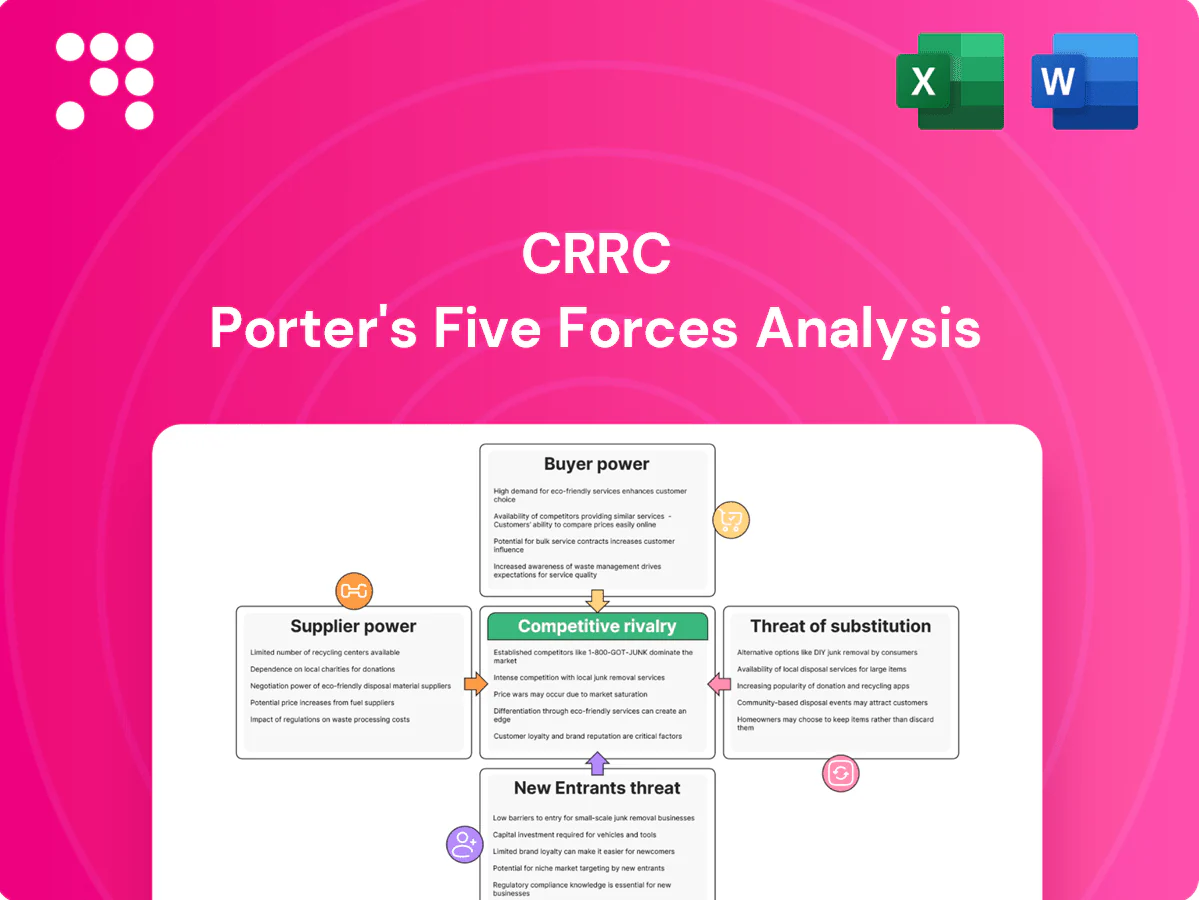
CRRC Porter's Five Forces Analysis

Elevate Your Analysis with the Complete Porter's Five Forces Analysis
CRRC faces intense competitive pressure from established global rail manufacturers, rising cost pressures from suppliers, moderate buyer negotiation power, limited threat from substitutes, and high regulatory barriers. This snapshot highlights key dynamics but only scratches the surface. Unlock the full Porter's Five Forces Analysis for force-by-force ratings, visuals, and strategic implications. Get the complete report to inform investment or strategy decisions.
Suppliers Bargaining Power

Scale dampens supplier leverage
CRRC’s scale — with over 90% share of China’s rail-vehicle market — enables bulk purchasing and standardized specs that materially lower per-unit input costs. Suppliers risk losing a dominant buyer, creating high switching risk and limiting their negotiating power. Multi-year frame agreements and formal vendor qualification programs further constrain price hikes, so leverage skews toward CRRC on mainstream inputs.
Critical components remain tight
Traction systems, power electronics, semiconductors and braking/signaling modules have few qualified global suppliers, raising supplier leverage over CRRC. Certification and strict safety standards constrain alternatives and elevate switching costs for complex subsystems. Periodic chip shortages and export controls have tightened inputs and delayed deliveries. CRRC still controls over 90% of China’s rolling-stock market, but these pockets boost supplier power.

Vertical integration buffers risk
CRRC's in-house production of bogies, car bodies and select traction components reduces supplier dependence and, per the 2024 annual report, strengthens delivery reliability and cost control through backward integration.
This vertical integration gives CRRC clear negotiating leverage with remaining vendors but necessitates sustained capex and continuous process excellence to maintain margins and on-time performance.

Commodity volatility hedged by contracts
Commodity volatility hedged by contracts: Steel, aluminum, copper and rare earths are globally traded and price-volatile; China accounted for about 57% of global crude steel in 2023 and supplies over 60% of rare earths. CRRC mitigates spikes via multi-year contracts, hedging and specification flexibility; supplier power rises in tight cycles but Chinese localization cushions exposure.
- China ~57% of global crude steel (2023)
- China >60% of rare earth supply (2023)
- CRRC: multi-year contracts, hedging, specification flexibility, localized inputs
Compliance and localization constraints
Export projects frequently mandate local content, narrowing qualified supplier pools and giving approved domestic vendors bargaining leverage; in many markets local-content rules often exceed 50%, raising supplier power. CRRC offsets this through partner ecosystems and technology-transfer frameworks deployed in 2024 to secure bids and comply with mandates. Nevertheless, localization increases procurement cost and project complexity for CRRC and partners.
- Local-content rules often >50%
- Approved local vendors gain price/leverage
- CRRC uses partners and tech transfer (2024)
- Localization raises cost and complexity
China rail dominance cuts supplier power; chips, signaling and local-content rules raise risk
CRRC’s >90% China rail-market share and vertical integration lower supplier power for mainstream inputs, supported by multi-year contracts and hedges. Critical subsystems (traction, semiconductors, signaling) remain supplier-concentrated, raising risk from chip shortages and export controls. Localization and local-content rules (>50% in many projects) increase approved vendors’ leverage despite CRRC’s 2024 tech-transfer strategies.
| Metric | 2023/2024 |
|---|---|
| CRRC China rail share | >90% |
| China crude steel | ~57% (2023) |
| China rare earths | >60% (2023) |
| Local-content rules | >50% in many markets |
What is included in the product
 Detailed Word Document
Provides a CRRC-specific Porter's Five Forces assessment that uncovers competitive pressures, supplier and buyer power, threat of new entrants and substitutes, and rivalry intensity; highlights disruptive technologies, regulatory dynamics, and market barriers shaping CRRC’s competitive moat. Identifies strategic levers affecting pricing, margins and long-term positioning.

 Customizable Excel Spreadsheet
One-sheet Porter’s Five Forces for CRRC—condenses competitive pressures into a single view for rapid boardroom decisions and investor pitches. Customize force scores, scenarios and radar visuals to reflect regulation, supply-chain shifts or new entrants for instant, actionable strategy guidance.
Customers Bargaining Power

Concentrated, sophisticated buyers
National railways (China Railway operates about 155,000 km of track) and city transit agencies (around 49 Chinese metro systems) dominate demand through large tenders. Professional procurement teams deploy competitive bidding and life-cycle costing to lower total ownership costs. Their scale and expertise raise bargaining power against suppliers; framework agreements and fleet-harmonization further amplify buyer leverage despite CRRC holding over 90% of the domestic rolling-stock market.
Price vs. total cost of ownership
Buyers weigh capex against decades-long TCO, with lifecycle studies showing energy and maintenance can represent 20–40% of total costs over 30–40 years; availability targets often exceed 99% for metros. CRRC emphasizes TCO and bundled services to shift decisions from price alone, citing extended warranties, spare-parts networks and performance-based contracts that tie payments to uptime and energy efficiency gains. These service guarantees materially reduce buyer bargaining leverage.

Financing and policy influence terms
Export credits and state-backed financing often sway awards and pricing for rolling stock; Belt and Road projects surpassed $1 trillion by 2024, amplifying leverage for suppliers tied to state banks. Policy goals—local jobs, tech transfer and localization—are routinely written into tenders, shifting requirements and altering buyer negotiating leverage. When financing aligns with procurement goals buyer power falls, otherwise it can strengthen buyers; tailored financing packages frequently decide wins.

High switching costs, long lifecycles
High switching costs in CRRC projects arise from fleet compatibility, proprietary spare parts and driver/maintenance training that lock buyers in; homologation and safety certifications commonly take 12–36 months and fleets typically run 25–30 years, so purchasers rarely switch mid-lifecycle unless performance fails, reducing buyer leverage after adoption.
- fleet compatibility
- spare parts lock-in
- training dependency
- homologation 12–36 months
- lifecycles 25–30 years
Reputation and security scrutiny
Public safety and national security concerns drive intensive due diligence for CRRC suppliers; CRRC reported RMB 229.3 billion revenue in 2023, making supplier risk material to major projects. Allegations or sanctions can legally exclude bidders, narrowing choice sets while increasing buyer insistence on cybersecurity, traceability and third-party audits. Contract terms grow stricter, shifting price, warranty and indemnity burdens to suppliers.
- Due diligence intensity up
- Sanctions can exclude bidders
- Reduced supplier pool, higher buyer leverage
- Stricter price, warranty, indemnity terms
Public buyers wield procurement leverage despite dominant domestic rolling-stock supplier
Large public buyers (China Railway: 155,000 km; ~49 metros) and professional procurement teams wield strong bargaining power via large tenders, competitive bidding and lifecycle TCO focus, despite CRRC’s >90% domestic market share and RMB 229.3bn 2023 revenue. Lifecycle costs (20–40% over 30–40 years), >99% metro availability targets and high switching costs (homologation 12–36 months; fleets 25–30 years) moderate buyer leverage. Export credits, BRI finance (~$1tn by 2024) and localization clauses often tilt outcomes toward suppliers.
| Metric | Value |
|---|---|
| CRRC 2023 revenue | RMB 229.3bn |
| Domestic market share | >90% |
| China track / metros | 155,000 km / 49 systems |
| Lifecycle cost % | 20–40% |
| Availability target | >99% |
| Homologation | 12–36 months |
| Fleet life | 25–30 years |
| BRI finance | ~$1tn (by 2024) |
Preview Before You Purchase
CRRC Porter's Five Forces Analysis
This preview shows the exact CRRC Porter’s Five Forces Analysis you’ll receive after purchase—no placeholders, no samples. It covers competitive rivalry, supplier and buyer power, threat of substitutes and entry, and is fully formatted for immediate use. Once you buy, you’ll get this same complete document instantly.

Elevate Your Analysis with the Complete Porter's Five Forces Analysis
CRRC faces intense competitive pressure from established global rail manufacturers, rising cost pressures from suppliers, moderate buyer negotiation power, limited threat from substitutes, and high regulatory barriers. This snapshot highlights key dynamics but only scratches the surface. Unlock the full Porter's Five Forces Analysis for force-by-force ratings, visuals, and strategic implications. Get the complete report to inform investment or strategy decisions.
Suppliers Bargaining Power
Scale dampens supplier leverage
CRRC’s scale — with over 90% share of China’s rail-vehicle market — enables bulk purchasing and standardized specs that materially lower per-unit input costs. Suppliers risk losing a dominant buyer, creating high switching risk and limiting their negotiating power. Multi-year frame agreements and formal vendor qualification programs further constrain price hikes, so leverage skews toward CRRC on mainstream inputs.
Critical components remain tight
Traction systems, power electronics, semiconductors and braking/signaling modules have few qualified global suppliers, raising supplier leverage over CRRC. Certification and strict safety standards constrain alternatives and elevate switching costs for complex subsystems. Periodic chip shortages and export controls have tightened inputs and delayed deliveries. CRRC still controls over 90% of China’s rolling-stock market, but these pockets boost supplier power.
Vertical integration buffers risk
CRRC's in-house production of bogies, car bodies and select traction components reduces supplier dependence and, per the 2024 annual report, strengthens delivery reliability and cost control through backward integration.
This vertical integration gives CRRC clear negotiating leverage with remaining vendors but necessitates sustained capex and continuous process excellence to maintain margins and on-time performance.
Commodity volatility hedged by contracts
Commodity volatility hedged by contracts: Steel, aluminum, copper and rare earths are globally traded and price-volatile; China accounted for about 57% of global crude steel in 2023 and supplies over 60% of rare earths. CRRC mitigates spikes via multi-year contracts, hedging and specification flexibility; supplier power rises in tight cycles but Chinese localization cushions exposure.
- China ~57% of global crude steel (2023)
- China >60% of rare earth supply (2023)
- CRRC: multi-year contracts, hedging, specification flexibility, localized inputs
Compliance and localization constraints
Export projects frequently mandate local content, narrowing qualified supplier pools and giving approved domestic vendors bargaining leverage; in many markets local-content rules often exceed 50%, raising supplier power. CRRC offsets this through partner ecosystems and technology-transfer frameworks deployed in 2024 to secure bids and comply with mandates. Nevertheless, localization increases procurement cost and project complexity for CRRC and partners.
- Local-content rules often >50%
- Approved local vendors gain price/leverage
- CRRC uses partners and tech transfer (2024)
- Localization raises cost and complexity
China rail dominance cuts supplier power; chips, signaling and local-content rules raise risk
CRRC’s >90% China rail-market share and vertical integration lower supplier power for mainstream inputs, supported by multi-year contracts and hedges. Critical subsystems (traction, semiconductors, signaling) remain supplier-concentrated, raising risk from chip shortages and export controls. Localization and local-content rules (>50% in many projects) increase approved vendors’ leverage despite CRRC’s 2024 tech-transfer strategies.
| Metric | 2023/2024 |
|---|---|
| CRRC China rail share | >90% |
| China crude steel | ~57% (2023) |
| China rare earths | >60% (2023) |
| Local-content rules | >50% in many markets |
What is included in the product
Detailed Word Document
Provides a CRRC-specific Porter's Five Forces assessment that uncovers competitive pressures, supplier and buyer power, threat of new entrants and substitutes, and rivalry intensity; highlights disruptive technologies, regulatory dynamics, and market barriers shaping CRRC’s competitive moat. Identifies strategic levers affecting pricing, margins and long-term positioning.
Customizable Excel Spreadsheet
One-sheet Porter’s Five Forces for CRRC—condenses competitive pressures into a single view for rapid boardroom decisions and investor pitches. Customize force scores, scenarios and radar visuals to reflect regulation, supply-chain shifts or new entrants for instant, actionable strategy guidance.
Customers Bargaining Power
Concentrated, sophisticated buyers
National railways (China Railway operates about 155,000 km of track) and city transit agencies (around 49 Chinese metro systems) dominate demand through large tenders. Professional procurement teams deploy competitive bidding and life-cycle costing to lower total ownership costs. Their scale and expertise raise bargaining power against suppliers; framework agreements and fleet-harmonization further amplify buyer leverage despite CRRC holding over 90% of the domestic rolling-stock market.
Price vs. total cost of ownership
Buyers weigh capex against decades-long TCO, with lifecycle studies showing energy and maintenance can represent 20–40% of total costs over 30–40 years; availability targets often exceed 99% for metros. CRRC emphasizes TCO and bundled services to shift decisions from price alone, citing extended warranties, spare-parts networks and performance-based contracts that tie payments to uptime and energy efficiency gains. These service guarantees materially reduce buyer bargaining leverage.
Financing and policy influence terms
Export credits and state-backed financing often sway awards and pricing for rolling stock; Belt and Road projects surpassed $1 trillion by 2024, amplifying leverage for suppliers tied to state banks. Policy goals—local jobs, tech transfer and localization—are routinely written into tenders, shifting requirements and altering buyer negotiating leverage. When financing aligns with procurement goals buyer power falls, otherwise it can strengthen buyers; tailored financing packages frequently decide wins.
High switching costs, long lifecycles
High switching costs in CRRC projects arise from fleet compatibility, proprietary spare parts and driver/maintenance training that lock buyers in; homologation and safety certifications commonly take 12–36 months and fleets typically run 25–30 years, so purchasers rarely switch mid-lifecycle unless performance fails, reducing buyer leverage after adoption.
- fleet compatibility
- spare parts lock-in
- training dependency
- homologation 12–36 months
- lifecycles 25–30 years
Reputation and security scrutiny
Public safety and national security concerns drive intensive due diligence for CRRC suppliers; CRRC reported RMB 229.3 billion revenue in 2023, making supplier risk material to major projects. Allegations or sanctions can legally exclude bidders, narrowing choice sets while increasing buyer insistence on cybersecurity, traceability and third-party audits. Contract terms grow stricter, shifting price, warranty and indemnity burdens to suppliers.
- Due diligence intensity up
- Sanctions can exclude bidders
- Reduced supplier pool, higher buyer leverage
- Stricter price, warranty, indemnity terms
Public buyers wield procurement leverage despite dominant domestic rolling-stock supplier
Large public buyers (China Railway: 155,000 km; ~49 metros) and professional procurement teams wield strong bargaining power via large tenders, competitive bidding and lifecycle TCO focus, despite CRRC’s >90% domestic market share and RMB 229.3bn 2023 revenue. Lifecycle costs (20–40% over 30–40 years), >99% metro availability targets and high switching costs (homologation 12–36 months; fleets 25–30 years) moderate buyer leverage. Export credits, BRI finance (~$1tn by 2024) and localization clauses often tilt outcomes toward suppliers.
| Metric | Value |
|---|---|
| CRRC 2023 revenue | RMB 229.3bn |
| Domestic market share | >90% |
| China track / metros | 155,000 km / 49 systems |
| Lifecycle cost % | 20–40% |
| Availability target | >99% |
| Homologation | 12–36 months |
| Fleet life | 25–30 years |
| BRI finance | ~$1tn (by 2024) |
Preview Before You Purchase
CRRC Porter's Five Forces Analysis
This preview shows the exact CRRC Porter’s Five Forces Analysis you’ll receive after purchase—no placeholders, no samples. It covers competitive rivalry, supplier and buyer power, threat of substitutes and entry, and is fully formatted for immediate use. Once you buy, you’ll get this same complete document instantly.
Original: $10.00
-65%$10.00
$3.50Description
Elevate Your Analysis with the Complete Porter's Five Forces Analysis
CRRC faces intense competitive pressure from established global rail manufacturers, rising cost pressures from suppliers, moderate buyer negotiation power, limited threat from substitutes, and high regulatory barriers. This snapshot highlights key dynamics but only scratches the surface. Unlock the full Porter's Five Forces Analysis for force-by-force ratings, visuals, and strategic implications. Get the complete report to inform investment or strategy decisions.
Suppliers Bargaining Power
Scale dampens supplier leverage
CRRC’s scale — with over 90% share of China’s rail-vehicle market — enables bulk purchasing and standardized specs that materially lower per-unit input costs. Suppliers risk losing a dominant buyer, creating high switching risk and limiting their negotiating power. Multi-year frame agreements and formal vendor qualification programs further constrain price hikes, so leverage skews toward CRRC on mainstream inputs.
Critical components remain tight
Traction systems, power electronics, semiconductors and braking/signaling modules have few qualified global suppliers, raising supplier leverage over CRRC. Certification and strict safety standards constrain alternatives and elevate switching costs for complex subsystems. Periodic chip shortages and export controls have tightened inputs and delayed deliveries. CRRC still controls over 90% of China’s rolling-stock market, but these pockets boost supplier power.
Vertical integration buffers risk
CRRC's in-house production of bogies, car bodies and select traction components reduces supplier dependence and, per the 2024 annual report, strengthens delivery reliability and cost control through backward integration.
This vertical integration gives CRRC clear negotiating leverage with remaining vendors but necessitates sustained capex and continuous process excellence to maintain margins and on-time performance.
Commodity volatility hedged by contracts
Commodity volatility hedged by contracts: Steel, aluminum, copper and rare earths are globally traded and price-volatile; China accounted for about 57% of global crude steel in 2023 and supplies over 60% of rare earths. CRRC mitigates spikes via multi-year contracts, hedging and specification flexibility; supplier power rises in tight cycles but Chinese localization cushions exposure.
- China ~57% of global crude steel (2023)
- China >60% of rare earth supply (2023)
- CRRC: multi-year contracts, hedging, specification flexibility, localized inputs
Compliance and localization constraints
Export projects frequently mandate local content, narrowing qualified supplier pools and giving approved domestic vendors bargaining leverage; in many markets local-content rules often exceed 50%, raising supplier power. CRRC offsets this through partner ecosystems and technology-transfer frameworks deployed in 2024 to secure bids and comply with mandates. Nevertheless, localization increases procurement cost and project complexity for CRRC and partners.
- Local-content rules often >50%
- Approved local vendors gain price/leverage
- CRRC uses partners and tech transfer (2024)
- Localization raises cost and complexity
China rail dominance cuts supplier power; chips, signaling and local-content rules raise risk
CRRC’s >90% China rail-market share and vertical integration lower supplier power for mainstream inputs, supported by multi-year contracts and hedges. Critical subsystems (traction, semiconductors, signaling) remain supplier-concentrated, raising risk from chip shortages and export controls. Localization and local-content rules (>50% in many projects) increase approved vendors’ leverage despite CRRC’s 2024 tech-transfer strategies.
| Metric | 2023/2024 |
|---|---|
| CRRC China rail share | >90% |
| China crude steel | ~57% (2023) |
| China rare earths | >60% (2023) |
| Local-content rules | >50% in many markets |
What is included in the product
Detailed Word Document
Provides a CRRC-specific Porter's Five Forces assessment that uncovers competitive pressures, supplier and buyer power, threat of new entrants and substitutes, and rivalry intensity; highlights disruptive technologies, regulatory dynamics, and market barriers shaping CRRC’s competitive moat. Identifies strategic levers affecting pricing, margins and long-term positioning.
Customizable Excel Spreadsheet
One-sheet Porter’s Five Forces for CRRC—condenses competitive pressures into a single view for rapid boardroom decisions and investor pitches. Customize force scores, scenarios and radar visuals to reflect regulation, supply-chain shifts or new entrants for instant, actionable strategy guidance.
Customers Bargaining Power
Concentrated, sophisticated buyers
National railways (China Railway operates about 155,000 km of track) and city transit agencies (around 49 Chinese metro systems) dominate demand through large tenders. Professional procurement teams deploy competitive bidding and life-cycle costing to lower total ownership costs. Their scale and expertise raise bargaining power against suppliers; framework agreements and fleet-harmonization further amplify buyer leverage despite CRRC holding over 90% of the domestic rolling-stock market.
Price vs. total cost of ownership
Buyers weigh capex against decades-long TCO, with lifecycle studies showing energy and maintenance can represent 20–40% of total costs over 30–40 years; availability targets often exceed 99% for metros. CRRC emphasizes TCO and bundled services to shift decisions from price alone, citing extended warranties, spare-parts networks and performance-based contracts that tie payments to uptime and energy efficiency gains. These service guarantees materially reduce buyer bargaining leverage.
Financing and policy influence terms
Export credits and state-backed financing often sway awards and pricing for rolling stock; Belt and Road projects surpassed $1 trillion by 2024, amplifying leverage for suppliers tied to state banks. Policy goals—local jobs, tech transfer and localization—are routinely written into tenders, shifting requirements and altering buyer negotiating leverage. When financing aligns with procurement goals buyer power falls, otherwise it can strengthen buyers; tailored financing packages frequently decide wins.
High switching costs, long lifecycles
High switching costs in CRRC projects arise from fleet compatibility, proprietary spare parts and driver/maintenance training that lock buyers in; homologation and safety certifications commonly take 12–36 months and fleets typically run 25–30 years, so purchasers rarely switch mid-lifecycle unless performance fails, reducing buyer leverage after adoption.
- fleet compatibility
- spare parts lock-in
- training dependency
- homologation 12–36 months
- lifecycles 25–30 years
Reputation and security scrutiny
Public safety and national security concerns drive intensive due diligence for CRRC suppliers; CRRC reported RMB 229.3 billion revenue in 2023, making supplier risk material to major projects. Allegations or sanctions can legally exclude bidders, narrowing choice sets while increasing buyer insistence on cybersecurity, traceability and third-party audits. Contract terms grow stricter, shifting price, warranty and indemnity burdens to suppliers.
- Due diligence intensity up
- Sanctions can exclude bidders
- Reduced supplier pool, higher buyer leverage
- Stricter price, warranty, indemnity terms
Public buyers wield procurement leverage despite dominant domestic rolling-stock supplier
Large public buyers (China Railway: 155,000 km; ~49 metros) and professional procurement teams wield strong bargaining power via large tenders, competitive bidding and lifecycle TCO focus, despite CRRC’s >90% domestic market share and RMB 229.3bn 2023 revenue. Lifecycle costs (20–40% over 30–40 years), >99% metro availability targets and high switching costs (homologation 12–36 months; fleets 25–30 years) moderate buyer leverage. Export credits, BRI finance (~$1tn by 2024) and localization clauses often tilt outcomes toward suppliers.
| Metric | Value |
|---|---|
| CRRC 2023 revenue | RMB 229.3bn |
| Domestic market share | >90% |
| China track / metros | 155,000 km / 49 systems |
| Lifecycle cost % | 20–40% |
| Availability target | >99% |
| Homologation | 12–36 months |
| Fleet life | 25–30 years |
| BRI finance | ~$1tn (by 2024) |
Preview Before You Purchase
CRRC Porter's Five Forces Analysis
This preview shows the exact CRRC Porter’s Five Forces Analysis you’ll receive after purchase—no placeholders, no samples. It covers competitive rivalry, supplier and buyer power, threat of substitutes and entry, and is fully formatted for immediate use. Once you buy, you’ll get this same complete document instantly.











