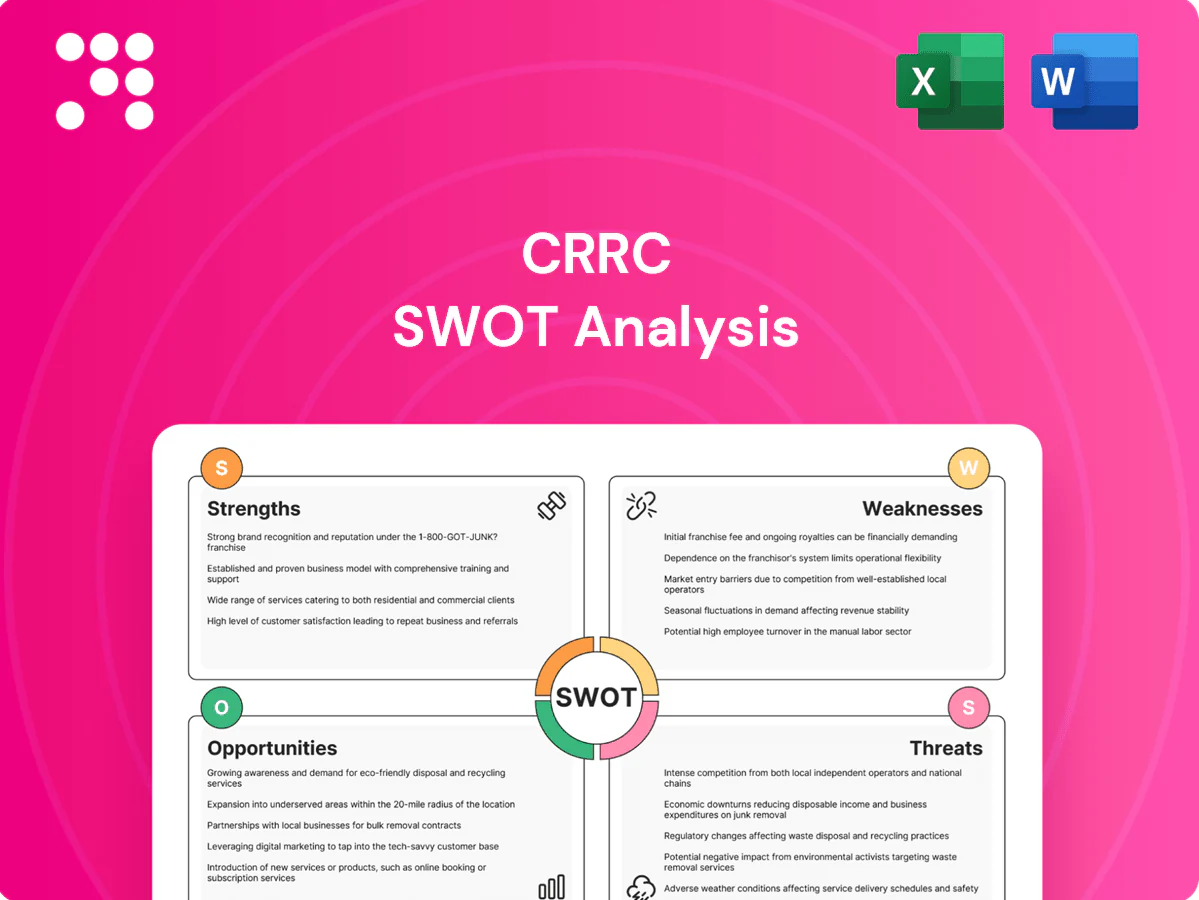
CRRC SWOT Analysis

Your Strategic Toolkit Starts Here
CRRC’s SWOT outlines a dominant market position in rail manufacturing, clear tech and global reach, but exposes margin pressures and geopolitical risks. Want the full story behind strengths, risks, and growth drivers? Purchase the complete SWOT analysis to get a professionally written, editable report with Word and Excel deliverables.
Strengths

Scale leadership
As the world’s largest rail rolling-stock supplier, CRRC leverages unmatched scale—more than 180,000 employees and annual revenues exceeding RMB 200 billion—delivering superior purchasing power and lower unit costs. Scale enables competitive pricing in global tenders and rapid delivery on mega-projects, while diversified operations across 100+ export markets and broad product lines smooth revenue volatility.
Comprehensive portfolio
CRRC supplies locomotives, freight wagons, passenger coaches, high-speed trainsets and urban transit vehicles end-to-end, enabling integrated system solutions and cross-selling across product lines. With over 90% domestic market share and exports to 100+ countries, customers can standardize procurement and maintenance with a single partner, reducing dependency on any one segment’s cycle.

Technology depth
CRRCs deep expertise in high-speed rail and urban transit systems underpins vehicle performance and reliability, supporting deployments across more than 100 countries and regions. Ongoing R&D and localized engineering efforts drive platform upgrades and adaptation to local standards. Proprietary designs and systems integration reduce lifecycle costs and strengthen bids for complex turnkey projects.

Aftermarket services
Aftermarket services — maintenance, refurbishment and upgrades — generate recurring, higher-margin revenue that improves CRRCs profitability and buffers cyclicality in new rolling-stock orders. Lifecycle support strengthens customer stickiness and extends asset life, reducing total cost of ownership for operators. Service-operation data feeds design improvements, accelerating iterative product upgrades and lowering warranty costs.
- Recurring higher-margin revenue
- Extended asset life & customer stickiness
- Service data → product improvements
- Buffers new-order cyclicality
State backing
As a state-owned enterprise controlled by SASAC, CRRC benefits from policy support, access to policy-bank financing and diplomatic channels that de-risk large export contracts and long lead-time projects; CRRC holds over 90% share of China’s rolling-stock market, reinforcing credibility with emerging-market partners and steady domestic demand tied to national rail initiatives.
- State control: SASAC-backed
- Domestic share: >90% rolling-stock market
- Financing: access to policy banks and export credit
State-owned rail leader: 180,000+ employees, >RMB 200bn revenue, exports to 100+ countries
CRRC’s unmatched scale—>180,000 employees and annual revenues >RMB 200bn—drives purchasing power, lower unit costs and competitive pricing on global tenders. Broad product scope (locomotives to urban transit) and >90% domestic share plus exports to 100+ countries enable cross-selling and revenue diversification. Aftermarket services and SASAC backing provide recurring higher-margin revenue and financing/diplomatic support for large exports.
| Metric | Value |
|---|---|
| Employees | >180,000 |
| Annual revenue | >RMB 200bn |
| Domestic market share | >90% |
| Export markets | 100+ |
| SASAC control | Yes |
What is included in the product
 Detailed Word Document
Provides a concise strategic overview of CRRC’s internal strengths and weaknesses and external opportunities and threats. Assesses the company’s competitive position, market drivers, operational challenges, and key risks shaping future growth.

 Customizable Excel Spreadsheet
Provides a concise CRRC SWOT matrix for fast, visual strategy alignment across rail-sector stakeholders. Editable format allows quick updates to reflect shifting market, regulatory, and supply-chain risks.
Weaknesses

China demand reliance
CRRC remains heavily exposed to domestic rail cycles, with China operating about 40,000 km of high-speed rail, so national infrastructure spending materially drives its order intake. A slowdown in China’s infrastructure capex can quickly pressure factory utilization and margins. Overexposure reduces resilience to regional shocks, while diversification abroad faces geopolitics and differing technical standards that slow overseas revenue growth.
Margin pressure
Price-sensitive tenders and intense competition have compressed CRRCs gross margins to the low-teens in recent years, while large turnkey projects expose the company to fixed-price risk and warranty claims that can further erode profitability; long build cycles and warranty provisions make working capital cyclical, with receivables and inventories often tying up several months of cash flow.

Perceived political risk
State ownership exposes CRRC to heightened political scrutiny that has led to procurement restrictions in North America and parts of Europe, with approval processes commonly extending 6–24 months and raising bid costs. These delays inflate project timelines and can deter buyers facing tight delivery windows. Reputation spillover has influenced allied countries’ procurement decisions, narrowing access to some Western markets.

Standardization complexity
Serving over 100 countries requires multiple certifications (EN, UIC, AAR) and significant localization, forcing CRRC into varied engineering and regulatory paths. Managing diverse standards raises supply-chain complexity, often slowing delivery and increasing costs versus local incumbents. Sustaining platform commonality across more than 20 overseas plants is progressively harder, reducing scale advantages.
- Markets: over 100 countries served
- Overseas footprint: 20+ manufacturing bases
- Standards: EN, UIC, AAR diversity increases costs
Bureaucratic inertia
Bureaucratic inertia in CRRC, a state-owned rolling-stock leader with over 100,000 employees, slows agile decision-making across its large SOE structure, hampering rapid product iterations and risking falling behind fast-moving digital and propulsion trends. Coordination across many subsidiaries often creates silos, reducing responsiveness to customer-specific innovations and bespoke orders.
- Large SOE structure impedes agility
- Slower iterations risk trailing digital/propulsion trends
- Subsidiary coordination creates silos
- Reduced responsiveness to customer-specific innovations
China rolling stock giant faces revenue swings, low margins, slow approvals and high costs
CRRC is highly tied to China’s rail cycle (China ~40,000 km HSR), making revenue volatile if domestic capex slows; gross margins compressed to low‑teens (≈11–13%) by price competition and turnkey risks. State ownership and export scrutiny lengthen approvals (6–24 months) and limit Western access, while 20+ overseas plants and 100,000+ staff hamper agility and raise localization costs.
| Metric | Value |
|---|---|
| HSR network (China) | ≈40,000 km |
| Gross margin | ≈11–13% |
| Employees | >100,000 |
| Overseas plants | 20+ |
| Countries served | 100+ |
Preview Before You Purchase
CRRC SWOT Analysis
This is the actual CRRC SWOT analysis document you’ll receive upon purchase—no surprises, just professional quality. The preview below is taken directly from the full report you'll get. Purchase unlocks the complete, editable version with in-depth strengths, weaknesses, opportunities, and threats.

Your Strategic Toolkit Starts Here
CRRC’s SWOT outlines a dominant market position in rail manufacturing, clear tech and global reach, but exposes margin pressures and geopolitical risks. Want the full story behind strengths, risks, and growth drivers? Purchase the complete SWOT analysis to get a professionally written, editable report with Word and Excel deliverables.
Strengths
Scale leadership
As the world’s largest rail rolling-stock supplier, CRRC leverages unmatched scale—more than 180,000 employees and annual revenues exceeding RMB 200 billion—delivering superior purchasing power and lower unit costs. Scale enables competitive pricing in global tenders and rapid delivery on mega-projects, while diversified operations across 100+ export markets and broad product lines smooth revenue volatility.
Comprehensive portfolio
CRRC supplies locomotives, freight wagons, passenger coaches, high-speed trainsets and urban transit vehicles end-to-end, enabling integrated system solutions and cross-selling across product lines. With over 90% domestic market share and exports to 100+ countries, customers can standardize procurement and maintenance with a single partner, reducing dependency on any one segment’s cycle.
Technology depth
CRRCs deep expertise in high-speed rail and urban transit systems underpins vehicle performance and reliability, supporting deployments across more than 100 countries and regions. Ongoing R&D and localized engineering efforts drive platform upgrades and adaptation to local standards. Proprietary designs and systems integration reduce lifecycle costs and strengthen bids for complex turnkey projects.
Aftermarket services
Aftermarket services — maintenance, refurbishment and upgrades — generate recurring, higher-margin revenue that improves CRRCs profitability and buffers cyclicality in new rolling-stock orders. Lifecycle support strengthens customer stickiness and extends asset life, reducing total cost of ownership for operators. Service-operation data feeds design improvements, accelerating iterative product upgrades and lowering warranty costs.
- Recurring higher-margin revenue
- Extended asset life & customer stickiness
- Service data → product improvements
- Buffers new-order cyclicality
State backing
As a state-owned enterprise controlled by SASAC, CRRC benefits from policy support, access to policy-bank financing and diplomatic channels that de-risk large export contracts and long lead-time projects; CRRC holds over 90% share of China’s rolling-stock market, reinforcing credibility with emerging-market partners and steady domestic demand tied to national rail initiatives.
- State control: SASAC-backed
- Domestic share: >90% rolling-stock market
- Financing: access to policy banks and export credit
State-owned rail leader: 180,000+ employees, >RMB 200bn revenue, exports to 100+ countries
CRRC’s unmatched scale—>180,000 employees and annual revenues >RMB 200bn—drives purchasing power, lower unit costs and competitive pricing on global tenders. Broad product scope (locomotives to urban transit) and >90% domestic share plus exports to 100+ countries enable cross-selling and revenue diversification. Aftermarket services and SASAC backing provide recurring higher-margin revenue and financing/diplomatic support for large exports.
| Metric | Value |
|---|---|
| Employees | >180,000 |
| Annual revenue | >RMB 200bn |
| Domestic market share | >90% |
| Export markets | 100+ |
| SASAC control | Yes |
What is included in the product
Detailed Word Document
Provides a concise strategic overview of CRRC’s internal strengths and weaknesses and external opportunities and threats. Assesses the company’s competitive position, market drivers, operational challenges, and key risks shaping future growth.
Customizable Excel Spreadsheet
Provides a concise CRRC SWOT matrix for fast, visual strategy alignment across rail-sector stakeholders. Editable format allows quick updates to reflect shifting market, regulatory, and supply-chain risks.
Weaknesses
China demand reliance
CRRC remains heavily exposed to domestic rail cycles, with China operating about 40,000 km of high-speed rail, so national infrastructure spending materially drives its order intake. A slowdown in China’s infrastructure capex can quickly pressure factory utilization and margins. Overexposure reduces resilience to regional shocks, while diversification abroad faces geopolitics and differing technical standards that slow overseas revenue growth.
Margin pressure
Price-sensitive tenders and intense competition have compressed CRRCs gross margins to the low-teens in recent years, while large turnkey projects expose the company to fixed-price risk and warranty claims that can further erode profitability; long build cycles and warranty provisions make working capital cyclical, with receivables and inventories often tying up several months of cash flow.
Perceived political risk
State ownership exposes CRRC to heightened political scrutiny that has led to procurement restrictions in North America and parts of Europe, with approval processes commonly extending 6–24 months and raising bid costs. These delays inflate project timelines and can deter buyers facing tight delivery windows. Reputation spillover has influenced allied countries’ procurement decisions, narrowing access to some Western markets.
Standardization complexity
Serving over 100 countries requires multiple certifications (EN, UIC, AAR) and significant localization, forcing CRRC into varied engineering and regulatory paths. Managing diverse standards raises supply-chain complexity, often slowing delivery and increasing costs versus local incumbents. Sustaining platform commonality across more than 20 overseas plants is progressively harder, reducing scale advantages.
- Markets: over 100 countries served
- Overseas footprint: 20+ manufacturing bases
- Standards: EN, UIC, AAR diversity increases costs
Bureaucratic inertia
Bureaucratic inertia in CRRC, a state-owned rolling-stock leader with over 100,000 employees, slows agile decision-making across its large SOE structure, hampering rapid product iterations and risking falling behind fast-moving digital and propulsion trends. Coordination across many subsidiaries often creates silos, reducing responsiveness to customer-specific innovations and bespoke orders.
- Large SOE structure impedes agility
- Slower iterations risk trailing digital/propulsion trends
- Subsidiary coordination creates silos
- Reduced responsiveness to customer-specific innovations
China rolling stock giant faces revenue swings, low margins, slow approvals and high costs
CRRC is highly tied to China’s rail cycle (China ~40,000 km HSR), making revenue volatile if domestic capex slows; gross margins compressed to low‑teens (≈11–13%) by price competition and turnkey risks. State ownership and export scrutiny lengthen approvals (6–24 months) and limit Western access, while 20+ overseas plants and 100,000+ staff hamper agility and raise localization costs.
| Metric | Value |
|---|---|
| HSR network (China) | ≈40,000 km |
| Gross margin | ≈11–13% |
| Employees | >100,000 |
| Overseas plants | 20+ |
| Countries served | 100+ |
Preview Before You Purchase
CRRC SWOT Analysis
This is the actual CRRC SWOT analysis document you’ll receive upon purchase—no surprises, just professional quality. The preview below is taken directly from the full report you'll get. Purchase unlocks the complete, editable version with in-depth strengths, weaknesses, opportunities, and threats.
Description
Your Strategic Toolkit Starts Here
CRRC’s SWOT outlines a dominant market position in rail manufacturing, clear tech and global reach, but exposes margin pressures and geopolitical risks. Want the full story behind strengths, risks, and growth drivers? Purchase the complete SWOT analysis to get a professionally written, editable report with Word and Excel deliverables.
Strengths
Scale leadership
As the world’s largest rail rolling-stock supplier, CRRC leverages unmatched scale—more than 180,000 employees and annual revenues exceeding RMB 200 billion—delivering superior purchasing power and lower unit costs. Scale enables competitive pricing in global tenders and rapid delivery on mega-projects, while diversified operations across 100+ export markets and broad product lines smooth revenue volatility.
Comprehensive portfolio
CRRC supplies locomotives, freight wagons, passenger coaches, high-speed trainsets and urban transit vehicles end-to-end, enabling integrated system solutions and cross-selling across product lines. With over 90% domestic market share and exports to 100+ countries, customers can standardize procurement and maintenance with a single partner, reducing dependency on any one segment’s cycle.
Technology depth
CRRCs deep expertise in high-speed rail and urban transit systems underpins vehicle performance and reliability, supporting deployments across more than 100 countries and regions. Ongoing R&D and localized engineering efforts drive platform upgrades and adaptation to local standards. Proprietary designs and systems integration reduce lifecycle costs and strengthen bids for complex turnkey projects.
Aftermarket services
Aftermarket services — maintenance, refurbishment and upgrades — generate recurring, higher-margin revenue that improves CRRCs profitability and buffers cyclicality in new rolling-stock orders. Lifecycle support strengthens customer stickiness and extends asset life, reducing total cost of ownership for operators. Service-operation data feeds design improvements, accelerating iterative product upgrades and lowering warranty costs.
- Recurring higher-margin revenue
- Extended asset life & customer stickiness
- Service data → product improvements
- Buffers new-order cyclicality
State backing
As a state-owned enterprise controlled by SASAC, CRRC benefits from policy support, access to policy-bank financing and diplomatic channels that de-risk large export contracts and long lead-time projects; CRRC holds over 90% share of China’s rolling-stock market, reinforcing credibility with emerging-market partners and steady domestic demand tied to national rail initiatives.
- State control: SASAC-backed
- Domestic share: >90% rolling-stock market
- Financing: access to policy banks and export credit
State-owned rail leader: 180,000+ employees, >RMB 200bn revenue, exports to 100+ countries
CRRC’s unmatched scale—>180,000 employees and annual revenues >RMB 200bn—drives purchasing power, lower unit costs and competitive pricing on global tenders. Broad product scope (locomotives to urban transit) and >90% domestic share plus exports to 100+ countries enable cross-selling and revenue diversification. Aftermarket services and SASAC backing provide recurring higher-margin revenue and financing/diplomatic support for large exports.
| Metric | Value |
|---|---|
| Employees | >180,000 |
| Annual revenue | >RMB 200bn |
| Domestic market share | >90% |
| Export markets | 100+ |
| SASAC control | Yes |
What is included in the product
Detailed Word Document
Provides a concise strategic overview of CRRC’s internal strengths and weaknesses and external opportunities and threats. Assesses the company’s competitive position, market drivers, operational challenges, and key risks shaping future growth.
Customizable Excel Spreadsheet
Provides a concise CRRC SWOT matrix for fast, visual strategy alignment across rail-sector stakeholders. Editable format allows quick updates to reflect shifting market, regulatory, and supply-chain risks.
Weaknesses
China demand reliance
CRRC remains heavily exposed to domestic rail cycles, with China operating about 40,000 km of high-speed rail, so national infrastructure spending materially drives its order intake. A slowdown in China’s infrastructure capex can quickly pressure factory utilization and margins. Overexposure reduces resilience to regional shocks, while diversification abroad faces geopolitics and differing technical standards that slow overseas revenue growth.
Margin pressure
Price-sensitive tenders and intense competition have compressed CRRCs gross margins to the low-teens in recent years, while large turnkey projects expose the company to fixed-price risk and warranty claims that can further erode profitability; long build cycles and warranty provisions make working capital cyclical, with receivables and inventories often tying up several months of cash flow.
Perceived political risk
State ownership exposes CRRC to heightened political scrutiny that has led to procurement restrictions in North America and parts of Europe, with approval processes commonly extending 6–24 months and raising bid costs. These delays inflate project timelines and can deter buyers facing tight delivery windows. Reputation spillover has influenced allied countries’ procurement decisions, narrowing access to some Western markets.
Standardization complexity
Serving over 100 countries requires multiple certifications (EN, UIC, AAR) and significant localization, forcing CRRC into varied engineering and regulatory paths. Managing diverse standards raises supply-chain complexity, often slowing delivery and increasing costs versus local incumbents. Sustaining platform commonality across more than 20 overseas plants is progressively harder, reducing scale advantages.
- Markets: over 100 countries served
- Overseas footprint: 20+ manufacturing bases
- Standards: EN, UIC, AAR diversity increases costs
Bureaucratic inertia
Bureaucratic inertia in CRRC, a state-owned rolling-stock leader with over 100,000 employees, slows agile decision-making across its large SOE structure, hampering rapid product iterations and risking falling behind fast-moving digital and propulsion trends. Coordination across many subsidiaries often creates silos, reducing responsiveness to customer-specific innovations and bespoke orders.
- Large SOE structure impedes agility
- Slower iterations risk trailing digital/propulsion trends
- Subsidiary coordination creates silos
- Reduced responsiveness to customer-specific innovations
China rolling stock giant faces revenue swings, low margins, slow approvals and high costs
CRRC is highly tied to China’s rail cycle (China ~40,000 km HSR), making revenue volatile if domestic capex slows; gross margins compressed to low‑teens (≈11–13%) by price competition and turnkey risks. State ownership and export scrutiny lengthen approvals (6–24 months) and limit Western access, while 20+ overseas plants and 100,000+ staff hamper agility and raise localization costs.
| Metric | Value |
|---|---|
| HSR network (China) | ≈40,000 km |
| Gross margin | ≈11–13% |
| Employees | >100,000 |
| Overseas plants | 20+ |
| Countries served | 100+ |
Preview Before You Purchase
CRRC SWOT Analysis
This is the actual CRRC SWOT analysis document you’ll receive upon purchase—no surprises, just professional quality. The preview below is taken directly from the full report you'll get. Purchase unlocks the complete, editable version with in-depth strengths, weaknesses, opportunities, and threats.











