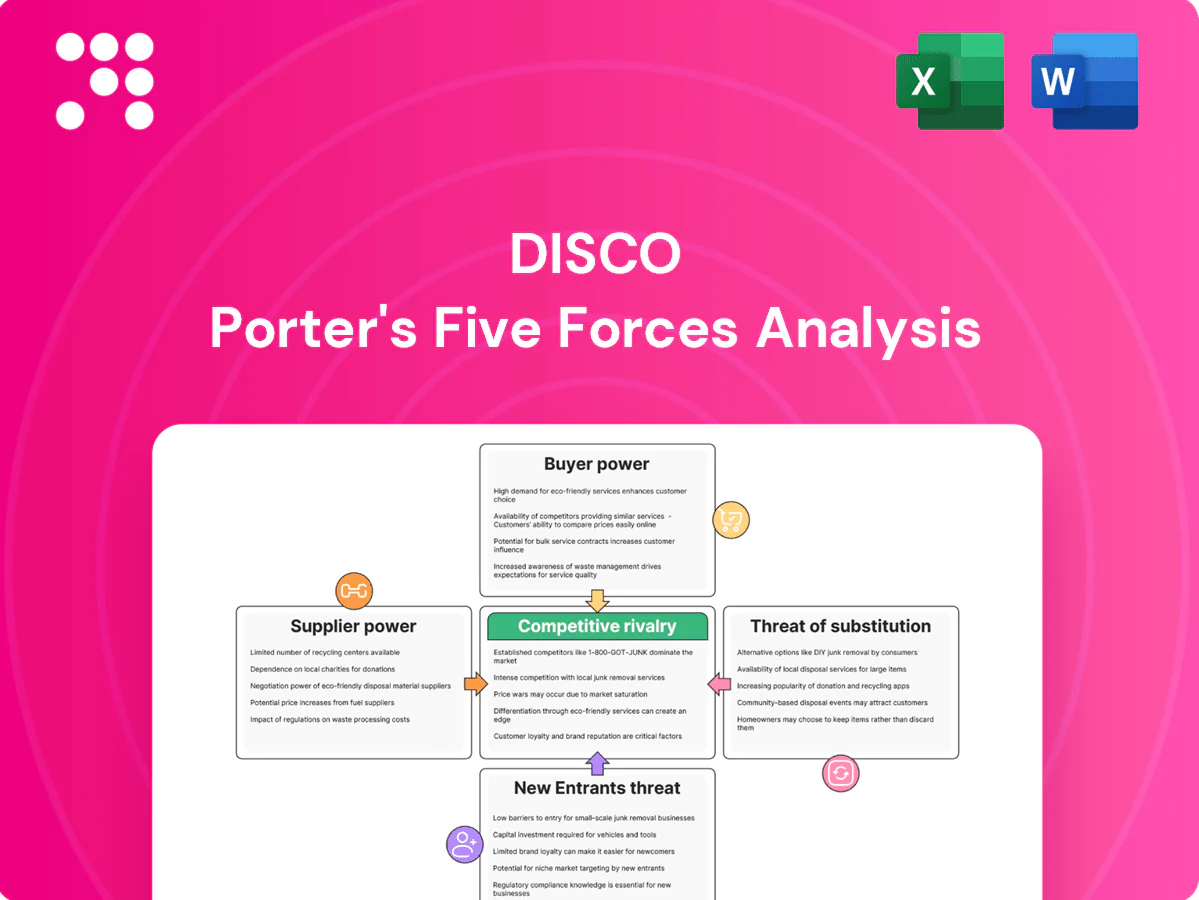
DISCO Porter's Five Forces Analysis

From Overview to Strategy Blueprint
This snapshot highlights DISCO’s key competitive pressures—supplier dynamics, buyer leverage, substitute risks, rivalry intensity, and entry barriers—and how they shape strategic choices. It surfaces high-level implications for pricing, innovation, and M&A strategy. Unlock the full Porter's Five Forces Analysis for force-by-force ratings, visuals, and actionable recommendations tailored to DISCO.
Suppliers Bargaining Power

Cloud infrastructure dependence
DISCO depends on hyperscalers (AWS ~32%, Azure ~22%, GCP ~10% global 2024 share), concentrating supplier influence; reserved-instance/savings-plan discounts (up to ~72%) and egress charges (AWS outbound ~$0.09/GB tiered) materially affect margins, while outages or policy changes directly impact DISCO’s SLAs; multi-cloud and optimization reduce but do not remove vendor leverage.
AI compute and tooling costs
Training and inference require GPUs and specialized tooling, giving chipmakers and AI platforms outsized pricing power; Nvidia held roughly 80% of the data-center GPU market in 2024, concentrating supplier leverage. Capacity scarcity in 2023–24 produced multi-month lead times for H100-class cards, delaying roadmaps. Long-term contracts with cloud and chip vendors reduce spot volatility but lock in terms. Parameter-efficient architectures and PEFT can cut fine-tuning compute by over 90%, partially mitigating exposure.

Data and software licensing
Third-party OCR, NLP and analytics libraries impose royalties and compliance constraints that can inflate unit economics; global enterprise AI software spending rose about 20% in 2024, amplifying supplier leverage. Licensing model shifts have triggered sudden per-seat cost jumps for vendors. Heavy use of open-source (widely adopted in 2024) reduces vendor dependence but increases maintenance and security overhead. Negotiating portfolio or enterprise licenses can materially lower per-seat fees.

Security and compliance vendors
Security and compliance vendors supplying certifications, key management, and monitoring—SOC 2, ISO 27001, FedRAMP—are niche and critical to win regulated clients, giving them strong leverage; FedRAMP lists over 300 authorized cloud services as of 2024. High technical switching costs and risk of compliance lapses make security-stack changes costly, while volume commitments and deep integrations create contractual stickiness on supplier terms.
- High leverage: niche certifications (SOC 2/ISO/FedRAMP)
- Stickiness: integrations + volume commitments
- Switching cost: costly and risky, raises supplier power
Specialized talent as a supplier
Senior ML engineers and legal-tech experts are a constrained supply; Levels.fyi 2024 shows median senior ML base pay ~180k–220k and top US total comp >300k, pressuring offers.
Wage inflation and retention bonuses raise input costs; remote hiring expands pools but intensifies global competition for talent.
Equity incentives reduce cash burn but typical option pools of 10–15% dilute ownership over funding rounds.
- Supply tight: senior ML pay ~180k–220k (2024)
- Retention/remote ↑ competition
- Equity pools 10–15% dilute founders
Hyperscaler and Nvidia dominance squeeze margins; multi-cloud, PEFT partly mitigate
DISCO faces concentrated supplier power: hyperscalers (AWS ~32% Azure ~22% GCP ~10% 2024), Nvidia ~80% DC GPU share (2024), reserved discounts up to ~72% and AWS egress ~$0.09/GB hit margins; security/fedRAMP (300+ services 2024) and senior ML pay (median 180k–220k 2024) create stickiness and cost pressure; multi-cloud, PEFT and long-term contracts partially mitigate vendor leverage.
| Metric | 2024 |
|---|---|
| AWS/Azure/GCP share | 32%/22%/10% |
| Nvidia DC GPU | ~80% |
| Reserved discounts | up to ~72% |
| AWS egress | ~$0.09/GB |
| FedRAMP services | 300+ |
| Senior ML pay | $180k–$220k |
What is included in the product
 Detailed Word Document
Tailored Porter's Five Forces analysis for DISCO that uncovers key drivers of competition, buyer and supplier power, substitutes, new‑entrant risks and industry rivalry, highlighting disruptive threats and strategic levers to protect market share and pricing power.

 Customizable Excel Spreadsheet
DISCO Porter's Five Forces gives a one-sheet, customizable snapshot of competitive pressure—complete with an instant spider chart and clean layout—so teams can quickly assess threats and opportunities without macros or heavy setup.
Customers Bargaining Power

Consolidated enterprise buyers
Consolidated buyers such as Am Law 100 firms, Fortune 1000 legal departments and large agencies buy at scale and routinely run competitive RFPs, extracting volume discounts and custom contracting terms. These customers’ purchasing power forces vendors to offer lower margins and bespoke SLAs. Losing a single large account can materially raise ARR concentration risk. Strong referenceability from one enterprise shapes pricing in adjacent deals.
Procurement rigor and audits
Legal ops teams now demand clear ROI, tight security posture evidence and lower TCO, driving 2024 enterprise procurement cycles to lengthen; surveys show median enterprise SaaS renewal rates near 90% in 2024, raising stakes on proof of value. Detailed pilots and PoV increase buyer leverage and benchmarking against incumbents narrows pricing corridors, while renewal audits often cut upsell runway by compressing feature add-on arguments.

Switching costs vs. portability
Data migration, reviewer retraining, and workflow rebuilds create tangible friction that tempers buyer power in DISCO’s market; a 2024 legal-tech survey found 54% of firms cite migration complexity as a major barrier to switching. Open formats and export features partially lower barriers, enabling buyers to extract concessions and negotiate discounts or favorable terms. Buyers routinely exploit this duality in negotiations, while strong onboarding, implementation services, and SLAs can reshape perceived risk and reduce churn.

Outcome and SLA expectations
Clients demand faster review speeds, lower error rates, and defensible results; strict SLAs with penalties and indemnities shift operational and financial risk onto DISCO, increasing cost of service delivery. Performance transparency via dashboards elevates accountability at renewal and underperformance often triggers repricing or displacement of tools.
- Outcome-focused SLAs
- Risk transfer via penalties
- Renewal tied to metrics
- Underperformance → repricing/displacement
Bundling and multi-vendor strategies
Many buyers maintain panels of tools to hedge risk and pricing, allocating volume by matter type and cost, which raises churn risk and price sensitivity; deep integrations and workflow embedding can capture a larger share of wallet and reduce switching. In 2024 this dynamic intensified as buyers demanded modular, integrated stacks, pressuring standalone pricing. Vendors that secure integrations see higher retention and wallet share.
- Panel sourcing increases churn risk
- Volume allocation tied to matter type/cost
- Price sensitivity rises with multi-vendor use
- Deep integrations boost share of wallet
Consolidated buyers raise ARR concentration risk; renewals ~90% and 54% cite migration friction
Consolidated buyers (Am Law 100, Fortune 1000 legal ops) extract discounts, bespoke SLAs and lengthen procurement cycles, raising ARR concentration risk. Buyers demand ROI, security evidence and lower TCO; 2024 enterprise SaaS renewal rates ~90%, increasing renewal stakes. Migration friction tempers switching—54% of firms cite migration complexity as a major barrier (2024).
| Metric | Value (2024) |
|---|---|
| Enterprise SaaS renewal rate | ~90% |
| Firms citing migration as major barrier | 54% |
What You See Is What You Get
DISCO Porter's Five Forces Analysis
This preview shows the exact DISCO Porter's Five Forces analysis you'll receive immediately after purchase—no placeholders or mockups. It contains a full assessment of competitive rivalry, supplier and buyer power, threat of substitutes, and barriers to entry, professionally formatted and ready to use. You’ll get instant access to this identical file upon payment.

From Overview to Strategy Blueprint
This snapshot highlights DISCO’s key competitive pressures—supplier dynamics, buyer leverage, substitute risks, rivalry intensity, and entry barriers—and how they shape strategic choices. It surfaces high-level implications for pricing, innovation, and M&A strategy. Unlock the full Porter's Five Forces Analysis for force-by-force ratings, visuals, and actionable recommendations tailored to DISCO.
Suppliers Bargaining Power
Cloud infrastructure dependence
DISCO depends on hyperscalers (AWS ~32%, Azure ~22%, GCP ~10% global 2024 share), concentrating supplier influence; reserved-instance/savings-plan discounts (up to ~72%) and egress charges (AWS outbound ~$0.09/GB tiered) materially affect margins, while outages or policy changes directly impact DISCO’s SLAs; multi-cloud and optimization reduce but do not remove vendor leverage.
AI compute and tooling costs
Training and inference require GPUs and specialized tooling, giving chipmakers and AI platforms outsized pricing power; Nvidia held roughly 80% of the data-center GPU market in 2024, concentrating supplier leverage. Capacity scarcity in 2023–24 produced multi-month lead times for H100-class cards, delaying roadmaps. Long-term contracts with cloud and chip vendors reduce spot volatility but lock in terms. Parameter-efficient architectures and PEFT can cut fine-tuning compute by over 90%, partially mitigating exposure.
Data and software licensing
Third-party OCR, NLP and analytics libraries impose royalties and compliance constraints that can inflate unit economics; global enterprise AI software spending rose about 20% in 2024, amplifying supplier leverage. Licensing model shifts have triggered sudden per-seat cost jumps for vendors. Heavy use of open-source (widely adopted in 2024) reduces vendor dependence but increases maintenance and security overhead. Negotiating portfolio or enterprise licenses can materially lower per-seat fees.
Security and compliance vendors
Security and compliance vendors supplying certifications, key management, and monitoring—SOC 2, ISO 27001, FedRAMP—are niche and critical to win regulated clients, giving them strong leverage; FedRAMP lists over 300 authorized cloud services as of 2024. High technical switching costs and risk of compliance lapses make security-stack changes costly, while volume commitments and deep integrations create contractual stickiness on supplier terms.
- High leverage: niche certifications (SOC 2/ISO/FedRAMP)
- Stickiness: integrations + volume commitments
- Switching cost: costly and risky, raises supplier power
Specialized talent as a supplier
Senior ML engineers and legal-tech experts are a constrained supply; Levels.fyi 2024 shows median senior ML base pay ~180k–220k and top US total comp >300k, pressuring offers.
Wage inflation and retention bonuses raise input costs; remote hiring expands pools but intensifies global competition for talent.
Equity incentives reduce cash burn but typical option pools of 10–15% dilute ownership over funding rounds.
- Supply tight: senior ML pay ~180k–220k (2024)
- Retention/remote ↑ competition
- Equity pools 10–15% dilute founders
Hyperscaler and Nvidia dominance squeeze margins; multi-cloud, PEFT partly mitigate
DISCO faces concentrated supplier power: hyperscalers (AWS ~32% Azure ~22% GCP ~10% 2024), Nvidia ~80% DC GPU share (2024), reserved discounts up to ~72% and AWS egress ~$0.09/GB hit margins; security/fedRAMP (300+ services 2024) and senior ML pay (median 180k–220k 2024) create stickiness and cost pressure; multi-cloud, PEFT and long-term contracts partially mitigate vendor leverage.
| Metric | 2024 |
|---|---|
| AWS/Azure/GCP share | 32%/22%/10% |
| Nvidia DC GPU | ~80% |
| Reserved discounts | up to ~72% |
| AWS egress | ~$0.09/GB |
| FedRAMP services | 300+ |
| Senior ML pay | $180k–$220k |
What is included in the product
Detailed Word Document
Tailored Porter's Five Forces analysis for DISCO that uncovers key drivers of competition, buyer and supplier power, substitutes, new‑entrant risks and industry rivalry, highlighting disruptive threats and strategic levers to protect market share and pricing power.
Customizable Excel Spreadsheet
DISCO Porter's Five Forces gives a one-sheet, customizable snapshot of competitive pressure—complete with an instant spider chart and clean layout—so teams can quickly assess threats and opportunities without macros or heavy setup.
Customers Bargaining Power
Consolidated enterprise buyers
Consolidated buyers such as Am Law 100 firms, Fortune 1000 legal departments and large agencies buy at scale and routinely run competitive RFPs, extracting volume discounts and custom contracting terms. These customers’ purchasing power forces vendors to offer lower margins and bespoke SLAs. Losing a single large account can materially raise ARR concentration risk. Strong referenceability from one enterprise shapes pricing in adjacent deals.
Procurement rigor and audits
Legal ops teams now demand clear ROI, tight security posture evidence and lower TCO, driving 2024 enterprise procurement cycles to lengthen; surveys show median enterprise SaaS renewal rates near 90% in 2024, raising stakes on proof of value. Detailed pilots and PoV increase buyer leverage and benchmarking against incumbents narrows pricing corridors, while renewal audits often cut upsell runway by compressing feature add-on arguments.
Switching costs vs. portability
Data migration, reviewer retraining, and workflow rebuilds create tangible friction that tempers buyer power in DISCO’s market; a 2024 legal-tech survey found 54% of firms cite migration complexity as a major barrier to switching. Open formats and export features partially lower barriers, enabling buyers to extract concessions and negotiate discounts or favorable terms. Buyers routinely exploit this duality in negotiations, while strong onboarding, implementation services, and SLAs can reshape perceived risk and reduce churn.
Outcome and SLA expectations
Clients demand faster review speeds, lower error rates, and defensible results; strict SLAs with penalties and indemnities shift operational and financial risk onto DISCO, increasing cost of service delivery. Performance transparency via dashboards elevates accountability at renewal and underperformance often triggers repricing or displacement of tools.
- Outcome-focused SLAs
- Risk transfer via penalties
- Renewal tied to metrics
- Underperformance → repricing/displacement
Bundling and multi-vendor strategies
Many buyers maintain panels of tools to hedge risk and pricing, allocating volume by matter type and cost, which raises churn risk and price sensitivity; deep integrations and workflow embedding can capture a larger share of wallet and reduce switching. In 2024 this dynamic intensified as buyers demanded modular, integrated stacks, pressuring standalone pricing. Vendors that secure integrations see higher retention and wallet share.
- Panel sourcing increases churn risk
- Volume allocation tied to matter type/cost
- Price sensitivity rises with multi-vendor use
- Deep integrations boost share of wallet
Consolidated buyers raise ARR concentration risk; renewals ~90% and 54% cite migration friction
Consolidated buyers (Am Law 100, Fortune 1000 legal ops) extract discounts, bespoke SLAs and lengthen procurement cycles, raising ARR concentration risk. Buyers demand ROI, security evidence and lower TCO; 2024 enterprise SaaS renewal rates ~90%, increasing renewal stakes. Migration friction tempers switching—54% of firms cite migration complexity as a major barrier (2024).
| Metric | Value (2024) |
|---|---|
| Enterprise SaaS renewal rate | ~90% |
| Firms citing migration as major barrier | 54% |
What You See Is What You Get
DISCO Porter's Five Forces Analysis
This preview shows the exact DISCO Porter's Five Forces analysis you'll receive immediately after purchase—no placeholders or mockups. It contains a full assessment of competitive rivalry, supplier and buyer power, threat of substitutes, and barriers to entry, professionally formatted and ready to use. You’ll get instant access to this identical file upon payment.
Original: $10.00
-65%$10.00
$3.50Description
From Overview to Strategy Blueprint
This snapshot highlights DISCO’s key competitive pressures—supplier dynamics, buyer leverage, substitute risks, rivalry intensity, and entry barriers—and how they shape strategic choices. It surfaces high-level implications for pricing, innovation, and M&A strategy. Unlock the full Porter's Five Forces Analysis for force-by-force ratings, visuals, and actionable recommendations tailored to DISCO.
Suppliers Bargaining Power
Cloud infrastructure dependence
DISCO depends on hyperscalers (AWS ~32%, Azure ~22%, GCP ~10% global 2024 share), concentrating supplier influence; reserved-instance/savings-plan discounts (up to ~72%) and egress charges (AWS outbound ~$0.09/GB tiered) materially affect margins, while outages or policy changes directly impact DISCO’s SLAs; multi-cloud and optimization reduce but do not remove vendor leverage.
AI compute and tooling costs
Training and inference require GPUs and specialized tooling, giving chipmakers and AI platforms outsized pricing power; Nvidia held roughly 80% of the data-center GPU market in 2024, concentrating supplier leverage. Capacity scarcity in 2023–24 produced multi-month lead times for H100-class cards, delaying roadmaps. Long-term contracts with cloud and chip vendors reduce spot volatility but lock in terms. Parameter-efficient architectures and PEFT can cut fine-tuning compute by over 90%, partially mitigating exposure.
Data and software licensing
Third-party OCR, NLP and analytics libraries impose royalties and compliance constraints that can inflate unit economics; global enterprise AI software spending rose about 20% in 2024, amplifying supplier leverage. Licensing model shifts have triggered sudden per-seat cost jumps for vendors. Heavy use of open-source (widely adopted in 2024) reduces vendor dependence but increases maintenance and security overhead. Negotiating portfolio or enterprise licenses can materially lower per-seat fees.
Security and compliance vendors
Security and compliance vendors supplying certifications, key management, and monitoring—SOC 2, ISO 27001, FedRAMP—are niche and critical to win regulated clients, giving them strong leverage; FedRAMP lists over 300 authorized cloud services as of 2024. High technical switching costs and risk of compliance lapses make security-stack changes costly, while volume commitments and deep integrations create contractual stickiness on supplier terms.
- High leverage: niche certifications (SOC 2/ISO/FedRAMP)
- Stickiness: integrations + volume commitments
- Switching cost: costly and risky, raises supplier power
Specialized talent as a supplier
Senior ML engineers and legal-tech experts are a constrained supply; Levels.fyi 2024 shows median senior ML base pay ~180k–220k and top US total comp >300k, pressuring offers.
Wage inflation and retention bonuses raise input costs; remote hiring expands pools but intensifies global competition for talent.
Equity incentives reduce cash burn but typical option pools of 10–15% dilute ownership over funding rounds.
- Supply tight: senior ML pay ~180k–220k (2024)
- Retention/remote ↑ competition
- Equity pools 10–15% dilute founders
Hyperscaler and Nvidia dominance squeeze margins; multi-cloud, PEFT partly mitigate
DISCO faces concentrated supplier power: hyperscalers (AWS ~32% Azure ~22% GCP ~10% 2024), Nvidia ~80% DC GPU share (2024), reserved discounts up to ~72% and AWS egress ~$0.09/GB hit margins; security/fedRAMP (300+ services 2024) and senior ML pay (median 180k–220k 2024) create stickiness and cost pressure; multi-cloud, PEFT and long-term contracts partially mitigate vendor leverage.
| Metric | 2024 |
|---|---|
| AWS/Azure/GCP share | 32%/22%/10% |
| Nvidia DC GPU | ~80% |
| Reserved discounts | up to ~72% |
| AWS egress | ~$0.09/GB |
| FedRAMP services | 300+ |
| Senior ML pay | $180k–$220k |
What is included in the product
Detailed Word Document
Tailored Porter's Five Forces analysis for DISCO that uncovers key drivers of competition, buyer and supplier power, substitutes, new‑entrant risks and industry rivalry, highlighting disruptive threats and strategic levers to protect market share and pricing power.
Customizable Excel Spreadsheet
DISCO Porter's Five Forces gives a one-sheet, customizable snapshot of competitive pressure—complete with an instant spider chart and clean layout—so teams can quickly assess threats and opportunities without macros or heavy setup.
Customers Bargaining Power
Consolidated enterprise buyers
Consolidated buyers such as Am Law 100 firms, Fortune 1000 legal departments and large agencies buy at scale and routinely run competitive RFPs, extracting volume discounts and custom contracting terms. These customers’ purchasing power forces vendors to offer lower margins and bespoke SLAs. Losing a single large account can materially raise ARR concentration risk. Strong referenceability from one enterprise shapes pricing in adjacent deals.
Procurement rigor and audits
Legal ops teams now demand clear ROI, tight security posture evidence and lower TCO, driving 2024 enterprise procurement cycles to lengthen; surveys show median enterprise SaaS renewal rates near 90% in 2024, raising stakes on proof of value. Detailed pilots and PoV increase buyer leverage and benchmarking against incumbents narrows pricing corridors, while renewal audits often cut upsell runway by compressing feature add-on arguments.
Switching costs vs. portability
Data migration, reviewer retraining, and workflow rebuilds create tangible friction that tempers buyer power in DISCO’s market; a 2024 legal-tech survey found 54% of firms cite migration complexity as a major barrier to switching. Open formats and export features partially lower barriers, enabling buyers to extract concessions and negotiate discounts or favorable terms. Buyers routinely exploit this duality in negotiations, while strong onboarding, implementation services, and SLAs can reshape perceived risk and reduce churn.
Outcome and SLA expectations
Clients demand faster review speeds, lower error rates, and defensible results; strict SLAs with penalties and indemnities shift operational and financial risk onto DISCO, increasing cost of service delivery. Performance transparency via dashboards elevates accountability at renewal and underperformance often triggers repricing or displacement of tools.
- Outcome-focused SLAs
- Risk transfer via penalties
- Renewal tied to metrics
- Underperformance → repricing/displacement
Bundling and multi-vendor strategies
Many buyers maintain panels of tools to hedge risk and pricing, allocating volume by matter type and cost, which raises churn risk and price sensitivity; deep integrations and workflow embedding can capture a larger share of wallet and reduce switching. In 2024 this dynamic intensified as buyers demanded modular, integrated stacks, pressuring standalone pricing. Vendors that secure integrations see higher retention and wallet share.
- Panel sourcing increases churn risk
- Volume allocation tied to matter type/cost
- Price sensitivity rises with multi-vendor use
- Deep integrations boost share of wallet
Consolidated buyers raise ARR concentration risk; renewals ~90% and 54% cite migration friction
Consolidated buyers (Am Law 100, Fortune 1000 legal ops) extract discounts, bespoke SLAs and lengthen procurement cycles, raising ARR concentration risk. Buyers demand ROI, security evidence and lower TCO; 2024 enterprise SaaS renewal rates ~90%, increasing renewal stakes. Migration friction tempers switching—54% of firms cite migration complexity as a major barrier (2024).
| Metric | Value (2024) |
|---|---|
| Enterprise SaaS renewal rate | ~90% |
| Firms citing migration as major barrier | 54% |
What You See Is What You Get
DISCO Porter's Five Forces Analysis
This preview shows the exact DISCO Porter's Five Forces analysis you'll receive immediately after purchase—no placeholders or mockups. It contains a full assessment of competitive rivalry, supplier and buyer power, threat of substitutes, and barriers to entry, professionally formatted and ready to use. You’ll get instant access to this identical file upon payment.











