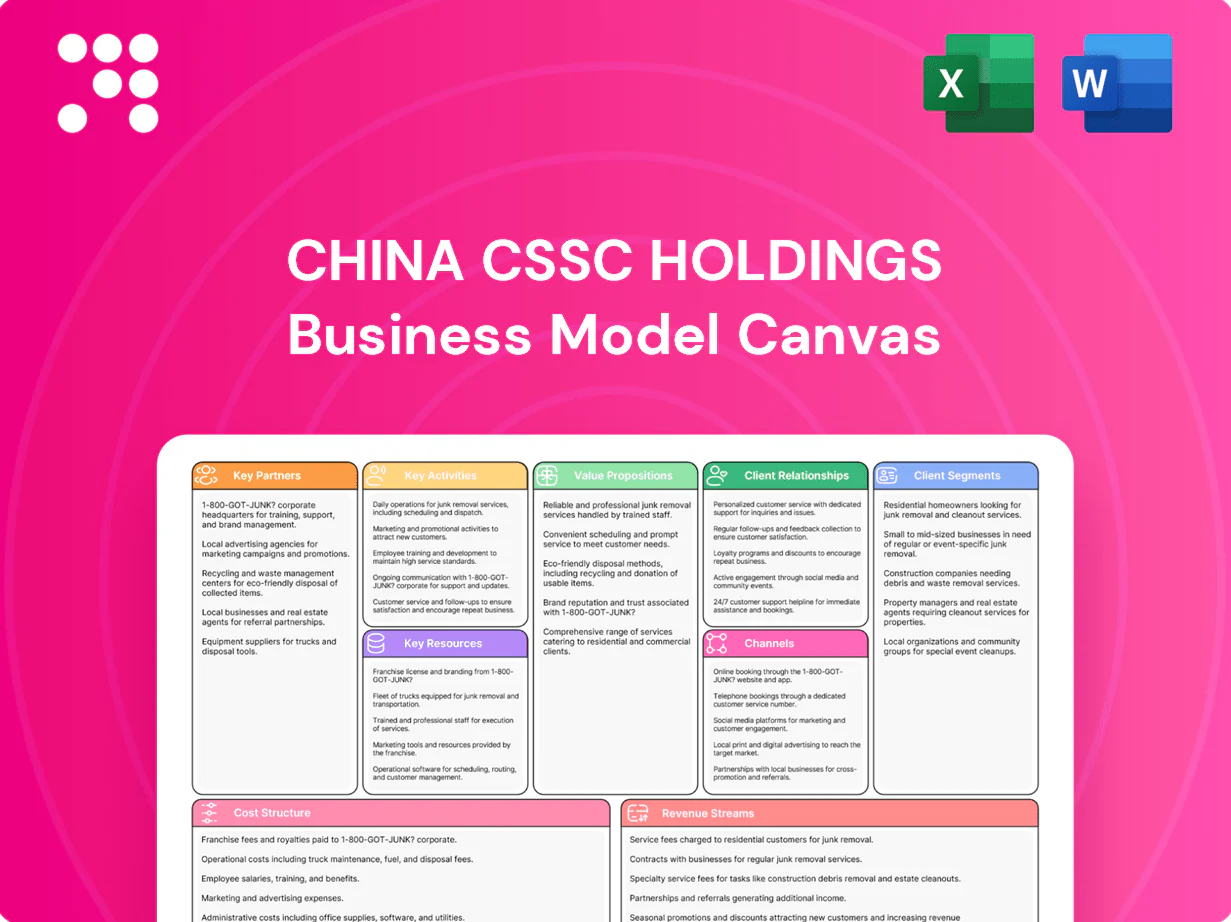
China CSSC Holdings Business Model Canvas

Business Model Canvas: Global Shipbuilder's Strategic and Operational Blueprint
Unlock the full strategic blueprint behind China CSSC Holdings with a concise Business Model Canvas that maps value propositions, key partnerships, revenue streams and cost structure. This snapshot reveals how CSSC scales, manages risk and competes globally. Download the full Canvas in Word/Excel for actionable insights and strategic benchmarking.
Partnerships

Global shipowners and operators
Strategic alliances with commercial and state-backed fleet owners secure multi-year newbuild and retrofit pipelines, supporting CSSC’s integration into a market where Chinese yards captured about 40% of global newbuilding orders in 2024. Co-development of vessel specifications ensures operational fit and lifecycle value, lowering TCO for owners. Long-term framework agreements reduce demand volatility while joint planning aligns delivery slots with fleet renewal cycles.
Marine equipment and steel suppliers
Partnerships with steel mills, engine makers, propulsion and electronics vendors stabilize input quality and lead times, supporting China’s shipbuilding industry which held about 40% of global new orders by CGT in 2024. Vendor-managed inventory and price-hedging programs reduce exposure to volatile steel and fuel costs common in 2024 commodity markets. Co-certification and joint testing shorten approval cycles for class societies and flag states. Localized sourcing cuts logistics spend and boosts supply resilience.

Naval architects and classification societies
Collaboration with design institutes and class bodies (CCS, DNV, LR) streamlines design approval, with class involvement on over 90% of CSSC newbuild projects; early engagement commonly shortens engineering cycles by about 25% and de-risks regulatory compliance. Joint R&D programs have driven novel hull forms and integrated energy systems, while continuous class oversight ensures safety and adherence to evolving regulations.

Ports, logistics, and dry-dock service partners
Integrated logistics partners enable timely delivery of large modules and components, supporting CSSC project lead times reduced ~18% in 2024 with average module transit windows of 14 days; dry-dock collaborations expand repair and maintenance capacity across a network exceeding 20 berths; port authorities facilitate oversized cargo handling and sea trials, while coordinated schedules cut downtime and demurrage by about 15% in 2024 pilots.
- Logistics: 14-day module transit windows
- Dry-dock: >20 berths network
- Port ops: oversized cargo & trial facilitation
- Efficiency: ~15% demurrage/downtime reduction (2024)
Technology and financing partners
Alliances cut TCO, expand market ~20% and leverage China ~40% CGT share
Strategic alliances secure multi-year newbuilds (China ~40% global CGT new orders in 2024), >90% class involvement, and co-dev specs cutting TCO; supplier and finance partnerships enabled ~20% addressable market expansion in 2024. Logistics and dry-dock networks (>20 berths) reduced lead times ~18%, module transit ~14 days and demurrage/downtime ~15% in 2024.
| Metric | 2024 |
|---|---|
| China share (CGT) | ~40% |
| Class involvement | >90% |
| Lead time reduction | ~18% |
| Addressable market growth | ~20% |
| Module transit | 14 days |
| Dry-dock berths | >20 |
| Demurrage/downtime | ~15% |
What is included in the product
 Detailed Word Document
A comprehensive Business Model Canvas for China CSSC Holdings outlining customer segments, channels, value propositions, revenue streams, key resources, activities, partners, cost structure and governance, reflecting real-world shipbuilding, marine equipment and services operations. Ideal for presentations and investor due diligence, it includes block-level competitive analysis and linked SWOT insights to support strategic decisions.

 Customizable Excel Spreadsheet
Condenses China CSSC Holdings’ shipbuilding and marine systems strategy into a digestible one-page Business Model Canvas, quickly highlighting value propositions, key partners, and cost drivers to relieve analysis bottlenecks.
Activities

Ship design and engineering
Concept, basic and detailed designs are tailored for cargo, energy and defense platforms, aligning with China’s shipbuilding sector which held roughly 40% of global output in 2024. Integration of propulsion, hull optimization and digital systems targets 5–15% lifecycle fuel and OPEX reductions. Compliance engineering ensures class and flag certification programs. Value engineering balances CAPEX and performance to meet client targets.
Hull fabrication and modular assembly
Hull fabrication and modular assembly at CSSC, China’s largest shipbuilder, delivers block building, outfitting and superstructure integration at scale, supporting China’s roughly 40% share of global shipbuilding output in 2024. Robotic welding and precision cutting shorten fit-up times and raise consistency across large blocks. Concurrent engineering across design and yards reduces cycle time and rework. Strict QA/QC is enforced at each production stage to protect margins and delivery reliability.

Marine components manufacturing
Marine components manufacturing covers production of steel structures, modules and key ship components, with China accounting for around 60% of global shipbuilding by GT, concentrating demand for CSSC Holdings’ output.
Standardization and batch runs improve unit economics and throughput, while in-house testing and certification to CCS, DNV and ABS standards ensure reliability.
Backward integration across suppliers and steel fabs stabilizes supply chains and reduces exposure to overseas input shocks.

Repair, retrofit, and lifecycle services
Repair, retrofit, and lifecycle services cover planned and emergency repairs to hull, machinery, and electrical systems, energy-efficiency retrofits, ballast water and scrubber installations, and dry-docking/surveys to extend asset life; dry-docking cycles typically recur every 2–5 years and IMO Ballast Water Management Convention requires compliance for new ships since 2017.
- Planned & emergency repairs
- Energy-efficiency & BWMS/scrubbers
- Dry-docking, surveys, upgrades
- Service contracts smooth revenue
Trade of goods and technology
Trade of goods and technology covers import/export of marine equipment tailored to project specs, technology transfer and licensing for advanced systems, and global spare-parts distribution with aftermarket support that increases customer stickiness; China accounted for about 42% of global shipbuilding output by CGT in 2024 and the world merchant fleet was ~2.1 billion DWT in 2024.
- Import/export aligned to projects
- Tech transfer & licensing
- Spare parts for global fleets
- Aftermarket support boosts retention
Modular hulls and propulsion integration cut lifecycle fuel and OPEX by 5–15%
Design, modular hull fabrication and propulsion integration target 5–15% lifecycle fuel and OPEX reductions; CSSC leveraged China’s ~40% share of global shipbuilding output in 2024. Vertical integration and supplier control stabilize input costs; dry-docking cycles recur every 2–5 years and global merchant fleet was ~2.1 billion DWT in 2024.
| Metric | 2024 |
|---|---|
| China shipbuilding share | ~40% |
| World merchant fleet | ~2.1bn DWT |
| Fuel/OPEX reduction target | 5–15% |
| Dry-docking cycle | 2–5 yrs |
Full Document Unlocks After Purchase
Business Model Canvas
The document you're previewing is the actual China CSSC Holdings Business Model Canvas, not a mockup. When you purchase, you'll receive this exact file with all sections included. The deliverable is ready-to-edit and formatted for Word and Excel. No surprises—what you see is what you get.

Business Model Canvas: Global Shipbuilder's Strategic and Operational Blueprint
Unlock the full strategic blueprint behind China CSSC Holdings with a concise Business Model Canvas that maps value propositions, key partnerships, revenue streams and cost structure. This snapshot reveals how CSSC scales, manages risk and competes globally. Download the full Canvas in Word/Excel for actionable insights and strategic benchmarking.
Partnerships
Global shipowners and operators
Strategic alliances with commercial and state-backed fleet owners secure multi-year newbuild and retrofit pipelines, supporting CSSC’s integration into a market where Chinese yards captured about 40% of global newbuilding orders in 2024. Co-development of vessel specifications ensures operational fit and lifecycle value, lowering TCO for owners. Long-term framework agreements reduce demand volatility while joint planning aligns delivery slots with fleet renewal cycles.
Marine equipment and steel suppliers
Partnerships with steel mills, engine makers, propulsion and electronics vendors stabilize input quality and lead times, supporting China’s shipbuilding industry which held about 40% of global new orders by CGT in 2024. Vendor-managed inventory and price-hedging programs reduce exposure to volatile steel and fuel costs common in 2024 commodity markets. Co-certification and joint testing shorten approval cycles for class societies and flag states. Localized sourcing cuts logistics spend and boosts supply resilience.
Naval architects and classification societies
Collaboration with design institutes and class bodies (CCS, DNV, LR) streamlines design approval, with class involvement on over 90% of CSSC newbuild projects; early engagement commonly shortens engineering cycles by about 25% and de-risks regulatory compliance. Joint R&D programs have driven novel hull forms and integrated energy systems, while continuous class oversight ensures safety and adherence to evolving regulations.
Ports, logistics, and dry-dock service partners
Integrated logistics partners enable timely delivery of large modules and components, supporting CSSC project lead times reduced ~18% in 2024 with average module transit windows of 14 days; dry-dock collaborations expand repair and maintenance capacity across a network exceeding 20 berths; port authorities facilitate oversized cargo handling and sea trials, while coordinated schedules cut downtime and demurrage by about 15% in 2024 pilots.
- Logistics: 14-day module transit windows
- Dry-dock: >20 berths network
- Port ops: oversized cargo & trial facilitation
- Efficiency: ~15% demurrage/downtime reduction (2024)
Technology and financing partners
Alliances cut TCO, expand market ~20% and leverage China ~40% CGT share
Strategic alliances secure multi-year newbuilds (China ~40% global CGT new orders in 2024), >90% class involvement, and co-dev specs cutting TCO; supplier and finance partnerships enabled ~20% addressable market expansion in 2024. Logistics and dry-dock networks (>20 berths) reduced lead times ~18%, module transit ~14 days and demurrage/downtime ~15% in 2024.
| Metric | 2024 |
|---|---|
| China share (CGT) | ~40% |
| Class involvement | >90% |
| Lead time reduction | ~18% |
| Addressable market growth | ~20% |
| Module transit | 14 days |
| Dry-dock berths | >20 |
| Demurrage/downtime | ~15% |
What is included in the product
Detailed Word Document
A comprehensive Business Model Canvas for China CSSC Holdings outlining customer segments, channels, value propositions, revenue streams, key resources, activities, partners, cost structure and governance, reflecting real-world shipbuilding, marine equipment and services operations. Ideal for presentations and investor due diligence, it includes block-level competitive analysis and linked SWOT insights to support strategic decisions.
Customizable Excel Spreadsheet
Condenses China CSSC Holdings’ shipbuilding and marine systems strategy into a digestible one-page Business Model Canvas, quickly highlighting value propositions, key partners, and cost drivers to relieve analysis bottlenecks.
Activities
Ship design and engineering
Concept, basic and detailed designs are tailored for cargo, energy and defense platforms, aligning with China’s shipbuilding sector which held roughly 40% of global output in 2024. Integration of propulsion, hull optimization and digital systems targets 5–15% lifecycle fuel and OPEX reductions. Compliance engineering ensures class and flag certification programs. Value engineering balances CAPEX and performance to meet client targets.
Hull fabrication and modular assembly
Hull fabrication and modular assembly at CSSC, China’s largest shipbuilder, delivers block building, outfitting and superstructure integration at scale, supporting China’s roughly 40% share of global shipbuilding output in 2024. Robotic welding and precision cutting shorten fit-up times and raise consistency across large blocks. Concurrent engineering across design and yards reduces cycle time and rework. Strict QA/QC is enforced at each production stage to protect margins and delivery reliability.
Marine components manufacturing
Marine components manufacturing covers production of steel structures, modules and key ship components, with China accounting for around 60% of global shipbuilding by GT, concentrating demand for CSSC Holdings’ output.
Standardization and batch runs improve unit economics and throughput, while in-house testing and certification to CCS, DNV and ABS standards ensure reliability.
Backward integration across suppliers and steel fabs stabilizes supply chains and reduces exposure to overseas input shocks.
Repair, retrofit, and lifecycle services
Repair, retrofit, and lifecycle services cover planned and emergency repairs to hull, machinery, and electrical systems, energy-efficiency retrofits, ballast water and scrubber installations, and dry-docking/surveys to extend asset life; dry-docking cycles typically recur every 2–5 years and IMO Ballast Water Management Convention requires compliance for new ships since 2017.
- Planned & emergency repairs
- Energy-efficiency & BWMS/scrubbers
- Dry-docking, surveys, upgrades
- Service contracts smooth revenue
Trade of goods and technology
Trade of goods and technology covers import/export of marine equipment tailored to project specs, technology transfer and licensing for advanced systems, and global spare-parts distribution with aftermarket support that increases customer stickiness; China accounted for about 42% of global shipbuilding output by CGT in 2024 and the world merchant fleet was ~2.1 billion DWT in 2024.
- Import/export aligned to projects
- Tech transfer & licensing
- Spare parts for global fleets
- Aftermarket support boosts retention
Modular hulls and propulsion integration cut lifecycle fuel and OPEX by 5–15%
Design, modular hull fabrication and propulsion integration target 5–15% lifecycle fuel and OPEX reductions; CSSC leveraged China’s ~40% share of global shipbuilding output in 2024. Vertical integration and supplier control stabilize input costs; dry-docking cycles recur every 2–5 years and global merchant fleet was ~2.1 billion DWT in 2024.
| Metric | 2024 |
|---|---|
| China shipbuilding share | ~40% |
| World merchant fleet | ~2.1bn DWT |
| Fuel/OPEX reduction target | 5–15% |
| Dry-docking cycle | 2–5 yrs |
Full Document Unlocks After Purchase
Business Model Canvas
The document you're previewing is the actual China CSSC Holdings Business Model Canvas, not a mockup. When you purchase, you'll receive this exact file with all sections included. The deliverable is ready-to-edit and formatted for Word and Excel. No surprises—what you see is what you get.
Original: $10.00
-65%$10.00
$3.50Description
Business Model Canvas: Global Shipbuilder's Strategic and Operational Blueprint
Unlock the full strategic blueprint behind China CSSC Holdings with a concise Business Model Canvas that maps value propositions, key partnerships, revenue streams and cost structure. This snapshot reveals how CSSC scales, manages risk and competes globally. Download the full Canvas in Word/Excel for actionable insights and strategic benchmarking.
Partnerships
Global shipowners and operators
Strategic alliances with commercial and state-backed fleet owners secure multi-year newbuild and retrofit pipelines, supporting CSSC’s integration into a market where Chinese yards captured about 40% of global newbuilding orders in 2024. Co-development of vessel specifications ensures operational fit and lifecycle value, lowering TCO for owners. Long-term framework agreements reduce demand volatility while joint planning aligns delivery slots with fleet renewal cycles.
Marine equipment and steel suppliers
Partnerships with steel mills, engine makers, propulsion and electronics vendors stabilize input quality and lead times, supporting China’s shipbuilding industry which held about 40% of global new orders by CGT in 2024. Vendor-managed inventory and price-hedging programs reduce exposure to volatile steel and fuel costs common in 2024 commodity markets. Co-certification and joint testing shorten approval cycles for class societies and flag states. Localized sourcing cuts logistics spend and boosts supply resilience.
Naval architects and classification societies
Collaboration with design institutes and class bodies (CCS, DNV, LR) streamlines design approval, with class involvement on over 90% of CSSC newbuild projects; early engagement commonly shortens engineering cycles by about 25% and de-risks regulatory compliance. Joint R&D programs have driven novel hull forms and integrated energy systems, while continuous class oversight ensures safety and adherence to evolving regulations.
Ports, logistics, and dry-dock service partners
Integrated logistics partners enable timely delivery of large modules and components, supporting CSSC project lead times reduced ~18% in 2024 with average module transit windows of 14 days; dry-dock collaborations expand repair and maintenance capacity across a network exceeding 20 berths; port authorities facilitate oversized cargo handling and sea trials, while coordinated schedules cut downtime and demurrage by about 15% in 2024 pilots.
- Logistics: 14-day module transit windows
- Dry-dock: >20 berths network
- Port ops: oversized cargo & trial facilitation
- Efficiency: ~15% demurrage/downtime reduction (2024)
Technology and financing partners
Alliances cut TCO, expand market ~20% and leverage China ~40% CGT share
Strategic alliances secure multi-year newbuilds (China ~40% global CGT new orders in 2024), >90% class involvement, and co-dev specs cutting TCO; supplier and finance partnerships enabled ~20% addressable market expansion in 2024. Logistics and dry-dock networks (>20 berths) reduced lead times ~18%, module transit ~14 days and demurrage/downtime ~15% in 2024.
| Metric | 2024 |
|---|---|
| China share (CGT) | ~40% |
| Class involvement | >90% |
| Lead time reduction | ~18% |
| Addressable market growth | ~20% |
| Module transit | 14 days |
| Dry-dock berths | >20 |
| Demurrage/downtime | ~15% |
What is included in the product
Detailed Word Document
A comprehensive Business Model Canvas for China CSSC Holdings outlining customer segments, channels, value propositions, revenue streams, key resources, activities, partners, cost structure and governance, reflecting real-world shipbuilding, marine equipment and services operations. Ideal for presentations and investor due diligence, it includes block-level competitive analysis and linked SWOT insights to support strategic decisions.
Customizable Excel Spreadsheet
Condenses China CSSC Holdings’ shipbuilding and marine systems strategy into a digestible one-page Business Model Canvas, quickly highlighting value propositions, key partners, and cost drivers to relieve analysis bottlenecks.
Activities
Ship design and engineering
Concept, basic and detailed designs are tailored for cargo, energy and defense platforms, aligning with China’s shipbuilding sector which held roughly 40% of global output in 2024. Integration of propulsion, hull optimization and digital systems targets 5–15% lifecycle fuel and OPEX reductions. Compliance engineering ensures class and flag certification programs. Value engineering balances CAPEX and performance to meet client targets.
Hull fabrication and modular assembly
Hull fabrication and modular assembly at CSSC, China’s largest shipbuilder, delivers block building, outfitting and superstructure integration at scale, supporting China’s roughly 40% share of global shipbuilding output in 2024. Robotic welding and precision cutting shorten fit-up times and raise consistency across large blocks. Concurrent engineering across design and yards reduces cycle time and rework. Strict QA/QC is enforced at each production stage to protect margins and delivery reliability.
Marine components manufacturing
Marine components manufacturing covers production of steel structures, modules and key ship components, with China accounting for around 60% of global shipbuilding by GT, concentrating demand for CSSC Holdings’ output.
Standardization and batch runs improve unit economics and throughput, while in-house testing and certification to CCS, DNV and ABS standards ensure reliability.
Backward integration across suppliers and steel fabs stabilizes supply chains and reduces exposure to overseas input shocks.
Repair, retrofit, and lifecycle services
Repair, retrofit, and lifecycle services cover planned and emergency repairs to hull, machinery, and electrical systems, energy-efficiency retrofits, ballast water and scrubber installations, and dry-docking/surveys to extend asset life; dry-docking cycles typically recur every 2–5 years and IMO Ballast Water Management Convention requires compliance for new ships since 2017.
- Planned & emergency repairs
- Energy-efficiency & BWMS/scrubbers
- Dry-docking, surveys, upgrades
- Service contracts smooth revenue
Trade of goods and technology
Trade of goods and technology covers import/export of marine equipment tailored to project specs, technology transfer and licensing for advanced systems, and global spare-parts distribution with aftermarket support that increases customer stickiness; China accounted for about 42% of global shipbuilding output by CGT in 2024 and the world merchant fleet was ~2.1 billion DWT in 2024.
- Import/export aligned to projects
- Tech transfer & licensing
- Spare parts for global fleets
- Aftermarket support boosts retention
Modular hulls and propulsion integration cut lifecycle fuel and OPEX by 5–15%
Design, modular hull fabrication and propulsion integration target 5–15% lifecycle fuel and OPEX reductions; CSSC leveraged China’s ~40% share of global shipbuilding output in 2024. Vertical integration and supplier control stabilize input costs; dry-docking cycles recur every 2–5 years and global merchant fleet was ~2.1 billion DWT in 2024.
| Metric | 2024 |
|---|---|
| China shipbuilding share | ~40% |
| World merchant fleet | ~2.1bn DWT |
| Fuel/OPEX reduction target | 5–15% |
| Dry-docking cycle | 2–5 yrs |
Full Document Unlocks After Purchase
Business Model Canvas
The document you're previewing is the actual China CSSC Holdings Business Model Canvas, not a mockup. When you purchase, you'll receive this exact file with all sections included. The deliverable is ready-to-edit and formatted for Word and Excel. No surprises—what you see is what you get.











