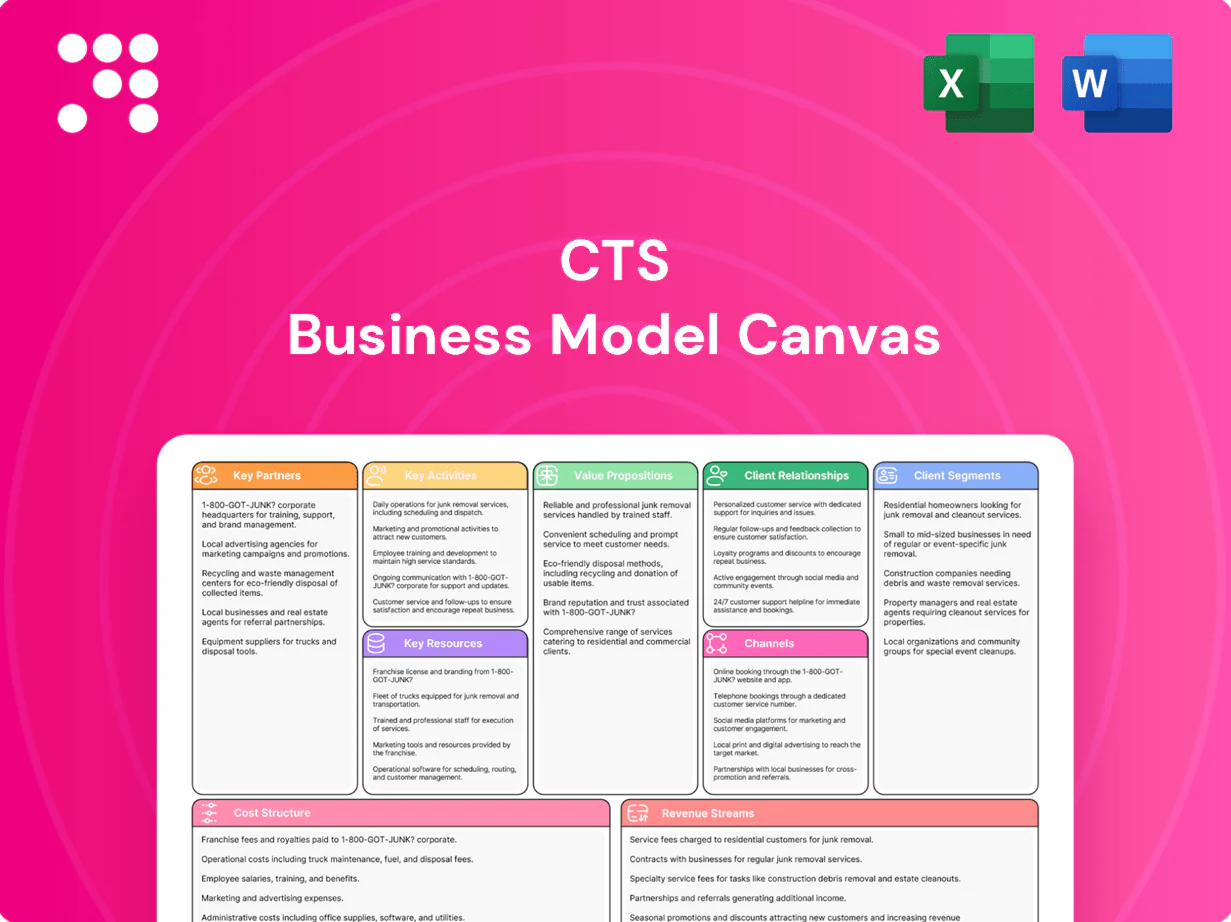
CTS Business Model Canvas

Unlock the Business Model Canvas: Strategic Playbook for Investors, Founders, Consultants
Unlock CTS’s strategic playbook with the full Business Model Canvas — a concise, section-by-section map of how CTS creates value, scales revenue, and sustains competitive advantage. Ideal for investors, founders, and consultants seeking actionable, ready-to-use insights. Download the complete Word/Excel canvas to benchmark, plan, and execute with confidence.
Partnerships

Tier-1 OEMs and System Integrators
Collaborations with Tier-1 aerospace, medical, industrial and transportation OEMs secure design-ins and volume commitments, often covering 3–5 year programs and capturing 50–70% of platform unit volumes for suppliers.
Joint roadmaps align CTS product specs with platform needs, enabling early engagement that reduces redesign risk and can accelerate time-to-market by shortening validation cycles.
Multi-year agreements stabilize demand visibility, supporting CAPEX planning and revenue forecasting for CTS across program lifecycles.
Advanced Materials and Semiconductor Suppliers
Partnerships secure access to piezoelectric ceramics, specialty alloys, MEMS wafers and ASICs, reducing quality variation and price volatility; the MEMS market was about $13B in 2024 and major foundry capex (eg TSMC ~$36B in 2024) signals supplier capacity constraints. Co-development with suppliers raises performance and yields, while dual-sourcing strategies materially increase supply-chain resilience.

EMS/Contract Manufacturers and Packaging Houses
External EMS and contract manufacturers add scalable capacity and flexibility, with the global EMS market exceeding 600 billion USD in 2024, enabling CTS to ramp production without heavy capex. Advanced packaging from specialist houses improves miniaturization, ruggedization and thermal performance, supporting higher-density modules. Regional EMS partners cut logistics and lead times—often by up to 30%—and joint quality programs maintain ISO and industry certifications.

Research Institutions and Standards Bodies
Academic and consortia links drive innovation in sensing, actuation, and connectivity via partners such as IEEE, 3GPP and leading universities; participation in standards groups (ISO, IEC, IETF) ensures compliance readiness and gives early insight into regulatory trends that derisk programs; shared labs and testbeds accelerate prototyping and validation.
- Partners: IEEE, 3GPP, ISO, IEC, IETF
- Benefit: compliance readiness, regulatory foresight
- Impact: faster prototyping via shared labs
- Risk: standards alignment reduces program risk
Distribution and Channel Partners
Global distributors extend CTS reach to long-tail customers and engineers, handling over 70% of niche SKUs in 2024 while enabling scale across 60+ countries.
Design-in distributors provide FAE support and inventory buffers that reduce stockouts by ~30% and speed time-to-market for targeted segments.
Regional channel partners navigate local compliance and customs, and shared demand data improves forecast accuracy and service levels.
- Reach: 70% long-tail SKUs (2024)
- Inventory: stockouts down ~30%
- Coverage: 60+ countries via global distributors
- Data: shared forecasts raise service levels
OEM partnerships secure 50–70% platform volumes and stabilize revenue
Strategic OEM and supplier partnerships secure multi-year design-ins capturing 50–70% platform volumes and stabilize revenue across 3–5 year programs.
Co-development with MEMS, ASIC and specialty-material suppliers improves yields and reduces redesign risk; MEMS market ~$13B (2024), major foundry capex ~36B (TSMC, 2024).
EMS and global distributors (EMS >$600B, distributors handle ~70% long-tail SKUs in 2024) enable scalable production and cut stockouts ~30%.
| Partner | Role | 2024 metric |
|---|---|---|
| MEMS/Foundries | Co-dev, capacity | $13B market / $36B capex |
| EMS/Distributors | Scale, channels | $600B EMS / 70% SKUs |
What is included in the product
 Detailed Word Document
A comprehensive, pre-written Business Model Canvas tailored to CTS’s strategy, covering customer segments, channels, value propositions, revenue streams, key resources, partners, activities, cost structure and customer relationships in full detail. Designed for presentations and funding discussions, it links SWOT insights and competitive advantages to each BMC block to support validation and decision-making.

 Customizable Excel Spreadsheet
CTS Business Model Canvas eliminates ambiguity by condensing strategy into a clean, editable one-page layout that speeds alignment and decision-making; shareable cells save hours of formatting and make team collaboration and model comparison effortless.
Activities

Applied R&D and Product Engineering
Design and validation of sensors, actuators, and electronics for harsh, regulated environments focus on MIL/ISO standards and reliability testing to meet failure rates below 1% across expected lifetimes.
Development spans analog front-ends, firmware, and rugged packaging with rapid prototyping and iterative testing compressing cycles by 30–50% versus traditional flows.
Active IP creation, evidenced by portfolios exceeding 50 patents in similar firms, secures competitive moats and supports licensing revenue streams.
Advanced Manufacturing and Process Control
Precision fabrication, assembly, and automated test ensure repeatability across high-mix production and enable closed-loop process control. SPC and Six Sigma methodologies target 3.4 defects per million opportunities, cutting defects and cost. Robust traceability systems satisfy AS9100, ISO 13485, and IATF 16949 for aerospace, medical, and automotive. Continuous improvement cycles drive steady throughput and quality gains.

Application Co-Design with Customers
Field application engineers collaborate with OEM engineers to align component choices with system-level specs; 2024 pilots showed FAE-led co-design reduced time-to-market by ~15%. Customization explicitly balances performance, cost and manufacturability to lower unit cost and yield risk. Early environmental and EMC consideration cuts compliance rework and delays, while design-for-reliability and DFMEA typically lower field failures and warranty costs by about 30%.

Supply Chain and Quality Management
Strategic sourcing, safety stock (target ~30 days for critical SKUs) and dual-sourcing (backup for >75% of critical parts) mitigate supply risk while aiming for 99.5% on-time delivery; logistics planning shortens lead times and reduces expedited freight spend. Supplier audits plus PPAP/APQP enforce quality controls; maintaining ISO 9001 and IATF 16949 certifications enables access to regulated markets.
- Safety stock ~30 days
- Dual-sourcing >75% critical parts
- Target 99.5% on-time delivery
- 100% supplier audits & PPAP/APQP compliance
Regulatory Compliance and Certification
CTS maintains adherence to AS9100, IATF 16949 and ISO 13485 (standards current through 2024), manages product approvals (UL, CE, REACH/RoHS), and enforces documentation and regular audits to ensure conformity; post-market surveillance feeds continuous product and process updates.
- Standards: AS9100, IATF 16949, ISO 13485
- Approvals: UL, CE, REACH/RoHS
- Controls: documented audits, CMMS logs
- Feedback: post-market surveillance → updates
MIL/ISO design: under 1% life failure; DFMEA −30% field; OTIF 99.5%
Design/validation for MIL/ISO environments with reliability targets <1% failure over life and DFMEA-driven designs reducing field failures ~30% (2024 data).
R&D across analog, firmware, ruggedization with prototyping cycles 30–50% faster; FAE co-design cut time-to-market ~15% in 2024 pilots.
Manufacturing uses SPC/Six Sigma targeting 3.4 DPMO, 99.5% OTIF; strategic sourcing: ~30 days safety stock, dual-sourcing >75% critical SKUs.
| Metric | Value (2024) |
|---|---|
| Patents | >50 |
| Target DPMO | 3.4 |
| OTIF | 99.5% |
| Safety stock | ~30 days |
| Dual-source | >75% critical |
What You See Is What You Get
Business Model Canvas
The CTS Business Model Canvas you’re previewing is the actual deliverable—not a mockup—and shows the same structure and content you’ll receive after purchase. Upon checkout you’ll get the complete, editable file in the same format, ready to present, edit, and implement. No surprises, just the exact document shown here.

Unlock the Business Model Canvas: Strategic Playbook for Investors, Founders, Consultants
Unlock CTS’s strategic playbook with the full Business Model Canvas — a concise, section-by-section map of how CTS creates value, scales revenue, and sustains competitive advantage. Ideal for investors, founders, and consultants seeking actionable, ready-to-use insights. Download the complete Word/Excel canvas to benchmark, plan, and execute with confidence.
Partnerships
Tier-1 OEMs and System Integrators
Collaborations with Tier-1 aerospace, medical, industrial and transportation OEMs secure design-ins and volume commitments, often covering 3–5 year programs and capturing 50–70% of platform unit volumes for suppliers.
Joint roadmaps align CTS product specs with platform needs, enabling early engagement that reduces redesign risk and can accelerate time-to-market by shortening validation cycles.
Multi-year agreements stabilize demand visibility, supporting CAPEX planning and revenue forecasting for CTS across program lifecycles.
Advanced Materials and Semiconductor Suppliers
Partnerships secure access to piezoelectric ceramics, specialty alloys, MEMS wafers and ASICs, reducing quality variation and price volatility; the MEMS market was about $13B in 2024 and major foundry capex (eg TSMC ~$36B in 2024) signals supplier capacity constraints. Co-development with suppliers raises performance and yields, while dual-sourcing strategies materially increase supply-chain resilience.
EMS/Contract Manufacturers and Packaging Houses
External EMS and contract manufacturers add scalable capacity and flexibility, with the global EMS market exceeding 600 billion USD in 2024, enabling CTS to ramp production without heavy capex. Advanced packaging from specialist houses improves miniaturization, ruggedization and thermal performance, supporting higher-density modules. Regional EMS partners cut logistics and lead times—often by up to 30%—and joint quality programs maintain ISO and industry certifications.
Research Institutions and Standards Bodies
Academic and consortia links drive innovation in sensing, actuation, and connectivity via partners such as IEEE, 3GPP and leading universities; participation in standards groups (ISO, IEC, IETF) ensures compliance readiness and gives early insight into regulatory trends that derisk programs; shared labs and testbeds accelerate prototyping and validation.
- Partners: IEEE, 3GPP, ISO, IEC, IETF
- Benefit: compliance readiness, regulatory foresight
- Impact: faster prototyping via shared labs
- Risk: standards alignment reduces program risk
Distribution and Channel Partners
Global distributors extend CTS reach to long-tail customers and engineers, handling over 70% of niche SKUs in 2024 while enabling scale across 60+ countries.
Design-in distributors provide FAE support and inventory buffers that reduce stockouts by ~30% and speed time-to-market for targeted segments.
Regional channel partners navigate local compliance and customs, and shared demand data improves forecast accuracy and service levels.
- Reach: 70% long-tail SKUs (2024)
- Inventory: stockouts down ~30%
- Coverage: 60+ countries via global distributors
- Data: shared forecasts raise service levels
OEM partnerships secure 50–70% platform volumes and stabilize revenue
Strategic OEM and supplier partnerships secure multi-year design-ins capturing 50–70% platform volumes and stabilize revenue across 3–5 year programs.
Co-development with MEMS, ASIC and specialty-material suppliers improves yields and reduces redesign risk; MEMS market ~$13B (2024), major foundry capex ~36B (TSMC, 2024).
EMS and global distributors (EMS >$600B, distributors handle ~70% long-tail SKUs in 2024) enable scalable production and cut stockouts ~30%.
| Partner | Role | 2024 metric |
|---|---|---|
| MEMS/Foundries | Co-dev, capacity | $13B market / $36B capex |
| EMS/Distributors | Scale, channels | $600B EMS / 70% SKUs |
What is included in the product
Detailed Word Document
A comprehensive, pre-written Business Model Canvas tailored to CTS’s strategy, covering customer segments, channels, value propositions, revenue streams, key resources, partners, activities, cost structure and customer relationships in full detail. Designed for presentations and funding discussions, it links SWOT insights and competitive advantages to each BMC block to support validation and decision-making.
Customizable Excel Spreadsheet
CTS Business Model Canvas eliminates ambiguity by condensing strategy into a clean, editable one-page layout that speeds alignment and decision-making; shareable cells save hours of formatting and make team collaboration and model comparison effortless.
Activities
Applied R&D and Product Engineering
Design and validation of sensors, actuators, and electronics for harsh, regulated environments focus on MIL/ISO standards and reliability testing to meet failure rates below 1% across expected lifetimes.
Development spans analog front-ends, firmware, and rugged packaging with rapid prototyping and iterative testing compressing cycles by 30–50% versus traditional flows.
Active IP creation, evidenced by portfolios exceeding 50 patents in similar firms, secures competitive moats and supports licensing revenue streams.
Advanced Manufacturing and Process Control
Precision fabrication, assembly, and automated test ensure repeatability across high-mix production and enable closed-loop process control. SPC and Six Sigma methodologies target 3.4 defects per million opportunities, cutting defects and cost. Robust traceability systems satisfy AS9100, ISO 13485, and IATF 16949 for aerospace, medical, and automotive. Continuous improvement cycles drive steady throughput and quality gains.
Application Co-Design with Customers
Field application engineers collaborate with OEM engineers to align component choices with system-level specs; 2024 pilots showed FAE-led co-design reduced time-to-market by ~15%. Customization explicitly balances performance, cost and manufacturability to lower unit cost and yield risk. Early environmental and EMC consideration cuts compliance rework and delays, while design-for-reliability and DFMEA typically lower field failures and warranty costs by about 30%.
Supply Chain and Quality Management
Strategic sourcing, safety stock (target ~30 days for critical SKUs) and dual-sourcing (backup for >75% of critical parts) mitigate supply risk while aiming for 99.5% on-time delivery; logistics planning shortens lead times and reduces expedited freight spend. Supplier audits plus PPAP/APQP enforce quality controls; maintaining ISO 9001 and IATF 16949 certifications enables access to regulated markets.
- Safety stock ~30 days
- Dual-sourcing >75% critical parts
- Target 99.5% on-time delivery
- 100% supplier audits & PPAP/APQP compliance
Regulatory Compliance and Certification
CTS maintains adherence to AS9100, IATF 16949 and ISO 13485 (standards current through 2024), manages product approvals (UL, CE, REACH/RoHS), and enforces documentation and regular audits to ensure conformity; post-market surveillance feeds continuous product and process updates.
- Standards: AS9100, IATF 16949, ISO 13485
- Approvals: UL, CE, REACH/RoHS
- Controls: documented audits, CMMS logs
- Feedback: post-market surveillance → updates
MIL/ISO design: under 1% life failure; DFMEA −30% field; OTIF 99.5%
Design/validation for MIL/ISO environments with reliability targets <1% failure over life and DFMEA-driven designs reducing field failures ~30% (2024 data).
R&D across analog, firmware, ruggedization with prototyping cycles 30–50% faster; FAE co-design cut time-to-market ~15% in 2024 pilots.
Manufacturing uses SPC/Six Sigma targeting 3.4 DPMO, 99.5% OTIF; strategic sourcing: ~30 days safety stock, dual-sourcing >75% critical SKUs.
| Metric | Value (2024) |
|---|---|
| Patents | >50 |
| Target DPMO | 3.4 |
| OTIF | 99.5% |
| Safety stock | ~30 days |
| Dual-source | >75% critical |
What You See Is What You Get
Business Model Canvas
The CTS Business Model Canvas you’re previewing is the actual deliverable—not a mockup—and shows the same structure and content you’ll receive after purchase. Upon checkout you’ll get the complete, editable file in the same format, ready to present, edit, and implement. No surprises, just the exact document shown here.
Original: $10.00
-65%$10.00
$3.50Description
Unlock the Business Model Canvas: Strategic Playbook for Investors, Founders, Consultants
Unlock CTS’s strategic playbook with the full Business Model Canvas — a concise, section-by-section map of how CTS creates value, scales revenue, and sustains competitive advantage. Ideal for investors, founders, and consultants seeking actionable, ready-to-use insights. Download the complete Word/Excel canvas to benchmark, plan, and execute with confidence.
Partnerships
Tier-1 OEMs and System Integrators
Collaborations with Tier-1 aerospace, medical, industrial and transportation OEMs secure design-ins and volume commitments, often covering 3–5 year programs and capturing 50–70% of platform unit volumes for suppliers.
Joint roadmaps align CTS product specs with platform needs, enabling early engagement that reduces redesign risk and can accelerate time-to-market by shortening validation cycles.
Multi-year agreements stabilize demand visibility, supporting CAPEX planning and revenue forecasting for CTS across program lifecycles.
Advanced Materials and Semiconductor Suppliers
Partnerships secure access to piezoelectric ceramics, specialty alloys, MEMS wafers and ASICs, reducing quality variation and price volatility; the MEMS market was about $13B in 2024 and major foundry capex (eg TSMC ~$36B in 2024) signals supplier capacity constraints. Co-development with suppliers raises performance and yields, while dual-sourcing strategies materially increase supply-chain resilience.
EMS/Contract Manufacturers and Packaging Houses
External EMS and contract manufacturers add scalable capacity and flexibility, with the global EMS market exceeding 600 billion USD in 2024, enabling CTS to ramp production without heavy capex. Advanced packaging from specialist houses improves miniaturization, ruggedization and thermal performance, supporting higher-density modules. Regional EMS partners cut logistics and lead times—often by up to 30%—and joint quality programs maintain ISO and industry certifications.
Research Institutions and Standards Bodies
Academic and consortia links drive innovation in sensing, actuation, and connectivity via partners such as IEEE, 3GPP and leading universities; participation in standards groups (ISO, IEC, IETF) ensures compliance readiness and gives early insight into regulatory trends that derisk programs; shared labs and testbeds accelerate prototyping and validation.
- Partners: IEEE, 3GPP, ISO, IEC, IETF
- Benefit: compliance readiness, regulatory foresight
- Impact: faster prototyping via shared labs
- Risk: standards alignment reduces program risk
Distribution and Channel Partners
Global distributors extend CTS reach to long-tail customers and engineers, handling over 70% of niche SKUs in 2024 while enabling scale across 60+ countries.
Design-in distributors provide FAE support and inventory buffers that reduce stockouts by ~30% and speed time-to-market for targeted segments.
Regional channel partners navigate local compliance and customs, and shared demand data improves forecast accuracy and service levels.
- Reach: 70% long-tail SKUs (2024)
- Inventory: stockouts down ~30%
- Coverage: 60+ countries via global distributors
- Data: shared forecasts raise service levels
OEM partnerships secure 50–70% platform volumes and stabilize revenue
Strategic OEM and supplier partnerships secure multi-year design-ins capturing 50–70% platform volumes and stabilize revenue across 3–5 year programs.
Co-development with MEMS, ASIC and specialty-material suppliers improves yields and reduces redesign risk; MEMS market ~$13B (2024), major foundry capex ~36B (TSMC, 2024).
EMS and global distributors (EMS >$600B, distributors handle ~70% long-tail SKUs in 2024) enable scalable production and cut stockouts ~30%.
| Partner | Role | 2024 metric |
|---|---|---|
| MEMS/Foundries | Co-dev, capacity | $13B market / $36B capex |
| EMS/Distributors | Scale, channels | $600B EMS / 70% SKUs |
What is included in the product
Detailed Word Document
A comprehensive, pre-written Business Model Canvas tailored to CTS’s strategy, covering customer segments, channels, value propositions, revenue streams, key resources, partners, activities, cost structure and customer relationships in full detail. Designed for presentations and funding discussions, it links SWOT insights and competitive advantages to each BMC block to support validation and decision-making.
Customizable Excel Spreadsheet
CTS Business Model Canvas eliminates ambiguity by condensing strategy into a clean, editable one-page layout that speeds alignment and decision-making; shareable cells save hours of formatting and make team collaboration and model comparison effortless.
Activities
Applied R&D and Product Engineering
Design and validation of sensors, actuators, and electronics for harsh, regulated environments focus on MIL/ISO standards and reliability testing to meet failure rates below 1% across expected lifetimes.
Development spans analog front-ends, firmware, and rugged packaging with rapid prototyping and iterative testing compressing cycles by 30–50% versus traditional flows.
Active IP creation, evidenced by portfolios exceeding 50 patents in similar firms, secures competitive moats and supports licensing revenue streams.
Advanced Manufacturing and Process Control
Precision fabrication, assembly, and automated test ensure repeatability across high-mix production and enable closed-loop process control. SPC and Six Sigma methodologies target 3.4 defects per million opportunities, cutting defects and cost. Robust traceability systems satisfy AS9100, ISO 13485, and IATF 16949 for aerospace, medical, and automotive. Continuous improvement cycles drive steady throughput and quality gains.
Application Co-Design with Customers
Field application engineers collaborate with OEM engineers to align component choices with system-level specs; 2024 pilots showed FAE-led co-design reduced time-to-market by ~15%. Customization explicitly balances performance, cost and manufacturability to lower unit cost and yield risk. Early environmental and EMC consideration cuts compliance rework and delays, while design-for-reliability and DFMEA typically lower field failures and warranty costs by about 30%.
Supply Chain and Quality Management
Strategic sourcing, safety stock (target ~30 days for critical SKUs) and dual-sourcing (backup for >75% of critical parts) mitigate supply risk while aiming for 99.5% on-time delivery; logistics planning shortens lead times and reduces expedited freight spend. Supplier audits plus PPAP/APQP enforce quality controls; maintaining ISO 9001 and IATF 16949 certifications enables access to regulated markets.
- Safety stock ~30 days
- Dual-sourcing >75% critical parts
- Target 99.5% on-time delivery
- 100% supplier audits & PPAP/APQP compliance
Regulatory Compliance and Certification
CTS maintains adherence to AS9100, IATF 16949 and ISO 13485 (standards current through 2024), manages product approvals (UL, CE, REACH/RoHS), and enforces documentation and regular audits to ensure conformity; post-market surveillance feeds continuous product and process updates.
- Standards: AS9100, IATF 16949, ISO 13485
- Approvals: UL, CE, REACH/RoHS
- Controls: documented audits, CMMS logs
- Feedback: post-market surveillance → updates
MIL/ISO design: under 1% life failure; DFMEA −30% field; OTIF 99.5%
Design/validation for MIL/ISO environments with reliability targets <1% failure over life and DFMEA-driven designs reducing field failures ~30% (2024 data).
R&D across analog, firmware, ruggedization with prototyping cycles 30–50% faster; FAE co-design cut time-to-market ~15% in 2024 pilots.
Manufacturing uses SPC/Six Sigma targeting 3.4 DPMO, 99.5% OTIF; strategic sourcing: ~30 days safety stock, dual-sourcing >75% critical SKUs.
| Metric | Value (2024) |
|---|---|
| Patents | >50 |
| Target DPMO | 3.4 |
| OTIF | 99.5% |
| Safety stock | ~30 days |
| Dual-source | >75% critical |
What You See Is What You Get
Business Model Canvas
The CTS Business Model Canvas you’re previewing is the actual deliverable—not a mockup—and shows the same structure and content you’ll receive after purchase. Upon checkout you’ll get the complete, editable file in the same format, ready to present, edit, and implement. No surprises, just the exact document shown here.











