CURO Porter's Five Forces Analysis

Elevate Your Analysis with the Complete Porter's Five Forces Analysis
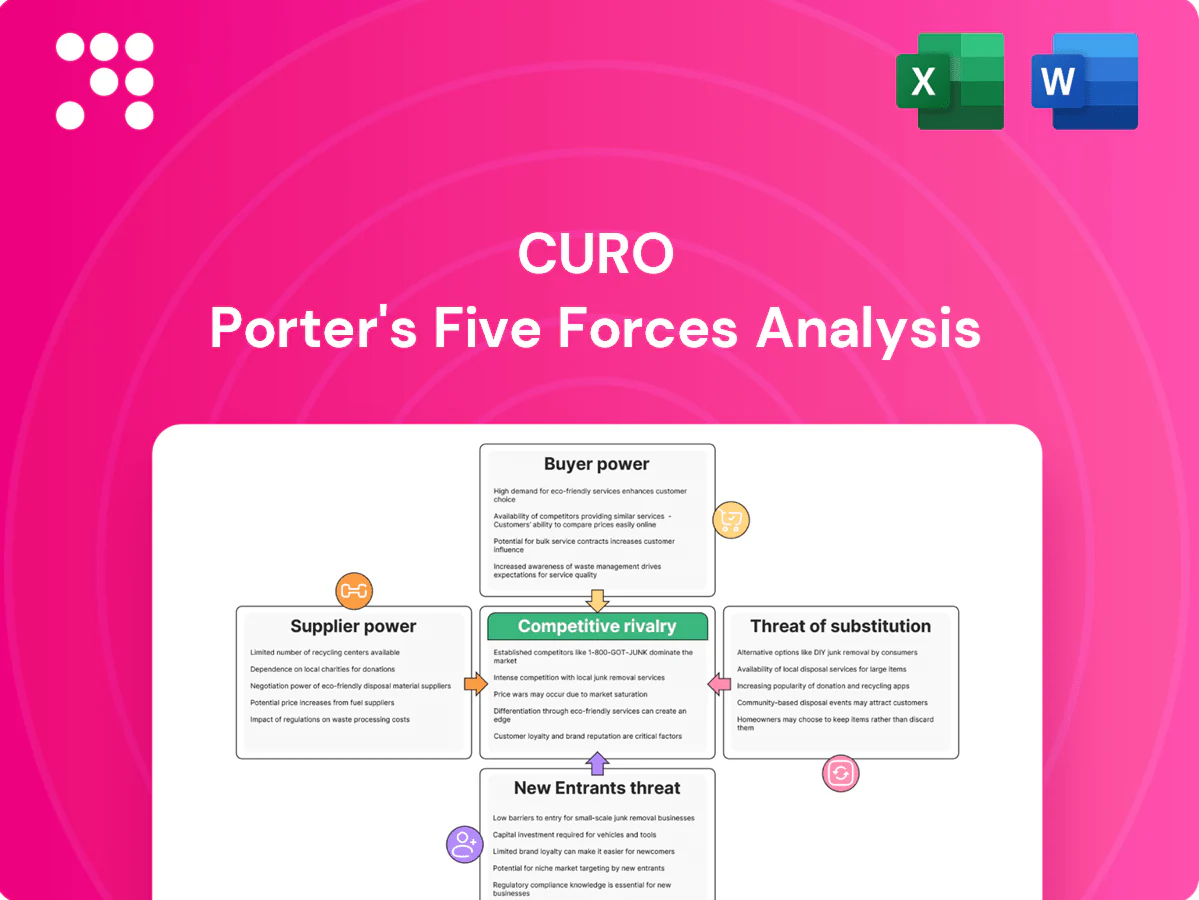
CURO's Porter's Five Forces snapshot highlights buyer and supplier power, competitive rivalry, barriers to entry, and substitute threats shaping its niche consumer finance position. This brief overview outlines strategic pressures and key risks but omits force-by-force ratings and visuals. Unlock the full Porter's Five Forces Analysis to explore CURO’s competitive dynamics, market pressures, and strategic advantages in detail.
Suppliers Bargaining Power

Dependence on wholesale funding and credit facilities
CURO relies on warehouse lines, securitizations and credit facilities to fund originations, and with the federal funds rate at about 5.25–5.50% in 2024 tightening credit, lenders can raise spreads, add covenants or ration capacity. That gives capital providers clear leverage over pricing and terms. Diversifying funding sources—while reducing concentration risk—can moderate but not eliminate this supplier power.
Data and credit bureau vendors
Core underwriting relies on credit bureaus, alternative data providers and identity/fraud services; in the US three major bureaus (Equifax, Experian, TransUnion) account for roughly 99% of consumer credit files, concentrating influence. Vendor concentration and switching frictions confer pricing power, with contractual minimums and integrations often requiring six-figure investments. Outages or data-policy changes have halted automated decisioning in past incidents, forcing manual reviews and slowing originations.

Technology platforms and payment processors
Technology platforms and payment processors (online originations, ACH, card processors, loan-servicing software) are mission-critical for CURO; NACHA reported ~30.6 billion ACH entries in 2023, underscoring network dependence. Card processors typically charge 1.5–3% plus $0.10–$0.30 per tx and can raise fees or pass through network costs. Limited viable substitutes for key modules increases supplier leverage. Volume commitments can secure discounts but create vendor lock-in and switching costs.

Retail landlords and store services
Physical CURO locations require leases, cash-handling and security vendors, concentrating fixed store-level costs and raising exit barriers; in tight U.S. retail markets landlords can push higher rents and stricter terms, with national retail vacancy about 6.6% mid-2024 (CBRE) increasing landlord leverage. Co-tenancy clauses and long-term leases partially mitigate volatility but limit flexibility.
- High fixed costs: leases + security + cash services
- Landlord leverage: 6.6% vacancy (mid-2024)
- Mitigants: co-tenancy clauses, long-term leases
Collections and recovery partners
Third-party collectors, legal recovery firms, and debt buyers materially influence CUROs loss severity through fee schedules and recovery rates; variability in performance directly shifts unit economics and provision needs. Regulatory scrutiny in 2024 narrowed tactics, boosting leverage of compliant partners and limiting aggressive recovery options. Dependence on these partners intensifies during downturns as delinquencies rise.
- Fee structures drive net recoveries
- Performance variability alters CECL provisioning
- Regulatory limits increase partner bargaining power
Suppliers Tighten Grip: High Funding Costs, Card Fees and Credit Bureau Dominance
Suppliers exert high power: capital providers can tighten terms with fed funds ~5.25–5.50% (2024), funding concentration raises pricing risk. Credit bureaus control ~99% of files; vendor lock-in and six-figure integrations hinder switching. Payments and ACH dependence (NACHA 30.6B entries in 2023) plus card fees (1.5–3% + $0.10–$0.30) amplify supplier leverage.
| Supplier | Key metric |
|---|---|
| Capital | Fed funds 5.25–5.50% (2024) |
| Credit bureaus | ~99% market share |
| Payments | ACH 30.6B (2023); card fees 1.5–3% + $0.10–$0.30 |
| Retail landlords | Vacancy 6.6% (mid-2024) |
What is included in the product
 Detailed Word Document
Condensed Porter’s Five Forces analysis for CURO, uncovering competitive drivers, buyer and supplier leverage, substitutes and entry threats, with strategic commentary on disruptive forces and protective market dynamics—fully editable for reports, investor materials, and strategy decks.

 Customizable Excel Spreadsheet
A one-sheet CURO Porter's Five Forces summary with customizable pressure levels and instant spider/radar visualization—clean, copy-ready layout that relieves analysis pain by letting teams swap in data, duplicate scenarios, and integrate into dashboards without macros.
Customers Bargaining Power

Price sensitivity of underbanked borrowers
Underbanked CURO borrowers are highly price-sensitive: payday and short-term loan APRs often exceed 300% (CFPB), so small APR or fee differences and promotional terms can trigger switching. Transparent disclosures and comparison sites magnify that sensitivity by making rates instantly comparable. Economic stress (rising cost pressures in 2023–24) increases demand but sharpens focus on price and repayment flexibility.
Low switching costs and abundant alternatives
Borrowers can apply across multiple lenders online within minutes, and many fintech and specialty lenders reported instant or same-day decisions in 2024, with industry averages often under 24 hours. Fast approvals and transparent rate comparisons make switching for better terms or speed straightforward. Minimal contractual lock-in reduces stickiness, empowering customers to negotiate or churn.

Regulatory protections and complaints channels
Disclosure, fair lending, and collections rules raised in 2024 increase customer leverage over CURO by creating formal grounds for complaints and enforcement, limiting pricing freedom. Regulator scrutiny of fees and practices narrows rate-setting, while complaint portals and social media amplify customer voice. Remediation costs and reputational risk push CURO toward concessions to avoid enforcement and public backlash.

Credit-constrained but option-aware segment
Customers are credit-constrained but option-aware, recognizing payday, installment, BNPL and wage-access products; mobile-first journeys (2024: >70% of loan apps via mobile) enable rapid cross-shopping. Repeat borrowers compare experience and speed more than price, and loyalty hinges on trust, customer service and transparency.
- Mobile-driven: >70% apps
- Repeat-focused: experience>price
- Loyalty drivers: trust, service, transparency
Income volatility and payment flexibility demands
Irregular cash flows push CURO customers to request deferrals, extensions and customized schedules, increasing churn for lenders that lack hardship options; in 2024 about 35% of US households reported irregular income patterns, raising demand for flexible credit terms. Lenders offering structured hardship programs gain retention leverage, while flexibility expectations raise servicing costs and operational complexity.
- Higher churn vs hardship programs
- Servicing cost uplift: +10–20% (operational estimate)
- 35% households irregular income (2024)
- Customer power grows when no-fee rescheduling advertised
High-APR borrowers switch fast - mobile-first apps, sub-24hr approvals, rising regulatory risk
CURO customers wield strong price and speed leverage: APRs often exceed 300% so small fee or speed differences drive switching; many lenders report approvals under 24 hours in 2024. Mobile-first shopping (>70% loan apps via mobile) and low contractual lock-in raise churn; hardship flexibility boosts retention. Regulatory scrutiny and complaint channels increase enforcement risk and bargaining power.
| Metric | 2024 Value |
|---|---|
| Mobile loan apps | >70% |
| Households irregular income | 35% |
| Typical approval time | <24 hrs |
| Payday APRs | >300% |
Same Document Delivered
CURO Porter's Five Forces Analysis
This preview shows the exact CURO Porter's Five Forces Analysis you'll receive immediately after purchase—no placeholders or samples. The document displayed is the final, professionally formatted file, ready for download and use the moment you buy. You're viewing the same deliverable you'll get instantly upon payment.

Elevate Your Analysis with the Complete Porter's Five Forces Analysis
CURO's Porter's Five Forces snapshot highlights buyer and supplier power, competitive rivalry, barriers to entry, and substitute threats shaping its niche consumer finance position. This brief overview outlines strategic pressures and key risks but omits force-by-force ratings and visuals. Unlock the full Porter's Five Forces Analysis to explore CURO’s competitive dynamics, market pressures, and strategic advantages in detail.
Suppliers Bargaining Power
Dependence on wholesale funding and credit facilities
CURO relies on warehouse lines, securitizations and credit facilities to fund originations, and with the federal funds rate at about 5.25–5.50% in 2024 tightening credit, lenders can raise spreads, add covenants or ration capacity. That gives capital providers clear leverage over pricing and terms. Diversifying funding sources—while reducing concentration risk—can moderate but not eliminate this supplier power.
Data and credit bureau vendors
Core underwriting relies on credit bureaus, alternative data providers and identity/fraud services; in the US three major bureaus (Equifax, Experian, TransUnion) account for roughly 99% of consumer credit files, concentrating influence. Vendor concentration and switching frictions confer pricing power, with contractual minimums and integrations often requiring six-figure investments. Outages or data-policy changes have halted automated decisioning in past incidents, forcing manual reviews and slowing originations.
Technology platforms and payment processors
Technology platforms and payment processors (online originations, ACH, card processors, loan-servicing software) are mission-critical for CURO; NACHA reported ~30.6 billion ACH entries in 2023, underscoring network dependence. Card processors typically charge 1.5–3% plus $0.10–$0.30 per tx and can raise fees or pass through network costs. Limited viable substitutes for key modules increases supplier leverage. Volume commitments can secure discounts but create vendor lock-in and switching costs.
Retail landlords and store services
Physical CURO locations require leases, cash-handling and security vendors, concentrating fixed store-level costs and raising exit barriers; in tight U.S. retail markets landlords can push higher rents and stricter terms, with national retail vacancy about 6.6% mid-2024 (CBRE) increasing landlord leverage. Co-tenancy clauses and long-term leases partially mitigate volatility but limit flexibility.
- High fixed costs: leases + security + cash services
- Landlord leverage: 6.6% vacancy (mid-2024)
- Mitigants: co-tenancy clauses, long-term leases
Collections and recovery partners
Third-party collectors, legal recovery firms, and debt buyers materially influence CUROs loss severity through fee schedules and recovery rates; variability in performance directly shifts unit economics and provision needs. Regulatory scrutiny in 2024 narrowed tactics, boosting leverage of compliant partners and limiting aggressive recovery options. Dependence on these partners intensifies during downturns as delinquencies rise.
- Fee structures drive net recoveries
- Performance variability alters CECL provisioning
- Regulatory limits increase partner bargaining power
Suppliers Tighten Grip: High Funding Costs, Card Fees and Credit Bureau Dominance
Suppliers exert high power: capital providers can tighten terms with fed funds ~5.25–5.50% (2024), funding concentration raises pricing risk. Credit bureaus control ~99% of files; vendor lock-in and six-figure integrations hinder switching. Payments and ACH dependence (NACHA 30.6B entries in 2023) plus card fees (1.5–3% + $0.10–$0.30) amplify supplier leverage.
| Supplier | Key metric |
|---|---|
| Capital | Fed funds 5.25–5.50% (2024) |
| Credit bureaus | ~99% market share |
| Payments | ACH 30.6B (2023); card fees 1.5–3% + $0.10–$0.30 |
| Retail landlords | Vacancy 6.6% (mid-2024) |
What is included in the product
Detailed Word Document
Condensed Porter’s Five Forces analysis for CURO, uncovering competitive drivers, buyer and supplier leverage, substitutes and entry threats, with strategic commentary on disruptive forces and protective market dynamics—fully editable for reports, investor materials, and strategy decks.
Customizable Excel Spreadsheet
A one-sheet CURO Porter's Five Forces summary with customizable pressure levels and instant spider/radar visualization—clean, copy-ready layout that relieves analysis pain by letting teams swap in data, duplicate scenarios, and integrate into dashboards without macros.
Customers Bargaining Power
Price sensitivity of underbanked borrowers
Underbanked CURO borrowers are highly price-sensitive: payday and short-term loan APRs often exceed 300% (CFPB), so small APR or fee differences and promotional terms can trigger switching. Transparent disclosures and comparison sites magnify that sensitivity by making rates instantly comparable. Economic stress (rising cost pressures in 2023–24) increases demand but sharpens focus on price and repayment flexibility.
Low switching costs and abundant alternatives
Borrowers can apply across multiple lenders online within minutes, and many fintech and specialty lenders reported instant or same-day decisions in 2024, with industry averages often under 24 hours. Fast approvals and transparent rate comparisons make switching for better terms or speed straightforward. Minimal contractual lock-in reduces stickiness, empowering customers to negotiate or churn.
Regulatory protections and complaints channels
Disclosure, fair lending, and collections rules raised in 2024 increase customer leverage over CURO by creating formal grounds for complaints and enforcement, limiting pricing freedom. Regulator scrutiny of fees and practices narrows rate-setting, while complaint portals and social media amplify customer voice. Remediation costs and reputational risk push CURO toward concessions to avoid enforcement and public backlash.
Credit-constrained but option-aware segment
Customers are credit-constrained but option-aware, recognizing payday, installment, BNPL and wage-access products; mobile-first journeys (2024: >70% of loan apps via mobile) enable rapid cross-shopping. Repeat borrowers compare experience and speed more than price, and loyalty hinges on trust, customer service and transparency.
- Mobile-driven: >70% apps
- Repeat-focused: experience>price
- Loyalty drivers: trust, service, transparency
Income volatility and payment flexibility demands
Irregular cash flows push CURO customers to request deferrals, extensions and customized schedules, increasing churn for lenders that lack hardship options; in 2024 about 35% of US households reported irregular income patterns, raising demand for flexible credit terms. Lenders offering structured hardship programs gain retention leverage, while flexibility expectations raise servicing costs and operational complexity.
- Higher churn vs hardship programs
- Servicing cost uplift: +10–20% (operational estimate)
- 35% households irregular income (2024)
- Customer power grows when no-fee rescheduling advertised
High-APR borrowers switch fast - mobile-first apps, sub-24hr approvals, rising regulatory risk
CURO customers wield strong price and speed leverage: APRs often exceed 300% so small fee or speed differences drive switching; many lenders report approvals under 24 hours in 2024. Mobile-first shopping (>70% loan apps via mobile) and low contractual lock-in raise churn; hardship flexibility boosts retention. Regulatory scrutiny and complaint channels increase enforcement risk and bargaining power.
| Metric | 2024 Value |
|---|---|
| Mobile loan apps | >70% |
| Households irregular income | 35% |
| Typical approval time | <24 hrs |
| Payday APRs | >300% |
Same Document Delivered
CURO Porter's Five Forces Analysis
This preview shows the exact CURO Porter's Five Forces Analysis you'll receive immediately after purchase—no placeholders or samples. The document displayed is the final, professionally formatted file, ready for download and use the moment you buy. You're viewing the same deliverable you'll get instantly upon payment.
Original: $10.00
-65%$10.00
$3.50Description
Elevate Your Analysis with the Complete Porter's Five Forces Analysis
CURO's Porter's Five Forces snapshot highlights buyer and supplier power, competitive rivalry, barriers to entry, and substitute threats shaping its niche consumer finance position. This brief overview outlines strategic pressures and key risks but omits force-by-force ratings and visuals. Unlock the full Porter's Five Forces Analysis to explore CURO’s competitive dynamics, market pressures, and strategic advantages in detail.
Suppliers Bargaining Power
Dependence on wholesale funding and credit facilities
CURO relies on warehouse lines, securitizations and credit facilities to fund originations, and with the federal funds rate at about 5.25–5.50% in 2024 tightening credit, lenders can raise spreads, add covenants or ration capacity. That gives capital providers clear leverage over pricing and terms. Diversifying funding sources—while reducing concentration risk—can moderate but not eliminate this supplier power.
Data and credit bureau vendors
Core underwriting relies on credit bureaus, alternative data providers and identity/fraud services; in the US three major bureaus (Equifax, Experian, TransUnion) account for roughly 99% of consumer credit files, concentrating influence. Vendor concentration and switching frictions confer pricing power, with contractual minimums and integrations often requiring six-figure investments. Outages or data-policy changes have halted automated decisioning in past incidents, forcing manual reviews and slowing originations.
Technology platforms and payment processors
Technology platforms and payment processors (online originations, ACH, card processors, loan-servicing software) are mission-critical for CURO; NACHA reported ~30.6 billion ACH entries in 2023, underscoring network dependence. Card processors typically charge 1.5–3% plus $0.10–$0.30 per tx and can raise fees or pass through network costs. Limited viable substitutes for key modules increases supplier leverage. Volume commitments can secure discounts but create vendor lock-in and switching costs.
Retail landlords and store services
Physical CURO locations require leases, cash-handling and security vendors, concentrating fixed store-level costs and raising exit barriers; in tight U.S. retail markets landlords can push higher rents and stricter terms, with national retail vacancy about 6.6% mid-2024 (CBRE) increasing landlord leverage. Co-tenancy clauses and long-term leases partially mitigate volatility but limit flexibility.
- High fixed costs: leases + security + cash services
- Landlord leverage: 6.6% vacancy (mid-2024)
- Mitigants: co-tenancy clauses, long-term leases
Collections and recovery partners
Third-party collectors, legal recovery firms, and debt buyers materially influence CUROs loss severity through fee schedules and recovery rates; variability in performance directly shifts unit economics and provision needs. Regulatory scrutiny in 2024 narrowed tactics, boosting leverage of compliant partners and limiting aggressive recovery options. Dependence on these partners intensifies during downturns as delinquencies rise.
- Fee structures drive net recoveries
- Performance variability alters CECL provisioning
- Regulatory limits increase partner bargaining power
Suppliers Tighten Grip: High Funding Costs, Card Fees and Credit Bureau Dominance
Suppliers exert high power: capital providers can tighten terms with fed funds ~5.25–5.50% (2024), funding concentration raises pricing risk. Credit bureaus control ~99% of files; vendor lock-in and six-figure integrations hinder switching. Payments and ACH dependence (NACHA 30.6B entries in 2023) plus card fees (1.5–3% + $0.10–$0.30) amplify supplier leverage.
| Supplier | Key metric |
|---|---|
| Capital | Fed funds 5.25–5.50% (2024) |
| Credit bureaus | ~99% market share |
| Payments | ACH 30.6B (2023); card fees 1.5–3% + $0.10–$0.30 |
| Retail landlords | Vacancy 6.6% (mid-2024) |
What is included in the product
Detailed Word Document
Condensed Porter’s Five Forces analysis for CURO, uncovering competitive drivers, buyer and supplier leverage, substitutes and entry threats, with strategic commentary on disruptive forces and protective market dynamics—fully editable for reports, investor materials, and strategy decks.
Customizable Excel Spreadsheet
A one-sheet CURO Porter's Five Forces summary with customizable pressure levels and instant spider/radar visualization—clean, copy-ready layout that relieves analysis pain by letting teams swap in data, duplicate scenarios, and integrate into dashboards without macros.
Customers Bargaining Power
Price sensitivity of underbanked borrowers
Underbanked CURO borrowers are highly price-sensitive: payday and short-term loan APRs often exceed 300% (CFPB), so small APR or fee differences and promotional terms can trigger switching. Transparent disclosures and comparison sites magnify that sensitivity by making rates instantly comparable. Economic stress (rising cost pressures in 2023–24) increases demand but sharpens focus on price and repayment flexibility.
Low switching costs and abundant alternatives
Borrowers can apply across multiple lenders online within minutes, and many fintech and specialty lenders reported instant or same-day decisions in 2024, with industry averages often under 24 hours. Fast approvals and transparent rate comparisons make switching for better terms or speed straightforward. Minimal contractual lock-in reduces stickiness, empowering customers to negotiate or churn.
Regulatory protections and complaints channels
Disclosure, fair lending, and collections rules raised in 2024 increase customer leverage over CURO by creating formal grounds for complaints and enforcement, limiting pricing freedom. Regulator scrutiny of fees and practices narrows rate-setting, while complaint portals and social media amplify customer voice. Remediation costs and reputational risk push CURO toward concessions to avoid enforcement and public backlash.
Credit-constrained but option-aware segment
Customers are credit-constrained but option-aware, recognizing payday, installment, BNPL and wage-access products; mobile-first journeys (2024: >70% of loan apps via mobile) enable rapid cross-shopping. Repeat borrowers compare experience and speed more than price, and loyalty hinges on trust, customer service and transparency.
- Mobile-driven: >70% apps
- Repeat-focused: experience>price
- Loyalty drivers: trust, service, transparency
Income volatility and payment flexibility demands
Irregular cash flows push CURO customers to request deferrals, extensions and customized schedules, increasing churn for lenders that lack hardship options; in 2024 about 35% of US households reported irregular income patterns, raising demand for flexible credit terms. Lenders offering structured hardship programs gain retention leverage, while flexibility expectations raise servicing costs and operational complexity.
- Higher churn vs hardship programs
- Servicing cost uplift: +10–20% (operational estimate)
- 35% households irregular income (2024)
- Customer power grows when no-fee rescheduling advertised
High-APR borrowers switch fast - mobile-first apps, sub-24hr approvals, rising regulatory risk
CURO customers wield strong price and speed leverage: APRs often exceed 300% so small fee or speed differences drive switching; many lenders report approvals under 24 hours in 2024. Mobile-first shopping (>70% loan apps via mobile) and low contractual lock-in raise churn; hardship flexibility boosts retention. Regulatory scrutiny and complaint channels increase enforcement risk and bargaining power.
| Metric | 2024 Value |
|---|---|
| Mobile loan apps | >70% |
| Households irregular income | 35% |
| Typical approval time | <24 hrs |
| Payday APRs | >300% |
Same Document Delivered
CURO Porter's Five Forces Analysis
This preview shows the exact CURO Porter's Five Forces Analysis you'll receive immediately after purchase—no placeholders or samples. The document displayed is the final, professionally formatted file, ready for download and use the moment you buy. You're viewing the same deliverable you'll get instantly upon payment.











