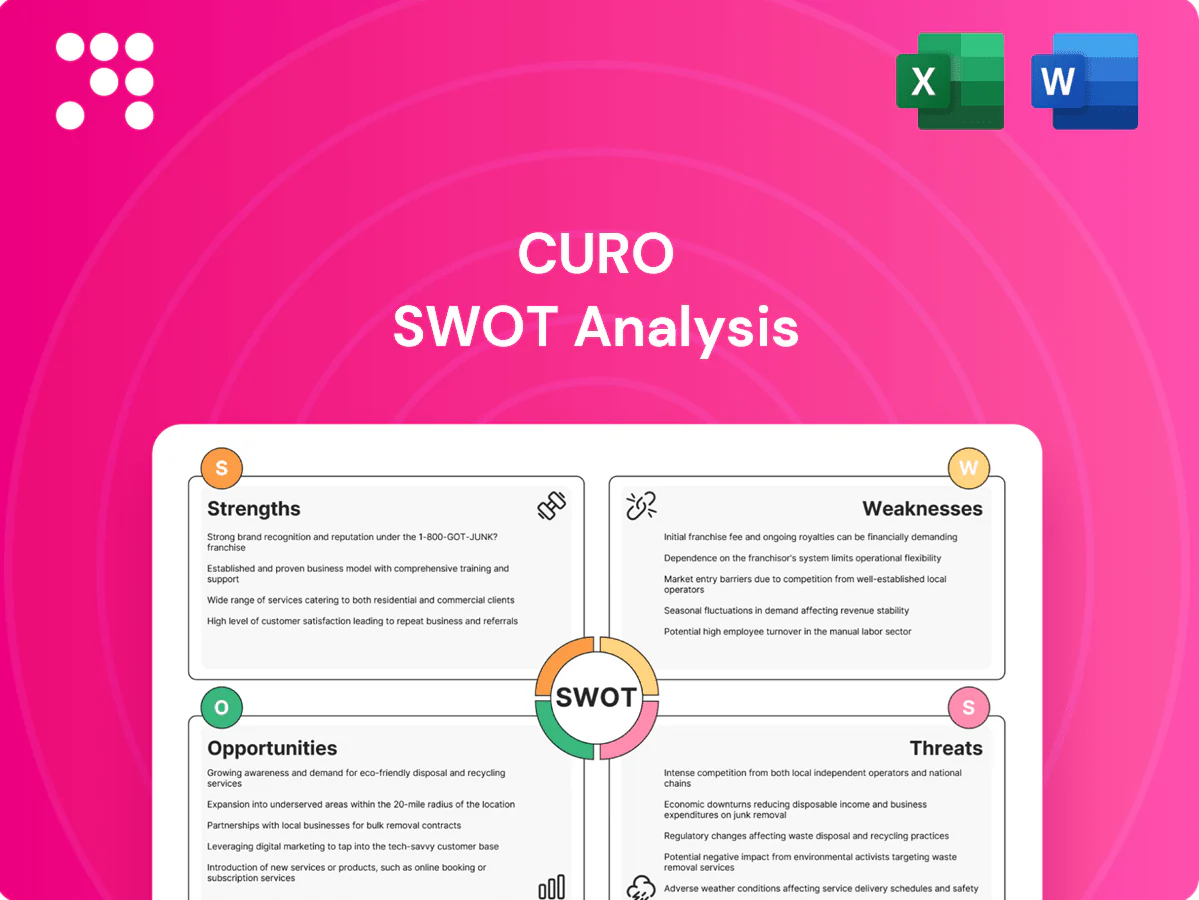
CURO SWOT Analysis

Elevate Your Analysis with the Complete SWOT Report
Explore CURO’s strategic landscape—our concise SWOT highlights competitive strengths, regulatory risks, and growth levers in consumer finance. Want deeper insights, financial context, and executable strategies? Purchase the full SWOT analysis to receive a professionally written, editable Word report plus an Excel model—designed to inform investment decisions, pitches, and strategic planning.
Strengths

Omnichannel delivery footprint
CURO serves customers online and via retail locations across North America, widening reach and convenience; industry data show omnichannel customers deliver 10–30% higher lifetime value (McKinsey/Forrester 2023–24). This model supports acquisition across diverse demographics, enables localized store presence while scaling digital channels, and helps smooth volumes through channel diversification.
Focus on underbanked niche
CUROs specialization in the roughly 33 million U.S. unbanked/underbanked consumers (FDIC 2022) creates a defensible niche with limited mainstream competition. Tailored products and underwriting designed for nonprime needs boost pricing power and customer loyalty, supporting higher yields. Focusing on this segment enables optimized, segment-specific risk models and more predictable loss metrics.

Diverse short-duration products
Diverse short-duration products—short-term loans, installment loans, and lines of credit—spread revenue sources and lower concentration risk by matching product terms to borrower cash flows. Multiple product structures enable tailored repayment schedules, reducing churn and improving cross-sell opportunities. Flexibility in product mix supports rapid response to demand shifts and pricing volatility.

Speed and accessibility
Fast approvals and simple applications are core to CURO's value proposition, enabling approvals in minutes and funding often within 24 hours. Convenience versus traditional banks increases access via mobile and online channels. Short time-to-cash supports urgent liquidity needs and drives high conversion and repeat usage.
- Approvals in minutes; funding often within 24 hours
- Mobile-first convenience vs traditional banks
- Supports urgent liquidity; boosts conversion and repeat use
Data-driven underwriting
Data-driven underwriting leverages CUROs deep experience with nonprime repayment patterns to enhance risk selection; industry studies through 2024 show alternative data consistently improves model discrimination and coverage for thin-file consumers. Better segmentation enables finer pricing and line management, and iterative learning from performance data can drive lower credit losses over time.
- Nonprime repayment expertise
- Alternative-data scorecards
- Segmentation for pricing
- Performance-driven loss reduction
Omnichannel lender: +10–30%, 33M, 24h
CURO's omnichannel reach boosts LTV 10–30% and expands acquisition across 33M unbanked/underbanked (FDIC 2022). Focused nonprime underwriting and alternative-data scorecards improve risk selection and pricing. Fast approvals (minutes) with funding typically <24 hours drive high conversion and repeat usage.
| Metric | Value |
|---|---|
| Unbanked/underbanked | 33M (FDIC 2022) |
| LTV lift | 10–30% |
| Funding time | <24h |
What is included in the product
 Detailed Word Document
Provides a concise strategic overview of CURO’s internal strengths and weaknesses and external opportunities and threats, mapping competitive position, growth drivers, operational gaps, and market risks to inform strategic decisions.

 Customizable Excel Spreadsheet
Provides a concise CURO SWOT matrix for rapid strategy alignment, streamlining stakeholder communication and executive decision-making.
Weaknesses

Elevated credit risk profile
Serving nonprime borrowers raises default volatility for CURO, with loss rates prone to spikes in economic downturns; elevated provisioning and charge-offs compress net interest margins and earnings, and regulatory and rating-driven capital buffers must be maintained, reducing balance-sheet flexibility and capacity to grow or return capital to shareholders.
Regulatory exposure
Nonprime lending like CURO faces intense federal, state and provincial scrutiny, with the Military Lending Act 36% APR cap and numerous state usury limits constraining pricing. CFPB actions and proposals in 2023–24 specifically targeted small‑dollar and short‑term products, increasing enforcement risk. Compliance costs are material and rising, and rapid rule changes can disrupt origination and underwriting workflows.

Reputational sensitivity
Reputational sensitivity: public perception of high-cost credit can erode CUROs brand equity, as media or advocacy scrutiny over elevated APRs triggers reputational damage. Negative coverage and regulatory pressure can deter bank and fintech partners and make strategic alliances harder to secure. Higher APRs also make sustaining customer trust more difficult and often elevate acquisition costs through increased churn and tighter marketing needs.

Funding cost dependence
CUROs business performance is highly sensitive to warehouse, ABS and corporate debt costs; benchmark rate volatility (Fed funds near 5.25–5.50% in 2024–25) drives spread compression and raises funding expense. Tight funding markets can force originations to contract, while debt covenants may limit strategic flexibility during stress, increasing earnings and liquidity risk.
- Exposure: warehouse/ABS/corp debt
- Benchmark: Fed funds ~5.25–5.50%
- Impact: originations can fall in tight markets
- Risk: covenants constrain actions under stress
Operational complexity
Running both digital and retail networks increases overhead and coordination costs, and as of 2024 CURO maintains a hybrid footprint that complicates scale economies. Collections, fraud control, and compliance demand robust systems and specialized staffing, stretching operating margins. Legacy processes slow product innovation and integration challenges with newer platforms can inflate unit costs.
- Hybrid channels: higher fixed OPEX
- Compliance/fraud: raises processing costs
- Legacy tech: slows time-to-market
- Integration: increases unit cost
Nonprime concentration increases loss volatility, compresses NIMs; funding tight at 5.25–5.50%
Concentration in nonprime lending drives volatile loss rates and compresses NIMs during downturns, limiting capital returns. Regulatory and enforcement risk (CFPB, state usury, MLA) raises compliance costs and caps pricing flexibility. Funding sensitivity to warehouse/ABS spreads and Fed funds ~5.25–5.50% constrains originations and strategic flexibility under stress.
| Weakness | Impact | Key metric |
|---|---|---|
| Nonprime exposure | Higher loss volatility | Charge-offs ↑ in stress |
| Regulatory risk | Pricing/cost constraints | CFPB/state actions 2023–24 |
| Funding sensitivity | Originations constrained | Fed funds ~5.25–5.50% |
Preview Before You Purchase
CURO SWOT Analysis
This is the actual CURO SWOT analysis document you’ll receive upon purchase—no surprises, just professional quality. The preview below is taken directly from the full SWOT report you'll get, with strengths, weaknesses, opportunities and threats presented in editable format. Buy to unlock the complete, detailed version for immediate download.

Elevate Your Analysis with the Complete SWOT Report
Explore CURO’s strategic landscape—our concise SWOT highlights competitive strengths, regulatory risks, and growth levers in consumer finance. Want deeper insights, financial context, and executable strategies? Purchase the full SWOT analysis to receive a professionally written, editable Word report plus an Excel model—designed to inform investment decisions, pitches, and strategic planning.
Strengths
Omnichannel delivery footprint
CURO serves customers online and via retail locations across North America, widening reach and convenience; industry data show omnichannel customers deliver 10–30% higher lifetime value (McKinsey/Forrester 2023–24). This model supports acquisition across diverse demographics, enables localized store presence while scaling digital channels, and helps smooth volumes through channel diversification.
Focus on underbanked niche
CUROs specialization in the roughly 33 million U.S. unbanked/underbanked consumers (FDIC 2022) creates a defensible niche with limited mainstream competition. Tailored products and underwriting designed for nonprime needs boost pricing power and customer loyalty, supporting higher yields. Focusing on this segment enables optimized, segment-specific risk models and more predictable loss metrics.
Diverse short-duration products
Diverse short-duration products—short-term loans, installment loans, and lines of credit—spread revenue sources and lower concentration risk by matching product terms to borrower cash flows. Multiple product structures enable tailored repayment schedules, reducing churn and improving cross-sell opportunities. Flexibility in product mix supports rapid response to demand shifts and pricing volatility.
Speed and accessibility
Fast approvals and simple applications are core to CURO's value proposition, enabling approvals in minutes and funding often within 24 hours. Convenience versus traditional banks increases access via mobile and online channels. Short time-to-cash supports urgent liquidity needs and drives high conversion and repeat usage.
- Approvals in minutes; funding often within 24 hours
- Mobile-first convenience vs traditional banks
- Supports urgent liquidity; boosts conversion and repeat use
Data-driven underwriting
Data-driven underwriting leverages CUROs deep experience with nonprime repayment patterns to enhance risk selection; industry studies through 2024 show alternative data consistently improves model discrimination and coverage for thin-file consumers. Better segmentation enables finer pricing and line management, and iterative learning from performance data can drive lower credit losses over time.
- Nonprime repayment expertise
- Alternative-data scorecards
- Segmentation for pricing
- Performance-driven loss reduction
Omnichannel lender: +10–30%, 33M, 24h
CURO's omnichannel reach boosts LTV 10–30% and expands acquisition across 33M unbanked/underbanked (FDIC 2022). Focused nonprime underwriting and alternative-data scorecards improve risk selection and pricing. Fast approvals (minutes) with funding typically <24 hours drive high conversion and repeat usage.
| Metric | Value |
|---|---|
| Unbanked/underbanked | 33M (FDIC 2022) |
| LTV lift | 10–30% |
| Funding time | <24h |
What is included in the product
Detailed Word Document
Provides a concise strategic overview of CURO’s internal strengths and weaknesses and external opportunities and threats, mapping competitive position, growth drivers, operational gaps, and market risks to inform strategic decisions.
Customizable Excel Spreadsheet
Provides a concise CURO SWOT matrix for rapid strategy alignment, streamlining stakeholder communication and executive decision-making.
Weaknesses
Elevated credit risk profile
Serving nonprime borrowers raises default volatility for CURO, with loss rates prone to spikes in economic downturns; elevated provisioning and charge-offs compress net interest margins and earnings, and regulatory and rating-driven capital buffers must be maintained, reducing balance-sheet flexibility and capacity to grow or return capital to shareholders.
Regulatory exposure
Nonprime lending like CURO faces intense federal, state and provincial scrutiny, with the Military Lending Act 36% APR cap and numerous state usury limits constraining pricing. CFPB actions and proposals in 2023–24 specifically targeted small‑dollar and short‑term products, increasing enforcement risk. Compliance costs are material and rising, and rapid rule changes can disrupt origination and underwriting workflows.
Reputational sensitivity
Reputational sensitivity: public perception of high-cost credit can erode CUROs brand equity, as media or advocacy scrutiny over elevated APRs triggers reputational damage. Negative coverage and regulatory pressure can deter bank and fintech partners and make strategic alliances harder to secure. Higher APRs also make sustaining customer trust more difficult and often elevate acquisition costs through increased churn and tighter marketing needs.
Funding cost dependence
CUROs business performance is highly sensitive to warehouse, ABS and corporate debt costs; benchmark rate volatility (Fed funds near 5.25–5.50% in 2024–25) drives spread compression and raises funding expense. Tight funding markets can force originations to contract, while debt covenants may limit strategic flexibility during stress, increasing earnings and liquidity risk.
- Exposure: warehouse/ABS/corp debt
- Benchmark: Fed funds ~5.25–5.50%
- Impact: originations can fall in tight markets
- Risk: covenants constrain actions under stress
Operational complexity
Running both digital and retail networks increases overhead and coordination costs, and as of 2024 CURO maintains a hybrid footprint that complicates scale economies. Collections, fraud control, and compliance demand robust systems and specialized staffing, stretching operating margins. Legacy processes slow product innovation and integration challenges with newer platforms can inflate unit costs.
- Hybrid channels: higher fixed OPEX
- Compliance/fraud: raises processing costs
- Legacy tech: slows time-to-market
- Integration: increases unit cost
Nonprime concentration increases loss volatility, compresses NIMs; funding tight at 5.25–5.50%
Concentration in nonprime lending drives volatile loss rates and compresses NIMs during downturns, limiting capital returns. Regulatory and enforcement risk (CFPB, state usury, MLA) raises compliance costs and caps pricing flexibility. Funding sensitivity to warehouse/ABS spreads and Fed funds ~5.25–5.50% constrains originations and strategic flexibility under stress.
| Weakness | Impact | Key metric |
|---|---|---|
| Nonprime exposure | Higher loss volatility | Charge-offs ↑ in stress |
| Regulatory risk | Pricing/cost constraints | CFPB/state actions 2023–24 |
| Funding sensitivity | Originations constrained | Fed funds ~5.25–5.50% |
Preview Before You Purchase
CURO SWOT Analysis
This is the actual CURO SWOT analysis document you’ll receive upon purchase—no surprises, just professional quality. The preview below is taken directly from the full SWOT report you'll get, with strengths, weaknesses, opportunities and threats presented in editable format. Buy to unlock the complete, detailed version for immediate download.
Description
Elevate Your Analysis with the Complete SWOT Report
Explore CURO’s strategic landscape—our concise SWOT highlights competitive strengths, regulatory risks, and growth levers in consumer finance. Want deeper insights, financial context, and executable strategies? Purchase the full SWOT analysis to receive a professionally written, editable Word report plus an Excel model—designed to inform investment decisions, pitches, and strategic planning.
Strengths
Omnichannel delivery footprint
CURO serves customers online and via retail locations across North America, widening reach and convenience; industry data show omnichannel customers deliver 10–30% higher lifetime value (McKinsey/Forrester 2023–24). This model supports acquisition across diverse demographics, enables localized store presence while scaling digital channels, and helps smooth volumes through channel diversification.
Focus on underbanked niche
CUROs specialization in the roughly 33 million U.S. unbanked/underbanked consumers (FDIC 2022) creates a defensible niche with limited mainstream competition. Tailored products and underwriting designed for nonprime needs boost pricing power and customer loyalty, supporting higher yields. Focusing on this segment enables optimized, segment-specific risk models and more predictable loss metrics.
Diverse short-duration products
Diverse short-duration products—short-term loans, installment loans, and lines of credit—spread revenue sources and lower concentration risk by matching product terms to borrower cash flows. Multiple product structures enable tailored repayment schedules, reducing churn and improving cross-sell opportunities. Flexibility in product mix supports rapid response to demand shifts and pricing volatility.
Speed and accessibility
Fast approvals and simple applications are core to CURO's value proposition, enabling approvals in minutes and funding often within 24 hours. Convenience versus traditional banks increases access via mobile and online channels. Short time-to-cash supports urgent liquidity needs and drives high conversion and repeat usage.
- Approvals in minutes; funding often within 24 hours
- Mobile-first convenience vs traditional banks
- Supports urgent liquidity; boosts conversion and repeat use
Data-driven underwriting
Data-driven underwriting leverages CUROs deep experience with nonprime repayment patterns to enhance risk selection; industry studies through 2024 show alternative data consistently improves model discrimination and coverage for thin-file consumers. Better segmentation enables finer pricing and line management, and iterative learning from performance data can drive lower credit losses over time.
- Nonprime repayment expertise
- Alternative-data scorecards
- Segmentation for pricing
- Performance-driven loss reduction
Omnichannel lender: +10–30%, 33M, 24h
CURO's omnichannel reach boosts LTV 10–30% and expands acquisition across 33M unbanked/underbanked (FDIC 2022). Focused nonprime underwriting and alternative-data scorecards improve risk selection and pricing. Fast approvals (minutes) with funding typically <24 hours drive high conversion and repeat usage.
| Metric | Value |
|---|---|
| Unbanked/underbanked | 33M (FDIC 2022) |
| LTV lift | 10–30% |
| Funding time | <24h |
What is included in the product
Detailed Word Document
Provides a concise strategic overview of CURO’s internal strengths and weaknesses and external opportunities and threats, mapping competitive position, growth drivers, operational gaps, and market risks to inform strategic decisions.
Customizable Excel Spreadsheet
Provides a concise CURO SWOT matrix for rapid strategy alignment, streamlining stakeholder communication and executive decision-making.
Weaknesses
Elevated credit risk profile
Serving nonprime borrowers raises default volatility for CURO, with loss rates prone to spikes in economic downturns; elevated provisioning and charge-offs compress net interest margins and earnings, and regulatory and rating-driven capital buffers must be maintained, reducing balance-sheet flexibility and capacity to grow or return capital to shareholders.
Regulatory exposure
Nonprime lending like CURO faces intense federal, state and provincial scrutiny, with the Military Lending Act 36% APR cap and numerous state usury limits constraining pricing. CFPB actions and proposals in 2023–24 specifically targeted small‑dollar and short‑term products, increasing enforcement risk. Compliance costs are material and rising, and rapid rule changes can disrupt origination and underwriting workflows.
Reputational sensitivity
Reputational sensitivity: public perception of high-cost credit can erode CUROs brand equity, as media or advocacy scrutiny over elevated APRs triggers reputational damage. Negative coverage and regulatory pressure can deter bank and fintech partners and make strategic alliances harder to secure. Higher APRs also make sustaining customer trust more difficult and often elevate acquisition costs through increased churn and tighter marketing needs.
Funding cost dependence
CUROs business performance is highly sensitive to warehouse, ABS and corporate debt costs; benchmark rate volatility (Fed funds near 5.25–5.50% in 2024–25) drives spread compression and raises funding expense. Tight funding markets can force originations to contract, while debt covenants may limit strategic flexibility during stress, increasing earnings and liquidity risk.
- Exposure: warehouse/ABS/corp debt
- Benchmark: Fed funds ~5.25–5.50%
- Impact: originations can fall in tight markets
- Risk: covenants constrain actions under stress
Operational complexity
Running both digital and retail networks increases overhead and coordination costs, and as of 2024 CURO maintains a hybrid footprint that complicates scale economies. Collections, fraud control, and compliance demand robust systems and specialized staffing, stretching operating margins. Legacy processes slow product innovation and integration challenges with newer platforms can inflate unit costs.
- Hybrid channels: higher fixed OPEX
- Compliance/fraud: raises processing costs
- Legacy tech: slows time-to-market
- Integration: increases unit cost
Nonprime concentration increases loss volatility, compresses NIMs; funding tight at 5.25–5.50%
Concentration in nonprime lending drives volatile loss rates and compresses NIMs during downturns, limiting capital returns. Regulatory and enforcement risk (CFPB, state usury, MLA) raises compliance costs and caps pricing flexibility. Funding sensitivity to warehouse/ABS spreads and Fed funds ~5.25–5.50% constrains originations and strategic flexibility under stress.
| Weakness | Impact | Key metric |
|---|---|---|
| Nonprime exposure | Higher loss volatility | Charge-offs ↑ in stress |
| Regulatory risk | Pricing/cost constraints | CFPB/state actions 2023–24 |
| Funding sensitivity | Originations constrained | Fed funds ~5.25–5.50% |
Preview Before You Purchase
CURO SWOT Analysis
This is the actual CURO SWOT analysis document you’ll receive upon purchase—no surprises, just professional quality. The preview below is taken directly from the full SWOT report you'll get, with strengths, weaknesses, opportunities and threats presented in editable format. Buy to unlock the complete, detailed version for immediate download.











