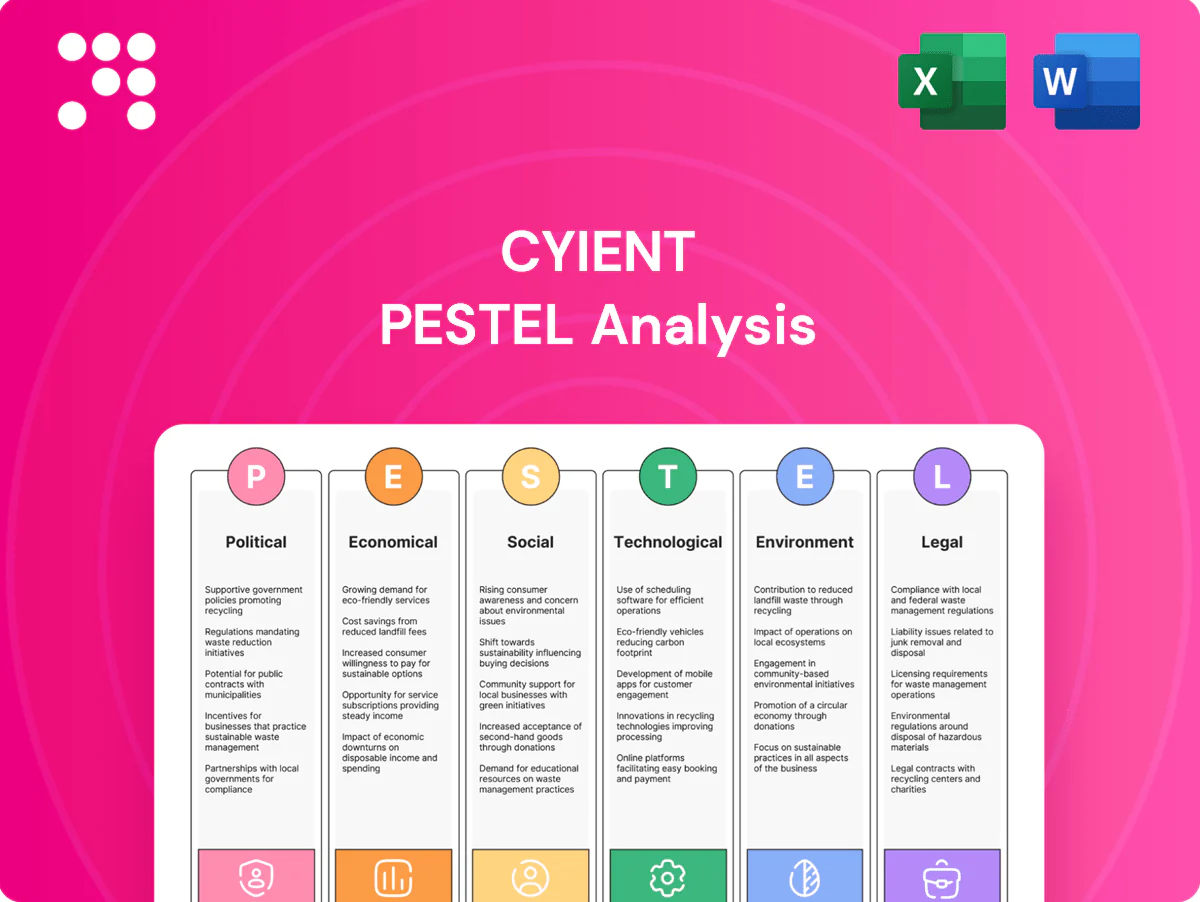
Cyient PESTLE Analysis

Skip the Research. Get the Strategy.
Unlock strategic clarity with our PESTLE Analysis of Cyient—three to five expert-level insights into political, economic, and technological forces shaping its future. Ideal for investors and strategists, this concise briefing highlights risks and growth areas. Buy the full report to get the complete, actionable breakdown instantly.
Political factors

Defense procurement policies
Government defense budgets and offset requirements—US FY2025 request ~$858B, India 2024–25 budget ₹5.94 lakh crore (~$72B), NATO members combine >$1.1T—shape pipeline timing and contract values for aerospace and defense programs. Tightened export controls and ITAR updates force alternate delivery models and reshuffle supply chains. Cyient must meet local-content and capability-building offsets to win strategic programs, and stability in US, EU, India and Australia reduces award uncertainty.
Trade tensions and tariffs
Geopolitical frictions raise input costs, slow cross-border collaboration and delay certifications, with US Section 301 tariffs still imposing up to 25% on roughly $250bn of Chinese imports, squeezing margins on electronics and semiconductors. Tariff shifts on metals, electronics or chips directly affect project profitability, so Cyient requires multi-country sourcing and hard pricing clauses to mitigate volatility. Diplomatic normalization can unlock new partnerships and joint ventures.

Infrastructure and digital policy
National pushes for 5G rollout and 100 Smart Cities plus large rail modernization programs are driving demand across communications and transportation; India’s 2022 5G spectrum auction fetched about Rs 1.5 lakh crore, accelerating deployments. Spectrum policy and targeted rural-connectivity funds from central schemes shape roll‑out timing and vendor choice. Public‑private pilots for digital twins and IoT—often state-backed—can be fast‑tracked through PPPs. Cyient can leverage its engineering and systems‑integration capabilities to win implementation contracts for state modernization programs.

Offsets and localization
Many governments require technology transfer and local employment for large contracts; Cyient’s global delivery model and nearshore centers help meet localization targets, enabling deeper market access but increasing compliance and onboarding costs. Cyient reported FY2024 revenue of INR 5,372 crore (≈USD 640m), supporting investments in local partnerships with universities and SMEs to strengthen bids.
- Localization mandates raise compliance costs
- Nearshore centers enable target achievement
- FY2024 revenue INR 5,372 crore
- University/SME partnerships boost competitiveness
Regulatory stability and incentives
Regulatory stability in India and key markets—through tax incentives, R&D credits and SEZ benefits—reduces Cyient’s operating costs and supports pricing for long-duration engineering programs, while sudden policy reversals can disrupt hiring and capital allocation; predictable public procurement cycles improve revenue forecasting; Cyient can engage industry bodies to advocate pro-innovation frameworks.
- Tax incentives: lower operating cost
- R&D credits: boost innovation investment
- SEZs: enable cost-competitive delivery
- Policy risk: hiring/capex disruption
- Procurement predictability: aids forecasting
- Lobbying: shape pro-innovation rules
US $858B, India ₹5.94L cr, NATO >$1.1T: Budgets and tariffs reshape aerospace supply chains
Government defense budgets (US FY2025 ~$858B; India 2024–25 ₹5.94 lakh crore ≈$72B; NATO >$1.1T) shape aerospace/defense pipelines and contract values. Tightened export controls and US Section 301 tariffs (up to 25% on ≈$250B) force alternate supply chains and raise compliance costs. State programs—India 5G auction ≈Rs 1.5 lakh crore—plus Cyient FY2024 revenue INR 5,372 crore guide localization and bidding strategy.
| Item | 2024/25 figure |
|---|---|
| US defense request | $858B |
| India defense budget | ₹5.94L crore (~$72B) |
| NATO spend | >$1.1T |
| Cyient FY2024 revenue | INR 5,372 crore |
| India 5G auction | ≈Rs 1.5L crore |
| Section 301 scope | Up to 25% on ≈$250B |
What is included in the product
 Detailed Word Document
Explores how external macro-environmental factors uniquely affect Cyient across Political, Economic, Social, Technological, Environmental and Legal dimensions; each section is data-backed, region- and industry-specific, delivered in clean format with forward-looking insights to aid executives, consultants and investors in scenario planning and strategy.

 Customizable Excel Spreadsheet
Concise, visually segmented Cyient PESTLE summary that eases meeting prep and can be dropped into presentations; editable for region or business-line notes and shareable across teams for quick alignment.
Economic factors

Global GDP and capex cycles
Engineering services revenues track customer capex in aerospace, energy and telecom; IMF projects global GDP growth of 3.1% in 2024 and 3.0% in 2025, so slowdowns delay product refreshes and fleet upgrades, pressuring utilization. Recoveries historically drive backlog growth and a shift to higher‑value digital work. Diversification across sectors smooths cyclicality and stabilizes cash flow.
Currency fluctuations
Revenues denominated in USD/EUR — over 90% of Cyient’s topline is export-linked — drive margin variability versus INR or other delivery currencies, making FX movement material to profitability. Hedging policies, including forwards and natural offsets from geographically diversified delivery centers, are vital for cashflow predictability and were highlighted in recent investor disclosures. Large multi-year contracts require explicit FX clauses to protect pricing, while increased nearshore delivery can help balance currency exposures.

Labor market and wage inflation
Tight engineering talent markets push Cyient's wage and attrition pressure—attrition ran near 22% in FY2024 while average annual salary inflation in Indian engineering services reached about 10% in 2024, raising delivery costs.
Strategic reskilling and pyramid optimization have preserved gross margins, cutting bench and hiring costs and helping protect roughly 100–200 basis points of margin dilution in recent quarters.
Automation and reusable IP (platforms, toolkits) have increased productivity per FTE, enabling higher revenue per employee and contributing to margin recovery; geographic diversification (India, Poland, US, APAC) reduces exposure to single-country wage shocks.

Supply chain constraints
Component shortages and logistics bottlenecks can delay Cyient prototyping and manufacturing services, with component lead times commonly stretching 8–20 weeks in volatile cycles. Early design-for-availability reduces program risk and rework. Multi-sourcing and inventory buffers protect milestones. Clients increasingly select partners who de-risk schedules amid ongoing supply volatility.
- Design-for-availability
- Multi-sourcing
- Inventory buffers
- Schedule de-risking
Client consolidation and pricing power
Consolidation among OEMs and operators has increased procurement leverage, pushing service suppliers like Cyient to accept sharper rate cards and outcome-based pricing in multi-year framework agreements. Cyient's emphasis on domain depth and proprietary IP enables premium capture and higher-margin deals, while reference wins in regulated sectors (aerospace, utilities, rail) strengthen its negotiating position with larger, consolidated clients. This shifts revenue mix toward strategic, outcome-linked contracts.
- Procurement leverage: higher
- Pricing: outcome-based, sharper rate cards
- Differentiation: domain depth + IP = premium
- Negotiation: strengthened by regulated-industry references
US $858B, India ₹5.94L cr, NATO >$1.1T: Budgets and tariffs reshape aerospace supply chains
Macro growth slowing (IMF: GDP +3.1% 2024, +3.0% 2025) pressures capex-led engineering demand but recoveries boost backlog and digital mix. >90% export revenue exposes margins to USD/EUR-INR moves; hedging and nearshoring limit volatility. FY2024 attrition ~22% and ~10% salary inflation raise costs; automation, reskilling and IP offset ~100–200bps margin impact.
| Metric | Value |
|---|---|
| IMF GDP | 3.1% (2024)/3.0% (2025) |
| Export share | >90% |
| Attrition | ~22% FY2024 |
| Salary inflation | ~10% 2024 |
Same Document Delivered
Cyient PESTLE Analysis
The preview shown here is the exact Cyient PESTLE Analysis document you’ll receive after purchase—fully formatted, professionally structured, and ready to use. It contains the same content, layout, and insights visible now, with no placeholders or surprises. After payment you’ll instantly download this final file.

Skip the Research. Get the Strategy.
Unlock strategic clarity with our PESTLE Analysis of Cyient—three to five expert-level insights into political, economic, and technological forces shaping its future. Ideal for investors and strategists, this concise briefing highlights risks and growth areas. Buy the full report to get the complete, actionable breakdown instantly.
Political factors
Defense procurement policies
Government defense budgets and offset requirements—US FY2025 request ~$858B, India 2024–25 budget ₹5.94 lakh crore (~$72B), NATO members combine >$1.1T—shape pipeline timing and contract values for aerospace and defense programs. Tightened export controls and ITAR updates force alternate delivery models and reshuffle supply chains. Cyient must meet local-content and capability-building offsets to win strategic programs, and stability in US, EU, India and Australia reduces award uncertainty.
Trade tensions and tariffs
Geopolitical frictions raise input costs, slow cross-border collaboration and delay certifications, with US Section 301 tariffs still imposing up to 25% on roughly $250bn of Chinese imports, squeezing margins on electronics and semiconductors. Tariff shifts on metals, electronics or chips directly affect project profitability, so Cyient requires multi-country sourcing and hard pricing clauses to mitigate volatility. Diplomatic normalization can unlock new partnerships and joint ventures.
Infrastructure and digital policy
National pushes for 5G rollout and 100 Smart Cities plus large rail modernization programs are driving demand across communications and transportation; India’s 2022 5G spectrum auction fetched about Rs 1.5 lakh crore, accelerating deployments. Spectrum policy and targeted rural-connectivity funds from central schemes shape roll‑out timing and vendor choice. Public‑private pilots for digital twins and IoT—often state-backed—can be fast‑tracked through PPPs. Cyient can leverage its engineering and systems‑integration capabilities to win implementation contracts for state modernization programs.
Offsets and localization
Many governments require technology transfer and local employment for large contracts; Cyient’s global delivery model and nearshore centers help meet localization targets, enabling deeper market access but increasing compliance and onboarding costs. Cyient reported FY2024 revenue of INR 5,372 crore (≈USD 640m), supporting investments in local partnerships with universities and SMEs to strengthen bids.
- Localization mandates raise compliance costs
- Nearshore centers enable target achievement
- FY2024 revenue INR 5,372 crore
- University/SME partnerships boost competitiveness
Regulatory stability and incentives
Regulatory stability in India and key markets—through tax incentives, R&D credits and SEZ benefits—reduces Cyient’s operating costs and supports pricing for long-duration engineering programs, while sudden policy reversals can disrupt hiring and capital allocation; predictable public procurement cycles improve revenue forecasting; Cyient can engage industry bodies to advocate pro-innovation frameworks.
- Tax incentives: lower operating cost
- R&D credits: boost innovation investment
- SEZs: enable cost-competitive delivery
- Policy risk: hiring/capex disruption
- Procurement predictability: aids forecasting
- Lobbying: shape pro-innovation rules
US $858B, India ₹5.94L cr, NATO >$1.1T: Budgets and tariffs reshape aerospace supply chains
Government defense budgets (US FY2025 ~$858B; India 2024–25 ₹5.94 lakh crore ≈$72B; NATO >$1.1T) shape aerospace/defense pipelines and contract values. Tightened export controls and US Section 301 tariffs (up to 25% on ≈$250B) force alternate supply chains and raise compliance costs. State programs—India 5G auction ≈Rs 1.5 lakh crore—plus Cyient FY2024 revenue INR 5,372 crore guide localization and bidding strategy.
| Item | 2024/25 figure |
|---|---|
| US defense request | $858B |
| India defense budget | ₹5.94L crore (~$72B) |
| NATO spend | >$1.1T |
| Cyient FY2024 revenue | INR 5,372 crore |
| India 5G auction | ≈Rs 1.5L crore |
| Section 301 scope | Up to 25% on ≈$250B |
What is included in the product
Detailed Word Document
Explores how external macro-environmental factors uniquely affect Cyient across Political, Economic, Social, Technological, Environmental and Legal dimensions; each section is data-backed, region- and industry-specific, delivered in clean format with forward-looking insights to aid executives, consultants and investors in scenario planning and strategy.
Customizable Excel Spreadsheet
Concise, visually segmented Cyient PESTLE summary that eases meeting prep and can be dropped into presentations; editable for region or business-line notes and shareable across teams for quick alignment.
Economic factors
Global GDP and capex cycles
Engineering services revenues track customer capex in aerospace, energy and telecom; IMF projects global GDP growth of 3.1% in 2024 and 3.0% in 2025, so slowdowns delay product refreshes and fleet upgrades, pressuring utilization. Recoveries historically drive backlog growth and a shift to higher‑value digital work. Diversification across sectors smooths cyclicality and stabilizes cash flow.
Currency fluctuations
Revenues denominated in USD/EUR — over 90% of Cyient’s topline is export-linked — drive margin variability versus INR or other delivery currencies, making FX movement material to profitability. Hedging policies, including forwards and natural offsets from geographically diversified delivery centers, are vital for cashflow predictability and were highlighted in recent investor disclosures. Large multi-year contracts require explicit FX clauses to protect pricing, while increased nearshore delivery can help balance currency exposures.
Labor market and wage inflation
Tight engineering talent markets push Cyient's wage and attrition pressure—attrition ran near 22% in FY2024 while average annual salary inflation in Indian engineering services reached about 10% in 2024, raising delivery costs.
Strategic reskilling and pyramid optimization have preserved gross margins, cutting bench and hiring costs and helping protect roughly 100–200 basis points of margin dilution in recent quarters.
Automation and reusable IP (platforms, toolkits) have increased productivity per FTE, enabling higher revenue per employee and contributing to margin recovery; geographic diversification (India, Poland, US, APAC) reduces exposure to single-country wage shocks.
Supply chain constraints
Component shortages and logistics bottlenecks can delay Cyient prototyping and manufacturing services, with component lead times commonly stretching 8–20 weeks in volatile cycles. Early design-for-availability reduces program risk and rework. Multi-sourcing and inventory buffers protect milestones. Clients increasingly select partners who de-risk schedules amid ongoing supply volatility.
- Design-for-availability
- Multi-sourcing
- Inventory buffers
- Schedule de-risking
Client consolidation and pricing power
Consolidation among OEMs and operators has increased procurement leverage, pushing service suppliers like Cyient to accept sharper rate cards and outcome-based pricing in multi-year framework agreements. Cyient's emphasis on domain depth and proprietary IP enables premium capture and higher-margin deals, while reference wins in regulated sectors (aerospace, utilities, rail) strengthen its negotiating position with larger, consolidated clients. This shifts revenue mix toward strategic, outcome-linked contracts.
- Procurement leverage: higher
- Pricing: outcome-based, sharper rate cards
- Differentiation: domain depth + IP = premium
- Negotiation: strengthened by regulated-industry references
US $858B, India ₹5.94L cr, NATO >$1.1T: Budgets and tariffs reshape aerospace supply chains
Macro growth slowing (IMF: GDP +3.1% 2024, +3.0% 2025) pressures capex-led engineering demand but recoveries boost backlog and digital mix. >90% export revenue exposes margins to USD/EUR-INR moves; hedging and nearshoring limit volatility. FY2024 attrition ~22% and ~10% salary inflation raise costs; automation, reskilling and IP offset ~100–200bps margin impact.
| Metric | Value |
|---|---|
| IMF GDP | 3.1% (2024)/3.0% (2025) |
| Export share | >90% |
| Attrition | ~22% FY2024 |
| Salary inflation | ~10% 2024 |
Same Document Delivered
Cyient PESTLE Analysis
The preview shown here is the exact Cyient PESTLE Analysis document you’ll receive after purchase—fully formatted, professionally structured, and ready to use. It contains the same content, layout, and insights visible now, with no placeholders or surprises. After payment you’ll instantly download this final file.
Original: $10.00
-65%$10.00
$3.50Description
Skip the Research. Get the Strategy.
Unlock strategic clarity with our PESTLE Analysis of Cyient—three to five expert-level insights into political, economic, and technological forces shaping its future. Ideal for investors and strategists, this concise briefing highlights risks and growth areas. Buy the full report to get the complete, actionable breakdown instantly.
Political factors
Defense procurement policies
Government defense budgets and offset requirements—US FY2025 request ~$858B, India 2024–25 budget ₹5.94 lakh crore (~$72B), NATO members combine >$1.1T—shape pipeline timing and contract values for aerospace and defense programs. Tightened export controls and ITAR updates force alternate delivery models and reshuffle supply chains. Cyient must meet local-content and capability-building offsets to win strategic programs, and stability in US, EU, India and Australia reduces award uncertainty.
Trade tensions and tariffs
Geopolitical frictions raise input costs, slow cross-border collaboration and delay certifications, with US Section 301 tariffs still imposing up to 25% on roughly $250bn of Chinese imports, squeezing margins on electronics and semiconductors. Tariff shifts on metals, electronics or chips directly affect project profitability, so Cyient requires multi-country sourcing and hard pricing clauses to mitigate volatility. Diplomatic normalization can unlock new partnerships and joint ventures.
Infrastructure and digital policy
National pushes for 5G rollout and 100 Smart Cities plus large rail modernization programs are driving demand across communications and transportation; India’s 2022 5G spectrum auction fetched about Rs 1.5 lakh crore, accelerating deployments. Spectrum policy and targeted rural-connectivity funds from central schemes shape roll‑out timing and vendor choice. Public‑private pilots for digital twins and IoT—often state-backed—can be fast‑tracked through PPPs. Cyient can leverage its engineering and systems‑integration capabilities to win implementation contracts for state modernization programs.
Offsets and localization
Many governments require technology transfer and local employment for large contracts; Cyient’s global delivery model and nearshore centers help meet localization targets, enabling deeper market access but increasing compliance and onboarding costs. Cyient reported FY2024 revenue of INR 5,372 crore (≈USD 640m), supporting investments in local partnerships with universities and SMEs to strengthen bids.
- Localization mandates raise compliance costs
- Nearshore centers enable target achievement
- FY2024 revenue INR 5,372 crore
- University/SME partnerships boost competitiveness
Regulatory stability and incentives
Regulatory stability in India and key markets—through tax incentives, R&D credits and SEZ benefits—reduces Cyient’s operating costs and supports pricing for long-duration engineering programs, while sudden policy reversals can disrupt hiring and capital allocation; predictable public procurement cycles improve revenue forecasting; Cyient can engage industry bodies to advocate pro-innovation frameworks.
- Tax incentives: lower operating cost
- R&D credits: boost innovation investment
- SEZs: enable cost-competitive delivery
- Policy risk: hiring/capex disruption
- Procurement predictability: aids forecasting
- Lobbying: shape pro-innovation rules
US $858B, India ₹5.94L cr, NATO >$1.1T: Budgets and tariffs reshape aerospace supply chains
Government defense budgets (US FY2025 ~$858B; India 2024–25 ₹5.94 lakh crore ≈$72B; NATO >$1.1T) shape aerospace/defense pipelines and contract values. Tightened export controls and US Section 301 tariffs (up to 25% on ≈$250B) force alternate supply chains and raise compliance costs. State programs—India 5G auction ≈Rs 1.5 lakh crore—plus Cyient FY2024 revenue INR 5,372 crore guide localization and bidding strategy.
| Item | 2024/25 figure |
|---|---|
| US defense request | $858B |
| India defense budget | ₹5.94L crore (~$72B) |
| NATO spend | >$1.1T |
| Cyient FY2024 revenue | INR 5,372 crore |
| India 5G auction | ≈Rs 1.5L crore |
| Section 301 scope | Up to 25% on ≈$250B |
What is included in the product
Detailed Word Document
Explores how external macro-environmental factors uniquely affect Cyient across Political, Economic, Social, Technological, Environmental and Legal dimensions; each section is data-backed, region- and industry-specific, delivered in clean format with forward-looking insights to aid executives, consultants and investors in scenario planning and strategy.
Customizable Excel Spreadsheet
Concise, visually segmented Cyient PESTLE summary that eases meeting prep and can be dropped into presentations; editable for region or business-line notes and shareable across teams for quick alignment.
Economic factors
Global GDP and capex cycles
Engineering services revenues track customer capex in aerospace, energy and telecom; IMF projects global GDP growth of 3.1% in 2024 and 3.0% in 2025, so slowdowns delay product refreshes and fleet upgrades, pressuring utilization. Recoveries historically drive backlog growth and a shift to higher‑value digital work. Diversification across sectors smooths cyclicality and stabilizes cash flow.
Currency fluctuations
Revenues denominated in USD/EUR — over 90% of Cyient’s topline is export-linked — drive margin variability versus INR or other delivery currencies, making FX movement material to profitability. Hedging policies, including forwards and natural offsets from geographically diversified delivery centers, are vital for cashflow predictability and were highlighted in recent investor disclosures. Large multi-year contracts require explicit FX clauses to protect pricing, while increased nearshore delivery can help balance currency exposures.
Labor market and wage inflation
Tight engineering talent markets push Cyient's wage and attrition pressure—attrition ran near 22% in FY2024 while average annual salary inflation in Indian engineering services reached about 10% in 2024, raising delivery costs.
Strategic reskilling and pyramid optimization have preserved gross margins, cutting bench and hiring costs and helping protect roughly 100–200 basis points of margin dilution in recent quarters.
Automation and reusable IP (platforms, toolkits) have increased productivity per FTE, enabling higher revenue per employee and contributing to margin recovery; geographic diversification (India, Poland, US, APAC) reduces exposure to single-country wage shocks.
Supply chain constraints
Component shortages and logistics bottlenecks can delay Cyient prototyping and manufacturing services, with component lead times commonly stretching 8–20 weeks in volatile cycles. Early design-for-availability reduces program risk and rework. Multi-sourcing and inventory buffers protect milestones. Clients increasingly select partners who de-risk schedules amid ongoing supply volatility.
- Design-for-availability
- Multi-sourcing
- Inventory buffers
- Schedule de-risking
Client consolidation and pricing power
Consolidation among OEMs and operators has increased procurement leverage, pushing service suppliers like Cyient to accept sharper rate cards and outcome-based pricing in multi-year framework agreements. Cyient's emphasis on domain depth and proprietary IP enables premium capture and higher-margin deals, while reference wins in regulated sectors (aerospace, utilities, rail) strengthen its negotiating position with larger, consolidated clients. This shifts revenue mix toward strategic, outcome-linked contracts.
- Procurement leverage: higher
- Pricing: outcome-based, sharper rate cards
- Differentiation: domain depth + IP = premium
- Negotiation: strengthened by regulated-industry references
US $858B, India ₹5.94L cr, NATO >$1.1T: Budgets and tariffs reshape aerospace supply chains
Macro growth slowing (IMF: GDP +3.1% 2024, +3.0% 2025) pressures capex-led engineering demand but recoveries boost backlog and digital mix. >90% export revenue exposes margins to USD/EUR-INR moves; hedging and nearshoring limit volatility. FY2024 attrition ~22% and ~10% salary inflation raise costs; automation, reskilling and IP offset ~100–200bps margin impact.
| Metric | Value |
|---|---|
| IMF GDP | 3.1% (2024)/3.0% (2025) |
| Export share | >90% |
| Attrition | ~22% FY2024 |
| Salary inflation | ~10% 2024 |
Same Document Delivered
Cyient PESTLE Analysis
The preview shown here is the exact Cyient PESTLE Analysis document you’ll receive after purchase—fully formatted, professionally structured, and ready to use. It contains the same content, layout, and insights visible now, with no placeholders or surprises. After payment you’ll instantly download this final file.











