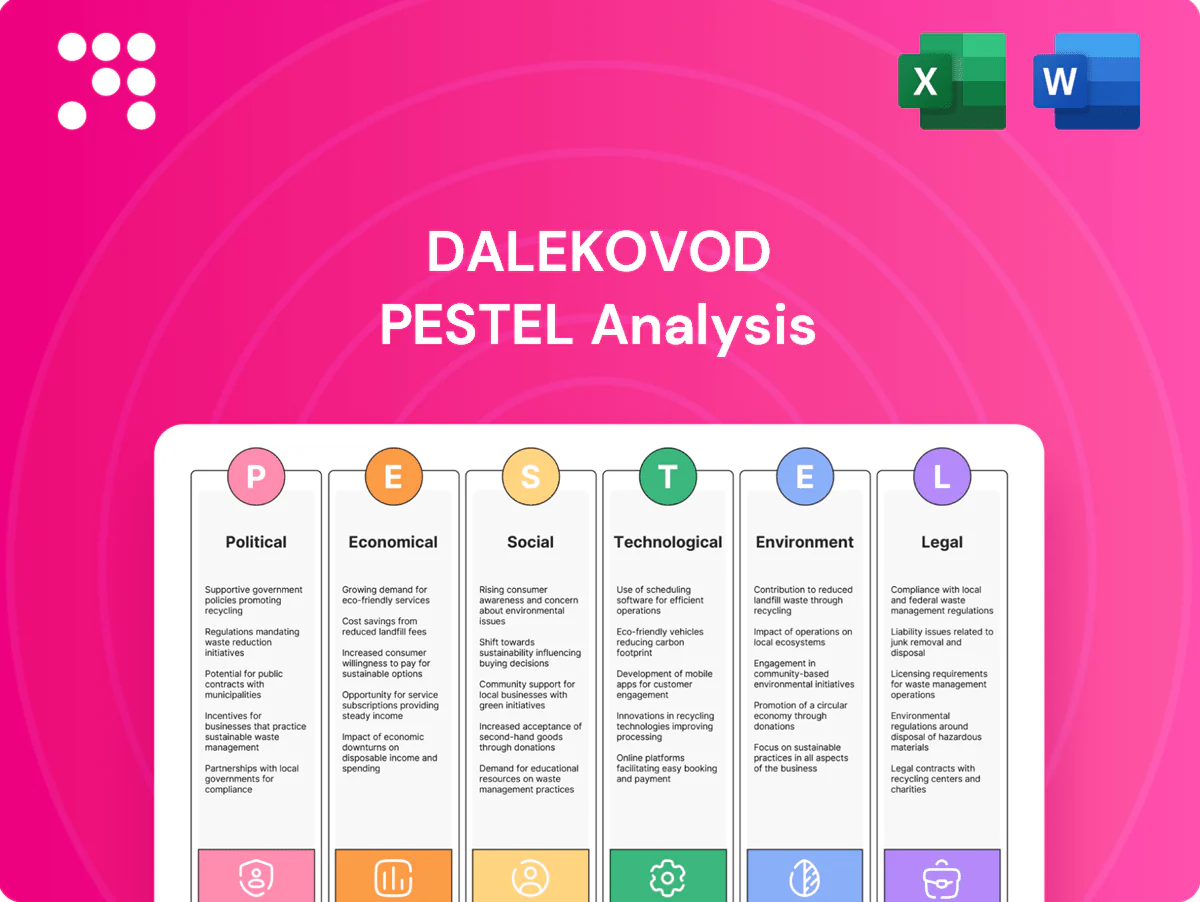
Dalekovod PESTLE Analysis

Your Competitive Advantage Starts with This Report
Our PESTLE analysis of Dalekovod reveals how political shifts, infrastructure spending, economic cycles, and technological trends shape its prospects. It highlights regulatory risks, environmental pressures, and social drivers affecting operations. Ideal for investors and strategists—buy the full report for actionable, downloadable insights.
Political factors

EU energy and cohesion policy alignment
EU Green Deal aims climate neutrality by 2050 and the 2030 renewables target was raised to 42.5–45%, while REPowerEU accelerates renewables and interconnectors to cut fossil-fuel reliance. Cohesion policy (~€330bn) and NextGenerationEU (€806.9bn) steer cross-border grid funding. Dalekovod can win EU-backed tenders prioritizing renewables integration; shifts in Brussels’ taxonomy or funding priorities could speed or delay pipelines, so active policy monitoring and consortium positioning are essential.
Croatian government priorities and SOE utilities
Croatian National Energy and Climate Plan 2021–2030 and HEP’s dominant role shape Dalekovod’s domestic pipeline, with HEP announcing roughly HRK 7.6bn capex for 2024 that steers grid and generation tenders. Budget cycles and election timing materially affect public-investment execution and tender flow volatility. Policy continuity provides multiyear EPC visibility for transmission and renewables. Leadership changes can re-rank projects or slow procurement pace.

Regional geopolitics and Western Balkans stability
Infrastructure demand in the Western Balkans is supported by EU IPA III funds of 14.2 billion EUR (2021–2027), but political frictions can stall permitting and cross‑border logistics, delaying projects and altering financing terms from lenders like EBRD, World Bank or EXIM Bank. Dalekovod’s regional footprint requires diversified market exposure and contingency planning for border, customs and security risks.

Local content and industrial policy pressures
Governments increasingly favor domestic manufacturing and workforce use in tenders, raising the importance of Dalekovod’s in-country steel fabrication and EPC capabilities for compliance and competitive scoring. Policy shifts on local content and industrial incentives can change sourcing economics and bid evaluation criteria, so Dalekovod should highlight local value-add in bids and cost models. Early engagement on industrial partnerships and workforce development reduces execution and bid-risk.
- Leverage Dalekovod steel fabrication to meet local content requirements
- Highlight domestic workforce use in tender scoring
- Monitor policy shifts affecting sourcing economics
- Pursue early industrial partnerships to mitigate bid and delivery risk
Permitting reform and administrative capacity
Streamlined permitting for transmission corridors can de-risk schedules and align with EU measures pushing one-year fast-track permitting for priority energy projects introduced under 2023–2024 reforms, reducing exposure to protracted delays.
Bureaucratic delays raise holding costs and claims; Dalekovod gains from early permitting diligence, stakeholder mapping and advocacy for one-stop-shop approaches to improve cycle times and execution certainty.
- Permitting: EU one-year fast-track for priority projects (2023–24)
- Risk: delays → higher holding costs and claims
- Action: early diligence + stakeholder mapping
- Advocacy: one-stop-shop reduces cycle times
EU renewables 42.5–45%; €806.9bn pipeline; Croatia HRK 7.6bn capex
EU 42.5–45% 2030 renewables target and NextGenerationEU €806.9bn/REPowerEU boost pipeline; Croatia HEP capex ~HRK 7.6bn in 2024 shapes domestic tenders; IPA III €14.2bn (2021–27) supports Western Balkans but political frictions risk delays; one-year fast-track permitting (2023–24) lowers schedule risk—active policy monitoring and local-content positioning required.
| Item | 2024/25 Figure |
|---|---|
| EU NextGen/REPowerEU | €806.9bn |
| 2030 renewables target | 42.5–45% |
| Croatia HEP capex 2024 | HRK 7.6bn |
| IPA III (2021–27) | €14.2bn |
| Fast-track permitting | 1 year |
What is included in the product
 Detailed Word Document
Explores how Political, Economic, Social, Technological, Environmental and Legal forces shape Dalekovod’s strategic position, using region- and sector-specific data and trends to identify risks and opportunities. Designed for executives and investors to inform scenario planning, funding and operational decisions.

 Customizable Excel Spreadsheet
A concise, visually segmented Dalekovod PESTLE summary that eases meeting prep, supports risk discussions and can be dropped into presentations or shared across teams.
Economic factors

Grid investment cycle and renewables integration
Mass renewable additions require new lines, substations and reinforcements, driving multiyear EPC demand across CEE and the Balkans; ENTSO-E’s TYNDP highlights urgent transmission upgrades to integrate variable generation. EU targets at least 42.5% renewables by 2030, underpinning sustained investment. Timing hinges on grid operators’ balance sheets and allowed regulatory returns, so Dalekovod’s backlog resilience is directly tied to this investment cycle.
Commodity prices and steel cost volatility
Steel inputs represent roughly 40% of tower and lattice structure costs for Dalekovod, so HRC price moves (about €900/ton in mid‑2025) materially compress margins. Sharp swings can erase gains on fixed‑price EPC contracts, making indexation clauses and steel hedges essential in bids. Active supplier diversification and safety‑stock inventory strategies limit procurement shocks and stabilize project cashflow.

Interest rates and project financing conditions
Rising policy rates—ECB main rate around 4% in mid‑2025—push up WACC for utilities and often delay FIDs as financing costs climb. EU instruments like the Recovery and Resilience Facility (EUR 723.8bn) and EBRD concessional loans can partially offset capital costs. Dalekovod faces tighter client budgets and more aggressive tendering, while stretched payment terms and reduced advance payments squeeze working capital.

Currency exposure and export markets
Croatia adopted the euro on 1 January 2023, removing domestic currency risk for Dalekovod but the company still faces multi-currency exposure from exports and foreign contracts. Contracts require FX clauses and use of natural hedges (revenue-cost currency matching) to mitigate volatility. Work in emerging markets carries convertibility and transfer risks; strict treasury discipline and centralized FX policy protect project margins.
- Euro adoption: 1 January 2023
- Export FX exposure: multi-currency
- Mitigation: FX clauses, natural hedges
- Risk: emerging-market convertibility
- Control: centralized treasury discipline
Supply chain resilience and logistics
Global disruptions have stretched lead times for steel, insulators, conductors and transformers to as much as 40–52 weeks in 2023–24, prompting Dalekovod to use early procurement and framework agreements to secure critical items and stabilize margins.
Rising transport costs and corridor congestion can add 1–3 weeks to site schedules and increase logistics spend; nearshoring and regional suppliers have cut import lead times by roughly 20–30% in recent projects.
- lead-times: 40–52 weeks
- transport delays: +1–3 weeks
- nearshoring benefit: ~20–30% shorter lead-time
- mitigation: early procurement, framework agreements
EU renewables 42.5–45%; €806.9bn pipeline; Croatia HRK 7.6bn capex
Renewables-driven transmission demand supports multiyear EPC flows; ENTSO-E TYNDP urgency underpins backlog stability. HRC ~€900/t (mid‑2025) and 40–52 week lead times squeeze margins; indexation, hedges and early procurement mitigate. ECB rate ~4% raises WACC; RRF €723.8bn and EBRD loans ease financing; euro adoption (1‑Jan‑2023) cuts FX risk.
| Metric | Value |
|---|---|
| HRC price | €900/t (mid‑2025) |
| Lead times | 40–52 weeks |
| ECB rate | ≈4% (mid‑2025) |
Full Version Awaits
Dalekovod PESTLE Analysis
This Dalekovod PESTLE Analysis preview is the exact document you’ll receive after purchase — fully formatted, professionally structured, and ready to use. The content, layout, and insights shown here match the downloadable file you’ll get immediately after checkout. No placeholders, no surprises.

Your Competitive Advantage Starts with This Report
Our PESTLE analysis of Dalekovod reveals how political shifts, infrastructure spending, economic cycles, and technological trends shape its prospects. It highlights regulatory risks, environmental pressures, and social drivers affecting operations. Ideal for investors and strategists—buy the full report for actionable, downloadable insights.
Political factors
EU energy and cohesion policy alignment
EU Green Deal aims climate neutrality by 2050 and the 2030 renewables target was raised to 42.5–45%, while REPowerEU accelerates renewables and interconnectors to cut fossil-fuel reliance. Cohesion policy (~€330bn) and NextGenerationEU (€806.9bn) steer cross-border grid funding. Dalekovod can win EU-backed tenders prioritizing renewables integration; shifts in Brussels’ taxonomy or funding priorities could speed or delay pipelines, so active policy monitoring and consortium positioning are essential.
Croatian government priorities and SOE utilities
Croatian National Energy and Climate Plan 2021–2030 and HEP’s dominant role shape Dalekovod’s domestic pipeline, with HEP announcing roughly HRK 7.6bn capex for 2024 that steers grid and generation tenders. Budget cycles and election timing materially affect public-investment execution and tender flow volatility. Policy continuity provides multiyear EPC visibility for transmission and renewables. Leadership changes can re-rank projects or slow procurement pace.
Regional geopolitics and Western Balkans stability
Infrastructure demand in the Western Balkans is supported by EU IPA III funds of 14.2 billion EUR (2021–2027), but political frictions can stall permitting and cross‑border logistics, delaying projects and altering financing terms from lenders like EBRD, World Bank or EXIM Bank. Dalekovod’s regional footprint requires diversified market exposure and contingency planning for border, customs and security risks.
Local content and industrial policy pressures
Governments increasingly favor domestic manufacturing and workforce use in tenders, raising the importance of Dalekovod’s in-country steel fabrication and EPC capabilities for compliance and competitive scoring. Policy shifts on local content and industrial incentives can change sourcing economics and bid evaluation criteria, so Dalekovod should highlight local value-add in bids and cost models. Early engagement on industrial partnerships and workforce development reduces execution and bid-risk.
- Leverage Dalekovod steel fabrication to meet local content requirements
- Highlight domestic workforce use in tender scoring
- Monitor policy shifts affecting sourcing economics
- Pursue early industrial partnerships to mitigate bid and delivery risk
Permitting reform and administrative capacity
Streamlined permitting for transmission corridors can de-risk schedules and align with EU measures pushing one-year fast-track permitting for priority energy projects introduced under 2023–2024 reforms, reducing exposure to protracted delays.
Bureaucratic delays raise holding costs and claims; Dalekovod gains from early permitting diligence, stakeholder mapping and advocacy for one-stop-shop approaches to improve cycle times and execution certainty.
- Permitting: EU one-year fast-track for priority projects (2023–24)
- Risk: delays → higher holding costs and claims
- Action: early diligence + stakeholder mapping
- Advocacy: one-stop-shop reduces cycle times
EU renewables 42.5–45%; €806.9bn pipeline; Croatia HRK 7.6bn capex
EU 42.5–45% 2030 renewables target and NextGenerationEU €806.9bn/REPowerEU boost pipeline; Croatia HEP capex ~HRK 7.6bn in 2024 shapes domestic tenders; IPA III €14.2bn (2021–27) supports Western Balkans but political frictions risk delays; one-year fast-track permitting (2023–24) lowers schedule risk—active policy monitoring and local-content positioning required.
| Item | 2024/25 Figure |
|---|---|
| EU NextGen/REPowerEU | €806.9bn |
| 2030 renewables target | 42.5–45% |
| Croatia HEP capex 2024 | HRK 7.6bn |
| IPA III (2021–27) | €14.2bn |
| Fast-track permitting | 1 year |
What is included in the product
Detailed Word Document
Explores how Political, Economic, Social, Technological, Environmental and Legal forces shape Dalekovod’s strategic position, using region- and sector-specific data and trends to identify risks and opportunities. Designed for executives and investors to inform scenario planning, funding and operational decisions.
Customizable Excel Spreadsheet
A concise, visually segmented Dalekovod PESTLE summary that eases meeting prep, supports risk discussions and can be dropped into presentations or shared across teams.
Economic factors
Grid investment cycle and renewables integration
Mass renewable additions require new lines, substations and reinforcements, driving multiyear EPC demand across CEE and the Balkans; ENTSO-E’s TYNDP highlights urgent transmission upgrades to integrate variable generation. EU targets at least 42.5% renewables by 2030, underpinning sustained investment. Timing hinges on grid operators’ balance sheets and allowed regulatory returns, so Dalekovod’s backlog resilience is directly tied to this investment cycle.
Commodity prices and steel cost volatility
Steel inputs represent roughly 40% of tower and lattice structure costs for Dalekovod, so HRC price moves (about €900/ton in mid‑2025) materially compress margins. Sharp swings can erase gains on fixed‑price EPC contracts, making indexation clauses and steel hedges essential in bids. Active supplier diversification and safety‑stock inventory strategies limit procurement shocks and stabilize project cashflow.
Interest rates and project financing conditions
Rising policy rates—ECB main rate around 4% in mid‑2025—push up WACC for utilities and often delay FIDs as financing costs climb. EU instruments like the Recovery and Resilience Facility (EUR 723.8bn) and EBRD concessional loans can partially offset capital costs. Dalekovod faces tighter client budgets and more aggressive tendering, while stretched payment terms and reduced advance payments squeeze working capital.
Currency exposure and export markets
Croatia adopted the euro on 1 January 2023, removing domestic currency risk for Dalekovod but the company still faces multi-currency exposure from exports and foreign contracts. Contracts require FX clauses and use of natural hedges (revenue-cost currency matching) to mitigate volatility. Work in emerging markets carries convertibility and transfer risks; strict treasury discipline and centralized FX policy protect project margins.
- Euro adoption: 1 January 2023
- Export FX exposure: multi-currency
- Mitigation: FX clauses, natural hedges
- Risk: emerging-market convertibility
- Control: centralized treasury discipline
Supply chain resilience and logistics
Global disruptions have stretched lead times for steel, insulators, conductors and transformers to as much as 40–52 weeks in 2023–24, prompting Dalekovod to use early procurement and framework agreements to secure critical items and stabilize margins.
Rising transport costs and corridor congestion can add 1–3 weeks to site schedules and increase logistics spend; nearshoring and regional suppliers have cut import lead times by roughly 20–30% in recent projects.
- lead-times: 40–52 weeks
- transport delays: +1–3 weeks
- nearshoring benefit: ~20–30% shorter lead-time
- mitigation: early procurement, framework agreements
EU renewables 42.5–45%; €806.9bn pipeline; Croatia HRK 7.6bn capex
Renewables-driven transmission demand supports multiyear EPC flows; ENTSO-E TYNDP urgency underpins backlog stability. HRC ~€900/t (mid‑2025) and 40–52 week lead times squeeze margins; indexation, hedges and early procurement mitigate. ECB rate ~4% raises WACC; RRF €723.8bn and EBRD loans ease financing; euro adoption (1‑Jan‑2023) cuts FX risk.
| Metric | Value |
|---|---|
| HRC price | €900/t (mid‑2025) |
| Lead times | 40–52 weeks |
| ECB rate | ≈4% (mid‑2025) |
Full Version Awaits
Dalekovod PESTLE Analysis
This Dalekovod PESTLE Analysis preview is the exact document you’ll receive after purchase — fully formatted, professionally structured, and ready to use. The content, layout, and insights shown here match the downloadable file you’ll get immediately after checkout. No placeholders, no surprises.
Original: $10.00
-65%$10.00
$3.50Description
Your Competitive Advantage Starts with This Report
Our PESTLE analysis of Dalekovod reveals how political shifts, infrastructure spending, economic cycles, and technological trends shape its prospects. It highlights regulatory risks, environmental pressures, and social drivers affecting operations. Ideal for investors and strategists—buy the full report for actionable, downloadable insights.
Political factors
EU energy and cohesion policy alignment
EU Green Deal aims climate neutrality by 2050 and the 2030 renewables target was raised to 42.5–45%, while REPowerEU accelerates renewables and interconnectors to cut fossil-fuel reliance. Cohesion policy (~€330bn) and NextGenerationEU (€806.9bn) steer cross-border grid funding. Dalekovod can win EU-backed tenders prioritizing renewables integration; shifts in Brussels’ taxonomy or funding priorities could speed or delay pipelines, so active policy monitoring and consortium positioning are essential.
Croatian government priorities and SOE utilities
Croatian National Energy and Climate Plan 2021–2030 and HEP’s dominant role shape Dalekovod’s domestic pipeline, with HEP announcing roughly HRK 7.6bn capex for 2024 that steers grid and generation tenders. Budget cycles and election timing materially affect public-investment execution and tender flow volatility. Policy continuity provides multiyear EPC visibility for transmission and renewables. Leadership changes can re-rank projects or slow procurement pace.
Regional geopolitics and Western Balkans stability
Infrastructure demand in the Western Balkans is supported by EU IPA III funds of 14.2 billion EUR (2021–2027), but political frictions can stall permitting and cross‑border logistics, delaying projects and altering financing terms from lenders like EBRD, World Bank or EXIM Bank. Dalekovod’s regional footprint requires diversified market exposure and contingency planning for border, customs and security risks.
Local content and industrial policy pressures
Governments increasingly favor domestic manufacturing and workforce use in tenders, raising the importance of Dalekovod’s in-country steel fabrication and EPC capabilities for compliance and competitive scoring. Policy shifts on local content and industrial incentives can change sourcing economics and bid evaluation criteria, so Dalekovod should highlight local value-add in bids and cost models. Early engagement on industrial partnerships and workforce development reduces execution and bid-risk.
- Leverage Dalekovod steel fabrication to meet local content requirements
- Highlight domestic workforce use in tender scoring
- Monitor policy shifts affecting sourcing economics
- Pursue early industrial partnerships to mitigate bid and delivery risk
Permitting reform and administrative capacity
Streamlined permitting for transmission corridors can de-risk schedules and align with EU measures pushing one-year fast-track permitting for priority energy projects introduced under 2023–2024 reforms, reducing exposure to protracted delays.
Bureaucratic delays raise holding costs and claims; Dalekovod gains from early permitting diligence, stakeholder mapping and advocacy for one-stop-shop approaches to improve cycle times and execution certainty.
- Permitting: EU one-year fast-track for priority projects (2023–24)
- Risk: delays → higher holding costs and claims
- Action: early diligence + stakeholder mapping
- Advocacy: one-stop-shop reduces cycle times
EU renewables 42.5–45%; €806.9bn pipeline; Croatia HRK 7.6bn capex
EU 42.5–45% 2030 renewables target and NextGenerationEU €806.9bn/REPowerEU boost pipeline; Croatia HEP capex ~HRK 7.6bn in 2024 shapes domestic tenders; IPA III €14.2bn (2021–27) supports Western Balkans but political frictions risk delays; one-year fast-track permitting (2023–24) lowers schedule risk—active policy monitoring and local-content positioning required.
| Item | 2024/25 Figure |
|---|---|
| EU NextGen/REPowerEU | €806.9bn |
| 2030 renewables target | 42.5–45% |
| Croatia HEP capex 2024 | HRK 7.6bn |
| IPA III (2021–27) | €14.2bn |
| Fast-track permitting | 1 year |
What is included in the product
Detailed Word Document
Explores how Political, Economic, Social, Technological, Environmental and Legal forces shape Dalekovod’s strategic position, using region- and sector-specific data and trends to identify risks and opportunities. Designed for executives and investors to inform scenario planning, funding and operational decisions.
Customizable Excel Spreadsheet
A concise, visually segmented Dalekovod PESTLE summary that eases meeting prep, supports risk discussions and can be dropped into presentations or shared across teams.
Economic factors
Grid investment cycle and renewables integration
Mass renewable additions require new lines, substations and reinforcements, driving multiyear EPC demand across CEE and the Balkans; ENTSO-E’s TYNDP highlights urgent transmission upgrades to integrate variable generation. EU targets at least 42.5% renewables by 2030, underpinning sustained investment. Timing hinges on grid operators’ balance sheets and allowed regulatory returns, so Dalekovod’s backlog resilience is directly tied to this investment cycle.
Commodity prices and steel cost volatility
Steel inputs represent roughly 40% of tower and lattice structure costs for Dalekovod, so HRC price moves (about €900/ton in mid‑2025) materially compress margins. Sharp swings can erase gains on fixed‑price EPC contracts, making indexation clauses and steel hedges essential in bids. Active supplier diversification and safety‑stock inventory strategies limit procurement shocks and stabilize project cashflow.
Interest rates and project financing conditions
Rising policy rates—ECB main rate around 4% in mid‑2025—push up WACC for utilities and often delay FIDs as financing costs climb. EU instruments like the Recovery and Resilience Facility (EUR 723.8bn) and EBRD concessional loans can partially offset capital costs. Dalekovod faces tighter client budgets and more aggressive tendering, while stretched payment terms and reduced advance payments squeeze working capital.
Currency exposure and export markets
Croatia adopted the euro on 1 January 2023, removing domestic currency risk for Dalekovod but the company still faces multi-currency exposure from exports and foreign contracts. Contracts require FX clauses and use of natural hedges (revenue-cost currency matching) to mitigate volatility. Work in emerging markets carries convertibility and transfer risks; strict treasury discipline and centralized FX policy protect project margins.
- Euro adoption: 1 January 2023
- Export FX exposure: multi-currency
- Mitigation: FX clauses, natural hedges
- Risk: emerging-market convertibility
- Control: centralized treasury discipline
Supply chain resilience and logistics
Global disruptions have stretched lead times for steel, insulators, conductors and transformers to as much as 40–52 weeks in 2023–24, prompting Dalekovod to use early procurement and framework agreements to secure critical items and stabilize margins.
Rising transport costs and corridor congestion can add 1–3 weeks to site schedules and increase logistics spend; nearshoring and regional suppliers have cut import lead times by roughly 20–30% in recent projects.
- lead-times: 40–52 weeks
- transport delays: +1–3 weeks
- nearshoring benefit: ~20–30% shorter lead-time
- mitigation: early procurement, framework agreements
EU renewables 42.5–45%; €806.9bn pipeline; Croatia HRK 7.6bn capex
Renewables-driven transmission demand supports multiyear EPC flows; ENTSO-E TYNDP urgency underpins backlog stability. HRC ~€900/t (mid‑2025) and 40–52 week lead times squeeze margins; indexation, hedges and early procurement mitigate. ECB rate ~4% raises WACC; RRF €723.8bn and EBRD loans ease financing; euro adoption (1‑Jan‑2023) cuts FX risk.
| Metric | Value |
|---|---|
| HRC price | €900/t (mid‑2025) |
| Lead times | 40–52 weeks |
| ECB rate | ≈4% (mid‑2025) |
Full Version Awaits
Dalekovod PESTLE Analysis
This Dalekovod PESTLE Analysis preview is the exact document you’ll receive after purchase — fully formatted, professionally structured, and ready to use. The content, layout, and insights shown here match the downloadable file you’ll get immediately after checkout. No placeholders, no surprises.











