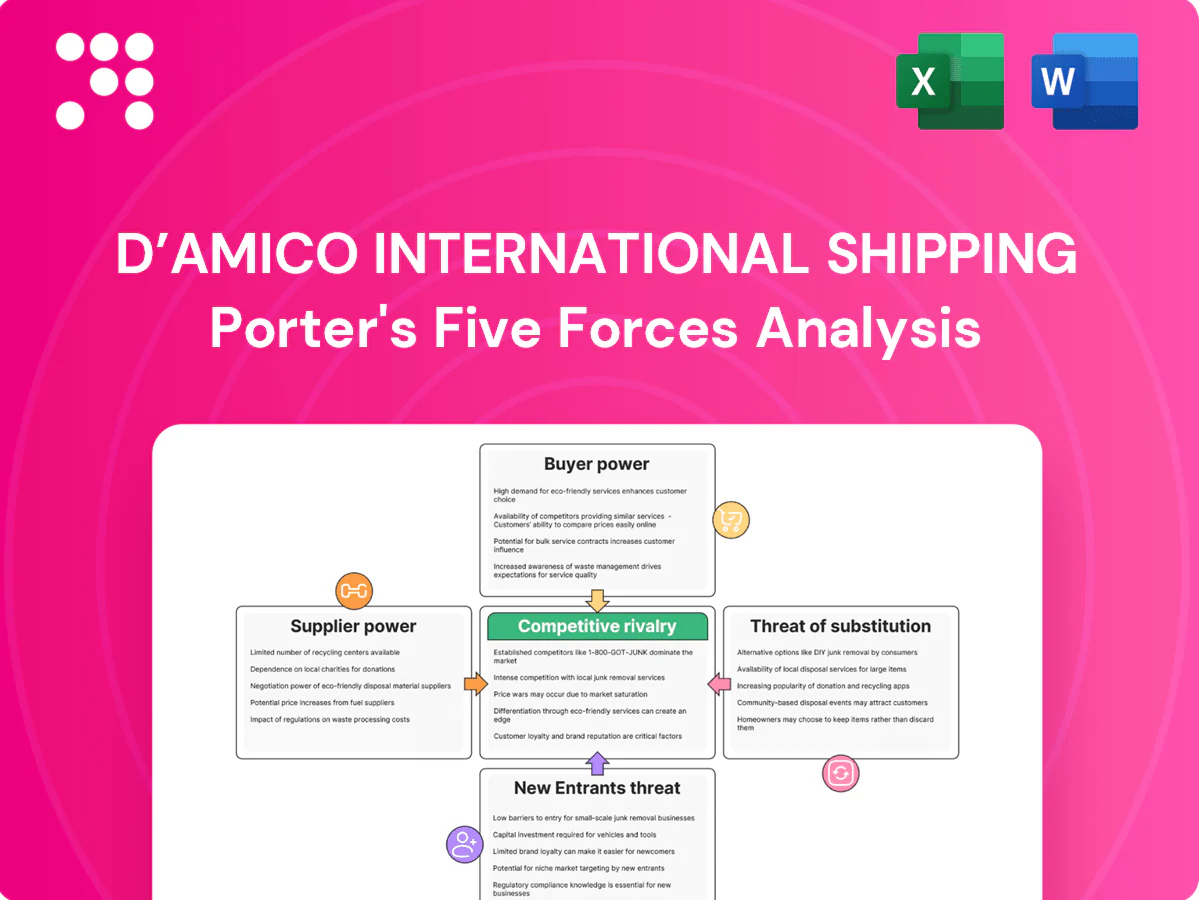
d’Amico International Shipping Porter's Five Forces Analysis

Elevate Your Analysis with the Complete Porter's Five Forces Analysis
d’Amico International Shipping faces intense competitive rivalry, cyclical freight rates and moderating buyer power from a handful of large charterers. Supplier influence is mixed—shipyards and fuel costs matter, while high capital requirements limit new entrants. This brief snapshot only scratches the surface. Unlock the full Porter's Five Forces Analysis to explore d’Amico International Shipping’s competitive dynamics, market pressures, and strategic advantages in detail.
Suppliers Bargaining Power

Concentrated shipyards for eco tankers
Modern double-hull MR/LR product tankers are concentrated among Tier-1 Asian yards (Korea, Japan, China), creating slot scarcity and lead times often of 24–36 months, which raises switching costs and pricing power for builders. Buyers pay premiums—eco MR/LR newbuilds ranged roughly $40–60m in 2024—while quality and delivery risk drive preference for proven yards, further concentrating supplier power. New EEXI/CII rules implemented from 2023–24 add technical complexity and bargaining leverage to shipyards.
Fuel and lubricants dependency
Bunker fuel and lubricants are critical recurring inputs with prices tied to volatile oil markets, leaving d’Amico operationally exposed. Although many suppliers exist, port-by-port availability and quality-assurance needs give local suppliers leverage. Low-sulfur compliance under IMO 2020 and shifts toward LNG and biofuels narrow supplier options in certain ports. Hedging reduces price volatility but cannot remove day-to-day supply dependency.

Crew, training, and technical services
Qualified seafarers, especially tanker officers with SIRE/RightShip vetting experience, remain constrained—BIMCO/ICS 2024 estimates an officer shortfall around 35,000. Wage inflation (crew pay rose roughly 8–12% in 2023–24), tighter rotation scheduling and expanded compliance training have increased bargaining power of crewing and technical managers. Vetting and safety standards reduce interchangeable labor; retention programs mitigate but do not fully offset market tightness.

Port, terminal, and drydock capacity
Port services, pilotage, towage and terminal windows exhibit localized monopolistic traits that create bottlenecks; limited drydock slots and specialized repair yards are seasonally congested, making schedule-critical maintenance and statutory surveys highly time-sensitive and increasing supplier leverage, while bundled service fees and scarce alternatives in some geographies amplify costs.
- Localized monopoly: port services, pilotage, towage
- Seasonal congestion: drydock and repair yards
- High time-sensitivity: maintenance and statutory surveys
- Cost pressure: bundled fees, limited alternatives
OEM spares, class, and insurance
Engine makers, OEM spares and class societies supply specialized, non-substitutable services—certifications, approvals and OEM warranty tie-ins raise dependence on specific vendors, while P&I Clubs and hull insurers (International Group covers roughly 90% of world tonnage) set terms that constrain operational flexibility. High technical and regulatory switching costs give these providers clear price and contractual power.
- Non-substitutable OEM parts and approvals
- Warranties increase supplier lock-in
- P&I/insurers (IG ~90%) influence terms
- High switching barriers = price/contractual leverage
Shipyard scarcity, 24–36m lead times and $40–60m newbuilds boost supplier pricing power
Shipyard concentration (Korea/Japan/China) with 24–36 month lead times and eco MR/LR newbuilds at $40–60m in 2024 gives builders strong pricing power and high switching costs.
Bunker volatility and port-specific fuel availability plus IMO 2020/ EEXI-CII constraints raise supplier leverage; hedging limits but does not remove exposure.
Officer shortfall ~35,000 (BIMCO/ICS 2024), crew pay +8–12% (2023–24) and P&I insurers (IG ~90%) further increase supplier bargaining power.
| Metric | 2024 |
|---|---|
| Newbuild price | $40–60m |
| Shipyard lead time | 24–36m |
| Officer shortfall | ~35,000 |
| P&I coverage (IG) | ~90% |
What is included in the product
 Detailed Word Document
Tailored Porter’s Five Forces analysis for d’Amico International Shipping, uncovering key drivers of competition, supplier and buyer power, substitutes, and entry barriers that shape pricing and profitability, with strategic commentary on emerging threats and defensive levers.

 Customizable Excel Spreadsheet
Clear, one-sheet Porter's Five Forces for d’Amico International Shipping—quickly spot competitive pressures, customize force levels with updated data, and drop a radar chart into decks for boardroom-ready decisions.
Customers Bargaining Power

Concentrated oil majors and traders
Charterers are concentrated among supermajors, NOCs, refiners and leading traders—Vitol, Glencore, Trafigura, Mercuria and Gunvor—whose global scale in 2024 sustained dominant volume control. Their centralized procurement, strict vetting and ability to reassign cargoes across owners and pools within days give them strong bargaining power. Long-standing relationships with owners reduce friction, but price remains the primary lever.
Spot versus time-charter mix
In spot markets buyers exploit short-term rate volatility and abundant availability, pressuring rates—d’Amico faced this while operating a fleet of 39 product tankers in 2024. Time charters lock capacity but in soft cycles they often favor charterers by capping upside. COAs and tenders further strengthen buyers’ negotiating position on rates and clauses. Owners therefore mix spot and time-charters to stabilize earnings and limit buyer leverage.

High switching ease among owners
Product tankers in MR/LR classes are highly standardized, so substitution among owners is easy; AIS and broker platforms make vessel availability and positioning transparent in real time, with thousands of product tankers visible globally in 2024. Charterers focus on vetting and punctuality, yet a large pool of compliant owners (dozens per route) sustains fierce price competition and elevated buyer power for d'Amico.

Stringent vetting and compliance terms
Oil major vetting, SIRE 2.0 (widely adopted by 2024) and tightening ESG clauses impose strict technical, safety and emissions requirements; non-compliance can lead to disqualification, giving buyers indirect control over supplier standards. Contractual laytime, demurrage (often >10,000 USD/day on large tankers) and performance clauses compress owners’ economics, forcing investment to pass vetting and effectively ceding leverage to buyers.
- Oil major vetting: buyer-driven disqualification risk
- SIRE 2.0 (2024): rigorous inspections, operational scrutiny
- ESG clauses: fuel/CO2 limits, reporting obligations
- Commercial squeeze: laytime/demurrage costs >10,000 USD/day
- CapEx to comply: owners accept reduced bargaining power
Cargo concentration and credit risk
Large repeat cargo programs centralize exposure to a few counterparties, giving buyers scope to negotiate favorable payment terms and options; in 2024 these dynamics remained pronounced in product tanker markets. Owner-led credit screening adds operational friction but seldom reverses the inherent bargaining leverage of major charterers. Diversified cargo portfolios mitigate but do not eliminate concentrated counterparty risk.
Charterers exploit spot volatility, compressing economics of 39-vessel owners
Charterers (Vitol, Glencore, Trafigura, Mercuria, Gunvor) held concentrated volume control in 2024, exploiting spot volatility against d’Amico’s 39-vessel product tanker fleet. SIRE 2.0 and ESG clauses tightened vetting; demurrage and laytime (>10,000 USD/day) compress owner economics. Repeat cargo programs and COAs further strengthen buyer bargaining power.
| Metric | 2024 |
|---|---|
| d’Amico fleet | 39 product tankers |
| Key charterers | Vitol, Glencore, Trafigura, Mercuria, Gunvor |
| Regulatory/vetting | SIRE 2.0 adoption (2024) |
| Demurrage | >10,000 USD/day |
Preview Before You Purchase
d’Amico International Shipping Porter's Five Forces Analysis
This Porter's Five Forces analysis of d'Amico International Shipping is the exact, fully formatted document you see in preview. What you preview is what you'll receive immediately after purchase—no placeholders or samples. The file is ready for download and use, professionally written for decision-making.

Elevate Your Analysis with the Complete Porter's Five Forces Analysis
d’Amico International Shipping faces intense competitive rivalry, cyclical freight rates and moderating buyer power from a handful of large charterers. Supplier influence is mixed—shipyards and fuel costs matter, while high capital requirements limit new entrants. This brief snapshot only scratches the surface. Unlock the full Porter's Five Forces Analysis to explore d’Amico International Shipping’s competitive dynamics, market pressures, and strategic advantages in detail.
Suppliers Bargaining Power
Concentrated shipyards for eco tankers
Modern double-hull MR/LR product tankers are concentrated among Tier-1 Asian yards (Korea, Japan, China), creating slot scarcity and lead times often of 24–36 months, which raises switching costs and pricing power for builders. Buyers pay premiums—eco MR/LR newbuilds ranged roughly $40–60m in 2024—while quality and delivery risk drive preference for proven yards, further concentrating supplier power. New EEXI/CII rules implemented from 2023–24 add technical complexity and bargaining leverage to shipyards.
Fuel and lubricants dependency
Bunker fuel and lubricants are critical recurring inputs with prices tied to volatile oil markets, leaving d’Amico operationally exposed. Although many suppliers exist, port-by-port availability and quality-assurance needs give local suppliers leverage. Low-sulfur compliance under IMO 2020 and shifts toward LNG and biofuels narrow supplier options in certain ports. Hedging reduces price volatility but cannot remove day-to-day supply dependency.
Crew, training, and technical services
Qualified seafarers, especially tanker officers with SIRE/RightShip vetting experience, remain constrained—BIMCO/ICS 2024 estimates an officer shortfall around 35,000. Wage inflation (crew pay rose roughly 8–12% in 2023–24), tighter rotation scheduling and expanded compliance training have increased bargaining power of crewing and technical managers. Vetting and safety standards reduce interchangeable labor; retention programs mitigate but do not fully offset market tightness.
Port, terminal, and drydock capacity
Port services, pilotage, towage and terminal windows exhibit localized monopolistic traits that create bottlenecks; limited drydock slots and specialized repair yards are seasonally congested, making schedule-critical maintenance and statutory surveys highly time-sensitive and increasing supplier leverage, while bundled service fees and scarce alternatives in some geographies amplify costs.
- Localized monopoly: port services, pilotage, towage
- Seasonal congestion: drydock and repair yards
- High time-sensitivity: maintenance and statutory surveys
- Cost pressure: bundled fees, limited alternatives
OEM spares, class, and insurance
Engine makers, OEM spares and class societies supply specialized, non-substitutable services—certifications, approvals and OEM warranty tie-ins raise dependence on specific vendors, while P&I Clubs and hull insurers (International Group covers roughly 90% of world tonnage) set terms that constrain operational flexibility. High technical and regulatory switching costs give these providers clear price and contractual power.
- Non-substitutable OEM parts and approvals
- Warranties increase supplier lock-in
- P&I/insurers (IG ~90%) influence terms
- High switching barriers = price/contractual leverage
Shipyard scarcity, 24–36m lead times and $40–60m newbuilds boost supplier pricing power
Shipyard concentration (Korea/Japan/China) with 24–36 month lead times and eco MR/LR newbuilds at $40–60m in 2024 gives builders strong pricing power and high switching costs.
Bunker volatility and port-specific fuel availability plus IMO 2020/ EEXI-CII constraints raise supplier leverage; hedging limits but does not remove exposure.
Officer shortfall ~35,000 (BIMCO/ICS 2024), crew pay +8–12% (2023–24) and P&I insurers (IG ~90%) further increase supplier bargaining power.
| Metric | 2024 |
|---|---|
| Newbuild price | $40–60m |
| Shipyard lead time | 24–36m |
| Officer shortfall | ~35,000 |
| P&I coverage (IG) | ~90% |
What is included in the product
Detailed Word Document
Tailored Porter’s Five Forces analysis for d’Amico International Shipping, uncovering key drivers of competition, supplier and buyer power, substitutes, and entry barriers that shape pricing and profitability, with strategic commentary on emerging threats and defensive levers.
Customizable Excel Spreadsheet
Clear, one-sheet Porter's Five Forces for d’Amico International Shipping—quickly spot competitive pressures, customize force levels with updated data, and drop a radar chart into decks for boardroom-ready decisions.
Customers Bargaining Power
Concentrated oil majors and traders
Charterers are concentrated among supermajors, NOCs, refiners and leading traders—Vitol, Glencore, Trafigura, Mercuria and Gunvor—whose global scale in 2024 sustained dominant volume control. Their centralized procurement, strict vetting and ability to reassign cargoes across owners and pools within days give them strong bargaining power. Long-standing relationships with owners reduce friction, but price remains the primary lever.
Spot versus time-charter mix
In spot markets buyers exploit short-term rate volatility and abundant availability, pressuring rates—d’Amico faced this while operating a fleet of 39 product tankers in 2024. Time charters lock capacity but in soft cycles they often favor charterers by capping upside. COAs and tenders further strengthen buyers’ negotiating position on rates and clauses. Owners therefore mix spot and time-charters to stabilize earnings and limit buyer leverage.
High switching ease among owners
Product tankers in MR/LR classes are highly standardized, so substitution among owners is easy; AIS and broker platforms make vessel availability and positioning transparent in real time, with thousands of product tankers visible globally in 2024. Charterers focus on vetting and punctuality, yet a large pool of compliant owners (dozens per route) sustains fierce price competition and elevated buyer power for d'Amico.
Stringent vetting and compliance terms
Oil major vetting, SIRE 2.0 (widely adopted by 2024) and tightening ESG clauses impose strict technical, safety and emissions requirements; non-compliance can lead to disqualification, giving buyers indirect control over supplier standards. Contractual laytime, demurrage (often >10,000 USD/day on large tankers) and performance clauses compress owners’ economics, forcing investment to pass vetting and effectively ceding leverage to buyers.
- Oil major vetting: buyer-driven disqualification risk
- SIRE 2.0 (2024): rigorous inspections, operational scrutiny
- ESG clauses: fuel/CO2 limits, reporting obligations
- Commercial squeeze: laytime/demurrage costs >10,000 USD/day
- CapEx to comply: owners accept reduced bargaining power
Cargo concentration and credit risk
Large repeat cargo programs centralize exposure to a few counterparties, giving buyers scope to negotiate favorable payment terms and options; in 2024 these dynamics remained pronounced in product tanker markets. Owner-led credit screening adds operational friction but seldom reverses the inherent bargaining leverage of major charterers. Diversified cargo portfolios mitigate but do not eliminate concentrated counterparty risk.
Charterers exploit spot volatility, compressing economics of 39-vessel owners
Charterers (Vitol, Glencore, Trafigura, Mercuria, Gunvor) held concentrated volume control in 2024, exploiting spot volatility against d’Amico’s 39-vessel product tanker fleet. SIRE 2.0 and ESG clauses tightened vetting; demurrage and laytime (>10,000 USD/day) compress owner economics. Repeat cargo programs and COAs further strengthen buyer bargaining power.
| Metric | 2024 |
|---|---|
| d’Amico fleet | 39 product tankers |
| Key charterers | Vitol, Glencore, Trafigura, Mercuria, Gunvor |
| Regulatory/vetting | SIRE 2.0 adoption (2024) |
| Demurrage | >10,000 USD/day |
Preview Before You Purchase
d’Amico International Shipping Porter's Five Forces Analysis
This Porter's Five Forces analysis of d'Amico International Shipping is the exact, fully formatted document you see in preview. What you preview is what you'll receive immediately after purchase—no placeholders or samples. The file is ready for download and use, professionally written for decision-making.
Original: $10.00
-65%$10.00
$3.50Description
Elevate Your Analysis with the Complete Porter's Five Forces Analysis
d’Amico International Shipping faces intense competitive rivalry, cyclical freight rates and moderating buyer power from a handful of large charterers. Supplier influence is mixed—shipyards and fuel costs matter, while high capital requirements limit new entrants. This brief snapshot only scratches the surface. Unlock the full Porter's Five Forces Analysis to explore d’Amico International Shipping’s competitive dynamics, market pressures, and strategic advantages in detail.
Suppliers Bargaining Power
Concentrated shipyards for eco tankers
Modern double-hull MR/LR product tankers are concentrated among Tier-1 Asian yards (Korea, Japan, China), creating slot scarcity and lead times often of 24–36 months, which raises switching costs and pricing power for builders. Buyers pay premiums—eco MR/LR newbuilds ranged roughly $40–60m in 2024—while quality and delivery risk drive preference for proven yards, further concentrating supplier power. New EEXI/CII rules implemented from 2023–24 add technical complexity and bargaining leverage to shipyards.
Fuel and lubricants dependency
Bunker fuel and lubricants are critical recurring inputs with prices tied to volatile oil markets, leaving d’Amico operationally exposed. Although many suppliers exist, port-by-port availability and quality-assurance needs give local suppliers leverage. Low-sulfur compliance under IMO 2020 and shifts toward LNG and biofuels narrow supplier options in certain ports. Hedging reduces price volatility but cannot remove day-to-day supply dependency.
Crew, training, and technical services
Qualified seafarers, especially tanker officers with SIRE/RightShip vetting experience, remain constrained—BIMCO/ICS 2024 estimates an officer shortfall around 35,000. Wage inflation (crew pay rose roughly 8–12% in 2023–24), tighter rotation scheduling and expanded compliance training have increased bargaining power of crewing and technical managers. Vetting and safety standards reduce interchangeable labor; retention programs mitigate but do not fully offset market tightness.
Port, terminal, and drydock capacity
Port services, pilotage, towage and terminal windows exhibit localized monopolistic traits that create bottlenecks; limited drydock slots and specialized repair yards are seasonally congested, making schedule-critical maintenance and statutory surveys highly time-sensitive and increasing supplier leverage, while bundled service fees and scarce alternatives in some geographies amplify costs.
- Localized monopoly: port services, pilotage, towage
- Seasonal congestion: drydock and repair yards
- High time-sensitivity: maintenance and statutory surveys
- Cost pressure: bundled fees, limited alternatives
OEM spares, class, and insurance
Engine makers, OEM spares and class societies supply specialized, non-substitutable services—certifications, approvals and OEM warranty tie-ins raise dependence on specific vendors, while P&I Clubs and hull insurers (International Group covers roughly 90% of world tonnage) set terms that constrain operational flexibility. High technical and regulatory switching costs give these providers clear price and contractual power.
- Non-substitutable OEM parts and approvals
- Warranties increase supplier lock-in
- P&I/insurers (IG ~90%) influence terms
- High switching barriers = price/contractual leverage
Shipyard scarcity, 24–36m lead times and $40–60m newbuilds boost supplier pricing power
Shipyard concentration (Korea/Japan/China) with 24–36 month lead times and eco MR/LR newbuilds at $40–60m in 2024 gives builders strong pricing power and high switching costs.
Bunker volatility and port-specific fuel availability plus IMO 2020/ EEXI-CII constraints raise supplier leverage; hedging limits but does not remove exposure.
Officer shortfall ~35,000 (BIMCO/ICS 2024), crew pay +8–12% (2023–24) and P&I insurers (IG ~90%) further increase supplier bargaining power.
| Metric | 2024 |
|---|---|
| Newbuild price | $40–60m |
| Shipyard lead time | 24–36m |
| Officer shortfall | ~35,000 |
| P&I coverage (IG) | ~90% |
What is included in the product
Detailed Word Document
Tailored Porter’s Five Forces analysis for d’Amico International Shipping, uncovering key drivers of competition, supplier and buyer power, substitutes, and entry barriers that shape pricing and profitability, with strategic commentary on emerging threats and defensive levers.
Customizable Excel Spreadsheet
Clear, one-sheet Porter's Five Forces for d’Amico International Shipping—quickly spot competitive pressures, customize force levels with updated data, and drop a radar chart into decks for boardroom-ready decisions.
Customers Bargaining Power
Concentrated oil majors and traders
Charterers are concentrated among supermajors, NOCs, refiners and leading traders—Vitol, Glencore, Trafigura, Mercuria and Gunvor—whose global scale in 2024 sustained dominant volume control. Their centralized procurement, strict vetting and ability to reassign cargoes across owners and pools within days give them strong bargaining power. Long-standing relationships with owners reduce friction, but price remains the primary lever.
Spot versus time-charter mix
In spot markets buyers exploit short-term rate volatility and abundant availability, pressuring rates—d’Amico faced this while operating a fleet of 39 product tankers in 2024. Time charters lock capacity but in soft cycles they often favor charterers by capping upside. COAs and tenders further strengthen buyers’ negotiating position on rates and clauses. Owners therefore mix spot and time-charters to stabilize earnings and limit buyer leverage.
High switching ease among owners
Product tankers in MR/LR classes are highly standardized, so substitution among owners is easy; AIS and broker platforms make vessel availability and positioning transparent in real time, with thousands of product tankers visible globally in 2024. Charterers focus on vetting and punctuality, yet a large pool of compliant owners (dozens per route) sustains fierce price competition and elevated buyer power for d'Amico.
Stringent vetting and compliance terms
Oil major vetting, SIRE 2.0 (widely adopted by 2024) and tightening ESG clauses impose strict technical, safety and emissions requirements; non-compliance can lead to disqualification, giving buyers indirect control over supplier standards. Contractual laytime, demurrage (often >10,000 USD/day on large tankers) and performance clauses compress owners’ economics, forcing investment to pass vetting and effectively ceding leverage to buyers.
- Oil major vetting: buyer-driven disqualification risk
- SIRE 2.0 (2024): rigorous inspections, operational scrutiny
- ESG clauses: fuel/CO2 limits, reporting obligations
- Commercial squeeze: laytime/demurrage costs >10,000 USD/day
- CapEx to comply: owners accept reduced bargaining power
Cargo concentration and credit risk
Large repeat cargo programs centralize exposure to a few counterparties, giving buyers scope to negotiate favorable payment terms and options; in 2024 these dynamics remained pronounced in product tanker markets. Owner-led credit screening adds operational friction but seldom reverses the inherent bargaining leverage of major charterers. Diversified cargo portfolios mitigate but do not eliminate concentrated counterparty risk.
Charterers exploit spot volatility, compressing economics of 39-vessel owners
Charterers (Vitol, Glencore, Trafigura, Mercuria, Gunvor) held concentrated volume control in 2024, exploiting spot volatility against d’Amico’s 39-vessel product tanker fleet. SIRE 2.0 and ESG clauses tightened vetting; demurrage and laytime (>10,000 USD/day) compress owner economics. Repeat cargo programs and COAs further strengthen buyer bargaining power.
| Metric | 2024 |
|---|---|
| d’Amico fleet | 39 product tankers |
| Key charterers | Vitol, Glencore, Trafigura, Mercuria, Gunvor |
| Regulatory/vetting | SIRE 2.0 adoption (2024) |
| Demurrage | >10,000 USD/day |
Preview Before You Purchase
d’Amico International Shipping Porter's Five Forces Analysis
This Porter's Five Forces analysis of d'Amico International Shipping is the exact, fully formatted document you see in preview. What you preview is what you'll receive immediately after purchase—no placeholders or samples. The file is ready for download and use, professionally written for decision-making.











