Darden Restaurants Porter's Five Forces Analysis

Don't Miss the Bigger Picture
Darden Restaurants faces intense rivalry and powerful buyers but benefits from scale, diversified brands, and supply-chain leverage; supplier pressures and low immediate threat of entrants temper but do not eliminate margin risks. This snapshot highlights key forces shaping strategy and performance. Unlock the full Porter's Five Forces Analysis for force-by-force ratings, visuals, and actionable insights.
Suppliers Bargaining Power

Diversified commodity inputs
Most ingredients for Darden are widely available proteins, produce and dry goods, limiting any single supplier’s leverage; Darden operated about 1,900 restaurants in 2024, giving scale in procurement. The company routinely dual-sources and rebids categories to keep terms competitive and visible. Broad availability keeps switching costs moderate for non-specialty items, so the diffuse market structure reduces sustained supplier price power.
Scale purchasing leverage
Darden's multi-brand scale—1,900+ restaurants and fiscal 2024 net sales of about $12.9 billion—lets it secure volume contracts, favorable payment and logistics terms. Consolidated procurement and standardized specs increase bargaining leverage and drive supplier consolidation. Long-term vendor relationships help lock pricing and continuity; scale supports commodity hedging and forward-buy strategies for beef, dairy and other key inputs.

Specialty items and branded beverages
Seafood species, premium steaks and branded wines/spirits face concentrated supply and quality constraints that raise dependence on fewer approved vendors. Traceability and strict quality standards further narrow the supplier pool, increasing price exposure for niche items. For a company like Darden, which operated about 1,900 restaurants in 2024, these pockets of specialized sourcing create localized supplier power despite overall industry fragmentation.

Logistics and inflation volatility
Freight, fuel, and cold-chain capacity swings amplified supplier leverage during tight periods, and in 2024 supply-side volatility remained material as fuel and logistics stress prompted intermittent spot-price surges; input inflation for beef, dairy and grains eased to mid-single digits in 2024 but still drove supplier attempts at rapid cost pass-through. Darden’s scale moderates negotiation power but cannot eliminate market-driven price shocks; contract structures and indexation clauses smooth spikes and limit immediate margin erosion.
- Freight/fuel volatility increases supplier leverage
- 2024 food inflation: mid-single digits, still prompts pass-through attempts
- Darden scale reduces but does not remove pressure
- Contracts/indexation mitigate short-term spikes
ESG and compliance requirements
- Limited suppliers: stricter certification filters supply pool
- Higher supplier costs: compliance raises input prices
- Increased leverage: concentrated approved networks boost bargaining power
- Mitigation: joint planning, long-term contracts, incentives
Scale and centralized procurement curb supplier power despite specialty supply risks
Supplier power is limited by broad availability of proteins/produce, but Darden’s scale and centralized procurement (≈1,900 restaurants, $12.9B net sales in 2024) secure volume leverage. Specialty items (seafood, premium steaks, branded spirits) and logistics/fuel volatility create concentrated supplier pockets. Contracts, hedging and dual-sourcing mitigate but do not eliminate pass-through risk.
| Metric | 2024 |
|---|---|
| Restaurants | ≈1,900 |
| Net sales | $12.9B |
| Food inflation | Mid-single digits |
| Specialty supply risk | High |
What is included in the product
 Detailed Word Document
Tailored Porter's Five Forces analysis for Darden Restaurants that assesses competitive rivalry, buyer/supplier power, substitution threats, and entry barriers to reveal strategic risks and opportunities.

 Customizable Excel Spreadsheet
A concise Porter's Five Forces snapshot for Darden Restaurants that clarifies supplier, buyer, rivalry and entrant pressures—empowering quick strategic decisions and easing stakeholder communication. Easily update force levels for new data or slide-ready export to remove analysis bottlenecks.
Customers Bargaining Power

Highly fragmented individual diners
Customers are mostly individuals and small groups, limiting organized bargaining. Collective switching is easy and immediate, raising price sensitivity due to lack of contractual lock-in. With about 1,900 restaurants in 2024, Darden relies on value menus, loyalty programs and consistent service to retain traffic and blunt customer price power.
Abundant alternatives and low switching costs
Consumers can pivot easily to QSR, fast-casual, independents or nearby chains, giving Darden high customer bargaining power; Darden operated about 1,900 restaurants in 2024 across brands like Olive Garden and LongHorn. Minimal monetary or time switching costs amplify this power, while visible pricing on apps and menus accelerates price comparisons. Differentiated experiences and brand loyalty help soften direct price wars, but value promotions remain influential.

Value orientation and promotions
Guests respond strongly to portion size, price points and perceived value, driving visit frequency and check size. Promotional cadence like limited-time offers conditions deal-seeking and raises elasticity in discretionary dining. Darden reported $11.9 billion in revenue for fiscal 2024; loyalty benefits and everyday value initiatives are used to stabilize traffic and reduce promotional reliance.

Digital reviews and social influence
Ratings on Google, Yelp and social media can shift diner traffic rapidly; a 2024 BrightLocal finding shows 87% of consumers consult online reviews for local businesses, amplifying reputational impact on chains like Darden. Word-of-mouth becomes quasi-collective bargaining as aggregated low scores pressure policy and pricing. Service or food issues scale quickly online, while proactive engagement and consistent execution limit downside.
- Review reach: Google/Yelp-driven traffic swings
- Reputation pressure: collective bargaining via word-of-mouth
- Mitigation: active engagement, operational consistency
Off-premise and aggregator dynamics
Aggregators steer demand via paid placements and discounts, broadening in-app choice and slightly raising customer leverage, while optimizing Darden's direct channels (loyalty, app offers) helps defend margins and repeat frequency.
- 2024 third-party delivery commissions ~20–25%
- Darden FY2024 revenue ≈ $13B
- Direct channel focus reduces reliance on aggregator-driven discounts
Customers wield high bargaining power; loyalty and value menus steady results in 2024
Customers have high bargaining power due to easy switching (QSR/fast-casual/independents), visible price transparency and strong review influence; Darden counters with loyalty, value menus and consistent execution. Key 2024 metrics below clarify impact.
| Metric | 2024 value | Note |
|---|---|---|
| Restaurants | ~1,900 | Company-wide |
| Revenue | $11.9B | FY2024 |
| Delivery fees | 20–25% | Third-party commissions |
| Review reliance | 87% | Consumers check reviews (BrightLocal) |
Same Document Delivered
Darden Restaurants Porter's Five Forces Analysis
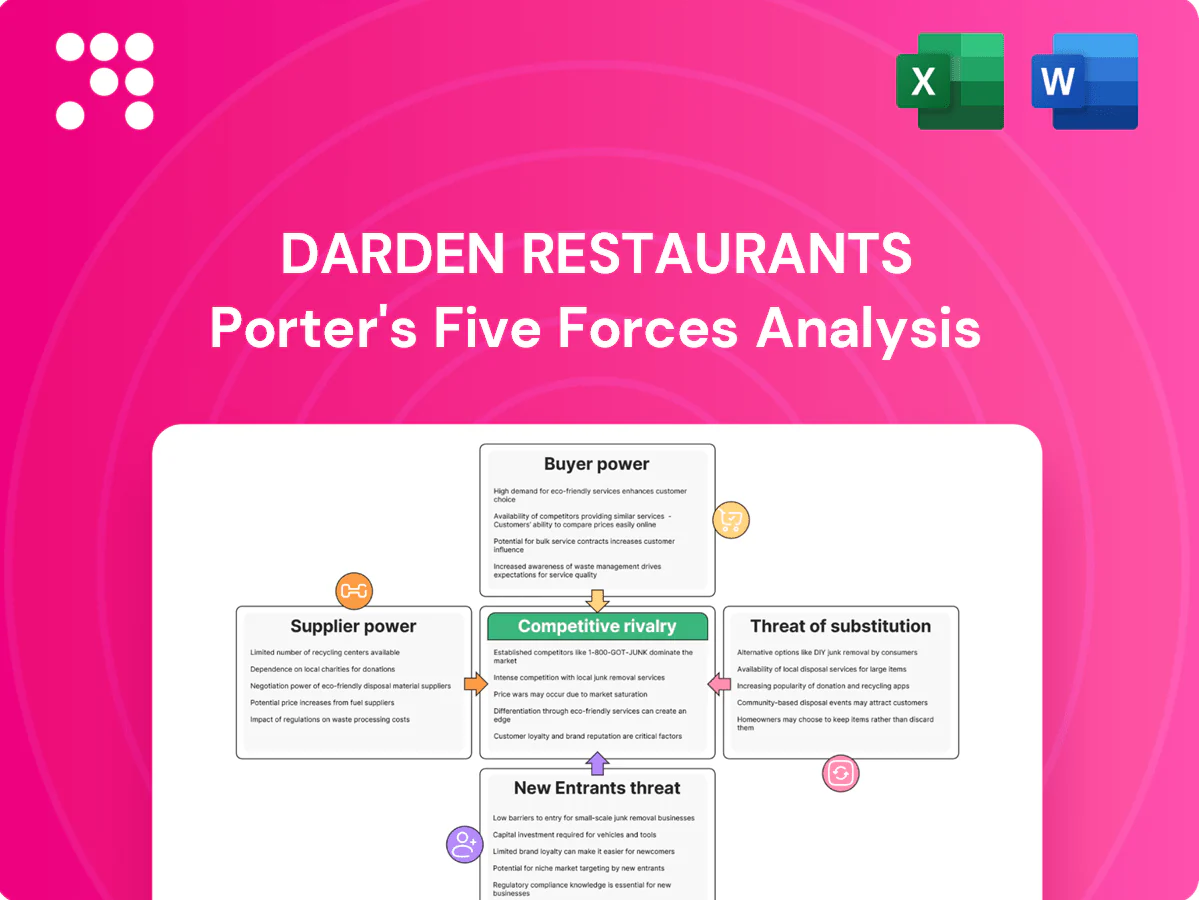
This preview shows the complete Porter's Five Forces analysis for Darden Restaurants and is the exact document you'll receive after purchase. It covers rivalry, supplier and buyer power, threats of entry and substitutes, and strategic implications. No placeholders—fully formatted and ready to download instantly.

Don't Miss the Bigger Picture
Darden Restaurants faces intense rivalry and powerful buyers but benefits from scale, diversified brands, and supply-chain leverage; supplier pressures and low immediate threat of entrants temper but do not eliminate margin risks. This snapshot highlights key forces shaping strategy and performance. Unlock the full Porter's Five Forces Analysis for force-by-force ratings, visuals, and actionable insights.
Suppliers Bargaining Power
Diversified commodity inputs
Most ingredients for Darden are widely available proteins, produce and dry goods, limiting any single supplier’s leverage; Darden operated about 1,900 restaurants in 2024, giving scale in procurement. The company routinely dual-sources and rebids categories to keep terms competitive and visible. Broad availability keeps switching costs moderate for non-specialty items, so the diffuse market structure reduces sustained supplier price power.
Scale purchasing leverage
Darden's multi-brand scale—1,900+ restaurants and fiscal 2024 net sales of about $12.9 billion—lets it secure volume contracts, favorable payment and logistics terms. Consolidated procurement and standardized specs increase bargaining leverage and drive supplier consolidation. Long-term vendor relationships help lock pricing and continuity; scale supports commodity hedging and forward-buy strategies for beef, dairy and other key inputs.
Specialty items and branded beverages
Seafood species, premium steaks and branded wines/spirits face concentrated supply and quality constraints that raise dependence on fewer approved vendors. Traceability and strict quality standards further narrow the supplier pool, increasing price exposure for niche items. For a company like Darden, which operated about 1,900 restaurants in 2024, these pockets of specialized sourcing create localized supplier power despite overall industry fragmentation.
Logistics and inflation volatility
Freight, fuel, and cold-chain capacity swings amplified supplier leverage during tight periods, and in 2024 supply-side volatility remained material as fuel and logistics stress prompted intermittent spot-price surges; input inflation for beef, dairy and grains eased to mid-single digits in 2024 but still drove supplier attempts at rapid cost pass-through. Darden’s scale moderates negotiation power but cannot eliminate market-driven price shocks; contract structures and indexation clauses smooth spikes and limit immediate margin erosion.
- Freight/fuel volatility increases supplier leverage
- 2024 food inflation: mid-single digits, still prompts pass-through attempts
- Darden scale reduces but does not remove pressure
- Contracts/indexation mitigate short-term spikes
ESG and compliance requirements
- Limited suppliers: stricter certification filters supply pool
- Higher supplier costs: compliance raises input prices
- Increased leverage: concentrated approved networks boost bargaining power
- Mitigation: joint planning, long-term contracts, incentives
Scale and centralized procurement curb supplier power despite specialty supply risks
Supplier power is limited by broad availability of proteins/produce, but Darden’s scale and centralized procurement (≈1,900 restaurants, $12.9B net sales in 2024) secure volume leverage. Specialty items (seafood, premium steaks, branded spirits) and logistics/fuel volatility create concentrated supplier pockets. Contracts, hedging and dual-sourcing mitigate but do not eliminate pass-through risk.
| Metric | 2024 |
|---|---|
| Restaurants | ≈1,900 |
| Net sales | $12.9B |
| Food inflation | Mid-single digits |
| Specialty supply risk | High |
What is included in the product
Detailed Word Document
Tailored Porter's Five Forces analysis for Darden Restaurants that assesses competitive rivalry, buyer/supplier power, substitution threats, and entry barriers to reveal strategic risks and opportunities.
Customizable Excel Spreadsheet
A concise Porter's Five Forces snapshot for Darden Restaurants that clarifies supplier, buyer, rivalry and entrant pressures—empowering quick strategic decisions and easing stakeholder communication. Easily update force levels for new data or slide-ready export to remove analysis bottlenecks.
Customers Bargaining Power
Highly fragmented individual diners
Customers are mostly individuals and small groups, limiting organized bargaining. Collective switching is easy and immediate, raising price sensitivity due to lack of contractual lock-in. With about 1,900 restaurants in 2024, Darden relies on value menus, loyalty programs and consistent service to retain traffic and blunt customer price power.
Abundant alternatives and low switching costs
Consumers can pivot easily to QSR, fast-casual, independents or nearby chains, giving Darden high customer bargaining power; Darden operated about 1,900 restaurants in 2024 across brands like Olive Garden and LongHorn. Minimal monetary or time switching costs amplify this power, while visible pricing on apps and menus accelerates price comparisons. Differentiated experiences and brand loyalty help soften direct price wars, but value promotions remain influential.
Value orientation and promotions
Guests respond strongly to portion size, price points and perceived value, driving visit frequency and check size. Promotional cadence like limited-time offers conditions deal-seeking and raises elasticity in discretionary dining. Darden reported $11.9 billion in revenue for fiscal 2024; loyalty benefits and everyday value initiatives are used to stabilize traffic and reduce promotional reliance.
Digital reviews and social influence
Ratings on Google, Yelp and social media can shift diner traffic rapidly; a 2024 BrightLocal finding shows 87% of consumers consult online reviews for local businesses, amplifying reputational impact on chains like Darden. Word-of-mouth becomes quasi-collective bargaining as aggregated low scores pressure policy and pricing. Service or food issues scale quickly online, while proactive engagement and consistent execution limit downside.
- Review reach: Google/Yelp-driven traffic swings
- Reputation pressure: collective bargaining via word-of-mouth
- Mitigation: active engagement, operational consistency
Off-premise and aggregator dynamics
Aggregators steer demand via paid placements and discounts, broadening in-app choice and slightly raising customer leverage, while optimizing Darden's direct channels (loyalty, app offers) helps defend margins and repeat frequency.
- 2024 third-party delivery commissions ~20–25%
- Darden FY2024 revenue ≈ $13B
- Direct channel focus reduces reliance on aggregator-driven discounts
Customers wield high bargaining power; loyalty and value menus steady results in 2024
Customers have high bargaining power due to easy switching (QSR/fast-casual/independents), visible price transparency and strong review influence; Darden counters with loyalty, value menus and consistent execution. Key 2024 metrics below clarify impact.
| Metric | 2024 value | Note |
|---|---|---|
| Restaurants | ~1,900 | Company-wide |
| Revenue | $11.9B | FY2024 |
| Delivery fees | 20–25% | Third-party commissions |
| Review reliance | 87% | Consumers check reviews (BrightLocal) |
Same Document Delivered
Darden Restaurants Porter's Five Forces Analysis
This preview shows the complete Porter's Five Forces analysis for Darden Restaurants and is the exact document you'll receive after purchase. It covers rivalry, supplier and buyer power, threats of entry and substitutes, and strategic implications. No placeholders—fully formatted and ready to download instantly.
Description
Don't Miss the Bigger Picture
Darden Restaurants faces intense rivalry and powerful buyers but benefits from scale, diversified brands, and supply-chain leverage; supplier pressures and low immediate threat of entrants temper but do not eliminate margin risks. This snapshot highlights key forces shaping strategy and performance. Unlock the full Porter's Five Forces Analysis for force-by-force ratings, visuals, and actionable insights.
Suppliers Bargaining Power
Diversified commodity inputs
Most ingredients for Darden are widely available proteins, produce and dry goods, limiting any single supplier’s leverage; Darden operated about 1,900 restaurants in 2024, giving scale in procurement. The company routinely dual-sources and rebids categories to keep terms competitive and visible. Broad availability keeps switching costs moderate for non-specialty items, so the diffuse market structure reduces sustained supplier price power.
Scale purchasing leverage
Darden's multi-brand scale—1,900+ restaurants and fiscal 2024 net sales of about $12.9 billion—lets it secure volume contracts, favorable payment and logistics terms. Consolidated procurement and standardized specs increase bargaining leverage and drive supplier consolidation. Long-term vendor relationships help lock pricing and continuity; scale supports commodity hedging and forward-buy strategies for beef, dairy and other key inputs.
Specialty items and branded beverages
Seafood species, premium steaks and branded wines/spirits face concentrated supply and quality constraints that raise dependence on fewer approved vendors. Traceability and strict quality standards further narrow the supplier pool, increasing price exposure for niche items. For a company like Darden, which operated about 1,900 restaurants in 2024, these pockets of specialized sourcing create localized supplier power despite overall industry fragmentation.
Logistics and inflation volatility
Freight, fuel, and cold-chain capacity swings amplified supplier leverage during tight periods, and in 2024 supply-side volatility remained material as fuel and logistics stress prompted intermittent spot-price surges; input inflation for beef, dairy and grains eased to mid-single digits in 2024 but still drove supplier attempts at rapid cost pass-through. Darden’s scale moderates negotiation power but cannot eliminate market-driven price shocks; contract structures and indexation clauses smooth spikes and limit immediate margin erosion.
- Freight/fuel volatility increases supplier leverage
- 2024 food inflation: mid-single digits, still prompts pass-through attempts
- Darden scale reduces but does not remove pressure
- Contracts/indexation mitigate short-term spikes
ESG and compliance requirements
- Limited suppliers: stricter certification filters supply pool
- Higher supplier costs: compliance raises input prices
- Increased leverage: concentrated approved networks boost bargaining power
- Mitigation: joint planning, long-term contracts, incentives
Scale and centralized procurement curb supplier power despite specialty supply risks
Supplier power is limited by broad availability of proteins/produce, but Darden’s scale and centralized procurement (≈1,900 restaurants, $12.9B net sales in 2024) secure volume leverage. Specialty items (seafood, premium steaks, branded spirits) and logistics/fuel volatility create concentrated supplier pockets. Contracts, hedging and dual-sourcing mitigate but do not eliminate pass-through risk.
| Metric | 2024 |
|---|---|
| Restaurants | ≈1,900 |
| Net sales | $12.9B |
| Food inflation | Mid-single digits |
| Specialty supply risk | High |
What is included in the product
Detailed Word Document
Tailored Porter's Five Forces analysis for Darden Restaurants that assesses competitive rivalry, buyer/supplier power, substitution threats, and entry barriers to reveal strategic risks and opportunities.
Customizable Excel Spreadsheet
A concise Porter's Five Forces snapshot for Darden Restaurants that clarifies supplier, buyer, rivalry and entrant pressures—empowering quick strategic decisions and easing stakeholder communication. Easily update force levels for new data or slide-ready export to remove analysis bottlenecks.
Customers Bargaining Power
Highly fragmented individual diners
Customers are mostly individuals and small groups, limiting organized bargaining. Collective switching is easy and immediate, raising price sensitivity due to lack of contractual lock-in. With about 1,900 restaurants in 2024, Darden relies on value menus, loyalty programs and consistent service to retain traffic and blunt customer price power.
Abundant alternatives and low switching costs
Consumers can pivot easily to QSR, fast-casual, independents or nearby chains, giving Darden high customer bargaining power; Darden operated about 1,900 restaurants in 2024 across brands like Olive Garden and LongHorn. Minimal monetary or time switching costs amplify this power, while visible pricing on apps and menus accelerates price comparisons. Differentiated experiences and brand loyalty help soften direct price wars, but value promotions remain influential.
Value orientation and promotions
Guests respond strongly to portion size, price points and perceived value, driving visit frequency and check size. Promotional cadence like limited-time offers conditions deal-seeking and raises elasticity in discretionary dining. Darden reported $11.9 billion in revenue for fiscal 2024; loyalty benefits and everyday value initiatives are used to stabilize traffic and reduce promotional reliance.
Digital reviews and social influence
Ratings on Google, Yelp and social media can shift diner traffic rapidly; a 2024 BrightLocal finding shows 87% of consumers consult online reviews for local businesses, amplifying reputational impact on chains like Darden. Word-of-mouth becomes quasi-collective bargaining as aggregated low scores pressure policy and pricing. Service or food issues scale quickly online, while proactive engagement and consistent execution limit downside.
- Review reach: Google/Yelp-driven traffic swings
- Reputation pressure: collective bargaining via word-of-mouth
- Mitigation: active engagement, operational consistency
Off-premise and aggregator dynamics
Aggregators steer demand via paid placements and discounts, broadening in-app choice and slightly raising customer leverage, while optimizing Darden's direct channels (loyalty, app offers) helps defend margins and repeat frequency.
- 2024 third-party delivery commissions ~20–25%
- Darden FY2024 revenue ≈ $13B
- Direct channel focus reduces reliance on aggregator-driven discounts
Customers wield high bargaining power; loyalty and value menus steady results in 2024
Customers have high bargaining power due to easy switching (QSR/fast-casual/independents), visible price transparency and strong review influence; Darden counters with loyalty, value menus and consistent execution. Key 2024 metrics below clarify impact.
| Metric | 2024 value | Note |
|---|---|---|
| Restaurants | ~1,900 | Company-wide |
| Revenue | $11.9B | FY2024 |
| Delivery fees | 20–25% | Third-party commissions |
| Review reliance | 87% | Consumers check reviews (BrightLocal) |
Same Document Delivered
Darden Restaurants Porter's Five Forces Analysis
This preview shows the complete Porter's Five Forces analysis for Darden Restaurants and is the exact document you'll receive after purchase. It covers rivalry, supplier and buyer power, threats of entry and substitutes, and strategic implications. No placeholders—fully formatted and ready to download instantly.











