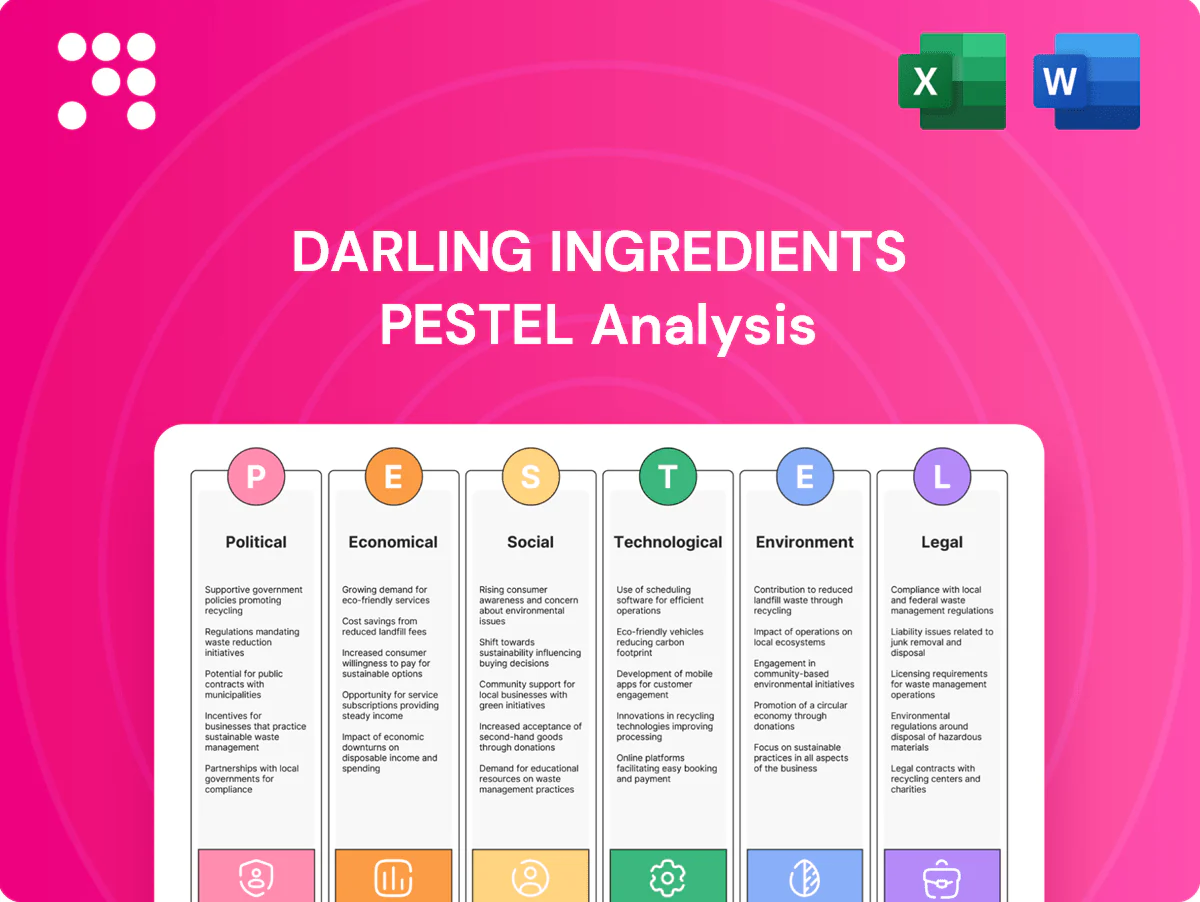
Darling Ingredients PESTLE Analysis

Skip the Research. Get the Strategy.
Uncover how political shifts, economic cycles, social trends, technological advances, legal changes, and environmental pressures influence Darling Ingredients’ strategy and risk profile. This concise PESTLE overview highlights key external drivers shaping future performance. Purchase the full analysis to access actionable insights, data-backed forecasts, and ready-to-use strategic recommendations.
Political factors

Renewable fuel policy volatility
Eligibility and credit values under the U.S. RFS, California LCFS (≈$130/tonne in 2024) and emerging LCFS programs directly shape renewable diesel margins; changes in D4/D3 RINs or CI scores can swing plant economics. Revisions to RIN regimes, CI scoring or SAF incentives reallocate capital toward SAF or renewable diesel. EU Fit-for-55 (55% GHG cut by 2030) and ReFuelEU mandates reshape export economics and siting. Policy shifts can be abrupt, requiring agile compliance and hedging strategies.
Trade relations and tariffs on animal fats
Import/export duties on tallow, used cooking oil and protein meals shape global feedstock arbitrage, raising input costs and narrowing margins; Darling operates across 30+ countries, so tariff shifts in key markets materially affect sourcing economics. Geopolitical tensions (e.g., trade restrictions) disrupt cross-border flows and lift logistics and compliance costs. Quotas or sanitary barriers can restrict access for rendered ingredients, making diversification of sourcing regions essential to reduce concentration risk.

Agricultural and livestock support programs
Subsidies and disease-control funding directly affect herd sizes and rendering feedstock; Darling Ingredients reported 2024 revenue of about $6.7 billion, tying margins to by-product availability. Government outbreak responses, such as culling and movement bans, can sharply tighten local supply and spike raw-material costs. Policy-driven shifts in meat consumption and engagement with ag agencies help stabilize collection networks and long-term rendering volumes.

Municipal waste and circular economy agendas
Municipal and national waste-diversion agendas increasingly favor rendering and organics recycling over landfill or incineration, driven by policies such as California SB 1383 requiring a 75% reduction in organic waste disposal by 2025 and the EU target of 65% municipal waste recycling by 2035; public procurement and grant programs fund new collection infrastructure, strengthening Darling Ingredients license-to-operate while city contract changes can redirect streams away from incumbents.
- California SB 1383: 75% organic waste reduction by 2025
- EU municipal recycling target: 65% by 2035
- Public procurement/grants expand collection infrastructure
Energy security and decarbonization targets
Governments prioritizing transport decarbonization are increasing demand for renewable diesel and SAF through mandates and incentives (US SAF targets and IRA credits); carbon budgets and net-zero mandates have pushed carbon prices (EU ETS ~€90/t in 2024, California LCFS ~USD150/t in 2024), raising compliance demand and credit values. Faster electrification adoption could temper long-term liquid biofuel growth, making strategic alignment with national targets essential to secure incentives and permits.
- Policy-driven demand: mandates & tax credits
- Carbon price pressure: EU ETS ~€90/t (2024)
- LCFS value: CA ~USD150/t (2024)
- Risk: electrification dampens long-term liquid fuel growth
Regulatory credits, RINs, LCFS & ETS swings plus D4 changes reshape renewable diesel/SAF margins
Regulatory credits (US RINs, CA LCFS ≈USD150/t in 2024, EU ETS ≈€90/t in 2024) and RFS/SAF incentives drive renewable diesel/SAF margins; changes to D4/D3 or CI scores can rapidly shift project economics. Tariffs and trade limits on tallow/UCO affect global feedstock costs; Darling reported ~USD6.7B revenue in 2024, tying margins to by-product supply. Waste-diversion rules (CA SB1383) and EU recycling targets support rendering volumes but create contract risk.
| Policy | Metric | 2024/Target |
|---|---|---|
| CA LCFS | Credit value | ≈USD150/t (2024) |
| EU ETS | Carbon price | ≈€90/t (2024) |
| Darling | Revenue | ≈USD6.7B (2024) |
What is included in the product
 Detailed Word Document
Explores how Political, Economic, Social, Technological, Environmental, and Legal forces uniquely impact Darling Ingredients, blending current data and trends with region- and industry-specific examples to highlight risks and growth levers for executives and investors; formatted for direct inclusion in business plans, pitch decks, or scenario-based strategy work.

 Customizable Excel Spreadsheet
Clean, summarized PESTLE insights for Darling Ingredients that are visually segmented and editable, enabling quick sharing in presentations or planning sessions to align teams and support external risk and market-position discussions.
Economic factors

Feedstock price and availability cycles
Prices for tallow, used cooking oil, and distillers corn oil fluctuate with slaughter rates, foodservice activity and global oilseed markets; in 2024 U.S. beef and pork slaughter returned to near pre-pandemic levels per USDA, lifting tallow supplies and tightening edible fat spreads. Tight feedstock availability has compressed renewable diesel margins and raised collagen input costs, pressuring producers' EBITDA. Contracts, pre-treatment flexibility and multi-feedstock capability help Darling mitigate volatility, while inventory management and procurement hedging remain critical financial controls.
Diesel cracks and carbon credit spreads
Renewable diesel profitability for Darling hinges on ULSD crack spreads (NYH ULSD averaged roughly $8–$12/bbl in 2024) plus RIN/LCFS/CI values (California LCFS credits traded near $130–$150/MT in 2024; D4 RINs broadly ranged ~$0.50–$1.50/RIN). Compression in spreads or LCFS/RIN oversupply can cut EBITDA materially, as seen in 2024 volatility. Regional optimization toward high-credit markets and financial hedges and long-term offtakes smooth earnings and improve netbacks.

Currency fluctuations across global footprint
Multi-continent operations expose Darling Ingredients to FX swings across USD, EUR, CAD, CNY and BRL, creating both translation and transaction volatility for collagen and feed segments. Translation losses or gains can be material for reported margins while transaction FX affects cashflows; company uses natural hedges and balance-sheet matching to blunt short-term swings. Pricing clauses tied to commodity and currency indices further help preserve margins amid currency moves.

Consumer demand in food, pharma, and pet care
Collagen, gelatin and specialty proteins correlate with discretionary and health/wellness spend, with consumers trading up for functional ingredients even as staples tighten. Pet food premiumization (US pet industry $136.8B in 2022 per APPA) sustains resilient pricing through slowdowns. Pharma-grade ingredients are defensive but demand higher capex and quality costs; Darling's diversified mix helps buffer energy-market cyclical shocks.
- Collagen/gelatin: premium/health-driven demand
- Pet food: premiumization supports pricing
- Pharma-grade: capex and quality intensity
- Portfolio mix: cushions energy cyclicality
Capital intensity and cost of financing
Refining expansions, pre-treatment and sustainability upgrades for Darling Ingredients are capex-intensive; higher rates compress project IRRs as the US federal funds target stood at 5.25–5.50% in mid‑2025 and wider credit spreads raise financing costs. Access to green finance, ESG debt and IRA-style investment tax credits (up to 30% for qualifying projects) materially improves economics; phased builds and JVs allocate risk and preserve liquidity.
- Capex intensity: large upfront outlays
- Rate backdrop: Fed 5.25–5.50% (mid‑2025)
- Policy boost: up to 30% ITC under IRA
- De‑risking: phased investments and JV financing
Regulatory credits, RINs, LCFS & ETS swings plus D4 changes reshape renewable diesel/SAF margins
Slaughter rates recovered to near pre‑pandemic levels in 2024 (USDA), boosting tallow supply and compressing renewable diesel margins; NYH ULSD cracks averaged ~$8–$12/bbl and CA LCFS credits traded ~$130–$150/MT in 2024. Fed funds at 5.25–5.50% (mid‑2025) raises capex costs; IRA ITC up to 30% improves project IRRs. Pet market resilience (US $136.8B 2022) supports specialty pricing.
| Metric | Value |
|---|---|
| NYH ULSD crack (2024) | $8–$12/bbl |
| CA LCFS (2024) | $130–$150/MT |
| Fed funds (mid‑2025) | 5.25–5.50% |
| IRA ITC | Up to 30% |
Preview Before You Purchase
Darling Ingredients PESTLE Analysis
This Darling Ingredients PESTLE Analysis examines political, economic, social, technological, legal and environmental factors affecting the company and includes concise insights for strategic decision-making. The preview shown here is the exact document you’ll receive after purchase—fully formatted and ready to use. No placeholders or teasers; the content and structure visible are what you’ll download immediately after buying.

Skip the Research. Get the Strategy.
Uncover how political shifts, economic cycles, social trends, technological advances, legal changes, and environmental pressures influence Darling Ingredients’ strategy and risk profile. This concise PESTLE overview highlights key external drivers shaping future performance. Purchase the full analysis to access actionable insights, data-backed forecasts, and ready-to-use strategic recommendations.
Political factors
Renewable fuel policy volatility
Eligibility and credit values under the U.S. RFS, California LCFS (≈$130/tonne in 2024) and emerging LCFS programs directly shape renewable diesel margins; changes in D4/D3 RINs or CI scores can swing plant economics. Revisions to RIN regimes, CI scoring or SAF incentives reallocate capital toward SAF or renewable diesel. EU Fit-for-55 (55% GHG cut by 2030) and ReFuelEU mandates reshape export economics and siting. Policy shifts can be abrupt, requiring agile compliance and hedging strategies.
Trade relations and tariffs on animal fats
Import/export duties on tallow, used cooking oil and protein meals shape global feedstock arbitrage, raising input costs and narrowing margins; Darling operates across 30+ countries, so tariff shifts in key markets materially affect sourcing economics. Geopolitical tensions (e.g., trade restrictions) disrupt cross-border flows and lift logistics and compliance costs. Quotas or sanitary barriers can restrict access for rendered ingredients, making diversification of sourcing regions essential to reduce concentration risk.
Agricultural and livestock support programs
Subsidies and disease-control funding directly affect herd sizes and rendering feedstock; Darling Ingredients reported 2024 revenue of about $6.7 billion, tying margins to by-product availability. Government outbreak responses, such as culling and movement bans, can sharply tighten local supply and spike raw-material costs. Policy-driven shifts in meat consumption and engagement with ag agencies help stabilize collection networks and long-term rendering volumes.
Municipal waste and circular economy agendas
Municipal and national waste-diversion agendas increasingly favor rendering and organics recycling over landfill or incineration, driven by policies such as California SB 1383 requiring a 75% reduction in organic waste disposal by 2025 and the EU target of 65% municipal waste recycling by 2035; public procurement and grant programs fund new collection infrastructure, strengthening Darling Ingredients license-to-operate while city contract changes can redirect streams away from incumbents.
- California SB 1383: 75% organic waste reduction by 2025
- EU municipal recycling target: 65% by 2035
- Public procurement/grants expand collection infrastructure
Energy security and decarbonization targets
Governments prioritizing transport decarbonization are increasing demand for renewable diesel and SAF through mandates and incentives (US SAF targets and IRA credits); carbon budgets and net-zero mandates have pushed carbon prices (EU ETS ~€90/t in 2024, California LCFS ~USD150/t in 2024), raising compliance demand and credit values. Faster electrification adoption could temper long-term liquid biofuel growth, making strategic alignment with national targets essential to secure incentives and permits.
- Policy-driven demand: mandates & tax credits
- Carbon price pressure: EU ETS ~€90/t (2024)
- LCFS value: CA ~USD150/t (2024)
- Risk: electrification dampens long-term liquid fuel growth
Regulatory credits, RINs, LCFS & ETS swings plus D4 changes reshape renewable diesel/SAF margins
Regulatory credits (US RINs, CA LCFS ≈USD150/t in 2024, EU ETS ≈€90/t in 2024) and RFS/SAF incentives drive renewable diesel/SAF margins; changes to D4/D3 or CI scores can rapidly shift project economics. Tariffs and trade limits on tallow/UCO affect global feedstock costs; Darling reported ~USD6.7B revenue in 2024, tying margins to by-product supply. Waste-diversion rules (CA SB1383) and EU recycling targets support rendering volumes but create contract risk.
| Policy | Metric | 2024/Target |
|---|---|---|
| CA LCFS | Credit value | ≈USD150/t (2024) |
| EU ETS | Carbon price | ≈€90/t (2024) |
| Darling | Revenue | ≈USD6.7B (2024) |
What is included in the product
Detailed Word Document
Explores how Political, Economic, Social, Technological, Environmental, and Legal forces uniquely impact Darling Ingredients, blending current data and trends with region- and industry-specific examples to highlight risks and growth levers for executives and investors; formatted for direct inclusion in business plans, pitch decks, or scenario-based strategy work.
Customizable Excel Spreadsheet
Clean, summarized PESTLE insights for Darling Ingredients that are visually segmented and editable, enabling quick sharing in presentations or planning sessions to align teams and support external risk and market-position discussions.
Economic factors
Feedstock price and availability cycles
Prices for tallow, used cooking oil, and distillers corn oil fluctuate with slaughter rates, foodservice activity and global oilseed markets; in 2024 U.S. beef and pork slaughter returned to near pre-pandemic levels per USDA, lifting tallow supplies and tightening edible fat spreads. Tight feedstock availability has compressed renewable diesel margins and raised collagen input costs, pressuring producers' EBITDA. Contracts, pre-treatment flexibility and multi-feedstock capability help Darling mitigate volatility, while inventory management and procurement hedging remain critical financial controls.
Diesel cracks and carbon credit spreads
Renewable diesel profitability for Darling hinges on ULSD crack spreads (NYH ULSD averaged roughly $8–$12/bbl in 2024) plus RIN/LCFS/CI values (California LCFS credits traded near $130–$150/MT in 2024; D4 RINs broadly ranged ~$0.50–$1.50/RIN). Compression in spreads or LCFS/RIN oversupply can cut EBITDA materially, as seen in 2024 volatility. Regional optimization toward high-credit markets and financial hedges and long-term offtakes smooth earnings and improve netbacks.
Currency fluctuations across global footprint
Multi-continent operations expose Darling Ingredients to FX swings across USD, EUR, CAD, CNY and BRL, creating both translation and transaction volatility for collagen and feed segments. Translation losses or gains can be material for reported margins while transaction FX affects cashflows; company uses natural hedges and balance-sheet matching to blunt short-term swings. Pricing clauses tied to commodity and currency indices further help preserve margins amid currency moves.
Consumer demand in food, pharma, and pet care
Collagen, gelatin and specialty proteins correlate with discretionary and health/wellness spend, with consumers trading up for functional ingredients even as staples tighten. Pet food premiumization (US pet industry $136.8B in 2022 per APPA) sustains resilient pricing through slowdowns. Pharma-grade ingredients are defensive but demand higher capex and quality costs; Darling's diversified mix helps buffer energy-market cyclical shocks.
- Collagen/gelatin: premium/health-driven demand
- Pet food: premiumization supports pricing
- Pharma-grade: capex and quality intensity
- Portfolio mix: cushions energy cyclicality
Capital intensity and cost of financing
Refining expansions, pre-treatment and sustainability upgrades for Darling Ingredients are capex-intensive; higher rates compress project IRRs as the US federal funds target stood at 5.25–5.50% in mid‑2025 and wider credit spreads raise financing costs. Access to green finance, ESG debt and IRA-style investment tax credits (up to 30% for qualifying projects) materially improves economics; phased builds and JVs allocate risk and preserve liquidity.
- Capex intensity: large upfront outlays
- Rate backdrop: Fed 5.25–5.50% (mid‑2025)
- Policy boost: up to 30% ITC under IRA
- De‑risking: phased investments and JV financing
Regulatory credits, RINs, LCFS & ETS swings plus D4 changes reshape renewable diesel/SAF margins
Slaughter rates recovered to near pre‑pandemic levels in 2024 (USDA), boosting tallow supply and compressing renewable diesel margins; NYH ULSD cracks averaged ~$8–$12/bbl and CA LCFS credits traded ~$130–$150/MT in 2024. Fed funds at 5.25–5.50% (mid‑2025) raises capex costs; IRA ITC up to 30% improves project IRRs. Pet market resilience (US $136.8B 2022) supports specialty pricing.
| Metric | Value |
|---|---|
| NYH ULSD crack (2024) | $8–$12/bbl |
| CA LCFS (2024) | $130–$150/MT |
| Fed funds (mid‑2025) | 5.25–5.50% |
| IRA ITC | Up to 30% |
Preview Before You Purchase
Darling Ingredients PESTLE Analysis
This Darling Ingredients PESTLE Analysis examines political, economic, social, technological, legal and environmental factors affecting the company and includes concise insights for strategic decision-making. The preview shown here is the exact document you’ll receive after purchase—fully formatted and ready to use. No placeholders or teasers; the content and structure visible are what you’ll download immediately after buying.
Original: $10.00
-65%$10.00
$3.50Description
Skip the Research. Get the Strategy.
Uncover how political shifts, economic cycles, social trends, technological advances, legal changes, and environmental pressures influence Darling Ingredients’ strategy and risk profile. This concise PESTLE overview highlights key external drivers shaping future performance. Purchase the full analysis to access actionable insights, data-backed forecasts, and ready-to-use strategic recommendations.
Political factors
Renewable fuel policy volatility
Eligibility and credit values under the U.S. RFS, California LCFS (≈$130/tonne in 2024) and emerging LCFS programs directly shape renewable diesel margins; changes in D4/D3 RINs or CI scores can swing plant economics. Revisions to RIN regimes, CI scoring or SAF incentives reallocate capital toward SAF or renewable diesel. EU Fit-for-55 (55% GHG cut by 2030) and ReFuelEU mandates reshape export economics and siting. Policy shifts can be abrupt, requiring agile compliance and hedging strategies.
Trade relations and tariffs on animal fats
Import/export duties on tallow, used cooking oil and protein meals shape global feedstock arbitrage, raising input costs and narrowing margins; Darling operates across 30+ countries, so tariff shifts in key markets materially affect sourcing economics. Geopolitical tensions (e.g., trade restrictions) disrupt cross-border flows and lift logistics and compliance costs. Quotas or sanitary barriers can restrict access for rendered ingredients, making diversification of sourcing regions essential to reduce concentration risk.
Agricultural and livestock support programs
Subsidies and disease-control funding directly affect herd sizes and rendering feedstock; Darling Ingredients reported 2024 revenue of about $6.7 billion, tying margins to by-product availability. Government outbreak responses, such as culling and movement bans, can sharply tighten local supply and spike raw-material costs. Policy-driven shifts in meat consumption and engagement with ag agencies help stabilize collection networks and long-term rendering volumes.
Municipal waste and circular economy agendas
Municipal and national waste-diversion agendas increasingly favor rendering and organics recycling over landfill or incineration, driven by policies such as California SB 1383 requiring a 75% reduction in organic waste disposal by 2025 and the EU target of 65% municipal waste recycling by 2035; public procurement and grant programs fund new collection infrastructure, strengthening Darling Ingredients license-to-operate while city contract changes can redirect streams away from incumbents.
- California SB 1383: 75% organic waste reduction by 2025
- EU municipal recycling target: 65% by 2035
- Public procurement/grants expand collection infrastructure
Energy security and decarbonization targets
Governments prioritizing transport decarbonization are increasing demand for renewable diesel and SAF through mandates and incentives (US SAF targets and IRA credits); carbon budgets and net-zero mandates have pushed carbon prices (EU ETS ~€90/t in 2024, California LCFS ~USD150/t in 2024), raising compliance demand and credit values. Faster electrification adoption could temper long-term liquid biofuel growth, making strategic alignment with national targets essential to secure incentives and permits.
- Policy-driven demand: mandates & tax credits
- Carbon price pressure: EU ETS ~€90/t (2024)
- LCFS value: CA ~USD150/t (2024)
- Risk: electrification dampens long-term liquid fuel growth
Regulatory credits, RINs, LCFS & ETS swings plus D4 changes reshape renewable diesel/SAF margins
Regulatory credits (US RINs, CA LCFS ≈USD150/t in 2024, EU ETS ≈€90/t in 2024) and RFS/SAF incentives drive renewable diesel/SAF margins; changes to D4/D3 or CI scores can rapidly shift project economics. Tariffs and trade limits on tallow/UCO affect global feedstock costs; Darling reported ~USD6.7B revenue in 2024, tying margins to by-product supply. Waste-diversion rules (CA SB1383) and EU recycling targets support rendering volumes but create contract risk.
| Policy | Metric | 2024/Target |
|---|---|---|
| CA LCFS | Credit value | ≈USD150/t (2024) |
| EU ETS | Carbon price | ≈€90/t (2024) |
| Darling | Revenue | ≈USD6.7B (2024) |
What is included in the product
Detailed Word Document
Explores how Political, Economic, Social, Technological, Environmental, and Legal forces uniquely impact Darling Ingredients, blending current data and trends with region- and industry-specific examples to highlight risks and growth levers for executives and investors; formatted for direct inclusion in business plans, pitch decks, or scenario-based strategy work.
Customizable Excel Spreadsheet
Clean, summarized PESTLE insights for Darling Ingredients that are visually segmented and editable, enabling quick sharing in presentations or planning sessions to align teams and support external risk and market-position discussions.
Economic factors
Feedstock price and availability cycles
Prices for tallow, used cooking oil, and distillers corn oil fluctuate with slaughter rates, foodservice activity and global oilseed markets; in 2024 U.S. beef and pork slaughter returned to near pre-pandemic levels per USDA, lifting tallow supplies and tightening edible fat spreads. Tight feedstock availability has compressed renewable diesel margins and raised collagen input costs, pressuring producers' EBITDA. Contracts, pre-treatment flexibility and multi-feedstock capability help Darling mitigate volatility, while inventory management and procurement hedging remain critical financial controls.
Diesel cracks and carbon credit spreads
Renewable diesel profitability for Darling hinges on ULSD crack spreads (NYH ULSD averaged roughly $8–$12/bbl in 2024) plus RIN/LCFS/CI values (California LCFS credits traded near $130–$150/MT in 2024; D4 RINs broadly ranged ~$0.50–$1.50/RIN). Compression in spreads or LCFS/RIN oversupply can cut EBITDA materially, as seen in 2024 volatility. Regional optimization toward high-credit markets and financial hedges and long-term offtakes smooth earnings and improve netbacks.
Currency fluctuations across global footprint
Multi-continent operations expose Darling Ingredients to FX swings across USD, EUR, CAD, CNY and BRL, creating both translation and transaction volatility for collagen and feed segments. Translation losses or gains can be material for reported margins while transaction FX affects cashflows; company uses natural hedges and balance-sheet matching to blunt short-term swings. Pricing clauses tied to commodity and currency indices further help preserve margins amid currency moves.
Consumer demand in food, pharma, and pet care
Collagen, gelatin and specialty proteins correlate with discretionary and health/wellness spend, with consumers trading up for functional ingredients even as staples tighten. Pet food premiumization (US pet industry $136.8B in 2022 per APPA) sustains resilient pricing through slowdowns. Pharma-grade ingredients are defensive but demand higher capex and quality costs; Darling's diversified mix helps buffer energy-market cyclical shocks.
- Collagen/gelatin: premium/health-driven demand
- Pet food: premiumization supports pricing
- Pharma-grade: capex and quality intensity
- Portfolio mix: cushions energy cyclicality
Capital intensity and cost of financing
Refining expansions, pre-treatment and sustainability upgrades for Darling Ingredients are capex-intensive; higher rates compress project IRRs as the US federal funds target stood at 5.25–5.50% in mid‑2025 and wider credit spreads raise financing costs. Access to green finance, ESG debt and IRA-style investment tax credits (up to 30% for qualifying projects) materially improves economics; phased builds and JVs allocate risk and preserve liquidity.
- Capex intensity: large upfront outlays
- Rate backdrop: Fed 5.25–5.50% (mid‑2025)
- Policy boost: up to 30% ITC under IRA
- De‑risking: phased investments and JV financing
Regulatory credits, RINs, LCFS & ETS swings plus D4 changes reshape renewable diesel/SAF margins
Slaughter rates recovered to near pre‑pandemic levels in 2024 (USDA), boosting tallow supply and compressing renewable diesel margins; NYH ULSD cracks averaged ~$8–$12/bbl and CA LCFS credits traded ~$130–$150/MT in 2024. Fed funds at 5.25–5.50% (mid‑2025) raises capex costs; IRA ITC up to 30% improves project IRRs. Pet market resilience (US $136.8B 2022) supports specialty pricing.
| Metric | Value |
|---|---|
| NYH ULSD crack (2024) | $8–$12/bbl |
| CA LCFS (2024) | $130–$150/MT |
| Fed funds (mid‑2025) | 5.25–5.50% |
| IRA ITC | Up to 30% |
Preview Before You Purchase
Darling Ingredients PESTLE Analysis
This Darling Ingredients PESTLE Analysis examines political, economic, social, technological, legal and environmental factors affecting the company and includes concise insights for strategic decision-making. The preview shown here is the exact document you’ll receive after purchase—fully formatted and ready to use. No placeholders or teasers; the content and structure visible are what you’ll download immediately after buying.











