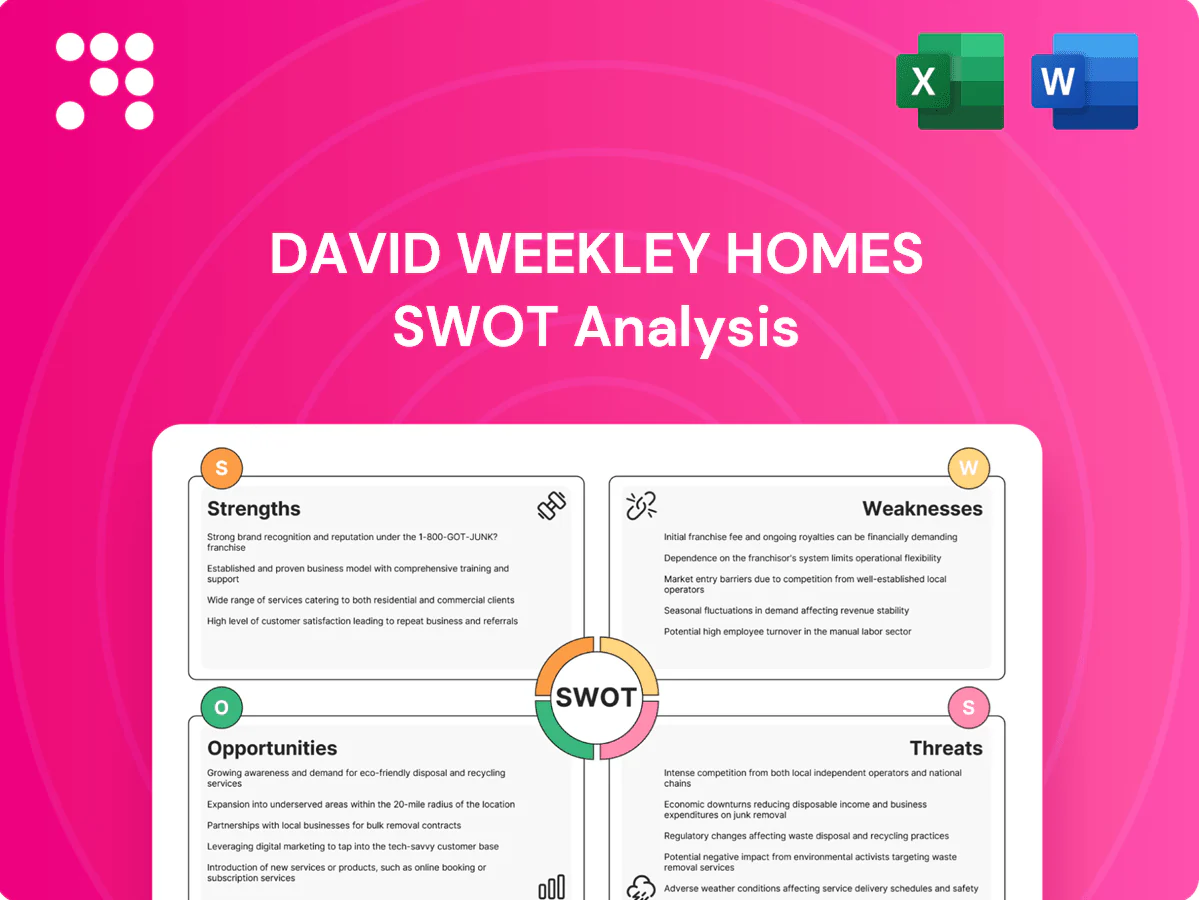
David Weekley Homes SWOT Analysis

Elevate Your Analysis with the Complete SWOT Report
David Weekley Homes’ SWOT highlights strong brand reputation and custom-build expertise, balanced by regional concentration and rising construction costs; opportunities include sustainability and geographic expansion while threats stem from market cycles and labor shortages. Discover the full, editable SWOT report—Word + Excel—for investor-ready insights and strategic action.
Strengths

Strong brand for quality and service
David Weekley Homes, founded in 1976, is widely recognized for high-quality construction and attentive service across the buyer journey, evidenced by industry awards and a large referral base; the company reports building over 60,000 homes to date. This brand trust boosts pricing power and faster sales velocity, helps reduce warranty claims, and sustains higher customer satisfaction and repeat buyers.
Customizable floor plans at scale
Customizable floor plans at scale let David Weekley offer wide-ranging layouts that address varied lifestyles without the cost and lead-time of fully bespoke homes, improving perceived personalization and favorable margin mix. Structured options and design centers standardize selections while streamlined change-order processes cut cycle-time risk and build variability. These capabilities drive higher sales conversion and upsell opportunities through targeted option packages and design upgrades.

Diverse buyer segments served
David Weekley Homes, founded 1976, serves first-time buyers through move-up and active-adult cohorts, tailoring floorplans, amenities and finish packages to each group's priorities; this segment diversity helps smooth demand across cycles and geographies and supports balanced community absorption and steady inventory turnover.

Presence in master-planned communities
Building within amenity-rich master-planned communities gives David Weekley Homes lower local traffic friction, shared marketing lift from community-level promotion, and consistent HOA-driven design standards that strengthen curb appeal and sustain resale values; developer land partnerships create predictable lot pipelines that support steady starts, higher absorption and the ability to command premium pricing.
- Advantage: shared marketing & reduced traffic friction
- Governance: HOA standards preserve curb appeal/value
- Pipeline: developer relationships ensure lot predictability
- Outcome: stronger absorption and premium pricing
Integrated design-build process
Integrated in-house design-build coordination enables faster decision-making and fewer RFIs, aligning construction and purchasing to improve schedule reliability and reduce rework; standardized specs and long-term vendor agreements enhance cost control and consistent quality, protecting gross margins and delivering a more predictable, higher-quality customer experience.
- Cost control: vendor contracts, standardized specs
- Quality consistency: repeatable assemblies
- Schedule reliability: fewer change orders
- Margin protection: lower rework/waste
- Customer experience: predictable delivery
Founded 1976, over 60,000 homes: trusted builder drives pricing premiums and faster sales
Founded 1976 with over 60,000 homes built, David Weekley leverages strong brand trust to command pricing premiums, faster sales velocity and lower warranty costs. Scalable customizable floorplans and design centers drive higher conversion and option upsell. In-house design-build coordination and vendor contracts improve schedule reliability and protect gross margins.
| Metric | Value |
|---|---|
| Homes built | >60,000 |
| Founded | 1976 |
What is included in the product
 Detailed Word Document
Provides a concise SWOT analysis of David Weekley Homes, highlighting internal strengths and weaknesses alongside external opportunities and threats to inform strategic positioning and growth decisions.

 Customizable Excel Spreadsheet
Provides a concise SWOT matrix for David Weekley Homes that pinpoints strategic pain points and enables rapid alignment of mitigation actions and growth priorities.
Weaknesses

Private ownership limits capital flexibility
Private ownership since 1976 limits access to low-cost public equity, constraining the ability to scale large land positions versus public peers that can tap equity and unsecured debt; lower disclosure can lead lenders and suppliers to demand tighter payment or covenant terms. Growth pacing often must rely on internal cash flow and retained earnings, reducing agility for rapid multi-market expansions and large JV land plays.
Geographic concentration in select states
Geographic concentration in select states exposes David Weekley Homes to regional housing cycles, extreme weather events, and local policy swings that can amplify demand volatility. If operations are clustered, localized demand shocks can materially reduce backlog and delay closings. Limited diversification compared with nationwide builders raises sensitivity to state-specific downturns. This concentration contributes to more pronounced volatility in starts and closings.

Working-capital intensive operations
David Weekley Homes operates with large amounts of cash tied up in land, lots and spec homes—industry norms show 6–12 months of capital committed through the build cycle—so slower sales directly increases carrying interest, taxes and holding costs. Cancellation rates, which can rise from mid-single digits to double digits in downturns, make the operation highly sensitive to sales pace. Slower absorption elevates carrying costs and materially compresses gross margins as finance and overhead are spread over fewer closings.

Price point vulnerability to interest rates
David Weekley Homes faces high sensitivity of monthly payments to mortgage rates—30-year fixed rates hovered near 7% in 2024–25 (Freddie Mac), squeezing first-time and move-up buyers’ affordability and reducing qualified buyers. Increased use of rate buydowns and closing-cost concessions to hold demand has compressed gross margins; when affordability tightens, announced backlog can see notable fall-through and cancellations. Production schedules are frequently rescheduled to align starts with buyer capability and sales velocity.
- rate-sensitivity: 30-yr ≈7% (2024–25)
- incentive pressure: buydowns/credits compress margins
- backlog risk: higher fall-through when rates rise
- operations: production rescheduled to match demand
Land acquisition and entitlement risk
Land acquisition risk for David Weekley Homes intensifies in hot markets where overpaying for lots and entitlement delays extend timelines, increasing holding costs and raising impairment risk; NAHB data showed lot costs reached about 20% of new-home prices in 2023–24, squeezing margins and reducing return on invested capital.
- Overpayment risk in frothy markets
- Entitlement delays → extended holding costs/impairments
- Competition for prime parcels raises basis
- Higher lot share (≈20%) lowers ROIC
Private ownership, concentrated lots and 7% rates heighten backlog risk
Private ownership since 1976 limits access to public equity, constraining large land plays and agility. Geographic concentration raises exposure to regional cycles and weather. High capital tied in land/specs (lot share ≈20% in 2023–24) and rate sensitivity (30‑yr ≈7% in 2024–25) amplify margin and backlog risk.
| Metric | Value |
|---|---|
| 30‑yr fixed rate | ≈7% (2024–25, Freddie Mac) |
| Lot share | ≈20% (NAHB 2023–24) |
| Ownership | Private since 1976 |
Preview Before You Purchase
David Weekley Homes SWOT Analysis
This is a real excerpt from the complete David Weekley Homes SWOT analysis you’ll receive upon purchase. The preview below is taken directly from the full report—no samples or placeholders. Buy to unlock the complete, editable, professional document ready for immediate use.

Elevate Your Analysis with the Complete SWOT Report
David Weekley Homes’ SWOT highlights strong brand reputation and custom-build expertise, balanced by regional concentration and rising construction costs; opportunities include sustainability and geographic expansion while threats stem from market cycles and labor shortages. Discover the full, editable SWOT report—Word + Excel—for investor-ready insights and strategic action.
Strengths
Strong brand for quality and service
David Weekley Homes, founded in 1976, is widely recognized for high-quality construction and attentive service across the buyer journey, evidenced by industry awards and a large referral base; the company reports building over 60,000 homes to date. This brand trust boosts pricing power and faster sales velocity, helps reduce warranty claims, and sustains higher customer satisfaction and repeat buyers.
Customizable floor plans at scale
Customizable floor plans at scale let David Weekley offer wide-ranging layouts that address varied lifestyles without the cost and lead-time of fully bespoke homes, improving perceived personalization and favorable margin mix. Structured options and design centers standardize selections while streamlined change-order processes cut cycle-time risk and build variability. These capabilities drive higher sales conversion and upsell opportunities through targeted option packages and design upgrades.
Diverse buyer segments served
David Weekley Homes, founded 1976, serves first-time buyers through move-up and active-adult cohorts, tailoring floorplans, amenities and finish packages to each group's priorities; this segment diversity helps smooth demand across cycles and geographies and supports balanced community absorption and steady inventory turnover.
Presence in master-planned communities
Building within amenity-rich master-planned communities gives David Weekley Homes lower local traffic friction, shared marketing lift from community-level promotion, and consistent HOA-driven design standards that strengthen curb appeal and sustain resale values; developer land partnerships create predictable lot pipelines that support steady starts, higher absorption and the ability to command premium pricing.
- Advantage: shared marketing & reduced traffic friction
- Governance: HOA standards preserve curb appeal/value
- Pipeline: developer relationships ensure lot predictability
- Outcome: stronger absorption and premium pricing
Integrated design-build process
Integrated in-house design-build coordination enables faster decision-making and fewer RFIs, aligning construction and purchasing to improve schedule reliability and reduce rework; standardized specs and long-term vendor agreements enhance cost control and consistent quality, protecting gross margins and delivering a more predictable, higher-quality customer experience.
- Cost control: vendor contracts, standardized specs
- Quality consistency: repeatable assemblies
- Schedule reliability: fewer change orders
- Margin protection: lower rework/waste
- Customer experience: predictable delivery
Founded 1976, over 60,000 homes: trusted builder drives pricing premiums and faster sales
Founded 1976 with over 60,000 homes built, David Weekley leverages strong brand trust to command pricing premiums, faster sales velocity and lower warranty costs. Scalable customizable floorplans and design centers drive higher conversion and option upsell. In-house design-build coordination and vendor contracts improve schedule reliability and protect gross margins.
| Metric | Value |
|---|---|
| Homes built | >60,000 |
| Founded | 1976 |
What is included in the product
Detailed Word Document
Provides a concise SWOT analysis of David Weekley Homes, highlighting internal strengths and weaknesses alongside external opportunities and threats to inform strategic positioning and growth decisions.
Customizable Excel Spreadsheet
Provides a concise SWOT matrix for David Weekley Homes that pinpoints strategic pain points and enables rapid alignment of mitigation actions and growth priorities.
Weaknesses
Private ownership limits capital flexibility
Private ownership since 1976 limits access to low-cost public equity, constraining the ability to scale large land positions versus public peers that can tap equity and unsecured debt; lower disclosure can lead lenders and suppliers to demand tighter payment or covenant terms. Growth pacing often must rely on internal cash flow and retained earnings, reducing agility for rapid multi-market expansions and large JV land plays.
Geographic concentration in select states
Geographic concentration in select states exposes David Weekley Homes to regional housing cycles, extreme weather events, and local policy swings that can amplify demand volatility. If operations are clustered, localized demand shocks can materially reduce backlog and delay closings. Limited diversification compared with nationwide builders raises sensitivity to state-specific downturns. This concentration contributes to more pronounced volatility in starts and closings.
Working-capital intensive operations
David Weekley Homes operates with large amounts of cash tied up in land, lots and spec homes—industry norms show 6–12 months of capital committed through the build cycle—so slower sales directly increases carrying interest, taxes and holding costs. Cancellation rates, which can rise from mid-single digits to double digits in downturns, make the operation highly sensitive to sales pace. Slower absorption elevates carrying costs and materially compresses gross margins as finance and overhead are spread over fewer closings.
Price point vulnerability to interest rates
David Weekley Homes faces high sensitivity of monthly payments to mortgage rates—30-year fixed rates hovered near 7% in 2024–25 (Freddie Mac), squeezing first-time and move-up buyers’ affordability and reducing qualified buyers. Increased use of rate buydowns and closing-cost concessions to hold demand has compressed gross margins; when affordability tightens, announced backlog can see notable fall-through and cancellations. Production schedules are frequently rescheduled to align starts with buyer capability and sales velocity.
- rate-sensitivity: 30-yr ≈7% (2024–25)
- incentive pressure: buydowns/credits compress margins
- backlog risk: higher fall-through when rates rise
- operations: production rescheduled to match demand
Land acquisition and entitlement risk
Land acquisition risk for David Weekley Homes intensifies in hot markets where overpaying for lots and entitlement delays extend timelines, increasing holding costs and raising impairment risk; NAHB data showed lot costs reached about 20% of new-home prices in 2023–24, squeezing margins and reducing return on invested capital.
- Overpayment risk in frothy markets
- Entitlement delays → extended holding costs/impairments
- Competition for prime parcels raises basis
- Higher lot share (≈20%) lowers ROIC
Private ownership, concentrated lots and 7% rates heighten backlog risk
Private ownership since 1976 limits access to public equity, constraining large land plays and agility. Geographic concentration raises exposure to regional cycles and weather. High capital tied in land/specs (lot share ≈20% in 2023–24) and rate sensitivity (30‑yr ≈7% in 2024–25) amplify margin and backlog risk.
| Metric | Value |
|---|---|
| 30‑yr fixed rate | ≈7% (2024–25, Freddie Mac) |
| Lot share | ≈20% (NAHB 2023–24) |
| Ownership | Private since 1976 |
Preview Before You Purchase
David Weekley Homes SWOT Analysis
This is a real excerpt from the complete David Weekley Homes SWOT analysis you’ll receive upon purchase. The preview below is taken directly from the full report—no samples or placeholders. Buy to unlock the complete, editable, professional document ready for immediate use.
Description
Elevate Your Analysis with the Complete SWOT Report
David Weekley Homes’ SWOT highlights strong brand reputation and custom-build expertise, balanced by regional concentration and rising construction costs; opportunities include sustainability and geographic expansion while threats stem from market cycles and labor shortages. Discover the full, editable SWOT report—Word + Excel—for investor-ready insights and strategic action.
Strengths
Strong brand for quality and service
David Weekley Homes, founded in 1976, is widely recognized for high-quality construction and attentive service across the buyer journey, evidenced by industry awards and a large referral base; the company reports building over 60,000 homes to date. This brand trust boosts pricing power and faster sales velocity, helps reduce warranty claims, and sustains higher customer satisfaction and repeat buyers.
Customizable floor plans at scale
Customizable floor plans at scale let David Weekley offer wide-ranging layouts that address varied lifestyles without the cost and lead-time of fully bespoke homes, improving perceived personalization and favorable margin mix. Structured options and design centers standardize selections while streamlined change-order processes cut cycle-time risk and build variability. These capabilities drive higher sales conversion and upsell opportunities through targeted option packages and design upgrades.
Diverse buyer segments served
David Weekley Homes, founded 1976, serves first-time buyers through move-up and active-adult cohorts, tailoring floorplans, amenities and finish packages to each group's priorities; this segment diversity helps smooth demand across cycles and geographies and supports balanced community absorption and steady inventory turnover.
Presence in master-planned communities
Building within amenity-rich master-planned communities gives David Weekley Homes lower local traffic friction, shared marketing lift from community-level promotion, and consistent HOA-driven design standards that strengthen curb appeal and sustain resale values; developer land partnerships create predictable lot pipelines that support steady starts, higher absorption and the ability to command premium pricing.
- Advantage: shared marketing & reduced traffic friction
- Governance: HOA standards preserve curb appeal/value
- Pipeline: developer relationships ensure lot predictability
- Outcome: stronger absorption and premium pricing
Integrated design-build process
Integrated in-house design-build coordination enables faster decision-making and fewer RFIs, aligning construction and purchasing to improve schedule reliability and reduce rework; standardized specs and long-term vendor agreements enhance cost control and consistent quality, protecting gross margins and delivering a more predictable, higher-quality customer experience.
- Cost control: vendor contracts, standardized specs
- Quality consistency: repeatable assemblies
- Schedule reliability: fewer change orders
- Margin protection: lower rework/waste
- Customer experience: predictable delivery
Founded 1976, over 60,000 homes: trusted builder drives pricing premiums and faster sales
Founded 1976 with over 60,000 homes built, David Weekley leverages strong brand trust to command pricing premiums, faster sales velocity and lower warranty costs. Scalable customizable floorplans and design centers drive higher conversion and option upsell. In-house design-build coordination and vendor contracts improve schedule reliability and protect gross margins.
| Metric | Value |
|---|---|
| Homes built | >60,000 |
| Founded | 1976 |
What is included in the product
Detailed Word Document
Provides a concise SWOT analysis of David Weekley Homes, highlighting internal strengths and weaknesses alongside external opportunities and threats to inform strategic positioning and growth decisions.
Customizable Excel Spreadsheet
Provides a concise SWOT matrix for David Weekley Homes that pinpoints strategic pain points and enables rapid alignment of mitigation actions and growth priorities.
Weaknesses
Private ownership limits capital flexibility
Private ownership since 1976 limits access to low-cost public equity, constraining the ability to scale large land positions versus public peers that can tap equity and unsecured debt; lower disclosure can lead lenders and suppliers to demand tighter payment or covenant terms. Growth pacing often must rely on internal cash flow and retained earnings, reducing agility for rapid multi-market expansions and large JV land plays.
Geographic concentration in select states
Geographic concentration in select states exposes David Weekley Homes to regional housing cycles, extreme weather events, and local policy swings that can amplify demand volatility. If operations are clustered, localized demand shocks can materially reduce backlog and delay closings. Limited diversification compared with nationwide builders raises sensitivity to state-specific downturns. This concentration contributes to more pronounced volatility in starts and closings.
Working-capital intensive operations
David Weekley Homes operates with large amounts of cash tied up in land, lots and spec homes—industry norms show 6–12 months of capital committed through the build cycle—so slower sales directly increases carrying interest, taxes and holding costs. Cancellation rates, which can rise from mid-single digits to double digits in downturns, make the operation highly sensitive to sales pace. Slower absorption elevates carrying costs and materially compresses gross margins as finance and overhead are spread over fewer closings.
Price point vulnerability to interest rates
David Weekley Homes faces high sensitivity of monthly payments to mortgage rates—30-year fixed rates hovered near 7% in 2024–25 (Freddie Mac), squeezing first-time and move-up buyers’ affordability and reducing qualified buyers. Increased use of rate buydowns and closing-cost concessions to hold demand has compressed gross margins; when affordability tightens, announced backlog can see notable fall-through and cancellations. Production schedules are frequently rescheduled to align starts with buyer capability and sales velocity.
- rate-sensitivity: 30-yr ≈7% (2024–25)
- incentive pressure: buydowns/credits compress margins
- backlog risk: higher fall-through when rates rise
- operations: production rescheduled to match demand
Land acquisition and entitlement risk
Land acquisition risk for David Weekley Homes intensifies in hot markets where overpaying for lots and entitlement delays extend timelines, increasing holding costs and raising impairment risk; NAHB data showed lot costs reached about 20% of new-home prices in 2023–24, squeezing margins and reducing return on invested capital.
- Overpayment risk in frothy markets
- Entitlement delays → extended holding costs/impairments
- Competition for prime parcels raises basis
- Higher lot share (≈20%) lowers ROIC
Private ownership, concentrated lots and 7% rates heighten backlog risk
Private ownership since 1976 limits access to public equity, constraining large land plays and agility. Geographic concentration raises exposure to regional cycles and weather. High capital tied in land/specs (lot share ≈20% in 2023–24) and rate sensitivity (30‑yr ≈7% in 2024–25) amplify margin and backlog risk.
| Metric | Value |
|---|---|
| 30‑yr fixed rate | ≈7% (2024–25, Freddie Mac) |
| Lot share | ≈20% (NAHB 2023–24) |
| Ownership | Private since 1976 |
Preview Before You Purchase
David Weekley Homes SWOT Analysis
This is a real excerpt from the complete David Weekley Homes SWOT analysis you’ll receive upon purchase. The preview below is taken directly from the full report—no samples or placeholders. Buy to unlock the complete, editable, professional document ready for immediate use.











