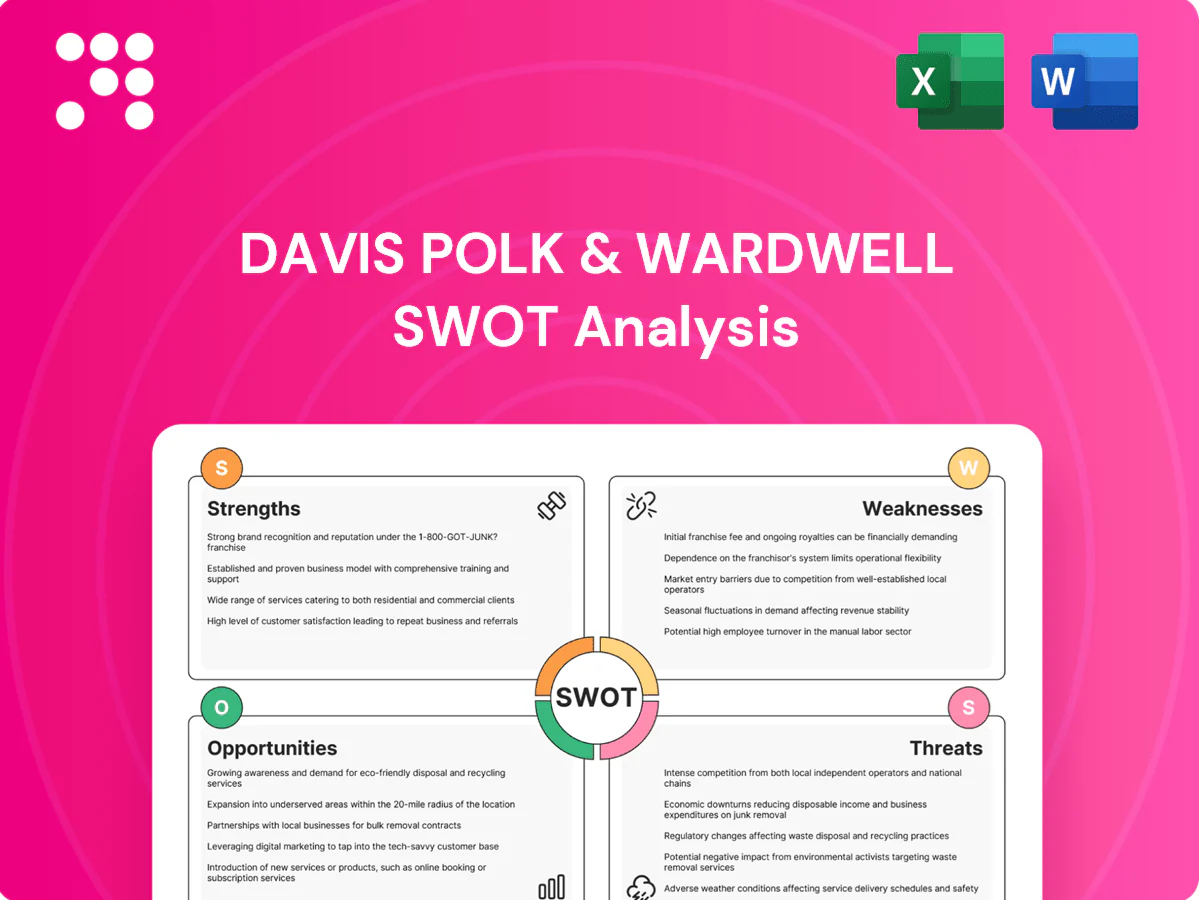
Davis Polk & Wardwell SWOT Analysis

Elevate Your Analysis with the Complete SWOT Report
Davis Polk & Wardwell’s SWOT highlights elite global legal capabilities, a top-tier client roster, and deep regulatory expertise, balanced by cyclical demand and talent-retention risks. Want the full story behind strengths, risks, and growth drivers? Purchase the complete SWOT analysis to get a professionally written, editable report with financial context and strategic takeaways. Use it to plan, pitch, or invest with confidence.
Strengths

Elite brand and blue-chip client roster
Davis Polk’s 175+ year heritage and roughly 900 lawyers across New York, London, Washington, Hong Kong and Tokyo attracts Fortune 500s, leading banks and sovereigns, shortening sales cycles and enabling premium billing. That elite brand equity drives cross-sell across capital markets, litigation and regulatory practices and the trust halo lowers perceived execution risk on bet-the-company matters.
Top-tier expertise in corporate, capital markets, litigation, restructuring, tax
Davis Polk leverages more than 175 years of experience across corporate, capital markets, litigation, restructuring and tax, consistently advising on complex M&A, IPOs, debt offerings, high‑stakes disputes and insolvencies. Depth across these pillars enables true end‑to‑end advisory on transformational events, while cross‑practice collaboration improves outcomes and efficiency. The mix helps balance cyclical swings across workflows.

Cross-border reach with sophisticated regulatory fluency
Global dealmaking and cross-border disputes require coordinated, multi-jurisdictional advice; Davis Polk’s international platform and regulatory fluency enable seamless execution on multi-country matters. Clients gain consistent quality and single-team accountability, reducing handoffs and accelerating time-sensitive transactions. This integrated capability differentiates the firm on complex cross-border mandates.

High-caliber talent, training, and institutional knowledge
Davis Polk attracts and develops top legal talent through rigorous mentorship and institutional knowledge built since 1849, leveraging playbooks that accelerate delivery and reduce risk. Experienced teams bring credibility when navigating novel issues before regulators and courts, sustaining high-quality outcomes at scale.
- Founded 1849
- Am Law 100 firm
- Institutional playbooks
Trusted advisor relationships and long client tenures
Deep, long-standing relationships with boards, C-suites and deal sponsors generate recurring, high-value mandates and give Davis Polk early visibility into client pipelines, allowing the firm to shape transactions before formal launch. This relationship capital routinely converts execution work into strategic counsel across governance, regulatory and M&A matters, creating client embeddedness that is difficult for rivals to displace.
- Board and C-suite access
- Early pipeline visibility
- Conversion to strategic counsel
- High client retention / hard-to-displace
175+ years, ~900 lawyers in five global hubs drive premium mandates
Davis Polk’s 175+ year heritage, founded 1849, and ~900 lawyers across New York, London, Washington, Hong Kong and Tokyo drive premium mandates from Fortune 500s, banks and sovereigns. Elite brand and Am Law 100 status enable cross‑sell across capital markets, litigation and regulatory practices, shortening sales cycles. Deep playbooks and board/C‑suite access secure high client retention and early pipeline visibility.
| Metric | Value (2024/25) |
|---|---|
| Founding | 1849 |
| Lawyers | ~900 |
| Offices | NY, London, Washington, HK, Tokyo |
| Am Law | Am Law 100 |
What is included in the product
 Detailed Word Document
Delivers a concise strategic overview of Davis Polk & Wardwell’s internal strengths and weaknesses and external opportunities and threats, mapping competitive position, growth drivers, operational gaps, and risks shaping the firm’s future.

 Customizable Excel Spreadsheet
Provides a concise, firm-specific SWOT matrix for Davis Polk & Wardwell to enable rapid strategic alignment, clear stakeholder communication, and quick updates as priorities shift.
Weaknesses

Premium pricing limits addressable market
High billing rates at Davis Polk can deter cost-sensitive clients and routine volumes, driving some work to lower-cost firms or in-house teams; 54% of corporate legal departments reported increasing use of alternative or lower-cost providers in 2023, raising exposure to procurement-led panel rationalization and potentially slowing growth in emerging client segments.
Dependence on cyclical deal and capital markets activity
Corporate and capital markets revenues are cyclical: Refinitiv reported global M&A value fell to about $2.2 trillion in 2023, down roughly 25% year-over-year, showing how risk-off cycles compress deal flow. Lumpy demand hurts utilization and margin stability at firms like Davis Polk, while litigation and restructuring work can partially offset lost deal fees but rarely fully hedge revenue swings. Planning and staffing become more complex during these cycles.

Conflicts of interest restrict client intake
Serving hundreds of leading institutions raises the likelihood of conflicts of interest that can block marquee mandates or force co-counsel arrangements, reducing flexibility in competitive pitches. Conflicts often shift work to co-counsel, compressing fee share and client control, and increase coordination costs across the firm’s multiple offices and dozens of practice teams.

Limited presence in alternative legal services and productization
Davis Polk lags many ALSPs and tech-enabled rivals in scaled process and productized offerings, reducing price competitiveness on standardized matters as clients shift routine work to lower-cost providers; ALSPs captured a growing share of commoditized legal spend by 2024 (industry estimates in the low tens of billions USD).
Missed leverage of firm-wide data and automation constrains margin expansion versus peers investing in analytics and RPA; client demand for tech-enabled delivery rose markedly through 2024.
- Limited productization
- Price competitiveness pressure
- Underused data/automation
- Rising client tech expectations
Concentration of expertise in key partners
Rainmaker and subject-matter concentration at Davis Polk creates succession risk, as high-value client relationships often attach to specific partners and practice leaders; any unexpected departure could disrupt revenue continuity and matter flow. Robust transition planning and systematic knowledge transfer are therefore critical to preserve client service and mitigate short-term earnings volatility.
- Succession risk: client ties to individuals
- Revenue exposure: departures impact continuity
- Mitigation: formal transition + knowledge transfer
High rates drive 54% of buyers to low-cost firms; M&A ~2.2T USD trims fees
High rates and limited productization have pushed 54% of corporate legal buyers toward lower‑cost providers in 2023, reducing addressable routine work; cyclical capital markets (global M&A ~2.2T USD in 2023, down ~25% y/y) compress revenues; rainmaker concentration heightens succession risk and potential short-term revenue shocks.
| Weakness | Metric | Impact |
|---|---|---|
| Price sensitivity | 54% buyers shift (2023) | Lost routine fees |
| Deal cyclicality | Global M&A ~2.2T USD (2023) | Revenue volatility |
| Succession | Partner concentration | Client/earnings risk |
Same Document Delivered
Davis Polk & Wardwell SWOT Analysis
This is the actual SWOT analysis document you’ll receive upon purchase—no surprises, just professional quality. The preview below is taken directly from the full SWOT report you'll get, and once purchased the complete, editable version is unlocked. You’re viewing a live preview of the real file; buy now to access the full, detailed report.

Elevate Your Analysis with the Complete SWOT Report
Davis Polk & Wardwell’s SWOT highlights elite global legal capabilities, a top-tier client roster, and deep regulatory expertise, balanced by cyclical demand and talent-retention risks. Want the full story behind strengths, risks, and growth drivers? Purchase the complete SWOT analysis to get a professionally written, editable report with financial context and strategic takeaways. Use it to plan, pitch, or invest with confidence.
Strengths
Elite brand and blue-chip client roster
Davis Polk’s 175+ year heritage and roughly 900 lawyers across New York, London, Washington, Hong Kong and Tokyo attracts Fortune 500s, leading banks and sovereigns, shortening sales cycles and enabling premium billing. That elite brand equity drives cross-sell across capital markets, litigation and regulatory practices and the trust halo lowers perceived execution risk on bet-the-company matters.
Top-tier expertise in corporate, capital markets, litigation, restructuring, tax
Davis Polk leverages more than 175 years of experience across corporate, capital markets, litigation, restructuring and tax, consistently advising on complex M&A, IPOs, debt offerings, high‑stakes disputes and insolvencies. Depth across these pillars enables true end‑to‑end advisory on transformational events, while cross‑practice collaboration improves outcomes and efficiency. The mix helps balance cyclical swings across workflows.
Cross-border reach with sophisticated regulatory fluency
Global dealmaking and cross-border disputes require coordinated, multi-jurisdictional advice; Davis Polk’s international platform and regulatory fluency enable seamless execution on multi-country matters. Clients gain consistent quality and single-team accountability, reducing handoffs and accelerating time-sensitive transactions. This integrated capability differentiates the firm on complex cross-border mandates.
High-caliber talent, training, and institutional knowledge
Davis Polk attracts and develops top legal talent through rigorous mentorship and institutional knowledge built since 1849, leveraging playbooks that accelerate delivery and reduce risk. Experienced teams bring credibility when navigating novel issues before regulators and courts, sustaining high-quality outcomes at scale.
- Founded 1849
- Am Law 100 firm
- Institutional playbooks
Trusted advisor relationships and long client tenures
Deep, long-standing relationships with boards, C-suites and deal sponsors generate recurring, high-value mandates and give Davis Polk early visibility into client pipelines, allowing the firm to shape transactions before formal launch. This relationship capital routinely converts execution work into strategic counsel across governance, regulatory and M&A matters, creating client embeddedness that is difficult for rivals to displace.
- Board and C-suite access
- Early pipeline visibility
- Conversion to strategic counsel
- High client retention / hard-to-displace
175+ years, ~900 lawyers in five global hubs drive premium mandates
Davis Polk’s 175+ year heritage, founded 1849, and ~900 lawyers across New York, London, Washington, Hong Kong and Tokyo drive premium mandates from Fortune 500s, banks and sovereigns. Elite brand and Am Law 100 status enable cross‑sell across capital markets, litigation and regulatory practices, shortening sales cycles. Deep playbooks and board/C‑suite access secure high client retention and early pipeline visibility.
| Metric | Value (2024/25) |
|---|---|
| Founding | 1849 |
| Lawyers | ~900 |
| Offices | NY, London, Washington, HK, Tokyo |
| Am Law | Am Law 100 |
What is included in the product
Detailed Word Document
Delivers a concise strategic overview of Davis Polk & Wardwell’s internal strengths and weaknesses and external opportunities and threats, mapping competitive position, growth drivers, operational gaps, and risks shaping the firm’s future.
Customizable Excel Spreadsheet
Provides a concise, firm-specific SWOT matrix for Davis Polk & Wardwell to enable rapid strategic alignment, clear stakeholder communication, and quick updates as priorities shift.
Weaknesses
Premium pricing limits addressable market
High billing rates at Davis Polk can deter cost-sensitive clients and routine volumes, driving some work to lower-cost firms or in-house teams; 54% of corporate legal departments reported increasing use of alternative or lower-cost providers in 2023, raising exposure to procurement-led panel rationalization and potentially slowing growth in emerging client segments.
Dependence on cyclical deal and capital markets activity
Corporate and capital markets revenues are cyclical: Refinitiv reported global M&A value fell to about $2.2 trillion in 2023, down roughly 25% year-over-year, showing how risk-off cycles compress deal flow. Lumpy demand hurts utilization and margin stability at firms like Davis Polk, while litigation and restructuring work can partially offset lost deal fees but rarely fully hedge revenue swings. Planning and staffing become more complex during these cycles.
Conflicts of interest restrict client intake
Serving hundreds of leading institutions raises the likelihood of conflicts of interest that can block marquee mandates or force co-counsel arrangements, reducing flexibility in competitive pitches. Conflicts often shift work to co-counsel, compressing fee share and client control, and increase coordination costs across the firm’s multiple offices and dozens of practice teams.
Limited presence in alternative legal services and productization
Davis Polk lags many ALSPs and tech-enabled rivals in scaled process and productized offerings, reducing price competitiveness on standardized matters as clients shift routine work to lower-cost providers; ALSPs captured a growing share of commoditized legal spend by 2024 (industry estimates in the low tens of billions USD).
Missed leverage of firm-wide data and automation constrains margin expansion versus peers investing in analytics and RPA; client demand for tech-enabled delivery rose markedly through 2024.
- Limited productization
- Price competitiveness pressure
- Underused data/automation
- Rising client tech expectations
Concentration of expertise in key partners
Rainmaker and subject-matter concentration at Davis Polk creates succession risk, as high-value client relationships often attach to specific partners and practice leaders; any unexpected departure could disrupt revenue continuity and matter flow. Robust transition planning and systematic knowledge transfer are therefore critical to preserve client service and mitigate short-term earnings volatility.
- Succession risk: client ties to individuals
- Revenue exposure: departures impact continuity
- Mitigation: formal transition + knowledge transfer
High rates drive 54% of buyers to low-cost firms; M&A ~2.2T USD trims fees
High rates and limited productization have pushed 54% of corporate legal buyers toward lower‑cost providers in 2023, reducing addressable routine work; cyclical capital markets (global M&A ~2.2T USD in 2023, down ~25% y/y) compress revenues; rainmaker concentration heightens succession risk and potential short-term revenue shocks.
| Weakness | Metric | Impact |
|---|---|---|
| Price sensitivity | 54% buyers shift (2023) | Lost routine fees |
| Deal cyclicality | Global M&A ~2.2T USD (2023) | Revenue volatility |
| Succession | Partner concentration | Client/earnings risk |
Same Document Delivered
Davis Polk & Wardwell SWOT Analysis
This is the actual SWOT analysis document you’ll receive upon purchase—no surprises, just professional quality. The preview below is taken directly from the full SWOT report you'll get, and once purchased the complete, editable version is unlocked. You’re viewing a live preview of the real file; buy now to access the full, detailed report.
Original: $10.00
-65%$10.00
$3.50Description
Elevate Your Analysis with the Complete SWOT Report
Davis Polk & Wardwell’s SWOT highlights elite global legal capabilities, a top-tier client roster, and deep regulatory expertise, balanced by cyclical demand and talent-retention risks. Want the full story behind strengths, risks, and growth drivers? Purchase the complete SWOT analysis to get a professionally written, editable report with financial context and strategic takeaways. Use it to plan, pitch, or invest with confidence.
Strengths
Elite brand and blue-chip client roster
Davis Polk’s 175+ year heritage and roughly 900 lawyers across New York, London, Washington, Hong Kong and Tokyo attracts Fortune 500s, leading banks and sovereigns, shortening sales cycles and enabling premium billing. That elite brand equity drives cross-sell across capital markets, litigation and regulatory practices and the trust halo lowers perceived execution risk on bet-the-company matters.
Top-tier expertise in corporate, capital markets, litigation, restructuring, tax
Davis Polk leverages more than 175 years of experience across corporate, capital markets, litigation, restructuring and tax, consistently advising on complex M&A, IPOs, debt offerings, high‑stakes disputes and insolvencies. Depth across these pillars enables true end‑to‑end advisory on transformational events, while cross‑practice collaboration improves outcomes and efficiency. The mix helps balance cyclical swings across workflows.
Cross-border reach with sophisticated regulatory fluency
Global dealmaking and cross-border disputes require coordinated, multi-jurisdictional advice; Davis Polk’s international platform and regulatory fluency enable seamless execution on multi-country matters. Clients gain consistent quality and single-team accountability, reducing handoffs and accelerating time-sensitive transactions. This integrated capability differentiates the firm on complex cross-border mandates.
High-caliber talent, training, and institutional knowledge
Davis Polk attracts and develops top legal talent through rigorous mentorship and institutional knowledge built since 1849, leveraging playbooks that accelerate delivery and reduce risk. Experienced teams bring credibility when navigating novel issues before regulators and courts, sustaining high-quality outcomes at scale.
- Founded 1849
- Am Law 100 firm
- Institutional playbooks
Trusted advisor relationships and long client tenures
Deep, long-standing relationships with boards, C-suites and deal sponsors generate recurring, high-value mandates and give Davis Polk early visibility into client pipelines, allowing the firm to shape transactions before formal launch. This relationship capital routinely converts execution work into strategic counsel across governance, regulatory and M&A matters, creating client embeddedness that is difficult for rivals to displace.
- Board and C-suite access
- Early pipeline visibility
- Conversion to strategic counsel
- High client retention / hard-to-displace
175+ years, ~900 lawyers in five global hubs drive premium mandates
Davis Polk’s 175+ year heritage, founded 1849, and ~900 lawyers across New York, London, Washington, Hong Kong and Tokyo drive premium mandates from Fortune 500s, banks and sovereigns. Elite brand and Am Law 100 status enable cross‑sell across capital markets, litigation and regulatory practices, shortening sales cycles. Deep playbooks and board/C‑suite access secure high client retention and early pipeline visibility.
| Metric | Value (2024/25) |
|---|---|
| Founding | 1849 |
| Lawyers | ~900 |
| Offices | NY, London, Washington, HK, Tokyo |
| Am Law | Am Law 100 |
What is included in the product
Detailed Word Document
Delivers a concise strategic overview of Davis Polk & Wardwell’s internal strengths and weaknesses and external opportunities and threats, mapping competitive position, growth drivers, operational gaps, and risks shaping the firm’s future.
Customizable Excel Spreadsheet
Provides a concise, firm-specific SWOT matrix for Davis Polk & Wardwell to enable rapid strategic alignment, clear stakeholder communication, and quick updates as priorities shift.
Weaknesses
Premium pricing limits addressable market
High billing rates at Davis Polk can deter cost-sensitive clients and routine volumes, driving some work to lower-cost firms or in-house teams; 54% of corporate legal departments reported increasing use of alternative or lower-cost providers in 2023, raising exposure to procurement-led panel rationalization and potentially slowing growth in emerging client segments.
Dependence on cyclical deal and capital markets activity
Corporate and capital markets revenues are cyclical: Refinitiv reported global M&A value fell to about $2.2 trillion in 2023, down roughly 25% year-over-year, showing how risk-off cycles compress deal flow. Lumpy demand hurts utilization and margin stability at firms like Davis Polk, while litigation and restructuring work can partially offset lost deal fees but rarely fully hedge revenue swings. Planning and staffing become more complex during these cycles.
Conflicts of interest restrict client intake
Serving hundreds of leading institutions raises the likelihood of conflicts of interest that can block marquee mandates or force co-counsel arrangements, reducing flexibility in competitive pitches. Conflicts often shift work to co-counsel, compressing fee share and client control, and increase coordination costs across the firm’s multiple offices and dozens of practice teams.
Limited presence in alternative legal services and productization
Davis Polk lags many ALSPs and tech-enabled rivals in scaled process and productized offerings, reducing price competitiveness on standardized matters as clients shift routine work to lower-cost providers; ALSPs captured a growing share of commoditized legal spend by 2024 (industry estimates in the low tens of billions USD).
Missed leverage of firm-wide data and automation constrains margin expansion versus peers investing in analytics and RPA; client demand for tech-enabled delivery rose markedly through 2024.
- Limited productization
- Price competitiveness pressure
- Underused data/automation
- Rising client tech expectations
Concentration of expertise in key partners
Rainmaker and subject-matter concentration at Davis Polk creates succession risk, as high-value client relationships often attach to specific partners and practice leaders; any unexpected departure could disrupt revenue continuity and matter flow. Robust transition planning and systematic knowledge transfer are therefore critical to preserve client service and mitigate short-term earnings volatility.
- Succession risk: client ties to individuals
- Revenue exposure: departures impact continuity
- Mitigation: formal transition + knowledge transfer
High rates drive 54% of buyers to low-cost firms; M&A ~2.2T USD trims fees
High rates and limited productization have pushed 54% of corporate legal buyers toward lower‑cost providers in 2023, reducing addressable routine work; cyclical capital markets (global M&A ~2.2T USD in 2023, down ~25% y/y) compress revenues; rainmaker concentration heightens succession risk and potential short-term revenue shocks.
| Weakness | Metric | Impact |
|---|---|---|
| Price sensitivity | 54% buyers shift (2023) | Lost routine fees |
| Deal cyclicality | Global M&A ~2.2T USD (2023) | Revenue volatility |
| Succession | Partner concentration | Client/earnings risk |
Same Document Delivered
Davis Polk & Wardwell SWOT Analysis
This is the actual SWOT analysis document you’ll receive upon purchase—no surprises, just professional quality. The preview below is taken directly from the full SWOT report you'll get, and once purchased the complete, editable version is unlocked. You’re viewing a live preview of the real file; buy now to access the full, detailed report.











