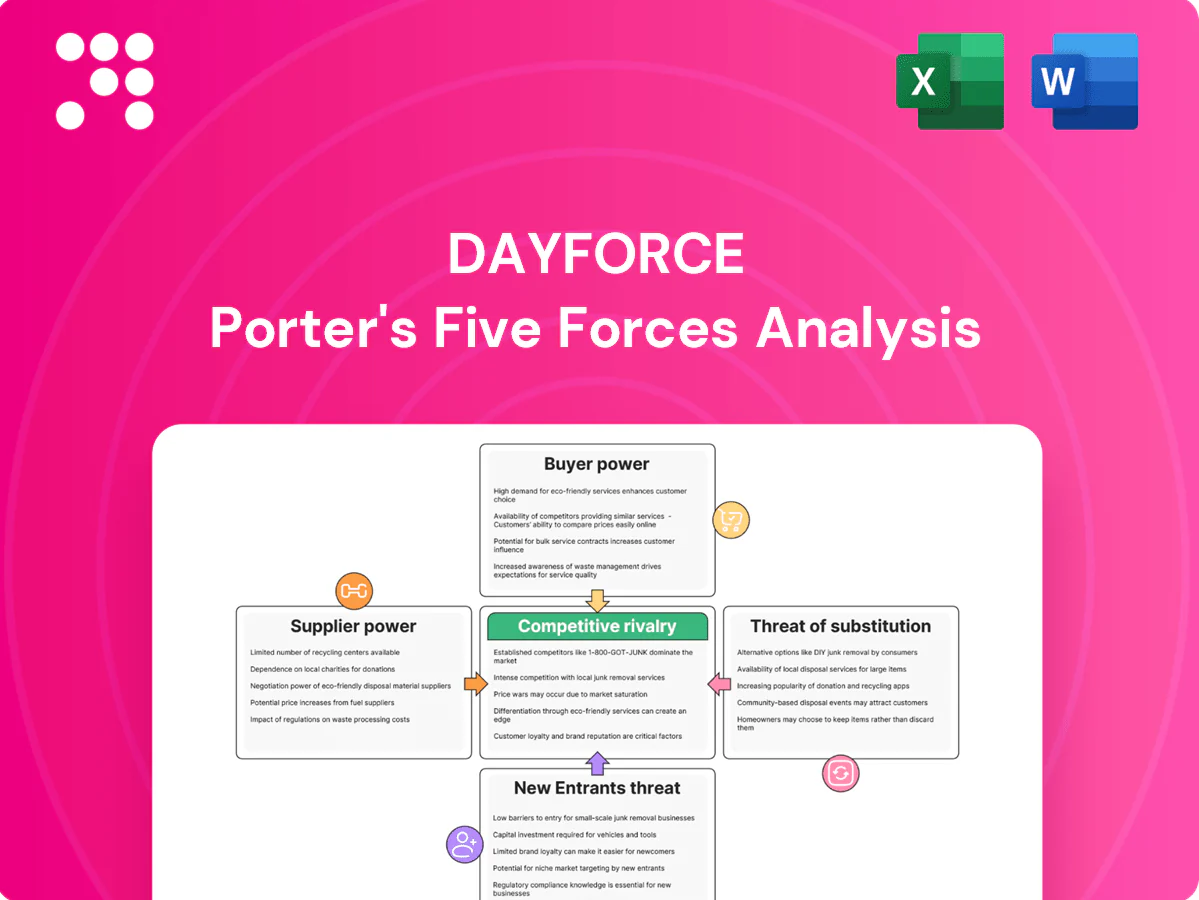
Dayforce Porter's Five Forces Analysis

A Must-Have Tool for Decision-Makers
This brief Porter's Five Forces snapshot highlights Dayforce’s buyer power, supplier dynamics, and competitive intensity, but only scratches the surface. Unlock the full Porter's Five Forces Analysis to explore force-by-force ratings, visuals, and strategic implications for Dayforce. Purchase the complete report for a consultant-grade, data-driven strategic toolkit.
Suppliers Bargaining Power

Hyperscaler dependence
Dayforce depends on hyperscalers for hosting, compute and storage, creating concentration risk given Synergy Research 2024 shares (AWS ~31%, Azure ~24%, GCP ~10%). Their scale gives pricing power, though multi-cloud and long-term reserved instances can mitigate cost exposure. Regional outages or capacity limits can breach SLAs and harm NPS. Negotiated reserved instances and co-selling programs reduce cost pressure and improve Go-to-Market economics.
Specialized compliance content
Regulatory data, payroll tax updates and compliance content for Dayforce are often sourced from niche vendors and government feeds covering 50 states and 3,000+ local jurisdictions, making accuracy and timeliness mission-critical and giving suppliers measurable leverage. Multiple sources and internal compliance teams can diversify that risk. Hundreds of annual tax changes reinforce supplier importance, though proprietary rules engines reduce dependency over time.

Benefits carriers and rails
Integrations with benefits carriers, payment processors and tax filing rails are essential for Dayforce’s product completeness, but large carriers and payment networks like Visa and Mastercard, which together handle roughly 80% of U.S. card volume, can impose technical and commercial terms. Certification requirements and multi-month testing cycles raise switching costs and compliance stakes. Expanding connectivity to multiple carriers and processors reduces single-supplier power.

Implementation partners
System integrator and consulting partners materially affect Dayforce deployment speed and outcomes; in 2024 US enterprise HRIS SI rates commonly ranged from 150 to 300 USD/hour, with boutique experts >300 USD/hour in tight markets.
Markets with limited expert talent see scheduling delays and higher cost; building internal professional services and structured partner enablement reduces supplier leverage and dependence.
Reference architectures and delivery automation cut variability—benchmarks show automation can lower time-to-live by 20–40% in cloud HR implementations.
- Partner rates: 150–300 USD/hour (2024)
- Automation impact: −20–40% deployment time
- Mitigants: internal PS, partner enablement, reference architectures
AI/ML tooling and data
Third-party AI platforms, models, and data enrichment underpin Dayforce advanced features; by 2024 many enterprise HCM deployments relied on external AI providers for core ML pipelines. Vendor pricing, usage caps, and data residency terms can shift costs materially, while model portability and bring-your-own-key options reduce lock-in. Growing first-party workforce and payroll data steadily strengthens bargaining power versus suppliers.
Supplier power: hyperscalers 31/24/10%, cards ~80%
Supplier power is moderate-high: hyperscalers (AWS 31%, Azure 24%, GCP 10% in 2024) and payment networks (~80% U.S. card volume) exert pricing and SLA leverage. Niche tax/compliance feeds and SI rates (2024: 150–300 USD/hr) raise switching costs. Mitigants: multi-cloud, reserved instances, BYOK, internal PS, automation (-20–40% deployment time).
| Supplier | 2024 Metric |
|---|---|
| Hyperscalers | AWS 31% / Azure 24% / GCP 10% |
| Card networks | ~80% U.S. volume |
| SIs | 150–300 USD/hr |
| Automation | -20–40% time |
What is included in the product
 Detailed Word Document
Uncovers key drivers of competition, customer influence, and market entry risks for Dayforce, offering detailed analysis of each force with industry data and strategic commentary; identifies disruptive substitutes, supplier/buyer power, and barriers protecting incumbents—fully editable for reports, investor materials, and strategy decks.

 Customizable Excel Spreadsheet
A clear, one-sheet Porter's Five Forces summary for Dayforce—instantly reveals competitive pressures to relieve strategic planning pain points and speed decision-making.
Customers Bargaining Power

Enterprise RFP leverage
Enterprise RFPs give large buyers leverage to demand discounts, custom SLAs and roadmap commitments, and multi-vendor shortlists intensify price competition for Dayforce. Referenceability and proven global capabilities materially improve win rates, with Ceridian reporting FY2024 revenue of about $1.5B, underscoring scale importance. Consolidation deals often trade margin for footprint expansion to secure large accounts and long-term recurring revenues.
Switching costs and lock-in
Data migration, change management, and reconfiguring workflows create high switching costs for Dayforce, contributing to post-implementation buyer lock-in; Ceridian reported over 8,000 customers and roughly $1.44B revenue in 2024, underscoring scale-driven stickiness. Strong CSAT and broad HCM functionality deepen retention, reducing churn risk. However, poor implementations still trigger re-tenders and contract renegotiations.

SMB price sensitivity
SMB buyers are highly price-sensitive: industry benchmarks show SMB SaaS annual churn often ranges 15–25% and freemium-to-paid conversion rates sit around 2–5% in 2024, intensifying price pressure on Dayforce. Simplified packaging and clear ROI messaging—highlighting payback periods under 12 months—help preserve value, while self-serve onboarding can cut acquisition costs by up to ~30–40% per industry studies.

Integration requirements
Buyers now insist on seamless ERP, finance and collaboration integrations; missing connectors can stall deals or force price or implementation concessions. Robust APIs and prebuilt connectors lower customization costs and time to value, and 2024 surveys show over half of enterprise buyers list integration readiness as a deal-breaker. Certification in major ecosystems measurably raises win rates.
- Integration readiness: deal-breaker for >50% buyers (2024)
- Prebuilt connectors reduce customization costs and time
- API robustness and ecosystem certification increase win likelihood
Global compliance needs
Global compliance needs in 2024 force multinationals to demand multi-country payroll and local regulatory coverage; gaps compel customers to multi-source, raising their negotiating leverage. As Dayforce expands country coverage and partner networks, that leverage narrows. Publishing transparent roadmap timelines further reduces churn and builds trust.
- Multi-country payroll requirement
- Multi-sourcing increases customer leverage
- Expanded coverage reduces leverage
- Transparent roadmaps build trust
Enterprise RFPs, multi-sourcing boost buyer leverage; $1.5B scale, integration readiness critical
Large enterprise RFPs and multi-sourcing drive buyer leverage; Ceridian FY2024 revenue ~$1.5B with >8,000 customers enhances Dayforce stickiness, while integration readiness is a deal-breaker for >50% of buyers. SMB churn 15–25% raises price sensitivity; high switching costs from data migration limit churn but bad implementations prompt renegotiations.
| Metric | 2024 Value | Impact |
|---|---|---|
| Revenue | $1.5B | Scale/credibility |
| Customers | 8,000+ | Retention |
| Integration deal-breaker | >50% | Negotiation leverage |
| SMB churn | 15–25% | Price pressure |
Full Version Awaits
Dayforce Porter's Five Forces Analysis
This Dayforce Porter's Five Forces Analysis preview is the exact, fully formatted document you'll receive immediately after purchase. No samples, no placeholders—what you see is the finished deliverable. Upon payment you'll get instant access to this identical file, ready for download and use.

A Must-Have Tool for Decision-Makers
This brief Porter's Five Forces snapshot highlights Dayforce’s buyer power, supplier dynamics, and competitive intensity, but only scratches the surface. Unlock the full Porter's Five Forces Analysis to explore force-by-force ratings, visuals, and strategic implications for Dayforce. Purchase the complete report for a consultant-grade, data-driven strategic toolkit.
Suppliers Bargaining Power
Hyperscaler dependence
Dayforce depends on hyperscalers for hosting, compute and storage, creating concentration risk given Synergy Research 2024 shares (AWS ~31%, Azure ~24%, GCP ~10%). Their scale gives pricing power, though multi-cloud and long-term reserved instances can mitigate cost exposure. Regional outages or capacity limits can breach SLAs and harm NPS. Negotiated reserved instances and co-selling programs reduce cost pressure and improve Go-to-Market economics.
Specialized compliance content
Regulatory data, payroll tax updates and compliance content for Dayforce are often sourced from niche vendors and government feeds covering 50 states and 3,000+ local jurisdictions, making accuracy and timeliness mission-critical and giving suppliers measurable leverage. Multiple sources and internal compliance teams can diversify that risk. Hundreds of annual tax changes reinforce supplier importance, though proprietary rules engines reduce dependency over time.
Benefits carriers and rails
Integrations with benefits carriers, payment processors and tax filing rails are essential for Dayforce’s product completeness, but large carriers and payment networks like Visa and Mastercard, which together handle roughly 80% of U.S. card volume, can impose technical and commercial terms. Certification requirements and multi-month testing cycles raise switching costs and compliance stakes. Expanding connectivity to multiple carriers and processors reduces single-supplier power.
Implementation partners
System integrator and consulting partners materially affect Dayforce deployment speed and outcomes; in 2024 US enterprise HRIS SI rates commonly ranged from 150 to 300 USD/hour, with boutique experts >300 USD/hour in tight markets.
Markets with limited expert talent see scheduling delays and higher cost; building internal professional services and structured partner enablement reduces supplier leverage and dependence.
Reference architectures and delivery automation cut variability—benchmarks show automation can lower time-to-live by 20–40% in cloud HR implementations.
- Partner rates: 150–300 USD/hour (2024)
- Automation impact: −20–40% deployment time
- Mitigants: internal PS, partner enablement, reference architectures
AI/ML tooling and data
Third-party AI platforms, models, and data enrichment underpin Dayforce advanced features; by 2024 many enterprise HCM deployments relied on external AI providers for core ML pipelines. Vendor pricing, usage caps, and data residency terms can shift costs materially, while model portability and bring-your-own-key options reduce lock-in. Growing first-party workforce and payroll data steadily strengthens bargaining power versus suppliers.
Supplier power: hyperscalers 31/24/10%, cards ~80%
Supplier power is moderate-high: hyperscalers (AWS 31%, Azure 24%, GCP 10% in 2024) and payment networks (~80% U.S. card volume) exert pricing and SLA leverage. Niche tax/compliance feeds and SI rates (2024: 150–300 USD/hr) raise switching costs. Mitigants: multi-cloud, reserved instances, BYOK, internal PS, automation (-20–40% deployment time).
| Supplier | 2024 Metric |
|---|---|
| Hyperscalers | AWS 31% / Azure 24% / GCP 10% |
| Card networks | ~80% U.S. volume |
| SIs | 150–300 USD/hr |
| Automation | -20–40% time |
What is included in the product
Detailed Word Document
Uncovers key drivers of competition, customer influence, and market entry risks for Dayforce, offering detailed analysis of each force with industry data and strategic commentary; identifies disruptive substitutes, supplier/buyer power, and barriers protecting incumbents—fully editable for reports, investor materials, and strategy decks.
Customizable Excel Spreadsheet
A clear, one-sheet Porter's Five Forces summary for Dayforce—instantly reveals competitive pressures to relieve strategic planning pain points and speed decision-making.
Customers Bargaining Power
Enterprise RFP leverage
Enterprise RFPs give large buyers leverage to demand discounts, custom SLAs and roadmap commitments, and multi-vendor shortlists intensify price competition for Dayforce. Referenceability and proven global capabilities materially improve win rates, with Ceridian reporting FY2024 revenue of about $1.5B, underscoring scale importance. Consolidation deals often trade margin for footprint expansion to secure large accounts and long-term recurring revenues.
Switching costs and lock-in
Data migration, change management, and reconfiguring workflows create high switching costs for Dayforce, contributing to post-implementation buyer lock-in; Ceridian reported over 8,000 customers and roughly $1.44B revenue in 2024, underscoring scale-driven stickiness. Strong CSAT and broad HCM functionality deepen retention, reducing churn risk. However, poor implementations still trigger re-tenders and contract renegotiations.
SMB price sensitivity
SMB buyers are highly price-sensitive: industry benchmarks show SMB SaaS annual churn often ranges 15–25% and freemium-to-paid conversion rates sit around 2–5% in 2024, intensifying price pressure on Dayforce. Simplified packaging and clear ROI messaging—highlighting payback periods under 12 months—help preserve value, while self-serve onboarding can cut acquisition costs by up to ~30–40% per industry studies.
Integration requirements
Buyers now insist on seamless ERP, finance and collaboration integrations; missing connectors can stall deals or force price or implementation concessions. Robust APIs and prebuilt connectors lower customization costs and time to value, and 2024 surveys show over half of enterprise buyers list integration readiness as a deal-breaker. Certification in major ecosystems measurably raises win rates.
- Integration readiness: deal-breaker for >50% buyers (2024)
- Prebuilt connectors reduce customization costs and time
- API robustness and ecosystem certification increase win likelihood
Global compliance needs
Global compliance needs in 2024 force multinationals to demand multi-country payroll and local regulatory coverage; gaps compel customers to multi-source, raising their negotiating leverage. As Dayforce expands country coverage and partner networks, that leverage narrows. Publishing transparent roadmap timelines further reduces churn and builds trust.
- Multi-country payroll requirement
- Multi-sourcing increases customer leverage
- Expanded coverage reduces leverage
- Transparent roadmaps build trust
Enterprise RFPs, multi-sourcing boost buyer leverage; $1.5B scale, integration readiness critical
Large enterprise RFPs and multi-sourcing drive buyer leverage; Ceridian FY2024 revenue ~$1.5B with >8,000 customers enhances Dayforce stickiness, while integration readiness is a deal-breaker for >50% of buyers. SMB churn 15–25% raises price sensitivity; high switching costs from data migration limit churn but bad implementations prompt renegotiations.
| Metric | 2024 Value | Impact |
|---|---|---|
| Revenue | $1.5B | Scale/credibility |
| Customers | 8,000+ | Retention |
| Integration deal-breaker | >50% | Negotiation leverage |
| SMB churn | 15–25% | Price pressure |
Full Version Awaits
Dayforce Porter's Five Forces Analysis
This Dayforce Porter's Five Forces Analysis preview is the exact, fully formatted document you'll receive immediately after purchase. No samples, no placeholders—what you see is the finished deliverable. Upon payment you'll get instant access to this identical file, ready for download and use.
Original: $10.00
-65%$10.00
$3.50Description
A Must-Have Tool for Decision-Makers
This brief Porter's Five Forces snapshot highlights Dayforce’s buyer power, supplier dynamics, and competitive intensity, but only scratches the surface. Unlock the full Porter's Five Forces Analysis to explore force-by-force ratings, visuals, and strategic implications for Dayforce. Purchase the complete report for a consultant-grade, data-driven strategic toolkit.
Suppliers Bargaining Power
Hyperscaler dependence
Dayforce depends on hyperscalers for hosting, compute and storage, creating concentration risk given Synergy Research 2024 shares (AWS ~31%, Azure ~24%, GCP ~10%). Their scale gives pricing power, though multi-cloud and long-term reserved instances can mitigate cost exposure. Regional outages or capacity limits can breach SLAs and harm NPS. Negotiated reserved instances and co-selling programs reduce cost pressure and improve Go-to-Market economics.
Specialized compliance content
Regulatory data, payroll tax updates and compliance content for Dayforce are often sourced from niche vendors and government feeds covering 50 states and 3,000+ local jurisdictions, making accuracy and timeliness mission-critical and giving suppliers measurable leverage. Multiple sources and internal compliance teams can diversify that risk. Hundreds of annual tax changes reinforce supplier importance, though proprietary rules engines reduce dependency over time.
Benefits carriers and rails
Integrations with benefits carriers, payment processors and tax filing rails are essential for Dayforce’s product completeness, but large carriers and payment networks like Visa and Mastercard, which together handle roughly 80% of U.S. card volume, can impose technical and commercial terms. Certification requirements and multi-month testing cycles raise switching costs and compliance stakes. Expanding connectivity to multiple carriers and processors reduces single-supplier power.
Implementation partners
System integrator and consulting partners materially affect Dayforce deployment speed and outcomes; in 2024 US enterprise HRIS SI rates commonly ranged from 150 to 300 USD/hour, with boutique experts >300 USD/hour in tight markets.
Markets with limited expert talent see scheduling delays and higher cost; building internal professional services and structured partner enablement reduces supplier leverage and dependence.
Reference architectures and delivery automation cut variability—benchmarks show automation can lower time-to-live by 20–40% in cloud HR implementations.
- Partner rates: 150–300 USD/hour (2024)
- Automation impact: −20–40% deployment time
- Mitigants: internal PS, partner enablement, reference architectures
AI/ML tooling and data
Third-party AI platforms, models, and data enrichment underpin Dayforce advanced features; by 2024 many enterprise HCM deployments relied on external AI providers for core ML pipelines. Vendor pricing, usage caps, and data residency terms can shift costs materially, while model portability and bring-your-own-key options reduce lock-in. Growing first-party workforce and payroll data steadily strengthens bargaining power versus suppliers.
Supplier power: hyperscalers 31/24/10%, cards ~80%
Supplier power is moderate-high: hyperscalers (AWS 31%, Azure 24%, GCP 10% in 2024) and payment networks (~80% U.S. card volume) exert pricing and SLA leverage. Niche tax/compliance feeds and SI rates (2024: 150–300 USD/hr) raise switching costs. Mitigants: multi-cloud, reserved instances, BYOK, internal PS, automation (-20–40% deployment time).
| Supplier | 2024 Metric |
|---|---|
| Hyperscalers | AWS 31% / Azure 24% / GCP 10% |
| Card networks | ~80% U.S. volume |
| SIs | 150–300 USD/hr |
| Automation | -20–40% time |
What is included in the product
Detailed Word Document
Uncovers key drivers of competition, customer influence, and market entry risks for Dayforce, offering detailed analysis of each force with industry data and strategic commentary; identifies disruptive substitutes, supplier/buyer power, and barriers protecting incumbents—fully editable for reports, investor materials, and strategy decks.
Customizable Excel Spreadsheet
A clear, one-sheet Porter's Five Forces summary for Dayforce—instantly reveals competitive pressures to relieve strategic planning pain points and speed decision-making.
Customers Bargaining Power
Enterprise RFP leverage
Enterprise RFPs give large buyers leverage to demand discounts, custom SLAs and roadmap commitments, and multi-vendor shortlists intensify price competition for Dayforce. Referenceability and proven global capabilities materially improve win rates, with Ceridian reporting FY2024 revenue of about $1.5B, underscoring scale importance. Consolidation deals often trade margin for footprint expansion to secure large accounts and long-term recurring revenues.
Switching costs and lock-in
Data migration, change management, and reconfiguring workflows create high switching costs for Dayforce, contributing to post-implementation buyer lock-in; Ceridian reported over 8,000 customers and roughly $1.44B revenue in 2024, underscoring scale-driven stickiness. Strong CSAT and broad HCM functionality deepen retention, reducing churn risk. However, poor implementations still trigger re-tenders and contract renegotiations.
SMB price sensitivity
SMB buyers are highly price-sensitive: industry benchmarks show SMB SaaS annual churn often ranges 15–25% and freemium-to-paid conversion rates sit around 2–5% in 2024, intensifying price pressure on Dayforce. Simplified packaging and clear ROI messaging—highlighting payback periods under 12 months—help preserve value, while self-serve onboarding can cut acquisition costs by up to ~30–40% per industry studies.
Integration requirements
Buyers now insist on seamless ERP, finance and collaboration integrations; missing connectors can stall deals or force price or implementation concessions. Robust APIs and prebuilt connectors lower customization costs and time to value, and 2024 surveys show over half of enterprise buyers list integration readiness as a deal-breaker. Certification in major ecosystems measurably raises win rates.
- Integration readiness: deal-breaker for >50% buyers (2024)
- Prebuilt connectors reduce customization costs and time
- API robustness and ecosystem certification increase win likelihood
Global compliance needs
Global compliance needs in 2024 force multinationals to demand multi-country payroll and local regulatory coverage; gaps compel customers to multi-source, raising their negotiating leverage. As Dayforce expands country coverage and partner networks, that leverage narrows. Publishing transparent roadmap timelines further reduces churn and builds trust.
- Multi-country payroll requirement
- Multi-sourcing increases customer leverage
- Expanded coverage reduces leverage
- Transparent roadmaps build trust
Enterprise RFPs, multi-sourcing boost buyer leverage; $1.5B scale, integration readiness critical
Large enterprise RFPs and multi-sourcing drive buyer leverage; Ceridian FY2024 revenue ~$1.5B with >8,000 customers enhances Dayforce stickiness, while integration readiness is a deal-breaker for >50% of buyers. SMB churn 15–25% raises price sensitivity; high switching costs from data migration limit churn but bad implementations prompt renegotiations.
| Metric | 2024 Value | Impact |
|---|---|---|
| Revenue | $1.5B | Scale/credibility |
| Customers | 8,000+ | Retention |
| Integration deal-breaker | >50% | Negotiation leverage |
| SMB churn | 15–25% | Price pressure |
Full Version Awaits
Dayforce Porter's Five Forces Analysis
This Dayforce Porter's Five Forces Analysis preview is the exact, fully formatted document you'll receive immediately after purchase. No samples, no placeholders—what you see is the finished deliverable. Upon payment you'll get instant access to this identical file, ready for download and use.











