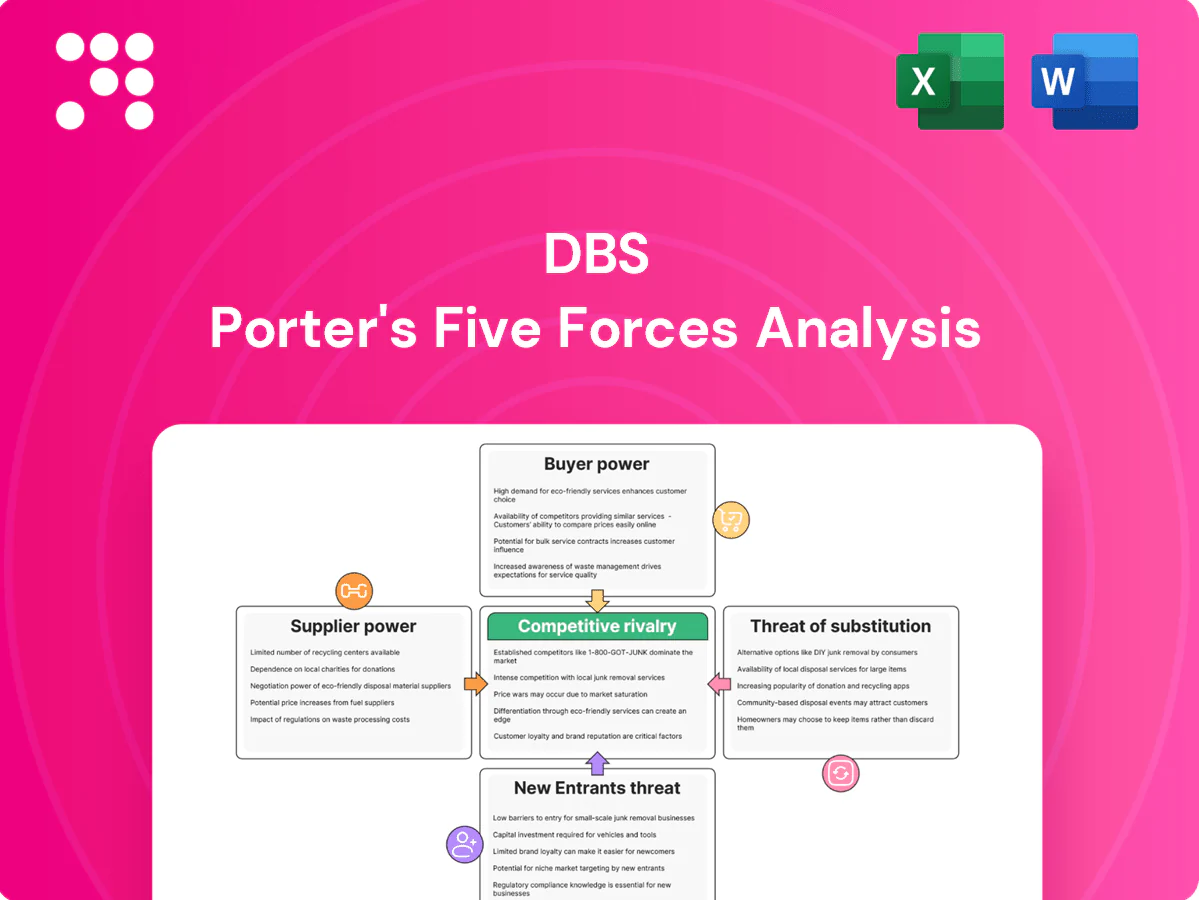
DBS Porter's Five Forces Analysis

Elevate Your Analysis with the Complete Porter's Five Forces Analysis
DBS's Porter's Five Forces snapshot highlights competitive intensity across rivals, buyer power, supplier influence, new entrants and substitutes, revealing where margins and growth are most pressured. Our concise review maps strategic strengths and vulnerabilities for rapid decision-making. This brief only scratches the surface—unlock the full Porter's Five Forces Analysis for force-by-force ratings, visuals, and actionable recommendations to inform investments or strategy.
Suppliers Bargaining Power

Diverse, low-cost funding base
DBS's diverse funding — with CASA above 50% in 2024 — keeps funding costs low and weakens wholesale lenders' bargaining power; granular retail and SME deposits are fragmented and less price-sensitive than institutional funds. In tight liquidity cycles deposit beta increases and savers push for higher yields, but strong trust and seamless digital channels help DBS retain sticky deposits.
Wholesale markets and institutional funding
Commercial paper, MTNs and interbank lines can become costlier and more selective in stress, elevating supplier leverage as spreads widen; market sentiment and credit ratings directly drive those spreads. DBS’s status as Southeast Asia’s largest bank and a CET1 ratio around 14% in 2024 moderates but does not eliminate reliance on wholesale funding. Diversification across currencies and tenors reduces concentration risk.

Technology and cloud vendors
Core banking platforms, cloud hyperscalers and cybersecurity providers exert strong bargaining power for DBS because high switching costs, vendor lock-in and regulatory compliance increase reliance; hyperscalers (AWS, Azure, GCP) held over 60% of the global cloud market in 2024. DBS’s scale and multi-vendor sourcing provide negotiation leverage, while open architecture and robust in-house engineering reduce single-supplier exposure and migration risk.

Skilled talent and data capabilities
Specialist talent in AI, risk, compliance and wealth is scarce, giving these employees elevated bargaining power; wage inflation and richer retention packages have pushed banks to increase compensation and benefits, raising operating costs. DBS’s strong brand, market position and clear career pathways improve attraction and retention, while targeted automation and upskilling programs mitigate but do not eliminate talent pressure.
- Scarcity: specialist AI, risk, compliance, wealth talent
- Cost: higher wages and retention packages raise Opex
- Anchor: DBS brand and career paths aid retention
- Relief: automation and upskilling partially reduce dependence
Payment rails and market infrastructures
Networks like Visa and Mastercard set interchange and technical standards, collectively handling approximately 70% of global card volume in 2024, while domestic RTGS/FAST and exchanges set access fees that limit DBS’s pricing power. Interoperability mandates (e.g., Singapore FAST/NETS frameworks) cap unilateral fee increases, but rising account-to-account and QR adoption—up ~30% YoY in APAC (2024)—dilutes card network dominance. DBS mitigates supplier power via strategic partnerships and negotiated cost-to-serve arrangements to secure rails access.
- Supplier concentration: Visa/Mastercard ~70% (2024)
- Interoperability limits DBS pricing
- Account-to-account/QR adoption +30% YoY (APAC, 2024)
- Strategy: partnerships to manage cost-to-serve
High CASA >50% & CET1 ~14% tighten funding; hyperscalers and card networks gain leverage
DBS's high CASA (>50% in 2024) and CET1 ~14% limit wholesale funding suppliers' leverage; deposit beta rises under stress. Cloud hyperscalers >60% market share and card networks ~70% (Visa/Mastercard) increase supplier power. Specialist talent scarcity and QR account growth +30% YoY (APAC, 2024) shape bargaining dynamics.
| Metric | 2024 |
|---|---|
| CASA | >50% |
| CET1 | ~14% |
| Cloud share | >60% |
| Card networks | ~70% |
| QR adoption (APAC) | +30% YoY |
What is included in the product
 Detailed Word Document
Concise Porter’s Five Forces review tailored for DBS, assessing competitive rivalry, buyer and supplier power, threat of new entrants and substitutes, and highlighting disruptive threats, barriers to entry, and implications for pricing and profitability.

 Customizable Excel Spreadsheet
A clear, one-sheet summary of DBS's five forces—perfect for quick strategic decisions, investor briefings, and boardroom alignment.
Customers Bargaining Power

Multi-banking reduces lock-in
Clients commonly maintain multiple banking relationships—over 60% held two or more banks in 2024—boosting price comparison and lowering switching costs. Faster digital onboarding (accounts opened in minutes via eKYC) accelerates movement across providers. DBS counters with integrated ecosystems and superior UX to raise stickiness. Loyalty programs and bundled wealth, payments and lending products deepen engagement and share of wallet.
Price-sensitive loans and deposits
Rate competition in mortgages, SME loans and time deposits gives buyers leverage as small basis-point moves sway choices; DBS faced intense spread pressure in 2024 despite serving roughly 11 million customers. Transparent comparison tools heighten sensitivity to basis-point differences, while DBS uses risk-based pricing and cross-sell to protect margins. Relationship pricing and fee waivers retain high-value clients through tailored bundles and preferential rates.

High-net-worth and institutional clout
HNWI, family offices and corporates negotiate bespoke pricing and service levels, leveraging large trade volumes and alternatives such as private banks and capital markets to extract concessions.
As the largest bank by assets in Singapore, DBS counters this bargaining power through deep advisory capabilities and broad platform breadth.
Dedicated coverage and solutions teams focus on retention and bespoke structuring, preserving margins despite strong customer clout.

Digital expectations and service quality
Customers demand instant, reliable, seamless digital experiences and any outage or friction quickly triggers churn or complaints, amplifying their negotiation leverage; DBS’s advanced digital platform and continuous UX upgrades and 24/7 support help contain this buyer power.
- Digital expectations: instant, frictionless service
- Risk: outages → rapid churn/complaints
- DBS mitigation: strong digital capabilities, ongoing UX improvements, 24/7 support
Switching costs via ecosystems
DBS embeds payroll, collections, treasury and wealth services into its ecosystem, increasing customer stickiness; by 2024 DBS served about 12 million customers across its digital platforms, making integrated workflows and data-driven insights a strong convenience moat that lowers effective customer bargaining power despite available alternatives.
- Embedded platforms raise practical switching costs
- APIs + analytics create workflow lock-in
- Contractual integrations deepen dependency
- Nominal alternatives exist but face higher migration hurdles
Price-sensitive: >60% multi-bank users; ecosystems raise switching costs
Customers hold multiple banking relationships (over 60% with 2+ banks in 2024), giving strong price sensitivity; DBS served ~11–12m customers in 2024. Rate competition compressed spreads across mortgages, SME loans and deposits in 2024, raising buyer leverage. DBS offsets this via embedded payroll/treasury/weath ecosystems and APIs that raise practical switching costs.
| Metric | 2024 |
|---|---|
| Customers | 11–12m |
| Multi-bank holders | >60% |
| Spread pressure | High (mortgages/SME/deposits) |
Preview Before You Purchase
DBS Porter's Five Forces Analysis
This preview shows the exact DBS Porter's Five Forces Analysis you'll receive immediately after purchase—no surprises, no placeholders. The document displayed is the full, professionally formatted analysis ready for download and use the moment you buy. You're looking at the actual file; instant access follows payment.

Elevate Your Analysis with the Complete Porter's Five Forces Analysis
DBS's Porter's Five Forces snapshot highlights competitive intensity across rivals, buyer power, supplier influence, new entrants and substitutes, revealing where margins and growth are most pressured. Our concise review maps strategic strengths and vulnerabilities for rapid decision-making. This brief only scratches the surface—unlock the full Porter's Five Forces Analysis for force-by-force ratings, visuals, and actionable recommendations to inform investments or strategy.
Suppliers Bargaining Power
Diverse, low-cost funding base
DBS's diverse funding — with CASA above 50% in 2024 — keeps funding costs low and weakens wholesale lenders' bargaining power; granular retail and SME deposits are fragmented and less price-sensitive than institutional funds. In tight liquidity cycles deposit beta increases and savers push for higher yields, but strong trust and seamless digital channels help DBS retain sticky deposits.
Wholesale markets and institutional funding
Commercial paper, MTNs and interbank lines can become costlier and more selective in stress, elevating supplier leverage as spreads widen; market sentiment and credit ratings directly drive those spreads. DBS’s status as Southeast Asia’s largest bank and a CET1 ratio around 14% in 2024 moderates but does not eliminate reliance on wholesale funding. Diversification across currencies and tenors reduces concentration risk.
Technology and cloud vendors
Core banking platforms, cloud hyperscalers and cybersecurity providers exert strong bargaining power for DBS because high switching costs, vendor lock-in and regulatory compliance increase reliance; hyperscalers (AWS, Azure, GCP) held over 60% of the global cloud market in 2024. DBS’s scale and multi-vendor sourcing provide negotiation leverage, while open architecture and robust in-house engineering reduce single-supplier exposure and migration risk.
Skilled talent and data capabilities
Specialist talent in AI, risk, compliance and wealth is scarce, giving these employees elevated bargaining power; wage inflation and richer retention packages have pushed banks to increase compensation and benefits, raising operating costs. DBS’s strong brand, market position and clear career pathways improve attraction and retention, while targeted automation and upskilling programs mitigate but do not eliminate talent pressure.
- Scarcity: specialist AI, risk, compliance, wealth talent
- Cost: higher wages and retention packages raise Opex
- Anchor: DBS brand and career paths aid retention
- Relief: automation and upskilling partially reduce dependence
Payment rails and market infrastructures
Networks like Visa and Mastercard set interchange and technical standards, collectively handling approximately 70% of global card volume in 2024, while domestic RTGS/FAST and exchanges set access fees that limit DBS’s pricing power. Interoperability mandates (e.g., Singapore FAST/NETS frameworks) cap unilateral fee increases, but rising account-to-account and QR adoption—up ~30% YoY in APAC (2024)—dilutes card network dominance. DBS mitigates supplier power via strategic partnerships and negotiated cost-to-serve arrangements to secure rails access.
- Supplier concentration: Visa/Mastercard ~70% (2024)
- Interoperability limits DBS pricing
- Account-to-account/QR adoption +30% YoY (APAC, 2024)
- Strategy: partnerships to manage cost-to-serve
High CASA >50% & CET1 ~14% tighten funding; hyperscalers and card networks gain leverage
DBS's high CASA (>50% in 2024) and CET1 ~14% limit wholesale funding suppliers' leverage; deposit beta rises under stress. Cloud hyperscalers >60% market share and card networks ~70% (Visa/Mastercard) increase supplier power. Specialist talent scarcity and QR account growth +30% YoY (APAC, 2024) shape bargaining dynamics.
| Metric | 2024 |
|---|---|
| CASA | >50% |
| CET1 | ~14% |
| Cloud share | >60% |
| Card networks | ~70% |
| QR adoption (APAC) | +30% YoY |
What is included in the product
Detailed Word Document
Concise Porter’s Five Forces review tailored for DBS, assessing competitive rivalry, buyer and supplier power, threat of new entrants and substitutes, and highlighting disruptive threats, barriers to entry, and implications for pricing and profitability.
Customizable Excel Spreadsheet
A clear, one-sheet summary of DBS's five forces—perfect for quick strategic decisions, investor briefings, and boardroom alignment.
Customers Bargaining Power
Multi-banking reduces lock-in
Clients commonly maintain multiple banking relationships—over 60% held two or more banks in 2024—boosting price comparison and lowering switching costs. Faster digital onboarding (accounts opened in minutes via eKYC) accelerates movement across providers. DBS counters with integrated ecosystems and superior UX to raise stickiness. Loyalty programs and bundled wealth, payments and lending products deepen engagement and share of wallet.
Price-sensitive loans and deposits
Rate competition in mortgages, SME loans and time deposits gives buyers leverage as small basis-point moves sway choices; DBS faced intense spread pressure in 2024 despite serving roughly 11 million customers. Transparent comparison tools heighten sensitivity to basis-point differences, while DBS uses risk-based pricing and cross-sell to protect margins. Relationship pricing and fee waivers retain high-value clients through tailored bundles and preferential rates.
High-net-worth and institutional clout
HNWI, family offices and corporates negotiate bespoke pricing and service levels, leveraging large trade volumes and alternatives such as private banks and capital markets to extract concessions.
As the largest bank by assets in Singapore, DBS counters this bargaining power through deep advisory capabilities and broad platform breadth.
Dedicated coverage and solutions teams focus on retention and bespoke structuring, preserving margins despite strong customer clout.
Digital expectations and service quality
Customers demand instant, reliable, seamless digital experiences and any outage or friction quickly triggers churn or complaints, amplifying their negotiation leverage; DBS’s advanced digital platform and continuous UX upgrades and 24/7 support help contain this buyer power.
- Digital expectations: instant, frictionless service
- Risk: outages → rapid churn/complaints
- DBS mitigation: strong digital capabilities, ongoing UX improvements, 24/7 support
Switching costs via ecosystems
DBS embeds payroll, collections, treasury and wealth services into its ecosystem, increasing customer stickiness; by 2024 DBS served about 12 million customers across its digital platforms, making integrated workflows and data-driven insights a strong convenience moat that lowers effective customer bargaining power despite available alternatives.
- Embedded platforms raise practical switching costs
- APIs + analytics create workflow lock-in
- Contractual integrations deepen dependency
- Nominal alternatives exist but face higher migration hurdles
Price-sensitive: >60% multi-bank users; ecosystems raise switching costs
Customers hold multiple banking relationships (over 60% with 2+ banks in 2024), giving strong price sensitivity; DBS served ~11–12m customers in 2024. Rate competition compressed spreads across mortgages, SME loans and deposits in 2024, raising buyer leverage. DBS offsets this via embedded payroll/treasury/weath ecosystems and APIs that raise practical switching costs.
| Metric | 2024 |
|---|---|
| Customers | 11–12m |
| Multi-bank holders | >60% |
| Spread pressure | High (mortgages/SME/deposits) |
Preview Before You Purchase
DBS Porter's Five Forces Analysis
This preview shows the exact DBS Porter's Five Forces Analysis you'll receive immediately after purchase—no surprises, no placeholders. The document displayed is the full, professionally formatted analysis ready for download and use the moment you buy. You're looking at the actual file; instant access follows payment.
Original: $10.00
-65%$10.00
$3.50Description
Elevate Your Analysis with the Complete Porter's Five Forces Analysis
DBS's Porter's Five Forces snapshot highlights competitive intensity across rivals, buyer power, supplier influence, new entrants and substitutes, revealing where margins and growth are most pressured. Our concise review maps strategic strengths and vulnerabilities for rapid decision-making. This brief only scratches the surface—unlock the full Porter's Five Forces Analysis for force-by-force ratings, visuals, and actionable recommendations to inform investments or strategy.
Suppliers Bargaining Power
Diverse, low-cost funding base
DBS's diverse funding — with CASA above 50% in 2024 — keeps funding costs low and weakens wholesale lenders' bargaining power; granular retail and SME deposits are fragmented and less price-sensitive than institutional funds. In tight liquidity cycles deposit beta increases and savers push for higher yields, but strong trust and seamless digital channels help DBS retain sticky deposits.
Wholesale markets and institutional funding
Commercial paper, MTNs and interbank lines can become costlier and more selective in stress, elevating supplier leverage as spreads widen; market sentiment and credit ratings directly drive those spreads. DBS’s status as Southeast Asia’s largest bank and a CET1 ratio around 14% in 2024 moderates but does not eliminate reliance on wholesale funding. Diversification across currencies and tenors reduces concentration risk.
Technology and cloud vendors
Core banking platforms, cloud hyperscalers and cybersecurity providers exert strong bargaining power for DBS because high switching costs, vendor lock-in and regulatory compliance increase reliance; hyperscalers (AWS, Azure, GCP) held over 60% of the global cloud market in 2024. DBS’s scale and multi-vendor sourcing provide negotiation leverage, while open architecture and robust in-house engineering reduce single-supplier exposure and migration risk.
Skilled talent and data capabilities
Specialist talent in AI, risk, compliance and wealth is scarce, giving these employees elevated bargaining power; wage inflation and richer retention packages have pushed banks to increase compensation and benefits, raising operating costs. DBS’s strong brand, market position and clear career pathways improve attraction and retention, while targeted automation and upskilling programs mitigate but do not eliminate talent pressure.
- Scarcity: specialist AI, risk, compliance, wealth talent
- Cost: higher wages and retention packages raise Opex
- Anchor: DBS brand and career paths aid retention
- Relief: automation and upskilling partially reduce dependence
Payment rails and market infrastructures
Networks like Visa and Mastercard set interchange and technical standards, collectively handling approximately 70% of global card volume in 2024, while domestic RTGS/FAST and exchanges set access fees that limit DBS’s pricing power. Interoperability mandates (e.g., Singapore FAST/NETS frameworks) cap unilateral fee increases, but rising account-to-account and QR adoption—up ~30% YoY in APAC (2024)—dilutes card network dominance. DBS mitigates supplier power via strategic partnerships and negotiated cost-to-serve arrangements to secure rails access.
- Supplier concentration: Visa/Mastercard ~70% (2024)
- Interoperability limits DBS pricing
- Account-to-account/QR adoption +30% YoY (APAC, 2024)
- Strategy: partnerships to manage cost-to-serve
High CASA >50% & CET1 ~14% tighten funding; hyperscalers and card networks gain leverage
DBS's high CASA (>50% in 2024) and CET1 ~14% limit wholesale funding suppliers' leverage; deposit beta rises under stress. Cloud hyperscalers >60% market share and card networks ~70% (Visa/Mastercard) increase supplier power. Specialist talent scarcity and QR account growth +30% YoY (APAC, 2024) shape bargaining dynamics.
| Metric | 2024 |
|---|---|
| CASA | >50% |
| CET1 | ~14% |
| Cloud share | >60% |
| Card networks | ~70% |
| QR adoption (APAC) | +30% YoY |
What is included in the product
Detailed Word Document
Concise Porter’s Five Forces review tailored for DBS, assessing competitive rivalry, buyer and supplier power, threat of new entrants and substitutes, and highlighting disruptive threats, barriers to entry, and implications for pricing and profitability.
Customizable Excel Spreadsheet
A clear, one-sheet summary of DBS's five forces—perfect for quick strategic decisions, investor briefings, and boardroom alignment.
Customers Bargaining Power
Multi-banking reduces lock-in
Clients commonly maintain multiple banking relationships—over 60% held two or more banks in 2024—boosting price comparison and lowering switching costs. Faster digital onboarding (accounts opened in minutes via eKYC) accelerates movement across providers. DBS counters with integrated ecosystems and superior UX to raise stickiness. Loyalty programs and bundled wealth, payments and lending products deepen engagement and share of wallet.
Price-sensitive loans and deposits
Rate competition in mortgages, SME loans and time deposits gives buyers leverage as small basis-point moves sway choices; DBS faced intense spread pressure in 2024 despite serving roughly 11 million customers. Transparent comparison tools heighten sensitivity to basis-point differences, while DBS uses risk-based pricing and cross-sell to protect margins. Relationship pricing and fee waivers retain high-value clients through tailored bundles and preferential rates.
High-net-worth and institutional clout
HNWI, family offices and corporates negotiate bespoke pricing and service levels, leveraging large trade volumes and alternatives such as private banks and capital markets to extract concessions.
As the largest bank by assets in Singapore, DBS counters this bargaining power through deep advisory capabilities and broad platform breadth.
Dedicated coverage and solutions teams focus on retention and bespoke structuring, preserving margins despite strong customer clout.
Digital expectations and service quality
Customers demand instant, reliable, seamless digital experiences and any outage or friction quickly triggers churn or complaints, amplifying their negotiation leverage; DBS’s advanced digital platform and continuous UX upgrades and 24/7 support help contain this buyer power.
- Digital expectations: instant, frictionless service
- Risk: outages → rapid churn/complaints
- DBS mitigation: strong digital capabilities, ongoing UX improvements, 24/7 support
Switching costs via ecosystems
DBS embeds payroll, collections, treasury and wealth services into its ecosystem, increasing customer stickiness; by 2024 DBS served about 12 million customers across its digital platforms, making integrated workflows and data-driven insights a strong convenience moat that lowers effective customer bargaining power despite available alternatives.
- Embedded platforms raise practical switching costs
- APIs + analytics create workflow lock-in
- Contractual integrations deepen dependency
- Nominal alternatives exist but face higher migration hurdles
Price-sensitive: >60% multi-bank users; ecosystems raise switching costs
Customers hold multiple banking relationships (over 60% with 2+ banks in 2024), giving strong price sensitivity; DBS served ~11–12m customers in 2024. Rate competition compressed spreads across mortgages, SME loans and deposits in 2024, raising buyer leverage. DBS offsets this via embedded payroll/treasury/weath ecosystems and APIs that raise practical switching costs.
| Metric | 2024 |
|---|---|
| Customers | 11–12m |
| Multi-bank holders | >60% |
| Spread pressure | High (mortgages/SME/deposits) |
Preview Before You Purchase
DBS Porter's Five Forces Analysis
This preview shows the exact DBS Porter's Five Forces Analysis you'll receive immediately after purchase—no surprises, no placeholders. The document displayed is the full, professionally formatted analysis ready for download and use the moment you buy. You're looking at the actual file; instant access follows payment.











