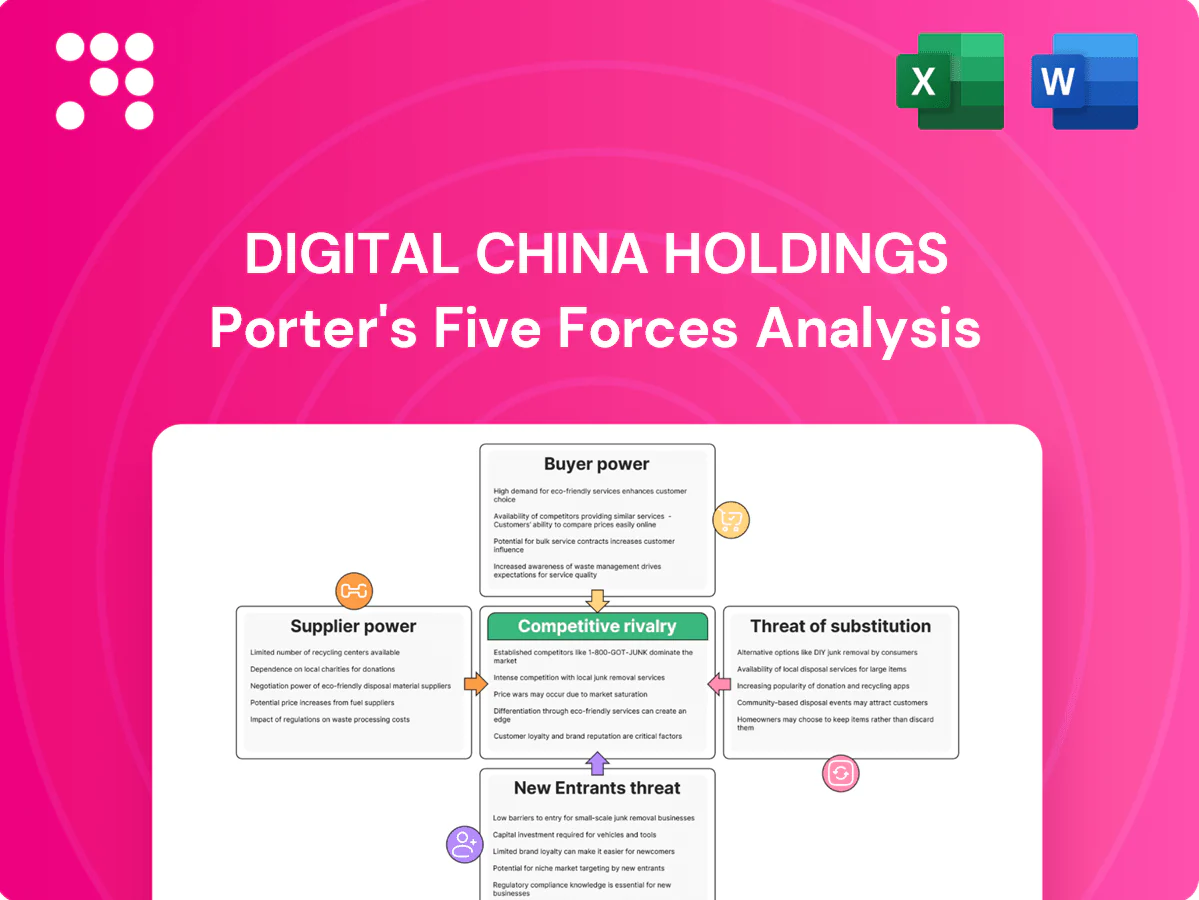
Digital China Holdings Porter's Five Forces Analysis

From Overview to Strategy Blueprint
Digital China Holdings faces nuanced competitive dynamics—strong buyer negotiation in enterprise IT, moderate supplier leverage for specialized solutions, and growing threats from cloud-native rivals and new entrants across China’s digital services market. This snapshot highlights pressure points and strategic levers, but the full Porter’s Five Forces Analysis delivers force-by-force ratings, visuals, and tactical implications. Unlock the complete report to inform smarter investment and strategy decisions.
Suppliers Bargaining Power

Concentrated OEM vendor base
Core IT hardware and software supply for Digital China is concentrated among a few OEMs and publishers—IDC reports the top five enterprise server and infrastructure vendors held over 70% of the China market in 2024—creating strong bargaining leverage. Authorized distributor status and quota-based rebates tie pricing and terms to performance metrics. Digital China’s scale and FY2023 distribution network mitigate some pressure, but vendor concentration remains structurally high. Any disruption or policy shift at a top OEM can quickly compress margins and service levels.
Authorized channel dependence
Authorized channel dependence means Digital China’s distribution is governed by vendor accreditation, territorial exclusivity and tiered discounts, so losing an authorization or demotion in tier can materially shrink product breadth and elevate costs for end customers. Renewal cycles create negotiation windows that favor suppliers, while compliance, certification requirements and MDF access further entrench supplier influence.

Component cycles and shortages
Semiconductor and infrastructure supply cycles drive component availability and pricing for Digital China; in 2024 semiconductor lead times averaged 12–18 weeks, pushing spot prices up and raising procurement costs. Suppliers ration stock to higher-margin or strategic channels during tight cycles, prioritizing OEMs over distributors. Distributors face a squeeze between fixed customer SLAs and volatile upstream costs, while inventory risk and expedited logistics fees—often adding 5–15% to costs—increase supplier leverage.

Switching costs in services stack
IT services for Digital China hinge on vendor ecosystems—cloud, databases, middleware—so skills, certifications and tooling tied to chosen stacks raise switching frictions; Flexera 2024 finds 92% of enterprises use public cloud, and global IaaS/PaaS shares in 2024 were roughly AWS 32% and Azure 23%, enabling suppliers to bundle training and license incentives that steer deals; multi-cloud reduces vendor lock but deep expertise is not easily portable.
Talent as a critical supplier
Skilled engineers, architects and project managers form a distinct supplier market for Digital China; tight 2024 labor conditions in cybersecurity, cloud and AI (ISC2 cybersecurity workforce gap ~3.4M in 2024) push wage inflation and hiring costs, while tech attrition around ~17% in 2024 can delay deliveries and compress margins; vendor-proprietary certs (AWS/Azure/Google) gate talent pipelines.
Top-5 OEMs dominate China infra; cloud adoption & skill gap: 70%/92%/3.4M
Top-five OEMs held >70% of China enterprise infra in 2024, giving suppliers strong leverage. Channel authorizations, renewals and 12–18 week semiconductor lead times plus expedited fees (5–15%) amplify pricing pressure. Cloud/vendor lock (92% public cloud; AWS ~32%, Azure ~23%) and a ISC2 cybersecurity gap ~3.4M with ~17% tech attrition raise switching and labor costs.
| Metric | 2024 |
|---|---|
| Top‑5 OEM share | >70% |
| Semiconductor lead times | 12–18 weeks |
| Expedite fees | +5–15% |
| Public cloud adoption | 92% |
| AWS / Azure share | ~32% / ~23% |
| ISC2 gap | ~3.4M |
| Tech attrition | ~17% |
What is included in the product
 Detailed Word Document
Concise Porter's Five Forces analysis for Digital China Holdings uncovering competitive intensity, buyer/supplier leverage, substitute threats, and entry barriers; highlights strategic levers to protect margins and market share.

 Customizable Excel Spreadsheet
Clear one-sheet Porter's Five Forces for Digital China Holdings that instantly highlights strategic pressures with adjustable ratings and a spider chart—ready to copy into decks or integrate with Excel/Word, no macros required and simple to customize for evolving market scenarios.
Customers Bargaining Power

Large enterprise and government tenders
Procurement for large enterprise and government tenders is concentrated in sizable, competitive RFPs with strict SLAs, and buyers in 2024 continue to leverage scale to secure double-digit discounts, extended credit terms and bundled value-added services. Multi-year framework agreements intensify pricing pressure at award, while public-sector compliance and audit trails raise switching hurdles but formalize and widen bid competition.
High price transparency in hardware
Commoditized SKUs face clear channel and e-commerce benchmarks, with Alibaba and JD controlling over 70% of China B2C e-commerce in 2024, making price discovery instantaneous. Buyers routinely cross-quote distributors and OEM direct, pressuring single-digit distributor gross margins. Thin margins are vulnerable to small cuts, so bundling hardware with services and managed offerings is necessary to defend ASPs.

Multi-sourcing and panel strategies
Enterprises maintain panels of distributors and integrators to reduce dependency, with Gartner 2024 reporting about 62% of large organizations adopting multi-sourcing to improve negotiation leverage. This enables rapid re-allocation of volumes to lower-priced providers, pressuring margins for suppliers like Digital China Holdings. Service differentiation must be explicit—SLAs, specialized solutions and vertical expertise—to resist rotation. Deep relationships and local support mitigate but do not eliminate buyer leverage.

Switching costs higher in integrated solutions
System integration, custom software and managed services embed client processes and data, making provider changes risky due to downtime and retraining; this raises switching costs and gives Digital China leverage to protect renewals and drive upsells while buyers still insist on benchmarks and break-fix clauses to cap pricing
- Switching costs: embedded processes and data
- Leverage: stronger renewal/upsell protection
- Buyer safeguards: benchmarks, break-fix clauses
Demand cyclicality and budget gating
- Deferred capex pressure
- Opex demand rise
- Extended payment terms
- Backlog and vertical diversification mitigate risk
RFPs force double-digit discounts; top two platforms >70%, multi-sourcing ~62%, IT spend ≈4.8T
Large RFPs and multi-year public frameworks drive double-digit discounts and extended terms; Alibaba+JD control >70% China B2C e-commerce in 2024, enforcing instant price discovery. Gartner 2024: ~62% of large orgs use multi-sourcing, while global IT spend ≈4.8T in 2024, enabling buyers to defer capex and press margins; strong SI/service differentiation raises switching costs.
| Metric | 2024 |
|---|---|
| Alibaba+JD share | >70% |
| Multi-sourcing (large orgs) | ~62% |
| Global IT spend | ≈4.8T |
Full Version Awaits
Digital China Holdings Porter's Five Forces Analysis
This preview shows the exact Porter’s Five Forces analysis of Digital China Holdings you'll receive immediately after purchase—no surprises or placeholders. The document is fully formatted, professionally written, and ready for download. Instant access to this same file occurs upon payment.

From Overview to Strategy Blueprint
Digital China Holdings faces nuanced competitive dynamics—strong buyer negotiation in enterprise IT, moderate supplier leverage for specialized solutions, and growing threats from cloud-native rivals and new entrants across China’s digital services market. This snapshot highlights pressure points and strategic levers, but the full Porter’s Five Forces Analysis delivers force-by-force ratings, visuals, and tactical implications. Unlock the complete report to inform smarter investment and strategy decisions.
Suppliers Bargaining Power
Concentrated OEM vendor base
Core IT hardware and software supply for Digital China is concentrated among a few OEMs and publishers—IDC reports the top five enterprise server and infrastructure vendors held over 70% of the China market in 2024—creating strong bargaining leverage. Authorized distributor status and quota-based rebates tie pricing and terms to performance metrics. Digital China’s scale and FY2023 distribution network mitigate some pressure, but vendor concentration remains structurally high. Any disruption or policy shift at a top OEM can quickly compress margins and service levels.
Authorized channel dependence
Authorized channel dependence means Digital China’s distribution is governed by vendor accreditation, territorial exclusivity and tiered discounts, so losing an authorization or demotion in tier can materially shrink product breadth and elevate costs for end customers. Renewal cycles create negotiation windows that favor suppliers, while compliance, certification requirements and MDF access further entrench supplier influence.
Component cycles and shortages
Semiconductor and infrastructure supply cycles drive component availability and pricing for Digital China; in 2024 semiconductor lead times averaged 12–18 weeks, pushing spot prices up and raising procurement costs. Suppliers ration stock to higher-margin or strategic channels during tight cycles, prioritizing OEMs over distributors. Distributors face a squeeze between fixed customer SLAs and volatile upstream costs, while inventory risk and expedited logistics fees—often adding 5–15% to costs—increase supplier leverage.
Switching costs in services stack
IT services for Digital China hinge on vendor ecosystems—cloud, databases, middleware—so skills, certifications and tooling tied to chosen stacks raise switching frictions; Flexera 2024 finds 92% of enterprises use public cloud, and global IaaS/PaaS shares in 2024 were roughly AWS 32% and Azure 23%, enabling suppliers to bundle training and license incentives that steer deals; multi-cloud reduces vendor lock but deep expertise is not easily portable.
Talent as a critical supplier
Skilled engineers, architects and project managers form a distinct supplier market for Digital China; tight 2024 labor conditions in cybersecurity, cloud and AI (ISC2 cybersecurity workforce gap ~3.4M in 2024) push wage inflation and hiring costs, while tech attrition around ~17% in 2024 can delay deliveries and compress margins; vendor-proprietary certs (AWS/Azure/Google) gate talent pipelines.
Top-5 OEMs dominate China infra; cloud adoption & skill gap: 70%/92%/3.4M
Top-five OEMs held >70% of China enterprise infra in 2024, giving suppliers strong leverage. Channel authorizations, renewals and 12–18 week semiconductor lead times plus expedited fees (5–15%) amplify pricing pressure. Cloud/vendor lock (92% public cloud; AWS ~32%, Azure ~23%) and a ISC2 cybersecurity gap ~3.4M with ~17% tech attrition raise switching and labor costs.
| Metric | 2024 |
|---|---|
| Top‑5 OEM share | >70% |
| Semiconductor lead times | 12–18 weeks |
| Expedite fees | +5–15% |
| Public cloud adoption | 92% |
| AWS / Azure share | ~32% / ~23% |
| ISC2 gap | ~3.4M |
| Tech attrition | ~17% |
What is included in the product
Detailed Word Document
Concise Porter's Five Forces analysis for Digital China Holdings uncovering competitive intensity, buyer/supplier leverage, substitute threats, and entry barriers; highlights strategic levers to protect margins and market share.
Customizable Excel Spreadsheet
Clear one-sheet Porter's Five Forces for Digital China Holdings that instantly highlights strategic pressures with adjustable ratings and a spider chart—ready to copy into decks or integrate with Excel/Word, no macros required and simple to customize for evolving market scenarios.
Customers Bargaining Power
Large enterprise and government tenders
Procurement for large enterprise and government tenders is concentrated in sizable, competitive RFPs with strict SLAs, and buyers in 2024 continue to leverage scale to secure double-digit discounts, extended credit terms and bundled value-added services. Multi-year framework agreements intensify pricing pressure at award, while public-sector compliance and audit trails raise switching hurdles but formalize and widen bid competition.
High price transparency in hardware
Commoditized SKUs face clear channel and e-commerce benchmarks, with Alibaba and JD controlling over 70% of China B2C e-commerce in 2024, making price discovery instantaneous. Buyers routinely cross-quote distributors and OEM direct, pressuring single-digit distributor gross margins. Thin margins are vulnerable to small cuts, so bundling hardware with services and managed offerings is necessary to defend ASPs.
Multi-sourcing and panel strategies
Enterprises maintain panels of distributors and integrators to reduce dependency, with Gartner 2024 reporting about 62% of large organizations adopting multi-sourcing to improve negotiation leverage. This enables rapid re-allocation of volumes to lower-priced providers, pressuring margins for suppliers like Digital China Holdings. Service differentiation must be explicit—SLAs, specialized solutions and vertical expertise—to resist rotation. Deep relationships and local support mitigate but do not eliminate buyer leverage.
Switching costs higher in integrated solutions
System integration, custom software and managed services embed client processes and data, making provider changes risky due to downtime and retraining; this raises switching costs and gives Digital China leverage to protect renewals and drive upsells while buyers still insist on benchmarks and break-fix clauses to cap pricing
- Switching costs: embedded processes and data
- Leverage: stronger renewal/upsell protection
- Buyer safeguards: benchmarks, break-fix clauses
Demand cyclicality and budget gating
- Deferred capex pressure
- Opex demand rise
- Extended payment terms
- Backlog and vertical diversification mitigate risk
RFPs force double-digit discounts; top two platforms >70%, multi-sourcing ~62%, IT spend ≈4.8T
Large RFPs and multi-year public frameworks drive double-digit discounts and extended terms; Alibaba+JD control >70% China B2C e-commerce in 2024, enforcing instant price discovery. Gartner 2024: ~62% of large orgs use multi-sourcing, while global IT spend ≈4.8T in 2024, enabling buyers to defer capex and press margins; strong SI/service differentiation raises switching costs.
| Metric | 2024 |
|---|---|
| Alibaba+JD share | >70% |
| Multi-sourcing (large orgs) | ~62% |
| Global IT spend | ≈4.8T |
Full Version Awaits
Digital China Holdings Porter's Five Forces Analysis
This preview shows the exact Porter’s Five Forces analysis of Digital China Holdings you'll receive immediately after purchase—no surprises or placeholders. The document is fully formatted, professionally written, and ready for download. Instant access to this same file occurs upon payment.
Original: $10.00
-65%$10.00
$3.50Description
From Overview to Strategy Blueprint
Digital China Holdings faces nuanced competitive dynamics—strong buyer negotiation in enterprise IT, moderate supplier leverage for specialized solutions, and growing threats from cloud-native rivals and new entrants across China’s digital services market. This snapshot highlights pressure points and strategic levers, but the full Porter’s Five Forces Analysis delivers force-by-force ratings, visuals, and tactical implications. Unlock the complete report to inform smarter investment and strategy decisions.
Suppliers Bargaining Power
Concentrated OEM vendor base
Core IT hardware and software supply for Digital China is concentrated among a few OEMs and publishers—IDC reports the top five enterprise server and infrastructure vendors held over 70% of the China market in 2024—creating strong bargaining leverage. Authorized distributor status and quota-based rebates tie pricing and terms to performance metrics. Digital China’s scale and FY2023 distribution network mitigate some pressure, but vendor concentration remains structurally high. Any disruption or policy shift at a top OEM can quickly compress margins and service levels.
Authorized channel dependence
Authorized channel dependence means Digital China’s distribution is governed by vendor accreditation, territorial exclusivity and tiered discounts, so losing an authorization or demotion in tier can materially shrink product breadth and elevate costs for end customers. Renewal cycles create negotiation windows that favor suppliers, while compliance, certification requirements and MDF access further entrench supplier influence.
Component cycles and shortages
Semiconductor and infrastructure supply cycles drive component availability and pricing for Digital China; in 2024 semiconductor lead times averaged 12–18 weeks, pushing spot prices up and raising procurement costs. Suppliers ration stock to higher-margin or strategic channels during tight cycles, prioritizing OEMs over distributors. Distributors face a squeeze between fixed customer SLAs and volatile upstream costs, while inventory risk and expedited logistics fees—often adding 5–15% to costs—increase supplier leverage.
Switching costs in services stack
IT services for Digital China hinge on vendor ecosystems—cloud, databases, middleware—so skills, certifications and tooling tied to chosen stacks raise switching frictions; Flexera 2024 finds 92% of enterprises use public cloud, and global IaaS/PaaS shares in 2024 were roughly AWS 32% and Azure 23%, enabling suppliers to bundle training and license incentives that steer deals; multi-cloud reduces vendor lock but deep expertise is not easily portable.
Talent as a critical supplier
Skilled engineers, architects and project managers form a distinct supplier market for Digital China; tight 2024 labor conditions in cybersecurity, cloud and AI (ISC2 cybersecurity workforce gap ~3.4M in 2024) push wage inflation and hiring costs, while tech attrition around ~17% in 2024 can delay deliveries and compress margins; vendor-proprietary certs (AWS/Azure/Google) gate talent pipelines.
Top-5 OEMs dominate China infra; cloud adoption & skill gap: 70%/92%/3.4M
Top-five OEMs held >70% of China enterprise infra in 2024, giving suppliers strong leverage. Channel authorizations, renewals and 12–18 week semiconductor lead times plus expedited fees (5–15%) amplify pricing pressure. Cloud/vendor lock (92% public cloud; AWS ~32%, Azure ~23%) and a ISC2 cybersecurity gap ~3.4M with ~17% tech attrition raise switching and labor costs.
| Metric | 2024 |
|---|---|
| Top‑5 OEM share | >70% |
| Semiconductor lead times | 12–18 weeks |
| Expedite fees | +5–15% |
| Public cloud adoption | 92% |
| AWS / Azure share | ~32% / ~23% |
| ISC2 gap | ~3.4M |
| Tech attrition | ~17% |
What is included in the product
Detailed Word Document
Concise Porter's Five Forces analysis for Digital China Holdings uncovering competitive intensity, buyer/supplier leverage, substitute threats, and entry barriers; highlights strategic levers to protect margins and market share.
Customizable Excel Spreadsheet
Clear one-sheet Porter's Five Forces for Digital China Holdings that instantly highlights strategic pressures with adjustable ratings and a spider chart—ready to copy into decks or integrate with Excel/Word, no macros required and simple to customize for evolving market scenarios.
Customers Bargaining Power
Large enterprise and government tenders
Procurement for large enterprise and government tenders is concentrated in sizable, competitive RFPs with strict SLAs, and buyers in 2024 continue to leverage scale to secure double-digit discounts, extended credit terms and bundled value-added services. Multi-year framework agreements intensify pricing pressure at award, while public-sector compliance and audit trails raise switching hurdles but formalize and widen bid competition.
High price transparency in hardware
Commoditized SKUs face clear channel and e-commerce benchmarks, with Alibaba and JD controlling over 70% of China B2C e-commerce in 2024, making price discovery instantaneous. Buyers routinely cross-quote distributors and OEM direct, pressuring single-digit distributor gross margins. Thin margins are vulnerable to small cuts, so bundling hardware with services and managed offerings is necessary to defend ASPs.
Multi-sourcing and panel strategies
Enterprises maintain panels of distributors and integrators to reduce dependency, with Gartner 2024 reporting about 62% of large organizations adopting multi-sourcing to improve negotiation leverage. This enables rapid re-allocation of volumes to lower-priced providers, pressuring margins for suppliers like Digital China Holdings. Service differentiation must be explicit—SLAs, specialized solutions and vertical expertise—to resist rotation. Deep relationships and local support mitigate but do not eliminate buyer leverage.
Switching costs higher in integrated solutions
System integration, custom software and managed services embed client processes and data, making provider changes risky due to downtime and retraining; this raises switching costs and gives Digital China leverage to protect renewals and drive upsells while buyers still insist on benchmarks and break-fix clauses to cap pricing
- Switching costs: embedded processes and data
- Leverage: stronger renewal/upsell protection
- Buyer safeguards: benchmarks, break-fix clauses
Demand cyclicality and budget gating
- Deferred capex pressure
- Opex demand rise
- Extended payment terms
- Backlog and vertical diversification mitigate risk
RFPs force double-digit discounts; top two platforms >70%, multi-sourcing ~62%, IT spend ≈4.8T
Large RFPs and multi-year public frameworks drive double-digit discounts and extended terms; Alibaba+JD control >70% China B2C e-commerce in 2024, enforcing instant price discovery. Gartner 2024: ~62% of large orgs use multi-sourcing, while global IT spend ≈4.8T in 2024, enabling buyers to defer capex and press margins; strong SI/service differentiation raises switching costs.
| Metric | 2024 |
|---|---|
| Alibaba+JD share | >70% |
| Multi-sourcing (large orgs) | ~62% |
| Global IT spend | ≈4.8T |
Full Version Awaits
Digital China Holdings Porter's Five Forces Analysis
This preview shows the exact Porter’s Five Forces analysis of Digital China Holdings you'll receive immediately after purchase—no surprises or placeholders. The document is fully formatted, professionally written, and ready for download. Instant access to this same file occurs upon payment.











