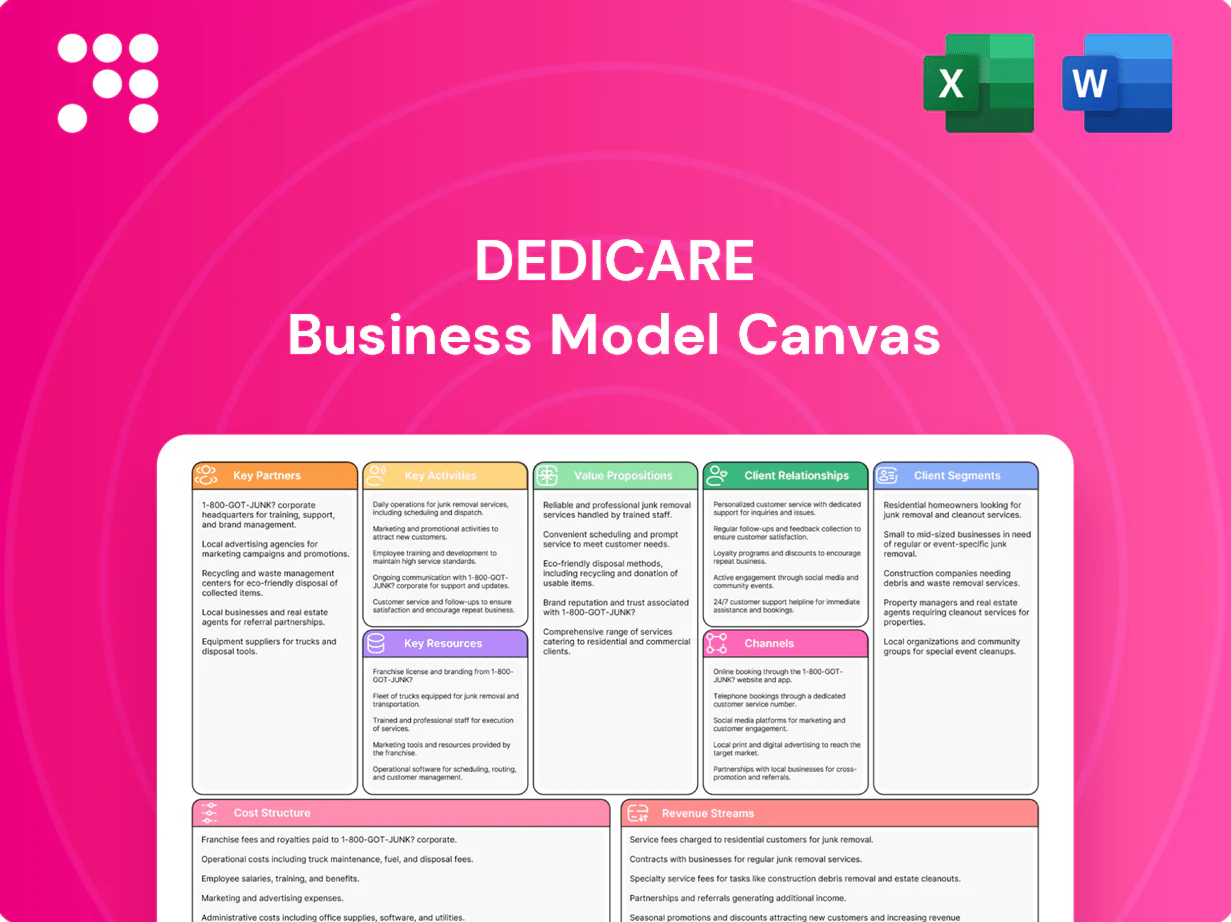
Dedicare Business Model Canvas

Unlock the strategic playbook with the Business Model Canvas to scale advantage
Unlock Dedicare’s strategic playbook with the full Business Model Canvas — a concise, actionable breakdown of value propositions, customer segments, channels, and revenue streams. This detailed, editable document reveals how Dedicare scales and sustains competitive advantage. Perfect for investors, advisors, and founders who want ready-to-use insights to benchmark or adapt proven strategies—download the full Canvas today.
Partnerships

Public healthcare providers
Partnerships with hospitals, clinics and regional health authorities secure steady demand through framework agreements (commonly 12–36 months), creating predictable call-off volumes. These contracts align supply with seasonal and acute staffing needs, smoothing winter peaks and weekend coverage. Joint planning with public providers improves service continuity, cutting vacancy-related overtime by about 25% and stabilizing utilization and pricing.
Municipalities and social care agencies
Collaboration with municipalities and social care agencies secures coverage across elderly care, social services and community care in a country where the 65+ cohort reached about 20% of the population in 2024. Contractual agreements specify compliance standards and target response times. Shared demand-data improves roster efficiency and capacity planning. Multi-year framework agreements, commonly 2–4 years in public procurement, reduce procurement friction.

Educational institutions and professional bodies
Ties with universities, nursing schools and medical associations create structured talent pipelines by aligning curricula with employer needs and facilitating direct recruitment from clinical cohorts.
Co-branded programs and paid internships improve candidate flow and workplace readiness through hands-on placements and joint assessment frameworks.
Continuous education partnerships deliver accredited upskilling to maintain competencies while formal endorsements from professional bodies strengthen market credibility.

Credentialing, licensing, and background-check partners
Accredited verifiers accelerate onboarding while ensuring regulatory compliance across Nordics (Sweden, Norway, Denmark, Finland, Iceland) by aligning with EU Public Procurement Directive 2014/24/EU and national licensing rules in 2024.
Automated checks reduce risk and time-to-deploy, integrating auditable logs that meet tender evidence requirements.
Technology, travel, and housing providers
Technology partners (ATS/CRM, scheduling, telehealth) deliver 99.9% uptime SLAs and enable rapid scaling of clinician placement workflows; travel and accommodation partners drive locum mobility and rural placements, supporting stretch coverage where permanent staff are scarce.
Integrated invoicing and timekeeping reduce billing errors and accelerate payments, while bundled logistics (travel + housing + credentialing) improve clinician experience and lift fill rates.
- ATS/CRM: centralized candidate pipeline
- Scheduling/telehealth: 99.9% uptime
- Travel/housing: enables rural locums
- Invoicing/timekeeping: fewer billing errors
- Bundled logistics: higher fill rates
Multi-year health partnerships: 20% elderly covered, 25% less OT, 15% higher rural fill
Partnerships with hospitals, municipalities and universities secure multi-year framework agreements (12–36 months public, 2–4 years municipal) covering ~20% elderly population in 2024 and reducing overtime costs ~25%. Tech and verifier partners cut onboarding time by ~40% and ensure 99.9% uptime for placement systems. Travel/logistics partners raise rural fill rates by ~15%.
| Partner | Metric (2024) |
|---|---|
| Hospitals/municipalities | 12–36m contracts, 25% less OT |
What is included in the product
 Detailed Word Document
A concise, pre-written Business Model Canvas for Dedicare outlining customer segments, channels, value propositions and revenue streams across the 9 classic BMC blocks with narratives and investor-ready insights; includes competitive analysis, SWOT linkage and practical validation using real company data for presentations and strategic decisions.

 Customizable Excel Spreadsheet
High-level snapshot of Dedicare’s business model with editable cells that relieve strategic uncertainty and align stakeholders quickly. Saves teams hours of structuring, enabling fast comparisons, collaborative adaptation, and concise executive-ready summaries.
Activities

Talent sourcing and recruitment
Proactive search across channels builds a vetted pool of clinicians, reducing time-to-fill and enabling rapid deployment. Data-driven campaigns target scarce specialties amid a WHO-estimated global shortfall of 10 million health workers by 2030. Referral programs sustain pipeline quality and diversity outreach widens access to specialist skills.
Credentialing and compliance management
Verification of licenses, references, vaccinations and background checks is standardized across Dedicare, with country-specific rules embedded in workflows covering 15 markets in 2024. Automated expiry tracking reduced compliance gaps to under 5% in 2024 and triggers rechecks before credential lapse. Centralized documentation supported 120 client audits in 2024, strengthening client assurance and audit readiness.

Workforce planning and scheduling
Forecasting aligns candidate availability with client demand peaks, using historical demand and 2024 shift-volume trends to anticipate surges. Smart rostering balances cost, continuity and clinician preferences to cut agency spend while improving retention. Rapid deployment processes aim to minimize vacancy downtime, supporting median time-to-fill targets of 24–72 hours. KPIs monitor fill rate and time-to-fill, with industry targets of 90–95% fill rate in 2024.

Account management and service delivery
Dedicated managers enforce SLAs (99.5% uptime target), produce monthly performance reports and coordinate stakeholders; quarterly reviews optimize coverage and cut delivery costs ~12% while improving outcomes; issue resolution follows 24-hour acknowledgement and 72-hour escalation-to-resolution paths; continuous improvement plans reduced average churn to about 6% in 2024, boosting client retention.
- Managers: SLA, reporting, coordination
- Reviews: quarterly, coverage & cost -12%
- Escalation: 24h ack, 72h resolution
- CI plans: churn ~6% (2024), higher retention
Employer branding and clinician engagement
Campaigns position Dedicare as a preferred employer, with 76% of candidates in 2024 reportedly weighing employer brand before applying, boosting applicant quality and fill rates. Learning, benefits and structured support raise clinician satisfaction and can lower turnover by double digits when well executed. Real-time feedback loops cut mismatches and churn rates, while community events strengthen loyalty and repeat placements.
- Employer brand: 76% candidate influence
- Learning & benefits: raises satisfaction, lowers turnover
- Feedback loops: improve matching, reduce churn
- Community events: increase loyalty & repeat hires
90–95% fill across 15 markets, 24–72h time-to-fill
Proactive sourcing and referral programs built a vetted pool across 15 markets (2024), supporting rapid deployment and 90–95% fill rates. Standardized credentialing cut compliance gaps below 5% and powered 120 client audits in 2024. Forecasting and rostering hit median time‑to‑fill 24–72h; CI reduced churn to ~6% and client delivery costs ~12%.
| Metric | 2024 |
|---|---|
| Markets | 15 |
| Fill rate | 90–95% |
| Time-to-fill | 24–72h |
| Compliance gaps | <5% |
| Audits | 120 |
| Churn | ~6% |
| Employer brand influence | 76% |
Full Version Awaits
Business Model Canvas
The document you're previewing is the actual Dedicare Business Model Canvas, not a mockup. After purchase you'll receive this same complete file ready to edit and present. Delivered formats include Word and Excel with all sections and content intact. No surprises—what you see is what you’ll own.

Unlock the strategic playbook with the Business Model Canvas to scale advantage
Unlock Dedicare’s strategic playbook with the full Business Model Canvas — a concise, actionable breakdown of value propositions, customer segments, channels, and revenue streams. This detailed, editable document reveals how Dedicare scales and sustains competitive advantage. Perfect for investors, advisors, and founders who want ready-to-use insights to benchmark or adapt proven strategies—download the full Canvas today.
Partnerships
Public healthcare providers
Partnerships with hospitals, clinics and regional health authorities secure steady demand through framework agreements (commonly 12–36 months), creating predictable call-off volumes. These contracts align supply with seasonal and acute staffing needs, smoothing winter peaks and weekend coverage. Joint planning with public providers improves service continuity, cutting vacancy-related overtime by about 25% and stabilizing utilization and pricing.
Municipalities and social care agencies
Collaboration with municipalities and social care agencies secures coverage across elderly care, social services and community care in a country where the 65+ cohort reached about 20% of the population in 2024. Contractual agreements specify compliance standards and target response times. Shared demand-data improves roster efficiency and capacity planning. Multi-year framework agreements, commonly 2–4 years in public procurement, reduce procurement friction.
Educational institutions and professional bodies
Ties with universities, nursing schools and medical associations create structured talent pipelines by aligning curricula with employer needs and facilitating direct recruitment from clinical cohorts.
Co-branded programs and paid internships improve candidate flow and workplace readiness through hands-on placements and joint assessment frameworks.
Continuous education partnerships deliver accredited upskilling to maintain competencies while formal endorsements from professional bodies strengthen market credibility.
Credentialing, licensing, and background-check partners
Accredited verifiers accelerate onboarding while ensuring regulatory compliance across Nordics (Sweden, Norway, Denmark, Finland, Iceland) by aligning with EU Public Procurement Directive 2014/24/EU and national licensing rules in 2024.
Automated checks reduce risk and time-to-deploy, integrating auditable logs that meet tender evidence requirements.
Technology, travel, and housing providers
Technology partners (ATS/CRM, scheduling, telehealth) deliver 99.9% uptime SLAs and enable rapid scaling of clinician placement workflows; travel and accommodation partners drive locum mobility and rural placements, supporting stretch coverage where permanent staff are scarce.
Integrated invoicing and timekeeping reduce billing errors and accelerate payments, while bundled logistics (travel + housing + credentialing) improve clinician experience and lift fill rates.
- ATS/CRM: centralized candidate pipeline
- Scheduling/telehealth: 99.9% uptime
- Travel/housing: enables rural locums
- Invoicing/timekeeping: fewer billing errors
- Bundled logistics: higher fill rates
Multi-year health partnerships: 20% elderly covered, 25% less OT, 15% higher rural fill
Partnerships with hospitals, municipalities and universities secure multi-year framework agreements (12–36 months public, 2–4 years municipal) covering ~20% elderly population in 2024 and reducing overtime costs ~25%. Tech and verifier partners cut onboarding time by ~40% and ensure 99.9% uptime for placement systems. Travel/logistics partners raise rural fill rates by ~15%.
| Partner | Metric (2024) |
|---|---|
| Hospitals/municipalities | 12–36m contracts, 25% less OT |
What is included in the product
Detailed Word Document
A concise, pre-written Business Model Canvas for Dedicare outlining customer segments, channels, value propositions and revenue streams across the 9 classic BMC blocks with narratives and investor-ready insights; includes competitive analysis, SWOT linkage and practical validation using real company data for presentations and strategic decisions.
Customizable Excel Spreadsheet
High-level snapshot of Dedicare’s business model with editable cells that relieve strategic uncertainty and align stakeholders quickly. Saves teams hours of structuring, enabling fast comparisons, collaborative adaptation, and concise executive-ready summaries.
Activities
Talent sourcing and recruitment
Proactive search across channels builds a vetted pool of clinicians, reducing time-to-fill and enabling rapid deployment. Data-driven campaigns target scarce specialties amid a WHO-estimated global shortfall of 10 million health workers by 2030. Referral programs sustain pipeline quality and diversity outreach widens access to specialist skills.
Credentialing and compliance management
Verification of licenses, references, vaccinations and background checks is standardized across Dedicare, with country-specific rules embedded in workflows covering 15 markets in 2024. Automated expiry tracking reduced compliance gaps to under 5% in 2024 and triggers rechecks before credential lapse. Centralized documentation supported 120 client audits in 2024, strengthening client assurance and audit readiness.
Workforce planning and scheduling
Forecasting aligns candidate availability with client demand peaks, using historical demand and 2024 shift-volume trends to anticipate surges. Smart rostering balances cost, continuity and clinician preferences to cut agency spend while improving retention. Rapid deployment processes aim to minimize vacancy downtime, supporting median time-to-fill targets of 24–72 hours. KPIs monitor fill rate and time-to-fill, with industry targets of 90–95% fill rate in 2024.
Account management and service delivery
Dedicated managers enforce SLAs (99.5% uptime target), produce monthly performance reports and coordinate stakeholders; quarterly reviews optimize coverage and cut delivery costs ~12% while improving outcomes; issue resolution follows 24-hour acknowledgement and 72-hour escalation-to-resolution paths; continuous improvement plans reduced average churn to about 6% in 2024, boosting client retention.
- Managers: SLA, reporting, coordination
- Reviews: quarterly, coverage & cost -12%
- Escalation: 24h ack, 72h resolution
- CI plans: churn ~6% (2024), higher retention
Employer branding and clinician engagement
Campaigns position Dedicare as a preferred employer, with 76% of candidates in 2024 reportedly weighing employer brand before applying, boosting applicant quality and fill rates. Learning, benefits and structured support raise clinician satisfaction and can lower turnover by double digits when well executed. Real-time feedback loops cut mismatches and churn rates, while community events strengthen loyalty and repeat placements.
- Employer brand: 76% candidate influence
- Learning & benefits: raises satisfaction, lowers turnover
- Feedback loops: improve matching, reduce churn
- Community events: increase loyalty & repeat hires
90–95% fill across 15 markets, 24–72h time-to-fill
Proactive sourcing and referral programs built a vetted pool across 15 markets (2024), supporting rapid deployment and 90–95% fill rates. Standardized credentialing cut compliance gaps below 5% and powered 120 client audits in 2024. Forecasting and rostering hit median time‑to‑fill 24–72h; CI reduced churn to ~6% and client delivery costs ~12%.
| Metric | 2024 |
|---|---|
| Markets | 15 |
| Fill rate | 90–95% |
| Time-to-fill | 24–72h |
| Compliance gaps | <5% |
| Audits | 120 |
| Churn | ~6% |
| Employer brand influence | 76% |
Full Version Awaits
Business Model Canvas
The document you're previewing is the actual Dedicare Business Model Canvas, not a mockup. After purchase you'll receive this same complete file ready to edit and present. Delivered formats include Word and Excel with all sections and content intact. No surprises—what you see is what you’ll own.
Original: $10.00
-65%$10.00
$3.50Description
Unlock the strategic playbook with the Business Model Canvas to scale advantage
Unlock Dedicare’s strategic playbook with the full Business Model Canvas — a concise, actionable breakdown of value propositions, customer segments, channels, and revenue streams. This detailed, editable document reveals how Dedicare scales and sustains competitive advantage. Perfect for investors, advisors, and founders who want ready-to-use insights to benchmark or adapt proven strategies—download the full Canvas today.
Partnerships
Public healthcare providers
Partnerships with hospitals, clinics and regional health authorities secure steady demand through framework agreements (commonly 12–36 months), creating predictable call-off volumes. These contracts align supply with seasonal and acute staffing needs, smoothing winter peaks and weekend coverage. Joint planning with public providers improves service continuity, cutting vacancy-related overtime by about 25% and stabilizing utilization and pricing.
Municipalities and social care agencies
Collaboration with municipalities and social care agencies secures coverage across elderly care, social services and community care in a country where the 65+ cohort reached about 20% of the population in 2024. Contractual agreements specify compliance standards and target response times. Shared demand-data improves roster efficiency and capacity planning. Multi-year framework agreements, commonly 2–4 years in public procurement, reduce procurement friction.
Educational institutions and professional bodies
Ties with universities, nursing schools and medical associations create structured talent pipelines by aligning curricula with employer needs and facilitating direct recruitment from clinical cohorts.
Co-branded programs and paid internships improve candidate flow and workplace readiness through hands-on placements and joint assessment frameworks.
Continuous education partnerships deliver accredited upskilling to maintain competencies while formal endorsements from professional bodies strengthen market credibility.
Credentialing, licensing, and background-check partners
Accredited verifiers accelerate onboarding while ensuring regulatory compliance across Nordics (Sweden, Norway, Denmark, Finland, Iceland) by aligning with EU Public Procurement Directive 2014/24/EU and national licensing rules in 2024.
Automated checks reduce risk and time-to-deploy, integrating auditable logs that meet tender evidence requirements.
Technology, travel, and housing providers
Technology partners (ATS/CRM, scheduling, telehealth) deliver 99.9% uptime SLAs and enable rapid scaling of clinician placement workflows; travel and accommodation partners drive locum mobility and rural placements, supporting stretch coverage where permanent staff are scarce.
Integrated invoicing and timekeeping reduce billing errors and accelerate payments, while bundled logistics (travel + housing + credentialing) improve clinician experience and lift fill rates.
- ATS/CRM: centralized candidate pipeline
- Scheduling/telehealth: 99.9% uptime
- Travel/housing: enables rural locums
- Invoicing/timekeeping: fewer billing errors
- Bundled logistics: higher fill rates
Multi-year health partnerships: 20% elderly covered, 25% less OT, 15% higher rural fill
Partnerships with hospitals, municipalities and universities secure multi-year framework agreements (12–36 months public, 2–4 years municipal) covering ~20% elderly population in 2024 and reducing overtime costs ~25%. Tech and verifier partners cut onboarding time by ~40% and ensure 99.9% uptime for placement systems. Travel/logistics partners raise rural fill rates by ~15%.
| Partner | Metric (2024) |
|---|---|
| Hospitals/municipalities | 12–36m contracts, 25% less OT |
What is included in the product
Detailed Word Document
A concise, pre-written Business Model Canvas for Dedicare outlining customer segments, channels, value propositions and revenue streams across the 9 classic BMC blocks with narratives and investor-ready insights; includes competitive analysis, SWOT linkage and practical validation using real company data for presentations and strategic decisions.
Customizable Excel Spreadsheet
High-level snapshot of Dedicare’s business model with editable cells that relieve strategic uncertainty and align stakeholders quickly. Saves teams hours of structuring, enabling fast comparisons, collaborative adaptation, and concise executive-ready summaries.
Activities
Talent sourcing and recruitment
Proactive search across channels builds a vetted pool of clinicians, reducing time-to-fill and enabling rapid deployment. Data-driven campaigns target scarce specialties amid a WHO-estimated global shortfall of 10 million health workers by 2030. Referral programs sustain pipeline quality and diversity outreach widens access to specialist skills.
Credentialing and compliance management
Verification of licenses, references, vaccinations and background checks is standardized across Dedicare, with country-specific rules embedded in workflows covering 15 markets in 2024. Automated expiry tracking reduced compliance gaps to under 5% in 2024 and triggers rechecks before credential lapse. Centralized documentation supported 120 client audits in 2024, strengthening client assurance and audit readiness.
Workforce planning and scheduling
Forecasting aligns candidate availability with client demand peaks, using historical demand and 2024 shift-volume trends to anticipate surges. Smart rostering balances cost, continuity and clinician preferences to cut agency spend while improving retention. Rapid deployment processes aim to minimize vacancy downtime, supporting median time-to-fill targets of 24–72 hours. KPIs monitor fill rate and time-to-fill, with industry targets of 90–95% fill rate in 2024.
Account management and service delivery
Dedicated managers enforce SLAs (99.5% uptime target), produce monthly performance reports and coordinate stakeholders; quarterly reviews optimize coverage and cut delivery costs ~12% while improving outcomes; issue resolution follows 24-hour acknowledgement and 72-hour escalation-to-resolution paths; continuous improvement plans reduced average churn to about 6% in 2024, boosting client retention.
- Managers: SLA, reporting, coordination
- Reviews: quarterly, coverage & cost -12%
- Escalation: 24h ack, 72h resolution
- CI plans: churn ~6% (2024), higher retention
Employer branding and clinician engagement
Campaigns position Dedicare as a preferred employer, with 76% of candidates in 2024 reportedly weighing employer brand before applying, boosting applicant quality and fill rates. Learning, benefits and structured support raise clinician satisfaction and can lower turnover by double digits when well executed. Real-time feedback loops cut mismatches and churn rates, while community events strengthen loyalty and repeat placements.
- Employer brand: 76% candidate influence
- Learning & benefits: raises satisfaction, lowers turnover
- Feedback loops: improve matching, reduce churn
- Community events: increase loyalty & repeat hires
90–95% fill across 15 markets, 24–72h time-to-fill
Proactive sourcing and referral programs built a vetted pool across 15 markets (2024), supporting rapid deployment and 90–95% fill rates. Standardized credentialing cut compliance gaps below 5% and powered 120 client audits in 2024. Forecasting and rostering hit median time‑to‑fill 24–72h; CI reduced churn to ~6% and client delivery costs ~12%.
| Metric | 2024 |
|---|---|
| Markets | 15 |
| Fill rate | 90–95% |
| Time-to-fill | 24–72h |
| Compliance gaps | <5% |
| Audits | 120 |
| Churn | ~6% |
| Employer brand influence | 76% |
Full Version Awaits
Business Model Canvas
The document you're previewing is the actual Dedicare Business Model Canvas, not a mockup. After purchase you'll receive this same complete file ready to edit and present. Delivered formats include Word and Excel with all sections and content intact. No surprises—what you see is what you’ll own.











