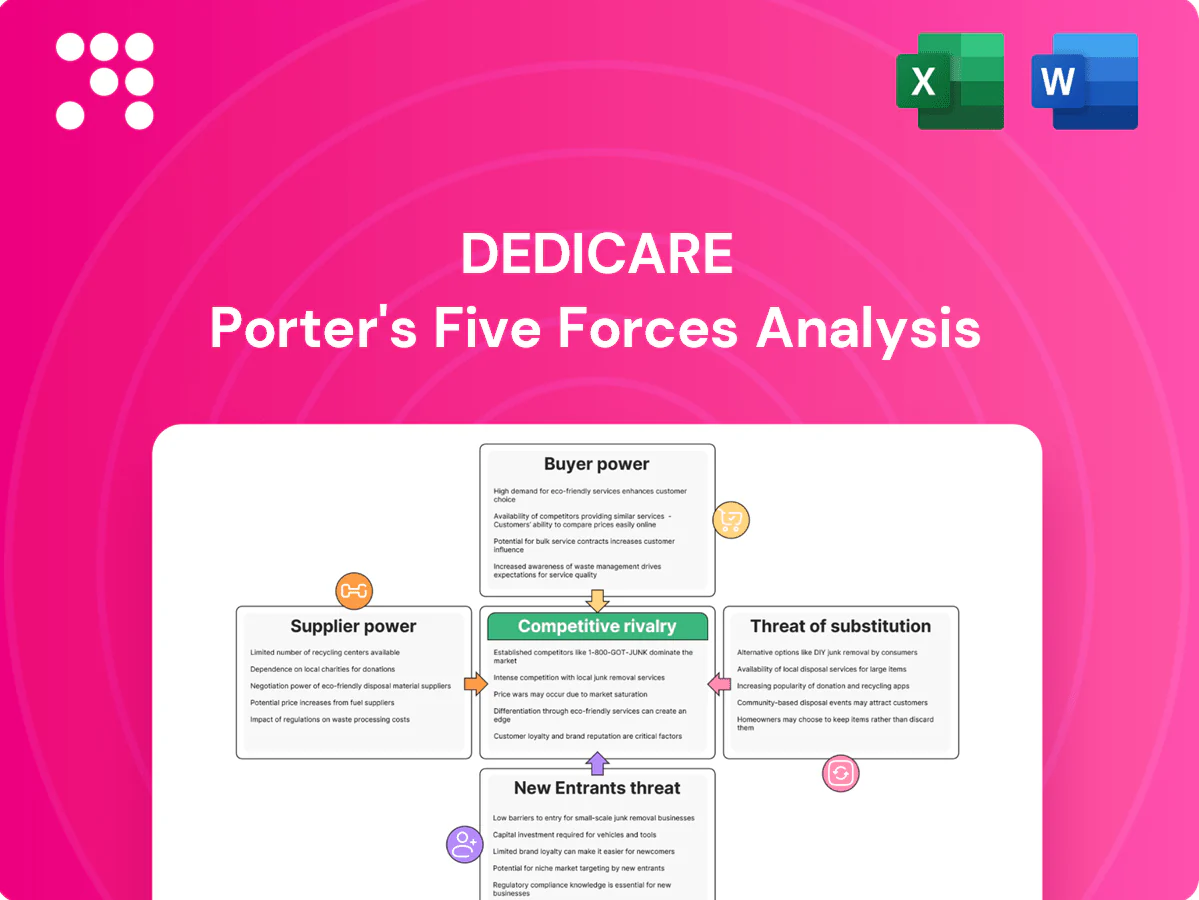
Dedicare Porter's Five Forces Analysis

Don't Miss the Bigger Picture
Dedicare's Porter's Five Forces snapshot highlights buyer and supplier pressures, competitive rivalry, substitute threats and entry barriers, showing where strategic risk and opportunity lie. Our analysis quantifies force intensity and links each to Dedicare’s business model. This brief snapshot only scratches the surface. Unlock the full Porter's Five Forces Analysis to explore Dedicare’s competitive dynamics, market pressures, and strategic advantages in detail.
Suppliers Bargaining Power

Scarce clinical talent holds pricing power
Healthcare professionals are chronically scarce across the Nordics, and in 2024 vacancy rates in nursing and social care exceed 8% in several regions, lifting suppliers’ bargaining power on pay and conditions. Shortages are acute in nursing, specialist medicine and social care, letting clinicians choose among agencies and assignments. Dedicare must therefore offer competitive rates and flexible terms to secure and retain talent.
Licensing, unions, and compliance strengthen suppliers
Regulatory credentials and union frameworks constrain supply elasticity and bolster worker leverage: with licensed clinicians in short supply, compliance and credential checks raise agency switching costs while clinicians face lower barriers to move; WHO data indicate persistent global health workforce gaps (millions) into the 2020s, enabling licensed clinicians to command premiums, insist on favorable schedules and locations, and leverage union backing to dictate terms.

High mobility across borders and settings
Nordic professionals frequently move cross-border and between public and private sectors, widening their options and strengthening negotiating power for assignments; agencies compete to place the same scarce candidates across jurisdictions, which raises bill rates and shortens acceptance windows.

Brand, experience, and support matter to talent
Clinicians value reliable payroll, housing/logistics support, fast onboarding and respectful scheduling; US nurse turnover was about 19.5% in 2023, keeping retention costly and recruitment urgent in 2024. Agencies that deliver strong candidate experience and benefits can lower supplier leverage by boosting loyalty, though top talent still exploits competing offers and premium travel-pay differentials. Dedicare’s responsiveness and benefits package remain critical retention levers.
- Reliable payroll: reduces attrition
- Housing/logistics: shortens placement time
- Onboarding speed: improves fill rates
- Respectful scheduling: increases loyalty
Digital platforms amplify visibility of offers
Digital marketplaces make pay and contract terms highly visible; LinkedIn reached roughly 1 billion members in 2024, amplifying offer transparency and enabling clinicians to benchmark rates and negotiate more effectively. This visibility compresses agency margins as offers must align with observable market rates, forcing Dedicare to compete beyond pay. Dedicare therefore must emphasize superior service, assignment continuity and value-added support to retain staff.
- Transparency: online platforms ~1B users (2024)
- Clinician leverage: easier benchmarking and negotiation
- Margin pressure: visible market rates compress agency spreads
- Differentiation: service, continuity, support
Clinician shortage: Nordic vacancies >8% and US turnover 19.5% force higher pay
Severe Nordic clinician shortages (nursing/social care vacancy >8% in 2024) and global health workforce gaps (WHO: millions) raise supplier leverage, forcing higher rates and flexible terms. Visible market data (LinkedIn ~1B users in 2024) and high US nurse turnover (19.5% in 2023) compress margins and speed decisions. Dedicare must compete on pay, speed, housing and scheduling to retain talent.
| Metric | 2024 value | Impact |
|---|---|---|
| Nordic vacancy rate | >8% | Higher pay/shorter acceptance |
| LinkedIn reach | ~1B | Offer transparency |
| US nurse turnover | 19.5% (2023) | Retention costs |
What is included in the product
 Detailed Word Document
Concise Porter’s Five Forces analysis tailored to Dedicare, identifying competitive rivalry, buyer and supplier power, threats from new entrants and substitutes, and strategic levers to protect market share and margins.

 Customizable Excel Spreadsheet
A single-sheet Dedicare Porter's Five Forces summary that distills competitive pressure into actionable insights—customize force levels, swap in your data, and copy into decks or dashboards for fast, boardroom-ready decisions.
Customers Bargaining Power

Consolidated public buyers wield volume leverage
Regions, municipalities and hospital systems procure at scale through tenders and multi-year framework agreements; public procurement in the EU represents roughly 14% of GDP, about €2.2–2.3 trillion, underscoring the volume at stake. Their purchasing size drives rate pressure and strict SLAs and lets buyers steer large volumes to preferred suppliers. Dedicare must secure framework wins to access that demand and sustain utilization.
Budget constraints intensify price sensitivity
Public-sector cost controls — in a market where Sweden’s public health spending is around 11% of GDP (OECD) — and private clinics’ margin targets cap acceptable bill rates, so buyers push for lower markups and longer payment terms. Clients also limit premium shifts and travel allowances, reducing extra revenue lines. This compresses agency pricing flexibility, even during peak-demand periods.

Switching costs are moderate but not prohibitive
Buyers can rotate among approved agencies, though onboarding and credential checks often take several weeks, keeping switching costs moderate. Service reliability, fill rates and compliance reduce willingness to switch; 2024 industry benchmarks set target fill rates above 90%. Poor performance prompts rapid reallocation of requisitions, and Dedicare’s consistent fill and audit-readiness help defend share.

Outcome and compliance metrics drive selection
Outcome and compliance metrics—fill speed, quality, incident rates and credential accuracy—drive selection: tenders increasingly score these KPIs allowing buyers to quantify and rank providers and prune panels for underperformance. Transparent KPIs give buyers leverage to favor higher-performing suppliers even when their prices are 5–15% above the lowest bid, shifting power toward informed purchasers.
- Fill speed — measured to minutes/hours
- Incident rates — basis for panel removal
- Credential accuracy — reduces liability
- Performance-based pruning — common in 2024 tenders
Framework tendering standardizes terms
Framework tendering standardizes master agreements that harmonize rates, penalties and service levels across vendors, reducing differentiation and compressing margins; EU public procurement alone is ~2 trillion EUR annually (Eurostat), highlighting scale. Standardization also simplifies switching between agencies, forcing Dedicare to win on operational excellence within fixed commercial envelopes.
- Master agreements harmonize commercial terms
- Standardization compresses margins
- Lower switching costs for buyers
- Competitive focus: operational excellence
Procurement shifts: win on ops with >90% fill rates to command 5-15% premium
Public buyers (EU procurement ~2.2–2.3 tn EUR; Sweden health spend ~11% GDP) buy via multi-year frameworks, creating rate pressure and strict SLAs. 2024 benchmarks set fill-rate targets >90% and KPI-scored tenders, giving informed buyers leverage to prefer performance over price. Standardized frameworks compress margins and lower switching costs, forcing Dedicare to win on operational excellence.
| Metric | 2024 value |
|---|---|
| EU public procurement | 2.2–2.3 tn EUR |
| Sweden health spend | ~11% GDP |
| Target fill rate | >90% |
| Price premium tolerated | 5–15% |
Full Version Awaits
Dedicare Porter's Five Forces Analysis
This preview shows the exact Dedicare Porter's Five Forces analysis you'll receive immediately after purchase—no placeholders or mockups. The document is fully formatted, professionally written, and ready for download and use the moment you buy. You're viewing the final deliverable; once payment is complete you'll have instant access to this identical file.

Don't Miss the Bigger Picture
Dedicare's Porter's Five Forces snapshot highlights buyer and supplier pressures, competitive rivalry, substitute threats and entry barriers, showing where strategic risk and opportunity lie. Our analysis quantifies force intensity and links each to Dedicare’s business model. This brief snapshot only scratches the surface. Unlock the full Porter's Five Forces Analysis to explore Dedicare’s competitive dynamics, market pressures, and strategic advantages in detail.
Suppliers Bargaining Power
Scarce clinical talent holds pricing power
Healthcare professionals are chronically scarce across the Nordics, and in 2024 vacancy rates in nursing and social care exceed 8% in several regions, lifting suppliers’ bargaining power on pay and conditions. Shortages are acute in nursing, specialist medicine and social care, letting clinicians choose among agencies and assignments. Dedicare must therefore offer competitive rates and flexible terms to secure and retain talent.
Licensing, unions, and compliance strengthen suppliers
Regulatory credentials and union frameworks constrain supply elasticity and bolster worker leverage: with licensed clinicians in short supply, compliance and credential checks raise agency switching costs while clinicians face lower barriers to move; WHO data indicate persistent global health workforce gaps (millions) into the 2020s, enabling licensed clinicians to command premiums, insist on favorable schedules and locations, and leverage union backing to dictate terms.
High mobility across borders and settings
Nordic professionals frequently move cross-border and between public and private sectors, widening their options and strengthening negotiating power for assignments; agencies compete to place the same scarce candidates across jurisdictions, which raises bill rates and shortens acceptance windows.
Brand, experience, and support matter to talent
Clinicians value reliable payroll, housing/logistics support, fast onboarding and respectful scheduling; US nurse turnover was about 19.5% in 2023, keeping retention costly and recruitment urgent in 2024. Agencies that deliver strong candidate experience and benefits can lower supplier leverage by boosting loyalty, though top talent still exploits competing offers and premium travel-pay differentials. Dedicare’s responsiveness and benefits package remain critical retention levers.
- Reliable payroll: reduces attrition
- Housing/logistics: shortens placement time
- Onboarding speed: improves fill rates
- Respectful scheduling: increases loyalty
Digital platforms amplify visibility of offers
Digital marketplaces make pay and contract terms highly visible; LinkedIn reached roughly 1 billion members in 2024, amplifying offer transparency and enabling clinicians to benchmark rates and negotiate more effectively. This visibility compresses agency margins as offers must align with observable market rates, forcing Dedicare to compete beyond pay. Dedicare therefore must emphasize superior service, assignment continuity and value-added support to retain staff.
- Transparency: online platforms ~1B users (2024)
- Clinician leverage: easier benchmarking and negotiation
- Margin pressure: visible market rates compress agency spreads
- Differentiation: service, continuity, support
Clinician shortage: Nordic vacancies >8% and US turnover 19.5% force higher pay
Severe Nordic clinician shortages (nursing/social care vacancy >8% in 2024) and global health workforce gaps (WHO: millions) raise supplier leverage, forcing higher rates and flexible terms. Visible market data (LinkedIn ~1B users in 2024) and high US nurse turnover (19.5% in 2023) compress margins and speed decisions. Dedicare must compete on pay, speed, housing and scheduling to retain talent.
| Metric | 2024 value | Impact |
|---|---|---|
| Nordic vacancy rate | >8% | Higher pay/shorter acceptance |
| LinkedIn reach | ~1B | Offer transparency |
| US nurse turnover | 19.5% (2023) | Retention costs |
What is included in the product
Detailed Word Document
Concise Porter’s Five Forces analysis tailored to Dedicare, identifying competitive rivalry, buyer and supplier power, threats from new entrants and substitutes, and strategic levers to protect market share and margins.
Customizable Excel Spreadsheet
A single-sheet Dedicare Porter's Five Forces summary that distills competitive pressure into actionable insights—customize force levels, swap in your data, and copy into decks or dashboards for fast, boardroom-ready decisions.
Customers Bargaining Power
Consolidated public buyers wield volume leverage
Regions, municipalities and hospital systems procure at scale through tenders and multi-year framework agreements; public procurement in the EU represents roughly 14% of GDP, about €2.2–2.3 trillion, underscoring the volume at stake. Their purchasing size drives rate pressure and strict SLAs and lets buyers steer large volumes to preferred suppliers. Dedicare must secure framework wins to access that demand and sustain utilization.
Budget constraints intensify price sensitivity
Public-sector cost controls — in a market where Sweden’s public health spending is around 11% of GDP (OECD) — and private clinics’ margin targets cap acceptable bill rates, so buyers push for lower markups and longer payment terms. Clients also limit premium shifts and travel allowances, reducing extra revenue lines. This compresses agency pricing flexibility, even during peak-demand periods.
Switching costs are moderate but not prohibitive
Buyers can rotate among approved agencies, though onboarding and credential checks often take several weeks, keeping switching costs moderate. Service reliability, fill rates and compliance reduce willingness to switch; 2024 industry benchmarks set target fill rates above 90%. Poor performance prompts rapid reallocation of requisitions, and Dedicare’s consistent fill and audit-readiness help defend share.
Outcome and compliance metrics drive selection
Outcome and compliance metrics—fill speed, quality, incident rates and credential accuracy—drive selection: tenders increasingly score these KPIs allowing buyers to quantify and rank providers and prune panels for underperformance. Transparent KPIs give buyers leverage to favor higher-performing suppliers even when their prices are 5–15% above the lowest bid, shifting power toward informed purchasers.
- Fill speed — measured to minutes/hours
- Incident rates — basis for panel removal
- Credential accuracy — reduces liability
- Performance-based pruning — common in 2024 tenders
Framework tendering standardizes terms
Framework tendering standardizes master agreements that harmonize rates, penalties and service levels across vendors, reducing differentiation and compressing margins; EU public procurement alone is ~2 trillion EUR annually (Eurostat), highlighting scale. Standardization also simplifies switching between agencies, forcing Dedicare to win on operational excellence within fixed commercial envelopes.
- Master agreements harmonize commercial terms
- Standardization compresses margins
- Lower switching costs for buyers
- Competitive focus: operational excellence
Procurement shifts: win on ops with >90% fill rates to command 5-15% premium
Public buyers (EU procurement ~2.2–2.3 tn EUR; Sweden health spend ~11% GDP) buy via multi-year frameworks, creating rate pressure and strict SLAs. 2024 benchmarks set fill-rate targets >90% and KPI-scored tenders, giving informed buyers leverage to prefer performance over price. Standardized frameworks compress margins and lower switching costs, forcing Dedicare to win on operational excellence.
| Metric | 2024 value |
|---|---|
| EU public procurement | 2.2–2.3 tn EUR |
| Sweden health spend | ~11% GDP |
| Target fill rate | >90% |
| Price premium tolerated | 5–15% |
Full Version Awaits
Dedicare Porter's Five Forces Analysis
This preview shows the exact Dedicare Porter's Five Forces analysis you'll receive immediately after purchase—no placeholders or mockups. The document is fully formatted, professionally written, and ready for download and use the moment you buy. You're viewing the final deliverable; once payment is complete you'll have instant access to this identical file.
Description
Don't Miss the Bigger Picture
Dedicare's Porter's Five Forces snapshot highlights buyer and supplier pressures, competitive rivalry, substitute threats and entry barriers, showing where strategic risk and opportunity lie. Our analysis quantifies force intensity and links each to Dedicare’s business model. This brief snapshot only scratches the surface. Unlock the full Porter's Five Forces Analysis to explore Dedicare’s competitive dynamics, market pressures, and strategic advantages in detail.
Suppliers Bargaining Power
Scarce clinical talent holds pricing power
Healthcare professionals are chronically scarce across the Nordics, and in 2024 vacancy rates in nursing and social care exceed 8% in several regions, lifting suppliers’ bargaining power on pay and conditions. Shortages are acute in nursing, specialist medicine and social care, letting clinicians choose among agencies and assignments. Dedicare must therefore offer competitive rates and flexible terms to secure and retain talent.
Licensing, unions, and compliance strengthen suppliers
Regulatory credentials and union frameworks constrain supply elasticity and bolster worker leverage: with licensed clinicians in short supply, compliance and credential checks raise agency switching costs while clinicians face lower barriers to move; WHO data indicate persistent global health workforce gaps (millions) into the 2020s, enabling licensed clinicians to command premiums, insist on favorable schedules and locations, and leverage union backing to dictate terms.
High mobility across borders and settings
Nordic professionals frequently move cross-border and between public and private sectors, widening their options and strengthening negotiating power for assignments; agencies compete to place the same scarce candidates across jurisdictions, which raises bill rates and shortens acceptance windows.
Brand, experience, and support matter to talent
Clinicians value reliable payroll, housing/logistics support, fast onboarding and respectful scheduling; US nurse turnover was about 19.5% in 2023, keeping retention costly and recruitment urgent in 2024. Agencies that deliver strong candidate experience and benefits can lower supplier leverage by boosting loyalty, though top talent still exploits competing offers and premium travel-pay differentials. Dedicare’s responsiveness and benefits package remain critical retention levers.
- Reliable payroll: reduces attrition
- Housing/logistics: shortens placement time
- Onboarding speed: improves fill rates
- Respectful scheduling: increases loyalty
Digital platforms amplify visibility of offers
Digital marketplaces make pay and contract terms highly visible; LinkedIn reached roughly 1 billion members in 2024, amplifying offer transparency and enabling clinicians to benchmark rates and negotiate more effectively. This visibility compresses agency margins as offers must align with observable market rates, forcing Dedicare to compete beyond pay. Dedicare therefore must emphasize superior service, assignment continuity and value-added support to retain staff.
- Transparency: online platforms ~1B users (2024)
- Clinician leverage: easier benchmarking and negotiation
- Margin pressure: visible market rates compress agency spreads
- Differentiation: service, continuity, support
Clinician shortage: Nordic vacancies >8% and US turnover 19.5% force higher pay
Severe Nordic clinician shortages (nursing/social care vacancy >8% in 2024) and global health workforce gaps (WHO: millions) raise supplier leverage, forcing higher rates and flexible terms. Visible market data (LinkedIn ~1B users in 2024) and high US nurse turnover (19.5% in 2023) compress margins and speed decisions. Dedicare must compete on pay, speed, housing and scheduling to retain talent.
| Metric | 2024 value | Impact |
|---|---|---|
| Nordic vacancy rate | >8% | Higher pay/shorter acceptance |
| LinkedIn reach | ~1B | Offer transparency |
| US nurse turnover | 19.5% (2023) | Retention costs |
What is included in the product
Detailed Word Document
Concise Porter’s Five Forces analysis tailored to Dedicare, identifying competitive rivalry, buyer and supplier power, threats from new entrants and substitutes, and strategic levers to protect market share and margins.
Customizable Excel Spreadsheet
A single-sheet Dedicare Porter's Five Forces summary that distills competitive pressure into actionable insights—customize force levels, swap in your data, and copy into decks or dashboards for fast, boardroom-ready decisions.
Customers Bargaining Power
Consolidated public buyers wield volume leverage
Regions, municipalities and hospital systems procure at scale through tenders and multi-year framework agreements; public procurement in the EU represents roughly 14% of GDP, about €2.2–2.3 trillion, underscoring the volume at stake. Their purchasing size drives rate pressure and strict SLAs and lets buyers steer large volumes to preferred suppliers. Dedicare must secure framework wins to access that demand and sustain utilization.
Budget constraints intensify price sensitivity
Public-sector cost controls — in a market where Sweden’s public health spending is around 11% of GDP (OECD) — and private clinics’ margin targets cap acceptable bill rates, so buyers push for lower markups and longer payment terms. Clients also limit premium shifts and travel allowances, reducing extra revenue lines. This compresses agency pricing flexibility, even during peak-demand periods.
Switching costs are moderate but not prohibitive
Buyers can rotate among approved agencies, though onboarding and credential checks often take several weeks, keeping switching costs moderate. Service reliability, fill rates and compliance reduce willingness to switch; 2024 industry benchmarks set target fill rates above 90%. Poor performance prompts rapid reallocation of requisitions, and Dedicare’s consistent fill and audit-readiness help defend share.
Outcome and compliance metrics drive selection
Outcome and compliance metrics—fill speed, quality, incident rates and credential accuracy—drive selection: tenders increasingly score these KPIs allowing buyers to quantify and rank providers and prune panels for underperformance. Transparent KPIs give buyers leverage to favor higher-performing suppliers even when their prices are 5–15% above the lowest bid, shifting power toward informed purchasers.
- Fill speed — measured to minutes/hours
- Incident rates — basis for panel removal
- Credential accuracy — reduces liability
- Performance-based pruning — common in 2024 tenders
Framework tendering standardizes terms
Framework tendering standardizes master agreements that harmonize rates, penalties and service levels across vendors, reducing differentiation and compressing margins; EU public procurement alone is ~2 trillion EUR annually (Eurostat), highlighting scale. Standardization also simplifies switching between agencies, forcing Dedicare to win on operational excellence within fixed commercial envelopes.
- Master agreements harmonize commercial terms
- Standardization compresses margins
- Lower switching costs for buyers
- Competitive focus: operational excellence
Procurement shifts: win on ops with >90% fill rates to command 5-15% premium
Public buyers (EU procurement ~2.2–2.3 tn EUR; Sweden health spend ~11% GDP) buy via multi-year frameworks, creating rate pressure and strict SLAs. 2024 benchmarks set fill-rate targets >90% and KPI-scored tenders, giving informed buyers leverage to prefer performance over price. Standardized frameworks compress margins and lower switching costs, forcing Dedicare to win on operational excellence.
| Metric | 2024 value |
|---|---|
| EU public procurement | 2.2–2.3 tn EUR |
| Sweden health spend | ~11% GDP |
| Target fill rate | >90% |
| Price premium tolerated | 5–15% |
Full Version Awaits
Dedicare Porter's Five Forces Analysis
This preview shows the exact Dedicare Porter's Five Forces analysis you'll receive immediately after purchase—no placeholders or mockups. The document is fully formatted, professionally written, and ready for download and use the moment you buy. You're viewing the final deliverable; once payment is complete you'll have instant access to this identical file.











