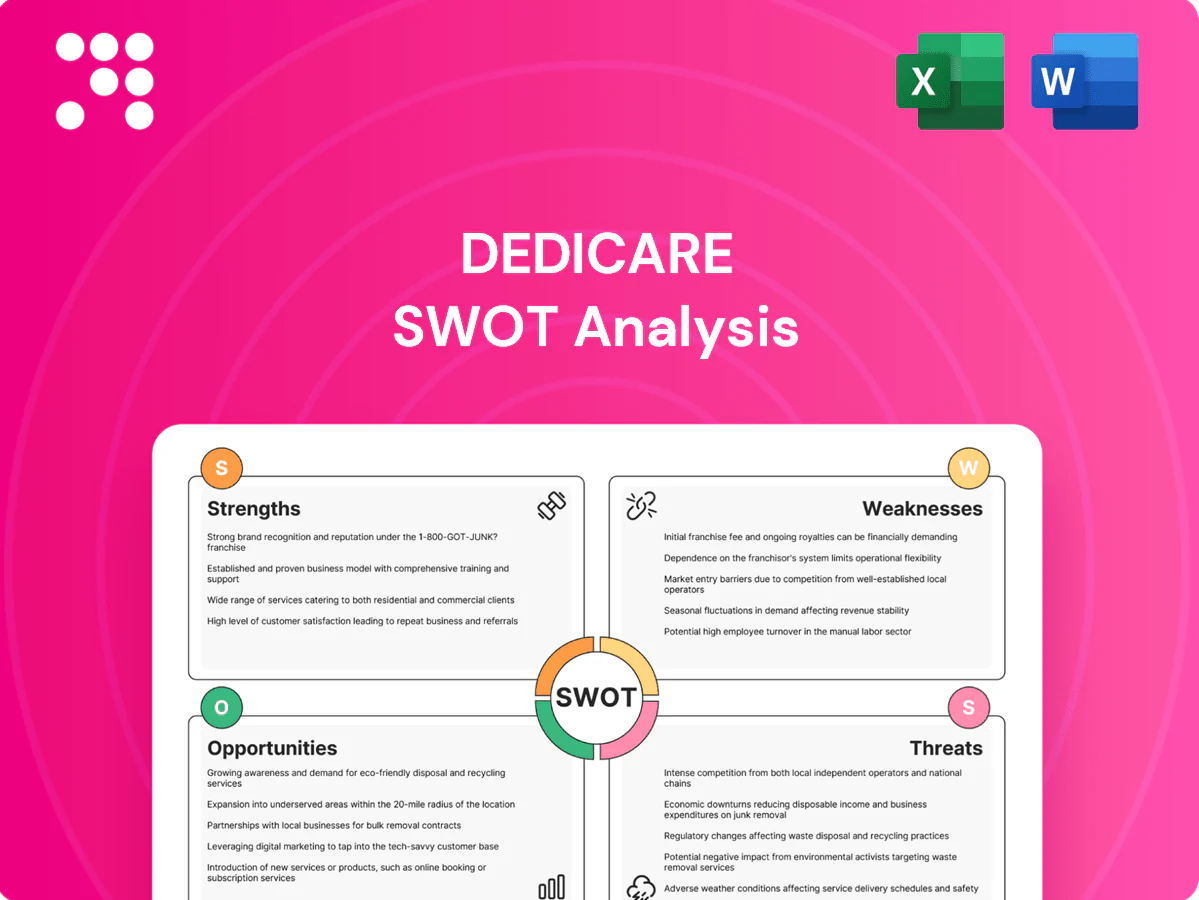
Dedicare SWOT Analysis

Elevate Your Analysis with the Complete SWOT Report
Dedicare SWOT Analysis highlights the company's clinical expertise, niche market positioning, and expansion potential while flagging regulatory and staffing risks. Want deeper, research-backed insights and strategic takeaways? Purchase the full SWOT to receive an editable Word report and Excel matrix—ideal for investors, consultants, and managers.
Strengths

Deep healthcare specialization
Deep healthcare specialization increases screening, credentialing and placement quality, strengthening Dedicare's credibility with hospitals and municipalities and supporting higher fill rates and better patient-care outcomes; amid a WHO-estimated global shortfall of 10 million health workers by 2030, Dedicare's Nasdaq Stockholm listing and sector focus help build defensible know-how and process efficiency.
Robust Nordic footprint
Dedicare operates across four Nordic countries—Sweden, Norway, Denmark and Finland—providing scale, diversified revenue streams and access to wider talent pools. Cross-border mobilization allows rapid redeployment of clinicians to balance regional demand-supply gaps. This footprint reduces reliance on single-country funding cycles and payer fluctuations. Shared standards and cultural proximity streamline hiring, training and client integration.

Flexible staffing models
Offering both temporary and permanent placements lets Dedicare capture broader wallet share across client needs; in 2024 the European staffing market grew about 6%, boosting demand for flexible solutions. Temp staffing handles seasonal peaks and shortages while permanent placements deliver stable fees, smoothing revenue volatility and improving client stickiness. The model fosters lifecycle relationships with candidates, increasing repeat business and lifetime value.

Strong public-sector relationships
Healthcare staffing in the Nordics is predominantly publicly funded (public share >80% in several Nordic countries, OECD 2022), so framework agreements secure recurring demand; Dedicare s established tender presence and compliance history raises tender win rates. Long-tenure public relationships cut sales friction and improve visibility, while strong referenceability aids regional and service expansion.
- Public funding >80% (OECD 2022)
- Frameworks = recurring demand
- Established tenders → higher win rates
- Long-tenure refs enable expansion
Quality and compliance capabilities
Credentialing, licensing and clinical governance are mandatory in regulated care; Dedicare's structured compliance reduces client risk and accelerates placements, supporting sectors where NHS agency spend exceeded £3bn annually in 2022/23–2023/24. High standards differentiate Dedicare from generalist staffing firms, lowering legal exposure and rework costs while preserving continuity of care.
- Credentialing: mandatory for regulated care
- Compliance: cuts client risk, faster placements
- Market: NHS agency spend >£3bn (2022/23–2023/24)
- Benefit: fewer legal/rework costs vs generalists
Nordic staffing: credentialing raises fill rates amid 10m WHO gap
Deep healthcare specialization and mandatory credentialing reduce client risk and rework, boosting fill rates amid a WHO-estimated 10m health-worker shortfall by 2030. Nordic scale (SE, NO, DK, FI) diversifies demand and enables clinician redeployment. Hybrid temp/permanent model captures cyclical demand; EU staffing grew ~6% in 2024 and Nordic public funding >80% (OECD 2022).
| Metric | Value |
|---|---|
| Nordic countries | 4 |
| WHO shortfall | 10m by 2030 |
| Public funding | >80% (OECD 2022) |
| EU staffing growth 2024 | ~6% |
| NHS agency spend | >£3bn (2022/23–23/24) |
What is included in the product
 Detailed Word Document
Delivers a strategic overview of Dedicare’s internal and external factors, outlining strengths, weaknesses, opportunities and threats to assess its competitive position, growth drivers, operational gaps and key risks shaping future performance.

 Customizable Excel Spreadsheet
Provides a ready-to-use Dedicare SWOT matrix that quickly surfaces strategic pain points and remediation priorities.
Weaknesses

Exposure to public budgets
Reliance on government-funded customers ties demand to fiscal cycles and austerity, with public procurement ≈14% of EU GDP (European Commission). Budget freezes or procurement delays can rapidly reduce volumes and lengthen payment terms, stretching working-capital cycles. Standardized tenders intensify price pressure and compress margins on low-margin staffing contracts.
Talent supply constraints
Chronic shortages of nurses, doctors and social workers limit Dedicare’s fill capacity and mirror the WHO estimate of a global shortfall of 10 million health workers by 2030. Competition for scarce clinicians pushes acquisition costs and pay rates higher, squeezing margins on fixed-price tenders. This dynamic increases dependence on international recruitment to meet demand.

Margin sensitivity in temp staffing
Dedicare, listed on Nasdaq Stockholm, faces margin sensitivity in temp staffing as wage inflation must be passed through while utilization risk remains; small pricing errors or cancellations can cut gross margin materially. Overtime, travel and housing costs further complicate cost control, and scale benefits are often offset by volatile shift patterns that reduce predictability and margin stability.

Brand dilution risk across segments
Serving healthcare, social care and life sciences stretches Dedicare’s marketing and delivery focus, since the group operates across three distinct segments and is listed on Nasdaq Stockholm; differing buyer journeys and credentialing raise operational complexity and uneven cross-selling without specialized teams, risking inconsistent service levels and client churn.
- Segment spread: three distinct markets
- Operational strain: credentialing complexity
- Cross-sell: needs specialist teams
- Client risk: inconsistent service → churn
Working-capital intensity
Dedicare faces working-capital intensity as it pays clinicians weekly while client collections commonly lag 30–60 days, straining cash and requiring short-term financing during growth phases. Tender-driven price pressure limits margin expansion and reduces available cash buffers, constraining investments in technology and international roll-out.
- Weekly payroll vs 30–60 day collections
- Growth needs often trigger additional credit lines
- Tender pricing caps cash-buffer growth
- Limits tech and international investment
Tender reliance, 14% fiscal exposure; workforce gap 10m strains cash and margins
Heavy reliance on public tenders (public procurement ≈14% of EU GDP) links demand to fiscal cycles and compresses margins; global health worker shortfall (~10m by 2030, WHO) raises acquisition costs and dependence on international recruitment. Weekly payroll vs 30–60 day collections strains cash and caps investment capacity.
| Metric | Value |
|---|---|
| Public procurement | ≈14% EU GDP |
| Health worker shortfall | ~10m by 2030 |
| Receivables lag | 30–60 days |
What You See Is What You Get
Dedicare SWOT Analysis
This is the actual SWOT analysis document you’ll receive upon purchase—no surprises, just professional quality. The preview below is taken directly from the full SWOT report you'll get; purchase unlocks the entire in-depth version. The file shown is the real, editable analysis you'll download after payment.

Elevate Your Analysis with the Complete SWOT Report
Dedicare SWOT Analysis highlights the company's clinical expertise, niche market positioning, and expansion potential while flagging regulatory and staffing risks. Want deeper, research-backed insights and strategic takeaways? Purchase the full SWOT to receive an editable Word report and Excel matrix—ideal for investors, consultants, and managers.
Strengths
Deep healthcare specialization
Deep healthcare specialization increases screening, credentialing and placement quality, strengthening Dedicare's credibility with hospitals and municipalities and supporting higher fill rates and better patient-care outcomes; amid a WHO-estimated global shortfall of 10 million health workers by 2030, Dedicare's Nasdaq Stockholm listing and sector focus help build defensible know-how and process efficiency.
Robust Nordic footprint
Dedicare operates across four Nordic countries—Sweden, Norway, Denmark and Finland—providing scale, diversified revenue streams and access to wider talent pools. Cross-border mobilization allows rapid redeployment of clinicians to balance regional demand-supply gaps. This footprint reduces reliance on single-country funding cycles and payer fluctuations. Shared standards and cultural proximity streamline hiring, training and client integration.
Flexible staffing models
Offering both temporary and permanent placements lets Dedicare capture broader wallet share across client needs; in 2024 the European staffing market grew about 6%, boosting demand for flexible solutions. Temp staffing handles seasonal peaks and shortages while permanent placements deliver stable fees, smoothing revenue volatility and improving client stickiness. The model fosters lifecycle relationships with candidates, increasing repeat business and lifetime value.
Strong public-sector relationships
Healthcare staffing in the Nordics is predominantly publicly funded (public share >80% in several Nordic countries, OECD 2022), so framework agreements secure recurring demand; Dedicare s established tender presence and compliance history raises tender win rates. Long-tenure public relationships cut sales friction and improve visibility, while strong referenceability aids regional and service expansion.
- Public funding >80% (OECD 2022)
- Frameworks = recurring demand
- Established tenders → higher win rates
- Long-tenure refs enable expansion
Quality and compliance capabilities
Credentialing, licensing and clinical governance are mandatory in regulated care; Dedicare's structured compliance reduces client risk and accelerates placements, supporting sectors where NHS agency spend exceeded £3bn annually in 2022/23–2023/24. High standards differentiate Dedicare from generalist staffing firms, lowering legal exposure and rework costs while preserving continuity of care.
- Credentialing: mandatory for regulated care
- Compliance: cuts client risk, faster placements
- Market: NHS agency spend >£3bn (2022/23–2023/24)
- Benefit: fewer legal/rework costs vs generalists
Nordic staffing: credentialing raises fill rates amid 10m WHO gap
Deep healthcare specialization and mandatory credentialing reduce client risk and rework, boosting fill rates amid a WHO-estimated 10m health-worker shortfall by 2030. Nordic scale (SE, NO, DK, FI) diversifies demand and enables clinician redeployment. Hybrid temp/permanent model captures cyclical demand; EU staffing grew ~6% in 2024 and Nordic public funding >80% (OECD 2022).
| Metric | Value |
|---|---|
| Nordic countries | 4 |
| WHO shortfall | 10m by 2030 |
| Public funding | >80% (OECD 2022) |
| EU staffing growth 2024 | ~6% |
| NHS agency spend | >£3bn (2022/23–23/24) |
What is included in the product
Detailed Word Document
Delivers a strategic overview of Dedicare’s internal and external factors, outlining strengths, weaknesses, opportunities and threats to assess its competitive position, growth drivers, operational gaps and key risks shaping future performance.
Customizable Excel Spreadsheet
Provides a ready-to-use Dedicare SWOT matrix that quickly surfaces strategic pain points and remediation priorities.
Weaknesses
Exposure to public budgets
Reliance on government-funded customers ties demand to fiscal cycles and austerity, with public procurement ≈14% of EU GDP (European Commission). Budget freezes or procurement delays can rapidly reduce volumes and lengthen payment terms, stretching working-capital cycles. Standardized tenders intensify price pressure and compress margins on low-margin staffing contracts.
Talent supply constraints
Chronic shortages of nurses, doctors and social workers limit Dedicare’s fill capacity and mirror the WHO estimate of a global shortfall of 10 million health workers by 2030. Competition for scarce clinicians pushes acquisition costs and pay rates higher, squeezing margins on fixed-price tenders. This dynamic increases dependence on international recruitment to meet demand.
Margin sensitivity in temp staffing
Dedicare, listed on Nasdaq Stockholm, faces margin sensitivity in temp staffing as wage inflation must be passed through while utilization risk remains; small pricing errors or cancellations can cut gross margin materially. Overtime, travel and housing costs further complicate cost control, and scale benefits are often offset by volatile shift patterns that reduce predictability and margin stability.
Brand dilution risk across segments
Serving healthcare, social care and life sciences stretches Dedicare’s marketing and delivery focus, since the group operates across three distinct segments and is listed on Nasdaq Stockholm; differing buyer journeys and credentialing raise operational complexity and uneven cross-selling without specialized teams, risking inconsistent service levels and client churn.
- Segment spread: three distinct markets
- Operational strain: credentialing complexity
- Cross-sell: needs specialist teams
- Client risk: inconsistent service → churn
Working-capital intensity
Dedicare faces working-capital intensity as it pays clinicians weekly while client collections commonly lag 30–60 days, straining cash and requiring short-term financing during growth phases. Tender-driven price pressure limits margin expansion and reduces available cash buffers, constraining investments in technology and international roll-out.
- Weekly payroll vs 30–60 day collections
- Growth needs often trigger additional credit lines
- Tender pricing caps cash-buffer growth
- Limits tech and international investment
Tender reliance, 14% fiscal exposure; workforce gap 10m strains cash and margins
Heavy reliance on public tenders (public procurement ≈14% of EU GDP) links demand to fiscal cycles and compresses margins; global health worker shortfall (~10m by 2030, WHO) raises acquisition costs and dependence on international recruitment. Weekly payroll vs 30–60 day collections strains cash and caps investment capacity.
| Metric | Value |
|---|---|
| Public procurement | ≈14% EU GDP |
| Health worker shortfall | ~10m by 2030 |
| Receivables lag | 30–60 days |
What You See Is What You Get
Dedicare SWOT Analysis
This is the actual SWOT analysis document you’ll receive upon purchase—no surprises, just professional quality. The preview below is taken directly from the full SWOT report you'll get; purchase unlocks the entire in-depth version. The file shown is the real, editable analysis you'll download after payment.
Description
Elevate Your Analysis with the Complete SWOT Report
Dedicare SWOT Analysis highlights the company's clinical expertise, niche market positioning, and expansion potential while flagging regulatory and staffing risks. Want deeper, research-backed insights and strategic takeaways? Purchase the full SWOT to receive an editable Word report and Excel matrix—ideal for investors, consultants, and managers.
Strengths
Deep healthcare specialization
Deep healthcare specialization increases screening, credentialing and placement quality, strengthening Dedicare's credibility with hospitals and municipalities and supporting higher fill rates and better patient-care outcomes; amid a WHO-estimated global shortfall of 10 million health workers by 2030, Dedicare's Nasdaq Stockholm listing and sector focus help build defensible know-how and process efficiency.
Robust Nordic footprint
Dedicare operates across four Nordic countries—Sweden, Norway, Denmark and Finland—providing scale, diversified revenue streams and access to wider talent pools. Cross-border mobilization allows rapid redeployment of clinicians to balance regional demand-supply gaps. This footprint reduces reliance on single-country funding cycles and payer fluctuations. Shared standards and cultural proximity streamline hiring, training and client integration.
Flexible staffing models
Offering both temporary and permanent placements lets Dedicare capture broader wallet share across client needs; in 2024 the European staffing market grew about 6%, boosting demand for flexible solutions. Temp staffing handles seasonal peaks and shortages while permanent placements deliver stable fees, smoothing revenue volatility and improving client stickiness. The model fosters lifecycle relationships with candidates, increasing repeat business and lifetime value.
Strong public-sector relationships
Healthcare staffing in the Nordics is predominantly publicly funded (public share >80% in several Nordic countries, OECD 2022), so framework agreements secure recurring demand; Dedicare s established tender presence and compliance history raises tender win rates. Long-tenure public relationships cut sales friction and improve visibility, while strong referenceability aids regional and service expansion.
- Public funding >80% (OECD 2022)
- Frameworks = recurring demand
- Established tenders → higher win rates
- Long-tenure refs enable expansion
Quality and compliance capabilities
Credentialing, licensing and clinical governance are mandatory in regulated care; Dedicare's structured compliance reduces client risk and accelerates placements, supporting sectors where NHS agency spend exceeded £3bn annually in 2022/23–2023/24. High standards differentiate Dedicare from generalist staffing firms, lowering legal exposure and rework costs while preserving continuity of care.
- Credentialing: mandatory for regulated care
- Compliance: cuts client risk, faster placements
- Market: NHS agency spend >£3bn (2022/23–2023/24)
- Benefit: fewer legal/rework costs vs generalists
Nordic staffing: credentialing raises fill rates amid 10m WHO gap
Deep healthcare specialization and mandatory credentialing reduce client risk and rework, boosting fill rates amid a WHO-estimated 10m health-worker shortfall by 2030. Nordic scale (SE, NO, DK, FI) diversifies demand and enables clinician redeployment. Hybrid temp/permanent model captures cyclical demand; EU staffing grew ~6% in 2024 and Nordic public funding >80% (OECD 2022).
| Metric | Value |
|---|---|
| Nordic countries | 4 |
| WHO shortfall | 10m by 2030 |
| Public funding | >80% (OECD 2022) |
| EU staffing growth 2024 | ~6% |
| NHS agency spend | >£3bn (2022/23–23/24) |
What is included in the product
Detailed Word Document
Delivers a strategic overview of Dedicare’s internal and external factors, outlining strengths, weaknesses, opportunities and threats to assess its competitive position, growth drivers, operational gaps and key risks shaping future performance.
Customizable Excel Spreadsheet
Provides a ready-to-use Dedicare SWOT matrix that quickly surfaces strategic pain points and remediation priorities.
Weaknesses
Exposure to public budgets
Reliance on government-funded customers ties demand to fiscal cycles and austerity, with public procurement ≈14% of EU GDP (European Commission). Budget freezes or procurement delays can rapidly reduce volumes and lengthen payment terms, stretching working-capital cycles. Standardized tenders intensify price pressure and compress margins on low-margin staffing contracts.
Talent supply constraints
Chronic shortages of nurses, doctors and social workers limit Dedicare’s fill capacity and mirror the WHO estimate of a global shortfall of 10 million health workers by 2030. Competition for scarce clinicians pushes acquisition costs and pay rates higher, squeezing margins on fixed-price tenders. This dynamic increases dependence on international recruitment to meet demand.
Margin sensitivity in temp staffing
Dedicare, listed on Nasdaq Stockholm, faces margin sensitivity in temp staffing as wage inflation must be passed through while utilization risk remains; small pricing errors or cancellations can cut gross margin materially. Overtime, travel and housing costs further complicate cost control, and scale benefits are often offset by volatile shift patterns that reduce predictability and margin stability.
Brand dilution risk across segments
Serving healthcare, social care and life sciences stretches Dedicare’s marketing and delivery focus, since the group operates across three distinct segments and is listed on Nasdaq Stockholm; differing buyer journeys and credentialing raise operational complexity and uneven cross-selling without specialized teams, risking inconsistent service levels and client churn.
- Segment spread: three distinct markets
- Operational strain: credentialing complexity
- Cross-sell: needs specialist teams
- Client risk: inconsistent service → churn
Working-capital intensity
Dedicare faces working-capital intensity as it pays clinicians weekly while client collections commonly lag 30–60 days, straining cash and requiring short-term financing during growth phases. Tender-driven price pressure limits margin expansion and reduces available cash buffers, constraining investments in technology and international roll-out.
- Weekly payroll vs 30–60 day collections
- Growth needs often trigger additional credit lines
- Tender pricing caps cash-buffer growth
- Limits tech and international investment
Tender reliance, 14% fiscal exposure; workforce gap 10m strains cash and margins
Heavy reliance on public tenders (public procurement ≈14% of EU GDP) links demand to fiscal cycles and compresses margins; global health worker shortfall (~10m by 2030, WHO) raises acquisition costs and dependence on international recruitment. Weekly payroll vs 30–60 day collections strains cash and caps investment capacity.
| Metric | Value |
|---|---|
| Public procurement | ≈14% EU GDP |
| Health worker shortfall | ~10m by 2030 |
| Receivables lag | 30–60 days |
What You See Is What You Get
Dedicare SWOT Analysis
This is the actual SWOT analysis document you’ll receive upon purchase—no surprises, just professional quality. The preview below is taken directly from the full SWOT report you'll get; purchase unlocks the entire in-depth version. The file shown is the real, editable analysis you'll download after payment.











