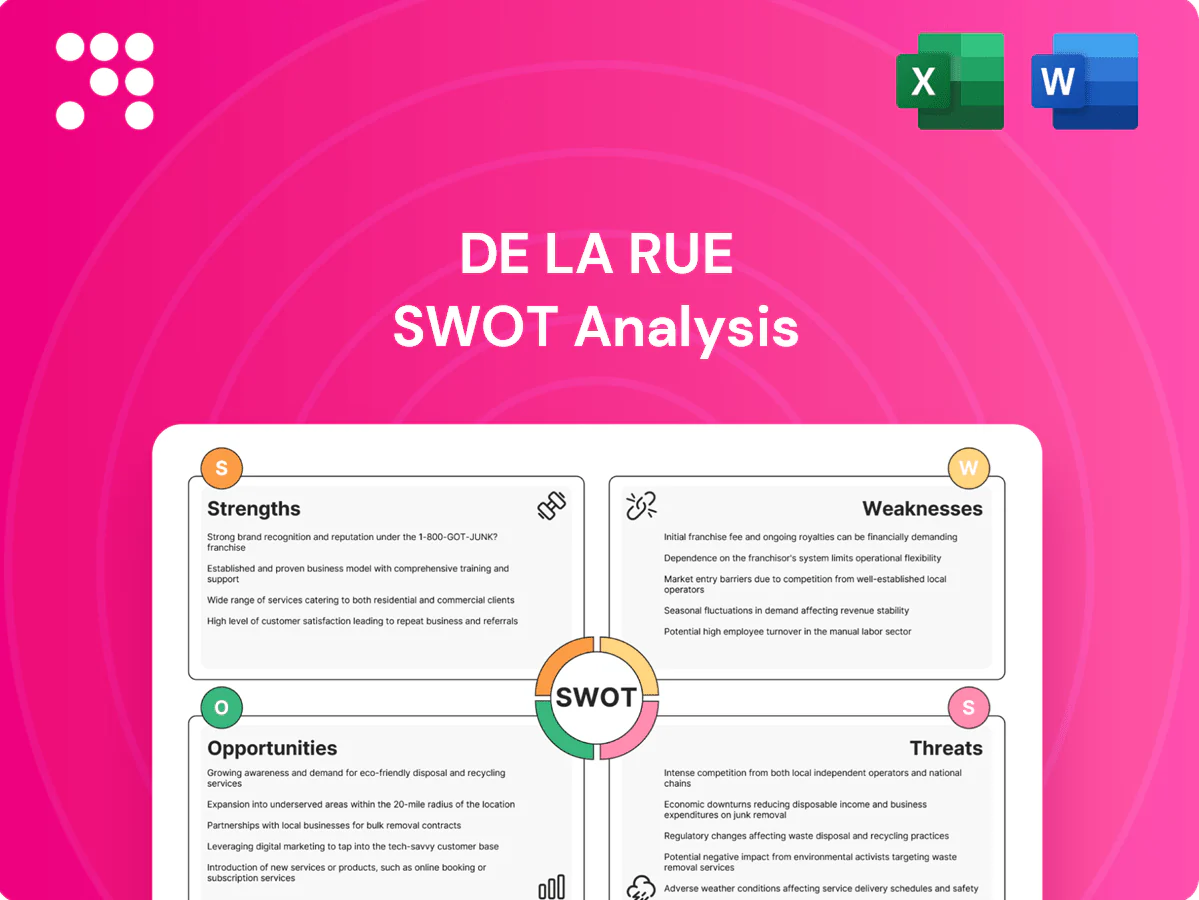
De La Rue SWOT Analysis

Your Strategic Toolkit Starts Here
De La Rue faces unique pressures from global currency trends, security printing digitization, and regulatory scrutiny, while retaining strength in specialized tech and long-standing government contracts. Our SWOT preview highlights key risks and growth levers, but the full analysis delivers data-backed strategies, financial context, and editable tools. Want actionable insight for investment or planning? Purchase the complete SWOT report to get a ready-to-use Word and Excel package.
Strengths

Global banknote leadership
De La Rue is among the leading commercial designers and producers of banknotes, trusted by central banks in over 140 countries. Its proven track record in complex tenders and delivery underpins reliability, supported by a workforce of around 1,900 employees and multi-site manufacturing. Scale drives cost efficiencies and rapid deployment, while strong brand recognition helps secure repeat contracts.
Advanced security technologies
De La Rue develops high-security features, inks, holographics and authentication elements that deter counterfeiting and serve customers in over 140 countries; continuous R&D raises the barrier to entry and supports premium pricing, while integrated design, print and feature development creates defensible IP and extends capabilities into brand protection and secure ID solutions.

Polymer substrate expertise
De La Rue supplies secure polymer substrates and finished polymer notes, a growing segment versus paper. Polymer notes typically last 2–3x longer, lowering lifecycle costs and accelerating issuer adoption. De La Rue’s substrate know-how combined with advanced security features is a clear differentiator, and proven field performance across 60+ issuing authorities builds issuer confidence.

Diverse secure document portfolio
De La Rue extends beyond banknotes into passports, ID cards and tax stamps, serving customers in over 140 countries; this diversifies revenue and reduces reliance on any single product. Reuse of authentication tech boosts margins and win rates and enables bundled government solutions across currency, ID and tax programs.
- Multi-vertical exposure
- Authentication tech synergies
- Bundled government solutions
Cash processing and services
Offering cash handling and verification deepens ties with central and commercial banks; De La Rue serves customers in over 140 countries. Services provide recurring revenue and data-driven upsell paths that boost stickiness via multi-year contracts. Integration with secure printing creates an end-to-end value proposition supporting long-term agreements.
- Geographic reach: 140+ countries
- Revenue quality: recurring services drive renewals
- Value chain: cash services + secure printing = end-to-end
Trusted cash security across 140+ countries, 60+ polymer issuers, 2–3x longevity
De La Rue is a trusted supplier to 140+ countries with ~1,900 employees, proven delivery in complex tenders and multi-site manufacturing. Advanced security features, inks and holographics plus polymer substrate know-how (deployed with 60+ issuers) enable premium pricing and 2–3x note longevity, supporting recurring cash services and bundled government solutions.
| Metric | Value |
|---|---|
| Countries served | 140+ |
| Employees | ~1,900 |
| Polymer issuers | 60+ |
| Polymer longevity | 2–3x paper |
What is included in the product
 Detailed Word Document
Provides a concise strategic overview of De La Rue’s internal strengths and weaknesses and external opportunities and threats, assessing its competitive position across secure printing, cash handling and identity solutions while highlighting operational risks, revenue drivers and market challenges.

 Customizable Excel Spreadsheet
Provides a concise De La Rue SWOT matrix for fast, visual strategy alignment and quick stakeholder briefings, ideal for executives needing a snapshot of competitive positioning and operational risks.
Weaknesses

Exposure to tender cycles
Exposure to tender cycles drives revenue volatility for De La Rue: government and central bank tenders are infrequent, large and highly competitive, so single bid outcomes can swing utilization and revenues materially. Bid timing causes capacity management challenges and renewals bring intense pricing pressure, complicating forecasting and short-term cash flow planning.
Legacy cost base
Specialized plants, security compliance and skilled labour result in a high fixed cost base for De La Rue; FY2023 revenue was about £218m while plant-heavy operations limit variable-cost flexibility. Underutilisation during demand lulls compresses margins and asset turns. Restructuring in this sector is slow and costly, and working capital rises materially during project peaks, creating cash-flow volatility for the business.

Client concentration risk
Client concentration risk: a limited number of large sovereign customers can dominate De La Rue sales, so losing a key contract can materially hit revenue and profit. Negotiating leverage often shifts to major issuers, pressuring margins. Political changes in client countries have repeatedly disrupted order schedules and contract renewals.

Past contract setbacks
High-profile losses in passport and ID tenders have exposed competitive gaps and intensified scrutiny of De La Rue’s delivery capabilities, creating tangible reputation risk that can weaken future bids.
Recovery hinges on sustained execution wins and proven contract performance; however, significant government switching costs mean once displaced, re-entry requires long-term relationship rebuilding and demonstrable track record.
- Competitive tender losses
- Reputation risk from delivery disputes
- Need for sustained execution to recover
- High government switching costs hinder re-entry
Currency and supply sensitivities
Input materials such as specialty inks and polymers face acute price and logistics volatility, driving margin pressure and production delays; FX movements further distort cross-border costs and revenue mix, amplifying reported volatility. Maintaining inventory buffers to mitigate shortages ties up working capital, while lengthy supplier qualification restricts rapid substitution and operational agility.
- Input volatility: specialty inks/polymers
- FX risk: cross-border cost/revenue mix
- Working capital: inventory buffers
- Supplier limits: slow qualification
Tender volatility and client concentration squeeze margins; FY2023 £218m
Tender-driven revenue volatility and infrequent large contracts cause sharp utilization swings and forecasting difficulty. High fixed costs from specialized plants and skilled labour compress margins during underuse; FY2023 revenue was £218m. Client concentration and high government switching costs magnify downside from lost tenders. Input-price, logistics and FX volatility ties up working capital.
| Metric | Value / Note |
|---|---|
| FY2023 revenue | £218m |
| Key operational risks | Tender volatility, high fixed costs, client concentration, input/FX volatility |
What You See Is What You Get
De La Rue SWOT Analysis
This is the actual De La Rue SWOT analysis document you’ll receive upon purchase—no surprises, just professional quality. The preview below is taken directly from the full report you'll get, showing strengths, weaknesses, opportunities and threats in detail. Purchase unlocks the complete, editable version for immediate download and use.

Your Strategic Toolkit Starts Here
De La Rue faces unique pressures from global currency trends, security printing digitization, and regulatory scrutiny, while retaining strength in specialized tech and long-standing government contracts. Our SWOT preview highlights key risks and growth levers, but the full analysis delivers data-backed strategies, financial context, and editable tools. Want actionable insight for investment or planning? Purchase the complete SWOT report to get a ready-to-use Word and Excel package.
Strengths
Global banknote leadership
De La Rue is among the leading commercial designers and producers of banknotes, trusted by central banks in over 140 countries. Its proven track record in complex tenders and delivery underpins reliability, supported by a workforce of around 1,900 employees and multi-site manufacturing. Scale drives cost efficiencies and rapid deployment, while strong brand recognition helps secure repeat contracts.
Advanced security technologies
De La Rue develops high-security features, inks, holographics and authentication elements that deter counterfeiting and serve customers in over 140 countries; continuous R&D raises the barrier to entry and supports premium pricing, while integrated design, print and feature development creates defensible IP and extends capabilities into brand protection and secure ID solutions.
Polymer substrate expertise
De La Rue supplies secure polymer substrates and finished polymer notes, a growing segment versus paper. Polymer notes typically last 2–3x longer, lowering lifecycle costs and accelerating issuer adoption. De La Rue’s substrate know-how combined with advanced security features is a clear differentiator, and proven field performance across 60+ issuing authorities builds issuer confidence.
Diverse secure document portfolio
De La Rue extends beyond banknotes into passports, ID cards and tax stamps, serving customers in over 140 countries; this diversifies revenue and reduces reliance on any single product. Reuse of authentication tech boosts margins and win rates and enables bundled government solutions across currency, ID and tax programs.
- Multi-vertical exposure
- Authentication tech synergies
- Bundled government solutions
Cash processing and services
Offering cash handling and verification deepens ties with central and commercial banks; De La Rue serves customers in over 140 countries. Services provide recurring revenue and data-driven upsell paths that boost stickiness via multi-year contracts. Integration with secure printing creates an end-to-end value proposition supporting long-term agreements.
- Geographic reach: 140+ countries
- Revenue quality: recurring services drive renewals
- Value chain: cash services + secure printing = end-to-end
Trusted cash security across 140+ countries, 60+ polymer issuers, 2–3x longevity
De La Rue is a trusted supplier to 140+ countries with ~1,900 employees, proven delivery in complex tenders and multi-site manufacturing. Advanced security features, inks and holographics plus polymer substrate know-how (deployed with 60+ issuers) enable premium pricing and 2–3x note longevity, supporting recurring cash services and bundled government solutions.
| Metric | Value |
|---|---|
| Countries served | 140+ |
| Employees | ~1,900 |
| Polymer issuers | 60+ |
| Polymer longevity | 2–3x paper |
What is included in the product
Detailed Word Document
Provides a concise strategic overview of De La Rue’s internal strengths and weaknesses and external opportunities and threats, assessing its competitive position across secure printing, cash handling and identity solutions while highlighting operational risks, revenue drivers and market challenges.
Customizable Excel Spreadsheet
Provides a concise De La Rue SWOT matrix for fast, visual strategy alignment and quick stakeholder briefings, ideal for executives needing a snapshot of competitive positioning and operational risks.
Weaknesses
Exposure to tender cycles
Exposure to tender cycles drives revenue volatility for De La Rue: government and central bank tenders are infrequent, large and highly competitive, so single bid outcomes can swing utilization and revenues materially. Bid timing causes capacity management challenges and renewals bring intense pricing pressure, complicating forecasting and short-term cash flow planning.
Legacy cost base
Specialized plants, security compliance and skilled labour result in a high fixed cost base for De La Rue; FY2023 revenue was about £218m while plant-heavy operations limit variable-cost flexibility. Underutilisation during demand lulls compresses margins and asset turns. Restructuring in this sector is slow and costly, and working capital rises materially during project peaks, creating cash-flow volatility for the business.
Client concentration risk
Client concentration risk: a limited number of large sovereign customers can dominate De La Rue sales, so losing a key contract can materially hit revenue and profit. Negotiating leverage often shifts to major issuers, pressuring margins. Political changes in client countries have repeatedly disrupted order schedules and contract renewals.
Past contract setbacks
High-profile losses in passport and ID tenders have exposed competitive gaps and intensified scrutiny of De La Rue’s delivery capabilities, creating tangible reputation risk that can weaken future bids.
Recovery hinges on sustained execution wins and proven contract performance; however, significant government switching costs mean once displaced, re-entry requires long-term relationship rebuilding and demonstrable track record.
- Competitive tender losses
- Reputation risk from delivery disputes
- Need for sustained execution to recover
- High government switching costs hinder re-entry
Currency and supply sensitivities
Input materials such as specialty inks and polymers face acute price and logistics volatility, driving margin pressure and production delays; FX movements further distort cross-border costs and revenue mix, amplifying reported volatility. Maintaining inventory buffers to mitigate shortages ties up working capital, while lengthy supplier qualification restricts rapid substitution and operational agility.
- Input volatility: specialty inks/polymers
- FX risk: cross-border cost/revenue mix
- Working capital: inventory buffers
- Supplier limits: slow qualification
Tender volatility and client concentration squeeze margins; FY2023 £218m
Tender-driven revenue volatility and infrequent large contracts cause sharp utilization swings and forecasting difficulty. High fixed costs from specialized plants and skilled labour compress margins during underuse; FY2023 revenue was £218m. Client concentration and high government switching costs magnify downside from lost tenders. Input-price, logistics and FX volatility ties up working capital.
| Metric | Value / Note |
|---|---|
| FY2023 revenue | £218m |
| Key operational risks | Tender volatility, high fixed costs, client concentration, input/FX volatility |
What You See Is What You Get
De La Rue SWOT Analysis
This is the actual De La Rue SWOT analysis document you’ll receive upon purchase—no surprises, just professional quality. The preview below is taken directly from the full report you'll get, showing strengths, weaknesses, opportunities and threats in detail. Purchase unlocks the complete, editable version for immediate download and use.
Original: $10.00
-65%$10.00
$3.50Description
Your Strategic Toolkit Starts Here
De La Rue faces unique pressures from global currency trends, security printing digitization, and regulatory scrutiny, while retaining strength in specialized tech and long-standing government contracts. Our SWOT preview highlights key risks and growth levers, but the full analysis delivers data-backed strategies, financial context, and editable tools. Want actionable insight for investment or planning? Purchase the complete SWOT report to get a ready-to-use Word and Excel package.
Strengths
Global banknote leadership
De La Rue is among the leading commercial designers and producers of banknotes, trusted by central banks in over 140 countries. Its proven track record in complex tenders and delivery underpins reliability, supported by a workforce of around 1,900 employees and multi-site manufacturing. Scale drives cost efficiencies and rapid deployment, while strong brand recognition helps secure repeat contracts.
Advanced security technologies
De La Rue develops high-security features, inks, holographics and authentication elements that deter counterfeiting and serve customers in over 140 countries; continuous R&D raises the barrier to entry and supports premium pricing, while integrated design, print and feature development creates defensible IP and extends capabilities into brand protection and secure ID solutions.
Polymer substrate expertise
De La Rue supplies secure polymer substrates and finished polymer notes, a growing segment versus paper. Polymer notes typically last 2–3x longer, lowering lifecycle costs and accelerating issuer adoption. De La Rue’s substrate know-how combined with advanced security features is a clear differentiator, and proven field performance across 60+ issuing authorities builds issuer confidence.
Diverse secure document portfolio
De La Rue extends beyond banknotes into passports, ID cards and tax stamps, serving customers in over 140 countries; this diversifies revenue and reduces reliance on any single product. Reuse of authentication tech boosts margins and win rates and enables bundled government solutions across currency, ID and tax programs.
- Multi-vertical exposure
- Authentication tech synergies
- Bundled government solutions
Cash processing and services
Offering cash handling and verification deepens ties with central and commercial banks; De La Rue serves customers in over 140 countries. Services provide recurring revenue and data-driven upsell paths that boost stickiness via multi-year contracts. Integration with secure printing creates an end-to-end value proposition supporting long-term agreements.
- Geographic reach: 140+ countries
- Revenue quality: recurring services drive renewals
- Value chain: cash services + secure printing = end-to-end
Trusted cash security across 140+ countries, 60+ polymer issuers, 2–3x longevity
De La Rue is a trusted supplier to 140+ countries with ~1,900 employees, proven delivery in complex tenders and multi-site manufacturing. Advanced security features, inks and holographics plus polymer substrate know-how (deployed with 60+ issuers) enable premium pricing and 2–3x note longevity, supporting recurring cash services and bundled government solutions.
| Metric | Value |
|---|---|
| Countries served | 140+ |
| Employees | ~1,900 |
| Polymer issuers | 60+ |
| Polymer longevity | 2–3x paper |
What is included in the product
Detailed Word Document
Provides a concise strategic overview of De La Rue’s internal strengths and weaknesses and external opportunities and threats, assessing its competitive position across secure printing, cash handling and identity solutions while highlighting operational risks, revenue drivers and market challenges.
Customizable Excel Spreadsheet
Provides a concise De La Rue SWOT matrix for fast, visual strategy alignment and quick stakeholder briefings, ideal for executives needing a snapshot of competitive positioning and operational risks.
Weaknesses
Exposure to tender cycles
Exposure to tender cycles drives revenue volatility for De La Rue: government and central bank tenders are infrequent, large and highly competitive, so single bid outcomes can swing utilization and revenues materially. Bid timing causes capacity management challenges and renewals bring intense pricing pressure, complicating forecasting and short-term cash flow planning.
Legacy cost base
Specialized plants, security compliance and skilled labour result in a high fixed cost base for De La Rue; FY2023 revenue was about £218m while plant-heavy operations limit variable-cost flexibility. Underutilisation during demand lulls compresses margins and asset turns. Restructuring in this sector is slow and costly, and working capital rises materially during project peaks, creating cash-flow volatility for the business.
Client concentration risk
Client concentration risk: a limited number of large sovereign customers can dominate De La Rue sales, so losing a key contract can materially hit revenue and profit. Negotiating leverage often shifts to major issuers, pressuring margins. Political changes in client countries have repeatedly disrupted order schedules and contract renewals.
Past contract setbacks
High-profile losses in passport and ID tenders have exposed competitive gaps and intensified scrutiny of De La Rue’s delivery capabilities, creating tangible reputation risk that can weaken future bids.
Recovery hinges on sustained execution wins and proven contract performance; however, significant government switching costs mean once displaced, re-entry requires long-term relationship rebuilding and demonstrable track record.
- Competitive tender losses
- Reputation risk from delivery disputes
- Need for sustained execution to recover
- High government switching costs hinder re-entry
Currency and supply sensitivities
Input materials such as specialty inks and polymers face acute price and logistics volatility, driving margin pressure and production delays; FX movements further distort cross-border costs and revenue mix, amplifying reported volatility. Maintaining inventory buffers to mitigate shortages ties up working capital, while lengthy supplier qualification restricts rapid substitution and operational agility.
- Input volatility: specialty inks/polymers
- FX risk: cross-border cost/revenue mix
- Working capital: inventory buffers
- Supplier limits: slow qualification
Tender volatility and client concentration squeeze margins; FY2023 £218m
Tender-driven revenue volatility and infrequent large contracts cause sharp utilization swings and forecasting difficulty. High fixed costs from specialized plants and skilled labour compress margins during underuse; FY2023 revenue was £218m. Client concentration and high government switching costs magnify downside from lost tenders. Input-price, logistics and FX volatility ties up working capital.
| Metric | Value / Note |
|---|---|
| FY2023 revenue | £218m |
| Key operational risks | Tender volatility, high fixed costs, client concentration, input/FX volatility |
What You See Is What You Get
De La Rue SWOT Analysis
This is the actual De La Rue SWOT analysis document you’ll receive upon purchase—no surprises, just professional quality. The preview below is taken directly from the full report you'll get, showing strengths, weaknesses, opportunities and threats in detail. Purchase unlocks the complete, editable version for immediate download and use.











