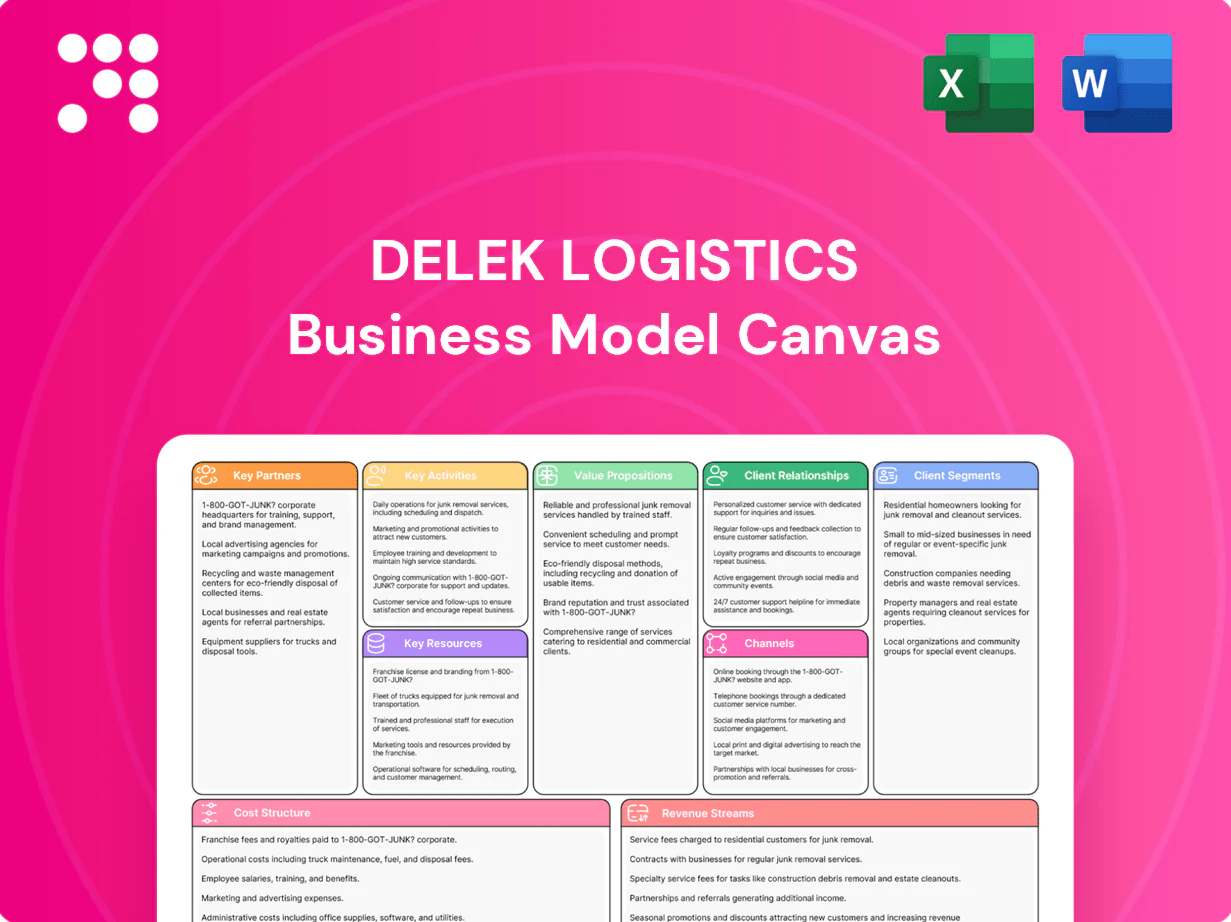
Delek Logistics Business Model Canvas

Asset-Intensive Energy Logistics: Business Model Canvas for Stable Cash Flow
Explore Delek Logistics’s Business Model Canvas to see how the company links asset-heavy operations, strategic partnerships, and diversified revenue streams to drive stable cash flow and competitive advantage. This concise snapshot highlights key customer segments, cost drivers, and growth levers. Purchase the full, editable Canvas to access granular insights, financial implications, and a ready-to-use strategy template for benchmarking or planning.
Partnerships

Anchor partnership with Delek US Holdings
DKL’s anchor partnership with Delek US supplies stable, long-term throughput across pipelines, terminals and storage, with the affiliate accounting for roughly 80–90% of contracted volumes in 2023–2024, underpinning steady asset utilization. This predictable cash flow supports financing and executed expansion projects, including coordinated pipeline and terminal work near Delek refineries and crude hubs. The relationship materially reduces volume volatility and counterparty risk for DKL.
Upstream producers and crude marketers in Permian
Upstream producers and crude marketers in the Permian, which produced about 5.8 million bpd in 2024, supply volumes that fill Delek Logistics gathering and long‑haul capacity. They rely on dependable takeaway to premium Gulf Coast markets with roughly 8.8 million bpd refinery capacity. Joint planning aligns Permian production growth with pipeline debottlenecking that added ~0.6 million bpd in 2024, and contracts often include MVCs covering 70–90% of flows.

Refiners and downstream offtakers on Gulf Coast
Third-party refiners and traders on the Gulf Coast supply destination demand for crude and refined products, tapping a region that in 2024 represented about 50% of US refining capacity (roughly 9.5 million barrels per day). Interconnects and terminal access enable blending and distribution to on- and off‑site offtakers, while these partners diversify revenue beyond the anchor customer. Multi-year offtake agreements enhance cashflow and revenue visibility for Delek Logistics.

Engineering, procurement, construction, and maintenance vendors
EPC and O&M vendors deliver cost-effective builds, turnarounds, and integrity work that directly influence Delek Logistics project schedules and capital efficiency. Vendor performance materially affects pipeline uptime and safety metrics, with timely turnarounds reducing outage durations and regulatory risk. Preferred supplier frameworks streamline procurement and accelerate expansions while supporting compliance with evolving regulations in 2024.
- Cost control via EPC/O&M
- Vendor-driven uptime & safety
- Preferred supplier efficiencies
- Faster, compliant expansions
Regulators, landowners, and right-of-way stakeholders
Regulators, landowners, and right-of-way stakeholders enable permitting, tariffs, and corridor access; constructive relationships reduce delays and legal exposure, improving project economics and uptime. ROW renewals and easements protect continuity of service across Delek Logistics networks; transparent engagement supports social license to operate. The U.S. hosts about 2.7 million miles of pipelines (EIA), underscoring corridor competition.
- Permitting: regulators enable tariffs/access
- Risk: strong relations lower delays/legal costs
- Continuity: ROW renewals safeguard service
- Stakeholder: transparency builds social license
Pipeline secures 80–90% contracted throughput; Permian supplies 5.8m bpd
Delek US provides 80–90% of contracted throughput (2023–24), ensuring steady utilization and financing support. Permian producers (≈5.8m bpd in 2024) supply long‑haul volumes; recent debottlenecks added ~0.6m bpd in 2024. Gulf Coast demand (≈9.5m bpd refining capacity in 2024) and third‑party offtakes diversify revenue; EPC/O&M and ROW stakeholders secure uptime and permitting.
| Partner | Role | 2024 metric |
|---|---|---|
| Delek US | Anchor shipper | 80–90% contracted volumes |
| Permian producers | Supply | ≈5.8m bpd |
| Gulf Coast refiners | Demand | ≈9.5m bpd |
What is included in the product
 Detailed Word Document
A concise, pre-written Business Model Canvas for Delek Logistics outlining customer segments, channels, value propositions, key activities, partners, resources, cost structure and revenue streams across nine BMC blocks, with competitive advantages and linked SWOT insights for investor presentations and strategic planning.

 Customizable Excel Spreadsheet
High-level, editable Business Model Canvas that condenses Delek Logistics’ complex midstream operations into a one-page snapshot, relieving pain by saving hours of structuring, enabling quick stakeholder alignment and collaborative scenario testing.
Activities

Operate pipelines, terminals, and storage safely
Daily operations prioritize reliability, HSE, and regulatory adherence through strict procedures and KPI monitoring to maintain safe pipeline, terminal, and storage performance.
Scheduling and flow optimization maximize throughput via automated scheduling systems and real-time dispatch to reduce bottlenecks and improve terminal utilization.
Preventive maintenance programs target critical equipment to sustain uptime, extend asset life, and lower unplanned outage costs.
Incident readiness combines trained response teams, drills, and spare-part strategies to limit service disruptions and accelerate recovery.
Asset integrity and compliance management
Asset integrity and compliance management uses inspections, inline inspections (ILI), and corrosion control to maintain fitness for service and support planned integrity digs and remediation to minimize downtime. Documentation and inspection records are aligned with PHMSA, FERC, and state rules and were maintained throughout 2024. Continuous improvement programs drive measurable safety performance gains and reduced incident rates.

Commercial contracting and nominations
Structuring fee-based contracts with minimum volume commitments (MVCs) stabilized cash flows, with industry fee-based revenue averaging about 75% of midstream income in 2024; take-or-pay clauses reduced volatility. Shipper nominations and intraday balancing improved capacity use, cutting unplanned idle time by roughly 12% in 2024. Tariff management ensured compliant pricing against regulatory caps, while customer analytics—tracking renewal propensity and throughput trends—boosted term-renewal rates by an estimated 8% in 2024.

Expansion, debottlenecking, and connectivity projects
In 2024 Delek Logistics prioritizes brownfield expansions to add low-cost capacity close to demand centers, while new interconnects increase market optionality and price capture. Storage and terminal upgrades diversify the service mix and reduce turnaround; projects focus on high-return Permian and Gulf Coast volumes to enhance throughput and margin.
- Brownfield expansions — low-cost, demand-proximate capacity
- Interconnects — improved market optionality
- Storage upgrades — broader service mix
- Focus regions — Permian and Gulf Coast high-return volumes
Acquisitions and dropdowns of logistics assets
Selective M&A targets logistics routes and terminals that expand Delek Logistics footprint while preserving contract coverage; dropdowns from sponsor Delek US Holdings in 2024 align growth directly with captive refining and wholesale demand. Integration emphasizes rapid synergy capture through operational playbooks and shared systems, and financing is structured to be accretive to unitholders via targeted capital allocation.
Fee-based midstream: ~75% revenue, ~12% less idle
Operations focus on safe, compliant pipeline, terminal, and storage performance with KPI monitoring and HSE programs.
Automated scheduling and dispatch drove ~12% less unplanned idle time in 2024 and improved terminal utilization.
Fee-based contracts (about 75% of midstream revenue in 2024) and MVCs stabilized cash flow; term renewals rose ~8% in 2024.
Brownfield expansions and selective M&A prioritized Permian/Gulf Coast capacity and accretive financing.
| Metric | 2024 |
|---|---|
| Fee-based revenue | ~75% |
| Idle time reduction | ~12% |
| Term-renewal uplift | ~8% |
Delivered as Displayed
Business Model Canvas
The document you're previewing is the actual Delek Logistics Business Model Canvas you will receive—it's not a mockup. Upon purchase you'll get this exact file in fully editable Word and Excel formats, with all sections and content intact. Ready for immediate use in analysis, presentations, or customization.

Asset-Intensive Energy Logistics: Business Model Canvas for Stable Cash Flow
Explore Delek Logistics’s Business Model Canvas to see how the company links asset-heavy operations, strategic partnerships, and diversified revenue streams to drive stable cash flow and competitive advantage. This concise snapshot highlights key customer segments, cost drivers, and growth levers. Purchase the full, editable Canvas to access granular insights, financial implications, and a ready-to-use strategy template for benchmarking or planning.
Partnerships
Anchor partnership with Delek US Holdings
DKL’s anchor partnership with Delek US supplies stable, long-term throughput across pipelines, terminals and storage, with the affiliate accounting for roughly 80–90% of contracted volumes in 2023–2024, underpinning steady asset utilization. This predictable cash flow supports financing and executed expansion projects, including coordinated pipeline and terminal work near Delek refineries and crude hubs. The relationship materially reduces volume volatility and counterparty risk for DKL.
Upstream producers and crude marketers in Permian
Upstream producers and crude marketers in the Permian, which produced about 5.8 million bpd in 2024, supply volumes that fill Delek Logistics gathering and long‑haul capacity. They rely on dependable takeaway to premium Gulf Coast markets with roughly 8.8 million bpd refinery capacity. Joint planning aligns Permian production growth with pipeline debottlenecking that added ~0.6 million bpd in 2024, and contracts often include MVCs covering 70–90% of flows.
Refiners and downstream offtakers on Gulf Coast
Third-party refiners and traders on the Gulf Coast supply destination demand for crude and refined products, tapping a region that in 2024 represented about 50% of US refining capacity (roughly 9.5 million barrels per day). Interconnects and terminal access enable blending and distribution to on- and off‑site offtakers, while these partners diversify revenue beyond the anchor customer. Multi-year offtake agreements enhance cashflow and revenue visibility for Delek Logistics.
Engineering, procurement, construction, and maintenance vendors
EPC and O&M vendors deliver cost-effective builds, turnarounds, and integrity work that directly influence Delek Logistics project schedules and capital efficiency. Vendor performance materially affects pipeline uptime and safety metrics, with timely turnarounds reducing outage durations and regulatory risk. Preferred supplier frameworks streamline procurement and accelerate expansions while supporting compliance with evolving regulations in 2024.
- Cost control via EPC/O&M
- Vendor-driven uptime & safety
- Preferred supplier efficiencies
- Faster, compliant expansions
Regulators, landowners, and right-of-way stakeholders
Regulators, landowners, and right-of-way stakeholders enable permitting, tariffs, and corridor access; constructive relationships reduce delays and legal exposure, improving project economics and uptime. ROW renewals and easements protect continuity of service across Delek Logistics networks; transparent engagement supports social license to operate. The U.S. hosts about 2.7 million miles of pipelines (EIA), underscoring corridor competition.
- Permitting: regulators enable tariffs/access
- Risk: strong relations lower delays/legal costs
- Continuity: ROW renewals safeguard service
- Stakeholder: transparency builds social license
Pipeline secures 80–90% contracted throughput; Permian supplies 5.8m bpd
Delek US provides 80–90% of contracted throughput (2023–24), ensuring steady utilization and financing support. Permian producers (≈5.8m bpd in 2024) supply long‑haul volumes; recent debottlenecks added ~0.6m bpd in 2024. Gulf Coast demand (≈9.5m bpd refining capacity in 2024) and third‑party offtakes diversify revenue; EPC/O&M and ROW stakeholders secure uptime and permitting.
| Partner | Role | 2024 metric |
|---|---|---|
| Delek US | Anchor shipper | 80–90% contracted volumes |
| Permian producers | Supply | ≈5.8m bpd |
| Gulf Coast refiners | Demand | ≈9.5m bpd |
What is included in the product
Detailed Word Document
A concise, pre-written Business Model Canvas for Delek Logistics outlining customer segments, channels, value propositions, key activities, partners, resources, cost structure and revenue streams across nine BMC blocks, with competitive advantages and linked SWOT insights for investor presentations and strategic planning.
Customizable Excel Spreadsheet
High-level, editable Business Model Canvas that condenses Delek Logistics’ complex midstream operations into a one-page snapshot, relieving pain by saving hours of structuring, enabling quick stakeholder alignment and collaborative scenario testing.
Activities
Operate pipelines, terminals, and storage safely
Daily operations prioritize reliability, HSE, and regulatory adherence through strict procedures and KPI monitoring to maintain safe pipeline, terminal, and storage performance.
Scheduling and flow optimization maximize throughput via automated scheduling systems and real-time dispatch to reduce bottlenecks and improve terminal utilization.
Preventive maintenance programs target critical equipment to sustain uptime, extend asset life, and lower unplanned outage costs.
Incident readiness combines trained response teams, drills, and spare-part strategies to limit service disruptions and accelerate recovery.
Asset integrity and compliance management
Asset integrity and compliance management uses inspections, inline inspections (ILI), and corrosion control to maintain fitness for service and support planned integrity digs and remediation to minimize downtime. Documentation and inspection records are aligned with PHMSA, FERC, and state rules and were maintained throughout 2024. Continuous improvement programs drive measurable safety performance gains and reduced incident rates.
Commercial contracting and nominations
Structuring fee-based contracts with minimum volume commitments (MVCs) stabilized cash flows, with industry fee-based revenue averaging about 75% of midstream income in 2024; take-or-pay clauses reduced volatility. Shipper nominations and intraday balancing improved capacity use, cutting unplanned idle time by roughly 12% in 2024. Tariff management ensured compliant pricing against regulatory caps, while customer analytics—tracking renewal propensity and throughput trends—boosted term-renewal rates by an estimated 8% in 2024.
Expansion, debottlenecking, and connectivity projects
In 2024 Delek Logistics prioritizes brownfield expansions to add low-cost capacity close to demand centers, while new interconnects increase market optionality and price capture. Storage and terminal upgrades diversify the service mix and reduce turnaround; projects focus on high-return Permian and Gulf Coast volumes to enhance throughput and margin.
- Brownfield expansions — low-cost, demand-proximate capacity
- Interconnects — improved market optionality
- Storage upgrades — broader service mix
- Focus regions — Permian and Gulf Coast high-return volumes
Acquisitions and dropdowns of logistics assets
Selective M&A targets logistics routes and terminals that expand Delek Logistics footprint while preserving contract coverage; dropdowns from sponsor Delek US Holdings in 2024 align growth directly with captive refining and wholesale demand. Integration emphasizes rapid synergy capture through operational playbooks and shared systems, and financing is structured to be accretive to unitholders via targeted capital allocation.
Fee-based midstream: ~75% revenue, ~12% less idle
Operations focus on safe, compliant pipeline, terminal, and storage performance with KPI monitoring and HSE programs.
Automated scheduling and dispatch drove ~12% less unplanned idle time in 2024 and improved terminal utilization.
Fee-based contracts (about 75% of midstream revenue in 2024) and MVCs stabilized cash flow; term renewals rose ~8% in 2024.
Brownfield expansions and selective M&A prioritized Permian/Gulf Coast capacity and accretive financing.
| Metric | 2024 |
|---|---|
| Fee-based revenue | ~75% |
| Idle time reduction | ~12% |
| Term-renewal uplift | ~8% |
Delivered as Displayed
Business Model Canvas
The document you're previewing is the actual Delek Logistics Business Model Canvas you will receive—it's not a mockup. Upon purchase you'll get this exact file in fully editable Word and Excel formats, with all sections and content intact. Ready for immediate use in analysis, presentations, or customization.
Original: $10.00
-65%$10.00
$3.50Description
Asset-Intensive Energy Logistics: Business Model Canvas for Stable Cash Flow
Explore Delek Logistics’s Business Model Canvas to see how the company links asset-heavy operations, strategic partnerships, and diversified revenue streams to drive stable cash flow and competitive advantage. This concise snapshot highlights key customer segments, cost drivers, and growth levers. Purchase the full, editable Canvas to access granular insights, financial implications, and a ready-to-use strategy template for benchmarking or planning.
Partnerships
Anchor partnership with Delek US Holdings
DKL’s anchor partnership with Delek US supplies stable, long-term throughput across pipelines, terminals and storage, with the affiliate accounting for roughly 80–90% of contracted volumes in 2023–2024, underpinning steady asset utilization. This predictable cash flow supports financing and executed expansion projects, including coordinated pipeline and terminal work near Delek refineries and crude hubs. The relationship materially reduces volume volatility and counterparty risk for DKL.
Upstream producers and crude marketers in Permian
Upstream producers and crude marketers in the Permian, which produced about 5.8 million bpd in 2024, supply volumes that fill Delek Logistics gathering and long‑haul capacity. They rely on dependable takeaway to premium Gulf Coast markets with roughly 8.8 million bpd refinery capacity. Joint planning aligns Permian production growth with pipeline debottlenecking that added ~0.6 million bpd in 2024, and contracts often include MVCs covering 70–90% of flows.
Refiners and downstream offtakers on Gulf Coast
Third-party refiners and traders on the Gulf Coast supply destination demand for crude and refined products, tapping a region that in 2024 represented about 50% of US refining capacity (roughly 9.5 million barrels per day). Interconnects and terminal access enable blending and distribution to on- and off‑site offtakers, while these partners diversify revenue beyond the anchor customer. Multi-year offtake agreements enhance cashflow and revenue visibility for Delek Logistics.
Engineering, procurement, construction, and maintenance vendors
EPC and O&M vendors deliver cost-effective builds, turnarounds, and integrity work that directly influence Delek Logistics project schedules and capital efficiency. Vendor performance materially affects pipeline uptime and safety metrics, with timely turnarounds reducing outage durations and regulatory risk. Preferred supplier frameworks streamline procurement and accelerate expansions while supporting compliance with evolving regulations in 2024.
- Cost control via EPC/O&M
- Vendor-driven uptime & safety
- Preferred supplier efficiencies
- Faster, compliant expansions
Regulators, landowners, and right-of-way stakeholders
Regulators, landowners, and right-of-way stakeholders enable permitting, tariffs, and corridor access; constructive relationships reduce delays and legal exposure, improving project economics and uptime. ROW renewals and easements protect continuity of service across Delek Logistics networks; transparent engagement supports social license to operate. The U.S. hosts about 2.7 million miles of pipelines (EIA), underscoring corridor competition.
- Permitting: regulators enable tariffs/access
- Risk: strong relations lower delays/legal costs
- Continuity: ROW renewals safeguard service
- Stakeholder: transparency builds social license
Pipeline secures 80–90% contracted throughput; Permian supplies 5.8m bpd
Delek US provides 80–90% of contracted throughput (2023–24), ensuring steady utilization and financing support. Permian producers (≈5.8m bpd in 2024) supply long‑haul volumes; recent debottlenecks added ~0.6m bpd in 2024. Gulf Coast demand (≈9.5m bpd refining capacity in 2024) and third‑party offtakes diversify revenue; EPC/O&M and ROW stakeholders secure uptime and permitting.
| Partner | Role | 2024 metric |
|---|---|---|
| Delek US | Anchor shipper | 80–90% contracted volumes |
| Permian producers | Supply | ≈5.8m bpd |
| Gulf Coast refiners | Demand | ≈9.5m bpd |
What is included in the product
Detailed Word Document
A concise, pre-written Business Model Canvas for Delek Logistics outlining customer segments, channels, value propositions, key activities, partners, resources, cost structure and revenue streams across nine BMC blocks, with competitive advantages and linked SWOT insights for investor presentations and strategic planning.
Customizable Excel Spreadsheet
High-level, editable Business Model Canvas that condenses Delek Logistics’ complex midstream operations into a one-page snapshot, relieving pain by saving hours of structuring, enabling quick stakeholder alignment and collaborative scenario testing.
Activities
Operate pipelines, terminals, and storage safely
Daily operations prioritize reliability, HSE, and regulatory adherence through strict procedures and KPI monitoring to maintain safe pipeline, terminal, and storage performance.
Scheduling and flow optimization maximize throughput via automated scheduling systems and real-time dispatch to reduce bottlenecks and improve terminal utilization.
Preventive maintenance programs target critical equipment to sustain uptime, extend asset life, and lower unplanned outage costs.
Incident readiness combines trained response teams, drills, and spare-part strategies to limit service disruptions and accelerate recovery.
Asset integrity and compliance management
Asset integrity and compliance management uses inspections, inline inspections (ILI), and corrosion control to maintain fitness for service and support planned integrity digs and remediation to minimize downtime. Documentation and inspection records are aligned with PHMSA, FERC, and state rules and were maintained throughout 2024. Continuous improvement programs drive measurable safety performance gains and reduced incident rates.
Commercial contracting and nominations
Structuring fee-based contracts with minimum volume commitments (MVCs) stabilized cash flows, with industry fee-based revenue averaging about 75% of midstream income in 2024; take-or-pay clauses reduced volatility. Shipper nominations and intraday balancing improved capacity use, cutting unplanned idle time by roughly 12% in 2024. Tariff management ensured compliant pricing against regulatory caps, while customer analytics—tracking renewal propensity and throughput trends—boosted term-renewal rates by an estimated 8% in 2024.
Expansion, debottlenecking, and connectivity projects
In 2024 Delek Logistics prioritizes brownfield expansions to add low-cost capacity close to demand centers, while new interconnects increase market optionality and price capture. Storage and terminal upgrades diversify the service mix and reduce turnaround; projects focus on high-return Permian and Gulf Coast volumes to enhance throughput and margin.
- Brownfield expansions — low-cost, demand-proximate capacity
- Interconnects — improved market optionality
- Storage upgrades — broader service mix
- Focus regions — Permian and Gulf Coast high-return volumes
Acquisitions and dropdowns of logistics assets
Selective M&A targets logistics routes and terminals that expand Delek Logistics footprint while preserving contract coverage; dropdowns from sponsor Delek US Holdings in 2024 align growth directly with captive refining and wholesale demand. Integration emphasizes rapid synergy capture through operational playbooks and shared systems, and financing is structured to be accretive to unitholders via targeted capital allocation.
Fee-based midstream: ~75% revenue, ~12% less idle
Operations focus on safe, compliant pipeline, terminal, and storage performance with KPI monitoring and HSE programs.
Automated scheduling and dispatch drove ~12% less unplanned idle time in 2024 and improved terminal utilization.
Fee-based contracts (about 75% of midstream revenue in 2024) and MVCs stabilized cash flow; term renewals rose ~8% in 2024.
Brownfield expansions and selective M&A prioritized Permian/Gulf Coast capacity and accretive financing.
| Metric | 2024 |
|---|---|
| Fee-based revenue | ~75% |
| Idle time reduction | ~12% |
| Term-renewal uplift | ~8% |
Delivered as Displayed
Business Model Canvas
The document you're previewing is the actual Delek Logistics Business Model Canvas you will receive—it's not a mockup. Upon purchase you'll get this exact file in fully editable Word and Excel formats, with all sections and content intact. Ready for immediate use in analysis, presentations, or customization.











