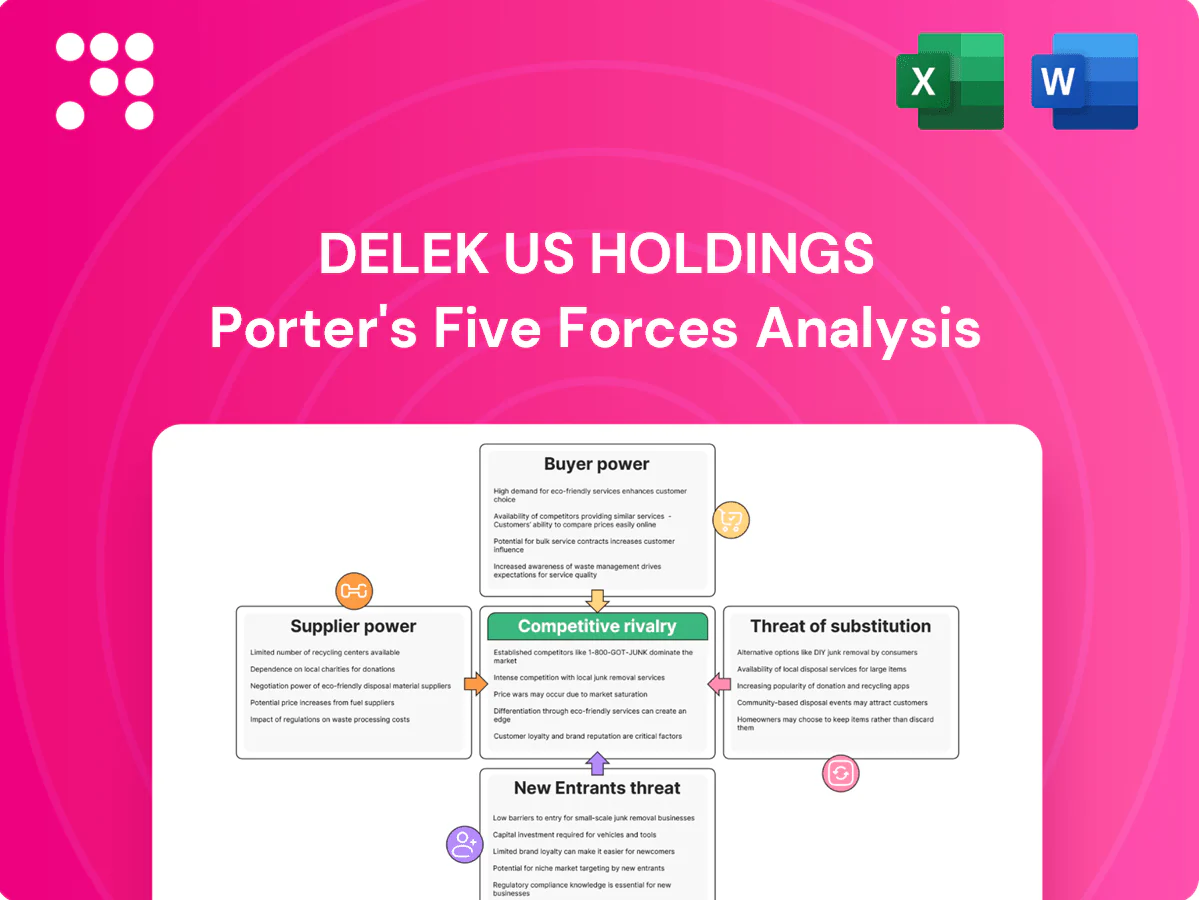
Delek US Holdings Porter's Five Forces Analysis

From Overview to Strategy Blueprint
Delek US Holdings faces intense downstream competition, margin pressure from volatile crude and refined product spreads, and concentrated supplier dynamics that can squeeze cost flexibility. Regulatory and environmental compliance elevate operational risk while scale and integration provide defensive advantages. This preview is just the beginning. The full analysis provides a complete strategic snapshot with force-by-force ratings, visuals, and business implications tailored to Delek US Holdings.
Suppliers Bargaining Power

Concentrated crude suppliers
Delek US depends heavily on regional crude such as the Permian, which produced about 6.5 million bpd in 2024, where pipeline takeaway limits and OPEC+ supply policy can tighten availability. Fewer proximate, high-quality suppliers increase their leverage on pricing and contract terms, widening local differentials. Disruptions or widened differentials materially compress refinery margins. Diversification and term contracts reduce but do not eliminate this exposure.
Pipeline and terminal access
Limited third-party pipeline, rail, and terminal capacity creates bottlenecks for Delek US; US crude pipeline takeaway was about 11.8 million barrels per day in 2024, concentrating leverage with midstream owners. Scarce capacity lets owners charge higher tariffs and demand priority, and take-or-pay or long-term commitments reduce marketing flexibility. In-house logistics mitigate some risk, but dependency on external nodes persists.

Specialty inputs and catalysts
Delek USs three refineries and asphalt operations rely on proprietary catalysts, chemicals and additives sourced from a concentrated vendor pool, raising supplier leverage. Qualification processes and switching costs for catalysts are lengthy, often taking months and increasing dependency on incumbent suppliers. Technical support and long lead times strengthen supplier bargaining power, and price pass-through to product margins is frequently delayed.

Retail merchandise vendors
MAPCO sources beverages, tobacco and CPG from global brand owners and national distributors whose shelf-space and promotional leverage raises switching costs for Delek US; in 2024 leading CPG brands still dominated category sales. Private-label penetration in US grocery rose to about 17% in 2024, moderating brand power, while MAPCO’s multi-sourcing reduces dependence on single suppliers. Retail fuel remains largely commoditized, with US average retail gasoline margins around $0.30–0.40/gal in 2024, limiting supplier differentiation.
- Brand dominance: national CPG leaders drive promotions and shelf priority
- Private label: ~17% US grocery share (2024), reduces supplier leverage
- Multi-sourcing: lowers supplier-specific risk
- Fuel: commoditized, margins ~$0.30–0.40/gal (2024)
Labor and services
Skilled refinery labor, maintenance contractors and safety-compliance services are highly specialized, and 2024 EIA refinery utilization near 92% tightens turnaround windows, inflating labor and contractor costs and creating scheduling constraints; union or regional labor dynamics add wage and timing pressure, and automation mitigates but cannot fully replace scarce expertise.
- High specialization
- 92% US refinery utilization (EIA 2024)
- Turnaround-driven cost spikes
- Automation partial offset
Permian + tight takeaway elevate supplier power; PL 17% provides buffer
Supplier power is high: Permian ~6.5M bpd (2024) and US pipeline takeaway ~11.8M bpd (2024) concentrate crude leverage and widen local differentials, compressing margins. Concentrated catalyst vendors and specialized labor with US refinery utilization ~92% (2024) raise switching costs. MAPCO benefits from multi-sourcing and private label ~17% (2024), partially reducing supplier leverage.
| Metric | 2024 |
|---|---|
| Permian crude | 6.5M bpd |
| Pipeline takeaway | 11.8M bpd |
| Refinery utilization | 92% |
| Private label | 17% |
What is included in the product
 Detailed Word Document
Tailored exclusively for Delek US Holdings, this Porter's Five Forces analysis uncovers key drivers of competition, assesses supplier and buyer power and evaluates market entry barriers, while identifying disruptive forces and substitutes that could threaten its refinery and fuel-marketing margins.

 Customizable Excel Spreadsheet
A concise one-sheet Porter's Five Forces for Delek US Holdings that highlights supplier power, buyer leverage, competitive rivalry, and threats of substitutes/new entrants—editable ratings and charts let teams quickly diagnose strategic pain points and adjust for changing refining market dynamics and regulatory shifts.
Customers Bargaining Power

Commodity fuel purchasers
Rack and wholesale buyers face transparent, intraday spot rack prices published by OPIS/Platts, enabling price-based switching and pressuring margins. Low product differentiation gives buyers leverage on pricing, terms and timing, and contracts are typically short (often under 12 months) with widespread multi-sourcing. Delek US’s defensible moats hinge on reliability, logistics proximity and pipeline/tank access that reduce switching for key customers.
Retail fuel consumers
Retail fuel consumers are highly price sensitive and can compare prices in real time, driving rapid switching when U.S. average gasoline was about $3.30/gal in 2024 (EIA). Loyalty programs and convenience offerings—used by roughly 35% of shoppers in 2024 (NACS)—partially soften elasticity by boosting retention and basket size. Non-fuel mixes (c-store margins) materially affect traffic and margins, while ~145,000 U.S. fueling stations in 2024 intensify buyer power via dense competition.

Asphalt customers (DOTs/contractors)
Government agencies and large paving firms purchase asphalt through competitive bid processes for bulk projects, with major highway paving concentrated in the April–October 2024 season, concentrating buyer power. Specifications often restrict substitutable blends, yet bids drive price competition on large contracts. Hot mix limits transport to roughly 30–90 minutes, making terminal logistics radius a critical factor in supplier selection.

Commercial and industrial off-takers
Commercial and industrial off-takers such as airlines, trucking fleets, and industrial users exert strong bargaining power by negotiating volume discounts, hedging fuel exposure, and switching suppliers within a region; contract structures often share margin risk while service levels and credit terms determine award decisions.
- Volume discounts
- Hedging practices
- Supplier switching
- Shared margin risk
- Service and credit terms
Retail merchandise shoppers
- Substitution pressure: convenience vs grocery vs dollar
- Promotions/private label: high influence on basket mix
- Digital coupons/apps: 2024 growth in comparison tools
- Fresh/foodservice: reduces sole price focus
Spot pricing squeezes wholesale margins; retailers and asphalt buyers hold leverage
Rack/wholesale buyers use OPIS/Platts spot pricing, enabling rapid switching and margin pressure. Retailers face high price sensitivity (U.S. avg gas ~$3.30/gal in 2024; ~145,000 stations) with ~35% loyalty program use. Asphalt procurement peaks Apr–Oct; 30–90 min hot‑mix transport and short contracts (<12 months) intensify buyer leverage.
| Buyer | 2024 metric | Impact |
|---|---|---|
| Rack/wholesale | OPIS/Platts spot | High price pressure |
| Retail consumers | $3.30/gal; 145,000 stations; 35% loyalty | High switching |
| Asphalt/contracts | Apr–Oct; 30–90 min | Logistics-driven choice |
What You See Is What You Get
Delek US Holdings Porter's Five Forces Analysis
You’re previewing the Delek US Holdings Porter’s Five Forces Analysis — this is the exact, fully formatted document you’ll receive immediately after purchase. No placeholders, no excerpts: the file shown is the complete deliverable. It’s ready for download and use as-is.

From Overview to Strategy Blueprint
Delek US Holdings faces intense downstream competition, margin pressure from volatile crude and refined product spreads, and concentrated supplier dynamics that can squeeze cost flexibility. Regulatory and environmental compliance elevate operational risk while scale and integration provide defensive advantages. This preview is just the beginning. The full analysis provides a complete strategic snapshot with force-by-force ratings, visuals, and business implications tailored to Delek US Holdings.
Suppliers Bargaining Power
Concentrated crude suppliers
Delek US depends heavily on regional crude such as the Permian, which produced about 6.5 million bpd in 2024, where pipeline takeaway limits and OPEC+ supply policy can tighten availability. Fewer proximate, high-quality suppliers increase their leverage on pricing and contract terms, widening local differentials. Disruptions or widened differentials materially compress refinery margins. Diversification and term contracts reduce but do not eliminate this exposure.
Pipeline and terminal access
Limited third-party pipeline, rail, and terminal capacity creates bottlenecks for Delek US; US crude pipeline takeaway was about 11.8 million barrels per day in 2024, concentrating leverage with midstream owners. Scarce capacity lets owners charge higher tariffs and demand priority, and take-or-pay or long-term commitments reduce marketing flexibility. In-house logistics mitigate some risk, but dependency on external nodes persists.
Specialty inputs and catalysts
Delek USs three refineries and asphalt operations rely on proprietary catalysts, chemicals and additives sourced from a concentrated vendor pool, raising supplier leverage. Qualification processes and switching costs for catalysts are lengthy, often taking months and increasing dependency on incumbent suppliers. Technical support and long lead times strengthen supplier bargaining power, and price pass-through to product margins is frequently delayed.
Retail merchandise vendors
MAPCO sources beverages, tobacco and CPG from global brand owners and national distributors whose shelf-space and promotional leverage raises switching costs for Delek US; in 2024 leading CPG brands still dominated category sales. Private-label penetration in US grocery rose to about 17% in 2024, moderating brand power, while MAPCO’s multi-sourcing reduces dependence on single suppliers. Retail fuel remains largely commoditized, with US average retail gasoline margins around $0.30–0.40/gal in 2024, limiting supplier differentiation.
- Brand dominance: national CPG leaders drive promotions and shelf priority
- Private label: ~17% US grocery share (2024), reduces supplier leverage
- Multi-sourcing: lowers supplier-specific risk
- Fuel: commoditized, margins ~$0.30–0.40/gal (2024)
Labor and services
Skilled refinery labor, maintenance contractors and safety-compliance services are highly specialized, and 2024 EIA refinery utilization near 92% tightens turnaround windows, inflating labor and contractor costs and creating scheduling constraints; union or regional labor dynamics add wage and timing pressure, and automation mitigates but cannot fully replace scarce expertise.
- High specialization
- 92% US refinery utilization (EIA 2024)
- Turnaround-driven cost spikes
- Automation partial offset
Permian + tight takeaway elevate supplier power; PL 17% provides buffer
Supplier power is high: Permian ~6.5M bpd (2024) and US pipeline takeaway ~11.8M bpd (2024) concentrate crude leverage and widen local differentials, compressing margins. Concentrated catalyst vendors and specialized labor with US refinery utilization ~92% (2024) raise switching costs. MAPCO benefits from multi-sourcing and private label ~17% (2024), partially reducing supplier leverage.
| Metric | 2024 |
|---|---|
| Permian crude | 6.5M bpd |
| Pipeline takeaway | 11.8M bpd |
| Refinery utilization | 92% |
| Private label | 17% |
What is included in the product
Detailed Word Document
Tailored exclusively for Delek US Holdings, this Porter's Five Forces analysis uncovers key drivers of competition, assesses supplier and buyer power and evaluates market entry barriers, while identifying disruptive forces and substitutes that could threaten its refinery and fuel-marketing margins.
Customizable Excel Spreadsheet
A concise one-sheet Porter's Five Forces for Delek US Holdings that highlights supplier power, buyer leverage, competitive rivalry, and threats of substitutes/new entrants—editable ratings and charts let teams quickly diagnose strategic pain points and adjust for changing refining market dynamics and regulatory shifts.
Customers Bargaining Power
Commodity fuel purchasers
Rack and wholesale buyers face transparent, intraday spot rack prices published by OPIS/Platts, enabling price-based switching and pressuring margins. Low product differentiation gives buyers leverage on pricing, terms and timing, and contracts are typically short (often under 12 months) with widespread multi-sourcing. Delek US’s defensible moats hinge on reliability, logistics proximity and pipeline/tank access that reduce switching for key customers.
Retail fuel consumers
Retail fuel consumers are highly price sensitive and can compare prices in real time, driving rapid switching when U.S. average gasoline was about $3.30/gal in 2024 (EIA). Loyalty programs and convenience offerings—used by roughly 35% of shoppers in 2024 (NACS)—partially soften elasticity by boosting retention and basket size. Non-fuel mixes (c-store margins) materially affect traffic and margins, while ~145,000 U.S. fueling stations in 2024 intensify buyer power via dense competition.
Asphalt customers (DOTs/contractors)
Government agencies and large paving firms purchase asphalt through competitive bid processes for bulk projects, with major highway paving concentrated in the April–October 2024 season, concentrating buyer power. Specifications often restrict substitutable blends, yet bids drive price competition on large contracts. Hot mix limits transport to roughly 30–90 minutes, making terminal logistics radius a critical factor in supplier selection.
Commercial and industrial off-takers
Commercial and industrial off-takers such as airlines, trucking fleets, and industrial users exert strong bargaining power by negotiating volume discounts, hedging fuel exposure, and switching suppliers within a region; contract structures often share margin risk while service levels and credit terms determine award decisions.
- Volume discounts
- Hedging practices
- Supplier switching
- Shared margin risk
- Service and credit terms
Retail merchandise shoppers
- Substitution pressure: convenience vs grocery vs dollar
- Promotions/private label: high influence on basket mix
- Digital coupons/apps: 2024 growth in comparison tools
- Fresh/foodservice: reduces sole price focus
Spot pricing squeezes wholesale margins; retailers and asphalt buyers hold leverage
Rack/wholesale buyers use OPIS/Platts spot pricing, enabling rapid switching and margin pressure. Retailers face high price sensitivity (U.S. avg gas ~$3.30/gal in 2024; ~145,000 stations) with ~35% loyalty program use. Asphalt procurement peaks Apr–Oct; 30–90 min hot‑mix transport and short contracts (<12 months) intensify buyer leverage.
| Buyer | 2024 metric | Impact |
|---|---|---|
| Rack/wholesale | OPIS/Platts spot | High price pressure |
| Retail consumers | $3.30/gal; 145,000 stations; 35% loyalty | High switching |
| Asphalt/contracts | Apr–Oct; 30–90 min | Logistics-driven choice |
What You See Is What You Get
Delek US Holdings Porter's Five Forces Analysis
You’re previewing the Delek US Holdings Porter’s Five Forces Analysis — this is the exact, fully formatted document you’ll receive immediately after purchase. No placeholders, no excerpts: the file shown is the complete deliverable. It’s ready for download and use as-is.
Original: $10.00
-65%$10.00
$3.50Description
From Overview to Strategy Blueprint
Delek US Holdings faces intense downstream competition, margin pressure from volatile crude and refined product spreads, and concentrated supplier dynamics that can squeeze cost flexibility. Regulatory and environmental compliance elevate operational risk while scale and integration provide defensive advantages. This preview is just the beginning. The full analysis provides a complete strategic snapshot with force-by-force ratings, visuals, and business implications tailored to Delek US Holdings.
Suppliers Bargaining Power
Concentrated crude suppliers
Delek US depends heavily on regional crude such as the Permian, which produced about 6.5 million bpd in 2024, where pipeline takeaway limits and OPEC+ supply policy can tighten availability. Fewer proximate, high-quality suppliers increase their leverage on pricing and contract terms, widening local differentials. Disruptions or widened differentials materially compress refinery margins. Diversification and term contracts reduce but do not eliminate this exposure.
Pipeline and terminal access
Limited third-party pipeline, rail, and terminal capacity creates bottlenecks for Delek US; US crude pipeline takeaway was about 11.8 million barrels per day in 2024, concentrating leverage with midstream owners. Scarce capacity lets owners charge higher tariffs and demand priority, and take-or-pay or long-term commitments reduce marketing flexibility. In-house logistics mitigate some risk, but dependency on external nodes persists.
Specialty inputs and catalysts
Delek USs three refineries and asphalt operations rely on proprietary catalysts, chemicals and additives sourced from a concentrated vendor pool, raising supplier leverage. Qualification processes and switching costs for catalysts are lengthy, often taking months and increasing dependency on incumbent suppliers. Technical support and long lead times strengthen supplier bargaining power, and price pass-through to product margins is frequently delayed.
Retail merchandise vendors
MAPCO sources beverages, tobacco and CPG from global brand owners and national distributors whose shelf-space and promotional leverage raises switching costs for Delek US; in 2024 leading CPG brands still dominated category sales. Private-label penetration in US grocery rose to about 17% in 2024, moderating brand power, while MAPCO’s multi-sourcing reduces dependence on single suppliers. Retail fuel remains largely commoditized, with US average retail gasoline margins around $0.30–0.40/gal in 2024, limiting supplier differentiation.
- Brand dominance: national CPG leaders drive promotions and shelf priority
- Private label: ~17% US grocery share (2024), reduces supplier leverage
- Multi-sourcing: lowers supplier-specific risk
- Fuel: commoditized, margins ~$0.30–0.40/gal (2024)
Labor and services
Skilled refinery labor, maintenance contractors and safety-compliance services are highly specialized, and 2024 EIA refinery utilization near 92% tightens turnaround windows, inflating labor and contractor costs and creating scheduling constraints; union or regional labor dynamics add wage and timing pressure, and automation mitigates but cannot fully replace scarce expertise.
- High specialization
- 92% US refinery utilization (EIA 2024)
- Turnaround-driven cost spikes
- Automation partial offset
Permian + tight takeaway elevate supplier power; PL 17% provides buffer
Supplier power is high: Permian ~6.5M bpd (2024) and US pipeline takeaway ~11.8M bpd (2024) concentrate crude leverage and widen local differentials, compressing margins. Concentrated catalyst vendors and specialized labor with US refinery utilization ~92% (2024) raise switching costs. MAPCO benefits from multi-sourcing and private label ~17% (2024), partially reducing supplier leverage.
| Metric | 2024 |
|---|---|
| Permian crude | 6.5M bpd |
| Pipeline takeaway | 11.8M bpd |
| Refinery utilization | 92% |
| Private label | 17% |
What is included in the product
Detailed Word Document
Tailored exclusively for Delek US Holdings, this Porter's Five Forces analysis uncovers key drivers of competition, assesses supplier and buyer power and evaluates market entry barriers, while identifying disruptive forces and substitutes that could threaten its refinery and fuel-marketing margins.
Customizable Excel Spreadsheet
A concise one-sheet Porter's Five Forces for Delek US Holdings that highlights supplier power, buyer leverage, competitive rivalry, and threats of substitutes/new entrants—editable ratings and charts let teams quickly diagnose strategic pain points and adjust for changing refining market dynamics and regulatory shifts.
Customers Bargaining Power
Commodity fuel purchasers
Rack and wholesale buyers face transparent, intraday spot rack prices published by OPIS/Platts, enabling price-based switching and pressuring margins. Low product differentiation gives buyers leverage on pricing, terms and timing, and contracts are typically short (often under 12 months) with widespread multi-sourcing. Delek US’s defensible moats hinge on reliability, logistics proximity and pipeline/tank access that reduce switching for key customers.
Retail fuel consumers
Retail fuel consumers are highly price sensitive and can compare prices in real time, driving rapid switching when U.S. average gasoline was about $3.30/gal in 2024 (EIA). Loyalty programs and convenience offerings—used by roughly 35% of shoppers in 2024 (NACS)—partially soften elasticity by boosting retention and basket size. Non-fuel mixes (c-store margins) materially affect traffic and margins, while ~145,000 U.S. fueling stations in 2024 intensify buyer power via dense competition.
Asphalt customers (DOTs/contractors)
Government agencies and large paving firms purchase asphalt through competitive bid processes for bulk projects, with major highway paving concentrated in the April–October 2024 season, concentrating buyer power. Specifications often restrict substitutable blends, yet bids drive price competition on large contracts. Hot mix limits transport to roughly 30–90 minutes, making terminal logistics radius a critical factor in supplier selection.
Commercial and industrial off-takers
Commercial and industrial off-takers such as airlines, trucking fleets, and industrial users exert strong bargaining power by negotiating volume discounts, hedging fuel exposure, and switching suppliers within a region; contract structures often share margin risk while service levels and credit terms determine award decisions.
- Volume discounts
- Hedging practices
- Supplier switching
- Shared margin risk
- Service and credit terms
Retail merchandise shoppers
- Substitution pressure: convenience vs grocery vs dollar
- Promotions/private label: high influence on basket mix
- Digital coupons/apps: 2024 growth in comparison tools
- Fresh/foodservice: reduces sole price focus
Spot pricing squeezes wholesale margins; retailers and asphalt buyers hold leverage
Rack/wholesale buyers use OPIS/Platts spot pricing, enabling rapid switching and margin pressure. Retailers face high price sensitivity (U.S. avg gas ~$3.30/gal in 2024; ~145,000 stations) with ~35% loyalty program use. Asphalt procurement peaks Apr–Oct; 30–90 min hot‑mix transport and short contracts (<12 months) intensify buyer leverage.
| Buyer | 2024 metric | Impact |
|---|---|---|
| Rack/wholesale | OPIS/Platts spot | High price pressure |
| Retail consumers | $3.30/gal; 145,000 stations; 35% loyalty | High switching |
| Asphalt/contracts | Apr–Oct; 30–90 min | Logistics-driven choice |
What You See Is What You Get
Delek US Holdings Porter's Five Forces Analysis
You’re previewing the Delek US Holdings Porter’s Five Forces Analysis — this is the exact, fully formatted document you’ll receive immediately after purchase. No placeholders, no excerpts: the file shown is the complete deliverable. It’s ready for download and use as-is.











