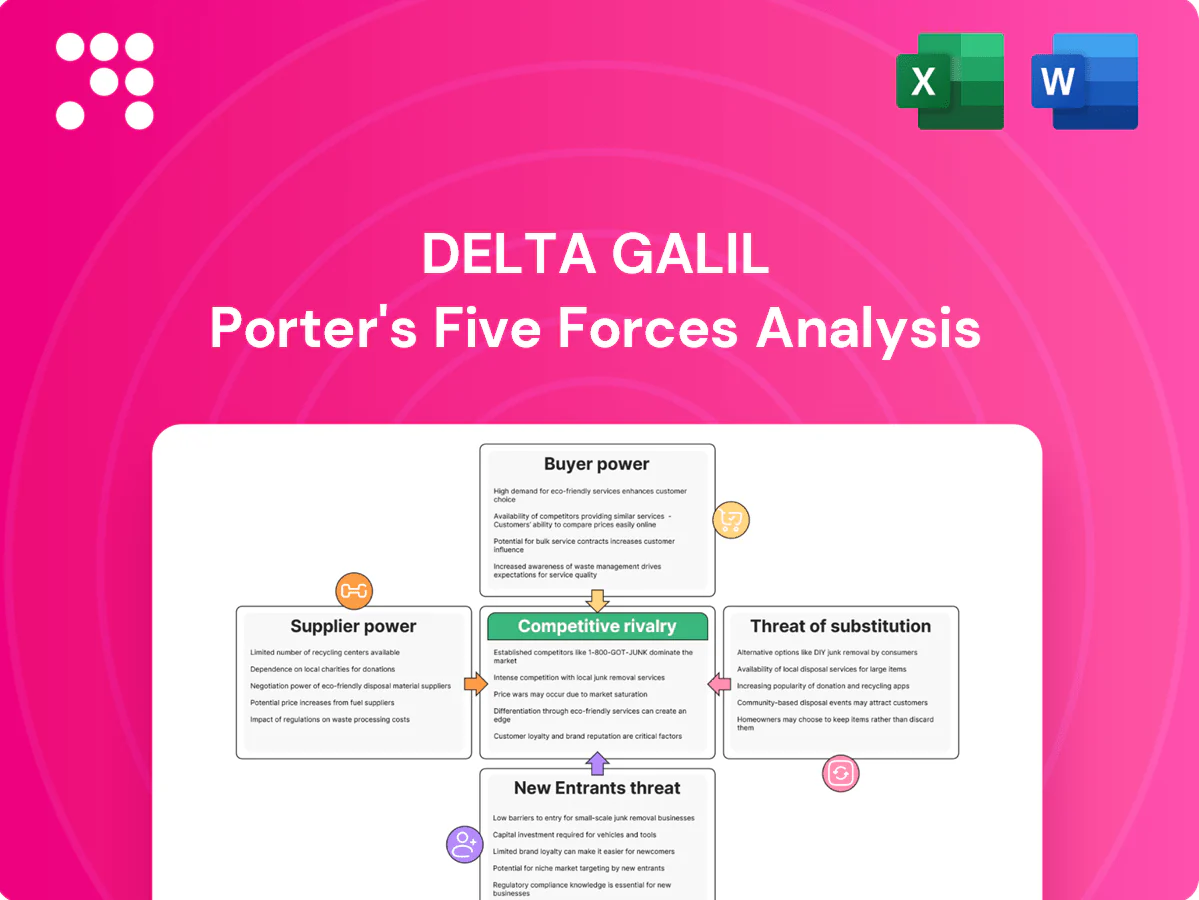
Delta Galil Porter's Five Forces Analysis

Elevate Your Analysis with the Complete Porter's Five Forces Analysis
Delta Galil’s Porter's Five Forces snapshot highlights competitive intensity, supplier and buyer leverage, substitute risks, and barriers to entry shaping its apparel-and-underwear niche. This brief teases strategic pressures and opportunities; unlock the full Porter's Five Forces Analysis for force-by-force ratings, visuals, and actionable insights to inform investment or strategy.
Suppliers Bargaining Power

Diverse textile input base limits leverage
Core inputs like cotton (world production ~110 million bales in 2023/24) and polyester (≈54% of the global fiber market in 2024) are widely available, limiting individual supplier leverage. Commodity price transparency and active spot markets reduce opportunistic pricing. Delta Galil can dual-source across regions to lower dependency. Short-term price spikes can still transmit into margins.
Specialty and sustainable materials elevate power
Performance yarns, technical fabrics and certified sustainable inputs are concentrated among a few global suppliers, with over 60% of specialty recycled-polyester and advanced-fiber capacity held by top producers, giving suppliers outsized leverage. Long lead times and strict qualification protocols slow switching, raising operational risk. Premium certifications (organic, GOTS, recycled) further tighten supply pools. This often translates into higher input costs or allocation constraints for Delta Galil.

Global footprint improves negotiation
Delta Galil’s manufacturing footprint across roughly 17 countries enables supplier competition and volume bundling, supporting its 2024 revenue base of about $1.3 billion. Geographic diversification reduces exposure to local disruptions and currency swings, while the ability to shift orders disciplines suppliers. This network helps ensure continuity for key customers facing tight deadlines.

Switching costs moderate due to quality standards
Switching mills requires testing, compliance checks and line requalification, typically adding 4–12 weeks and incremental costs often in the $50k–$250k range in apparel supply chains (2024 industry benchmarks), giving incumbent suppliers measurable leverage; standardized components in basics, however, keep these switching costs moderate and predictable. Structured vendor scorecards and prequalified backup mills can cut transition time by 30% or more.
- Impact: moderate supplier power
- Time cost: 4–12 weeks
- Financial cost: $50k–$250k
- Mitigation: vendor scorecards, prequalified backups
Logistics, energy, and compliance affect input power
Freight rate volatility—container rates fell roughly 60-70% from 2021 peaks into 2023-24—alongside 2024 average Brent near $85/bbl and elevated industrial energy prices raise suppliers’ cost bases, increasing pass-through pressure to Delta Galil.
Suppliers with stronger ESG and labor compliance increasingly win contracts and can command price premia; Delta Galil’s scale aids negotiation, but structural logistics and energy costs still flow downstream.
- Freight: -60 to -70% since 2021 peaks
- Energy: Brent ~USD 85/bbl (2024 avg)
- Compliance: ESG-ready suppliers gain preference
- Delta Galil: scale mitigates but cannot fully absorb structural costs
Core fibers commoditized; specialty yarns concentrated — suppliers wield moderate power
Core fibers (cotton ~110M bales 2023/24; polyester ≈54% of fiber market in 2024) are commoditized, limiting supplier leverage, but specialty yarns/fabrics are concentrated (>60% capacity with top producers) raising supplier power. Delta Galil (2024 revenue ~$1.3B) mitigates via 17-country footprint and volume bundling; switching costs (4–12 weeks; $50k–$250k) and energy/logistics pass-throughs sustain moderate supplier power.
| Topic | 2024 Metric |
|---|---|
| Cotton supply | ~110M bales (2023/24) |
| Polyester share | ≈54% global fiber market |
| Specialty capacity | Top producers >60% |
| Delta Galil revenue | ~$1.3B (2024) |
| Switching cost/time | $50k–$250k; 4–12 weeks |
| Freight/energy | Container rates -60–70% since 2021; Brent ~USD85/bbl (2024) |
What is included in the product
 Detailed Word Document
Tailored Porter’s Five Forces analysis for Delta Galil that uncovers key drivers of competition, buyer and supplier power, entry barriers and substitute threats, highlighting disruptive forces and strategic levers to protect margins and market share.

 Customizable Excel Spreadsheet
A concise Five Forces snapshot tailored to Delta Galil—quickly identify supplier, buyer, competitor, entrant, and substitute pressures to guide sourcing, pricing, and product strategy, easing boardroom decisions and operational action plans.
Customers Bargaining Power

Large retailers and brands wield scale
Large consolidated buyers like Walmart (FY2024 sales $611B) and Amazon (2023 net sales $514B) use scale to extract lower prices, tighter payment terms and higher service levels from suppliers such as Delta Galil. Retail private-label programs intensify cost pressure and margin compression. Volume concentration raises the stakes of each account, enabling buyers to impose chargebacks and strict KPIs tied to delivery and quality.
Category breadth offers cross-selling leverage
Supplying underwear, activewear, socks and sleepwear lets Delta Galil offer bundled deals across categories, increasing order value and enabling preferred-vendor status with large retailers. Multi-category supply reduces retailers’ ability to switch one category at a time, raising customer bargaining costs. Bundling also smooths demand volatility by diversifying seasonal sales drivers across product lines.

Design and innovation create stickiness
Delta Galil’s proprietary fits, seamless knitting and functional finishes—central to its 2024 product strategy—differentiate offerings and raise buyer dependence. Co-development partnerships embed Delta Galil into retail calendars, making design cycles and launch timing hard to detach from. The switching risk of missed launches or quality drift reduces pure price-based churn, shifting negotiations toward product and service terms.

Lead-time and speed-to-market dynamics
Fast-fashion and replenishment models prize quick response—Inditex’s platform turns designs into store-ready pieces in about 2–4 weeks—boosting buyer expectations for rapid cycles and lower costs. Vendors blending nearshore speed with offshore scale gain leverage, while consistent on-time delivery reduces buyer pressure on price and terms.
- Lead-time: Inditex ~2–4 weeks
- Leverage: nearshore + offshore
- Buyer pressure: faster cycles, lower cost
- Mitigator: reliable on-time delivery
DTC and owned brands partially offset buyer power
DTC and owned-brand expansion in 2024 diversified Delta Galil revenue streams, reducing dependence on a handful of mega-retailers and improving margin visibility. Direct retail sell-through data sharpened forecasting and inventory turns, giving the company an informational edge. That edge supports tighter pricing discipline versus wholesale-driven peers.
- 2024 focus: DTC and owned brands
- Reduces retailer concentration risk
- Sell-through data improves forecasting
- Enables stronger pricing discipline
DTC surge eases retailer concentration; big buyers and fast-fashion still drive service pressure
Large buyers (Walmart FY2024 sales $611B; Amazon 2023 net sales $514B) exert strong price and terms pressure, amplified by private-label programs and volume concentration. Delta Galil’s multi-category bundling, proprietary fits and co-development reduce pure price churn and raise switching costs. DTC and owned-brand growth in 2024 lowered retailer concentration and improved sell-through data, strengthening pricing discipline. Fast-fashion lead-time demands (Inditex ~2–4 weeks) keep service pressure high.
| Metric | Value |
|---|---|
| Walmart sales (FY2024) | $611B |
| Amazon sales (2023) | $514B |
| Inditex lead-time | 2–4 weeks |
| 2024 focus | DTC & owned brands |
Full Version Awaits
Delta Galil Porter's Five Forces Analysis
This Porter’s Five Forces analysis of Delta Galil examines competitive rivalry, supplier and buyer power, threat of new entrants, and substitute products, highlighting industry dynamics and strategic implications. The preview you see is the exact, fully formatted document you’ll receive instantly after purchase—no samples, no placeholders. Use it immediately for valuation, strategic planning, or investor presentations.

Elevate Your Analysis with the Complete Porter's Five Forces Analysis
Delta Galil’s Porter's Five Forces snapshot highlights competitive intensity, supplier and buyer leverage, substitute risks, and barriers to entry shaping its apparel-and-underwear niche. This brief teases strategic pressures and opportunities; unlock the full Porter's Five Forces Analysis for force-by-force ratings, visuals, and actionable insights to inform investment or strategy.
Suppliers Bargaining Power
Diverse textile input base limits leverage
Core inputs like cotton (world production ~110 million bales in 2023/24) and polyester (≈54% of the global fiber market in 2024) are widely available, limiting individual supplier leverage. Commodity price transparency and active spot markets reduce opportunistic pricing. Delta Galil can dual-source across regions to lower dependency. Short-term price spikes can still transmit into margins.
Specialty and sustainable materials elevate power
Performance yarns, technical fabrics and certified sustainable inputs are concentrated among a few global suppliers, with over 60% of specialty recycled-polyester and advanced-fiber capacity held by top producers, giving suppliers outsized leverage. Long lead times and strict qualification protocols slow switching, raising operational risk. Premium certifications (organic, GOTS, recycled) further tighten supply pools. This often translates into higher input costs or allocation constraints for Delta Galil.
Global footprint improves negotiation
Delta Galil’s manufacturing footprint across roughly 17 countries enables supplier competition and volume bundling, supporting its 2024 revenue base of about $1.3 billion. Geographic diversification reduces exposure to local disruptions and currency swings, while the ability to shift orders disciplines suppliers. This network helps ensure continuity for key customers facing tight deadlines.
Switching costs moderate due to quality standards
Switching mills requires testing, compliance checks and line requalification, typically adding 4–12 weeks and incremental costs often in the $50k–$250k range in apparel supply chains (2024 industry benchmarks), giving incumbent suppliers measurable leverage; standardized components in basics, however, keep these switching costs moderate and predictable. Structured vendor scorecards and prequalified backup mills can cut transition time by 30% or more.
- Impact: moderate supplier power
- Time cost: 4–12 weeks
- Financial cost: $50k–$250k
- Mitigation: vendor scorecards, prequalified backups
Logistics, energy, and compliance affect input power
Freight rate volatility—container rates fell roughly 60-70% from 2021 peaks into 2023-24—alongside 2024 average Brent near $85/bbl and elevated industrial energy prices raise suppliers’ cost bases, increasing pass-through pressure to Delta Galil.
Suppliers with stronger ESG and labor compliance increasingly win contracts and can command price premia; Delta Galil’s scale aids negotiation, but structural logistics and energy costs still flow downstream.
- Freight: -60 to -70% since 2021 peaks
- Energy: Brent ~USD 85/bbl (2024 avg)
- Compliance: ESG-ready suppliers gain preference
- Delta Galil: scale mitigates but cannot fully absorb structural costs
Core fibers commoditized; specialty yarns concentrated — suppliers wield moderate power
Core fibers (cotton ~110M bales 2023/24; polyester ≈54% of fiber market in 2024) are commoditized, limiting supplier leverage, but specialty yarns/fabrics are concentrated (>60% capacity with top producers) raising supplier power. Delta Galil (2024 revenue ~$1.3B) mitigates via 17-country footprint and volume bundling; switching costs (4–12 weeks; $50k–$250k) and energy/logistics pass-throughs sustain moderate supplier power.
| Topic | 2024 Metric |
|---|---|
| Cotton supply | ~110M bales (2023/24) |
| Polyester share | ≈54% global fiber market |
| Specialty capacity | Top producers >60% |
| Delta Galil revenue | ~$1.3B (2024) |
| Switching cost/time | $50k–$250k; 4–12 weeks |
| Freight/energy | Container rates -60–70% since 2021; Brent ~USD85/bbl (2024) |
What is included in the product
Detailed Word Document
Tailored Porter’s Five Forces analysis for Delta Galil that uncovers key drivers of competition, buyer and supplier power, entry barriers and substitute threats, highlighting disruptive forces and strategic levers to protect margins and market share.
Customizable Excel Spreadsheet
A concise Five Forces snapshot tailored to Delta Galil—quickly identify supplier, buyer, competitor, entrant, and substitute pressures to guide sourcing, pricing, and product strategy, easing boardroom decisions and operational action plans.
Customers Bargaining Power
Large retailers and brands wield scale
Large consolidated buyers like Walmart (FY2024 sales $611B) and Amazon (2023 net sales $514B) use scale to extract lower prices, tighter payment terms and higher service levels from suppliers such as Delta Galil. Retail private-label programs intensify cost pressure and margin compression. Volume concentration raises the stakes of each account, enabling buyers to impose chargebacks and strict KPIs tied to delivery and quality.
Category breadth offers cross-selling leverage
Supplying underwear, activewear, socks and sleepwear lets Delta Galil offer bundled deals across categories, increasing order value and enabling preferred-vendor status with large retailers. Multi-category supply reduces retailers’ ability to switch one category at a time, raising customer bargaining costs. Bundling also smooths demand volatility by diversifying seasonal sales drivers across product lines.
Design and innovation create stickiness
Delta Galil’s proprietary fits, seamless knitting and functional finishes—central to its 2024 product strategy—differentiate offerings and raise buyer dependence. Co-development partnerships embed Delta Galil into retail calendars, making design cycles and launch timing hard to detach from. The switching risk of missed launches or quality drift reduces pure price-based churn, shifting negotiations toward product and service terms.
Lead-time and speed-to-market dynamics
Fast-fashion and replenishment models prize quick response—Inditex’s platform turns designs into store-ready pieces in about 2–4 weeks—boosting buyer expectations for rapid cycles and lower costs. Vendors blending nearshore speed with offshore scale gain leverage, while consistent on-time delivery reduces buyer pressure on price and terms.
- Lead-time: Inditex ~2–4 weeks
- Leverage: nearshore + offshore
- Buyer pressure: faster cycles, lower cost
- Mitigator: reliable on-time delivery
DTC and owned brands partially offset buyer power
DTC and owned-brand expansion in 2024 diversified Delta Galil revenue streams, reducing dependence on a handful of mega-retailers and improving margin visibility. Direct retail sell-through data sharpened forecasting and inventory turns, giving the company an informational edge. That edge supports tighter pricing discipline versus wholesale-driven peers.
- 2024 focus: DTC and owned brands
- Reduces retailer concentration risk
- Sell-through data improves forecasting
- Enables stronger pricing discipline
DTC surge eases retailer concentration; big buyers and fast-fashion still drive service pressure
Large buyers (Walmart FY2024 sales $611B; Amazon 2023 net sales $514B) exert strong price and terms pressure, amplified by private-label programs and volume concentration. Delta Galil’s multi-category bundling, proprietary fits and co-development reduce pure price churn and raise switching costs. DTC and owned-brand growth in 2024 lowered retailer concentration and improved sell-through data, strengthening pricing discipline. Fast-fashion lead-time demands (Inditex ~2–4 weeks) keep service pressure high.
| Metric | Value |
|---|---|
| Walmart sales (FY2024) | $611B |
| Amazon sales (2023) | $514B |
| Inditex lead-time | 2–4 weeks |
| 2024 focus | DTC & owned brands |
Full Version Awaits
Delta Galil Porter's Five Forces Analysis
This Porter’s Five Forces analysis of Delta Galil examines competitive rivalry, supplier and buyer power, threat of new entrants, and substitute products, highlighting industry dynamics and strategic implications. The preview you see is the exact, fully formatted document you’ll receive instantly after purchase—no samples, no placeholders. Use it immediately for valuation, strategic planning, or investor presentations.
Original: $10.00
-65%$10.00
$3.50Description
Elevate Your Analysis with the Complete Porter's Five Forces Analysis
Delta Galil’s Porter's Five Forces snapshot highlights competitive intensity, supplier and buyer leverage, substitute risks, and barriers to entry shaping its apparel-and-underwear niche. This brief teases strategic pressures and opportunities; unlock the full Porter's Five Forces Analysis for force-by-force ratings, visuals, and actionable insights to inform investment or strategy.
Suppliers Bargaining Power
Diverse textile input base limits leverage
Core inputs like cotton (world production ~110 million bales in 2023/24) and polyester (≈54% of the global fiber market in 2024) are widely available, limiting individual supplier leverage. Commodity price transparency and active spot markets reduce opportunistic pricing. Delta Galil can dual-source across regions to lower dependency. Short-term price spikes can still transmit into margins.
Specialty and sustainable materials elevate power
Performance yarns, technical fabrics and certified sustainable inputs are concentrated among a few global suppliers, with over 60% of specialty recycled-polyester and advanced-fiber capacity held by top producers, giving suppliers outsized leverage. Long lead times and strict qualification protocols slow switching, raising operational risk. Premium certifications (organic, GOTS, recycled) further tighten supply pools. This often translates into higher input costs or allocation constraints for Delta Galil.
Global footprint improves negotiation
Delta Galil’s manufacturing footprint across roughly 17 countries enables supplier competition and volume bundling, supporting its 2024 revenue base of about $1.3 billion. Geographic diversification reduces exposure to local disruptions and currency swings, while the ability to shift orders disciplines suppliers. This network helps ensure continuity for key customers facing tight deadlines.
Switching costs moderate due to quality standards
Switching mills requires testing, compliance checks and line requalification, typically adding 4–12 weeks and incremental costs often in the $50k–$250k range in apparel supply chains (2024 industry benchmarks), giving incumbent suppliers measurable leverage; standardized components in basics, however, keep these switching costs moderate and predictable. Structured vendor scorecards and prequalified backup mills can cut transition time by 30% or more.
- Impact: moderate supplier power
- Time cost: 4–12 weeks
- Financial cost: $50k–$250k
- Mitigation: vendor scorecards, prequalified backups
Logistics, energy, and compliance affect input power
Freight rate volatility—container rates fell roughly 60-70% from 2021 peaks into 2023-24—alongside 2024 average Brent near $85/bbl and elevated industrial energy prices raise suppliers’ cost bases, increasing pass-through pressure to Delta Galil.
Suppliers with stronger ESG and labor compliance increasingly win contracts and can command price premia; Delta Galil’s scale aids negotiation, but structural logistics and energy costs still flow downstream.
- Freight: -60 to -70% since 2021 peaks
- Energy: Brent ~USD 85/bbl (2024 avg)
- Compliance: ESG-ready suppliers gain preference
- Delta Galil: scale mitigates but cannot fully absorb structural costs
Core fibers commoditized; specialty yarns concentrated — suppliers wield moderate power
Core fibers (cotton ~110M bales 2023/24; polyester ≈54% of fiber market in 2024) are commoditized, limiting supplier leverage, but specialty yarns/fabrics are concentrated (>60% capacity with top producers) raising supplier power. Delta Galil (2024 revenue ~$1.3B) mitigates via 17-country footprint and volume bundling; switching costs (4–12 weeks; $50k–$250k) and energy/logistics pass-throughs sustain moderate supplier power.
| Topic | 2024 Metric |
|---|---|
| Cotton supply | ~110M bales (2023/24) |
| Polyester share | ≈54% global fiber market |
| Specialty capacity | Top producers >60% |
| Delta Galil revenue | ~$1.3B (2024) |
| Switching cost/time | $50k–$250k; 4–12 weeks |
| Freight/energy | Container rates -60–70% since 2021; Brent ~USD85/bbl (2024) |
What is included in the product
Detailed Word Document
Tailored Porter’s Five Forces analysis for Delta Galil that uncovers key drivers of competition, buyer and supplier power, entry barriers and substitute threats, highlighting disruptive forces and strategic levers to protect margins and market share.
Customizable Excel Spreadsheet
A concise Five Forces snapshot tailored to Delta Galil—quickly identify supplier, buyer, competitor, entrant, and substitute pressures to guide sourcing, pricing, and product strategy, easing boardroom decisions and operational action plans.
Customers Bargaining Power
Large retailers and brands wield scale
Large consolidated buyers like Walmart (FY2024 sales $611B) and Amazon (2023 net sales $514B) use scale to extract lower prices, tighter payment terms and higher service levels from suppliers such as Delta Galil. Retail private-label programs intensify cost pressure and margin compression. Volume concentration raises the stakes of each account, enabling buyers to impose chargebacks and strict KPIs tied to delivery and quality.
Category breadth offers cross-selling leverage
Supplying underwear, activewear, socks and sleepwear lets Delta Galil offer bundled deals across categories, increasing order value and enabling preferred-vendor status with large retailers. Multi-category supply reduces retailers’ ability to switch one category at a time, raising customer bargaining costs. Bundling also smooths demand volatility by diversifying seasonal sales drivers across product lines.
Design and innovation create stickiness
Delta Galil’s proprietary fits, seamless knitting and functional finishes—central to its 2024 product strategy—differentiate offerings and raise buyer dependence. Co-development partnerships embed Delta Galil into retail calendars, making design cycles and launch timing hard to detach from. The switching risk of missed launches or quality drift reduces pure price-based churn, shifting negotiations toward product and service terms.
Lead-time and speed-to-market dynamics
Fast-fashion and replenishment models prize quick response—Inditex’s platform turns designs into store-ready pieces in about 2–4 weeks—boosting buyer expectations for rapid cycles and lower costs. Vendors blending nearshore speed with offshore scale gain leverage, while consistent on-time delivery reduces buyer pressure on price and terms.
- Lead-time: Inditex ~2–4 weeks
- Leverage: nearshore + offshore
- Buyer pressure: faster cycles, lower cost
- Mitigator: reliable on-time delivery
DTC and owned brands partially offset buyer power
DTC and owned-brand expansion in 2024 diversified Delta Galil revenue streams, reducing dependence on a handful of mega-retailers and improving margin visibility. Direct retail sell-through data sharpened forecasting and inventory turns, giving the company an informational edge. That edge supports tighter pricing discipline versus wholesale-driven peers.
- 2024 focus: DTC and owned brands
- Reduces retailer concentration risk
- Sell-through data improves forecasting
- Enables stronger pricing discipline
DTC surge eases retailer concentration; big buyers and fast-fashion still drive service pressure
Large buyers (Walmart FY2024 sales $611B; Amazon 2023 net sales $514B) exert strong price and terms pressure, amplified by private-label programs and volume concentration. Delta Galil’s multi-category bundling, proprietary fits and co-development reduce pure price churn and raise switching costs. DTC and owned-brand growth in 2024 lowered retailer concentration and improved sell-through data, strengthening pricing discipline. Fast-fashion lead-time demands (Inditex ~2–4 weeks) keep service pressure high.
| Metric | Value |
|---|---|
| Walmart sales (FY2024) | $611B |
| Amazon sales (2023) | $514B |
| Inditex lead-time | 2–4 weeks |
| 2024 focus | DTC & owned brands |
Full Version Awaits
Delta Galil Porter's Five Forces Analysis
This Porter’s Five Forces analysis of Delta Galil examines competitive rivalry, supplier and buyer power, threat of new entrants, and substitute products, highlighting industry dynamics and strategic implications. The preview you see is the exact, fully formatted document you’ll receive instantly after purchase—no samples, no placeholders. Use it immediately for valuation, strategic planning, or investor presentations.











