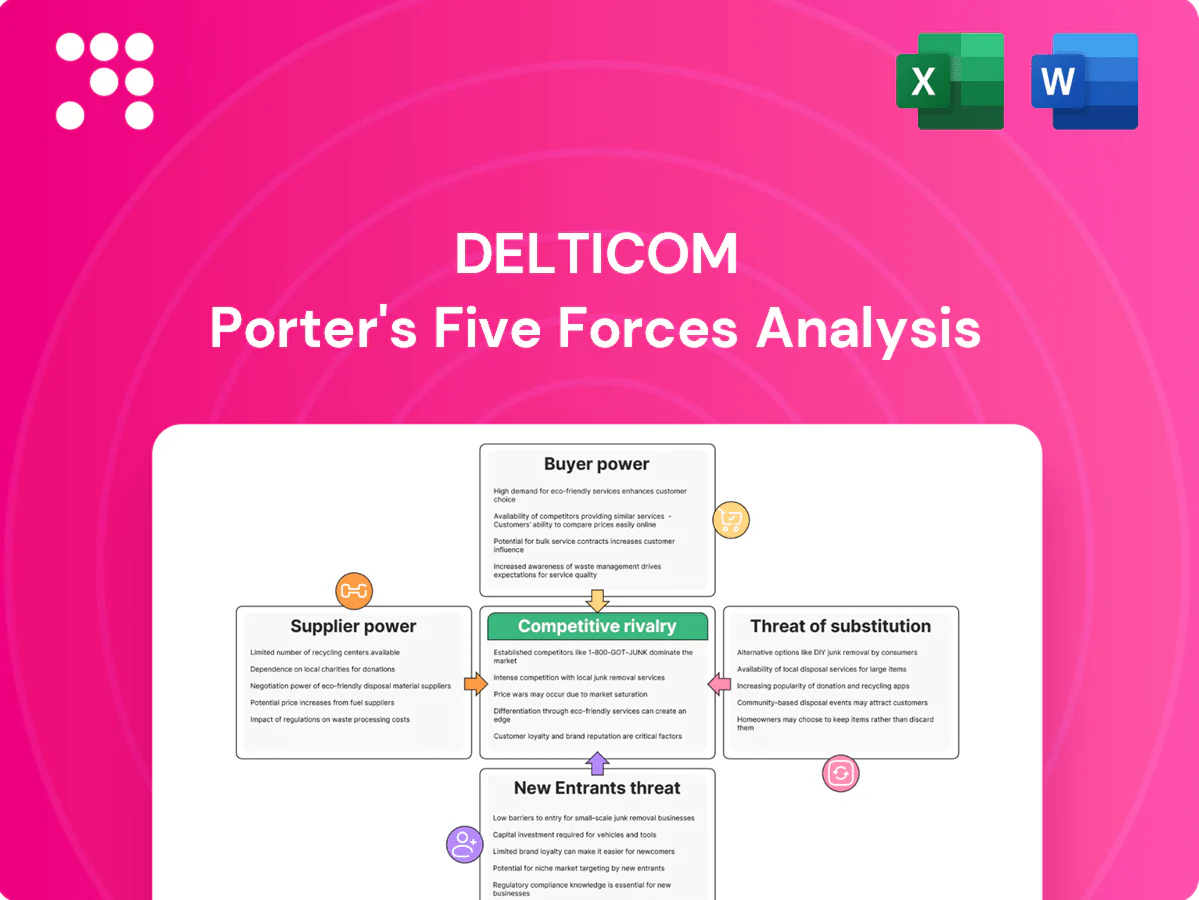
Delticom Porter's Five Forces Analysis

Go Beyond the Preview—Access the Full Strategic Report
Delticom operates in a competitive online tyre market where buyer price sensitivity, supplier margins, and low switching costs shape margins. Digital distribution and scale limit new entrants but intensify rivalry. Substitutes and regulatory shifts add external pressure. This brief snapshot only scratches the surface—unlock the full Porter's Five Forces Analysis for actionable, force-by-force insights.
Suppliers Bargaining Power

Concentrated tire brands
Supplier power is elevated as premium tire production is concentrated among a few global brands—top five manufacturers hold roughly two-thirds of market share (≈66% in 2024), controlling coveted SKUs and brand equity that influence pricing and allocation; Delticom mitigates this through multi-brand sourcing and a broad mid/low-tier assortment to preserve margins and supply flexibility.
Alternative sourcing options
Wholesalers, distributors and parallel import channels create supply redundancy for Delticom, lowering reliance on any single OEM and strengthening purchasing leverage. This diversified sourcing enables better price negotiations and contingency during localized shortages. However, availability from these channels can be volatile in peak seasons, raising short-term stock and fulfillment risks.

Private label and exclusives
Private-label and exclusive lines reduce supplier power by shifting demand to Delticom-controlled SKUs, enabling higher margins and unique online assortments. They support assortment differentiation and price flexibility but require strict quality assurance to avoid reputational risk. Sustained marketing and after-sales support are essential to maintain perceived value and repeat purchase rates.

Logistics and fitting partners
Carriers and partner workshops directly shape service quality and last-mile costs for Delticom, with carrier choice affecting delivery lead times and return rates.
Switching carriers is operationally feasible, capping supplier power, but capacity crunches (peak-season surcharges) can push parcel rates up sharply, sometimes in the low double-digit percent range.
Workshop density correlates with higher fitment conversion and better customer experience; closer coverage can lift conversion by low-double-digit percentages and reduce failed-install callbacks.
- carriers influence last-mile costs and lead times
- switching feasible, limits supplier power
- capacity crunches can raise rates by low double digits
- higher workshop density improves conversion and CX by low double digits
Input and seasonality volatility
Rubber, energy and freight price swings materially affect Delticom supplier pricing and lead times; in 2024 natural rubber rose ~15–20% YoY, Brent crude swung ~30% and container spot rates moved +/-25%, amplifying cost pass-through and delays. Seasonal winter/summer peaks compress inventories and trigger allocations. Robust forecasting and flexible, index-linked contracts are critical to rebalance supplier power.
- Rubber +15–20% YoY (2024)
- Brent swing ~30% (2024)
- Container rates ±25% (2024)
- Action: index-linked, flexible delivery terms
Top-5 tire makers hold ≈66%; rubber +15–20% (2024)
Supplier power is high: top five tire makers hold ~66% global share (2024), controlling premium SKUs and pricing; Delticom offsets via multi-brand sourcing and private-label SKUs. Logistics and workshops add operational supplier dynamics—carriers face low-double-digit seasonal surcharges; higher workshop density raises fitment conversion by low double digits. Commodity swings: rubber +15–20% YoY, Brent ±30%, container rates ±25% (2024); index-linked contracts recommended.
| Metric | 2024 | Impact |
|---|---|---|
| Top-5 share | ≈66% | High pricing power |
| Natural rubber | +15–20% YoY | Cost pass-through |
| Brent crude | ±30% | Freight fuel cost |
| Container rates | ±25% | Lead-time volatility |
What is included in the product
 Detailed Word Document
Tailored Porter's Five Forces analysis for Delticom that uncovers competitive intensity, supplier and buyer power, threat of substitutes and new entrants, and highlights disruptive forces and strategic levers affecting profitability.

 Customizable Excel Spreadsheet
Concise Porter's Five Forces snapshot tailored to Delticom—quickly highlights supplier, buyer, entrant, substitute and rivalry pressures so teams can prioritize strategic fixes and accelerate decision-making.
Customers Bargaining Power

High price transparency
High price transparency via comparison tools (idealo, Google Shopping) makes tyre prices instantly comparable, and with EU e-commerce share at 15.3% in 2023 (Eurostat) customers can switch retailers with minimal friction over small price gaps. This enforces tight margins and frequent repricing for Delticom.
Low switching costs
Checkout friction is low with streamlined web flows and delivery options typically standardized to 24–72 hours, keeping switching costs minimal. Loyalty is limited unless Delticom bundles installation convenience or extended warranties, which boost retention. Delticom’s workshop network of thousands of partner garages raises perceived switching costs by linking purchase to local service.

Mixed B2C and B2B needs
Fleet and trade buyers push strong leverage over Delticom by negotiating volume-based discounts and strict service-level agreements, often securing prioritized delivery and reducing margins. B2C customers exert pressure through public reviews and liberal return policies that drive reputational risk; 2024 surveys show roughly 90% of shoppers consult reviews and online return rates in apparel/tyres can approach 15–20%, amplifying consumer bargaining power.

Service speed sensitivity
Buyers value fast delivery and guaranteed fitting slots, especially during seasonal changeovers; in 2024, 61% of EU online shoppers ranked delivery speed as a top purchase driver (Statista 2024). Delays rapidly trigger cancellations or returns, raising return costs and lowering lifetime value. Reliable fulfillment reduces price sensitivity, improving retention and margin stability for Delticom.
- 61% fast-delivery priority (Statista 2024)
- High cancellation/return risk from delays
- Guaranteed slots boost retention
- Reliable fulfillment lowers price sensitivity
Information-rich content
Fitment guides, customer reviews and the EU tire label (revised in 2021) enable highly informed purchase choices, letting buyers compare wet braking, fuel efficiency and noise; clearer specs reduce mismatched orders and lower return frequency while anchoring expectations on performance and price. Transparency in content both empowers buyers and strengthens trust in Delticom, founded in 1999.
- Fitment guides: reduce fit-related returns
- Reviews: social proof, price anchoring
- EU tire label (rev. 2021): standardized specs
- Transparency: fosters trust and repeat business
High transparency, 15.3% e‑commerce; 61% want speed
High price transparency and 15.3% EU e‑commerce penetration (Eurostat 2023) keep switching costs low; 61% of shoppers cite delivery speed as top driver (Statista 2024). Fleet buyers secure volume discounts; ~90% consult reviews and return rates for tyres can reach 15–20%, pressuring margins. Reliable fitment and guaranteed slots reduce sensitivity and raise retention.
| Metric | Value | Source |
|---|---|---|
| E‑commerce share | 15.3% | Eurostat 2023 |
| Delivery priority | 61% | Statista 2024 |
| Review consult | ~90% | 2024 surveys |
| Return rate | 15–20% | Industry estimates 2024 |
Preview Before You Purchase
Delticom Porter's Five Forces Analysis
This preview shows the complete Delticom Porter’s Five Forces analysis you’ll receive upon purchase—no placeholders or excerpts. The file is fully formatted, professionally written and ready for immediate download and use. What you see here is the exact deliverable included with your order, ensuring transparency and no surprises.

Go Beyond the Preview—Access the Full Strategic Report
Delticom operates in a competitive online tyre market where buyer price sensitivity, supplier margins, and low switching costs shape margins. Digital distribution and scale limit new entrants but intensify rivalry. Substitutes and regulatory shifts add external pressure. This brief snapshot only scratches the surface—unlock the full Porter's Five Forces Analysis for actionable, force-by-force insights.
Suppliers Bargaining Power
Concentrated tire brands
Supplier power is elevated as premium tire production is concentrated among a few global brands—top five manufacturers hold roughly two-thirds of market share (≈66% in 2024), controlling coveted SKUs and brand equity that influence pricing and allocation; Delticom mitigates this through multi-brand sourcing and a broad mid/low-tier assortment to preserve margins and supply flexibility.
Alternative sourcing options
Wholesalers, distributors and parallel import channels create supply redundancy for Delticom, lowering reliance on any single OEM and strengthening purchasing leverage. This diversified sourcing enables better price negotiations and contingency during localized shortages. However, availability from these channels can be volatile in peak seasons, raising short-term stock and fulfillment risks.
Private label and exclusives
Private-label and exclusive lines reduce supplier power by shifting demand to Delticom-controlled SKUs, enabling higher margins and unique online assortments. They support assortment differentiation and price flexibility but require strict quality assurance to avoid reputational risk. Sustained marketing and after-sales support are essential to maintain perceived value and repeat purchase rates.
Logistics and fitting partners
Carriers and partner workshops directly shape service quality and last-mile costs for Delticom, with carrier choice affecting delivery lead times and return rates.
Switching carriers is operationally feasible, capping supplier power, but capacity crunches (peak-season surcharges) can push parcel rates up sharply, sometimes in the low double-digit percent range.
Workshop density correlates with higher fitment conversion and better customer experience; closer coverage can lift conversion by low-double-digit percentages and reduce failed-install callbacks.
- carriers influence last-mile costs and lead times
- switching feasible, limits supplier power
- capacity crunches can raise rates by low double digits
- higher workshop density improves conversion and CX by low double digits
Input and seasonality volatility
Rubber, energy and freight price swings materially affect Delticom supplier pricing and lead times; in 2024 natural rubber rose ~15–20% YoY, Brent crude swung ~30% and container spot rates moved +/-25%, amplifying cost pass-through and delays. Seasonal winter/summer peaks compress inventories and trigger allocations. Robust forecasting and flexible, index-linked contracts are critical to rebalance supplier power.
- Rubber +15–20% YoY (2024)
- Brent swing ~30% (2024)
- Container rates ±25% (2024)
- Action: index-linked, flexible delivery terms
Top-5 tire makers hold ≈66%; rubber +15–20% (2024)
Supplier power is high: top five tire makers hold ~66% global share (2024), controlling premium SKUs and pricing; Delticom offsets via multi-brand sourcing and private-label SKUs. Logistics and workshops add operational supplier dynamics—carriers face low-double-digit seasonal surcharges; higher workshop density raises fitment conversion by low double digits. Commodity swings: rubber +15–20% YoY, Brent ±30%, container rates ±25% (2024); index-linked contracts recommended.
| Metric | 2024 | Impact |
|---|---|---|
| Top-5 share | ≈66% | High pricing power |
| Natural rubber | +15–20% YoY | Cost pass-through |
| Brent crude | ±30% | Freight fuel cost |
| Container rates | ±25% | Lead-time volatility |
What is included in the product
Detailed Word Document
Tailored Porter's Five Forces analysis for Delticom that uncovers competitive intensity, supplier and buyer power, threat of substitutes and new entrants, and highlights disruptive forces and strategic levers affecting profitability.
Customizable Excel Spreadsheet
Concise Porter's Five Forces snapshot tailored to Delticom—quickly highlights supplier, buyer, entrant, substitute and rivalry pressures so teams can prioritize strategic fixes and accelerate decision-making.
Customers Bargaining Power
High price transparency
High price transparency via comparison tools (idealo, Google Shopping) makes tyre prices instantly comparable, and with EU e-commerce share at 15.3% in 2023 (Eurostat) customers can switch retailers with minimal friction over small price gaps. This enforces tight margins and frequent repricing for Delticom.
Low switching costs
Checkout friction is low with streamlined web flows and delivery options typically standardized to 24–72 hours, keeping switching costs minimal. Loyalty is limited unless Delticom bundles installation convenience or extended warranties, which boost retention. Delticom’s workshop network of thousands of partner garages raises perceived switching costs by linking purchase to local service.
Mixed B2C and B2B needs
Fleet and trade buyers push strong leverage over Delticom by negotiating volume-based discounts and strict service-level agreements, often securing prioritized delivery and reducing margins. B2C customers exert pressure through public reviews and liberal return policies that drive reputational risk; 2024 surveys show roughly 90% of shoppers consult reviews and online return rates in apparel/tyres can approach 15–20%, amplifying consumer bargaining power.
Service speed sensitivity
Buyers value fast delivery and guaranteed fitting slots, especially during seasonal changeovers; in 2024, 61% of EU online shoppers ranked delivery speed as a top purchase driver (Statista 2024). Delays rapidly trigger cancellations or returns, raising return costs and lowering lifetime value. Reliable fulfillment reduces price sensitivity, improving retention and margin stability for Delticom.
- 61% fast-delivery priority (Statista 2024)
- High cancellation/return risk from delays
- Guaranteed slots boost retention
- Reliable fulfillment lowers price sensitivity
Information-rich content
Fitment guides, customer reviews and the EU tire label (revised in 2021) enable highly informed purchase choices, letting buyers compare wet braking, fuel efficiency and noise; clearer specs reduce mismatched orders and lower return frequency while anchoring expectations on performance and price. Transparency in content both empowers buyers and strengthens trust in Delticom, founded in 1999.
- Fitment guides: reduce fit-related returns
- Reviews: social proof, price anchoring
- EU tire label (rev. 2021): standardized specs
- Transparency: fosters trust and repeat business
High transparency, 15.3% e‑commerce; 61% want speed
High price transparency and 15.3% EU e‑commerce penetration (Eurostat 2023) keep switching costs low; 61% of shoppers cite delivery speed as top driver (Statista 2024). Fleet buyers secure volume discounts; ~90% consult reviews and return rates for tyres can reach 15–20%, pressuring margins. Reliable fitment and guaranteed slots reduce sensitivity and raise retention.
| Metric | Value | Source |
|---|---|---|
| E‑commerce share | 15.3% | Eurostat 2023 |
| Delivery priority | 61% | Statista 2024 |
| Review consult | ~90% | 2024 surveys |
| Return rate | 15–20% | Industry estimates 2024 |
Preview Before You Purchase
Delticom Porter's Five Forces Analysis
This preview shows the complete Delticom Porter’s Five Forces analysis you’ll receive upon purchase—no placeholders or excerpts. The file is fully formatted, professionally written and ready for immediate download and use. What you see here is the exact deliverable included with your order, ensuring transparency and no surprises.
Original: $10.00
-65%$10.00
$3.50Description
Go Beyond the Preview—Access the Full Strategic Report
Delticom operates in a competitive online tyre market where buyer price sensitivity, supplier margins, and low switching costs shape margins. Digital distribution and scale limit new entrants but intensify rivalry. Substitutes and regulatory shifts add external pressure. This brief snapshot only scratches the surface—unlock the full Porter's Five Forces Analysis for actionable, force-by-force insights.
Suppliers Bargaining Power
Concentrated tire brands
Supplier power is elevated as premium tire production is concentrated among a few global brands—top five manufacturers hold roughly two-thirds of market share (≈66% in 2024), controlling coveted SKUs and brand equity that influence pricing and allocation; Delticom mitigates this through multi-brand sourcing and a broad mid/low-tier assortment to preserve margins and supply flexibility.
Alternative sourcing options
Wholesalers, distributors and parallel import channels create supply redundancy for Delticom, lowering reliance on any single OEM and strengthening purchasing leverage. This diversified sourcing enables better price negotiations and contingency during localized shortages. However, availability from these channels can be volatile in peak seasons, raising short-term stock and fulfillment risks.
Private label and exclusives
Private-label and exclusive lines reduce supplier power by shifting demand to Delticom-controlled SKUs, enabling higher margins and unique online assortments. They support assortment differentiation and price flexibility but require strict quality assurance to avoid reputational risk. Sustained marketing and after-sales support are essential to maintain perceived value and repeat purchase rates.
Logistics and fitting partners
Carriers and partner workshops directly shape service quality and last-mile costs for Delticom, with carrier choice affecting delivery lead times and return rates.
Switching carriers is operationally feasible, capping supplier power, but capacity crunches (peak-season surcharges) can push parcel rates up sharply, sometimes in the low double-digit percent range.
Workshop density correlates with higher fitment conversion and better customer experience; closer coverage can lift conversion by low-double-digit percentages and reduce failed-install callbacks.
- carriers influence last-mile costs and lead times
- switching feasible, limits supplier power
- capacity crunches can raise rates by low double digits
- higher workshop density improves conversion and CX by low double digits
Input and seasonality volatility
Rubber, energy and freight price swings materially affect Delticom supplier pricing and lead times; in 2024 natural rubber rose ~15–20% YoY, Brent crude swung ~30% and container spot rates moved +/-25%, amplifying cost pass-through and delays. Seasonal winter/summer peaks compress inventories and trigger allocations. Robust forecasting and flexible, index-linked contracts are critical to rebalance supplier power.
- Rubber +15–20% YoY (2024)
- Brent swing ~30% (2024)
- Container rates ±25% (2024)
- Action: index-linked, flexible delivery terms
Top-5 tire makers hold ≈66%; rubber +15–20% (2024)
Supplier power is high: top five tire makers hold ~66% global share (2024), controlling premium SKUs and pricing; Delticom offsets via multi-brand sourcing and private-label SKUs. Logistics and workshops add operational supplier dynamics—carriers face low-double-digit seasonal surcharges; higher workshop density raises fitment conversion by low double digits. Commodity swings: rubber +15–20% YoY, Brent ±30%, container rates ±25% (2024); index-linked contracts recommended.
| Metric | 2024 | Impact |
|---|---|---|
| Top-5 share | ≈66% | High pricing power |
| Natural rubber | +15–20% YoY | Cost pass-through |
| Brent crude | ±30% | Freight fuel cost |
| Container rates | ±25% | Lead-time volatility |
What is included in the product
Detailed Word Document
Tailored Porter's Five Forces analysis for Delticom that uncovers competitive intensity, supplier and buyer power, threat of substitutes and new entrants, and highlights disruptive forces and strategic levers affecting profitability.
Customizable Excel Spreadsheet
Concise Porter's Five Forces snapshot tailored to Delticom—quickly highlights supplier, buyer, entrant, substitute and rivalry pressures so teams can prioritize strategic fixes and accelerate decision-making.
Customers Bargaining Power
High price transparency
High price transparency via comparison tools (idealo, Google Shopping) makes tyre prices instantly comparable, and with EU e-commerce share at 15.3% in 2023 (Eurostat) customers can switch retailers with minimal friction over small price gaps. This enforces tight margins and frequent repricing for Delticom.
Low switching costs
Checkout friction is low with streamlined web flows and delivery options typically standardized to 24–72 hours, keeping switching costs minimal. Loyalty is limited unless Delticom bundles installation convenience or extended warranties, which boost retention. Delticom’s workshop network of thousands of partner garages raises perceived switching costs by linking purchase to local service.
Mixed B2C and B2B needs
Fleet and trade buyers push strong leverage over Delticom by negotiating volume-based discounts and strict service-level agreements, often securing prioritized delivery and reducing margins. B2C customers exert pressure through public reviews and liberal return policies that drive reputational risk; 2024 surveys show roughly 90% of shoppers consult reviews and online return rates in apparel/tyres can approach 15–20%, amplifying consumer bargaining power.
Service speed sensitivity
Buyers value fast delivery and guaranteed fitting slots, especially during seasonal changeovers; in 2024, 61% of EU online shoppers ranked delivery speed as a top purchase driver (Statista 2024). Delays rapidly trigger cancellations or returns, raising return costs and lowering lifetime value. Reliable fulfillment reduces price sensitivity, improving retention and margin stability for Delticom.
- 61% fast-delivery priority (Statista 2024)
- High cancellation/return risk from delays
- Guaranteed slots boost retention
- Reliable fulfillment lowers price sensitivity
Information-rich content
Fitment guides, customer reviews and the EU tire label (revised in 2021) enable highly informed purchase choices, letting buyers compare wet braking, fuel efficiency and noise; clearer specs reduce mismatched orders and lower return frequency while anchoring expectations on performance and price. Transparency in content both empowers buyers and strengthens trust in Delticom, founded in 1999.
- Fitment guides: reduce fit-related returns
- Reviews: social proof, price anchoring
- EU tire label (rev. 2021): standardized specs
- Transparency: fosters trust and repeat business
High transparency, 15.3% e‑commerce; 61% want speed
High price transparency and 15.3% EU e‑commerce penetration (Eurostat 2023) keep switching costs low; 61% of shoppers cite delivery speed as top driver (Statista 2024). Fleet buyers secure volume discounts; ~90% consult reviews and return rates for tyres can reach 15–20%, pressuring margins. Reliable fitment and guaranteed slots reduce sensitivity and raise retention.
| Metric | Value | Source |
|---|---|---|
| E‑commerce share | 15.3% | Eurostat 2023 |
| Delivery priority | 61% | Statista 2024 |
| Review consult | ~90% | 2024 surveys |
| Return rate | 15–20% | Industry estimates 2024 |
Preview Before You Purchase
Delticom Porter's Five Forces Analysis
This preview shows the complete Delticom Porter’s Five Forces analysis you’ll receive upon purchase—no placeholders or excerpts. The file is fully formatted, professionally written and ready for immediate download and use. What you see here is the exact deliverable included with your order, ensuring transparency and no surprises.











