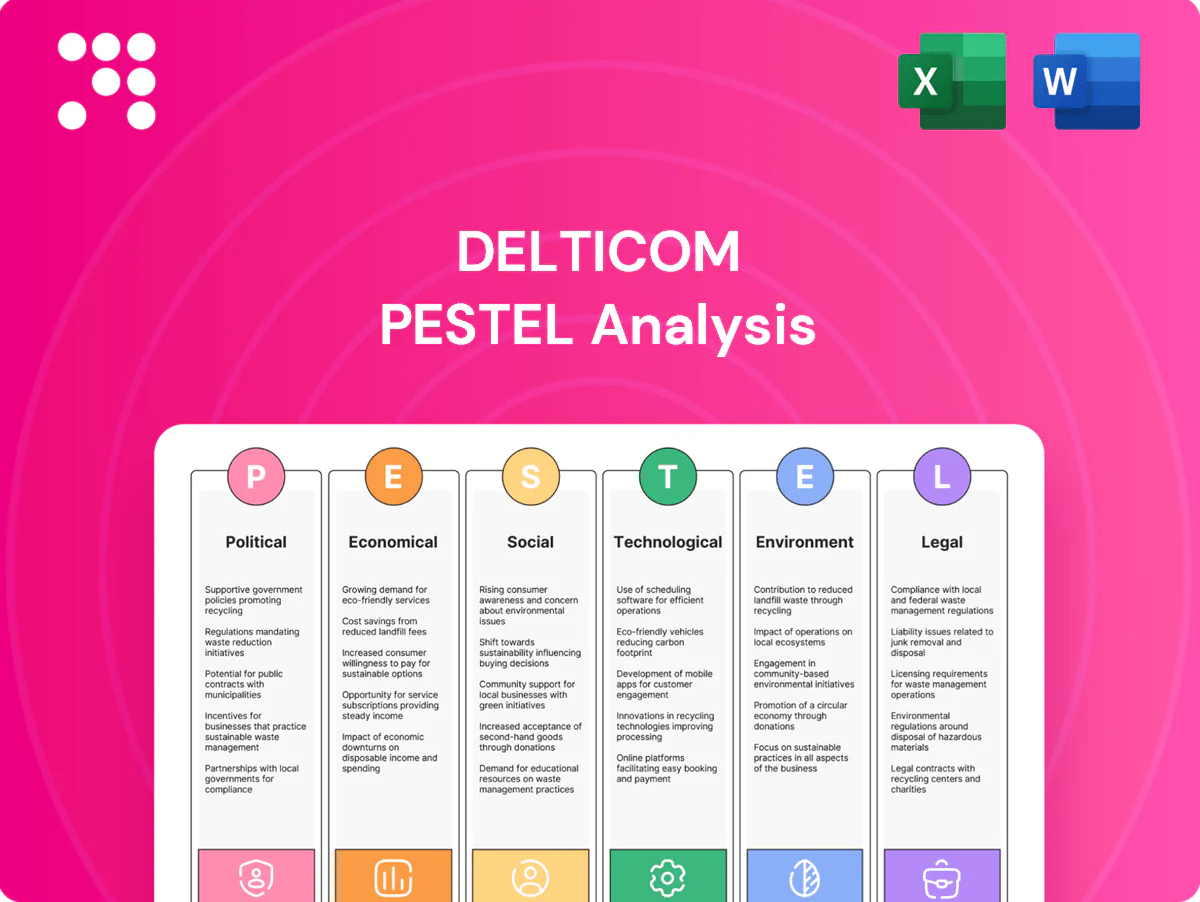
Delticom PESTLE Analysis

Skip the Research. Get the Strategy.
Unlock strategic clarity with our targeted PESTLE Analysis of Delticom, highlighting political, economic, social, technological, legal, and environmental forces shaping its trajectory. This concise briefing surfaces risks and growth levers for investors and strategists. Purchase the full report to access detailed, actionable insights you can use immediately.
Political factors

EU trade and tariff policies
Changes to EU tariffs on rubber, tires or auto parts directly affect Delticom’s sourcing costs and margins, while anti-dumping duties on Asian tire imports (applied periodically by the EU) can shift price competitiveness and product mix. Continuous monitoring of trade agreements, sanctions and customs measures is critical to avoid supply disruptions. Diversifying supplier geographies reduces exposure to concentrated political risk.
Regulatory harmonization and country variance
EU-wide rules harmonize many standards across 27 member states, but national laws on winter tyre mandates differ—at least 6 European countries (e.g., Germany, Austria, Sweden, Finland, Norway, Switzerland) require seasonal tyres. Delticom must tailor assortments and site content per country; political shifts can add or relax mandates, so local compliance boosts conversion and cuts returns.

Infrastructure and logistics policy
Government investment in roads, rail and ports—notably the EU Connecting Europe Facility budget of €33.7bn for 2021–2027—directly affects shipping reliability and costs for tyre e-retailers like Delticom. Cross-border e-commerce facilitation policies (customs digitalisation, VAT harmonisation) speed deliveries. Conversely, strikes and policy-induced bottlenecks raise lead times. Delticom’s multi-warehouse strategy should align with evolving transport corridors and funding flows.

Brexit and non-EU market dynamics
Post-Brexit UK-EU customs frictions add paperwork, delays and potential duties under changing rules of origin; the Trade and Cooperation Agreement (signed 30 December 2020) preserves tariff-free trade only if origin rules are met. Political relations also determine data-transfer mechanisms (EU adequacy or SCCs) affecting customer data flows. Stock positioning in UK vs EU can buffer volatility; clear customer communication reduces post-Brexit friction costs.
- Trade deal: Trade and Cooperation Agreement (30-12-2020)
- Customs: paperwork/delays raise logistics costs
- Data: adequacy or SCCs govern transfers
- Mitigation: regional stock, customer notices
Energy and industrial policy
- Energy cost: EU industrial electricity ~€0.18/kWh (2023)
- EV momentum: EU EV new-car share >20% (2024)
- Demand shift: higher need for low rolling-resistance tyres
- Action: align assortment, regional stock and dynamic pricing
EU trade measures, CEF €33.7bn, energy €0.18/kWh and EVs >20% reshape tyre sourcing
EU trade measures, anti-dumping duties and changing tariffs affect Delticom’s sourcing costs and margins; diversification of suppliers and regional stock mitigate risk. Infrastructure funding (€33.7bn CEF 2021–27) and customs digitalisation influence lead times and logistics costs. Post-Brexit frictions, data-transfer rules and rising energy (EU industrial €0.18/kWh 2023) plus EV uptake (>20% new car share 2024) shift assortment and pricing.
| Risk | Metric | Impact | Mitigation |
|---|---|---|---|
| Trade | Tariffs/anti-dumping | Cost/price | Diversify suppliers |
| Logistics | CEF €33.7bn | Lead times | Multi-warehouse |
| Market | EV>20% (2024) | Assortment | Low rolling-resistance SKUs |
What is included in the product
 Detailed Word Document
Explores how macro-environmental factors (Political, Economic, Social, Technological, Environmental, Legal) uniquely impact Delticom, with data-backed trends and forward-looking insights to identify risks and opportunities for executives, investors, and strategists, ready for inclusion in reports and plans.

 Customizable Excel Spreadsheet
Concise, visually segmented PESTLE summary for Delticom that streamlines meeting prep and risk discussions, is editable for region or business line, and can be dropped into presentations or shared across teams for quick alignment.
Economic factors

Consumer confidence and inflation
High inflation (Euro area HICP 2024: 2.4%) compresses discretionary spend, raising price sensitivity and demand for budget tires while denting premium sales. Improving consumer confidence in 2025 shifts demand toward premium segments, enabling upsell and higher ASPs. Delticom’s dynamic pricing, promotions and private-label range allow rapid SKU-level shifts with macro cycles. Real-time elasticity tracking preserves margins by optimizing promo depth and inventory turnover.
Raw material and freight volatility
Raw material costs for tires are driven by natural rubber (TSR20 ~ $1.60/kg in 2024), carbon black (~$900/t) and oil-derived feedstocks linked to Brent (~$83/bbl in 2024). Ocean freight and last-mile rates remain volatile—WCI averaged ≈$1,800/FEU in 2024 with spot swings tied to capacity cycles and bunker fuel. Hedging, multi-sourcing and dynamic repricing are used to protect margins. Inventory turns (~3–4x for tyre retailers) must balance cost risk and availability.

FX and cross-border sales
Operating in 70+ countries exposes Delticom to FX swings across EUR, GBP, USD and regional currencies, affecting COGS, margin and local competitiveness. FX-driven price gaps versus local players can erode market share. Baymard Institute (2024) found unexpected costs cause 49% of cart abandonment, so transparent landed-cost calculators reduce checkout dropoff. Selective local-currency pricing stabilizes conversion by removing buyer friction.

Fleet and B2B demand
Logistics, ride-hailing and delivery fleets provide steady contract-based tyre demand, but economic slowdowns reduce mileage and replacement cycles; e-commerce growth (online retail ≈22% of global retail sales in 2024) increases last-mile wear. Tailored B2B terms and service SLAs raise retention, while data-driven replenishment and telematics keep uptime high.
- Contracted fleet demand: predictable purchasing cadence
- Macro risk: downturns cut replacement frequency
- E-commerce boost: higher mileage and wear (2024 e‑commerce ≈22% global retail)
- SLA + data replenishment: improved retention and uptime
Seasonality and weather
Winter–summer tire swaps create clear seasonal peaks typically in October–November and March–April, amplified by severe weather events; mild winters reduce swap volumes and increase markdown risk on winter inventory. Flexible procurement, regional inventory staging and logistics responsiveness help mitigate stock imbalances, while weather-informed marketing and dynamic pricing improve demand capture during short windows of peak demand.
- Seasonal peaks: Oct–Nov, Mar–Apr
- Mild winters → lower volumes, higher markdown risk
- Mitigation: flexible procurement, regional staging
- Opportunity: weather-triggered marketing & dynamic pricing
EU trade measures, CEF €33.7bn, energy €0.18/kWh and EVs >20% reshape tyre sourcing
Euro area HICP 2024: 2.4% compresses discretionary spend, boosting budget tyre demand but 2025 confidence upsell to premium. Key inputs: TSR20 ≈ $1.60/kg, Brent ≈ $83/bbl, WCI ≈ $1,800/FEU; inventory turns ~3–4x. FX across EUR/GBP/USD and seasonal swaps (Oct–Nov, Mar–Apr) drive pricing and stocking cadence.
| Metric | 2024 Value |
|---|---|
| Euro area HICP | 2.4% |
| TSR20 (natural rubber) | $1.60/kg |
| Brent | $83/bbl |
| WCI (freight) | $1,800/FEU |
| Online retail | 22% |
Same Document Delivered
Delticom PESTLE Analysis
The preview shown here is the exact Delticom PESTLE Analysis you’ll receive after purchase—fully formatted and ready to use. It contains the complete political, economic, social, technological, legal and environmental assessment as displayed. No placeholders or teasers; this is the final file ready to download.

Skip the Research. Get the Strategy.
Unlock strategic clarity with our targeted PESTLE Analysis of Delticom, highlighting political, economic, social, technological, legal, and environmental forces shaping its trajectory. This concise briefing surfaces risks and growth levers for investors and strategists. Purchase the full report to access detailed, actionable insights you can use immediately.
Political factors
EU trade and tariff policies
Changes to EU tariffs on rubber, tires or auto parts directly affect Delticom’s sourcing costs and margins, while anti-dumping duties on Asian tire imports (applied periodically by the EU) can shift price competitiveness and product mix. Continuous monitoring of trade agreements, sanctions and customs measures is critical to avoid supply disruptions. Diversifying supplier geographies reduces exposure to concentrated political risk.
Regulatory harmonization and country variance
EU-wide rules harmonize many standards across 27 member states, but national laws on winter tyre mandates differ—at least 6 European countries (e.g., Germany, Austria, Sweden, Finland, Norway, Switzerland) require seasonal tyres. Delticom must tailor assortments and site content per country; political shifts can add or relax mandates, so local compliance boosts conversion and cuts returns.
Infrastructure and logistics policy
Government investment in roads, rail and ports—notably the EU Connecting Europe Facility budget of €33.7bn for 2021–2027—directly affects shipping reliability and costs for tyre e-retailers like Delticom. Cross-border e-commerce facilitation policies (customs digitalisation, VAT harmonisation) speed deliveries. Conversely, strikes and policy-induced bottlenecks raise lead times. Delticom’s multi-warehouse strategy should align with evolving transport corridors and funding flows.
Brexit and non-EU market dynamics
Post-Brexit UK-EU customs frictions add paperwork, delays and potential duties under changing rules of origin; the Trade and Cooperation Agreement (signed 30 December 2020) preserves tariff-free trade only if origin rules are met. Political relations also determine data-transfer mechanisms (EU adequacy or SCCs) affecting customer data flows. Stock positioning in UK vs EU can buffer volatility; clear customer communication reduces post-Brexit friction costs.
- Trade deal: Trade and Cooperation Agreement (30-12-2020)
- Customs: paperwork/delays raise logistics costs
- Data: adequacy or SCCs govern transfers
- Mitigation: regional stock, customer notices
Energy and industrial policy
- Energy cost: EU industrial electricity ~€0.18/kWh (2023)
- EV momentum: EU EV new-car share >20% (2024)
- Demand shift: higher need for low rolling-resistance tyres
- Action: align assortment, regional stock and dynamic pricing
EU trade measures, CEF €33.7bn, energy €0.18/kWh and EVs >20% reshape tyre sourcing
EU trade measures, anti-dumping duties and changing tariffs affect Delticom’s sourcing costs and margins; diversification of suppliers and regional stock mitigate risk. Infrastructure funding (€33.7bn CEF 2021–27) and customs digitalisation influence lead times and logistics costs. Post-Brexit frictions, data-transfer rules and rising energy (EU industrial €0.18/kWh 2023) plus EV uptake (>20% new car share 2024) shift assortment and pricing.
| Risk | Metric | Impact | Mitigation |
|---|---|---|---|
| Trade | Tariffs/anti-dumping | Cost/price | Diversify suppliers |
| Logistics | CEF €33.7bn | Lead times | Multi-warehouse |
| Market | EV>20% (2024) | Assortment | Low rolling-resistance SKUs |
What is included in the product
Detailed Word Document
Explores how macro-environmental factors (Political, Economic, Social, Technological, Environmental, Legal) uniquely impact Delticom, with data-backed trends and forward-looking insights to identify risks and opportunities for executives, investors, and strategists, ready for inclusion in reports and plans.
Customizable Excel Spreadsheet
Concise, visually segmented PESTLE summary for Delticom that streamlines meeting prep and risk discussions, is editable for region or business line, and can be dropped into presentations or shared across teams for quick alignment.
Economic factors
Consumer confidence and inflation
High inflation (Euro area HICP 2024: 2.4%) compresses discretionary spend, raising price sensitivity and demand for budget tires while denting premium sales. Improving consumer confidence in 2025 shifts demand toward premium segments, enabling upsell and higher ASPs. Delticom’s dynamic pricing, promotions and private-label range allow rapid SKU-level shifts with macro cycles. Real-time elasticity tracking preserves margins by optimizing promo depth and inventory turnover.
Raw material and freight volatility
Raw material costs for tires are driven by natural rubber (TSR20 ~ $1.60/kg in 2024), carbon black (~$900/t) and oil-derived feedstocks linked to Brent (~$83/bbl in 2024). Ocean freight and last-mile rates remain volatile—WCI averaged ≈$1,800/FEU in 2024 with spot swings tied to capacity cycles and bunker fuel. Hedging, multi-sourcing and dynamic repricing are used to protect margins. Inventory turns (~3–4x for tyre retailers) must balance cost risk and availability.
FX and cross-border sales
Operating in 70+ countries exposes Delticom to FX swings across EUR, GBP, USD and regional currencies, affecting COGS, margin and local competitiveness. FX-driven price gaps versus local players can erode market share. Baymard Institute (2024) found unexpected costs cause 49% of cart abandonment, so transparent landed-cost calculators reduce checkout dropoff. Selective local-currency pricing stabilizes conversion by removing buyer friction.
Fleet and B2B demand
Logistics, ride-hailing and delivery fleets provide steady contract-based tyre demand, but economic slowdowns reduce mileage and replacement cycles; e-commerce growth (online retail ≈22% of global retail sales in 2024) increases last-mile wear. Tailored B2B terms and service SLAs raise retention, while data-driven replenishment and telematics keep uptime high.
- Contracted fleet demand: predictable purchasing cadence
- Macro risk: downturns cut replacement frequency
- E-commerce boost: higher mileage and wear (2024 e‑commerce ≈22% global retail)
- SLA + data replenishment: improved retention and uptime
Seasonality and weather
Winter–summer tire swaps create clear seasonal peaks typically in October–November and March–April, amplified by severe weather events; mild winters reduce swap volumes and increase markdown risk on winter inventory. Flexible procurement, regional inventory staging and logistics responsiveness help mitigate stock imbalances, while weather-informed marketing and dynamic pricing improve demand capture during short windows of peak demand.
- Seasonal peaks: Oct–Nov, Mar–Apr
- Mild winters → lower volumes, higher markdown risk
- Mitigation: flexible procurement, regional staging
- Opportunity: weather-triggered marketing & dynamic pricing
EU trade measures, CEF €33.7bn, energy €0.18/kWh and EVs >20% reshape tyre sourcing
Euro area HICP 2024: 2.4% compresses discretionary spend, boosting budget tyre demand but 2025 confidence upsell to premium. Key inputs: TSR20 ≈ $1.60/kg, Brent ≈ $83/bbl, WCI ≈ $1,800/FEU; inventory turns ~3–4x. FX across EUR/GBP/USD and seasonal swaps (Oct–Nov, Mar–Apr) drive pricing and stocking cadence.
| Metric | 2024 Value |
|---|---|
| Euro area HICP | 2.4% |
| TSR20 (natural rubber) | $1.60/kg |
| Brent | $83/bbl |
| WCI (freight) | $1,800/FEU |
| Online retail | 22% |
Same Document Delivered
Delticom PESTLE Analysis
The preview shown here is the exact Delticom PESTLE Analysis you’ll receive after purchase—fully formatted and ready to use. It contains the complete political, economic, social, technological, legal and environmental assessment as displayed. No placeholders or teasers; this is the final file ready to download.
Original: $10.00
-65%$10.00
$3.50Description
Skip the Research. Get the Strategy.
Unlock strategic clarity with our targeted PESTLE Analysis of Delticom, highlighting political, economic, social, technological, legal, and environmental forces shaping its trajectory. This concise briefing surfaces risks and growth levers for investors and strategists. Purchase the full report to access detailed, actionable insights you can use immediately.
Political factors
EU trade and tariff policies
Changes to EU tariffs on rubber, tires or auto parts directly affect Delticom’s sourcing costs and margins, while anti-dumping duties on Asian tire imports (applied periodically by the EU) can shift price competitiveness and product mix. Continuous monitoring of trade agreements, sanctions and customs measures is critical to avoid supply disruptions. Diversifying supplier geographies reduces exposure to concentrated political risk.
Regulatory harmonization and country variance
EU-wide rules harmonize many standards across 27 member states, but national laws on winter tyre mandates differ—at least 6 European countries (e.g., Germany, Austria, Sweden, Finland, Norway, Switzerland) require seasonal tyres. Delticom must tailor assortments and site content per country; political shifts can add or relax mandates, so local compliance boosts conversion and cuts returns.
Infrastructure and logistics policy
Government investment in roads, rail and ports—notably the EU Connecting Europe Facility budget of €33.7bn for 2021–2027—directly affects shipping reliability and costs for tyre e-retailers like Delticom. Cross-border e-commerce facilitation policies (customs digitalisation, VAT harmonisation) speed deliveries. Conversely, strikes and policy-induced bottlenecks raise lead times. Delticom’s multi-warehouse strategy should align with evolving transport corridors and funding flows.
Brexit and non-EU market dynamics
Post-Brexit UK-EU customs frictions add paperwork, delays and potential duties under changing rules of origin; the Trade and Cooperation Agreement (signed 30 December 2020) preserves tariff-free trade only if origin rules are met. Political relations also determine data-transfer mechanisms (EU adequacy or SCCs) affecting customer data flows. Stock positioning in UK vs EU can buffer volatility; clear customer communication reduces post-Brexit friction costs.
- Trade deal: Trade and Cooperation Agreement (30-12-2020)
- Customs: paperwork/delays raise logistics costs
- Data: adequacy or SCCs govern transfers
- Mitigation: regional stock, customer notices
Energy and industrial policy
- Energy cost: EU industrial electricity ~€0.18/kWh (2023)
- EV momentum: EU EV new-car share >20% (2024)
- Demand shift: higher need for low rolling-resistance tyres
- Action: align assortment, regional stock and dynamic pricing
EU trade measures, CEF €33.7bn, energy €0.18/kWh and EVs >20% reshape tyre sourcing
EU trade measures, anti-dumping duties and changing tariffs affect Delticom’s sourcing costs and margins; diversification of suppliers and regional stock mitigate risk. Infrastructure funding (€33.7bn CEF 2021–27) and customs digitalisation influence lead times and logistics costs. Post-Brexit frictions, data-transfer rules and rising energy (EU industrial €0.18/kWh 2023) plus EV uptake (>20% new car share 2024) shift assortment and pricing.
| Risk | Metric | Impact | Mitigation |
|---|---|---|---|
| Trade | Tariffs/anti-dumping | Cost/price | Diversify suppliers |
| Logistics | CEF €33.7bn | Lead times | Multi-warehouse |
| Market | EV>20% (2024) | Assortment | Low rolling-resistance SKUs |
What is included in the product
Detailed Word Document
Explores how macro-environmental factors (Political, Economic, Social, Technological, Environmental, Legal) uniquely impact Delticom, with data-backed trends and forward-looking insights to identify risks and opportunities for executives, investors, and strategists, ready for inclusion in reports and plans.
Customizable Excel Spreadsheet
Concise, visually segmented PESTLE summary for Delticom that streamlines meeting prep and risk discussions, is editable for region or business line, and can be dropped into presentations or shared across teams for quick alignment.
Economic factors
Consumer confidence and inflation
High inflation (Euro area HICP 2024: 2.4%) compresses discretionary spend, raising price sensitivity and demand for budget tires while denting premium sales. Improving consumer confidence in 2025 shifts demand toward premium segments, enabling upsell and higher ASPs. Delticom’s dynamic pricing, promotions and private-label range allow rapid SKU-level shifts with macro cycles. Real-time elasticity tracking preserves margins by optimizing promo depth and inventory turnover.
Raw material and freight volatility
Raw material costs for tires are driven by natural rubber (TSR20 ~ $1.60/kg in 2024), carbon black (~$900/t) and oil-derived feedstocks linked to Brent (~$83/bbl in 2024). Ocean freight and last-mile rates remain volatile—WCI averaged ≈$1,800/FEU in 2024 with spot swings tied to capacity cycles and bunker fuel. Hedging, multi-sourcing and dynamic repricing are used to protect margins. Inventory turns (~3–4x for tyre retailers) must balance cost risk and availability.
FX and cross-border sales
Operating in 70+ countries exposes Delticom to FX swings across EUR, GBP, USD and regional currencies, affecting COGS, margin and local competitiveness. FX-driven price gaps versus local players can erode market share. Baymard Institute (2024) found unexpected costs cause 49% of cart abandonment, so transparent landed-cost calculators reduce checkout dropoff. Selective local-currency pricing stabilizes conversion by removing buyer friction.
Fleet and B2B demand
Logistics, ride-hailing and delivery fleets provide steady contract-based tyre demand, but economic slowdowns reduce mileage and replacement cycles; e-commerce growth (online retail ≈22% of global retail sales in 2024) increases last-mile wear. Tailored B2B terms and service SLAs raise retention, while data-driven replenishment and telematics keep uptime high.
- Contracted fleet demand: predictable purchasing cadence
- Macro risk: downturns cut replacement frequency
- E-commerce boost: higher mileage and wear (2024 e‑commerce ≈22% global retail)
- SLA + data replenishment: improved retention and uptime
Seasonality and weather
Winter–summer tire swaps create clear seasonal peaks typically in October–November and March–April, amplified by severe weather events; mild winters reduce swap volumes and increase markdown risk on winter inventory. Flexible procurement, regional inventory staging and logistics responsiveness help mitigate stock imbalances, while weather-informed marketing and dynamic pricing improve demand capture during short windows of peak demand.
- Seasonal peaks: Oct–Nov, Mar–Apr
- Mild winters → lower volumes, higher markdown risk
- Mitigation: flexible procurement, regional staging
- Opportunity: weather-triggered marketing & dynamic pricing
EU trade measures, CEF €33.7bn, energy €0.18/kWh and EVs >20% reshape tyre sourcing
Euro area HICP 2024: 2.4% compresses discretionary spend, boosting budget tyre demand but 2025 confidence upsell to premium. Key inputs: TSR20 ≈ $1.60/kg, Brent ≈ $83/bbl, WCI ≈ $1,800/FEU; inventory turns ~3–4x. FX across EUR/GBP/USD and seasonal swaps (Oct–Nov, Mar–Apr) drive pricing and stocking cadence.
| Metric | 2024 Value |
|---|---|
| Euro area HICP | 2.4% |
| TSR20 (natural rubber) | $1.60/kg |
| Brent | $83/bbl |
| WCI (freight) | $1,800/FEU |
| Online retail | 22% |
Same Document Delivered
Delticom PESTLE Analysis
The preview shown here is the exact Delticom PESTLE Analysis you’ll receive after purchase—fully formatted and ready to use. It contains the complete political, economic, social, technological, legal and environmental assessment as displayed. No placeholders or teasers; this is the final file ready to download.











