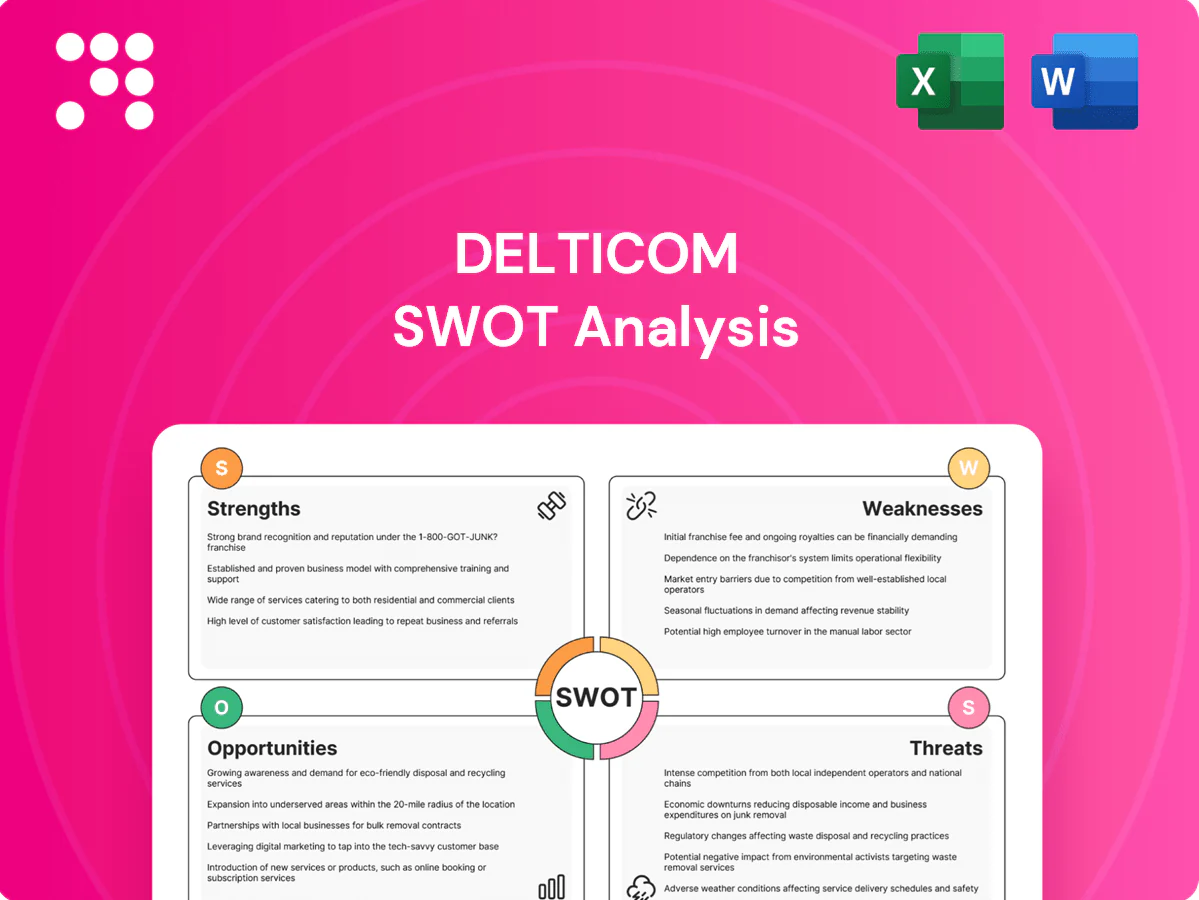
Delticom SWOT Analysis

Dive Deeper Into the Company’s Strategic Blueprint
Our Delticom SWOT analysis distils the online tire retailer’s strengths, market threats, and growth levers into concise, actionable insights. Want the full picture—financial context, strategic implications, and editable tools? Purchase the complete SWOT report (Word + Excel) to plan, pitch, or invest with confidence.
Strengths

Pan-European e-commerce footprint
Operating 100+ online shops across 70+ countries gives Delticom broad market access and demand diversification, reducing reliance on any single market. This scale supports localized marketing, language and pricing strategies at low incremental cost. It enables rapid A/B testing of assortments and UX across markets to accelerate learning. Over time network effects from shared inventory, reviews and traffic can lower customer acquisition costs.
Wide product assortment
Wide product assortment — over 150,000 SKUs in 2024 — boosts average basket size and customer stickiness by enabling cross-sell of tires, wheels and accessories. Breadth captures niche and premium segments, supporting higher ASPs and lifetime value. Deep assortment reduces stockout risk through ready substitutes and enables dynamic pricing algorithms to optimize margins in real time.

Partner workshop fitting network
Integrated fitting via Delticom’s partner workshop network (≈12,000 garages) converts online intent into completed sales, tapping an estimated €25bn European tyre aftermarket (2024).
On-site fitting enhances convenience and trust for customers wary of DIY, while service attachment historically drives roughly +15% ARPU and improves retention. Asset-light partner model scales with minimal capex, supporting growth without heavy fixed investment.

Data-driven online retailing
Delticom’s e-commerce DNA drives superior SEO/SEM, conversion optimization and personalization, leveraging analytics for dynamic pricing, inventory and localized demand forecasting; industry e‑commerce conversion averages ~2.5% while personalization can boost revenue ~10–15% (McKinsey). Automation and fulfillment scaling cut operating costs and continuous A/B testing accelerates CX gains.
- SEO/SEM-led traffic growth
- Analytics-driven pricing & forecast
- Automation lowers OPEX
- Continuous A/B testing
Efficient logistics and fulfillment
Efficient logistics and fulfillment boost Delticom by ensuring reliable delivery for bulky tire SKUs through specialized handling and packaging, reducing damage rates and returns. Multi-warehouse routing cuts lead times and shipping costs via regional distribution, while tight supplier integrations enable rapid replenishment and higher in-stock rates. Strong fulfillment performance drives customer satisfaction and review scores, supporting repeat sales and lower support costs.
- Specialized tire logistics: improved delivery reliability
- Multi-warehouse routing: shorter lead times, lower costs
- Supplier integrations: faster replenishment
- Fulfillment performance: higher satisfaction and reviews
100+ shops, 70+ countries, €25bn market
Delticom runs 100+ online shops in 70+ countries, enabling localized scale and lower CAC; assortment reached 150,000 SKUs in 2024, boosting ASP and cross‑sell. Partner network ≈12,000 garages converts online intent in Europe’s €25bn tyre aftermarket, historically adding ~+15% ARPU. E‑commerce DNA (SEO/SEM, personalization) lifts revenue ~10–15% vs 2.5% avg conversion.
| Metric | 2024 |
|---|---|
| Online shops | 100+ |
| Countries | 70+ |
| SKUs | 150,000 |
| Garages | ≈12,000 |
| Market size | €25bn |
What is included in the product
 Detailed Word Document
Provides a concise SWOT assessment of Delticom, outlining internal strengths and weaknesses alongside external opportunities and threats shaping its competitive position.

 Customizable Excel Spreadsheet
Provides a concise Delticom-specific SWOT matrix for fast strategic alignment and decision-making, ideal for executives needing a clear snapshot of competitive positioning. Easy to integrate into reports and presentations for quick stakeholder briefings and iterative updates.
Weaknesses

Thin margins in a price-driven category
Tires are highly commoditized—online penetration reached about 12% in 2023, intensifying price competition and keeping take rates low; periodic discounting can shave 3–5 percentage points off gross margins in slow seasons, pressuring Delticom’s profitability; sustainable margin expansion will hinge on higher‑margin services or scaling private‑label offerings.
Dependence on third-party workshops
Dependence on third-party workshops leaves service quality partially uncontrollable across Delticom’s partner network of over 12,000 workshops, risking inconsistent experiences that can depress NPS and repeat purchases. Scheduling frictions are a known conversion killer—industry data show up to 30% cart abandonment from appointment issues—while aligning incentives with independent partners adds contractual and margin complexity.

Seasonality and weather exposure
Seasonal winter/summer tyre cycles drive volatile demand for Delticom, concentrating sales in autumn/winter and creating inventory risk as mild winters force markdowns; industry patterns show peak-season sales often represent roughly 50–60% of annual replacement tyre volumes. Cash flow is lumpy around seasonal peaks, straining working capital and credit lines, with forecasting errors propagating through procurement and distribution and increasing fulfillment costs. Weather-driven demand variability magnified by online lead times raises margin pressure and stock obsolescence risk.

High working capital intensity
Wide assortment forces high inventory to maintain availability, while bulky SKUs increase storage and handling costs; slow-moving sizes lock up cash and extended supplier lead times and terms further complicate working capital management.
- High inventory to ensure availability
- Bulky SKUs → higher storage/handling costs
- Slow-moving sizes tie up cash
- Supplier terms and lead-time complexity
Limited physical brand presence
Delticom’s predominantly online model can erode trust for safety-critical tyre purchases, since customers cannot physically inspect tyres before buying.
Absence of showrooms limits tactile evaluation and professional fitting reassurance, while omnichannel competitors (retailers with stores plus e-commerce) can better reassure buyers.
Returns for bulky tyre and wheel orders remain customer-unfriendly, increasing friction and potential churn.
- Online-only model
- No tactile inspection
- Omnichannel competitors advantage
- Bulky returns friction
Tire e-commerce strain: ~12% online, scheduling loss 30%, 50–60% seasonality
Tires are commoditized: online penetration ~12% in 2023, discounting can cut gross margins 3–5 pp and keep take rates low; dependence on 12,000+ third‑party workshops risks inconsistent service and up to 30% cart abandonment from scheduling frictions. Seasonal peaks (50–60% of annual volumes) create lumpy cash flow and inventory obsolescence; bulky SKUs raise storage/returns costs.
| Metric | Value |
|---|---|
| Online penetration (2023) | ~12% |
| Workshops in network | 12,000+ |
| Peak-season share | 50–60% |
| Cart abandonment (scheduling) | up to 30% |
Preview the Actual Deliverable
Delticom SWOT Analysis
This is the actual Delticom SWOT analysis document you’ll receive upon purchase—no surprises, just professional quality. The preview below is taken directly from the full report and reflects the structure and insights included in the downloadable file. Buy to unlock the complete, editable version ready for immediate use.

Dive Deeper Into the Company’s Strategic Blueprint
Our Delticom SWOT analysis distils the online tire retailer’s strengths, market threats, and growth levers into concise, actionable insights. Want the full picture—financial context, strategic implications, and editable tools? Purchase the complete SWOT report (Word + Excel) to plan, pitch, or invest with confidence.
Strengths
Pan-European e-commerce footprint
Operating 100+ online shops across 70+ countries gives Delticom broad market access and demand diversification, reducing reliance on any single market. This scale supports localized marketing, language and pricing strategies at low incremental cost. It enables rapid A/B testing of assortments and UX across markets to accelerate learning. Over time network effects from shared inventory, reviews and traffic can lower customer acquisition costs.
Wide product assortment
Wide product assortment — over 150,000 SKUs in 2024 — boosts average basket size and customer stickiness by enabling cross-sell of tires, wheels and accessories. Breadth captures niche and premium segments, supporting higher ASPs and lifetime value. Deep assortment reduces stockout risk through ready substitutes and enables dynamic pricing algorithms to optimize margins in real time.
Partner workshop fitting network
Integrated fitting via Delticom’s partner workshop network (≈12,000 garages) converts online intent into completed sales, tapping an estimated €25bn European tyre aftermarket (2024).
On-site fitting enhances convenience and trust for customers wary of DIY, while service attachment historically drives roughly +15% ARPU and improves retention. Asset-light partner model scales with minimal capex, supporting growth without heavy fixed investment.
Data-driven online retailing
Delticom’s e-commerce DNA drives superior SEO/SEM, conversion optimization and personalization, leveraging analytics for dynamic pricing, inventory and localized demand forecasting; industry e‑commerce conversion averages ~2.5% while personalization can boost revenue ~10–15% (McKinsey). Automation and fulfillment scaling cut operating costs and continuous A/B testing accelerates CX gains.
- SEO/SEM-led traffic growth
- Analytics-driven pricing & forecast
- Automation lowers OPEX
- Continuous A/B testing
Efficient logistics and fulfillment
Efficient logistics and fulfillment boost Delticom by ensuring reliable delivery for bulky tire SKUs through specialized handling and packaging, reducing damage rates and returns. Multi-warehouse routing cuts lead times and shipping costs via regional distribution, while tight supplier integrations enable rapid replenishment and higher in-stock rates. Strong fulfillment performance drives customer satisfaction and review scores, supporting repeat sales and lower support costs.
- Specialized tire logistics: improved delivery reliability
- Multi-warehouse routing: shorter lead times, lower costs
- Supplier integrations: faster replenishment
- Fulfillment performance: higher satisfaction and reviews
100+ shops, 70+ countries, €25bn market
Delticom runs 100+ online shops in 70+ countries, enabling localized scale and lower CAC; assortment reached 150,000 SKUs in 2024, boosting ASP and cross‑sell. Partner network ≈12,000 garages converts online intent in Europe’s €25bn tyre aftermarket, historically adding ~+15% ARPU. E‑commerce DNA (SEO/SEM, personalization) lifts revenue ~10–15% vs 2.5% avg conversion.
| Metric | 2024 |
|---|---|
| Online shops | 100+ |
| Countries | 70+ |
| SKUs | 150,000 |
| Garages | ≈12,000 |
| Market size | €25bn |
What is included in the product
Detailed Word Document
Provides a concise SWOT assessment of Delticom, outlining internal strengths and weaknesses alongside external opportunities and threats shaping its competitive position.
Customizable Excel Spreadsheet
Provides a concise Delticom-specific SWOT matrix for fast strategic alignment and decision-making, ideal for executives needing a clear snapshot of competitive positioning. Easy to integrate into reports and presentations for quick stakeholder briefings and iterative updates.
Weaknesses
Thin margins in a price-driven category
Tires are highly commoditized—online penetration reached about 12% in 2023, intensifying price competition and keeping take rates low; periodic discounting can shave 3–5 percentage points off gross margins in slow seasons, pressuring Delticom’s profitability; sustainable margin expansion will hinge on higher‑margin services or scaling private‑label offerings.
Dependence on third-party workshops
Dependence on third-party workshops leaves service quality partially uncontrollable across Delticom’s partner network of over 12,000 workshops, risking inconsistent experiences that can depress NPS and repeat purchases. Scheduling frictions are a known conversion killer—industry data show up to 30% cart abandonment from appointment issues—while aligning incentives with independent partners adds contractual and margin complexity.
Seasonality and weather exposure
Seasonal winter/summer tyre cycles drive volatile demand for Delticom, concentrating sales in autumn/winter and creating inventory risk as mild winters force markdowns; industry patterns show peak-season sales often represent roughly 50–60% of annual replacement tyre volumes. Cash flow is lumpy around seasonal peaks, straining working capital and credit lines, with forecasting errors propagating through procurement and distribution and increasing fulfillment costs. Weather-driven demand variability magnified by online lead times raises margin pressure and stock obsolescence risk.
High working capital intensity
Wide assortment forces high inventory to maintain availability, while bulky SKUs increase storage and handling costs; slow-moving sizes lock up cash and extended supplier lead times and terms further complicate working capital management.
- High inventory to ensure availability
- Bulky SKUs → higher storage/handling costs
- Slow-moving sizes tie up cash
- Supplier terms and lead-time complexity
Limited physical brand presence
Delticom’s predominantly online model can erode trust for safety-critical tyre purchases, since customers cannot physically inspect tyres before buying.
Absence of showrooms limits tactile evaluation and professional fitting reassurance, while omnichannel competitors (retailers with stores plus e-commerce) can better reassure buyers.
Returns for bulky tyre and wheel orders remain customer-unfriendly, increasing friction and potential churn.
- Online-only model
- No tactile inspection
- Omnichannel competitors advantage
- Bulky returns friction
Tire e-commerce strain: ~12% online, scheduling loss 30%, 50–60% seasonality
Tires are commoditized: online penetration ~12% in 2023, discounting can cut gross margins 3–5 pp and keep take rates low; dependence on 12,000+ third‑party workshops risks inconsistent service and up to 30% cart abandonment from scheduling frictions. Seasonal peaks (50–60% of annual volumes) create lumpy cash flow and inventory obsolescence; bulky SKUs raise storage/returns costs.
| Metric | Value |
|---|---|
| Online penetration (2023) | ~12% |
| Workshops in network | 12,000+ |
| Peak-season share | 50–60% |
| Cart abandonment (scheduling) | up to 30% |
Preview the Actual Deliverable
Delticom SWOT Analysis
This is the actual Delticom SWOT analysis document you’ll receive upon purchase—no surprises, just professional quality. The preview below is taken directly from the full report and reflects the structure and insights included in the downloadable file. Buy to unlock the complete, editable version ready for immediate use.
Description
Dive Deeper Into the Company’s Strategic Blueprint
Our Delticom SWOT analysis distils the online tire retailer’s strengths, market threats, and growth levers into concise, actionable insights. Want the full picture—financial context, strategic implications, and editable tools? Purchase the complete SWOT report (Word + Excel) to plan, pitch, or invest with confidence.
Strengths
Pan-European e-commerce footprint
Operating 100+ online shops across 70+ countries gives Delticom broad market access and demand diversification, reducing reliance on any single market. This scale supports localized marketing, language and pricing strategies at low incremental cost. It enables rapid A/B testing of assortments and UX across markets to accelerate learning. Over time network effects from shared inventory, reviews and traffic can lower customer acquisition costs.
Wide product assortment
Wide product assortment — over 150,000 SKUs in 2024 — boosts average basket size and customer stickiness by enabling cross-sell of tires, wheels and accessories. Breadth captures niche and premium segments, supporting higher ASPs and lifetime value. Deep assortment reduces stockout risk through ready substitutes and enables dynamic pricing algorithms to optimize margins in real time.
Partner workshop fitting network
Integrated fitting via Delticom’s partner workshop network (≈12,000 garages) converts online intent into completed sales, tapping an estimated €25bn European tyre aftermarket (2024).
On-site fitting enhances convenience and trust for customers wary of DIY, while service attachment historically drives roughly +15% ARPU and improves retention. Asset-light partner model scales with minimal capex, supporting growth without heavy fixed investment.
Data-driven online retailing
Delticom’s e-commerce DNA drives superior SEO/SEM, conversion optimization and personalization, leveraging analytics for dynamic pricing, inventory and localized demand forecasting; industry e‑commerce conversion averages ~2.5% while personalization can boost revenue ~10–15% (McKinsey). Automation and fulfillment scaling cut operating costs and continuous A/B testing accelerates CX gains.
- SEO/SEM-led traffic growth
- Analytics-driven pricing & forecast
- Automation lowers OPEX
- Continuous A/B testing
Efficient logistics and fulfillment
Efficient logistics and fulfillment boost Delticom by ensuring reliable delivery for bulky tire SKUs through specialized handling and packaging, reducing damage rates and returns. Multi-warehouse routing cuts lead times and shipping costs via regional distribution, while tight supplier integrations enable rapid replenishment and higher in-stock rates. Strong fulfillment performance drives customer satisfaction and review scores, supporting repeat sales and lower support costs.
- Specialized tire logistics: improved delivery reliability
- Multi-warehouse routing: shorter lead times, lower costs
- Supplier integrations: faster replenishment
- Fulfillment performance: higher satisfaction and reviews
100+ shops, 70+ countries, €25bn market
Delticom runs 100+ online shops in 70+ countries, enabling localized scale and lower CAC; assortment reached 150,000 SKUs in 2024, boosting ASP and cross‑sell. Partner network ≈12,000 garages converts online intent in Europe’s €25bn tyre aftermarket, historically adding ~+15% ARPU. E‑commerce DNA (SEO/SEM, personalization) lifts revenue ~10–15% vs 2.5% avg conversion.
| Metric | 2024 |
|---|---|
| Online shops | 100+ |
| Countries | 70+ |
| SKUs | 150,000 |
| Garages | ≈12,000 |
| Market size | €25bn |
What is included in the product
Detailed Word Document
Provides a concise SWOT assessment of Delticom, outlining internal strengths and weaknesses alongside external opportunities and threats shaping its competitive position.
Customizable Excel Spreadsheet
Provides a concise Delticom-specific SWOT matrix for fast strategic alignment and decision-making, ideal for executives needing a clear snapshot of competitive positioning. Easy to integrate into reports and presentations for quick stakeholder briefings and iterative updates.
Weaknesses
Thin margins in a price-driven category
Tires are highly commoditized—online penetration reached about 12% in 2023, intensifying price competition and keeping take rates low; periodic discounting can shave 3–5 percentage points off gross margins in slow seasons, pressuring Delticom’s profitability; sustainable margin expansion will hinge on higher‑margin services or scaling private‑label offerings.
Dependence on third-party workshops
Dependence on third-party workshops leaves service quality partially uncontrollable across Delticom’s partner network of over 12,000 workshops, risking inconsistent experiences that can depress NPS and repeat purchases. Scheduling frictions are a known conversion killer—industry data show up to 30% cart abandonment from appointment issues—while aligning incentives with independent partners adds contractual and margin complexity.
Seasonality and weather exposure
Seasonal winter/summer tyre cycles drive volatile demand for Delticom, concentrating sales in autumn/winter and creating inventory risk as mild winters force markdowns; industry patterns show peak-season sales often represent roughly 50–60% of annual replacement tyre volumes. Cash flow is lumpy around seasonal peaks, straining working capital and credit lines, with forecasting errors propagating through procurement and distribution and increasing fulfillment costs. Weather-driven demand variability magnified by online lead times raises margin pressure and stock obsolescence risk.
High working capital intensity
Wide assortment forces high inventory to maintain availability, while bulky SKUs increase storage and handling costs; slow-moving sizes lock up cash and extended supplier lead times and terms further complicate working capital management.
- High inventory to ensure availability
- Bulky SKUs → higher storage/handling costs
- Slow-moving sizes tie up cash
- Supplier terms and lead-time complexity
Limited physical brand presence
Delticom’s predominantly online model can erode trust for safety-critical tyre purchases, since customers cannot physically inspect tyres before buying.
Absence of showrooms limits tactile evaluation and professional fitting reassurance, while omnichannel competitors (retailers with stores plus e-commerce) can better reassure buyers.
Returns for bulky tyre and wheel orders remain customer-unfriendly, increasing friction and potential churn.
- Online-only model
- No tactile inspection
- Omnichannel competitors advantage
- Bulky returns friction
Tire e-commerce strain: ~12% online, scheduling loss 30%, 50–60% seasonality
Tires are commoditized: online penetration ~12% in 2023, discounting can cut gross margins 3–5 pp and keep take rates low; dependence on 12,000+ third‑party workshops risks inconsistent service and up to 30% cart abandonment from scheduling frictions. Seasonal peaks (50–60% of annual volumes) create lumpy cash flow and inventory obsolescence; bulky SKUs raise storage/returns costs.
| Metric | Value |
|---|---|
| Online penetration (2023) | ~12% |
| Workshops in network | 12,000+ |
| Peak-season share | 50–60% |
| Cart abandonment (scheduling) | up to 30% |
Preview the Actual Deliverable
Delticom SWOT Analysis
This is the actual Delticom SWOT analysis document you’ll receive upon purchase—no surprises, just professional quality. The preview below is taken directly from the full report and reflects the structure and insights included in the downloadable file. Buy to unlock the complete, editable version ready for immediate use.











